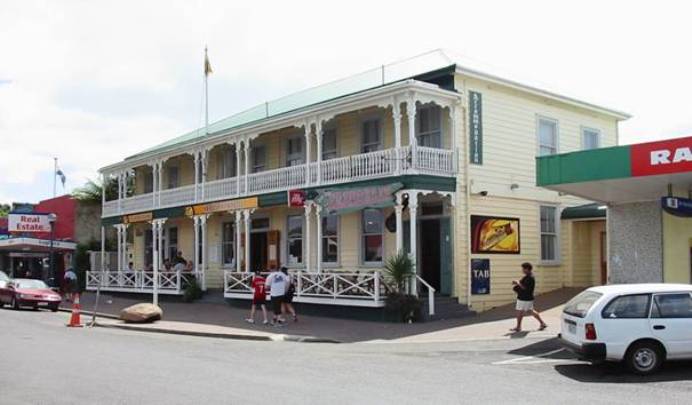
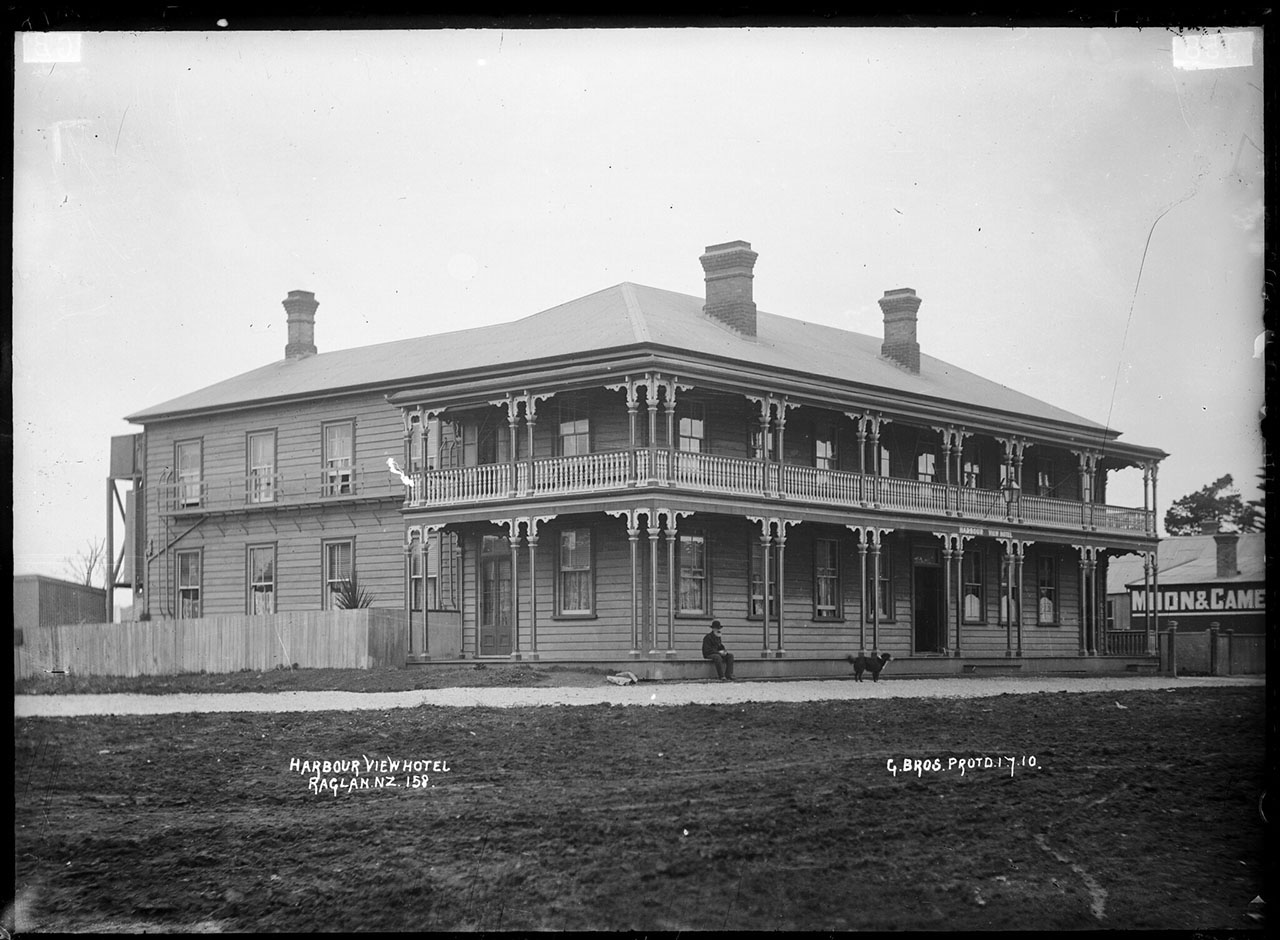
The Harbour View Hotel, Bow Street, Raglan, is a two-storey villa-style building that visually dominates the heart of Raglan's retail area. Built in early 1905 it is the third Harbour View Hotel building on the site, two previous buildings having burnt down in 1901 and 1904. The first was erected in 1866 by George Moon at a time when Raglan (then known as Whaingaroa) was developing as a European-style town. The hotel has been a major part of community and social life for over 140 years with its various owners and publicans making contributions at local and national levels. The original 1905 L-shaped building has had several recent additions.
The Raglan-Whaingaroa Harbour area was part of the rohe of Tainui iwi Ngati Mahanga when Europeans first made contact in the early 19th century. Methodist missionary James Wallis was stationed at Raglan first in 1835 and permanently from 1838. Ngati Mahanga chief Wiremu Neera [William Naylor] Te Awaitaia converted to Christianity in the early 1830s. European and Maori ships used the Whaingaroa Harbour as safe anchorage, and traders sent out flax, wheat, flour and produce grown or harvested by Maori and Pakeha farmers; Raglan township grew from this trade. During the 1850s and early 1860s Te Awaitaia and others sold parcels of land in and around Raglan, allowing settlement by Europeans earlier than in most of the Waikato. The first general store opened in c.1854. The town was surveyed in the mid-1850s.
Although Raglan was relatively inaccessible from the rest of the Waikato, the colonial government established a military outpost there at New Year 1864 to defend its troops during the Waikato War. At that time Raglan was a town with three stores, three hotels, stables, European settlers and about 100 of Te Awaitaia's men. There were no military engagements in the immediate area, but nonetheless the Waikato wars had a major impact on the settlement as many local people evacuated the town. Amongst the 31 settlers who left Raglan in 1863 were George Moon's wife Rachel (nee McGregor) and their two children. George Moon's farming operation was affected too as he had to abandon the farm and sell his flock; on return he found that his equipment had been stolen or damaged, reputedly by the Imperial and government troops.
Raglan was flourishing by November 1864 with several new houses being built. The government paid for a large weatherboard house for Te Awaitaia and his people to be built in Nera Street, to acknowledge his support. In 1866 the Whaingaroa Highways Board was established as the first local body in the district. Also in 1866 the first secular school was begun at Raglan with 40 Maori and Pakeha pupils. In late April 1866 the licensing committee approved renewed liquor licenses for Fuller and Joseph Graham, Raglan, and J. Moon, Waitetuna, and at the same time George Moon 'was, to the general public satisfaction promised a license on completion of his new house'. This new house was to be the Harbour View Hotel. Raglan's dependence on the sea and shipping for access created a need for accommodation and Moon, who was one of the district's entrepreneurs, saw an opportunity despite the existence of two other hotels in the town.
George Moon was one of the earliest European settlers in the Raglan district, having arrived in 1855 when he bought land at Te Uku-Waitetuna with his two brothers John and Philip. He is attributed with bringing the first flock of sheep to the district. He also started a grocery business in Raglan. George Moon became a well-known citizen in Raglan and played a prominent part in local affairs. He was elected to the first Raglan Highway Board in 1868 and was still there in 1882. In 1870 he was one of three men appointed to audit the Town Board's accounts. Moon was also a member of the Raglan Coal Committee and commissioner for the Raglan School District. In partnership with Samuel Vercoe Moon operated a lime-burning kiln; the lime was exported to Onehunga. He was amongst those who agitated for better representation on the Auckland Provincial Council in 1859 and for better mail service in 1885. In 1887 he erected a bathing house for the convenience of bathers. After selling the hotel George and Rachel Moon farmed for a few years then built a large home on the corner of Bow and Gilmour Streets, Raglan. Mrs Moon ran a boarding house in Raglan in 1903. Their son Walter and son-in-law Donald Cameron ran a general store adjacent to the Harbour View Hotel. George Moon died in 1911.
The first Harbour View Hotel faced south onto Bow Street, the main commercial street in Raglan. The hotel was two-storeyed with a single-storey extension back from the northwest corner making an L-shaped floor plan. It had a stable building at the rear, and another small building to the east fronting onto Bow Street. The hotel was described as 'an imposing ...edifice... anyone and everyone was welcome there. Guests could chat to Mrs Moon over a glowing baking fire in the spacious kitchen at the back, or they could discus the latest news with George on the shady verandah'. The first hotel was built on the western part of Allotment 14.
By 1874 Raglan was a township of 52 dwellings housing a population of 112. The town grew to such an extent that when Raglan County was constituted in 1876, Raglan was made its centre. The district's main industries were flax milling, timber, fishing and sheep farming. The sea was the main access to Raglan, and Bow Street was the main road leading from the wharf. The hotel was only 100 metres from the jetty, built in 1874, where supplies and passengers were landed. Road access through to Raglan from Hamilton was achieved in 1879 but remained inadequate for freight for decades.
The Harbour View Hotel was used as a meeting place for local clubs such as the Raglan Rifle Club and Raglan Jockey Club. The hotel was also the venue for an inquest into a death by drowning, the body being held at the hotel. It was involved politically too, being the venue in 1869 for a meeting of settlers concerned about the proximity of Te Kooti and the presence of only one military officer.
An 1880 guide to the Waikato mentions two hotels in Raglan, but only describes the Harbour View, which:
commands a fine view of the harbour [and] has plenty of first class accommodation [with] convenient paddocks for travellers' and visitors' horse [sic]; also horses and boats on hire for fishing. Families requiring an outing at the seaside could scarcely find a better place to stay a...
According to one chronicler of Raglan in the 1890s, the hotel 'was a favourite meeting place for Maoris... [who] sat along the verandah edge, talking quietly'. Moon made many improvements to the hotel during 1884-85. The hotel must have been doing good business, as in 1890 the Raglan District Licensing Committee reported that several bedrooms and a sitting room had been added, thus providing increased accommodation for visitors. Nonetheless, a month later Moon was attempting to sell the hotel.
On 9 March 1893 Moon sold both parts of Allotment 14 to Arthur Edward Langley, storekeeper of Kawhia. Arthur Langley was one of two brothers who set up various businesses in the Kawhia-Raglan district in the late 19th century, including flax mills at Papanui and Kawhia and a land and commission agency in Raglan and Kawhia. In 1890 at a meeting in Raglan Arthur Langley proposed the formation of an association of flax-mill owners. In 1891 he and 'other spirited citizens' investigated the purchase of a small steamer to set up an opposition freight service to Raglan. Arthur Langley was involved in community affairs, including being chairman of the Kawhia Town Board in 1915. The purchase of the Harbour View Hotel was only one of his many business ventures.
The purchase by Langley was the beginning of a long period of absentee owners with leaseholders holding the liquor license and running the hotel. Langley first leased the hotel properties to George Howard on 17 Feb 1894, however on 14 March 1894 the lease transferred to Laurence David Nathan and Nathan Alfred Nathan, merchants of Auckland, who subleased back to Howard; on 27 August 1894 it was subleased to William Smith. By mid-1895 the Nathans also held two mortgages on the property and on 3 September 1901 they purchased both parts of Allotment 14.
Laurence and Nathan were sons of David Nathan (1816-86), a merchant, shipping agent and property owner who set up L.D. Nathan and Company in 1868. The company was originally a partnership owned by Lawrence and Nathan Nathan, later including their nephew Elias Benjamin; it became a limited company in 1904. In the early 1900s the company acquired a number of hotels in the North Island, as well as agencies for Shaw Savill and other shipping lines, distillers and Lever Brothers soaps. Changes in hotel use, especially the reduced use of accommodation by commercial travellers, led the company to set up Consolidated Hotels Limited in 1951. Consolidated Hotels was able to borrow funds for refurbishing the company's old hotels 'by means of a debenture issue'. In 1961 L.D. Nathan and Company purchased the major share of Waikato Breweries Limited and in 1964 soft drink manufacturers C.L. Innes Limited, allowing their hotels to buy beer and soft drink at discount prices. They became partners with New Zealand Breweries (later Lion Breweries), and owned several other major New Zealand companies. They are now part of Lion Nathan.
Visitors to Raglan in 1901 described Raglan as neglected, with 'furze, brambles, and blackberry... The town has two hotels... besides two boarding houses, but never a bakery. ... We had soda bread and scones at the hotels'.
On 7 December 1901 the hotel burnt down. The only occupants at the time were the proprietor Baker and his family, who escaped in their nightclothes; Baker had planned to leave the following day, Mrs Cochrane of the Onehunga Hotel being due to take up the license. The hotel was re-built, larger and with verandahs across the front at both ground floor and first floor levels. The hotel occupied most of the Bow Street frontage of both parts of Allotment 14.
Hotel proprietors in this period were transitory, often staying for short periods only. From at least June 1903 the proprietor was Mrs Elizabeth Reid. She advertised that she had newly furnished throughout and that the hotel provided 'Good Accommodation for Tourists... drawing rooms for Lady Visitors [and] a Billiard Room'. The hotel continued to be used as a meeting venue for local committees such as those for the Annual New Year Sports.
On 2 December 1904 the hotel burnt down again. Mrs Reid was away in Auckland, but several of her staff and lodgers only just managed to get out in time. An enquiry was held into the cause of the fire. After the 1904 fire Mrs Reid's license was transferred to the Town Hall.
The hotel was again re-built, in very similar size and style to the 1902 building, but with plainer fretwork decoration on the verandahs. It is believed that John Currie of Auckland designed the hotel, as the architect used by L.D. Nathan and Co. at this time was Currie. The building faced south-south-west on Bow Street, opposite the end of Wainui Road, which made it highly visible. The weatherboard building was two-storeyed, L-shaped in floor plan plus a single-storey extension at the northeast rear. The building had hipped roofs. There were four chimneys, two in the front face of the roof, a large one at east rear and another at the rear of the extension (leg of the L). The building had verandahs across the front and part of the west side at ground and upper floor levels.
Allotment 14 fronting onto Bow Street was irregular in shape and backed onto Allotment 10, a rectangular section fronting onto Wallis Street which runs at an angle to Bow Street. At some time Allotment 10 was purchased and the two allotments managed as one property. In 1886 Allotment 10 was owned by R. Gilmour but by 13 November 1913 it was owned by members of the Nathan family. A 1911 survey plan shows the hotel extending onto Allotment 10; also on Allotment 10 were a large stables building and two latrines. By 1926 the southwest portion was split off, the balance becoming Lot 1 DP 14392.
The new hotel saw a succession of proprietors, some of whom stayed for many years and made a mark on the town. Elizabeth Reid continued in the new hotel in 1905, then from 1906 to 1911 the proprietor was J. Darrow [Dallow], followed by S.J. Rawlinson. Rawlinson's advertisement for the hotel stated that:
Tourists, Commercials and Families will find the HOTEL replete with every comfort and convenience' including 'Good Stabling, Paddocks, and Billiard Saloon.
By 1915 there was a windmill behind the hotel; it is presumed to have drawn up water from an adjacent well.
In 1921 the proprietor was H. Orams and in 1925 A.M. Baird. In 1925 there were 'two excellent hotels in the town, while private board and residence may also be obtained'. After the Royal Hotel burnt down in the late 1920s the Harbour View became the only hotel in Raglan, although there was at least one boarding-house too.
From 1931 the licensee was Rueben Henry Adcock Cushman. Reuben Cushman was on the Raglan Town Board in 1937 and was a well-respected personality in the town. By 1939 alterations had been made to the upstairs rooms in the rear extension, as evidenced by changes from double-hung sash windows to casement windows. These probably reflect the installation of indoor toilets. On 3 August 1939 ownership of Lot 1 and Allotment 14 transferred to L.D. Nathan and Company and the property was leased to New Zealand Breweries Limited.
During the Second World War, local teenager Claire Goodison was employed as housemaid and was there until after the war. Her duties included cleaning, ironing and serving at tables. Mrs Cushman's standards were high, the table silver being cleaned weekly and table cloths starched. Goodison's room was downstairs in the room adjacent to Rueben Cushman's room; these rooms were west of the stairwell. Cushman had had a crippling stroke and for several years lived downstairs while his son Harry George Cushman ran the hotel. Two other girls assisted, (one had a bedroom at the rear behind the kitchen), and there was a boy who did the cooking. The upstairs and downstairs flooring in the hallways consisted of carpet runners on top of linoleum. The shower upstairs had a lead floor. Most of the overnight guests were commercial travellers, few of whom had cars, so they relied on bus transport. Harry and his wife had twins in 1948, and a Karitane nurse, now Pamela Pegler, lived-in to help care for them and the older son. At that stage, five of the upstairs rooms were used by the family and the nurse. The Cushmans had a private sitting room downstairs to the west of the main door. The dining room was in its current position.
In the 1940s-1950s the locals used the east side door as the main access as they drank in the room in the southeast corner; the main entrance was used as access to the accommodation and dining areas and to the 'posh' bar, the one immediately to the east of the front door. The bar man served the two bar rooms from a double-sided counter in-between. As was the custom at the time, women drank separately, in a small room with fireplace on the northeast corner. There was a small building at the east rear, previously the stables site that was used as a morgue.
On 30 Oct 1951 L.D. Nathan & Co. sold the property to their subsidiary Consolidated Hotels. Harry Cushman had the lease from 20 November 1951. In April 1955 Consolidated Hotels applied for a building permit to erect a concrete block building for men's toilets and in November 1956 a building permit was requested by builder G. Gamom for alterations to create conveniences for hotel staff and better bar facilities. The latter work involved moving the existing back door to a new position on the back verandah and removing part of the existing spirits store wall, creating a new exterior wall and fitting out the space with a sink and bench. One of the aims was to improve service to the new beer garden at the rear, drinks having previously been supplied through a window. Changes also included changing the existing store (at the northeast corner of the extension) to a bathroom and toilet for women staff and a new fit-out for the cook's pantry.
On 6 May 1958 it was sold out of the company's hands to Derick Frederick Bilham, hotelkeeper of Auckland, leased to Consolidated Hotels Limited and sub-leased to Bilham. Bilham undertook extensive interior alterations to form a private bar, public bar, a lounge and a lounge-bar, using builder Lee Construction Co. Ltd.
Bilham ran the hotel until mid-1963 when the lease changed hands twice in quick succession and then changed again when the hotel was sold to John and Mary Neeson on 28 September 1965. Licensees stayed for short periods only during the 1960s to mid-70s. During the lease period of Arthur and Veronica Frandi (March 1965 to March 1966) Lord and Lady Cobham were guests at the hotel; the Frandis supplied the drinks for the social activities held at the Town Hall in their honour. In July 1971 the property changed hands again to Resort Hotels Limited.
In October 1973 the chimneys were removed, as they were perceived to be an earthquake hazard. At some time between 1956 and 1975 several changes were made. These included building-in the back verandah to form a passage to the kitchen. On the east side of the original building the window and door were transposed. After an inspection in 1974, the Chief Inspector of Licensed Premises advised that substantial work was required to improve the standard of the premises. Initially most of the work planned was cosmetic with new carpets, vinyl and curtains, however, proposed extensions in July 1975 included an additional bar area, women's toilets with direct access from the bar room and men's toilets with outdoor access protected by a covered walkway. By 1975 there had been many internal changes, in particular the removal of walls in the southeast corner to form one large bar room instead of the former three bar rooms and spirit room; removal and addition of walls in the middle section to create a smaller office and men's toilets (in the front); converting the staff bedroom and store to ladies toilets (rear, by the stairs), a hallway to the new back door and an extension to the dining room. A major change at the rear northeast has been the demolition or conversion of the hipped-roof single storey room to a larger open bar room. The lean-tos at the north end of the extension (leg of the L) were added by 1975. Additions since 1975 are the cooler, store, laundry and open shelter. In 1976 the hotel had three bars: the Sportsman, Settlers Lounge (public bar) and Lounge Bar.
In 1979 the management received complaints about the noise level from music in the beer garden at the rear, and that in Easter 1978 the Roman Catholic priest had had to stop his church service because he could not make himself heard.
Prior to July 1980 the hotel boasted it had the cheapest beer prices in New Zealand, but this was to change with its sale to Dominion Breweries. John Douglas was the licensee in 1981. On 2 February 1983 the property transferred to Dominion Breweries Limited. The community continued to use the hotel as a meeting venue, with the Western Shears shearing competition committee meeting there, and until a few years ago the Raglan 60s Club met there also.
Murray P. Borland and Associates drew up a plan in June 1987 for alterations to the large 1975 addition. In 1989 a permit was issued for an extensive up-grade of the existing wholesale building, which had previously been a drive-through. In 1991 proprietor J. Humphrey applied for building consent to re-roof the hotel, using builder M.J. Mathers of Raglan. By 1993 the beer garden had become a 'garden bar' with an open shelter, indicative of trends in hotel drinking facilities. Other changes in 1993 were the addition of a cooler and store and re-positioning the stand-alone laundry.
Under their new name of D.B. Breweries Ltd the company sold the property in January 1994 to Heather Kay Barton of Palmerston North, hotel proprietor, who retained the property for only two years before selling to James and Priscilla White, farmers of Raglan. In September 1996 the Whites applied for resource consent to make renovations and extensions to the hotel bar, install new toilets, create disabled access and up-grade fire protection. A further consent was applied for in 1997 to extend the store and in 1998 a building consent was issued for refurbishment of the hotel with architects Snell Keiser Hale. The work entailed refurbishment, demolition of existing toilet blocks and the stand-alone wholesale building (on Lot 1) and erection of a new wholesale block, new bar and chiller and change entries off Bow Street and Wallis Street.
On 8 December 1998 the Raglan Community Board approved the forward extension of the front verandah, which encroached on the footpath. This change allowed patrons to sit at tables on the verandah, following the outdoor café trend of the time.
The Whites ran the hotel for five years before selling to Jeff Holloway and E.W.J. Ciurlionis in September 2001. Holloway was the licensee since 28 October 1999. At that time the hotel could accommodate 23 guests and had restaurant facilities for 50 people, plus a café menu offered in the Verandah Bar. In 2003 the Harbour View Hotel was voted winner of the Waikato Wine and Food Challenge by diners. In 2006 a Code Compliance Certificate was issued for the erection of a pergola at the rear of the main building, plus a gaming room. Since March 2007 the property has belonged to Jeff Holloway and Kerry Wells Trust Services Limited.
The hotel has nine bedrooms available for visitors, some marketed as family rooms in keeping with current trends. Also available is a sitting room with access to the upstairs verandah. Facilities downstairs include a formal restaurant, bar meals or snacks, a choice of two bars, an extensive garden bar and a private gaming room. The hotel has a wholesale liquor license.
The hotel is very popular in the Waikato as a socialising venue; the hotel has regular live music by popular bands and has acquired a following for this reason. Regular performers have been the Mudsharx, the Midge Marsden Band, saxophonist Clarry Cresswell and Moana Thompson and currently musical entertainment is enjoyed most weekends with such artists as Midge Marsden, Bullfrog Rata and Cornerstone Roots. The Harbour View Hotel is part of the 'Raglan scene' for surfers, holiday makers, café-frequenters and day visitors; Raglan is the place to go for an afternoon or evening's relaxation that combines the beach, good cafes and the hotel. It is credited with being a popular venue for tourists. It has been included in travel brochures e.g. the Bradbury's guides from 1915 onwards, a recent Lonely Planet and as one of New Zealand's 150 best 'pubs with personality'. In January 2009 it featured in the Waikato Times' series of iconic Waikato pubs. It has acquired stories around its customers, including a man riding his horse up the staircase and a local chief staging a week-long protest sit-in. The Harbour View Hotel has a well-established popularity and has long been a recognisable feature of Raglan.