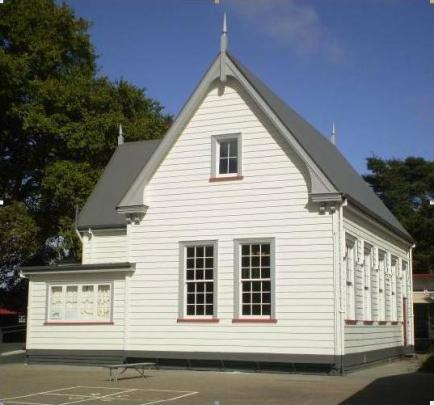
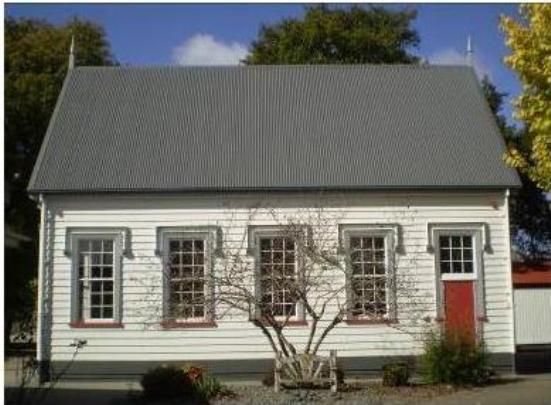
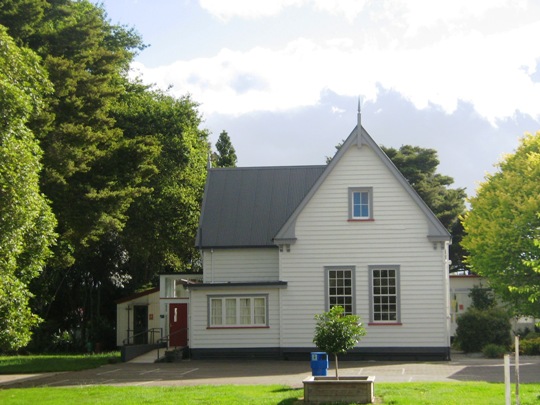
Tamahere School was established in 1884 in a rural Waikato settlement in a purpose-built structure that still exists today as part of a larger campus now known as Tamahere Model Country School. The school was established by the European settlers in the region, to ensure their children had access to free and secular education as promised by the Education Act 1877. The school has remained community focused for the subsequent decades.
The Tamahere district was once intensively occupied and cultivated by Ngati Haua, with Tamahere village estimated to have 300-400 inhabitants in 1863. The area is associated with Tainui leader Wiremu Tamihana Tarapipipi Te Waharoa, as not only was it his birth place, it was at Tamahere that he met with Brigadier General G.J. Carey to discuss terms of peace between the colonial government and the Kingitanga in 1865. Tamihana’s cousin Te Raihi Toroa-a-Tai remained with his hapu at Tamahere throughout the 1863-64 conflict and into the 1880s. Although their land was confiscated in 1864, 6070 hectares were subsequently returned to members of Ngati Haua, in the form of individual holdings. Allotment 1 of 1550 acres (627 hectares), plus other large parcels, was allocated to Te Raihi and others, the size reflecting their status within Ngati Haua.
George Graham, the facilitator of the meeting between Carey and Tamihana, leased Allotment 1 from Te Raihi. His sons William Australia Graham (1841-1916), and Samuel Sargeant Graham (?-1895) farmed it from 1865 as a cattle station. W.A. Graham purchased the land in 1868. The Grahams maintained close friendships with Tamihana and both their home and Te Raihi’s village played important roles in hosting dignitaries and officials of the government and Kingitanga during this period.
W.A. Graham, a surveyor who surveyed the town of Hamilton East and large areas of the Waikato and Bay of Plenty, became a prominent and influential member of the Hamilton community. He was a member of the Auckland Provincial Council, mayor of Hamilton Borough, chairman of the first Waikato Hospital and Charitable Aid Board and a strong influence in the establishment of Waikato Hospital. He was a close friend and adviser to King Mahuta and a strong supporter of Maori rights. He and his brother Samuel experimented with sugar beet and other crops at Tamahere. Samuel Graham was also influential, being on the Tamahere Highway Board, both the Hamilton and Cambridge Licensing Committees and the Farmers’ Co-operative Association. Samuel left the district in 1889 after declaring insolvency. William owned land at Tamahere until 1892.
By 1872, nearly 5000 hectares had been sold by Tamahere Maori to Europeans and pastoral farming developed. A mill was erected at Tamahere to process Maori-grown wheat. There was a natural landing place for the Waikato River steamers on Graham’s land. In 1879 a bridge built over the river at the Narrows provided the stimulus for development: a store, smithies, a hotel and a church were opened by 1883. By the early 1880s the larger farms were being split up into smaller holdings. By 1882 the community had grown sufficiently to warrant a local school, the nearest school being at Hautapu. In September 1882 the Education Board of the District of Auckland, responsible for the district’s education under the provisions of the 1877 Education Act, was petitioned by community members for a school at Tamahere.
In October 1883 W.A. Graham and his wife Alice (circa 1853-1931) gave three acres (1.2 hectares) of Allotment 1 to the Board for the establishment of a school; the Board purchased a further two acres (0.8 hectares) from them. The Board commissioned plans to be drawn up; these were completed by October 1883. The building was designed by Henry Allright, architect for the Board. Tenders were called for its construction; James Furey’s tender for £438 was accepted on 28 November 1883 and the contract signed 3 December 1883. Construction was underway by late January 1884. The chairman of the first committee was S.S. Graham; other members included local farmers and the owners of the store and the hotel. After a celebratory concert and dance held in the new building on 7 May 1884, which was attended by large numbers of the community, Tamahere School (Original Building) opened on 12 May 1884 with a roll of 33 children.
The school was built as a single classroom with two porches. Each porch had an external door with separate entry for boys and girls. A single open brick fireplace was set in the interior wall of the classroom. The school was built on a roughly-rectangular block of land with Hamilton-Cambridge Road to the northeast and Graham Road along the northwest side – both of these sections of road are now called Devine Road. The school was erected near the north eastern end of this plot; in 1887 a teacher’s house was erected at the south western end.
The Maori community at Tamahere wished to send their children to the school as well, but as this would have necessitated an assistant teacher it was deemed not possible. In 1886 three Maori children enrolled, but no further Maori names occur in the early registers; some, possibly all, Maori families shifted to other areas in the 1880s. During the 1880s the children of both William and Samuel Graham attended. The road to the Narrows Bridge passes close to the school and this enabled children from the western side of the Waikato River to attend.
Most of the children attending came from local farms, and those administering school affairs were also involved with the agricultural progress of the district. A chairman of the school committee for 14 years, William Newell, was chairman of the Waikato County Council in the late 1920s-30s and influential in the setting up of the sale yards in Hamilton East. Also on the committee at one time were Ambrose Main, who was on the road board, and Joseph J. Barugh, a co-founder of the Farmers’ Co-operative Auctioneering Company and the Auckland Farmers’ Freezing Works. Several of the school committee members were also on the first committee of St Stephen’s Church, built at Tamahere in 1882.
The school building was used for community purposes also, one instance being a concert in aid of funds for the local church in 1885, and later for dances.
Despite a dairy factory being established at Tamahere in 1895, Tamahere remained a rural area, with further subdivision into smaller allotments supporting a larger population. In about 1914 or soon after, a partition was put up dividing the classroom, to enable two classes to operate; however in 1923 it was again one big room.
In 1930 the size of the school grounds was reduced by one acre (0.4 hectares). A small parcel of land was transferred to the Tamahere Hall Association in 1950; the hall is close to the old school building and has been used for school activities.
Sometime prior to 1947 two potbelly stoves were installed and the roofing material changed to corrugated iron. In 1955 a small room was added in the east corner and was used as a teacher’s room with sickbay and kitchen facilities. Other small alterations continued to be made and in 1955 a ‘permanent partition’ to divide the main room was added along with a suspended ceiling. This ‘put an end to many years of socials and dances conducted on the only good floor for miles around’. This was removed in 1959 when a separate classroom block was also erected to cope with increasing pupil numbers; the old building was subsequently referred to as the ‘Old Classroom Block’.
From 1960 the school was known as Tamahere Model Country School as it was used by the newly-established Hamilton Teachers’ College as a representative typical rural school for the training of teachers. It became common practice to have groups of student teachers observing in the classrooms. Land was gazetted as taken for a public school as of 21 November 1960.
By the 1970s Tamahere land was being subdivided into small lifestyle blocks (mostly four hectares), with many owners commuting to Hamilton or Cambridge for work. The increased population meant more children needing to attend Tamahere School. More classrooms, an administration block and a library were added. The old building was retained as a classroom, initially as the infants’ room.
At some time in the 1970s an exterior door was constructed in the western end of the northwest wall, partly replacing one of the original windows, and the old windows were changed from six-light to nine-light. In 1980 the staff room was described as ‘cleaner’s room’. By 1980 the school had expanded as a complex of six main buildings; adjacent were the community hall and play centre buildings, reinforcing the concept of the school being the hub of the community.
In 1984 the old school building was a much photographed centrepiece of the centenary celebrations, which attracted over 300 people on each of the three days. 2009 saw further subdivision and development of the Tamahere district with the school roll growing to 400 pupils. That year the school building was converted for use as a library and information centre for the school; the re-modelling won the 2010 Waikato Registered Master Builders Award in the education category. Also that year the 125th anniversary celebrations attracted over 100 former pupils and teachers. The building is proudly and prominently displayed on the school website.