List Entry Information
Status
Listed
List Entry Status
Historic Place Category 1
Access
Private/No Public Access
List Number
7423
Date Entered
17th April 1998
Date of Effect
17th April 1998
City/District Council
Waitaki District
Region
Otago Region
Extent of List Entry
Extent includes part of the land described as Lot 2 DP 460155 (RT 602633), Otago Land District, and the building known as Burnside Homestead, thereon.
Legal description
Lot 2 DP 460155 (RT 602633), Otago Land District
Status
Listed
List Entry Status
Historic Place Category 1
Access
Private/No Public Access
List Number
7423
Date Entered
17th April 1998
Date of Effect
17th April 1998
City/District Council
Waitaki District
Region
Otago Region
Extent of List Entry
Extent includes part of the land described as Lot 2 DP 460155 (RT 602633), Otago Land District, and the building known as Burnside Homestead, thereon.
Legal description
Lot 2 DP 460155 (RT 602633), Otago Land District
Why is this place significant?
Historic Significance
Historical Significance or Value This historic place was registered under the Historic Places Act 1993. The following text is from the original Historic Place Assessment Under Section 23 Criteria report considered by the NZHPT Board at the time of registration. Historical: In 1898 John Forrester Reid, a son of renowned North Otago pastoralist John Reid, completed the villa Burnside on the 550 hectare Burnside Block of the family's historic Elderslie Estate. Two years later much of Elderslie was sold to the Liberal Government for small farm development. Burnside remained in Reid family ownership along with until the interwar period, when it passed into the hands of the Hudson family. They owned it until Bruce and Alison Albiston acquired the building, which currently serves as a guest house.
Physical Significance
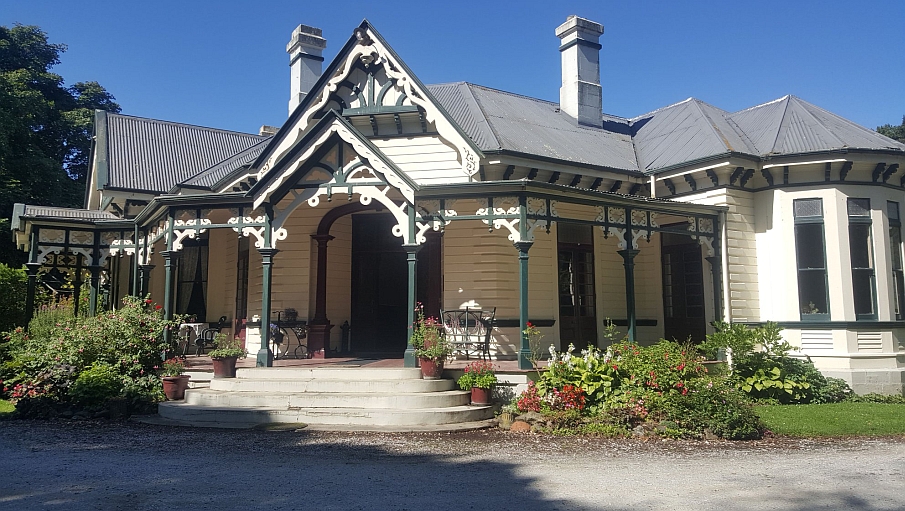
This historic place was registered under the Historic Places Act 1993. The following text is from the original Historic Place Assessment Under Section 23 Criteria report considered by the NZHPT Board at the time of registration. Architectural: Burnside Homestead was designed in the late Victorian Bay Villa style of the period 1880-1915. Style indicators are: - Highly developed Comer Angle Bay Villa form. - Complex building form cantered on an octagonal great hall. - Ensemble of roof shapes, hipped ridged and valley, with Centre gutter roof form corresponding to enlarged villa design. - Hipped and gabled bay projections. - Tied gable-end barge boards exhibiting decorative fretwork with decorative half-timbering in the gable ends. - Corrugated iron roof cladding. - Boxed eaves. - Tall brick chimneys with moulded cornice. - Rusticated weatherboarding. - Double-hung windows with single light sashes. - Decorative eaves brackets. - Double return verandahs with decorative fretwork valances on the theme of the letter 'E'; verandah posts with capitals and decorative brackets. - Main door with stained glass side-light panels and fanlight - Eclectic architectural Italianate Villa features inside and out - Eastlake features in the treatment of walls, doors and architraves.
Why is this place Category 1 / Category 2?
Detail Of Assessed Criteria
This historic place was registered under the Historic Places Act 1993. The following text is from the original Historic Place Assessment Under Section 23 Criteria report considered by the NZHPT Board at the time of registration. (g) The technical accomplishment or value, or design of the place: DATE: 1898 ARCHITECT: Not known STYLE CODE: 36: Victorian/Edwardian Bay Villa DESIGN: Burnside conforms to the highly developed complex villa form which had evolved by the 1890s from an earlier type which had only plain flush gables without faceted window bays, and a hall which bisected the interior plan. The planning of Burnside in fact reveals its link with the earlier villa form by retaining the simple layout of formal rooms placed at the front of the house, and private rooms (including the servant's quarters) placed at the back. By the time Burnside was built however, both the formal and functional needs of families who preferred the villa style had increased to the point where the form of the building (as distinct from its plan) had become complicated in order to accommodate the increase in the number of rooms intended for different purposes. The plan of Burnside reveals that it is twice the size of most bay villas having been designed with no less than 21 rooms if one includes the Great Hall and bathrooms. This is considerably larger than the usual 9-10 rooms of the average Victorian/Edwardian Bay Villa. One of the main architectural features of the complex villa form which expressed changing economic and social needs, was the increased size and prominence allocated to the dining room as a formal space. Extra windows became a feature of this room in order to impart a sense of dignity, and in the case of Burnside this was achieved by the unusual expedient of a circular bay containing seven windows. A further departure from the standard villa form at Burnside is the Great Hall - a large octagonal space in the centre of the building which is an extension of the entrance hall, but which becomes the central axis of the house around which all the other rooms are arranged. The plan of Burnside therefore begins to resemble a great wheel revolving around the Great Hall although the plan also has typical asymmetrical characteristics with the servants quarters being added at right angles to the rear, and a typical 'Corner Bay' feature where the right angle space between the dining room and drawing room is occupied by a gabled projection at 45 degree forming the main entrance, entrance hall, guest room and office. Burnside is a highly decorated bay villa in contrast with some other contemporary villas of the same period. The exterior exhibits decorated gables with half-timbering and verandahs where the ornamental fretwork surpasses itself in excellence of detail, and in some ways crosses over the stylistic boundaries of the Bay Villa form and enters into the realm of the English Domestic Revival Elizabethan/Tudoresque style. In keeping with this eclectic treatment of the period, Classical Italianate features dominate the interior decoration with such details as a coffered ceiling in the Great Hall, an elaborate cornice and entablature with dentils, a classically pedimented doorway with bolection mouldings in the door panel (as with all the doors in the main part of the house), and segmented arches on the eight sides of the Great Hall supported variously by plastered Corinthian columns and decorative classical corbels. The influence of Charles Eastlake is everywhere evident in this treatment, particularly in the tripartite division of the walls of the formal rooms of the house into a lower zone, with skirting and dado, a middle zone occupied by the thematic treatment of doors and the upper zone occupied by a frieze, entablature, cornice and decorated ceiling. The visual and aesthetic impression conveyed by these exterior and interior architectural details is one of outstanding quality, but the point needs to be made that these features in themselves are not special and outstanding in terms of the architectural genre of the developed New Zealand Bay Villa. There are perhaps more of these details at Burnside, but they were in fact standard forms of decoration for the bay villa produced in quantity at the time in standard patterns by machine tools. The special and outstanding quality of Burnside instead lies in the arrangement of these standard elements. As mentioned, the form of Burnside is complex being determined essentially by the octagonal Great Hall - a feature unique to Burnside and not found in any other registered historic villa. The architectural elements that make this complex design work in terms of the fashions and taste of the period are precisely the standard decorative features identified above. Their treatment, or arrangement for effect, is unique to the house and because of the size and scale of Burnside relative to other single storey houses of the period, have no equal in any other contemporary Bay Villa from the same period. (m) Such additional criteria not inconsistent with those in paragraphs (a) to (k): The Victorian/Edwardian Bay Villa is a very common building style in New Zealand. There are 373 registered houses built between 1880-1915 of which about 25% can be regarded as true Bay Villas ranging in form from Single Bay Faceted to Complex Corner Angle Bay. The style is therefore well represented in the national register. The majority of these registered Bay Villas are to be found in the North Island, and most of these in the Far North down to the Waikato, although they are also found further south. Outstanding examples of the style are to be found in the Waikato and include such special places as "Valmai" Rest Home, 1895-1901, Cat.II, and Villa Mandeno, 1910, Cat.II. Both of these places are noted for their high degree of architectural originality and fine detailing. Registered single storey villas of this quality are not common in the South Island, placing Burnside in a somewhat unique position as regards outstanding examples of this genre in the South. The Otago Daily Times felt that the unique and special quality of Burnside lies in the fact that it was purported to be "the largest single-storeyed home in the country at that time". Although the source given for this claim does not actually verify it, the architectural design significance of Burnside does not in any case depend exclusively on its size. The place is indisputably a very large timber-built house, but as suggested the complexity and detailing of the formal design of the place is a sufficient recommendation in itself for Burnside to be considered as being special and outstanding. This must also be seen in both a national and regional context. At the national level there are no registered examples of a complex bay villa where the conventional long hallway is replaced half-way along its length by a Great Hall decorated in outstanding Italianate style, and which determines the overall design form of the house. At the regional level- specifically the Otago/North Otago/Waitaki District region- there are 14 houses which can be described as bay villas. Only 4 of these places are built of timber, the remainder being built of either brick and plaster or stone. This means that Burnside, being indeed a very large house built of timber, is unusual by South Island standards and has an affinity therefore with registered North Island Bay Villas which, with few exceptions, are exclusively built of timber. None of the regional sample surveyed are anywhere near comparable in architectural quality with Burnside. In the Waitaki District itself only one registered place might be said to be a bay villa although part of it is of an earlier period and style, and is built of local and Australian limestone (Tokarahi Station Homestead, 1876; 1889, Cat.II). The remaining stock of domestic buildings in the district ranges from the Colonial Box Cottage with lean-to and verandah (Western House, Korow, 1871, Cat.II), through to Queen Anne (House, 24 Reed Street, Oamaru, 1901, Cat.II, and Redcastle, St Kevin's College, 1903, Cat.II), Elizabethan Domestic Revival (Pen'y'brn, 1888-1912, Cat.I), Italianate (David Millar House, 1875-76, Cat.II), and Scottish Baronial (Robert Campbell House, Otekaieke, 1876-79, Cat.I). The nomination for Burnside contains no information on the grounds other than that given on the backs of photographs. The photographs nevertheless indicate a mature and evidently historical setting for the homestead which is clearly of great beauty and aesthetic quality. The grounds appear to consist of a park with a winding drive of local crushed whitestone flanked by 3 different specimens of spreading oaks and 20 specimen trees of Sequoia, Wellingtonia, Deodara and Atlantica.
Why is this place significant?
Historic Significance
Historical Significance or Value This historic place was registered under the Historic Places Act 1993. The following text is from the original Historic Place Assessment Under Section 23 Criteria report considered by the NZHPT Board at the time of registration. Historical: In 1898 John Forrester Reid, a son of renowned North Otago pastoralist John Reid, completed the villa Burnside on the 550 hectare Burnside Block of the family's historic Elderslie Estate. Two years later much of Elderslie was sold to the Liberal Government for small farm development. Burnside remained in Reid family ownership along with until the interwar period, when it passed into the hands of the Hudson family. They owned it until Bruce and Alison Albiston acquired the building, which currently serves as a guest house.
Physical Significance
This historic place was registered under the Historic Places Act 1993. The following text is from the original Historic Place Assessment Under Section 23 Criteria report considered by the NZHPT Board at the time of registration. Architectural: Burnside Homestead was designed in the late Victorian Bay Villa style of the period 1880-1915. Style indicators are: - Highly developed Comer Angle Bay Villa form. - Complex building form cantered on an octagonal great hall. - Ensemble of roof shapes, hipped ridged and valley, with Centre gutter roof form corresponding to enlarged villa design. - Hipped and gabled bay projections. - Tied gable-end barge boards exhibiting decorative fretwork with decorative half-timbering in the gable ends. - Corrugated iron roof cladding. - Boxed eaves. - Tall brick chimneys with moulded cornice. - Rusticated weatherboarding. - Double-hung windows with single light sashes. - Decorative eaves brackets. - Double return verandahs with decorative fretwork valances on the theme of the letter 'E'; verandah posts with capitals and decorative brackets. - Main door with stained glass side-light panels and fanlight - Eclectic architectural Italianate Villa features inside and out - Eastlake features in the treatment of walls, doors and architraves.
Why is this place Category 1 / Category 2?
Detail Of Assessed Criteria
This historic place was registered under the Historic Places Act 1993. The following text is from the original Historic Place Assessment Under Section 23 Criteria report considered by the NZHPT Board at the time of registration. (g) The technical accomplishment or value, or design of the place: DATE: 1898 ARCHITECT: Not known STYLE CODE: 36: Victorian/Edwardian Bay Villa DESIGN: Burnside conforms to the highly developed complex villa form which had evolved by the 1890s from an earlier type which had only plain flush gables without faceted window bays, and a hall which bisected the interior plan. The planning of Burnside in fact reveals its link with the earlier villa form by retaining the simple layout of formal rooms placed at the front of the house, and private rooms (including the servant's quarters) placed at the back. By the time Burnside was built however, both the formal and functional needs of families who preferred the villa style had increased to the point where the form of the building (as distinct from its plan) had become complicated in order to accommodate the increase in the number of rooms intended for different purposes. The plan of Burnside reveals that it is twice the size of most bay villas having been designed with no less than 21 rooms if one includes the Great Hall and bathrooms. This is considerably larger than the usual 9-10 rooms of the average Victorian/Edwardian Bay Villa. One of the main architectural features of the complex villa form which expressed changing economic and social needs, was the increased size and prominence allocated to the dining room as a formal space. Extra windows became a feature of this room in order to impart a sense of dignity, and in the case of Burnside this was achieved by the unusual expedient of a circular bay containing seven windows. A further departure from the standard villa form at Burnside is the Great Hall - a large octagonal space in the centre of the building which is an extension of the entrance hall, but which becomes the central axis of the house around which all the other rooms are arranged. The plan of Burnside therefore begins to resemble a great wheel revolving around the Great Hall although the plan also has typical asymmetrical characteristics with the servants quarters being added at right angles to the rear, and a typical 'Corner Bay' feature where the right angle space between the dining room and drawing room is occupied by a gabled projection at 45 degree forming the main entrance, entrance hall, guest room and office. Burnside is a highly decorated bay villa in contrast with some other contemporary villas of the same period. The exterior exhibits decorated gables with half-timbering and verandahs where the ornamental fretwork surpasses itself in excellence of detail, and in some ways crosses over the stylistic boundaries of the Bay Villa form and enters into the realm of the English Domestic Revival Elizabethan/Tudoresque style. In keeping with this eclectic treatment of the period, Classical Italianate features dominate the interior decoration with such details as a coffered ceiling in the Great Hall, an elaborate cornice and entablature with dentils, a classically pedimented doorway with bolection mouldings in the door panel (as with all the doors in the main part of the house), and segmented arches on the eight sides of the Great Hall supported variously by plastered Corinthian columns and decorative classical corbels. The influence of Charles Eastlake is everywhere evident in this treatment, particularly in the tripartite division of the walls of the formal rooms of the house into a lower zone, with skirting and dado, a middle zone occupied by the thematic treatment of doors and the upper zone occupied by a frieze, entablature, cornice and decorated ceiling. The visual and aesthetic impression conveyed by these exterior and interior architectural details is one of outstanding quality, but the point needs to be made that these features in themselves are not special and outstanding in terms of the architectural genre of the developed New Zealand Bay Villa. There are perhaps more of these details at Burnside, but they were in fact standard forms of decoration for the bay villa produced in quantity at the time in standard patterns by machine tools. The special and outstanding quality of Burnside instead lies in the arrangement of these standard elements. As mentioned, the form of Burnside is complex being determined essentially by the octagonal Great Hall - a feature unique to Burnside and not found in any other registered historic villa. The architectural elements that make this complex design work in terms of the fashions and taste of the period are precisely the standard decorative features identified above. Their treatment, or arrangement for effect, is unique to the house and because of the size and scale of Burnside relative to other single storey houses of the period, have no equal in any other contemporary Bay Villa from the same period. (m) Such additional criteria not inconsistent with those in paragraphs (a) to (k): The Victorian/Edwardian Bay Villa is a very common building style in New Zealand. There are 373 registered houses built between 1880-1915 of which about 25% can be regarded as true Bay Villas ranging in form from Single Bay Faceted to Complex Corner Angle Bay. The style is therefore well represented in the national register. The majority of these registered Bay Villas are to be found in the North Island, and most of these in the Far North down to the Waikato, although they are also found further south. Outstanding examples of the style are to be found in the Waikato and include such special places as "Valmai" Rest Home, 1895-1901, Cat.II, and Villa Mandeno, 1910, Cat.II. Both of these places are noted for their high degree of architectural originality and fine detailing. Registered single storey villas of this quality are not common in the South Island, placing Burnside in a somewhat unique position as regards outstanding examples of this genre in the South. The Otago Daily Times felt that the unique and special quality of Burnside lies in the fact that it was purported to be "the largest single-storeyed home in the country at that time". Although the source given for this claim does not actually verify it, the architectural design significance of Burnside does not in any case depend exclusively on its size. The place is indisputably a very large timber-built house, but as suggested the complexity and detailing of the formal design of the place is a sufficient recommendation in itself for Burnside to be considered as being special and outstanding. This must also be seen in both a national and regional context. At the national level there are no registered examples of a complex bay villa where the conventional long hallway is replaced half-way along its length by a Great Hall decorated in outstanding Italianate style, and which determines the overall design form of the house. At the regional level- specifically the Otago/North Otago/Waitaki District region- there are 14 houses which can be described as bay villas. Only 4 of these places are built of timber, the remainder being built of either brick and plaster or stone. This means that Burnside, being indeed a very large house built of timber, is unusual by South Island standards and has an affinity therefore with registered North Island Bay Villas which, with few exceptions, are exclusively built of timber. None of the regional sample surveyed are anywhere near comparable in architectural quality with Burnside. In the Waitaki District itself only one registered place might be said to be a bay villa although part of it is of an earlier period and style, and is built of local and Australian limestone (Tokarahi Station Homestead, 1876; 1889, Cat.II). The remaining stock of domestic buildings in the district ranges from the Colonial Box Cottage with lean-to and verandah (Western House, Korow, 1871, Cat.II), through to Queen Anne (House, 24 Reed Street, Oamaru, 1901, Cat.II, and Redcastle, St Kevin's College, 1903, Cat.II), Elizabethan Domestic Revival (Pen'y'brn, 1888-1912, Cat.I), Italianate (David Millar House, 1875-76, Cat.II), and Scottish Baronial (Robert Campbell House, Otekaieke, 1876-79, Cat.I). The nomination for Burnside contains no information on the grounds other than that given on the backs of photographs. The photographs nevertheless indicate a mature and evidently historical setting for the homestead which is clearly of great beauty and aesthetic quality. The grounds appear to consist of a park with a winding drive of local crushed whitestone flanked by 3 different specimens of spreading oaks and 20 specimen trees of Sequoia, Wellingtonia, Deodara and Atlantica.
Construction Details
Start Year
1898
Type
Original Construction
Construction Details
Start Year
1898
Type
Original Construction
Historical and Associated Iwi / Hapū / Whānau
Other Information
A copy of the original report is available from the NZHPT Southern region office Please note that entry on the New Zealand Heritage List/Rarangi Korero identifies only the heritage values of the property concerned, and should not be construed as advice on the state of the property, or as a comment of its soundness or safety, including in regard to earthquake risk, safety in the event of fire, or insanitary conditions.
Historical and Associated Iwi / Hapū / Whānau
Other Information
A copy of the original report is available from the NZHPT Southern region office Please note that entry on the New Zealand Heritage List/Rarangi Korero identifies only the heritage values of the property concerned, and should not be construed as advice on the state of the property, or as a comment of its soundness or safety, including in regard to earthquake risk, safety in the event of fire, or insanitary conditions.
Current Usages
Uses: Accommodation
Specific Usage: House
Former Usages
General Usage: Accommodation
Specific Usage: House
Web Links
description:
Current Usages
Uses: Accommodation
Specific Usage: House
Former Usages
General Usage: Accommodation
Specific Usage: House
Web Links
description: