

List Entry Information
Status
Listed
List Entry Status
Historic Place Category 2
Access
Private/No Public Access
List Number
7435
Date Entered
30th October 1998
Date of Effect
30th October 1998
City/District Council
Auckland Council
Region
Auckland Council
Legal description
Lot 1 LO 36940
Status
Listed
List Entry Status
Historic Place Category 2
Access
Private/No Public Access
List Number
7435
Date Entered
30th October 1998
Date of Effect
30th October 1998
City/District Council
Auckland Council
Region
Auckland Council
Legal description
Lot 1 LO 36940
Why is this place significant?
Historic Significance
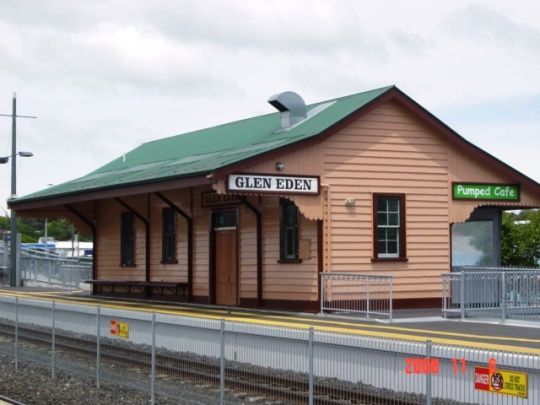
Historical Significance or Value This historic place was registered under the Historic Places Act 1993. The following text is from the original Historic Places Assessment Under Section 23 Criteria report considered by the NZHPT Board at the time of registration. Historical: The Glen Eden railway station was built to serve the branch line from Newmarket to Waikomiti, which was completed in 1880. Originally a simple Vogel Period Class 5 building, the station was altered in October 1928 to became a Modified Vogel Class 5. Its history was somewhat unusual in that its existence determined the location of the new Waikumete Hill cemetery, opened to replace the Symonds St cemetery in 1886; a special siding was constructed to receive funeral trains. In 1940 a verandah was added to the northern side of the building in anticipation of the construction of a double line to Henderson that never eventuated.
Physical Significance
This historic place was registered under the Historic Places Act 1993. The following text is from the original Historic Places Assessment Under Section 23 Criteria report considered by the NZHPT Board at the time of registration. Architectural: Designed as a Vogel Period Class 5 station building in 1880-1, the Glen Eden Railway Station became in 1929 a Modified Vogel Class 5 station, or a Troup Period Type A station. An additional verandah was built on the road frontage of the building in 1940. Although the effects of these modifications have changed the appearance of the Vogel Class 5 station almost beyond recognition, style indicators common to the Vogel and Troup class designs are: - Simple rectangular plan with pitched roof subsequently altered to a gable-ended building with ridged roof. - Three rooms divided into Porter's Office, centrally located open lobby, and ladies' W.C. - Fireplace in Porter's Office. This was a departure from the standard drawing for Vogel Class 5 stations, but it was standard for Modified Vogel Class 5 stations. A copy of the 1881 plans for the Glen Eden station show a chimney for the Porter's Office. - Verandah added on Railway line facade (1928) and on road facade in 1940 to allow for a new branch line which did not eventuate. - Extension to ladies' W.C. to allow for a more discreet design with a waiting room. - Match lined interior. - Verandahs with decorative valances at ends.
Why is this place Category 1 / Category 2?
Detail Of Assessed Criteria
This historic place was registered under the Historic Places Act 1993. The following text is from the original Historic Places Assessment Under Section 23 Criteria report considered by the NZHPT Board at the time of registration. 23(2)(a) The extent to which the place reflects important or representative aspects of New Zealand history. Railways were central to politics and to economic development in late Victorian New Zealand, with the location of lines and stations sometimes being hotly contested. The Glen Eden station is not mentioned in the standard reference work on the subject, Down at the Station, by J.D. Mahoney (Dunmore Press, 1987). However, Glen Eden is made special by two factors. The first was that its existence influenced the location of a cemetery Waikomiti, (later the Waikumete Hill) cemetery, which was when the Symonds St cemetery reached full capacity. The station handled special funeral service trains, an extremely unusual if not unique undertaking in New Zealand. Secondly, the building was further modified in 1940 in anticipation of the addition of a double line to Henderson that never eventuated. These factors mean that Glen Eden has more than representative significance. 23(2)(g): The technical accomplishment or value, or design of the place: DATE: 1880 ARCHITECT: NZR/PWD STYLE CODE: Modified Vogel Class 5 station, Troup Period Type A. DESIGN: Paul Mahoney in his essay New Zealand Railway Station Buildings. A Heritage in Timber and Tin, 1990, says of the Modified Vogel Station Buildings, A large number of Vogel station buildings remained in use throughout the Troup period. Many were modified to cope with increased railway business, and in that changed form served out the rest of the timber and tin era. The common additions were extra office space, fireplaces, and verandahs. The main alterations were the enclosing of the open lobby and conversion of the womens WC to a more discreet design. The effects of these modifications changed the appearance of some Class 4 and 5 stations almost beyond recognition and so they warrant separate categories in their own right. In the case of the Glen Eden station modifications consisted of: - Modification of a Vogel Class 5 station to a Troup period Type A station in 1928. The pitched roof was altered to a gable-ended building with a ridged roof. The lobby was not enclosed at this time, but a standard extension was built to the ladies W.C. to allow for a more discreet design with 3 W.C.s separated by a partition wall from a new Ladies waiting room. - A verandah was added on the railway line facade of the building. Additional modifications to the station took place in 1940 consisting of: - A second verandah was added to the road-side frontage in anticipation of a new branch line to Henderson which did not eventuate because of the War. - The lobby was enclosed. This may actually have taken place before the 1940 modifications, but the plans of the station dated 7/11/28 show the lobby as being open whereas the plans dated 15/4/40 show it as being enclosed in the proposed alterations. Post 1940 alterations to the Glen Eden Railway Station probably took place when the building was used as a Neighbourhood Care Drop In Centre administered by the Baptist Church (no date given, but presumably post 1980) and appear to have consisted of the removal of the chimney, and the removal of the 1928 partition wall between the ladies W.C. and ladies waiting room. 23(2)(m): Such additional criteria not inconsistent with those in paragraphs (a) to (k): For comparative purposes reference must be made to the Rail Heritage Trust Register as a benchmark for assessing significance. The Glen Eden station is not classified by the RHT. The view of the RHT is that the majority of surviving Vogel Class 5 stations "have been severely modified" and have therefore not been classified for that reason. Against that standard the RHT consider the Wedderburn Station building (Otago) to be of considerable importance as the only extant unmodified Vogel Class 5 station, and Ormondville Station building (Tararua) to be New Zealand's finest example of a Modified Vogel Class 5 station. There are 29 railway station buildings registered by the Historic Places Trust. Wedderburn is not listed by the Trust, but Ormondville is a registered Category II historic place. Out of the total number of HPT registrations, only one station (Ormondville) is a Modified Vogel Class 5 station. On a purely comparative basis Ormondville is greatly superior to the Glen Eden station as an example of this type for at least two reasons; (1) the station building can still be seen as a Vogel Class 5 station since it has retained its original pitched roof; (2) the verandah is of considerable character with Troup period Art Nouveau style wrought iron work in the verandah ends. Glen Eden station by comparison, although it is an example of a modified Vogel station, has nothing to compare with this. However it does have the special feature of having an additional verandah on the road frontage side of the building, and so far as we know no other station buildings have this feature apart, that is, from purpose-built and designed Island Stations, which Glen Eden is not. This makes for Glen Eden being an unusual example of a Modified Vogel Class 5 station with a Troup period Island Station feature. On this basis registration would extend the national register by including in it an unusual and uncommon example of a Modified Vogel Class 5 station which stands in interesting contrast to the only other registered example, Ormandville station. The assertion in the registration proposal that Glen Eden station is "the only station in New Zealand built for, and with a direct link to, a public cemetery", may be true and would otherwise count as a relevant factor in assessing the significance of the place, but the claim is not sourced and would in fact require a survey, beyond the resources of this assessment, of all railway stations in new Zealand to establish what links, if any, they have with cemeteries.
Why is this place significant?
Historic Significance
Historical Significance or Value This historic place was registered under the Historic Places Act 1993. The following text is from the original Historic Places Assessment Under Section 23 Criteria report considered by the NZHPT Board at the time of registration. Historical: The Glen Eden railway station was built to serve the branch line from Newmarket to Waikomiti, which was completed in 1880. Originally a simple Vogel Period Class 5 building, the station was altered in October 1928 to became a Modified Vogel Class 5. Its history was somewhat unusual in that its existence determined the location of the new Waikumete Hill cemetery, opened to replace the Symonds St cemetery in 1886; a special siding was constructed to receive funeral trains. In 1940 a verandah was added to the northern side of the building in anticipation of the construction of a double line to Henderson that never eventuated.
Physical Significance
This historic place was registered under the Historic Places Act 1993. The following text is from the original Historic Places Assessment Under Section 23 Criteria report considered by the NZHPT Board at the time of registration. Architectural: Designed as a Vogel Period Class 5 station building in 1880-1, the Glen Eden Railway Station became in 1929 a Modified Vogel Class 5 station, or a Troup Period Type A station. An additional verandah was built on the road frontage of the building in 1940. Although the effects of these modifications have changed the appearance of the Vogel Class 5 station almost beyond recognition, style indicators common to the Vogel and Troup class designs are: - Simple rectangular plan with pitched roof subsequently altered to a gable-ended building with ridged roof. - Three rooms divided into Porter's Office, centrally located open lobby, and ladies' W.C. - Fireplace in Porter's Office. This was a departure from the standard drawing for Vogel Class 5 stations, but it was standard for Modified Vogel Class 5 stations. A copy of the 1881 plans for the Glen Eden station show a chimney for the Porter's Office. - Verandah added on Railway line facade (1928) and on road facade in 1940 to allow for a new branch line which did not eventuate. - Extension to ladies' W.C. to allow for a more discreet design with a waiting room. - Match lined interior. - Verandahs with decorative valances at ends.
Why is this place Category 1 / Category 2?
Detail Of Assessed Criteria
This historic place was registered under the Historic Places Act 1993. The following text is from the original Historic Places Assessment Under Section 23 Criteria report considered by the NZHPT Board at the time of registration. 23(2)(a) The extent to which the place reflects important or representative aspects of New Zealand history. Railways were central to politics and to economic development in late Victorian New Zealand, with the location of lines and stations sometimes being hotly contested. The Glen Eden station is not mentioned in the standard reference work on the subject, Down at the Station, by J.D. Mahoney (Dunmore Press, 1987). However, Glen Eden is made special by two factors. The first was that its existence influenced the location of a cemetery Waikomiti, (later the Waikumete Hill) cemetery, which was when the Symonds St cemetery reached full capacity. The station handled special funeral service trains, an extremely unusual if not unique undertaking in New Zealand. Secondly, the building was further modified in 1940 in anticipation of the addition of a double line to Henderson that never eventuated. These factors mean that Glen Eden has more than representative significance. 23(2)(g): The technical accomplishment or value, or design of the place: DATE: 1880 ARCHITECT: NZR/PWD STYLE CODE: Modified Vogel Class 5 station, Troup Period Type A. DESIGN: Paul Mahoney in his essay New Zealand Railway Station Buildings. A Heritage in Timber and Tin, 1990, says of the Modified Vogel Station Buildings, A large number of Vogel station buildings remained in use throughout the Troup period. Many were modified to cope with increased railway business, and in that changed form served out the rest of the timber and tin era. The common additions were extra office space, fireplaces, and verandahs. The main alterations were the enclosing of the open lobby and conversion of the womens WC to a more discreet design. The effects of these modifications changed the appearance of some Class 4 and 5 stations almost beyond recognition and so they warrant separate categories in their own right. In the case of the Glen Eden station modifications consisted of: - Modification of a Vogel Class 5 station to a Troup period Type A station in 1928. The pitched roof was altered to a gable-ended building with a ridged roof. The lobby was not enclosed at this time, but a standard extension was built to the ladies W.C. to allow for a more discreet design with 3 W.C.s separated by a partition wall from a new Ladies waiting room. - A verandah was added on the railway line facade of the building. Additional modifications to the station took place in 1940 consisting of: - A second verandah was added to the road-side frontage in anticipation of a new branch line to Henderson which did not eventuate because of the War. - The lobby was enclosed. This may actually have taken place before the 1940 modifications, but the plans of the station dated 7/11/28 show the lobby as being open whereas the plans dated 15/4/40 show it as being enclosed in the proposed alterations. Post 1940 alterations to the Glen Eden Railway Station probably took place when the building was used as a Neighbourhood Care Drop In Centre administered by the Baptist Church (no date given, but presumably post 1980) and appear to have consisted of the removal of the chimney, and the removal of the 1928 partition wall between the ladies W.C. and ladies waiting room. 23(2)(m): Such additional criteria not inconsistent with those in paragraphs (a) to (k): For comparative purposes reference must be made to the Rail Heritage Trust Register as a benchmark for assessing significance. The Glen Eden station is not classified by the RHT. The view of the RHT is that the majority of surviving Vogel Class 5 stations "have been severely modified" and have therefore not been classified for that reason. Against that standard the RHT consider the Wedderburn Station building (Otago) to be of considerable importance as the only extant unmodified Vogel Class 5 station, and Ormondville Station building (Tararua) to be New Zealand's finest example of a Modified Vogel Class 5 station. There are 29 railway station buildings registered by the Historic Places Trust. Wedderburn is not listed by the Trust, but Ormondville is a registered Category II historic place. Out of the total number of HPT registrations, only one station (Ormondville) is a Modified Vogel Class 5 station. On a purely comparative basis Ormondville is greatly superior to the Glen Eden station as an example of this type for at least two reasons; (1) the station building can still be seen as a Vogel Class 5 station since it has retained its original pitched roof; (2) the verandah is of considerable character with Troup period Art Nouveau style wrought iron work in the verandah ends. Glen Eden station by comparison, although it is an example of a modified Vogel station, has nothing to compare with this. However it does have the special feature of having an additional verandah on the road frontage side of the building, and so far as we know no other station buildings have this feature apart, that is, from purpose-built and designed Island Stations, which Glen Eden is not. This makes for Glen Eden being an unusual example of a Modified Vogel Class 5 station with a Troup period Island Station feature. On this basis registration would extend the national register by including in it an unusual and uncommon example of a Modified Vogel Class 5 station which stands in interesting contrast to the only other registered example, Ormandville station. The assertion in the registration proposal that Glen Eden station is "the only station in New Zealand built for, and with a direct link to, a public cemetery", may be true and would otherwise count as a relevant factor in assessing the significance of the place, but the claim is not sourced and would in fact require a survey, beyond the resources of this assessment, of all railway stations in new Zealand to establish what links, if any, they have with cemeteries.
Construction Details
Start Year
1880
Type
Original Construction
Construction Details
Start Year
1880
Type
Original Construction
ARCHITECT: NZR/PWD
ARCHITECT: NZR/PWD
Historical and Associated Iwi / Hapū / Whānau
Completion Date
1st May 1998
Report Written By
Gavin McLean & Wayne Nelson
Other Information
A copy of the original report is available from the NZHPT Northern region office Please note that entry on the New Zealand Heritage List/Rarangi Korero identifies only the heritage values of the property concerned, and should not be construed as advice on the state of the property, or as a comment of its soundness or safety, including in regard to earthquake risk, safety in the event of fire, or insanitary conditions.
Historical and Associated Iwi / Hapū / Whānau
Completion Date
1st May 1998
Report Written By
Gavin McLean & Wayne Nelson
Other Information
A copy of the original report is available from the NZHPT Northern region office Please note that entry on the New Zealand Heritage List/Rarangi Korero identifies only the heritage values of the property concerned, and should not be construed as advice on the state of the property, or as a comment of its soundness or safety, including in regard to earthquake risk, safety in the event of fire, or insanitary conditions.
Former Usages
General Usage: Transport
Specific Usage: Railway station/ platform/ refreshment room
Themes
North Island Main Trunk Line
Former Usages
General Usage: Transport
Specific Usage: Railway station/ platform/ refreshment room
Themes
North Island Main Trunk Line
Location
Stay up to date with Heritage this month
