

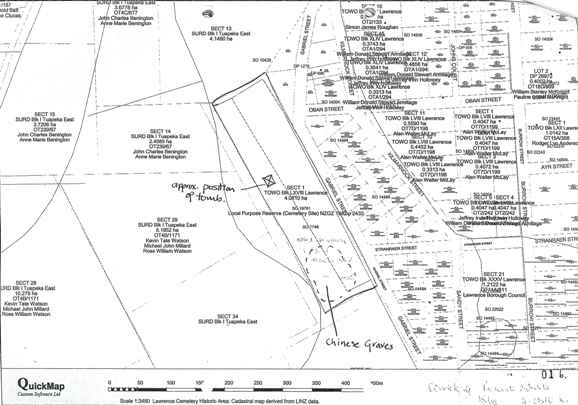
The Lawrence Chinese Graves Historic Area encompasses Sam Chiew Lain's Tomb in the Presbyterian section of the cemetery, and the collection of Chinese graves at the southern and western edges of the cemetery. The land is within Section 1 Block LXVIII, Town of Lawrence, SO 19781, Local Purpose Reserve (Cemetery Site) NZG, 1982, p.2433.
List Entry Information
Status
Listed
List Entry Status
Historic Area
Access
Private/No Public Access
List Number
7546
Date Entered
25th June 2004
Date of Effect
25th June 2004
City/District Council
Clutha District
Region
Otago Region
Extent of List Entry
The Lawrence Chinese Graves Historic Area encompasses Sam Chiew Lain's Tomb in the Presbyterian section of the cemetery, and the collection of Chinese graves at the southern and western edges of the cemetery. The land is within Section 1 Block LXVIII, Town of Lawrence, SO 19781, Local Purpose Reserve (Cemetery Site) NZG, 1982, p.2433.
Legal description
Sec 1 Blk LXVIII Town of Lawrence, SO 19781, Local Purpose Reserve (Cemetery Site) NZ Gazette, 1982, p.2433
Status
Listed
List Entry Status
Historic Area
Access
Private/No Public Access
List Number
7546
Date Entered
25th June 2004
Date of Effect
25th June 2004
City/District Council
Clutha District
Region
Otago Region
Extent of List Entry
The Lawrence Chinese Graves Historic Area encompasses Sam Chiew Lain's Tomb in the Presbyterian section of the cemetery, and the collection of Chinese graves at the southern and western edges of the cemetery. The land is within Section 1 Block LXVIII, Town of Lawrence, SO 19781, Local Purpose Reserve (Cemetery Site) NZG, 1982, p.2433.
Legal description
Sec 1 Blk LXVIII Town of Lawrence, SO 19781, Local Purpose Reserve (Cemetery Site) NZ Gazette, 1982, p.2433
Why is this place significant?
Cultural Significance
The Chinese graves and Sam Chiew Lain's tomb provide an insight into the culture of both Chinese and European communities in the late nineteenth and early twentieth centuries. As has been noted in the Australian context of developing Chinese communities, tombs such as Sam Chiew Lain's represent the social position within the community -the change from sojourner to settler, living in the margin to becoming a person of financial and political influence. As Chinese writers have noted cemeteries are cultural landscapes which "reflect the essential values of those who occupy and visit them" and are landscapes that require interpretation in terms of time as well as of space." For the Chinese the "landscapes of death" are regarded as potentially powerful and an highly charged. The Chinese headstones provide an illustration of Chinese burial practices in New Zealand, and the miners' genealogical links to China. When few biographical details are available about Chinese miners, these graves provide crucial signposts to their past. In their close grouping they provide an indication of the close knit community that Chinese miners created for themselves. The absence of some of the bodies, as well, illustrates the Chinese practice of second burial where the cleaned bones were repatriated to China and reburied there. In their isolation from the rest of the Cemetery they provide an indication of the segregation and ostracism experienced at times at the hands of the European community. The juxtaposition of the grandness of Sam Chiew Lain's tomb against the modest cluster of small headstones provides an insight into the culture of nineteenth century goldfields, and the isolation of the Chinese community as a whole. The acceptance of prominent individuals within that culture by European communities such as Lawrence is illustrated by the scale and prominence of Sam Chiew Lain's tomb.
Historic Significance
Historical Significance or Value The Chinese graves in Lawrence Cemetery are a physical reminder of the highly visible and distinctive Chinese history in nineteenth century goldfields New Zealand. They represent the often unwritten and untraceable histories of individual miners who came to New Zealand to seek their fortune in the goldfields. Chinese experiences in the goldfields have been largely underrepresented beyond the stereotype of the lone miner. These graves represent the life and death of a community, as well as of its individual members represented by the headstones. The empty plots are also important reminders of the connection to China that the miners felt, and their wish to be united with their distant home, as indicated by the exhumation of bodies and the return to China for reburial. Sam Chiew Lain's tomb is a significant memorial. Sam Chiew Lain's part in the history of the Lawrence community illustrates a pathway through both European and Chinese communities. He represents an important aspect of nineteenth century goldfields life as a bridge between two cultures.
Why is this place significant?
Cultural Significance
The Chinese graves and Sam Chiew Lain's tomb provide an insight into the culture of both Chinese and European communities in the late nineteenth and early twentieth centuries. As has been noted in the Australian context of developing Chinese communities, tombs such as Sam Chiew Lain's represent the social position within the community -the change from sojourner to settler, living in the margin to becoming a person of financial and political influence. As Chinese writers have noted cemeteries are cultural landscapes which "reflect the essential values of those who occupy and visit them" and are landscapes that require interpretation in terms of time as well as of space." For the Chinese the "landscapes of death" are regarded as potentially powerful and an highly charged. The Chinese headstones provide an illustration of Chinese burial practices in New Zealand, and the miners' genealogical links to China. When few biographical details are available about Chinese miners, these graves provide crucial signposts to their past. In their close grouping they provide an indication of the close knit community that Chinese miners created for themselves. The absence of some of the bodies, as well, illustrates the Chinese practice of second burial where the cleaned bones were repatriated to China and reburied there. In their isolation from the rest of the Cemetery they provide an indication of the segregation and ostracism experienced at times at the hands of the European community. The juxtaposition of the grandness of Sam Chiew Lain's tomb against the modest cluster of small headstones provides an insight into the culture of nineteenth century goldfields, and the isolation of the Chinese community as a whole. The acceptance of prominent individuals within that culture by European communities such as Lawrence is illustrated by the scale and prominence of Sam Chiew Lain's tomb.
Historic Significance
Historical Significance or Value The Chinese graves in Lawrence Cemetery are a physical reminder of the highly visible and distinctive Chinese history in nineteenth century goldfields New Zealand. They represent the often unwritten and untraceable histories of individual miners who came to New Zealand to seek their fortune in the goldfields. Chinese experiences in the goldfields have been largely underrepresented beyond the stereotype of the lone miner. These graves represent the life and death of a community, as well as of its individual members represented by the headstones. The empty plots are also important reminders of the connection to China that the miners felt, and their wish to be united with their distant home, as indicated by the exhumation of bodies and the return to China for reburial. Sam Chiew Lain's tomb is a significant memorial. Sam Chiew Lain's part in the history of the Lawrence community illustrates a pathway through both European and Chinese communities. He represents an important aspect of nineteenth century goldfields life as a bridge between two cultures.
The Chinese Miners in Lawrence Lawrence was the main service town for the Tuapeka goldfields district which was comprised of four main goldfields - Gabriels Gully, Waitahuna, Waipori and Munros, and several secondary fields. Lawrence became the chief gateway for Chinese travelling to Central Otago, especially after the road was improved in 1872, and the railway reached Lawrence in 1877. By 1871 there were 1,083 Chinese out of a total population of 4,374 at Tuapeka, with numbers decreasing after that as the goldfields returns declined. From 1893 the European miners remained fairly stable, but the Chinese population fell giving figures of 450 European, and 200 Chinese miners in 1900. In Lawrence an 1867 by-law limited Chinese shops and dwellings to Chinaman Flat, described by James Ng as "an acre of wet ground approximately 1.2 kilometres north of the town proper, by the main road", known as 'Canton' or 'Hong Kong.' By making such a law Lawrence was copying by-laws passed in Victoria, although it was the only Otago town to do so. Elsewhere in Otago the Chinese opened shops within townships to serve both Chinese and Europeans, but they did also cluster in Chinese Camps on the outskirts - Macraes Flat had two Chinese Camps. The heart of Chinese settlement at Tuapeka was the Lawrence Chinese Camp formed around 1869 , bordered on the north by the Tuapeka stream and a strip of mining reserve, and the main road south. James Ng describes it as a "conglomeration of huts, stores, gambling dens, a hotel, lodging houses and a public hall or Joss House." The Camp was outside the jurisdiction of the Lawrence township council. No single authority seemed to be legally responsible for the Camp until the Tuapeka County Council surveyed the area in 1882 and agreed to subsidise a drain for the site in 1883. Prior to that the Chinese had subscribed to the formation of streets in the Camp, and had dug their own wells and latrines. By 1883 there were 60-70 residents in the Camp. The Chinese residents boiled water from their wells before drinking, which was recognized as having kept down the disease rate of the Camp. There was only one recorded disease outbreak in the Lawrence Camp - that of two cases of diphtheria in 1883. James Ng notes that the disease-free record was remarkable given that hundreds (probably thousands) of people - Europeans and Chinese visited the Camp each year. Typhoid outbreaks as a result of poor sanitation occurred in Cromwell, Lawrence itself, Arrowtown and Dunedin - but not in the Chinese Camps of Lawrence and other Central Otago townships. Europeans visited the Camp for the Chinese festivals, and frequented both the Chinese Empire Hotel in the Camp, and the Chinese stores - whose prices were lower than European businesses. The Camp also served passing trade particularly from the Tuapeka and Evans Flats. There were several stores, possibly three cook shops, more than one gambling den and a hairdresser. As well as the hotel being rebuilt in 1884, other buildings in the Camp were also rebuilt from 1884, when the Chinese were allowed to buy sections there - which resulted in much improved quality of buildings, given that the Camp had become dilapidated and overdue for rebuilding. A barracks known to Europeans as the 'company house' was erected for newcomers, and also catered for Chinese who had hit hard times. The barracks were burnt down in 1897-98 in a fire that burnt part of the Camp as well. Early Chinese businesses operating in the Camp include the merchant firm He Tie, in which Wong On (Ong) was a senior partner (mentioned 1867). By 1871 there was an important shop keeper Qui Hing (Que Hine or Chew Ling) whose shop was named Sun Kum Hop, and who catered for itinerant Panyu Cantonese, as well as his local clientele. Wong On and Qui Hing represented the Chinese when Governor Fergusson passed through Lawrence in 1874. Sam Yeck Mong was another well-known Lawrence firm, which was mentioned as pork butchers in 1871, and applied for a slaughterhouse licence in 1877. It became an important general store in the 1880s-1900s and was run by Chau Mong and Chow Tie, probably the last Panyu storekeepers in Lawrence. Sam Yeck Mong bought out Sun Kum Hop so owned two stores in the Camp. When goldmining was no longer economically viable, the Chinese who remained in the Tuapeka area worked in a variety of occupations. Local Historian W.R. Mayhew notes that their hardworking ability to finish contracts was highly valued by farmers who employed them to clear land, and also notes that they kept market gardens, the produce from which they sold around the district. In addition they worked on the railways and as general farm labourers. By 1928 there were only fourteen old men left at the Chinese Camp, and by 1949, none. W.R. Mayhew notes that part of the hotel was still in use around 1949, but was the only remaining building from the Chinese Camp. Sam Chiew Lain and his Tomb Sam Chiew Lain was a Hakka Cantonese man, probably from Baoan or Huiyang county, which bordered on Kowloon. Hakka were minority Chinese on the Otago goldfields. He had been a miner in Victoria before coming to Otago in the 1860s to mine at Munros Gully and Switzers. He settled in Lawrence in the 1870s. In 1872 he was naturalized and married Amelia Newbiggins with a celebration at the Chinese Empire Hotel attended by members of the Chinese community. According to James Ng, Sam Chiew Lain was probably the chief Hakka leader, and his position explains why he "played little part in the affairs of the Otago Chinese generally, despite his popularity with Europeans." Being of Hakka origin, Sam Chiew Lain may have supplied the general merchandise to the Hakka Cantonese goldseekers, a number of whom were on the Adams Flat and Evans Flat fields, and possibly Beaumont as well. Sam Chiew Lain had a long association with the Chinese Empire Hotel. Sam Chiew Lain went into partnership with Wong On in the hotel in the mid 1870s. Sam Chiew Lain was granted a billiard licence in 1877, and publican and midnight licences in June 1878. When Wong On left for China in 1881 Sam Chiew Lain became sole proprietor. He is noted as freeholding the property worth £500 in Lawrence in an 1882 return , one of 20 Chinese people on the list. James Ng suggested that the hotel catered mainly a European clientele, with Chinese using another Chinese store/accommodation house in Lawrence - Sun Kum Hop. The Chinese Empire Hotel was rebuilt in brick in 1884, when the Tuapeka Times described it as "second to none" in Otago. The architect-designed hotel is the only building left at the Lawrence Chinese Camp site. Sam Chiew Lain's hotel business brought him into contact with a wide clientele. One author noted that the hotel was well known "for its good conduct and fine quality liquors." The writer recalled that Sam Chiew Lain "served no one whom he judged to be too young (the usual test being the possession of whiskers), and furthermore, when he considered his customers had had sufficient, he would suggest it was time they went home to dig their gardens." Sam Chiew Lain's obituary stated that he had a "reputation for thorough honesty and scrupulous exactness in business matters...proved in every respect a thoroughly successful businessman...To his countrymen and Europeans alike he has proved in many cases a friend indeed and stories of large-hearted generosity are legion." Sam Chiew Lain spoke good English, and was a frequent court interpreter. On occasion he was a police witness against residents of the Chinese Camp. On one occasion he was a police witness against Qui Hing, who was charged with allowing two white men to drink beer in his store. The men were police informers, acting at a time when police were taking a harsh line against the Chinese in Lawrence. It was significant to find Sam Chiew Lain on the police side against other members of the Chinese community. Presbyterian missionary to the Chinese, Alexander Don, believed that Hakka were generally spurned by the Poontei clan in both Otago and China. Sam Chiew Lain's obituary was recorded in the Tuapeka Times 18 March 1903 [p.3.]. According to James Ng he was one of only four Otago Chinese who were accorded newspaper obituaries or tributes up to the turn of the century. His respectability in European eyes was perhaps due to the perception among Europeans that he was adopting British ways - Ng identifies Sam Chiew Lain as someone who was respected perhaps because of the degree to which he was anglicized. He was buried in the Presbyterian section of the Lawrence Cemetery, his tomb costing £167, a substantial price tag at that time. Since Sam had no children, he apparently asked the Lodge St George Masonic Brotherhood to look after his wife's affairs. The remainder of his estate was bequeathed to the Lodge. James Ng considers that few of the leaders of the Chinese gold seekers sought to stay permanently in New Zealand, and Sam Chiew Lain was one of the only inland Otago leaders who consciously chose to do so. Chinese Burial Customs in New Zealand As noted by James Ng, burial customs reflect the social history of ethnic groups and Chinese burial customs in New Zealand differed noticeably from those of the general population. In general they were based on Cantonese village customs of the Guandong province. Burial was preferred over cremation. In the nineteenth century many New Zealand cemeteries segregated the Chinese and other groups of the community by religion. The Chinese were adjudged as pagans or heathens. Only a few Chinese were buried among European plots, and they were Christians like Sam Chiew Lain. Old New Zealand-Chinese graves have deteriorated over time. The Chinese sections of the old goldfields cemeteries were often on a boundary and were among the first to suffer neglect or disrespect. James Ng writes that Christian Chinese were buried in the Christian sectors of cemeteries, but that there were only a few of these, including the European wives of the Chinese. There is one exception in the Lawrence Cemetery, Christian Fung Ming Cho, a Heungshan County man was buried by the Presbyterian Church in the Chinese sector. This is one of the best preserved graves. In the Lawrence cemetery the early graves are generally non-Poonyu Cantonese. Poonyu graves appear after the last mass Chinese exhumation in 1909. Graves of old New Zealand-Chinese miners are relatively rare. There are a few known Chinese graves located away from cemeteries as at Waikaia and Nokomai, but even including these the Central Otago total adds up to around 150, for a total of possibly 1,000 Chinese deaths in New Zealand up to 1900. Chinese miners were also buried in unmarked graves. While many graves lost their headstones and disappeared as bodies were disinterred and sent back to China, an extension of the custom that one should be buried in the soil one was born in. The Poon Fah Association aided in the sending of bodies back to China, with mass exhumations in 1883 (230 bodies) and 1902 (474 bodies). The Association maintained a cemetery and mortuary temple near Shek Moon in Upper Panyu for its overseas members. The sending of bodies back to China became more infrequent after 1900 after the mining era had ended. Gravestones may also be considered a surviving aspect of the print culture of early New Zealand Chinese. They provide genealogical information vital to the study of the origins of the Chinese miners, including links with other goldfields in Australia, as well as to their Chinese homeland. On the old Chinese graves, there was in Chinese script a description of overseas origins, dates, name Guandong county, village and life span. Older Chinese males may have had two or three separate Chinese names, and the stone may have carried the least used, but prestigious scholar's name. Chinese headstones in general had no statuary and the like. A 1947 tour of New Zealand Chinese graves noted wooden markers for Chinese graves, but they have since disappeared. The most elaborate old New Zealand-Chinese grave was that of Sam Chew Lain (see above).
The Chinese Miners in Lawrence Lawrence was the main service town for the Tuapeka goldfields district which was comprised of four main goldfields - Gabriels Gully, Waitahuna, Waipori and Munros, and several secondary fields. Lawrence became the chief gateway for Chinese travelling to Central Otago, especially after the road was improved in 1872, and the railway reached Lawrence in 1877. By 1871 there were 1,083 Chinese out of a total population of 4,374 at Tuapeka, with numbers decreasing after that as the goldfields returns declined. From 1893 the European miners remained fairly stable, but the Chinese population fell giving figures of 450 European, and 200 Chinese miners in 1900. In Lawrence an 1867 by-law limited Chinese shops and dwellings to Chinaman Flat, described by James Ng as "an acre of wet ground approximately 1.2 kilometres north of the town proper, by the main road", known as 'Canton' or 'Hong Kong.' By making such a law Lawrence was copying by-laws passed in Victoria, although it was the only Otago town to do so. Elsewhere in Otago the Chinese opened shops within townships to serve both Chinese and Europeans, but they did also cluster in Chinese Camps on the outskirts - Macraes Flat had two Chinese Camps. The heart of Chinese settlement at Tuapeka was the Lawrence Chinese Camp formed around 1869 , bordered on the north by the Tuapeka stream and a strip of mining reserve, and the main road south. James Ng describes it as a "conglomeration of huts, stores, gambling dens, a hotel, lodging houses and a public hall or Joss House." The Camp was outside the jurisdiction of the Lawrence township council. No single authority seemed to be legally responsible for the Camp until the Tuapeka County Council surveyed the area in 1882 and agreed to subsidise a drain for the site in 1883. Prior to that the Chinese had subscribed to the formation of streets in the Camp, and had dug their own wells and latrines. By 1883 there were 60-70 residents in the Camp. The Chinese residents boiled water from their wells before drinking, which was recognized as having kept down the disease rate of the Camp. There was only one recorded disease outbreak in the Lawrence Camp - that of two cases of diphtheria in 1883. James Ng notes that the disease-free record was remarkable given that hundreds (probably thousands) of people - Europeans and Chinese visited the Camp each year. Typhoid outbreaks as a result of poor sanitation occurred in Cromwell, Lawrence itself, Arrowtown and Dunedin - but not in the Chinese Camps of Lawrence and other Central Otago townships. Europeans visited the Camp for the Chinese festivals, and frequented both the Chinese Empire Hotel in the Camp, and the Chinese stores - whose prices were lower than European businesses. The Camp also served passing trade particularly from the Tuapeka and Evans Flats. There were several stores, possibly three cook shops, more than one gambling den and a hairdresser. As well as the hotel being rebuilt in 1884, other buildings in the Camp were also rebuilt from 1884, when the Chinese were allowed to buy sections there - which resulted in much improved quality of buildings, given that the Camp had become dilapidated and overdue for rebuilding. A barracks known to Europeans as the 'company house' was erected for newcomers, and also catered for Chinese who had hit hard times. The barracks were burnt down in 1897-98 in a fire that burnt part of the Camp as well. Early Chinese businesses operating in the Camp include the merchant firm He Tie, in which Wong On (Ong) was a senior partner (mentioned 1867). By 1871 there was an important shop keeper Qui Hing (Que Hine or Chew Ling) whose shop was named Sun Kum Hop, and who catered for itinerant Panyu Cantonese, as well as his local clientele. Wong On and Qui Hing represented the Chinese when Governor Fergusson passed through Lawrence in 1874. Sam Yeck Mong was another well-known Lawrence firm, which was mentioned as pork butchers in 1871, and applied for a slaughterhouse licence in 1877. It became an important general store in the 1880s-1900s and was run by Chau Mong and Chow Tie, probably the last Panyu storekeepers in Lawrence. Sam Yeck Mong bought out Sun Kum Hop so owned two stores in the Camp. When goldmining was no longer economically viable, the Chinese who remained in the Tuapeka area worked in a variety of occupations. Local Historian W.R. Mayhew notes that their hardworking ability to finish contracts was highly valued by farmers who employed them to clear land, and also notes that they kept market gardens, the produce from which they sold around the district. In addition they worked on the railways and as general farm labourers. By 1928 there were only fourteen old men left at the Chinese Camp, and by 1949, none. W.R. Mayhew notes that part of the hotel was still in use around 1949, but was the only remaining building from the Chinese Camp. Sam Chiew Lain and his Tomb Sam Chiew Lain was a Hakka Cantonese man, probably from Baoan or Huiyang county, which bordered on Kowloon. Hakka were minority Chinese on the Otago goldfields. He had been a miner in Victoria before coming to Otago in the 1860s to mine at Munros Gully and Switzers. He settled in Lawrence in the 1870s. In 1872 he was naturalized and married Amelia Newbiggins with a celebration at the Chinese Empire Hotel attended by members of the Chinese community. According to James Ng, Sam Chiew Lain was probably the chief Hakka leader, and his position explains why he "played little part in the affairs of the Otago Chinese generally, despite his popularity with Europeans." Being of Hakka origin, Sam Chiew Lain may have supplied the general merchandise to the Hakka Cantonese goldseekers, a number of whom were on the Adams Flat and Evans Flat fields, and possibly Beaumont as well. Sam Chiew Lain had a long association with the Chinese Empire Hotel. Sam Chiew Lain went into partnership with Wong On in the hotel in the mid 1870s. Sam Chiew Lain was granted a billiard licence in 1877, and publican and midnight licences in June 1878. When Wong On left for China in 1881 Sam Chiew Lain became sole proprietor. He is noted as freeholding the property worth £500 in Lawrence in an 1882 return , one of 20 Chinese people on the list. James Ng suggested that the hotel catered mainly a European clientele, with Chinese using another Chinese store/accommodation house in Lawrence - Sun Kum Hop. The Chinese Empire Hotel was rebuilt in brick in 1884, when the Tuapeka Times described it as "second to none" in Otago. The architect-designed hotel is the only building left at the Lawrence Chinese Camp site. Sam Chiew Lain's hotel business brought him into contact with a wide clientele. One author noted that the hotel was well known "for its good conduct and fine quality liquors." The writer recalled that Sam Chiew Lain "served no one whom he judged to be too young (the usual test being the possession of whiskers), and furthermore, when he considered his customers had had sufficient, he would suggest it was time they went home to dig their gardens." Sam Chiew Lain's obituary stated that he had a "reputation for thorough honesty and scrupulous exactness in business matters...proved in every respect a thoroughly successful businessman...To his countrymen and Europeans alike he has proved in many cases a friend indeed and stories of large-hearted generosity are legion." Sam Chiew Lain spoke good English, and was a frequent court interpreter. On occasion he was a police witness against residents of the Chinese Camp. On one occasion he was a police witness against Qui Hing, who was charged with allowing two white men to drink beer in his store. The men were police informers, acting at a time when police were taking a harsh line against the Chinese in Lawrence. It was significant to find Sam Chiew Lain on the police side against other members of the Chinese community. Presbyterian missionary to the Chinese, Alexander Don, believed that Hakka were generally spurned by the Poontei clan in both Otago and China. Sam Chiew Lain's obituary was recorded in the Tuapeka Times 18 March 1903 [p.3.]. According to James Ng he was one of only four Otago Chinese who were accorded newspaper obituaries or tributes up to the turn of the century. His respectability in European eyes was perhaps due to the perception among Europeans that he was adopting British ways - Ng identifies Sam Chiew Lain as someone who was respected perhaps because of the degree to which he was anglicized. He was buried in the Presbyterian section of the Lawrence Cemetery, his tomb costing £167, a substantial price tag at that time. Since Sam had no children, he apparently asked the Lodge St George Masonic Brotherhood to look after his wife's affairs. The remainder of his estate was bequeathed to the Lodge. James Ng considers that few of the leaders of the Chinese gold seekers sought to stay permanently in New Zealand, and Sam Chiew Lain was one of the only inland Otago leaders who consciously chose to do so. Chinese Burial Customs in New Zealand As noted by James Ng, burial customs reflect the social history of ethnic groups and Chinese burial customs in New Zealand differed noticeably from those of the general population. In general they were based on Cantonese village customs of the Guandong province. Burial was preferred over cremation. In the nineteenth century many New Zealand cemeteries segregated the Chinese and other groups of the community by religion. The Chinese were adjudged as pagans or heathens. Only a few Chinese were buried among European plots, and they were Christians like Sam Chiew Lain. Old New Zealand-Chinese graves have deteriorated over time. The Chinese sections of the old goldfields cemeteries were often on a boundary and were among the first to suffer neglect or disrespect. James Ng writes that Christian Chinese were buried in the Christian sectors of cemeteries, but that there were only a few of these, including the European wives of the Chinese. There is one exception in the Lawrence Cemetery, Christian Fung Ming Cho, a Heungshan County man was buried by the Presbyterian Church in the Chinese sector. This is one of the best preserved graves. In the Lawrence cemetery the early graves are generally non-Poonyu Cantonese. Poonyu graves appear after the last mass Chinese exhumation in 1909. Graves of old New Zealand-Chinese miners are relatively rare. There are a few known Chinese graves located away from cemeteries as at Waikaia and Nokomai, but even including these the Central Otago total adds up to around 150, for a total of possibly 1,000 Chinese deaths in New Zealand up to 1900. Chinese miners were also buried in unmarked graves. While many graves lost their headstones and disappeared as bodies were disinterred and sent back to China, an extension of the custom that one should be buried in the soil one was born in. The Poon Fah Association aided in the sending of bodies back to China, with mass exhumations in 1883 (230 bodies) and 1902 (474 bodies). The Association maintained a cemetery and mortuary temple near Shek Moon in Upper Panyu for its overseas members. The sending of bodies back to China became more infrequent after 1900 after the mining era had ended. Gravestones may also be considered a surviving aspect of the print culture of early New Zealand Chinese. They provide genealogical information vital to the study of the origins of the Chinese miners, including links with other goldfields in Australia, as well as to their Chinese homeland. On the old Chinese graves, there was in Chinese script a description of overseas origins, dates, name Guandong county, village and life span. Older Chinese males may have had two or three separate Chinese names, and the stone may have carried the least used, but prestigious scholar's name. Chinese headstones in general had no statuary and the like. A 1947 tour of New Zealand Chinese graves noted wooden markers for Chinese graves, but they have since disappeared. The most elaborate old New Zealand-Chinese grave was that of Sam Chew Lain (see above).
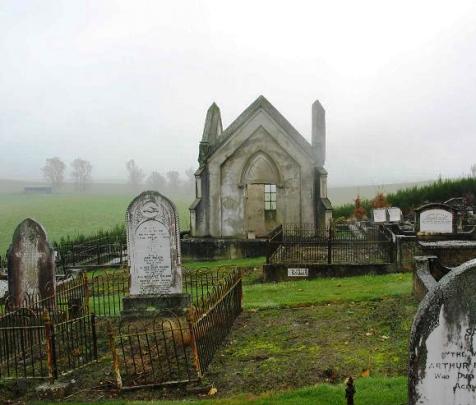
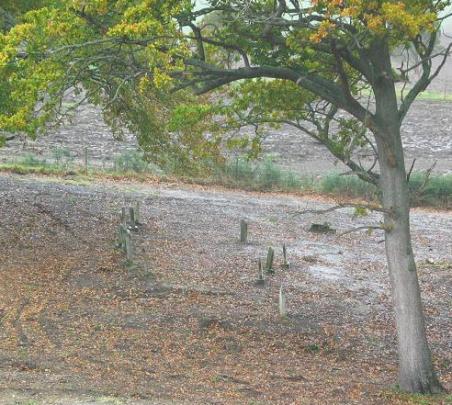
The Lawrence Cemetery is on a hill on the outskirts of the town overlooking State Highway 8. Entrance to the Cemetery is through a side gate. On the crest of the hill within the Cemetery the most obvious structure is Sam Chiew Lain's tomb, set at a high point in the Presbyterian section of the Cemetery. It is a gothic style plastered tomb with a door on its eastern elevation and narrow windows on its northern and southern elevations. It had a slate roof, although this has collapsed. The main section of the Chinese graves is in the south eastern corner of the Lawrence Cemetery. This area is in a sloping scrub and tree covered area. There are at least 30 graves nestled in the undergrowth. Where the vegetation is dominated by trees, and the undergrowth clear the graves are visible. Where there is more dense scrubby growth, the graves are less evident. Looking through the southern window of Sam Chiew Lain's tomb the Chinese graves in the gully are visible. Their positioning at the lower, extreme southern end of the Cemetery, in the only overgrown section is a poignant reminder of the cultural divisions experienced by Chinese miners in Otago. The proposed Historic Area includes Sam Chiew Lain's tomb and the Chinese graves. Current Physical Condition: Sam Chiew Lain's tomb has lost some of its windows and the slate roof has collapsed. The Chinese graves are in varying conditions.
The Lawrence Cemetery is on a hill on the outskirts of the town overlooking State Highway 8. Entrance to the Cemetery is through a side gate. On the crest of the hill within the Cemetery the most obvious structure is Sam Chiew Lain's tomb, set at a high point in the Presbyterian section of the Cemetery. It is a gothic style plastered tomb with a door on its eastern elevation and narrow windows on its northern and southern elevations. It had a slate roof, although this has collapsed. The main section of the Chinese graves is in the south eastern corner of the Lawrence Cemetery. This area is in a sloping scrub and tree covered area. There are at least 30 graves nestled in the undergrowth. Where the vegetation is dominated by trees, and the undergrowth clear the graves are visible. Where there is more dense scrubby growth, the graves are less evident. Looking through the southern window of Sam Chiew Lain's tomb the Chinese graves in the gully are visible. Their positioning at the lower, extreme southern end of the Cemetery, in the only overgrown section is a poignant reminder of the cultural divisions experienced by Chinese miners in Otago. The proposed Historic Area includes Sam Chiew Lain's tomb and the Chinese graves. Current Physical Condition: Sam Chiew Lain's tomb has lost some of its windows and the slate roof has collapsed. The Chinese graves are in varying conditions.
Historical and Associated Iwi / Hapū / Whānau
Public NZAA Number
H44/1136
Completion Date
31st August 2004
Report Written By
Heather Bauchop
Information Sources
Chun-Shing, 1998
Chun-Shing Chow and Elizabeth Kenworthy Teather, 'Chinese Graves and Gravemakers in Hong Kong', Paper presented to the ASCDAPI Conference, Dunedin, November, 1998
Mayhew, 1977
WR Mayhew, 'Tuapeka The Land and Its People. A Social History of the Borough of Lawrence and its Surrounding Districts', Capper Press, Christchurch, 1977, [First published, Otago Centennial Historical Publications, Dunedin, 1949]
Ng, 1993
Ng, James, Windows on a Chinese Past, Volume 1, Otago Heritage Books, Dunedin, 1993
Ng, 1995
Ng, James, Windows on a Chinese Past, Volume 2, Otago Heritage Books, Dunedin, 1995
Ng, 1999
Ng, James, Windows on a Chinese Past, Volume 3, Otago Heritage Books, Dunedin, 1999
Ritchie, 1986
Neville Ritchie, 'Archaeology and History of the Chinese in Southern New Zealand During the Nineteenth Century: A Study of Acculturation, Adaptation, and Change', PhD, University of Otago, 1986 [Hocken Library]
Salmon, 1963
J H M Salmon, J.H.M. 'A History of Goldmining in New Zealand', Wellington, 1963
Yau-chong Jones, 1998
Doris Yau-chong Jones, 'Chinese Grave Design in Rookwood: The Mystery Explained', Paper presented to the ASCDAPI Conference, Dunedin, November, 1998
Hamel, 2001
Jill Hamel, The Archaeology of Otago, Department of Conservation, Wellington, 2001
Other Information
A fully referenced version of this report is available from the NZHPT Southern Region Office. Please note that entry on the New Zealand Heritage List/Rarangi Korero identifies only the heritage values of the property concerned, and should not be construed as advice on the state of the property, or as a comment of its soundness or safety, including in regard to earthquake risk, safety in the event of fire, or insanitary conditions.
Historical and Associated Iwi / Hapū / Whānau
Public NZAA Number
H44/1136
Completion Date
31st August 2004
Report Written By
Heather Bauchop
Information Sources
Chun-Shing, 1998
Chun-Shing Chow and Elizabeth Kenworthy Teather, 'Chinese Graves and Gravemakers in Hong Kong', Paper presented to the ASCDAPI Conference, Dunedin, November, 1998
Mayhew, 1977
WR Mayhew, 'Tuapeka The Land and Its People. A Social History of the Borough of Lawrence and its Surrounding Districts', Capper Press, Christchurch, 1977, [First published, Otago Centennial Historical Publications, Dunedin, 1949]
Ng, 1993
Ng, James, Windows on a Chinese Past, Volume 1, Otago Heritage Books, Dunedin, 1993
Ng, 1995
Ng, James, Windows on a Chinese Past, Volume 2, Otago Heritage Books, Dunedin, 1995
Ng, 1999
Ng, James, Windows on a Chinese Past, Volume 3, Otago Heritage Books, Dunedin, 1999
Ritchie, 1986
Neville Ritchie, 'Archaeology and History of the Chinese in Southern New Zealand During the Nineteenth Century: A Study of Acculturation, Adaptation, and Change', PhD, University of Otago, 1986 [Hocken Library]
Salmon, 1963
J H M Salmon, J.H.M. 'A History of Goldmining in New Zealand', Wellington, 1963
Yau-chong Jones, 1998
Doris Yau-chong Jones, 'Chinese Grave Design in Rookwood: The Mystery Explained', Paper presented to the ASCDAPI Conference, Dunedin, November, 1998
Hamel, 2001
Jill Hamel, The Archaeology of Otago, Department of Conservation, Wellington, 2001
Other Information
A fully referenced version of this report is available from the NZHPT Southern Region Office. Please note that entry on the New Zealand Heritage List/Rarangi Korero identifies only the heritage values of the property concerned, and should not be construed as advice on the state of the property, or as a comment of its soundness or safety, including in regard to earthquake risk, safety in the event of fire, or insanitary conditions.
Current Usages
Uses: Funerary Sites
Specific Usage: Cemetery/Graveyard/Burial Ground
Former Usages
General Usage: Funerary Sites
Specific Usage: Cemetery/Graveyard/Burial Ground
Themes
Cultures (other than Maori and Pakeha)
Current Usages
Uses: Funerary Sites
Specific Usage: Cemetery/Graveyard/Burial Ground
Former Usages
General Usage: Funerary Sites
Specific Usage: Cemetery/Graveyard/Burial Ground
Themes
Cultures (other than Maori and Pakeha)
Location
Related listings
Sign up to hear more
Get the latest heritage news, features and events delivered
straight to your inbox.
