

The manufacture of the Pioneer and the modification of another vessel into an iron-clad gunship - the Avon - caused concern among Maori in the Waikato, leading to calls from the Kingitanga movement in February 1863 that the steamers should not be allowed to enter their waters. Construction of the vessel nevertheless proceeded and took just seventeen weeks, being completed in July 1863. Built for river conditions, the steamer was towed across the Tasman to Onehunga by the Eclipse, arriving in the Manukau Harbour on 3 October 1863. The colonial authorities subsequently handed the vessel over to a British naval crew, who used it in action on the Waikato River before the end of the month.
Originally named Paparata, and later Waikato, the Pioneer measured 43 metres long and was 7 metres wide. It was powered by two 30-hp engines through paddles that were 4 metres in diameter and a little over 2 metres wide. Created with a flat-bottomed hull that drew less than one metre, the vessel was designed to pull barges capable of carrying 300-400 men. It was fully armour-plated to withstand rifle shot and was armed with two rotating Armstrong twelve-pound guns - or possibly larger artillery - located in its cupolas fore and aft. The Pioneer is likely to have been one of the earliest vessels in the Southern Hemisphere to have employed this technology.
The Pioneer played an instrumental part in the military campaign to defeat the Kingitanga forces during the Waikato - or third New Zealand - War, which had begun in July 1863. It was used to transport troops and supplies to the battlefields, to reconnoitre enemy positions, and to shell defended pas, taking part in the battles at Meremere and Rangiriri. Its deployment for artillery fire is said to have persuaded King Tawhiao (?-1894) to abandon his gun-fighting pa and headquarters at Pikirero in Ngaruawahia, which was vulnerable to shelling from both the Waikato and Waipa Rivers. The Pioneer subsequently transported 500 British troops to Ngaruawahia on 8 December 1863, where they converted the empty pa into a redoubt and supply base for the remaining campaign. One of the gun turrets was removed to lighten the vessel's load later in the same month, possibly at Ngaruawahia, while the second turret was taken off shortly afterwards at Mercer. The Pioneer itself was used to transport supplies and settlers into the Waikato region immediately after the war, and eventually sank on the Manukau bar in December 1866.
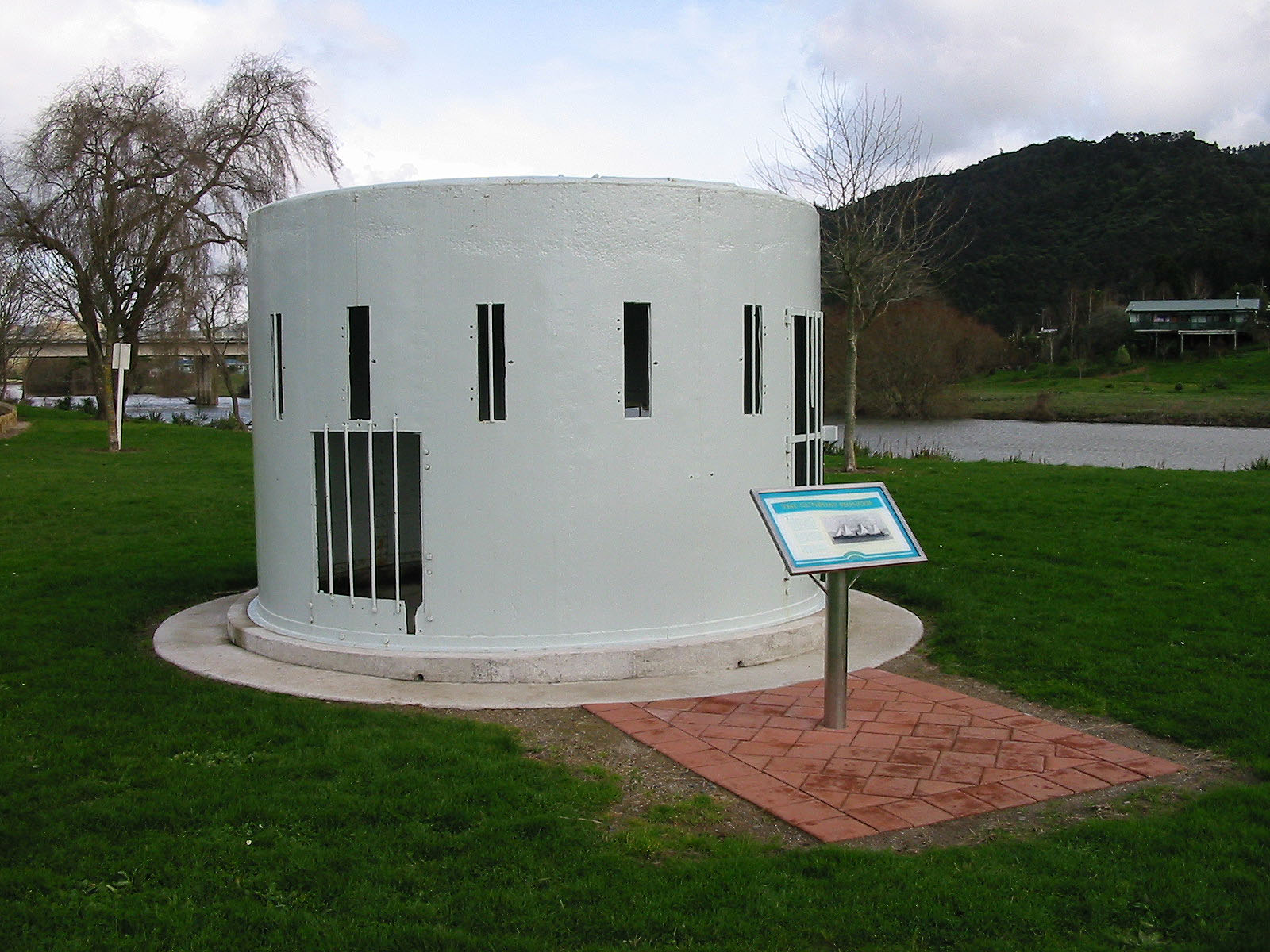
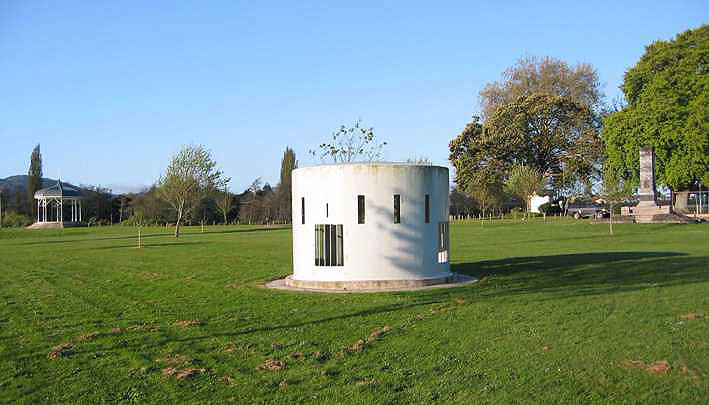
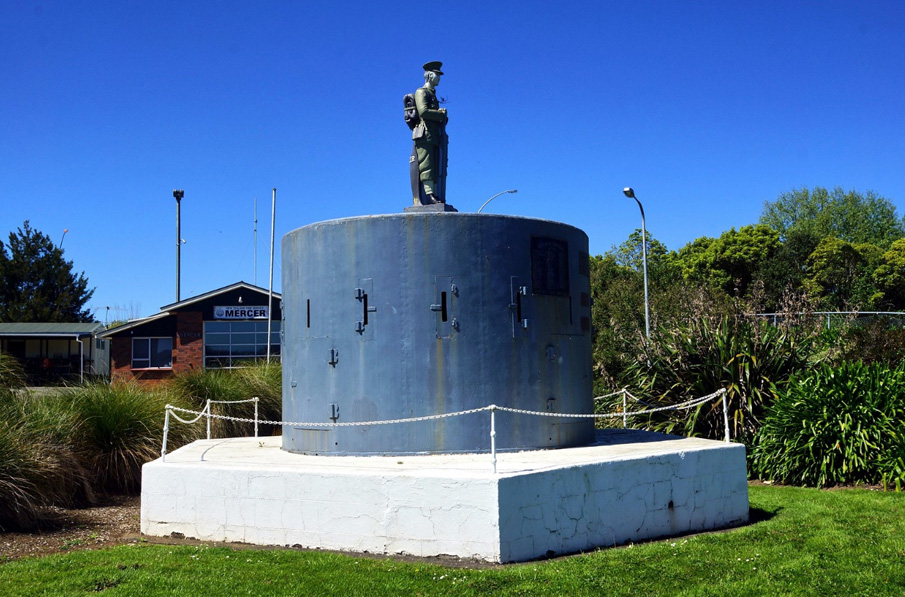
Following its removal from the Pioneer, the turret at Mercer became a lock-up and later a First World War Memorial, while the other was placed at The Point - then known as the Regatta Grounds - in Ngaruawahia in 1927. This turret was presented to the town by the Minister of Internal Affairs, R. F. Bollard, on behalf of the Government and was officially opened on Regatta Day. Initiated in the early 1890s, the Ngaruawahia Regatta was an important cultural and social event in the township, celebrating the settlement's links with its two rivers. The presentation occurred shortly after the Kingitanga movement had symbolically returned to its original home and headquarters, constructing a parliament building on or next to Pikirero pa in 1912-1919, and founding Turangawaewae Marae on the opposite side of the Waikato River in the early 1920s. The regatta grounds themselves had been created after 1907, when a large flood devastated the houses and commercial wharf that had previously occupied The Point. A previous memorial to war had been erected at The Point in 1922, when a cenotaph to the First World War was unveiled.
The turret was initially positioned towards the northern end of the regatta grounds, near a 1912 band rotunda. Prior to 1976, it was moved to another site nearby to cover up an earlier water supply. It has since been relocated to its current position on the western side of the grounds, which is closer to the site of Pikirero pa. Serving as a reminder of the Waikato War and its consequences - including the confiscation of nearly 500,000 hectares of Maori land by the colonial authorities - the structure has been recently provided with interpretative panels outlining its history, and forms part of the Kingitanga Heritage Trail.
List Entry Information
Status
Listed
List Entry Status
Historic Place Category 2
Access
Able to Visit
List Number
756
Date Entered
11th December 2003
Date of Effect
11th December 2003
City/District Council
Waikato District
Region
Waikato Region
Extent of List Entry
Registration includes the turret, its concrete base and footings, and the ground beneath its footprint. It includes all fixtures and finishes.
Legal description
Road reserve used as a recreation reserve, on riverbank south side of junction between Waipa and Waikato Rivers
Status
Listed
List Entry Status
Historic Place Category 2
Access
Able to Visit
List Number
756
Date Entered
11th December 2003
Date of Effect
11th December 2003
City/District Council
Waikato District
Region
Waikato Region
Extent of List Entry
Registration includes the turret, its concrete base and footings, and the ground beneath its footprint. It includes all fixtures and finishes.
Legal description
Road reserve used as a recreation reserve, on riverbank south side of junction between Waipa and Waikato Rivers
Why is this place significant?
Historic Significance
Historical Significance or Value It is historically significant for its role during the British military conquest of the Waikato in 1863-1864, and Ngaruawahia's transformation from a Kingitanga stronghold to a colonial settlement. It is particularly important as the earliest believed commission of a purpose-built warship by the New Zealand authorities, and reflects the colony's reliance on the Australian manufacturing industry in its early years.
Physical Significance
The gun turret has high technological significance as one of the earliest surviving international examples of Cowper Coles' revolving gun cupolas, and as part of the earliest purpose-built gunboat designed for New Zealand conditions.
Why is this place Category 1 / Category 2?
Detail Of Assessed Criteria
The gun turret is linked to important events in New Zealand history, including the New Zealand Wars. It has significant public education potential, forming part of the Kingitanga Heritage Trail. The turret has very high technical value for its innovative cupola design. It dates from an early period of Pakeha activity and settlement in the Waikato region. The turret is important as one of only two early gun cupolas known to survive in New Zealand, and may have international significance as a well-preserved and unusual survival of Cowper Coles' designs at an international level. The structure is part of an important cultural and historical landscape at The Point, which includes places of value to tangata whenua, archaeological sites and registered historic places such as the Band Rotunda (#4257) and the World War One and Two Memorial (#4258).
Why is this place significant?
Historic Significance
Historical Significance or Value It is historically significant for its role during the British military conquest of the Waikato in 1863-1864, and Ngaruawahia's transformation from a Kingitanga stronghold to a colonial settlement. It is particularly important as the earliest believed commission of a purpose-built warship by the New Zealand authorities, and reflects the colony's reliance on the Australian manufacturing industry in its early years.
Physical Significance
The gun turret has high technological significance as one of the earliest surviving international examples of Cowper Coles' revolving gun cupolas, and as part of the earliest purpose-built gunboat designed for New Zealand conditions.
Why is this place Category 1 / Category 2?
Detail Of Assessed Criteria
The gun turret is linked to important events in New Zealand history, including the New Zealand Wars. It has significant public education potential, forming part of the Kingitanga Heritage Trail. The turret has very high technical value for its innovative cupola design. It dates from an early period of Pakeha activity and settlement in the Waikato region. The turret is important as one of only two early gun cupolas known to survive in New Zealand, and may have international significance as a well-preserved and unusual survival of Cowper Coles' designs at an international level. The structure is part of an important cultural and historical landscape at The Point, which includes places of value to tangata whenua, archaeological sites and registered historic places such as the Band Rotunda (#4257) and the World War One and Two Memorial (#4258).
Construction Professional
Name
Cowper-Coles
Type
Designer
Biography
Cowper Coles (1819-70) Coles was commissioned in the British Navy in 1838, rising to the rank of captain. He served in the Crimean War in the 1850s, where he developed the idea of a low-lying, shallow-draught ship designed for inshore or river combat. Coles extended his ideas after the war, and in 1859 invented the notion of shielded turntable guns for large ships. His ideas were trialled in Britain in 1860, but it was the success of the Monitor in 1861 - designed by John Ericsson but incorporating a shielded gun turret - that led to the widespread popularity of Coles' designs throughout the 1860s. The Coles cupola, or turret, was subsequently used on warships around the world, including the Rolf Krake for the Danish Navy (1862-63), the Wivern and Scorpion (1862-63) initially for the American Confederate Navy, the Pioneer for the New Zealand colonial forces (1863), and the Prince Albert for the British Navy (1862-66). Turrets of a similar design were also used on land-based defences, such as those at Anvers, Belgium (1863). Coles later competed with his colleague in the British Admiralty, Edward Reed, to design the best ocean-going warship bearing revolving turrets. In 1867-1870, the H.M.S. Captain was designed and built as a test platform for Coles' turret warship design. The vessel had turrets arranged on its centerline, and an exceptionally low freeboard. Also over-rigged, the vessel was blown over in a gale and sank on its maiden voyage, killing almost all the 499 men on board, including Captain Coles. A stained glass window was erected in Westminster Abbey in 1871 to commemorate the sinking of the HMS Captain, while a brass on the floor remembers Captain Coles and his colleagues who died.
Name
Australasian Steam Navigation Company
Type
Builder
Biography
Australasian Steam Navigation Company (1851-87) The Australasian Steam Navigation Company was a large ship owning company, which was instrumental in developing early maritime trade within Australia and in the Pacific. Founded as the Hunter River Steam Navigation Company in Sydney in 1839, it initially running ships between Sydney and the Hunter River. It changed its name in 1851 and began operating in other parts of Australia. It also extended its services to the Pacific Islands and New Zealand, beginning a mail service between Melbourne and Wellington in 1858. By 1861, the ASNC had a fleet of 15 steamers. In 1887, the company changed its name again to the Australasian United Steam Navigation Company. It continued to operate a large fleet of ships until at least the Second World War (1939-1945).
Name
McArthur, Tom
Type
Engineer
Biography
No biography is currently available for this construction professional
Construction Details
Start Year
1863
Type
Original Construction
Description
Original construction of the Pioneer (March-July)
Start Year
1863
Type
Other
Description
Turret removed from the Pioneer (December)
Start Year
1927
Type
Other
Description
Turret erected at The Point
Start Year
1976
startYearCirca
Type
Relocation
Description
Relocated within the reserve
Start Year
2001
Type
Relocation
Description
Relocated to current position
Construction Materials
Iron-plate walls and roof, with a concrete base
Construction Professional
Name
Cowper-Coles
Type
Designer
Biography
Cowper Coles (1819-70) Coles was commissioned in the British Navy in 1838, rising to the rank of captain. He served in the Crimean War in the 1850s, where he developed the idea of a low-lying, shallow-draught ship designed for inshore or river combat. Coles extended his ideas after the war, and in 1859 invented the notion of shielded turntable guns for large ships. His ideas were trialled in Britain in 1860, but it was the success of the Monitor in 1861 - designed by John Ericsson but incorporating a shielded gun turret - that led to the widespread popularity of Coles' designs throughout the 1860s. The Coles cupola, or turret, was subsequently used on warships around the world, including the Rolf Krake for the Danish Navy (1862-63), the Wivern and Scorpion (1862-63) initially for the American Confederate Navy, the Pioneer for the New Zealand colonial forces (1863), and the Prince Albert for the British Navy (1862-66). Turrets of a similar design were also used on land-based defences, such as those at Anvers, Belgium (1863). Coles later competed with his colleague in the British Admiralty, Edward Reed, to design the best ocean-going warship bearing revolving turrets. In 1867-1870, the H.M.S. Captain was designed and built as a test platform for Coles' turret warship design. The vessel had turrets arranged on its centerline, and an exceptionally low freeboard. Also over-rigged, the vessel was blown over in a gale and sank on its maiden voyage, killing almost all the 499 men on board, including Captain Coles. A stained glass window was erected in Westminster Abbey in 1871 to commemorate the sinking of the HMS Captain, while a brass on the floor remembers Captain Coles and his colleagues who died.
Name
Australasian Steam Navigation Company
Type
Builder
Biography
Australasian Steam Navigation Company (1851-87) The Australasian Steam Navigation Company was a large ship owning company, which was instrumental in developing early maritime trade within Australia and in the Pacific. Founded as the Hunter River Steam Navigation Company in Sydney in 1839, it initially running ships between Sydney and the Hunter River. It changed its name in 1851 and began operating in other parts of Australia. It also extended its services to the Pacific Islands and New Zealand, beginning a mail service between Melbourne and Wellington in 1858. By 1861, the ASNC had a fleet of 15 steamers. In 1887, the company changed its name again to the Australasian United Steam Navigation Company. It continued to operate a large fleet of ships until at least the Second World War (1939-1945).
Name
McArthur, Tom
Type
Engineer
Biography
No biography is currently available for this construction professional
Construction Details
Start Year
1863
Type
Original Construction
Description
Original construction of the Pioneer (March-July)
Start Year
1863
Type
Other
Description
Turret removed from the Pioneer (December)
Start Year
1927
Type
Other
Description
Turret erected at The Point
Start Year
1976
startYearCirca
Type
Relocation
Description
Relocated within the reserve
Start Year
2001
Type
Relocation
Description
Relocated to current position
Construction Materials
Iron-plate walls and roof, with a concrete base
The Pioneer Gun Turret is located next to the Waipa River, close to its junction with the Waikato River. It is situated in the south-western part of a public reserve at The Point, Ngaruawahia, which although designated as a road reserve, is currently used as a park. The turret is located a short distance to the west of a First World War Memorial and to the south of a 1912 band rotunda. It lies a few metres to the north of Sampson Street, close to its junction with Broadway Street. The turret is circular in plan, with a slightly convex roof. It measures roughly four metres in diameter and is less than three metres high. The turret is constructed of 9mm-thick iron plates, which are riveted to a framework of narrow iron bands. The walls incorporate fifteen metal sheets and the roof ten smaller panels. The turret has a single entrance in its northern side, and three smaller apertures in its lower sides to the west, south and east. All - including the doorway - were originally firing ports for a rotating artillery gun that was accommodated within the turret. A series of fourteen narrow vertical apertures are evenly distributed around the top half of the structure, which allowed rifle fire at shoulder height. A pair of these slots located immediately above artillery ports are narrower than the rest. The artillery port in the southern part of the turret is not directly opposite the main entrance in the north, but is slightly offset to the east. Most of the artillery and rifle apertures retain evidence that they originally contained hinged flaps or shutters that could be locked from the inside. Although these elements are now missing, a sister turret from the Pioneer at Mercer holds more complete evidence that these features once existed. Most of the openings are now barred with lengths of iron or twisted steel, including the main doorway. The turret roof contains two circular holes - currently blocked with solid metal sheets - which may have accommodated a central pivot socket or vent, and a hatch. The turret currently sits on a slightly raised concrete base and has been recently painted pale grey. It may lie on the site of late nineteenth-century railway lines, which were used to transport goods to and from a jetty slightly further north along the bank of the Waipa.
The Pioneer Gun Turret is located next to the Waipa River, close to its junction with the Waikato River. It is situated in the south-western part of a public reserve at The Point, Ngaruawahia, which although designated as a road reserve, is currently used as a park. The turret is located a short distance to the west of a First World War Memorial and to the south of a 1912 band rotunda. It lies a few metres to the north of Sampson Street, close to its junction with Broadway Street. The turret is circular in plan, with a slightly convex roof. It measures roughly four metres in diameter and is less than three metres high. The turret is constructed of 9mm-thick iron plates, which are riveted to a framework of narrow iron bands. The walls incorporate fifteen metal sheets and the roof ten smaller panels. The turret has a single entrance in its northern side, and three smaller apertures in its lower sides to the west, south and east. All - including the doorway - were originally firing ports for a rotating artillery gun that was accommodated within the turret. A series of fourteen narrow vertical apertures are evenly distributed around the top half of the structure, which allowed rifle fire at shoulder height. A pair of these slots located immediately above artillery ports are narrower than the rest. The artillery port in the southern part of the turret is not directly opposite the main entrance in the north, but is slightly offset to the east. Most of the artillery and rifle apertures retain evidence that they originally contained hinged flaps or shutters that could be locked from the inside. Although these elements are now missing, a sister turret from the Pioneer at Mercer holds more complete evidence that these features once existed. Most of the openings are now barred with lengths of iron or twisted steel, including the main doorway. The turret roof contains two circular holes - currently blocked with solid metal sheets - which may have accommodated a central pivot socket or vent, and a hatch. The turret currently sits on a slightly raised concrete base and has been recently painted pale grey. It may lie on the site of late nineteenth-century railway lines, which were used to transport goods to and from a jetty slightly further north along the bank of the Waipa.
Historical and Associated Iwi / Hapū / Whānau
Completion Date
6th September 2004
Report Written By
Martin Jones
Information Sources
Auckland Waikato Historical Society Journal
Auckland Waikato Historical Society Journal
Howard, 1981
Grant Howard, The Navy in New Zealand: An Illustrated History, Wellington, 1981
Latta, 1980
A.M. Latta, Meeting of the Waters: The Story of Ngaruawahia, Ngaruawahia, 1980
More, 1976
David More, Between the River and the Hills: Waikato County 1876-1976, Auckland, 1976
Ross, 1967 (8)
J. Ross, The White Ensign in Early New Zealand, Wellington, 1967
Other Information
A fully referenced version of this report is available from the NZHPT Northern Region Office Please note that entry on the New Zealand Heritage List/Rarangi Korero identifies only the heritage values of the property concerned, and should not be construed as advice on the state of the property, or as a comment of its soundness or safety, including in regard to earthquake risk, safety in the event of fire, or insanitary conditions.
Historical and Associated Iwi / Hapū / Whānau
Completion Date
6th September 2004
Report Written By
Martin Jones
Information Sources
Auckland Waikato Historical Society Journal
Auckland Waikato Historical Society Journal
Howard, 1981
Grant Howard, The Navy in New Zealand: An Illustrated History, Wellington, 1981
Latta, 1980
A.M. Latta, Meeting of the Waters: The Story of Ngaruawahia, Ngaruawahia, 1980
More, 1976
David More, Between the River and the Hills: Waikato County 1876-1976, Auckland, 1976
Ross, 1967 (8)
J. Ross, The White Ensign in Early New Zealand, Wellington, 1967
Other Information
A fully referenced version of this report is available from the NZHPT Northern Region Office Please note that entry on the New Zealand Heritage List/Rarangi Korero identifies only the heritage values of the property concerned, and should not be construed as advice on the state of the property, or as a comment of its soundness or safety, including in regard to earthquake risk, safety in the event of fire, or insanitary conditions.
Current Usages
Uses: Commemoration
Specific Usage: Memorial - New Zealand Wars
Themes
War Memorial
New Zealand Wars
Current Usages
Uses: Commemoration
Specific Usage: Memorial - New Zealand Wars
Themes
War Memorial
New Zealand Wars
Sign up to hear more
Get the latest heritage news, features and events delivered
straight to your inbox.
