Early history of the site
The site lies near the confluence of the Waikato and Waipā rivers at Ngāruawāhia. Both waterways formed major access routes for settlement of the fertile Waikato region after initial human arrival in New Zealand. Ngāruawāhia is situated within the area occupied by Waikato-Tainui following the arrival of the Tainui waka at Kāwhia in the thirteenth century. Archaeological information suggests that occupation in the surrounding area focussed extensively on the cultivation of kūmara.
A large papakāinga to the south of Ngāruawāhia, Pukeiāhua, was occupied from perhaps the sixteenth century onwards. Pukeiāhua held an important role within the Waikato region as a place where marriage that was not otherwise formally sanctioned could occur. According to an account by Pei Te Hurinui Jones, it was where Ngaere of Waikato and Heke-i-te-rangi of Ngāti Maniapoto eloped in circa 1675, defying an agreement between their two iwi to strengthen ties through other means. Friendly relations between Waikato and Ngāti Maniapoto were reaffirmed when the eloped couple’s union was subsequently sanctioned through a large hākari or feast. Land used for this event lay between the papakāinga and the confluence of the Waikato and Waipā rivers, on which the current site is located. One account states that the land contained pits and other features in which the food was stored; another notes that the food was displayed at the confluence of the two rivers.
Pukeiāhua subsequently formed the home of many notable Waikato-Tainui rangatira. In the early nineteenth century, it was evidently affected by Ngāpuhi incursions during the so-called Musket Wars. In 1822, a taua of some 3000 warriors under Ngāpuhi leader Hongi Hika travelled up the Waikato, inflicting heavy losses on Waikato-Tainui at the battle of Mātakitaki on the Waipā – upstream from Ngāruawāhia. Later taua included a smaller incursion led by Pōmare in 1826.
The current site is reported to have been used as an urupā at an early stage in these conflicts, accommodating the burial of fallen warriors. Settlement patterns are likely to have been affected: in the 1830s, early European missionaries found the vicinity to be relatively sparsely occupied. The urupā at Ngāruawāhia appears to have remained in use, however, including after the introduction of Christianity. An eyewitness report in 1863 refers to an embanked and ditched enclosure (or enclosures) of some antiquity, containing the graves of ‘two men of some consequence’, one of these marked by a wooden cross.
Ditched and banked burial enclosures appear to have been relatively rare within Māoridom and are said to have been used at Ngāruawāhia to provide protection from pigs - animals introduced to New Zealand through European contact.
Pōtatau Te Wherowhero and Ngāruawāhia (1858-60)
One of the main Waikato-Tainui warriors during the early nineteenth century was the Ngāti Mahuta leader, Pōtatau Te Wherowhero (d.1860). Descended from the captains of the Tainui and Te Arawa waka, Te Wherowhero fought at Mātakitaki and also led campaigns against Taranaki iwi in the late 1820s and early 1830s. In addition to authority provided by his ancestry and military skills, his influence increased after protecting displaced iwi during the Musket Wars and undertaking alliances forged by marriage. In 1839, he became one of the few leaders outside Northland to sign He Whakaputanga o te Rangatiratanga o Nu Tireni / The Declaration of Independence of New Zealand (1835) – a key document affirming the relationship between northern Māori and the British Crown.
Although Te Wherowhero declined to sign Te Tiriti o Waitangi / The Treaty of Waitangi in 1840, he established friendly relations with British authorities at the time of initial colonisation. Following the establishment of a new capital at Auckland, he was considered the most influential chief in New Zealand. Approached by the colonial governor George Grey to place his mana over the capital, Te Wherowhero and other Ngāti Mahuta leaders established a ‘fencible’ settlement on the site of a seasonal kāinga at nearby Māngere in 1849. Although Waikato-Tainui peoples initially benefitted from trading with European settlers in the capital, tensions soon arose.
During the 1850s, the Kīngitanga movement emerged to counter growing European demands, particularly for land. The movement was especially strong in the Waikato, which remained under Māori control. Following numerous hui among Waikato-Tainui and allied iwi, Pōtatau Te Wherowhero was selected as kīngi, or ‘king’, a position that he eventually agreed to accept. Ngāruawāhia, important both symbolically and strategically for its location at a major confluence in the Waikato region, was selected as his capital or seat of government.
A house for Te Wherowhero was erected at the confluence by early 1858, shortly before his formal installation as Kīngitanga leader. The new capital also included a whare rūnanga or council house, a flagstaff on which the Kīngitanga flag was flown and other structures. Te Wherowhero presided over large rūnanga at the settlement, including one in May 1860 attended by some 3000 people, at which opposition to government forces in the Taranaki War was discussed.
Te Wherowhero died at Ngāruawāhia in June 1860, and was succeeded by his son, Tūkāroto Matutaera Pōtatau Te Wherowhero - later known as Tāwhiao.
Construction and initial use of Pōtatau Te Wherowhero’s tomb (1860-3)
After a large tangi, Pōtatau Te Wherowhero was laid to rest some 65 metres to the south of his residence, in the pre-existing urupā. His tomb was demarcated by a rectangular, ditched enclosure, bounding an area approximately 9.15 metres (30 feet) square. The latter contained an earth mound on which a small, timber mausoleum or papa tūpāpaka was erected.
The papa tūpāpaka consisted of a single-storey building of distinctive appearance. Said to have been erected by a pākehā artisan, it measured approximately 4.9 x 3.65 metres (16 x 12 feet). The white-painted, weatherboarded building contained two glass windows of lancet design in its main elevation and a door in one end wall. It also incorporated a surrounding verandah with trelliswork posts, scalloped canopies and distinctive, trefoil-shaped pediments. Internally, it housed Te Wherowhero’s canoe or waka as well as his coffin, which incorporated a glass window at the head.
Created to hold Te Wherowhero’s body for a period until eventual burial, the papa tūpāpaka both reflected important traditional practices and Māori engagement with new ideas. Customarily, many iwi and hapū had placed the bones of high-ranking individuals in secret locations to ensure that the living retained connections with their ancestors and consolidated their status as tangata whenua, but later reductions in inter-tribal warfare and other factors enabled some people of status to be initially commemorated by placing their bodies in elaborate papa tūpāpaka during the first cycle of grieving and before permanent interment occurred. At least some of these were surrounded by enclosures. In contrast with traditional papa tūpāpaka embellished with carvings and similar expressions of tribally-based identity, Te Wherowhero’s structure drew more extensively on western technology and design. This has been seen as proclaiming Te Wherowhero’s ‘legitimacy, mana and equal status to the British monarch’.
The tomb soon became a place for people to pay their respects. In June 1861, a large number of Kīngitanga followers visited it during a major rūnanga. Shortly before the government invasion of the Waikato in 1863, Governor George Grey also visited the site, ‘where he stood yearning over the grave of Potatau to reflect on the place’.
The wider urupā, which may have extended to the south of Eyre Street, remained in use during the Waikato War (1863-4). Following the first battle, which took place at Koheroa in July 1863, the bodies of Māori casualties were returned to Ngāruawāhia and buried ‘just without the ditch’, on one side of the tomb enclosure. The interments may have included that of Te Huirama, who had been closely involved in Te Wherowhero’s initial selection as Kīngitanga leader. The graves were evidently fenced or otherwise enclosed.
As an integral part of the Kīngitanga capital, the urupā lay behind defensive features erected around Ngāruawāhia during the conflict, including a redoubt and rifle pits to the west and north. When the defenders withdrew before Government forces arrived in December 1863, they took Te Wherowhero’s remains with them for safekeeping. They also requested the Government not to destroy their buildings and cultivations, and to respect the remains of those buried there.
After occupying Ngāruawāhia, the British authorities posted a sentry at Te Wherowhero’s tomb. Men of the 12th Regiment were subsequently reported to have kept the papa tūpāpaka in repair.
Creation and use of the Octagon (1864-94)
At the conclusion of direct military conflict in the Waikato in mid-1864, the main Kīngitanga force, including Tāwhaio, withdrew to the King Country. The following year, most land in the Waikato was formally taken by the Government through raupatu or confiscation. A European-style town was laid out at Ngāruawāhia, incorporating the tomb and at least some other parts of the urupā into its design. The latter occupied a distinctive space, The Octagon, which contained Te Wherowhero’s enclosure as its central feature.
The Octagon was designed to form a visual focus for a stretch of the Great South Road, the main north-south land route through the Waikato. It remained in use as a cemetery, accommodating the additional burial of some thirteen Government soldiers while British military forces were encamped in the immediate neighbourhood. Graves may have included those of combatants who died of wounds before the war ended.
After the soldiers left Ngāruawāhia, the Octagon was fenced, and Te Wherowhero’s mausoleum itself repaired and painted. Other land in the township was subdivided and sold to incoming European settlers.
For the next thirty years, the papa tūpāpaka was maintained by the colonial government. In 1868, the new governor Sir George Ferguson Bowen visited Ngāruawāhia, pledging the government to preserve the mausoleum as a gesture of reconciliation. When the structure was blown down by a gale in 1872, it was repaired or reconstructed by the Armed Constabulary. The following year, Bowen was received by large Māori gathering beside the tomb, where he proposed proclaiming ‘a general amnesty for past acts of rebellion and other political offences.’ He may also have offered to erect an obelisk on the site. During Bowen’s governorship, memorials on the graves of other Māori leaders such as Tamati Waka Nene (d.1871) and Patuone (d.1872) were created or initiated.
Increasingly integrated into the growing colonial township, the Octagon was beautified by the town council by 1874 through the planting of ornamental trees, possibly weeping willows. In 1877, however, railway lines forming part of the North Island Main Trunk line and a siding to a wharf on the Waipā River were constructed immediately to the south and east, partly impinging on the land. Fencing around the cemetery was soon reported as dilapidated. In 1878, the government again repaired and repainted Te Wherowhero’s tomb, and may also have placed an iron railing around the graves of the European soldiers.
In July 1881 - the same month that he first returned to the Waikato and symbolically laid down his weapons - Tāwhiao made an emotional return to his father’s mausoleum, together with some 500 supporters. Outside the tomb, he declared that Ngāruawāhia would become his turangawaewae, or place to stand – a prophecy of great importance to Kīngitanga. During an associated hui, two further burials occurred in the Octagon ‘near Potatau’s tomb’. The first was of Terekaunuku an elderly rangatira of Ngāti Naho and Ngāti Paoa, who was attending the gathering. The second was of Te Oti, from Taupo, who died while travelling with the Kīngitanga party at nearby Taupiri.
While Tāwhiao sought to create dialogue about the return of confiscated lands, settler sympathy with Māori grievances declined. Colonists called for the remains of Pākehā soldiers who had died in the Waikato War to be disinterred and placed in formal cemeteries where they could be appropriately maintained and commemorated. In August 1882, the remains of up to seventeen individuals considered to be military personnel were removed from the Octagon and reburied at nearby Havelock Hill cemetery. Although Te Wherowhero’s enclosure was reportedly left undisturbed, some Māori remains or koiwi may have been removed from the wider site. Associated headboards or headstones were relocated at the same time.
Settler reaction to their concerns led Kīngitanga to directly petition the British Crown and to take steps to create greater autonomy through the establishment of a separate parliament, or Kauhanganui. In the same year that Tāwhiao published a constitution for this council (1894), Waikato Māori also took direct action to protect the urupā and Te Wherowhero’s tomb which, being inadequately fenced, had become used both as a makeshift bandstand and children’s playground, as well as being subject to grazing by cattle and horses. A substantial post and barbed wire fence was erected around the Octagon, and an access gate was also nailed shut at around the time of Tāwhiao’s death in late 1894. Contemporary Māori estimates were that between 40 and 50 individuals remained buried there.
In March 1894, Kīngitanga had met with Premier Richard Seddon at Ngāruawāhia. The leader of New Zealand’s first Liberal Government, Seddon had a complex relationship with Māori, having supported greater Crown pre-emption of land purchase in 1893 but also indicating that he wished Māori to be full members of the improved society that his Government sought to create. Responding to Seddon’s desire to resolve the Octagon dispute, the Commissioner of Crown Lands suggested either removing the remains or fencing in ‘the small mound’ which he considered ‘contains all the bones’. Evidently opting for the latter, Seddon additionally decided to erect a memorial to Te Wherowhero and others on top of the mound. This may partly have been in fulfilment of the Government’s earlier promise to build an obelisk on the site. However, it also took place in the context of other government commemoration of prominent Waikato Māori, notably Rewi Maniapoto at Kihikihi (1894) and Wiremu Te Wheoro at Rangiriri (1896). This sequence of monument-building has been seen as commemorating the Crown’s reconciliation with Tainui.
Construction of the Pōtatau Te Wherowhero monument (1895)
The Ngāruawāhia monument appears to have been commissioned in early 1895 from Auckland-based stonemason, James H. Buchanan (1846-1937). Later referred to as the ‘Father of Stonemasons in New Zealand’, Buchanan had been in the monumental masonry business since the early 1860s. He had also recently completed a commission by the Tongan Government for monuments to the memory of King George of Tonga, and was responsible for other substantial memorials such as that to wealthy Auckland benefactor, James Dilworth (1895). Buchanan’s design for Te Wherowhero’s monument consisted of an obelisk of high-quality Carrara marble, 3.35 metres (11 feet) tall, sitting on a pedestal of Timaru bluestone. Obelisks were based on ancient Egyptian solar symbols often located at the entrance to tombs, and had been utilised within European mortuary architecture from the Renaissance onwards.
The new monument was unveiled on 31 July 1895. At this time, it was described as ‘of fine design and excellent workmanship’. Erected on top of the earlier enclosure mound, it replaced Pōtatau’s timber mausoleum, which was evidently taken down at this time. Both the mound and the ditch - which may have been largely infilled - were enclosed by a new paling fence, described as measuring 60 x 70 feet (18.3 x 21.35 metres).
As well as commemorating Pōtatau Te Wherowhero, the structure was dedicated to Tāwhiao and numerous other leaders connected with Te Wherowhero. One panel at the base of the obelisk remembered Paratene Te Maioha; Harepata Te Keha, who signed Te Tiriti o Waitangi at Waikato Heads in 1840; Hori Kerei Kati Takiwaru, a close relative of Te Wherowhero who married Matire Toha of Ngāpuhi to seal peace during the Musket Wars; and Epiha Putini Te Rangiatahua. An opposing panel contained the names of Te Kēpa Tuwhatau; Haunui Te Kokoti; Te Huirama, who may have been buried nearby; and Hakaraia Tuwhatau. A rear panel commemorated Harihona; Hone Pihama Te Rei Hanataua, who was a powerful Taranaki ally, with whom Te Wherowhero had initially fought; Mare; and Te Warena Kahawai. Although most of those named were of Ngāti Mahuta, some had strong affiliations to other Waikato-Tainui hapū such as Ngāti Tamaoho and Ngāti Naho, or in Hone Pihama’s case Ngāti Ruanui of Taranaki.
The new monument was visible from major transport routes adjacent to the site, including the Great South Road and the North Island Main Trunk line. Almost immediately after it was unveiled, the entire Octagon was gazetted as a railway reserve. By 1912, railway encroachment had included a goods shed to the east of the monument.
Subsequent history
Under the third kīngi, Mahuta Tāwhiao Pōtatau Te Wherowhero (1854/1855?-1912), the Kīngitanga Kauhanganui continued to meet regularly to discuss Māori autonomy and related issues. In 1911, it sought permission to obtain the Octagon for the construction of a suitable meeting house or parliament building designed by Louch and Son of Auckland - a move resisted by the Ngaruawahia Town Board who put in a counter-proposal to erect a power station. After Mahuta’s death in late 1912, Kīngitanga requested permission to erect a memorial on the site, emphasising the latter’s ancestral importance and as a place that was ‘sacred to the footsteps of various governors’.
The Crown declined this request, instead proposing to subdivide the reserve and relocate the 1895 monument. However, the notable Victoria League campaigner and War Graves Inspector Edith Statham, intervened, emphasising that the site was ‘one of the historical spots in the Dominion’. The monument was cleaned and its fence painted in 1915; and the enclosure containing the memorial proposed to be set aside ‘to protect the native monument’, with the remainder of the Octagon provided as a recreation reserve to the Ngaruawahia Town Board. In 1917, Octagon land outside the monument enclosure was gazetted as part of the Ngaruawahia Domain. The enclosure remained in central government hands.
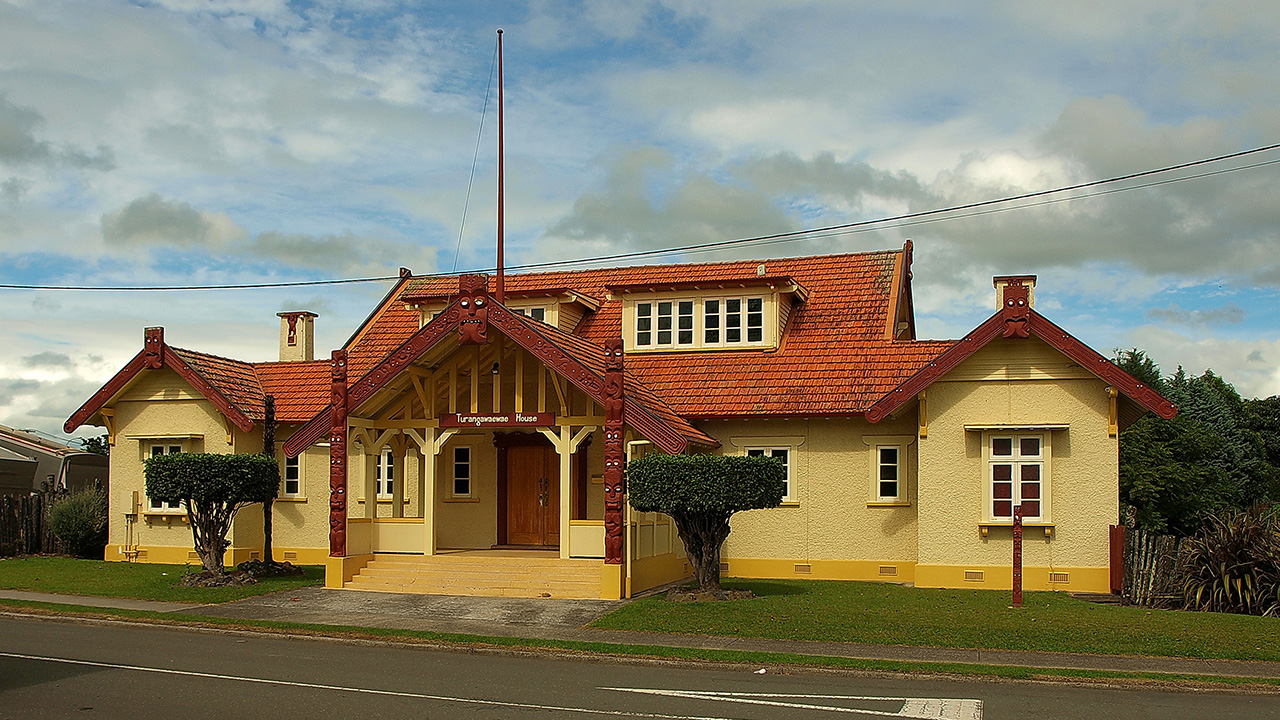
Transferral occurred at the same time that Kīngitanga erected a new parliament building (List No. 4170, Turangawaewae House / Maori Parliament Building, Category 1 historic place) on adjacent land to the south (1917-19). Of impressive appearance, this structure’s front elevation was designed to face the monument as closely as possible. It was used as a Kauhanganui before becoming a health clinic during the Second World War (1939-45), and subsequently the first headquarters of the Tainui Trust Board. In the 1920s, Kīngitanga achieved its aim of a large-scale return to Ngāruawāhia with the construction of Turangawaewae Marae nearby, on the eastern side of the Waikato River.
In 1922, the Domain Board carried out significant ‘tidying up’ and beautification of the Octagon, when the ground was ploughed and tree stumps removed. Grass lawn and seats were also planned. In 1926, the picket fence around the monument was replaced by a low stone wall, at least partly to allow greater visibility of the memorial. In 1964, the monument was restored at a cost of £300. Recreational features in the surrounding reserve included a swing and an open fireplace ‘for boiling the billie’.
Since the 1960s, the monument and reserve have remained closely associated with the activities of nearby Turangawaewae House. As well as karakia and waiata performed on the site, gatherings at the latter frequently spilled out onto the reserve. In 1995, Queen Elizabeth II acknowledged the wrongs of the earlier land confiscations with a formal apology. In 2013, Waikato-Tainui erected a sculpture representing the facial tattoos or tā moko of Te Wherowhero and Tāwhaio on the reserve, facing the monument. This was created by master carver, Inia Te Wiata junior, and unveiled by Kīngi Tuheitia.
The Octagon was subsequently renamed the Kīngitanga Reserve, reflecting the place’s ongoing importance to Kīngitanga - one of New Zealand’s longest-standing political institutions and an important force within Māoridom.