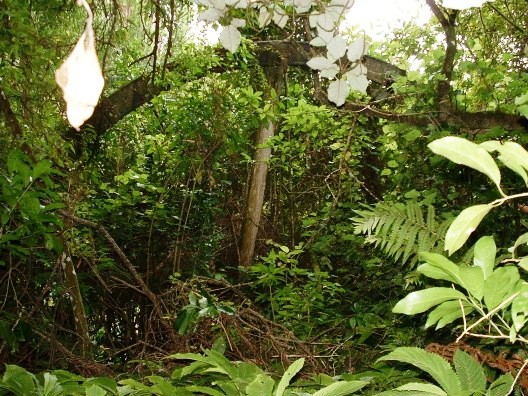
The archaeological remains of the Pipiriki Flourmill, constructed between 1854 and 1857 on the Whanganui River, represent the fluorescence of agricultural activity carried out by Maori following contact with Europeans in the 1840s.
Agricultural Developments
By the 1820s, European crops such as wheat, maize and potatoes were well established in New Zealand. Missionaries, required to be self-supporting, planted the crops to feed the communities that developed around mission stations. Maori rapidly adopted the practice for use in their own communities. By the 1850s, Maori had planted almost 90,000 acres of wheat in the Auckland province alone, and were the primary suppliers of agricultural produce for trade in the growing settlements of Auckland and Wellington. Initially, hand-operated steel mills, introduced in New Zealand in 1814, were used to grind the wheat produced into flour. However, such mills were labour intensive; an hour's grinding produced just half a kilo of flour. In 1835, Anglican missionaries of the Church Missionary Society (CMS) constructed New Zealand's first water-powered flourmill at their Maori mission station in Waimate. The mill's success led the CMS to construct others at Hokianga (1838), Wellington (1841), and Auckland (1844). During this period, an increasing rate of agricultural industry by Maori created a new demand for the more efficient water-powered mills. The first Maori-owned mill was constructed at Aotea, near Raglan harbour, in 1846, and in 1856, it was reported by Mr. Boyton, Inspector of Mills, that at least 29 Maori-owned mills in the North Island had been constructed, or were in the process of construction.
Response
Government officials and missionaries alike initially encouraged the development. The growth of agricultural independence among Maori was seen as an essential. One means of doing so was to encourage the ability of Maori to engage in Pakeha-style economic activities by providing access to technological developments such as flourmills. In 1840, for instance, CMS missionary Reverend John Morgan noted that 'I know of no plan that would so tend to check the progress of disease and rescue from destruction the native population as the erection of wind or water mills...'. CMS authorities concurred, and it became part of CMS practice to promote the construction of mills in areas where their missionaries were active.
Between 1845 and 1847, the mills took on further significance for the Government, and prompted a scheme to help fund their construction in Maori communities. In several districts of the North Island there had been violent disputes between settlers and Maori over land claims. In Wellington, Nelson, and Taranaki, there had been conflict over disputed New Zealand Company land purchases. The then Governor of New Zealand, Sir George Grey (1812-1898) believed that the possession of valuable property by Maori would make them less disposed to 'indulge' in war. He attempted to persuade Maori to 'concentrate on producing a surplus of pigs and potatoes, corn, flax and timber for the Europeans, and thus improve their own standard of living'. To this end, the government provided funding for six mills worth £1400 at Raniaowia, Otawhao and Maungatauri in 1849. Further funding was provided in later years and, on the Whanganui River, Sir George Grey's policy assisted the construction of water wheels at Jerusalem, Kawana, Koroniti, Kaiwhaike, and Pipiriki.
The Whanganui River
In 1851, the results of an official census of the Whanganui River Basin undertaken between 1849 and 1851 indicated that there were at least 3374 Maori living in the area. The area was settled by the descendants of Tamekehu and his three children Hinengakau, Tupoho, and Tama-Upoko, whose descendants settled around the river's upper reaches. Distributed among 34 kainga along 140 miles (225.3 kilometres) of riverbank, the Whanganui iwi were closely linked by marriage and the common use of river resources, which did not restrict hapu to a particular rohe. In 1839, when the first European missionary, Henry Williams (1792-1867), arrived in the area, the Whanganui iwi had a sound understanding of Christianity, indicating an awareness of European developments elsewhere in the country. Shortly after Williams' visit, the CMS posted missionaries John Mason and Richard Matthews to the Whanganui Region. Mason established himself at Putiki Waranui, a settlement attacked by Te Rauparaha (? - 1849) in 1829 and, with the support of key Maori leaders, he established a thriving mission in the region prior to his death in 1843. Later that year Mason was replaced by Richard Taylor (1805-1873). Taylor, an English born missionary, baptised 'perhaps two-thirds of the population in Wanganui', and acted as a keeper of the peace both among Maori tribes and between settler and Maori. However, Taylor also encouraged Maori towards European policies and practices. As Owens has noted, religious belief served as a form of social control and, as well as a spiritual role, missionaries like Taylor took responsibility for 'civilising' Maori. It was in this capacity, and with the aid of government funding prompted by Grey's policy, that Taylor helped to facilitate the construction of the first flourmills along the Whanganui River.
Agricultural Development on the Whanganui River
It is not known when imported crops, such as potatoes, wheat and maize, were first planted in the Whanganui River region. In 1845, Taylor instigated the construction of the first mill in the area at Putiki Wharanui, indicating that at least some cultivation of crops had occurred by this period. The construction of Taylor's mill may have then served as a catalyst for agricultural development along the river. The following year Taylor reported that 'I was much pleased to notice how generally the natives are cultivating wheat up the river, I should think there are several hundred acres of it'. The growing number of acres cultivated during this period created a demand for water-powered flourmills, and Taylor further noted that 'The general anxiety in all parts to procure mills argues well for the future improvement of the native population in this district if it please the Lord to give us peace'. In the years following the construction of the mill at Putiki until 1852, Maori were the primary instigators of mill construction along the river. Taylor records their activities to this end without involving himself greatly in the process of their erection or operation. For instance, in 1851 he wrote 'The Ketemarae natives built a mill, the second within 16 miles, for which they paid 200 pigs'. This lack of involvement was to end in 1852, with the arrival of the Catholic missionary Father Jean Lampila, in the Whanganui region.
Missionary Involvement in Mill Construction on the Whanganui River
In 1852, Taylor recorded that a lay assistant to the Roman Catholic priest was assisting Maori to build a mill at Towhera. It was to be the first of many similar observations. Tensions mounted between Taylor and Lampila, and Maori played on both missionaries to obtain the flourmills they required. The following year, Taylor became involved in a plan by Maori at Pipiriki to obtain a flourmill. His journal entries regarding this plan demonstrate the use made by Maori of the battle between the rival churches:
I held service this morning by six and afterwards attended a large meeting of all the principal chiefs relative to the erection of the mill at Pipiriki. Pehi spoke first and spoke in favour of the priests and said that they were the first to erect a mill at Otaki and this gave proof that they were the true friends of the natives, that for his part he had first leaned to the church but when Mr Kirk came he turned Wesleyan and now he felt disposed to turn over to the church of Rome and let the priest make his mills.
Taylor responded by pointing out Anglican missionaries had been responsible for New Zealand's first mill (at Waimate), and reflected on the superior nature of Anglican mills over 'trumpery' Catholic mills and berated those present for connecting mill building with religion. The outcome of the meeting was that Taylor would find a millwright for the Maori of Pipiriki.
The Pipiriki Flourmill
Following the meeting, Taylor contacted the then chief land purchase commissioner Donald McLean (1820-1877) to ask if he knew of a suitable millwright, writing 'I am very anxious to get these mills erected without delay'. On 1 December 1853 Taylor contacted a millwright named Mr. Soulby, and took him to Pipiriki to arrange for the construction of the Pipiriki Flourmill. On 3 December, Soulby's offer to construct the Mill for £320 was accepted and he was taken to examine a suitable site on the river. The site was the same site that had been viewed by Taylor in the company of Hori Patene and Haumera in 1848. Taylor had then noted of his companion that 'they are most anxious to have a water mill finding already how tedious the steel mills are'. On 5 December Soulby was given a first instalment of £100, baskets of coal for the ironwork, and an assistant from Pipiriki. When Taylor visited the site in March the following year, he found Soulby constructing the Mill and approximately 50 Maori at work on the dam. He was greeted with loud cheers.
Pipiriki Flourmill in Operation
The Pipiriki Flourmill was completed in 1857 and began processing wheat grown on the flat terraces near the Pipiriki settlement. The stream from which the Mill drew water was re-named 'Kaukore', meaning 'no swimming' as a warning that the waters were tapu because of their connection with the grinding of flour. The Mill itself was originally housed in a three-storied, pit-sawn timber structure. To the side of the Mill was the waterwheel, which was propelled by water flooding through the flume gate from the millpond. A tailrace allowed the water to flow away into the river. The turning of the wheel operated the millstones, which were located at ground level, which ground the wheat into flour. However, just a few months after its completion, the dam gave way following severe flooding in the Whanganui River, and wheat had to be processed by the newly constructed Kawana Kerei mill (Category I Historic Place, Reg # 158) until it was repaired.
Maori-owned Mills
It has been estimated that approximately 79 Maori owned flourmills were constructed during the latter half of the nineteenth-century. By the early 1860s, between 15 and 20 of these flourmills were in operation on the Whanganui River. Over the next decade, the number of Maori-owned mills in the North Island dropped dramatically. During the New Zealand Wars, mills, which had been promoted as a means of encouraging Maori economic independence, were targeted for destruction, and land formerly used to grow crops was lost after the wars through confiscation. This was exacerbated by a declining Maori population, and a drop in flour prices, which made it uneconomical to repair the ageing mills. By the late 1870s, only a handful of Maori-owned mills were still in operation. At least two of these, the Pipiriki Flourmill and the Kawana Mill, were located on the Whanganui River.
Impact of War on Pipirikir
Issues of power and government were central to the wars of the 1860s, which Pipiriki Maori were drawn into with significant consequences. In 1860, the first fighting between Maori and British forces began in Taranaki, where Whanganui Maori had strong kin links. Along with many other upper river Maori, the inhabitants of Pipiriki became involved in the King Movement - the Waikato based pan-tribal organisation that emerged in the late 1850s with the principal objective of opposing further land sales to the government. By 1860, a boundary - the 'rohe potae' - was being defined around a large territory within which followers of the King Movement claimed a right of autonomy. Though Pipiriki lay just outside this territory, James Booth, Taylor's assistant, reported in March 1863 that all Maori from Pipiriki to the head of the river had joined the King Movement. Showing a divide between upper and lower river Maori, Booth stated that: 'they are very jealous of Mr Taylor, & do not welcome him as formerly his station being in town'. In June 1863, a number of Pipiriki Maori were among a party of 50 Whanganui who supported their Taranaki relatives in fighting on the Tataraimaka block. Twenty-four Whanganui died in this conflict, including Hori Patene, the leading chief at Pipiriki.
Following from the losses at Taranaki, many Pipiriki Maori embraced the Pai Marire or Hauhau faith, which was influential within the King Movement. With a mixture of traditional and new influences, Pai Marire was founded by the south Taranaki prophet Te Ua, who had a vision in September 1862. Though Te Ua's message was of largely one of peace, this was subverted by the motivations of his converts, and in the minds of Europeans at the time the word 'Hauhau' became synonymous with fanaticism and atrocities. Te Ua's message was taken to Pipiriki early in 1864 by Pai Marire convert Matene Rangitauira, who carried the preserved head of Captain Lloyd of the 57th Regiment, who had been killed in fighting at Taranaki. The Pai Marire faith established a strong footing among upper river Maori, who sought to reclaim control over their lives and land. Ceremonial niu poles were erected in a number of settlements along the river, including Pipiriki.
On 14 May 1864, a battle was fought at Moutoa Island between a Hauhau taua that threatened to attack Wanganui township and a force of lower river Maori. The attacking party was forced to retreat, with about 50 of their number having been killed. Further clashes on the river led the government to post troops at Pipiriki. A member of this force described the location of the Pipiriki kainga, noting that the troops entered the settlement unopposed on 3 April 1865:
On the right bank of the river there lies right on the bank about 20 feet high or so on a narrow but fairly long plateau, the village of the natives which fell into our hands . . . without firing a shot.
After entering Pipiriki, the government troops occupied three positions on the right bank. About a quarter of a mile further up the river, on the left bank, forces of opposing Maori occupied a hill named Pukihinau. Desultory fighting lasted for several weeks, with the government troops becoming besieged by a large number of upriver Maori, who eventually withdrew when reinforcements and supplies were brought forward from Wanganui.
The prospect of further fighting along the river was removed when a peace meeting was held at Pipiriki in October 1866. This meeting was attended by Governor Grey and lower and upper river chiefs. It had been called by Te Pehi Pakaro, an upper river chief who, with many others, had been to the Waikato to declare their allegiance to the Crown rather than the Maori King. The meeting agreed that peace should always be maintained along the river. In response to this, the government garrison at Pipiriki was withdrawn, leaving the settlement almost completely deserted. When Taylor visited Pipiriki in November 1866, he came into contact with only three people.
Recovery and the Pipiriki Flourmill
It appears that many Pipiriki Maori did not immediately return to the settlement after peace had been established on the river. In his annual report for 1873, Resident Magistrate Woon noted that efforts were being made to re-build the flourmill at Pipiriki, 'with the view of resuscitating the Pipiriki settlement, and encouraging its scattered inhabitants to return to that locality and settle down again there in peace and prosperity.' Woon explained that, as a result of the conflict of the 1860s, many Pipiriki Maori were residing 'at Taranaki and elsewhere . . . in a state of sullenness and despair.' In his report for 1874, Woon again expressed hope that the mill would attract Pipiriki Maori to return to the settlement:
Some of the absent Natives are about returning to Pipiriki to assist in putting up this mill, and I believe it will be a means of attracting thither again the scattered remnant of a once powerful tribe on the Whanganui River. Pipiriki, a place already noted in the past, will, I trust, ere long again assume its importance as the most flourishing and advantageously situated settlement on the river.
Censuses carried out by officers of the Native Department in 1874, 1878, and 1881 indicate that the Pipiriki population - along with other Whanganui settlements - had declined markedly since the earlier counts of the 1840s and 1850s. The 1874 census recorded 118 inhabitants at Pipiriki, while the counts taken in 1878 and 1881 respectively returned population figures of 77 and 73. These censuses are thought to provide only a rough approximation of the Whanganui Maori population owing to people being absent from the district, mostly at Parihaka and Murimotu. The decline in the Whanganui Maori population between the 1840s and 1870s is attributed principally to the impact of disease, but at Pipiriki the wars of the 1860s were clearly also significant. In 1887, land purchase officer W J Butler reported that a number of Whanganui Maori had returned from Parihaka. It is likely that some of these individuals were from Pipiriki and that they resettled at their old home.
Decline of the Pipiriki Flourmill
The Pipiriki Flourmill continued to operate until 1892, when Alexander Hatrick (1857-1918), ship-owner and entrepreneur, began promoting the Whanganui River as a tourist destination. Hatrick advertised his steamboat service both in New Zealand and overseas, and extolled the scenic attractions of the 'Rhine of Maoriland'. In 1901 Hatrick purchased 'Huddle's Temperance Hotel', and developed the complex into a luxurious resort known as Pipiriki House for those using his steamer boat service. As part of this development, Hatrick converted the water wheel of the Mill into an electricity generator to power the electric lights in the hotel. The hotel was extremely successful, with over 12,000 visitors staying at the resort in 1905. The water wheel is presumed to have functioned in this capacity until Pipiriki was connected to the national grid. In 1928 the creation of the Kaukore road bridge, which was part of the Whanganui River Road upgrade, bisected the Mill and the water race leaving the building, the waterwheel, and a short length of the water race, below the road level. In 1949, 21 years later, the Pipiriki and Kawana Mill sites were inspected by the Department of Internal Affairs. The two sites were the last remaining examples on the Whanganui River and were considered by the Department for restoration, to recognise the historical importance of the milling industry. The Kawana Mill was selected as the best-preserved example and its restoration was completed in 1980. The Pipiriki Flourmill was abandoned until the 1980s, when the Department of Conservation created a walking track to the site. This track was obliterated by a major landslide in 1992 and for safety reasons access by members of the public is now strongly discouraged. The remains of the Pipiriki Flourmill now lie hidden amongst the regenerating native bush.