The history of large sheep runs such as Shag Valley dates to the early years of European settlement of Otago. Following the establishment of Dunedin in 1848 the Waste Lands Board was set up in 1853 to allocate pastoral runs in the country outside the original Otago Block. Many of these blocks were located in inland Otago, with those exploring this new country often applying for the first leases. After the leases were granted, freehold title to a homestead block, known as a pre-emptive right, was also granted. Most run holders stocked their land with sheep, although a few also ran cattle. Sheep were brought into Southland and Otago ports from 1853 onwards; others drove flocks south from Nelson, Marlborough and Canterbury although this was a difficult trek through country with many rivers and no bridges. Poisonous tutu and wild dogs also took a heavy toll on flocks with numbers much reduced by the time they reached their destinations. While the Shag Valley Station land was first obtained by a Crown Grant, the station acreage was added to with more leasehold land.
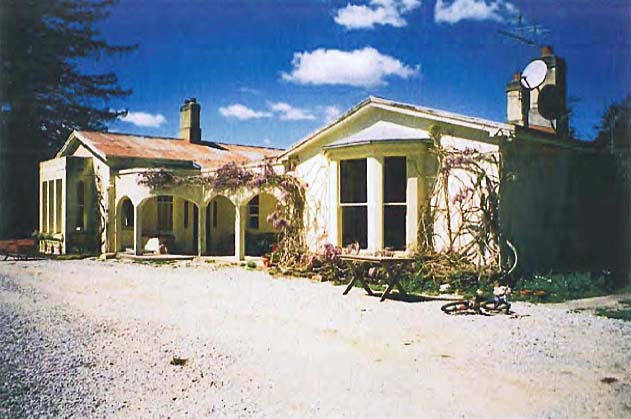
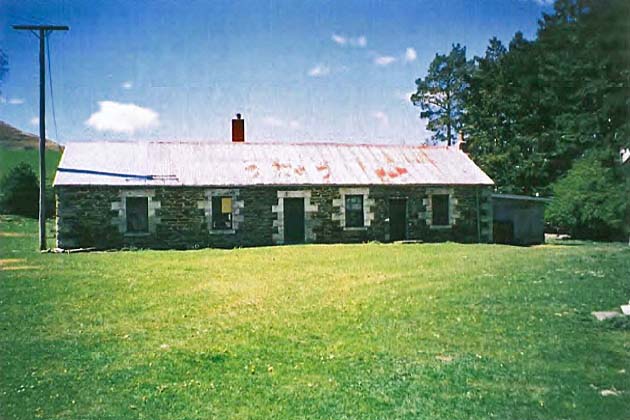
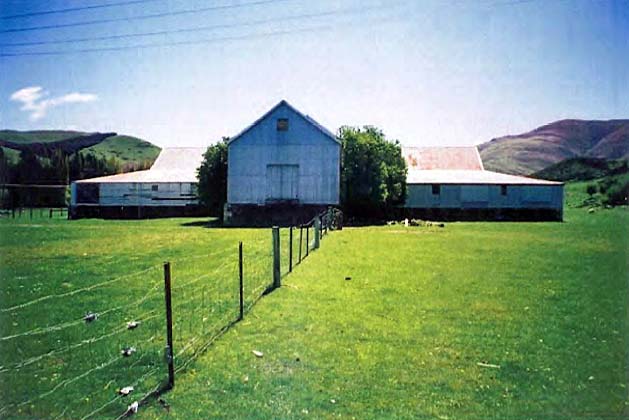
Johnny Jones, an iconic figure in the early history of Otago, took up the first pastoral leases for the runs that later made up Shag Valley Station. This land was part of that Jones purchased prior to British annexation of New Zealand in 1840; the Old Land Claims Commission granted him 11,060 acres freehold after their investigation of the extensive earlier purchases. This is confirmed by Land Information New Zealand records of the station that begin with a "pre-emptive right" plan (Run no. 255) granted to John Jones, dated 1862. This consisted of 92 acres with buildings marked: woolshed, men's house, house, sheep yards and the outline of one paddock. The woolshed and men's quarters are the original buildings, noted for this registration, and the stables evidently also date to this period. The house drawn on the plan is likely to be the earlier cottage that was replaced in 1868 with the beginnings of the still-standing homestead. Johnny Jones' sons took up other leasehold land surrounding the Shag River and its hinterland, from Waihemo to the Horse Range. According to Robert Pinney these runs were collectively known as Coal Creek at that time and were probably sublet from 1859-1863 to W.A. Low, of the Galloway run. After Low gave up his sub-lease of Coal Creek in 1863, it was purchased by Francis Dillon Bell. In the early 1860s, when he leased the Shag Valley Station, Low used this property as a staging area when droving stock inland to Galloway Station, as did William Gilbert Rees when he had 3,000 Australian-bought sheep driven to his Lake Wakatipu run.
Francis Dillon Bell, born in 1821, was raised in France and at the age of seventeen became assistant secretary in England for the New Zealand Company. In 1843 he travelled to New Zealand in the Company's service, and acted as its agent, negotiating for and/or buying land in Auckland, the Wairarapa, Nelson and New Plymouth. Bell became involved in colonial politics and was Minister in Charge of the Treasury, Customs and Native Affairs in the Domett Ministry from 1862, but on the fall of this government the following year moved to Dunedin to enter business. There, he was involved in provincial and city politics and entered national politics again in 1871. He was Speaker of the General Assembly from 1871 until 1875 and in 1877 was called to the Legislative Council. He was knighted in 1873. Bell was Agent General for New Zealand in London from 1881 to 1891. In 1896 he returned to Shag Valley, where he remained until his death in 1898. His wife, Lady Margaret Bell, died in London in 1892.
In 1851 Bell was appointed to deal with the still unsettled claims of the Old Land Claims Commission. In this role he dealt with the claimant Johnny Jones and the two became good friends. Bell's first land purchase was in the Ida Valley, Runs 261 and 306, in 1858. Bell's land purchases in the Shag Valley, making up the components of the Shag Valley Station evidently date from some time after this period. The Bell family records note that "our first guaranteed record of having bought Shag Valley" dates to 1864. According to Pinney, Bell purchased part of the land from Johnny Jones' son William in 1865; he purchased another run in Waihemo in the same year, and in 1869 the main aggregation of Shag Valley leasehold land, across the Waikouaiti River, making a total of 138,089 acres (Moore however states, giving no dates, that the total acreage at its highest point was 400,000 acres carrying 70,000 sheep ). Francis Dillon Bell's name first appears on a deposited plan dated 1871. This plan, totalling 193 acres includes the earlier "pre-emptive run 255" and shows the homestead ("house") in its current location, slightly east of the "sheep yards" in the 1862 plan.
By 1870 the name of the station was changed from Coal Creek to Shag Valley. It appears from this point on the station size was reduced as leases expired, with one increase, run 217C, added in 1889. In 1895 the total leasehold land consisted of 15,110 acres, with leases falling due in 1899; the 1895 Pastoral Tenants Relief Act combined the leases and extended them until March 1917. In 1884 the greatest number of sheep was recorded, 42,899, but after 1887 there were never over 40,000. Eighty years later, by 1975 the leasehold land was reduced to 5,100 acres with 8,300 freehold acres worked from the homestead. At this time there were 9,500 sheep and 1,000 head of cattle.
Francis Dillon Bell was a busy politician, not a farmer, although he took an interest in the station and often rode to visit it from Dunedin. Bell established the infrastructure of a great station, adding to the already-standing complex of buildings that included the stables and men's quarters and cookshop. He replaced the early cottage (which then became the manager's residence ) with the first four rooms and subsequent additions of the homestead that was known as "government house", and according to Pinney replaced Jones' earlier woolshed. It is not clear whether the shearers' quarters, standing alongside the woolshed, are those on the 1862 plan or whether they post-date this building. Several early managers ran the station until Bell's second son, Alfred Dillon Bell, left Otago Boys' High School in 1868 to work as bookkeeper and jackaroo, a kind of apprenticeship until he took over as manager. Bell's eldest son, Sir Francis Henry Dillon Bell, qualified as a lawyer and subsequently followed his father's interests into the world of politics, where he became Attorney General and was the country's first New Zealand born Prime Minister for a short term of two weeks.
The station passed into the hands of Alfred Dillon Bell after his father's death, although the certificate of title is dated January 1906, some eight years later. Alfred reduced the extensive landholdings of the station in order to decrease the large mortgages that had enabled his father to take up so much land and employed a manager to deal with the day-to-day running of the station, allowing him to follow his pursuits in science and writing. Alfred Bell was a Fellow of both the Royal Astronomical and Royal Microscopical Societies. He laid what is said to be the first telephone line in New Zealand between the homestead and his brother's house.
Alfred died in 1933, and the station has remained in the Bell family's ownership since, passing to his son Frank Dillon Bell (who was also known as Francis Wigman Dillon Bell) and daughters Gertrude Elizabeth and Margaret Brenda in 1934. Frank Bell continued his father's interests in scientific matters, making the first radio contact from New Zealand to Australia, Europe and the USA. On 18 October 1924, along with his sister Brenda Bell, he made the first trans-world communication from the Shag Valley homestead when he made radio contact with London. Prior to this there had been no two-way communication by radio by either commercial or amateur operators. A collection of scientific instruments used for radio transmission and Alfred Bell's telescope are now housed in the former cookshop and men's quarters. Frank Bell died in 1987, but title to the station passed to his son, Alfred Dillon Bell and Alfred's wife Louise four years earlier in 1983. Their son Jonathan Dillon Bell and his wife Tanya now run the Shag Valley Station.