Quick links


Quick links
Quick links
Quick links
Quick links
Quick links
81-83 Whitaker Street and Rolleston Street, TE AROHA
Public
Historic Place Category 1
List No. 762
List Entry Information
Status
Listed
List Entry Status
Historic Place Category 1
Access
Able to Visit
List Number
762
Date Entered
28th June 1990
Date of Effect
28th June 1990
City/District Council
Matamata-Piako District
Region
Waikato Region
Extent of List Entry
Extent includes the land described as Lot 2 DPS 420642 (RT 478560), South Auckland Land District, part of the land described as Legal Road, South Auckland Land District, and the building known as Grand Tavern thereon.
Legal description
Lot 2 DPS 420642 (RT 478560) and Legal Road, South Auckland Land District
Status
Listed
List Entry Status
Historic Place Category 1
Access
Able to Visit
List Number
762
Date Entered
28th June 1990
Date of Effect
28th June 1990
City/District Council
Matamata-Piako District
Region
Waikato Region
Extent of List Entry
Extent includes the land described as Lot 2 DPS 420642 (RT 478560), South Auckland Land District, part of the land described as Legal Road, South Auckland Land District, and the building known as Grand Tavern thereon.
Legal description
Lot 2 DPS 420642 (RT 478560) and Legal Road, South Auckland Land District
Why is this place significant?
Historic Significance
Historical Significance or Value The establishment of the Grand Hotel coincided with the opening of the Te Aroha goldfields. This marks the earliest phase of the town's history. The hotel prospered as the mineral spa was developed and is a visible reminder of Te Aroha's importance as one of New Zealand's early spa resorts. With the demolition of the only other major hotel from the spa era, the Hot Springs Hotel, in 1971, the Grand Tavern is the only existing hotel dating from the establishment of the resort.
Physical Significance
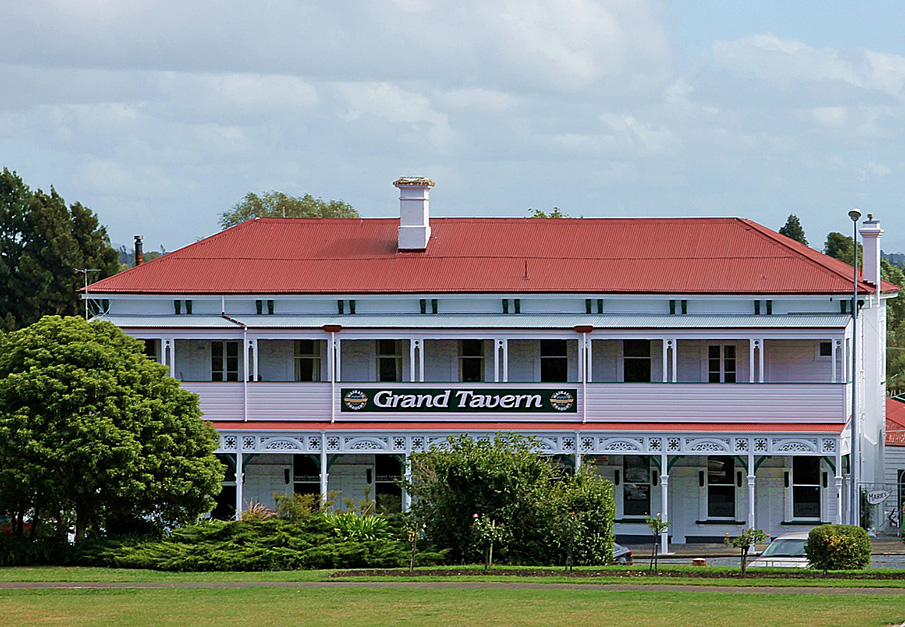
ARCHITECTURAL QUALITY: The Grand Tavern is in many ways typical of Victorian hotel design in New Zealand. Characteristics of such hotels include the sweeping verandah, hipped roof and street corner location. However, hotels such as this are becoming increasingly rare in New Zealand and the Grand Tavern is a fine example of this genre. Of particular note is the very fine and unusual surface detailing. TOWNSCAPE/LANDMARK VALUE: The Grand Tavern is a prominent building in Te Aroha. Its corner site and the similar treatment of the two street facades add to its distinction. The building is a focal point from the promenade through the Domain grounds.
Why is this place significant?
Historic Significance
Historical Significance or Value The establishment of the Grand Hotel coincided with the opening of the Te Aroha goldfields. This marks the earliest phase of the town's history. The hotel prospered as the mineral spa was developed and is a visible reminder of Te Aroha's importance as one of New Zealand's early spa resorts. With the demolition of the only other major hotel from the spa era, the Hot Springs Hotel, in 1971, the Grand Tavern is the only existing hotel dating from the establishment of the resort.
Physical Significance
ARCHITECTURAL QUALITY: The Grand Tavern is in many ways typical of Victorian hotel design in New Zealand. Characteristics of such hotels include the sweeping verandah, hipped roof and street corner location. However, hotels such as this are becoming increasingly rare in New Zealand and the Grand Tavern is a fine example of this genre. Of particular note is the very fine and unusual surface detailing. TOWNSCAPE/LANDMARK VALUE: The Grand Tavern is a prominent building in Te Aroha. Its corner site and the similar treatment of the two street facades add to its distinction. The building is a focal point from the promenade through the Domain grounds.
Construction Professional
Name
Crump, Henry
Type
Architect
Biography
Little is known of the life of Henry Crump, other than that he worked in the fields of architecture, surveying, town planning and engineering. About 1873 he was involved with mine engineering in Coromandel and by 1883 he was involved in surveying water races, batteries and furnace sites at Te Aroha. As an architect he was responsible for a villa residence at Manawaru (1882), and additions to the British (now Grand) and Hot Springs Hotels, both at Te Aroha, in 1885.
Construction Details
Start Year
1880
Finish Year
1881
Type
Original Construction
Description
Construction of British Hotel (now Grand Tavern)
Start Year
1885
Type
Addition
Description
Extensive addition on Whitaker Street
Finish Year
1902
Type
Addition
Description
Further extension
Period
pre-1902
Type
Modification
Description
Conversion of downstairs interior to bar
Construction Materials
Concrete foundations. Timber frame clad with weatherboards, rusticated on street facades except for the verandah, and lapped elsewhere. Corrugated iron roof.
Notable Features
Registration covers the building, its fixtures and finishes. It also includes recent modifications. Fine surface detailing on the street facades.
Construction Professional
Name
Crump, Henry
Type
Architect
Biography
Little is known of the life of Henry Crump, other than that he worked in the fields of architecture, surveying, town planning and engineering. About 1873 he was involved with mine engineering in Coromandel and by 1883 he was involved in surveying water races, batteries and furnace sites at Te Aroha. As an architect he was responsible for a villa residence at Manawaru (1882), and additions to the British (now Grand) and Hot Springs Hotels, both at Te Aroha, in 1885.
Construction Details
Start Year
1880
Finish Year
1881
Type
Original Construction
Description
Construction of British Hotel (now Grand Tavern)
Start Year
1885
Type
Addition
Description
Extensive addition on Whitaker Street
Finish Year
1902
Type
Addition
Description
Further extension
Period
pre-1902
Type
Modification
Description
Conversion of downstairs interior to bar
Construction Materials
Concrete foundations. Timber frame clad with weatherboards, rusticated on street facades except for the verandah, and lapped elsewhere. Corrugated iron roof.
Notable Features
Registration covers the building, its fixtures and finishes. It also includes recent modifications. Fine surface detailing on the street facades.
The goldfield town of Te Aroha grew quickly from 1880 but it was the Domain's hot mineral spa and the associated tourist activity, rather than the goldfield, which brought prosperity to the area. By 1880 the Hot Springs Hotel, the Wairoa Hotel and the Te Aroha Hotel had all been established. In December 1880 Messrs Farrell Brothers of Thames were reported to have started erecting a large hotel for Patrick Quinlan (1854-1926). Believed to be the present Grand Tavern, but known then as the British Hotel, it was opened in January 1881. This extremely short construction period suggests that the building may have been prefabricated. Brown and Campbell, liquor merchants of Auckland, purchased the hotel late in 1885 and additions were carried out to the design of Henry Crump that year. The completion of the railway line through Te Aroha in 1886 made travel to the spa easier and confirmed the town as a popular tourist and health resort. Initially Te Aroha outshone Rotorua as a social centre, although the latter went on to become New Zealand's main international spa resort. Te Aroha's popularity continued into the 1920s and it was not until 1961 with the closure of Cadman Baths and the Hot Springs Hotel that the spa in effect ended.
The goldfield town of Te Aroha grew quickly from 1880 but it was the Domain's hot mineral spa and the associated tourist activity, rather than the goldfield, which brought prosperity to the area. By 1880 the Hot Springs Hotel, the Wairoa Hotel and the Te Aroha Hotel had all been established. In December 1880 Messrs Farrell Brothers of Thames were reported to have started erecting a large hotel for Patrick Quinlan (1854-1926). Believed to be the present Grand Tavern, but known then as the British Hotel, it was opened in January 1881. This extremely short construction period suggests that the building may have been prefabricated. Brown and Campbell, liquor merchants of Auckland, purchased the hotel late in 1885 and additions were carried out to the design of Henry Crump that year. The completion of the railway line through Te Aroha in 1886 made travel to the spa easier and confirmed the town as a popular tourist and health resort. Initially Te Aroha outshone Rotorua as a social centre, although the latter went on to become New Zealand's main international spa resort. Te Aroha's popularity continued into the 1920s and it was not until 1961 with the closure of Cadman Baths and the Hot Springs Hotel that the spa in effect ended.
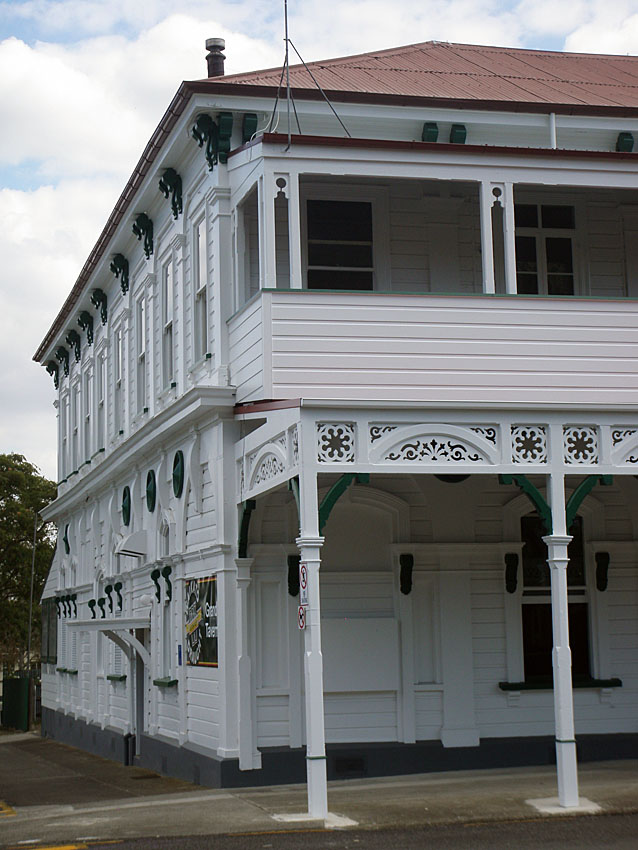
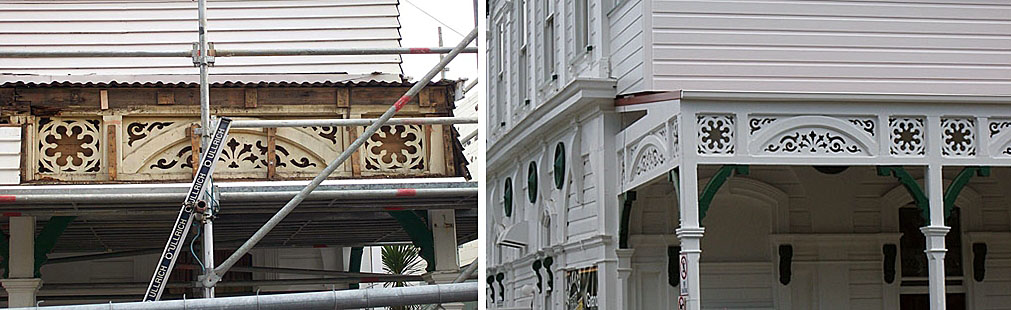
ARCHITECT/ENGINEER/DESIGNER: 1881-82 portion, Not Known 1885 additions, Henry CRUMP (n.d.) ARCHITECTURAL DESCRIPTION: This two-storeyed Victorian hotel is sited on the corner of Whitaker and Rolleston Streets. The two street facades have hipped roofs, regular fenestration and a similar decorative treatment, although the main facade is distinguished by the verandah. The ground floor has segmental headed double hung sash windows with pilasters in between. The pilasters have flared capitals. Oversize 'brackets', some of which also serve as keystones, are evenly spaced along the facade, directly beneath the cornice dividing the two floors. A string course is continuous around the two street facades at a height equal to that of the Whitaker Street door head. Underneath this moulding large scroll brackets are attached to window frames. The first floor has square headed double hung sash windows again with pilasters in between. The pilasters have simple flared capitals with decorative paired eaves brackets above. The Whitaker Street facade has a verandah at first floor level. It is somewhat unsympathetically clad in lapped boards and supported on chamfered posts with brackets. Beams are fixed to large medallions on the facade and while the Rolleston Street facade has no verandah, similar medallions can be seen on the flared pilasters and suggest that there also was a verandah on this elevation. The interior retains some of its original character, particularly in the house bar which has a panelled ceiling and walls and double hung sash windows. Part of the first floor has been converted into a manager's house. Elsewhere corridors have wooden arches with simple keystones. The guest rooms remain intact but are no longer used. MODIFICATIONS: Extended 1885 and 1902. Dates unknown: - Repiled - Cellar closed - Bottle Store added to entrance hall, stairs closed off - Cold Store added under stairs - Wall removed between sitting and dining rooms - Dining room relocated to kitchen - Whitaker Street entrance to public bar closed - Public bar enlarged by removing partitions, new bar area built - Rolleston Street wing at first floor level converted to manager's house - Guest rooms enlarged, basins added - Rolleston Street verandah removed - Whitaker Street verandah covered with lapped boards
ARCHITECT/ENGINEER/DESIGNER: 1881-82 portion, Not Known 1885 additions, Henry CRUMP (n.d.) ARCHITECTURAL DESCRIPTION: This two-storeyed Victorian hotel is sited on the corner of Whitaker and Rolleston Streets. The two street facades have hipped roofs, regular fenestration and a similar decorative treatment, although the main facade is distinguished by the verandah. The ground floor has segmental headed double hung sash windows with pilasters in between. The pilasters have flared capitals. Oversize 'brackets', some of which also serve as keystones, are evenly spaced along the facade, directly beneath the cornice dividing the two floors. A string course is continuous around the two street facades at a height equal to that of the Whitaker Street door head. Underneath this moulding large scroll brackets are attached to window frames. The first floor has square headed double hung sash windows again with pilasters in between. The pilasters have simple flared capitals with decorative paired eaves brackets above. The Whitaker Street facade has a verandah at first floor level. It is somewhat unsympathetically clad in lapped boards and supported on chamfered posts with brackets. Beams are fixed to large medallions on the facade and while the Rolleston Street facade has no verandah, similar medallions can be seen on the flared pilasters and suggest that there also was a verandah on this elevation. The interior retains some of its original character, particularly in the house bar which has a panelled ceiling and walls and double hung sash windows. Part of the first floor has been converted into a manager's house. Elsewhere corridors have wooden arches with simple keystones. The guest rooms remain intact but are no longer used. MODIFICATIONS: Extended 1885 and 1902. Dates unknown: - Repiled - Cellar closed - Bottle Store added to entrance hall, stairs closed off - Cold Store added under stairs - Wall removed between sitting and dining rooms - Dining room relocated to kitchen - Whitaker Street entrance to public bar closed - Public bar enlarged by removing partitions, new bar area built - Rolleston Street wing at first floor level converted to manager's house - Guest rooms enlarged, basins added - Rolleston Street verandah removed - Whitaker Street verandah covered with lapped boards
Historical and Associated Iwi / Hapū / Whānau
Completion Date
21st November 2001
Report Written By
Martin Jones
Information Sources
Auckland Public Libraries
Auckland Public Libraries
Cyclopedia of New Zealand, 1902
Cyclopedia Company, Industrial, descriptive, historical, biographical facts, figures, illustrations, Wellington, N.Z, 1897-1908, Vol.2, Christchurch, 1902
Wright, 1887
Alfred Wright, Te Aroha, New Zealand: A Guide for Invalids and Visitors to the Thermal Springs and Baths, Te Aroha, 1887
Kingsley-Smith, 1981
Clive Kingsley-Smith, This is Te Aroha: The Story of the Founding of Te Aroha and the Settling of the Adjacent Districts 1880-1980, Te Aroha, 1981
New Zealand Herald
New Zealand Herald, 12 July 1932, p. 6; 28 September 1933, p. 6.
New Zealand Historic Places Trust (NZHPT)
New Zealand Historic Places Trust
Rockel, 1986
Ian Rockel, Taking the Waters: Early Spas in New Zealand, Wellington, 1986
Salmond, 1986
Jeremy Salmond, Old New Zealand Houses 1800-1940, Auckland, 1986, Reed Methuen
Waikato Times
Wild, 1930
F W Wild, (Ed) Te Aroha and The Fortunate Valley, Te Aroha, 1930
Coromandel Mail
Coromandel Mail
Other Information
This historic place was registered under the Historic Places Act 1980. This report includes the text from the original Building Classification Committee report considered by the NZHPT Board at the time of registration. Please note that entry on the New Zealand Heritage List/Rarangi Korero identifies only the heritage values of the property concerned, and should not be construed as advice on the state of the property, or as a comment of its soundness or safety, including in regard to earthquake risk, safety in the event of fire, or insanitary conditions.
Historical and Associated Iwi / Hapū / Whānau
Completion Date
21st November 2001
Report Written By
Martin Jones
Information Sources
Auckland Public Libraries
Auckland Public Libraries
Cyclopedia of New Zealand, 1902
Cyclopedia Company, Industrial, descriptive, historical, biographical facts, figures, illustrations, Wellington, N.Z, 1897-1908, Vol.2, Christchurch, 1902
Wright, 1887
Alfred Wright, Te Aroha, New Zealand: A Guide for Invalids and Visitors to the Thermal Springs and Baths, Te Aroha, 1887
Kingsley-Smith, 1981
Clive Kingsley-Smith, This is Te Aroha: The Story of the Founding of Te Aroha and the Settling of the Adjacent Districts 1880-1980, Te Aroha, 1981
New Zealand Herald
New Zealand Herald, 12 July 1932, p. 6; 28 September 1933, p. 6.
New Zealand Historic Places Trust (NZHPT)
New Zealand Historic Places Trust
Rockel, 1986
Ian Rockel, Taking the Waters: Early Spas in New Zealand, Wellington, 1986
Salmond, 1986
Jeremy Salmond, Old New Zealand Houses 1800-1940, Auckland, 1986, Reed Methuen
Waikato Times
Wild, 1930
F W Wild, (Ed) Te Aroha and The Fortunate Valley, Te Aroha, 1930
Coromandel Mail
Coromandel Mail
Other Information
This historic place was registered under the Historic Places Act 1980. This report includes the text from the original Building Classification Committee report considered by the NZHPT Board at the time of registration. Please note that entry on the New Zealand Heritage List/Rarangi Korero identifies only the heritage values of the property concerned, and should not be construed as advice on the state of the property, or as a comment of its soundness or safety, including in regard to earthquake risk, safety in the event of fire, or insanitary conditions.
Current Usages
Uses: Trade
Specific Usage: Pub/bar/tavern/public hotel
Former Usages
General Usage: Accommodation
Specific Usage: Hotel
Current Usages
Uses: Trade
Specific Usage: Pub/bar/tavern/public hotel
Former Usages
General Usage: Accommodation
Specific Usage: Hotel
Location
Get the latest heritage news, features and events delivered
straight to your inbox.
