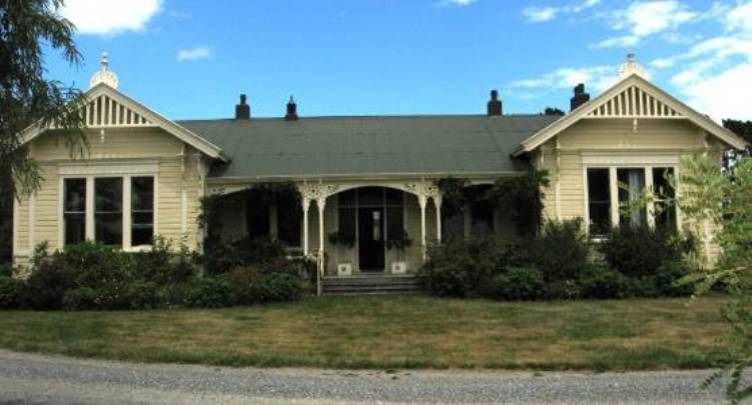
Charles Rooking Carter (1822-1896) was born in England in 1822. Initially apprenticed to the building trade, Carter read widely and developed a strong interest in the Chartist movement. He wrote extensively on labour conditions and served as secretary of the movement which resulted in a shorter working Saturday for many London shops. In 1850 he married Jane Robertson and, shortly after the marriage, the couple relocated to New Zealand. In New Zealand, Carter worked initially as a builder and architect. In 1853 he obtained a position on the committee of the Small Farms Association in the Wairarapa, which initiated the settlement of Masterton and Greytown. While serving on the committee, Carter acquired land in the Taratahi block and his work led, in 1859, to the new town of Carterton being named after him. Carter represented Wairarapa on the Provincial Council between 1857 and 1864 and in the General Assembly between 1859 and 1865. In his later years he spent prolonged periods in England and wrote valuable commentary on a number of New Zealand subjects. Carter made a number of significant donations prior to his death on 22 July 1896 and the provisions of his will enabled the establishment of the Carter Observatory in Wellington, an area of bush land known as the Carter Reserve and the Carter Home for Aged Men.
Carter's bequest to establish the Carter Home was prompted by a real social need. Aging workers found casual work difficult to obtain and those that found employment were often poorly paid. Miles Fairburn's biography of James Cox, an unskilled labourer who experienced increasing ill health, provides an in-depth study of the plight of poor and aged men during this period. Fairburn demonstrates that Cox held firmly to a Victorian ideology of self-help, viewing dependency as a kind of moral failure. As he aged, casual work became increasingly difficult to obtain and his pursuit of it required regular relocations that made the formation of long-term relationships difficult. Cox's desire for self-determination meant that, on occasion, he became a vagrant and was forced to resort to begging. According to Fairburn:
The psycho-sociological effects of poverty dulled his appetite for public gatherings and his sense of community-belonging in other ways. We cannot underestimate the extent to which over these years he was preoccupied with and distracted by the mechanical problems of economic survival.
Carter's response to the issue of the aged poor was typical for the period. In the late nineteenth and early twentieth centuries there was an expansion in the number of institutions built to provide long-term institutional care. In 1880, the Government identified twelve institutions charged with caring for orphans, the elderly and the destitute. By 1920, there were 24 institutions that cared for the elderly and destitute alone. In such homes elderly men like Cox were often domesticated for the first time. As was also typical, Carter's bequest was targeted towards the 'deserving poor'. Carter specified that:
all applicants for admission to the Home must be of good character and a special preference shall be given to those who have not been habitual drunkards and have not become Bankrupt.
Yet while Carter's response reflected the social attitudes of the period, Carter's bequest resulted in a Home that was atypical in a number of ways. Elderly applicants for government assistance were often in boarding situations where care was minimal and exploitation was common. For instance, in 1904 Auckland's Costley Home for the Aged Poor was found to be 'lamentably wanting in those ideals of comfort, hygiene, privacy and manners that characterised the model home'. Carter's Home, on the other hand, was to be described by Miles Fairburn as 'a sort of seventh heaven' for the elderly, itinerant males who found a home there. The origins for this difference arose from the terms of Carter's bequest. He emphasised that residents of the Home were not to be required to contribute to their upkeep: 'The purposes and object of The Home shall be the gratuitous support in the buildings of the said Home of Aged men of good character'. The Home, which was to be established on five acres of Carter's Estate, was to be funded from the proceeds from leases on the remainder of the estate lands. Carter also specified that the Home should be built to accommodate 20 residents, although he had hoped that contributions from others would enable the facility to be expanded. This contrasted with the typical Home, which tended to house hundreds of 'inmates'. Finally, Carter emphasised the importance of a building that was soundly constructed and properly maintained and managed.
In accordance with the terms of the will, a committee was established to manage the bequest. The committee was chaired by the Mayor of Carterton and included the 'resident Clergyman of the Church of England' and 'three members of the Borough Council'. To allow £300 interest to accrue, there was a four-year delay between Carter's death in 1896 and the commencement of work on the home in 1900. That year the committee commissioned architects William Crichton of Wellington (1862-1922) and Joseph E. Roe of Masterton to complete plans for the building. In March tenders for its construction were called for and in June it was announced that Crichton & Roe had completed plans:
of a handsomely designed and very solid building in wood, to the order of the Trustees of the estate. The foundations are to be of concrete, and special care has been observed in the lighting, warming and sanitary arrangements of the building, and the comforts of the old men studied in every way.
The new, single storey building was dedicated on 7 January 1901. It resembled a large villa and included two large, well-ventilated dormitories and a large dining and smoking room for the 'inmates'. A comfortable sitting room, bedrooms and office were provided for the Matron and Master of the Home.
It appears that there were between seven and 10 residents in the Home's early years, although initial purchases recorded in the account book for 1901 indicate an expectation of 10-12 residents. In accordance with Carter's will, residents were at least 65 years old and had spent at least the last five years in the Carterton district. A few early application forms from the period 1909 to 1914 survive: the applicants were: Daniel Carey (b 1840), John C. Grady (b 1838), William Brigham (b 1836), Peter Fealick, (fl 1913), John Taylor (b 1825) and James Fortune (b 1846). Carey's application form indicates that he was originally from Ireland where he was orphaned at an early age and, at the time of his application, had been living in a boarding house while supporting himself with savings from his labour. He was a Roman Catholic and illiterate but had never been bankrupt and, unlike most of his peers, he managed to contribute £100 towards the Home.
Although basic medical care was provided, the Home was not a hospital: inmates who became chronically unwell were often transferred to the Greytown Home for Incurables. The Carter Home was somewhat unusual in this regard. However, the approach made the environment more pleasant for residents. Life was not all roses however, as an incident was reported where one resident pushed another down the stairs over a dispute about how to pronounce a word! Such outbursts of violence appear rare, however, particularly compared to the public institutions of the period. Unlike other (often larger) institutions of the time, the Home did not appear have a long authoritarian list of rules, including a requirement of temperance. Incidents of drunkenness were reported to the Committee in the monthly reports, but there is no suggestion that any sort of punishment was meted.
The Home had sufficient income to employ a staff of four: the caretaker/manager and his wife, a cook and a grounds-man / handyman. Under their management, facilities at the Home were gradually developed. Fruit trees, shrubs and hedging plants were requested and planted, while the highest of the pine trees were topped. Water pipes were laid in the garden and a garden hose was bought. Bricks were set around the footpaths and six loads of metal were spread around the home. Residents were encouraged to help a little around the Home, although not to the extent seen in similar institutions of the time. In 1918, James Cox, the subject of Miles Fairburn's biography, was referred to the home by his doctor at the age of 71. Cox was disgusted to find that the grounds had been neglected and developed a routine of spending most weekday mornings working in the gardens. When the Home acquired a new lawnmower in 1922, Cox was thrilled to be trusted to use it.
Fairburn's biography of Cox provides a useful window on the home. Cox, for instance, particularly enjoyed the food: For Christmas dinner in 1918, he tucked into roast turkey with seasoning, young potatoes, greens, mince pies, apples, oranges, dates, raisins, two or three kinds of biscuits, and a bottle of ginger ale. Aside from the lack of privacy the only thing Cox particularly disliked about his life in the Home was the other residents. 'He despised them for their decrepitude, for their indolence, for the fact that they were not active like he was but dozed their days away in front of the fire in the smoking room'. This preference of many residents for remaining inside 'enveloped in a fug of tobacco smoke, or huddled around the fireplace' was also noted in other institutions of the period. Cox was particularly unsympathetic towards those showing signs of senility, apparently attributing it to a character deficiency. The residents 'were always quick to petition the trustees to rid the home of anyone 'in an irresponsible frame of mind'. Cox remained in the home until shortly before his death in 1925, and Fairburn notes the impact the Home had on Cox's life:
By bringing his poverty to an end, retirement [at the Carter Home] gave him the resources - the residential stability, the prosperity, the economic security - that allowed him to develop his friendship network to an unprecedented degree; he was tempted to go to more community events knowing that there would be a good chance of meeting friends there...Cox loved the place...his last years were the happiest...he had ever experienced in New Zealand. His adopted country, which for years had cruelly treated this decent man, suddenly decided to bestow good fortune upon him.
Fairburn puts much of the success of the Home down to the Andersons, who took over management of the Home in 1914. Joseph Anderson in particular was greatly respected by the residents, in part because of a caring approach particularly evident when his charges became sick, providing both fuss and practical assistance. When the Andersons retired in early 1925 'the inmates held a party in their honour and all but two pitched in to purchase a farewell present'. Mr and Mrs King took over the management of the Home.
In 1955 Harry and Grace Berney became the Master and Matron of the Home. During their tenure, the staffing level was reduced to two; labour was divided largely along traditional lines, with Harry looking after the vegetable garden, orchard and other gardens plus helping Grace in the house as well. In the late 1950s, the 'Mayor Ron Wakelin realised what a burden the [washing for around a dozen residents was] he arranged for all the bed linen to go to a commercial laundry', lightening Grace's duties somewhat. The residents were still not required to work, although some helped with small chores.
By this stage, however, the numbers in the Home were falling. Social expectations had changed and the dormitory layout, which provided no privacy, was less appealing. This precipitated a financial crisis. Carter's will failed to allow for female residents, who would have boosted numbers, and the male residents were not required to contribute financially. Meanwhile, inflation had eaten away at the Home's income source: the rent levels for the estate leases were set only every 21 years. In 1958, the Committee attempted to get the term of the leases reduced, but to no avail.
The financial difficulties prompted Reverend de Candole to plan a new retirement facility in Carterton that would be more 'keeping with the expectations of retirement accommodation of the day. The plan, known as 'the Carter Plan', took some time to come to fruition. In 1960, when Doug Whitcombe and his wife took over management of the Home, the Carter Society was formed to progress the Plan. The Society's executive included representatives from the Carterton Borough Council, the Wairarapa South County Council and the local churches. This was at a time when the Government:
was advancing a new policy which aimed to: "encourage the development of district nursing and domiciliary services", so that, as they informed the Society, it would be possible "for old people to continue living in their own homes as long as possible."...
In October 1960 the Government indicated its willingness to establish a 12-bedroom home for the aged in Carterton, on certain conditions. In 1961, Parliament passed the Carter Trust Act, which modified the terms of Carter's will. The Act meant that women could be admitted to the new home and that residents could be charged a small weekly boarding fee. On 12 December 1964 the new home, named 'Carter Court' by the public was opened in central Carterton. The Carter Home, which has been described as 'the forerunner of today's retirement homes', officially closed in 1964.
In 1966 William James Mason (1919-1994) and Maureen Mason (nee Innes-Smith) purchased the former Home for use as business premises and a private residence. Mason is New Zealand's most successful interior designer; he was a printer of unique textiles and wallpapers, and a creator of décor. He reached and achieved this status during his residence in the former Carter Home.
William (Bill) Mason was born in New Zealand and served in the Navy during the Second World War. After the war he trained as a painter at the Goldsmith's College School of Art in London and also enrolled in the Central School of Arts and Crafts, studying textile design under Gordon Crook. Mason returned to New Zealand in 1950 to explore Modernist ideas through his painting. Despite holding a number of exhibitions, Mason failed to achieve much acclaim as a painter and, in the early 1960s, turned increasingly towards textile art.
In 1961 Mason won both first and second prize in a wallpaper design competition; a verification of his ability as a designer of repeat patterns. This success prompted Mason and his wife to establish 'Mason Handprints'. Together they began producing hand-printed textiles for the commercial market. Textile art allowed Mason to draw on his flair with strong colour and patterns and he rapidly developed his own distinctive style of modern eclecticism. The innovative new looks Mason was able to create had widespread appeal and, by the mid-1960s, Mason and Mason's prints and textiles were in strong demand. The mix of historical and modern references meant Mason's designs, which made bold use of colour and strong repeating patterns, allowed the creation of thoroughly contemporary environments within the framework of Victorian era homes, fuelling a groundswell of interest in the renovation of such houses from the Victorian era. As Douglas Lloyd-Jenkins noted, Mason's designs 'created a spirited reinterpretation of the original structure that was more in tune with the early 1970s than any Victorian experience'.
The Masons operated the business from the former dormitory wing of the Carter Home, which was ideal housing for the 33 foot (10 metre) long printing tables. The high stud in the dormitories was not only aesthetically pleasing, but enabled freshly printed papers and fabrics to be hung from the ceilings on dryings racks. Their printing operation was run from the former bathroom wing, which was altered to suit their needs. The old dining room was transformed into a darkroom and the windows blocked out.
When the Masons purchased the house it was in generally sound condition and they made few structural changes. Yet, as Douglas Lloyd-Jenkins had noted, 'what made Mason's approach to the interior so distinctive was that at heart Mason's effects were essentially decorative rather than structural'. The Masons repainted the exterior of the Home in what they believed to be the original colours: cream with white trim. The interior walls were left as they were - primarily natural wood below the dado and white paint above. Yet the Masons added their own distinctive touches. Photographs taken by John Ashton show some of the Carter Home interiors from this period. One photo of the main hallway shows:
split bamboo lamp shades share space with heavily decorated Victorian oil lamps. Oversize couches and chairs are given a modern appearance with the addition of colourful hand-printed slipcovers. Heavy dark door surrounds [in polished wood] are contrasted with the white frames of Mason's abstract paintings.
Mason retired from design work at the age of 55, selling his highly successful business to Resene Paints in 1974. A large collection of Mason's work is now held by the Hawke's Bay Museum and in 1998 an exhibition of his work received widespread acclaim.
The Masons also sold Carter House in 1974. It was purchased by Richard and Caroline Hall. The Halls used the Home as a private residence and carried out renovations to the property. In 1979 when the Carter Estate leases were due for renewal and the Carter Society again petitioned the Public Trustee and Parliament to get the term of the lease reduced so that rental reviews could be more frequent. Richard Hall, a solicitor, represented the Estate lessees at the Private Bills Committee and the Bill reached a first reading, but not a second. In 1980 the Carter Home property was bought by company director Trevor Sim of Wellington. He owned the property for about five years, but no additional information has been uncovered about this period. Rex Sinnott, a factory manager, and Judy Sinnott bought the property in 1985, having moved down to Carterton from Te Awamutu. The Sinnots named the property 'Carter Lodge'. The Sinnotts remained for just two years and in 1987 the Home was purchased its current owners, Greg and Sue Hoskins. The Hoskins used the property as a private residence and as a base for their business, Hoskins Energy Systems Ltd. The Hoskins have made minor changes to the Home and added two outbuildings to the property. In 1998 Richard William Birch joined the Hoskins as owners of the property. Two years later, in 2000, the law regarding the intent of a will was relaxed, enabling the Public Trust to arrange for the sale of the farms forming the Carter Estate, drawing another chapter closed in the story of Carter's Estate. The original land surrounding the Home remained intact. The Carter Home, with its complex of outbuildings, and rich history remains as tangible evidence Carter's compassion and foresight.