In 1910, the number of registered newspapers in New Zealand peaked at 193, of which 67 were daily newspapers. Yet, over the next few decades, the rising cost of ever-faster machinery, wages and newsprint deterred newcomers to the industry. Faster transportation and improved roading made it easier for larger daily newspapers to encroach on the territory of local papers, undermining their circulation. The Depression put many smaller papers, which depended heavily on income from advertising and job printing, out of business. By the 1930s the number of new newspapers being created fell to 17, and 48 established newspapers ceased publication. During this period, previously competing local papers were forced to merge in order to survive. One such merger resulted in the Wairarapa Times-Age. The Wairarapa Times-Age (WTA) was established in Masterton in 1938 after a merger between the Wairarapa Daily Times (1892-1938) and the Wairarapa Age (1902-1938).
The Wairarapa Daily Times was an evening paper established by Joseph Peyton, in 1892. Peyton was the son-in-law of Richard Wakelin (1816-1881), a Chartist publisher associated with the New Zealand newspaper industry from 1852. Peyton trained under Wakelin and, in 1872, became a partner in Wakelin's Greytown newspaper, the Wairarapa Standard (1872-1942). Peyton went on to establish Masterton's first newspaper, the Wairarapa News (1874-1877?). Under Peyton's management, the Wairarapa Daily Times was "conspicuous amongst the provincial papers of New Zealand for the excellence of its production". Members of the Peyton family retained interest in the newspaper and in 1938 the Director was Douglas Moore Graham.
The Wairarapa Age (1902-1938) was a continuation of an earlier newspaper, the Wairarapa Star (1881-1902), and emphasised advertising over other reading matter. The name change coincided with a shift from evening to morning production, which was made to allow the paper to compete more effectively with the Wairarapa Daily Times. In 1910 shares in the newspaper were purchased by James Brown, the manager and editor of the Wairarapa Observer and other early Wairarapa newspapers. In 1913, Brown's son, Ebenezer James Brown, became Managing Director of the paper, holding that role until the company ceased in 1938. In 1921 the paper was purchased by Guy Hardy Scholefield (1877-1963), who floated the Wairarapa Age Co Ltd. Scholefield edited the paper and was a director until 1926 when he left to become the Parliamentary Librarian. W. A. Michael then became editor until the amalgamation with the Wairarapa Daily Times.
Despite decades of competition, in the 1930s the two companies merged. In 1925 the Wairarapa Age Company Ltd had bought an undeveloped property on the corner of Chapel and Cole Streets near the centre of Masterton. The land was acquired from the Wellington Farmers Meat & Manufacturing Company Ltd, who owned considerable amounts of land in the township. The following year it purchased a neighbouring part-section, which was also bare land. Eleven years later, in 1937, the Director of the Wairarapa Daily Times, Douglas M. Graham, and the Managing Director of the Wairarapa Age, Ebenezer James Brown, jointly commissioned the Wellington architectural firm Mitchell & Mitchell to design an office building for the production of a new Wairarapa newspaper. The firm produced the plans in April 1937 and, in June that year, applied for a building permit to begin the £10,317 project. The site for the new offices was the land purchased earlier by the Wairarapa Age Company Ltd, together with a new part-section that was jointly purchased by Graham and Brown in December 1937.
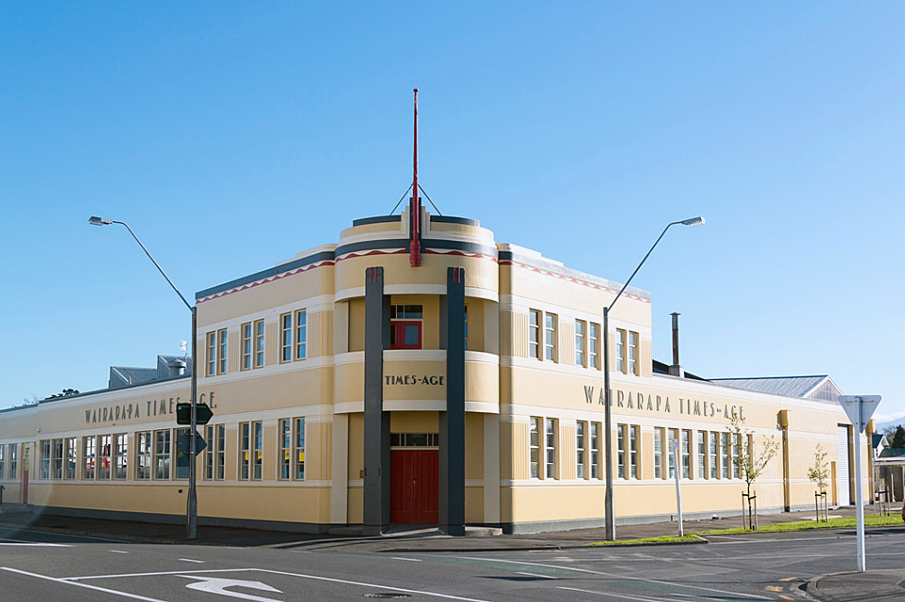
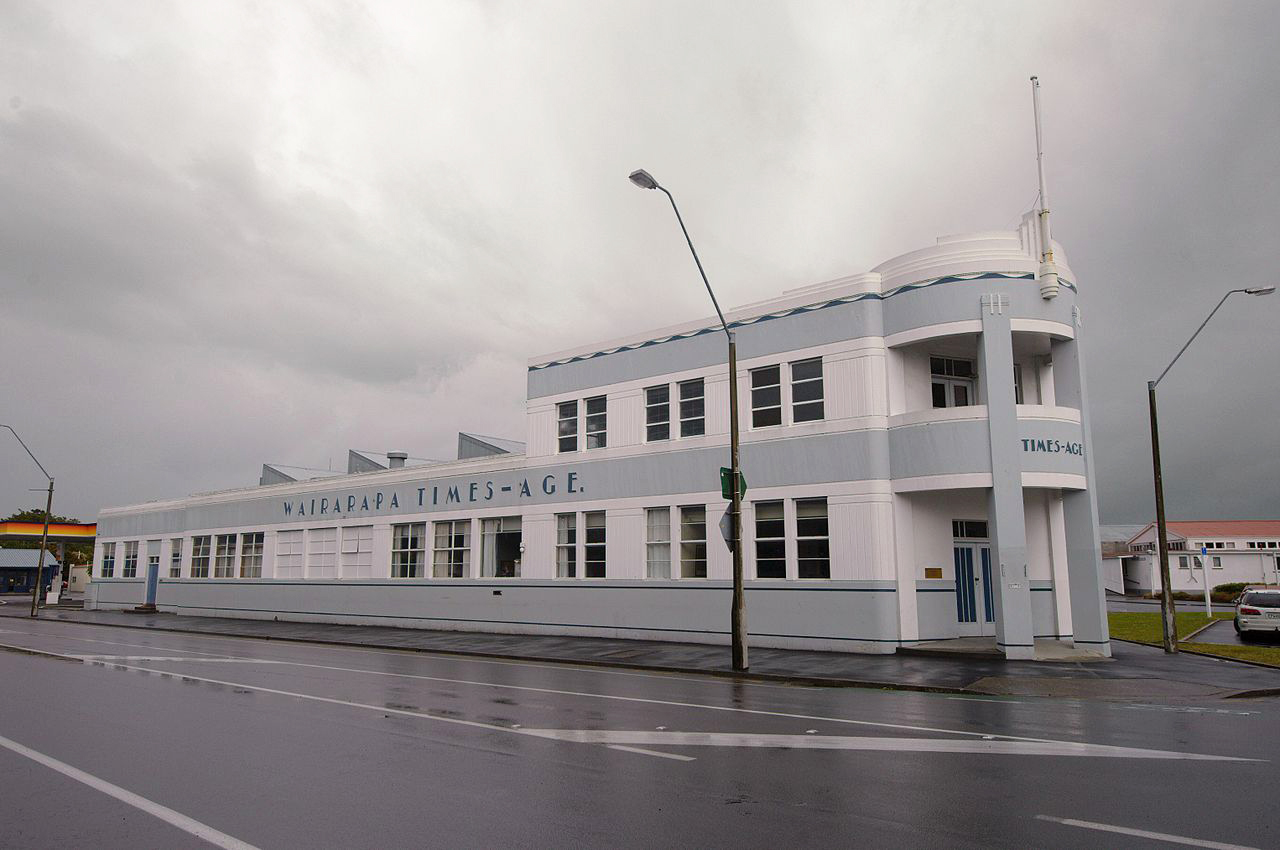
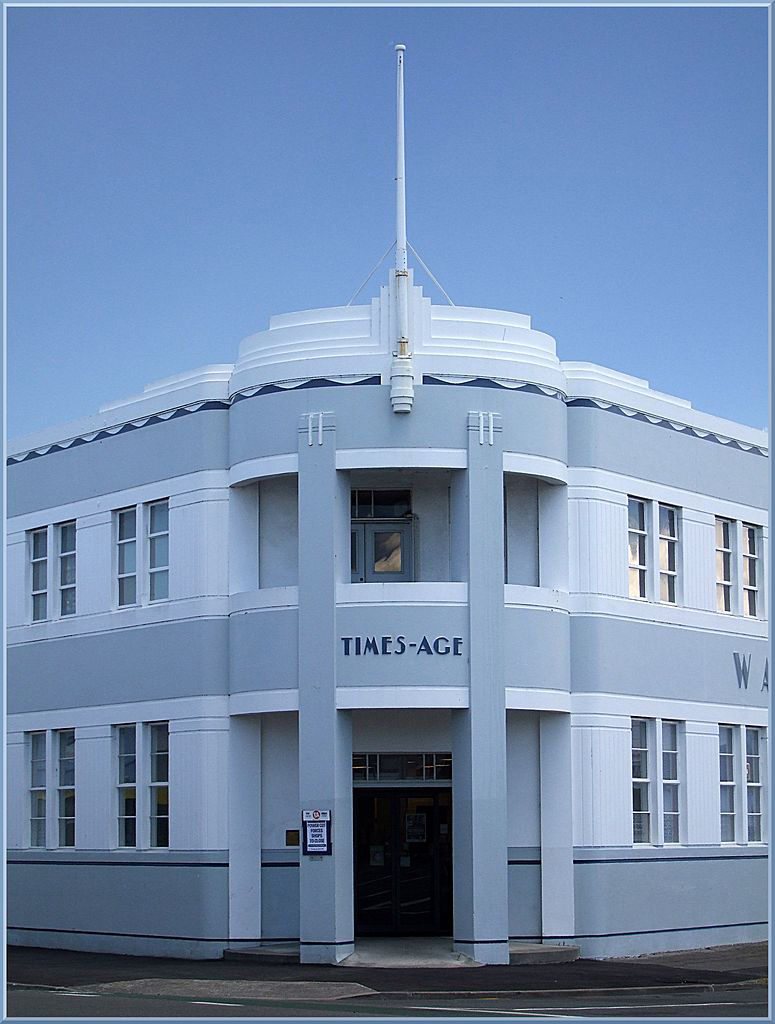
Mitchell & Mitchell's design for the new, reinforced concrete offices drew on international architectural fashions and are said to be based on the striking Art Deco Cruise Liner style Miami Herald building. Like the Miami Herald, the building was designed for a triangular site, with its curved frontage forming the main entrance. In 1938, after the new offices were completed, the Wairarapa Age and Wairarapa Daily Times officially amalgamated, transferring the three adjoining properties into ownership of the new Wairarapa Times-Age Co Ltd. Publishing of the new Wairarapa Times-Age commenced immediately from its purpose-built premises. The first edition of the evening paper was published on 1 April 1938. The new building's style contrasted sharply with the former buildings of both companies, marking out the new paper as a modern and significant arrival.
The new paper not only had a new purpose-built facility, it also boasted a brand new Cossar reel-fed flatbed press which could print about 3500 copies per hour, fed by five linotype machines. The linotype typesetting process had been in use in New Zealand since 1897. The machines used a hot metal process to produce metal slugs of a 'line-o-type', which was faster than composing using pre-cast individual letters. Both The Age and the Wairarapa Daily Times had run linotype machines prior to the merger, and it is possible that these were transferred to the new premises. Some other printers of this period had already moved on to using monotype and intertype. Initial print runs were about 3500 copies per day. The print room was also fitted with a new electric crane at the cost of £300. There was no facility for producing illustrations, so important photographs had to be sent to Palmerston North for processing, usually at short notice. Images used for advertisements were supplied by advertisers on print-ready plates.
The WTA was initially managed by Douglas Moore Graham with the assistance of Ebenezer James Brown. Other early staff included the former Wairarapa Age editor, W. A. Michael, reporter Bob Stidolph (perhaps better known as a national authority on world birds), the advertising manager Jack Baybutt and Office Manager, Mary Diggins with a staff of three. Behind the scenes was the machinist Bill McArley who was more used to using a slower flat press, and said to be somewhat scared of the new high-speed equipment. Linotypists included Frank Madsen, Gordon Lawton and Lacey King while Albert Grimes worked in the publishing department. Charlie Roys was a general hand, and travelled 60 miles a day on his motorcycle delivering newspapers. Some staff came from the two papers that had merged, while others were new appointments from as far away as Gisborne and Dunedin. By 1941 the new paper had taken on its second apprentice, Len Wickens, to learn compositions although like many staff at the time he learned a bit of everything, including helping Bill McArley run the press.
Various options were used to provide back-up power to the presses in the event of power or gas failure, but initially this did not include a back-up generator for lighting, restricting emergency printing to daylight hours. Len Wickens, who worked for the paper almost from the outset to 1975, comments:
People not involved in newspapers find it hard to appreciate, but the pressman's life is ruled by the clock. The slightest little delay anywhere along the production line could mean that you would be late with the first edition - it had to be off the press in time to connect with Fly & Young's service car to Castlepoint, or Donovans' buses to other parts - in those days that was 12.30.
If we were lucky, we'd manage a bite of lunch before starting the second edition, as close to one o'clock as we could make it. And, although we had a few close calls, we actually never missed printing one edition of the paper. The closest I remember was one day we had a breakdown, a simple little thing as it turned out, but we had to get an engineer from the Evening Post to help us out. I remember we were three or four hours late, and had to broadcast notices over the radio - but we still got it printed!
Surplus space on the first floor over the Chapel St/Cole St corner was leased out to the dentist W Kemble Welsh. Mitchell & Mitchell were contracted to provide plans for subdividing the space and adding a sun porch. Tenders were called the same year, 1941, creating a surgery, workshop, darkroom and accommodation at the estimated cost of £1147. Framing, joinery and fittings were in rimu, including a tongue and groove heart rimu floor, installed to compensate for the gently sloping roof. The sink bench tops were kauri and the interior doors were also faced with kauri. The sliding windows installed in the sun porch were framed with heart totara. A wrought iron gate was installed part way up the stairs.
The dentist's lease required that access be given through the surgery on election nights so that election results could be progressively displayed. This job was usually done by the Masterton signwriter Sid Smith, who was kept up to date by messengers from the telegraph office. Photographs, probably from the late 1940s, also show another colourful local character involved in the election result process, Harry Byrn, on the balcony with his mobile sound system. Using a newspaper publishing house for election related displays was not confined to the WTA: the Dominion building in Wellington (1928) was designed to display large election hoardings and had a platform above the main entrance for giving public addresses, including electioneering, with optional floodlighting, and there are photographs of the Waikato Times offices displaying local election results. After 1951 the display of election results was no longer necessary due to improved mass communication through radio.
In June 1942 the Wairarapa suffered a major earthquake. Fortunately no lives were lost, but property damage was extensive. Experts from the Public Works Department visited all public and commercial buildings to give advice, and members of the Treasury spent several weeks in the area trying to ascertain the cost. After the earthquake, the local Borough Council introduced more stringent earthquake strengthening rules. Private owners could ask for financial assistance subject to means testing, but this was not available to commercial premises. Insurance often only covered replacement value, not the cost of upgrading to the new building code. The public were already involved in supporting the war effort, so few donations arrived from that quarter. Unlike the Hawke's Bay earthquake of 1931, where there was an embarrassment of architects, builders and other tradesmen, the war also meant a shortage of labour and other resources to carry out reconstruction. According to the Masterton architect Fred C Daniell in a letter of complaint to the Mayor in 1949, this resulted in many owners cutting their losses and selling un-inhabitable buildings. Thus reconstruction was still a major issue in 1949. In a report he stated:
It is well to remember that a price has always to be paid and it could well be in human lives, too, if building restoration in Masterton is delayed unduly. The per capita cost in Masterton will be much greater than the cost to Napier in monetary terms... There are in Masterton only two or three buildings that can be cited as being fully up to code standards, but there are several that survived possessing earthquake resisting qualities in good measure...
It is likely that the WTA building fitted into the latter category, as it was built out of reinforced concrete after the lessons of the Hawke's Bay quake. It took until 1944 before an application for a building permit was lodged to replace an internal brick wall in the storeroom, damaged in the earthquake - although in the context of Daniell's report, this was relatively speedy action compared to many buildings, suggesting the WTA funded its own repairs, perhaps from insurance. The replacement partition built by G. O. J. Price was finished with Pinex wallboard and had an asbestos base, at a cost of £77:15:0. Surprisingly there is no record of the chimney being replaced: most buildings in the Wairarapa lost their chimneys. Perhaps the reinforced concrete withstood the shaking. As with many Art Deco flat-roofed buildings, examinations of architects' files and oral accounts show ongoing issues with leaks from at least the 1950s, perhaps exacerbated by the earlier earthquake.
In August 1947 an additional neighbouring part-section was purchased by the Wairarapa Times Age Co Ltd and by 1949, staff numbers had grown to about 30, with eight staff involved in administration and advertising work, six in the editorial department, five or six in the workroom and 10 involved in the paper layout and printing operations. In addition there was a team of part-time staff involved in wrapping and distributing the papers, including newspaper boys.
By 1951 the exterior of the building was looking tired and stained, but it was not until 1953 that architect Trevor Daniell advised Stan Leitch (WTA managing director) and Mick Seller (WTA accountant) on the choice of suitable paint colours. This appears to be the first time the full exterior had been painted.
Klichograph processing was installed in the 1950s, enabling in-house production of illustrations. The electronic half-tone photo engraving process had been patented in 1950, with production beginning in Germany in 1954. This method produced better quality pictures than photo-chemical processes used previously. According to the Melbourne Museum of Printing:
The original line drawing or photograph is attached to a rotating cylinder, and a piece of plastic foil is placed near it. As the cylinder rotates, a detector measures the darkness of the image at each point and signals an engraving tool which removes tiny pieces of material from the foil: a lighter image is produced by the tool cutting deeper.
These machines were popular in Australia in the 1960's and enabled smaller and more isolated newspapers to produce their own engravings rather than depend on a (possibly far distant) photoengraver.
The Cossar press was recognized as being too slow to cope with increasing demand during the 1950s, so a new press, a Crabtree rotary was planned for. Masterton architect, Trevor H Daniell (son and business partner of architect Fred C Daniell mentioned earlier) had drawn up plans for the foundations it would sit on in June 1953, and was constructed by the Masterton firm W (Wilfred) Rigg Ltd "Builders painters paperhangers".
Later in 1953 T. Daniell also appears to have been involved in some WTA building maintenance, pointing out the need to resurface the roof and repair leaks plus overseeing the repainting of the exterior. Daniell recorded in his work diary that he requested Sellar and Leich to "try a portion of the wall as the grey with a little blue and also one window in the red. Some opinion in favour of off white sashes".
The Crabtree press was installed in 1954. It was a large double-decker affair with a rotary motion from a curved plate. Such presses were invariably web fed, printing from long rolls of paper rather than pre-cut sheets and folding and sheeting off as it went. The New Zealand Herald had installed New Zealand's first high-speed rotary (also known as 'web') press in 1882, so this was not new technology, rather a reflection of the growth in the WTA's circulation.
Indeed, the press had been imported in 1948 to print Wellington's Southern Cross Newspaper; however, it was never used and was still in its original packing cases when obtained by the WTA. Joe Wills was the engineer who travelled to Masterton to set up the Crabtree press, and stayed on as head machinist until eventually leaving in 1976. With the arrival of the new press, Len Wickens was made second machinist and supervised the stereo department, "casting the curved metal plates of type that were mounted on the press." The press ran well for most of its 20 year life, although it was rarely run at more than half-speed: it was designed to produce 36,000 copies of a 16 page paper in an hour.
Daniell's work correspondence for 1957 shows that he was still involved in changes to the building and was starting to use pine in place of rimu in the interior. Outside, there was still room for a courtyard with carport, bicycle shed and a matai fence. The same year WA Michael retired and was succeeded by M R Keane. In 1958 the newspaper's layout was changed so that instead of advertisements, important news was put on the front page,"in line with modern newspaper practice."
Around late 1960 or early 1961, the dentist, Walsh, moved out of the first floor apartment, after residing there for 20 years. Afterwards, the space was used as a flat for some time before being reclaimed by the WTA to use as office space.
In early 1961 plans were drawn up by architects Sargent, Smith & Partners (via their Taupo partner, Ewen Maxwell Christie). This work included extensions to the WTA building to house the editorial staff, incorporate photographers' rooms, two darkrooms, a new floor for the library (in what was part of the paper store) and a female editor's room complete with a mirror on the back of her office door. The work included demolishing the chimney and picket fence. The building permit was approved in June the same year, with building costs expected to be in the region of £15,631. The builder Braggins was contracted for a six month period to carry out the work.
In 1962 another building permit application was lodged by the builder J W Hodgetts of Masterton to remove some temporary partitions in the storerooms on the Chapel Street side of the building and put in new partitions creating larger spaces along the same wall.
In the 1960s an international trend had begun to impact on New Zealand, with newspaper ownership becoming increasingly business oriented, with managing editors becoming fewer while the number of management executives increased. Scholefield saw parallels to the situation in Britain, where some of "the provincial press...found themselves turned into mere units in great financial deals, bought and sold like so much merchandise". Again, some newspapers were being forced out of business by rising costs and competition, while some amalgamated with former rivals, or became part of large companies with head offices off-shore. By the late 1960s the WTA had become the only remaining daily paper between Wellington and Dannevirke.
In March 1975 two new Cottrell web-offset presses were installed, designed so that the image moves from type or plate to paper via an intermediate surface (blanket). This made the WTA possibly just the third paper in NZ to change from using hot-metal type to offset printing. Again, Joe Wills was involved, overseeing the installation of the press. According to Frank Fyfe, one-time WTA journalist and press operator, this meant that the "Wairarapa's only locally owned newspaper not only joined the computer revolution, it spearheaded it by making the change in an unprecedented one-step move that made the Times-Age New Zealand's first provincial daily newspaper to be entirely composed by the new technology". According to the machinist Stephen (Steve) Hewson:
When the web-offset arrived it was like a baby compared to the Crabtree - about a third of the height and, although nearly twice as fast as we ran the Crabtree, it was only designed for a maximum speed of 15,000. Although we had a bit of trouble coming to grips with it, we soon found out that it was something of a mighty midget. It could do everything we had been doing and then some. And since we'd learned how to handle it, it really was cleaner, quicker and easier all round.
The managing director pressed the start button for the first offset edition printing, and the tradition of wetting a new press's head was observed by the popping of champagne corks.
In 1975 the staff lunchroom was relocated to the Cole Street side of the building just beyond the main reception area. The work was carried out by builder W W Henderson, and plumber R Burns.
In June 1983 another building permit application was lodged, this time for alterations to the main office, expected to cost $55,000. The builder was again Braggins, with plumbing services provided by Groombridge.
At the WTA, management bought-out a majority of the shares in 1986 to ensure local ownership, which had been considerably diminished. About the same time renovations were carried out in the office and editorial area, removing almost all of the internal brick walls to make for a more open plan layout in the belief that this would improve communication. A suspended ceiling was created using Monocoustic panels in a Donn Grid System. An additional men's toilet was added and the bathroom fittings upgraded. Pirelli tiles were laid in the entry, carpet in the office areas and Polyfloor elsewhere.
By the time the paper reached its 50th anniversary in 1988, staff numbers had climbed to 160 full and part time staff, in part due to the production of an additional weekly paper, Midweek. Each day 10,200 copies of the WTA were produced, with an additional 15,500 copies of Midweek printed on Wednesdays. The production of such free local newspapers, funded through advertising, focusing purely on local news and using an existing local printery had been trialled in Wellington around 1900, but became common in urban centres during the 1960s.
Spot colour printing was made available in the early 1990s and by the mid-1990s, Steve Hewson could be found enjoying making aluminium printing plates, relieving in the process camera-room, or helping to run the Cottrell presses.
The WTA continued to buy into new media-related technology, purchasing the internet operation "WINZ" in 1997, which then operated out of the WTA offices. Around the same time Keith Davidson set up the paper's own website, well ahead of many of their newspaper competitors. Digitisation has had a major effect on the newspaper industry, mirrored in the workings of the WTA. As with many newspapers, proof reading, a job that dated back to the days of the hand press, was disestablished in response to the development of the word-processing spell-checker, so when the editorial department was computerised in 1998 the proofing room was shut down. One of the proof readers from that time is still on the newspaper's staff, but proof reading is only one small component of his job and only some types of work, such as features, are checked. Fewer and fewer New Zealand newspapers have any proofing staff at all, expecting journalists to check their own work.
From 1 June 1999 the WINZ internet operation was renamed WISE Net (short for Wairarapa Internet Services), to avoid continued confusion with other organisations sporting the WINZ name. In December 1999 an additional sliver of land was purchased running between Cole and Chapel Streets and an addition on the Cole Street side of the building was constructed to house more colour printing units, allowing the paper to publish a greater number of full-colour pages.
The Napier Mail, a community newspaper, began publication in September 2000. The WTA was half-owner until 2002, but continued printing the weekly paper in its Masterton printery for a while. In early 2006 the Napier Mail describes itself on its website as 'locally owned and operated,' and is printed in Hastings by an APN newspaper.
Digital photography was introduced in early 2001, but for a time both negative and digital photography was used.
On the 13th of July 2002, the WTA ran the headline "Buy-out ends an independent era". The Wairarapa Times-Age Co had been sold to newspaper publishers Wilson & Horton, known particularly for their flagship paper, the New Zealand Herald in Auckland. The year before, Wilson & Horton had merged with Australian-based APN News & Media Ltd (APN). Subsequently, WISE Net changed owners and relocated to another property in Chapel Street, while the look of the paper's website changed to fit the APN style, though very few other APN newspapers were online at that time.
About three years ago the photographic darkrooms ceased to be used and the photography department ceased to use negative film. Reprints from older photographs which had been taken on negative film are digitally scanned in-house, with a local photo lab producing prints from the digital file on sub-contract.
Until very recently, running a newspaper office almost always went hand in hand with running a printery. The ability to lay the paper out digitally and send it electronically to another location (rather than the more time-consuming physical transportation of plates) and improvements in roading has made it possible to print the paper off-site overnight and still get the print copies delivered on time the next day. Thus, in December 2004, the WTA printing press room was decommissioned, and 35 staff lost their jobs. The WTA is now printed by The Print Place, the printing division of the Wanganui Chronicle, also a Wilson & Horton paper. By the following December, the WTA press and associated equipment had been bought by a Pacific Island newspaper, and divided between their Auckland and Pacific offices. The WTA head printer assisted with installation at both sites. In late 2005, part of the rear section of the building associated with printing was sold. Despite this change, the WTA building remains a publishing house, and production is still done entirely in-house; only the physical printing is done off-site.
The WTA website states that:
As well as earning advertising revenue from outside the region from National and wholesale sources, the Times-Age also prints a large number of specialist newsprint publications for markets throughout the North Island of New Zealand. More than 33% of the company's total revenue is earned from outside the Wairarapa region, which is a significant benefit to the local economy - The Times-Age is in an ideal position to offer a highly cost-competitive and efficient web printing service.
By printing, they mean publish: they produce a wide range of publications which they arrange to have printed elsewhere in the APN network, not always at Wanganui's The Print Place, sometimes at the fast high-quality presses of the Herald in Auckland, or presses in Tauranga, Hastings, etc., depending on the nature of the job. They continue to regularly produce the Golden Shears programmes, Property Press publications, etc.: digital communication has made their location largely irrelevant. For example, the WTA produces two property-press type real estate publications for Cambridge which get printed in Wanganui on an APN press. Advertisers sometimes opt to re-use their WTA designed property page in the Waikato Times - which is part of the Fairfax group of papers, APNs main competitor - and which is also involved in jobbing work which they can print on the Waikato Times own presses in Hamilton, just half an hour from Cambridge. This non-newspaper WTA work is a natural continuation of the job printing of the paper's earliest days: making sufficient income by newspaper subscriptions and newspaper advertising alone was challenging, and it did not make economic sense to own expensive printing equipment and then use it for around only one hour a day to print a newspaper. The printing equipment may have gone, but the staff expertise built up from publishing a wide range of materials has remained and is an asset to the company.
The Wairarapa Times-Age building remains a remarkable example of vibrant Art Deco architecture and a stable symbol of the newspaper produced within. In 2006, the WTA is one of just 21 New Zealand daily newspapers, being published six days a week. It is still classed as an evening paper apart from its Saturday edition, which is published in the morning. The WTA website states it "has an audited paid circulation of 8,061 copies per day. The company also publishes "Midweek", a weekly community newspaper which is delivered free to 19,200 homes throughout the Wairarapa district." The website attracts a large number of hits; most appear to be from overseas, with heaviest usage around the times of large annual events such as the Golden Shears competitions and the balloon festival.
The company policy published in the first WTA stated its goal was to "provide a complete service of news of all kinds - overseas, Dominion and district. While due attention will be paid to external affairs and events, arrangements are being made to give all parts of this extensive and important district, a publicity service which will fully satisfy its needs". Today, it publishes in both the traditional print format and on the web. It is active not only within its own district, but also within the newspaper publishing community, through its membership in the Newspaper Publishers Association (NPA), Newspaper Advertising Bureau (NAB), the New Zealand Community Newspapers Association (NZCNA), Pacific Area Newspaper Publishers Association, (PANPA) and the International Newspaper Marketing Association (INMA). It must have succeeded in its initial goals, as it is has outlasted its regional competitors and embraced, often early on, numerous technological changes from lead linotype to digital production, now presenting Wairarapa news not only to the region, but to the world.