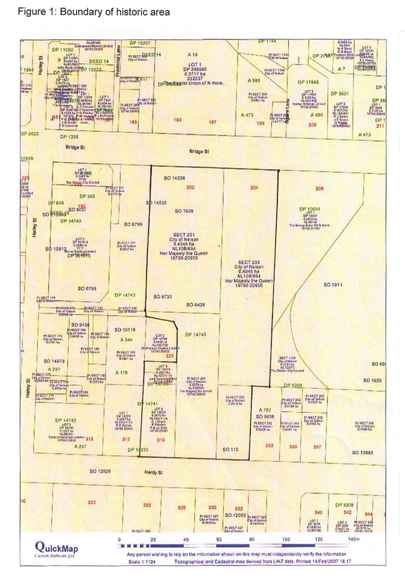
Historical records of pre-European Nelson give detailed accounts of the sequence of Maori settlement in the area and pre-European land use. It is known that Maori had a number of sites in the area of Whakatu (now Nelson city) where they lived seasonally or on a short term basis for food harvesting. The area was not permanently inhabited between the late 1820s and 1830s and was not occupied when the New Zealand Company arrived in 1841. However, it remained an important area to Tasman Bay Maori, particularly for those living at the eastern end at Whakapuaka and other nearby settlements along the shores. The Wood, the Eel Pond and the nearby river margins and swamps were significant as food resources. The Wood was some 150 acres and extended down the north bank of the Maitai. J. D. Peart, an historian who collected oral histories from local Maori, wrote that 'The Wood was dark and dense and the home of kaka and keruru'. Lowther Broad, who wrote an history of Nelson at the end of the nineteenth century, noted that the forest trees in the Wood included maitai, pukatere, tikotea, totara, white and red pine [kahikatea and rimu]; and the forest birds included pigeon [keruru], kaka, weka, pukakai and the native rat. The Eel Pond was a traditional eel fishing and food gathering area and the surrounding swamp would have been a source of weka, native ducks and pukeko. Other Maori foods which would have been in good supply in the area were kahikatea and maitai berries, flax, honey, fern shoots and fern roots, and forest birds. Flax and raupo were also used for weaving baskets and cloth, and for making cords and bindings.
In 1842, British immigrants were first brought to the Nelson area by the New Zealand Company, a private company set up to promote colonial settlement programmes. The plan was to attract settlers from all social classes; and to form, right from the start, a town with all the services and amenities, schools and administration, necessary to ensure a civilised community. By mid 1843, more than 1900 adult settlers with nearly 1400 children had arrived in Nelson.
When the first expeditionary part of the New Zealand Company arrived in Nelson Whakatu in October 1841, they found a Wood of several hundred acres, alive with birds and pigs. The main part of the town site, west of the Wood, was covered in bush, fern, flax and toitoi. From the first arrival in the spring of 1841, the New Zealand Company and settlers quickly cleared and burned off the scrub and forest to obtain land for the town sections. The Wood was cut down for building timber for the settlers' first houses and for firewood. Sketches of Nelson by the first English settlers show the Wood standing, and indicate how quickly it was levelled. John Saxton, an English settler who arrived in Nelson in 1842, made a sketch in that year of the town of Nelson from the Grampians and the Valley of the Maitai. The early tent settlement is on cleared, flat ground and the great Wood is shown as an extensive cover of tall trees along the Maitai River and up the Maitai Valley. A sketch by Francis Dillon Bell, Nelson in 1845 also shows an extensive wood with permanent buildings now starting to define the town area. By the next year, when William Fox painted Nelson 1846, a watercolour from a similar point of view to Saxton's, there was only light tree cover along the Maitai River and light scrub cover in the area of the Eel Pond. Charles Heaphy's View of Nelson shows that, by the 1850s, the entire area had been cleared, with only a small group of trees on the Hardy Street side of the Eel Pond and the occasional tree on the Tasman Street side.
As part of the establishment of Nelson, the British Government required that the New Zealand Company set aside specific reserves for Crown use; and for Maori ownership. The Eel Pond and its surrounding land were set aside for use as a meat market. The formal description at the time was 'Reserve H - Meat Market and the Serpentine: 4 acres 2 roods - Colonial Reserve', . However most newspaper, map and title references from the 1840s onwards refer to the pond as the 'Eel Pond'. Two adjacent sections, Sections 203 and 205, were set aside for Maori, indicating the importance of this area for fishing and food gathering purposes. In 1844, Section 205 was given to the Nelson School Society for the Matthew Campbell School. In 1848, the reserve status of Section 203 was also revoked. It is not known whether Maori continued eel fishing at the pond after this occurred.
Reserve H, one of the Crown Reserves set aside in 1842, was an almost rectangular block of land extending from the Eel Pond north to Bridge Street and running from Tasman Street across to what is now the east side of Albion Square. It was the only 'meat market' reserve designated for the new town. It seems the intention was for Reserve H to be a killing area or abattoir, rather than a meat sale area. The Crown's instructions were that the meat market was to be near water, which would not have been an issue if its sole use was as a place for the sale of meat, and a separate reserve, Reserve K - a 'cattle market' had been formed for sale purposes on Waimea Road beyond Toi Toi street. In 1856, the majority of Reserve H was renamed 'Reserve M' and described as 'reserved for cattle, meat, fish and other markets'. By 1874, the north east corner of Reserve M had been renamed 'Reserve D, part of Reserve H' and had been 'set apart for a Meat Market' and vested in Nelson City Council, suggesting that the meat market was still functioning in 1874.
The meat market corner appears in early photographs. There were stockyards made of timber paling fences on the corner of Tasman and Bridge Streets, and running back into the land between the two arms of the eel pond. A photograph dated between 1861 and 1880 shows the stock yards on the land between the Pond arms. Also on the Reserve during the 1870s was a house on Bridge Street, and a public pound on Tasman Street. At that time, the west arm of the pond extended almost to the centre of Bridge Street.
There is no record of when the meat market moved away from the site but, in 1879, the City Council decided that the area should be a 'recreation ground', a statutory definition which included 'public gardens, parks and domains'. The Hardy Street Baths, comprising a public bathhouse and a swimming pool, were located at the Hardy Street end of the Gardens, on land set aside as Public Utility Reserve G, part of Section 202, the area now just inside the Trask Gates. Part of the Eel Pond was enclosed to form the swimming pool. They operated between 1866-1886, after which time the land was taken by Council to be part of the Gardens.
In 1880, the City Council gave permission for the Bishop to erect a Sunday School Centenary Gathering Memorial on the Reserve. A photograph taken in the 1880s shows what is presumed to be the memorial, a tall, obelisk style structure in the centre of the grounds. The same photograph indicates that, by this time the Reserve had been substantially grassed but that the Eel Pond was covered with raupo and bulrush.
The need for a public garden had been in the mind of progressive Nelsonians since the start of the colony. While the first settlers had been largely preoccupied with establishing essential services, they had still found time to form the Nelson Horticultural Society in 1843. The New Zealand Company had set aside land in 1842 for botanical gardens, to be located along the Maitai River between Nile Street East and Hardy Street, but that land was soon reassigned for housing. The Horticultural Society repeatedly called for the development of botanic gardens and parks over many years. By the 1880s, a number of other New Zealand towns had developed public gardens. Second generation European settlers had developed a sense of civic pride in their new home towns, and a public garden was a way to demonstrate how civilised the town had become. By 1886, Nelson was ready for its own botanic garden.
At the end of 1886, the City Council decided to drain and reshape the Eel Pond and to form a public garden on the Eel Pond Reserve land. One of the councillors, Mr. Graham, hoped the work would not only 'remove an intolerable nuisance, but be the commencement of...a very beautiful garden'. The Council's goal was:
The providing of recreation grounds and gardens for the pleasure of citizens and visitors to our town, for which purpose they are of opinion no better domain exists in New Zealand than could be ours by uniting the present Eel Pond reserve with the public grounds already connected with our Provincial Buildings, and beautifying them to an almost unlimited extent.
Councillors envisioned that adjacent land uses would be absorbed into the new garden and that land between the new garden and the Provincial Buildings would be acquired for inclusion into the garden. The Public Works Committee recommended the Nelson School Society land (Section 205) be acquired for the Gardens. The Council adopted the report enthusiastically and unanimously. Councillor Trask was a strong supporter of the project, saying there was currently no proper garden in the town and:
If they could get the small strip between the Buildings and the reserve, and in time do away with the stables and pound, and possibly get the baths and the other property, they would have a fine square which would prove a beautiful garden. In every other town in New Zealand but Nelson there was a public garden and he hoped to see one here.
On 22 June 1887, as part of the town's celebrations of the 50th Jubilee of the coronation of Queen Victoria, the Mayor Charles Y. Fell, the Bishop and the townspeople gathered at the Reserve to dedicate the area as the new public gardens. Mayor Fell turned the first sod in the new gardens and named them the 'Queens Gardens', in honour of Queen Victoria.
The first steps in the formation of the Queens Gardens were to plan the layout and to tidy up the Eel Pond to make it a smooth and reflective 'ornamental piece of water'. A competition was held for the design of the garden in June 1887, for a prize of £5. Five designs of 'more or less merit' were submitted but the judging panel, which included the Public Works Committee and the Bishop, found none of them 'sufficiently good'. A second competition was then advertised, emphasising the Council's requirement that the existing water area was not to be substantially reduced. While waiting for the competition entries, the City Surveyor was given permission to proceed with plans for levelling the bottom of the Eel pond and trimming its banks. At that time, the plan was for the work to the pond to be paid for by the city funds. The Surveyor's plans were completed and the work ready to be tendered by the end of August 1887.
Around this time, the seven entries to the design competition were considered. The winning design was compiled by Mr. Antequil F. T. Somerville. Somerville's winning design retained the pond much in its existing shape, except to reclaim the ground at the north end of the west arm, which then extended halfway across the street. There were to be shrubs on the Bridge Street boundary. A pathway between the shrubs was to lead into the area between the two arms of the pond to a band rotunda and flower beds. Somerville's design included a rustic bridge 'across from the Pond from the western side' and walks and shrubberies. In the area where the foundations of a mill were, the ground had already been excavated and was to become a fernery.
In 1887, members of the public contributed funds to reshape the pond and for planting. Turning the pond into an ornamental body of water proved more difficult than envisioned. It would not hold water and for two years it collected rubbish and was a muddy eyesore. Eventually, in January 1889, the bottom and sides were sealed with tar and the pond filled. It was noted in the Colonist that, by next season, the Gardens would be a 'pleasant resort'. Also in 1889, the central area within the arms of the Eel Pond was sown as grass and 'forest trees' were planted around the margins of the pond.
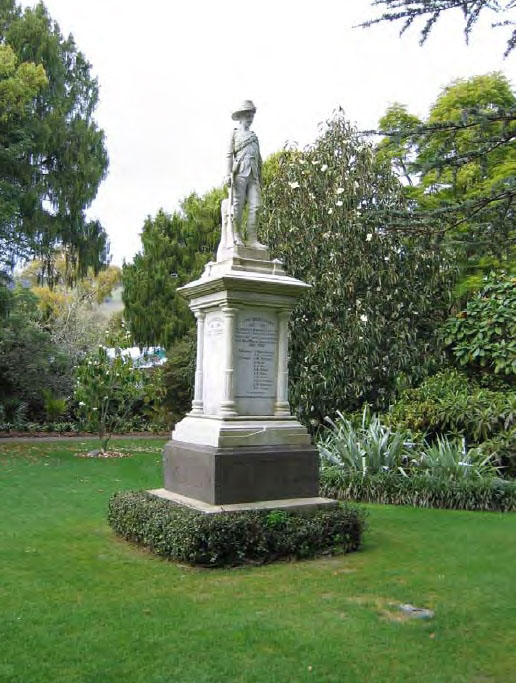
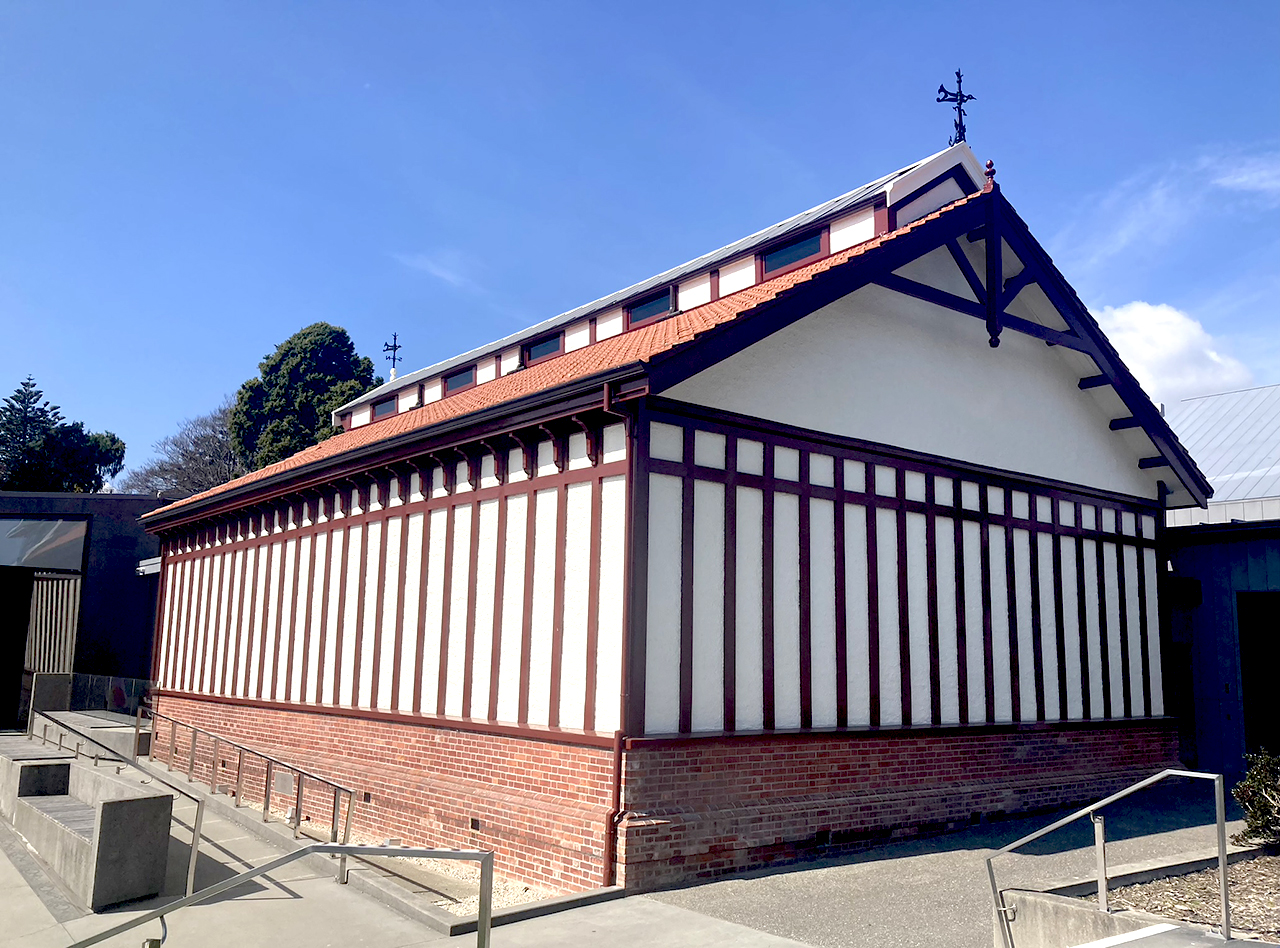
The Queens Gardens were formally opened by Mayor Trask in 1891 but continued to develop over the next few years. The Gardens were managed from the outset by a caretaker, the first being Edward Christian, who was housed in the Gardens in a building completed by the Municipal Corporation in 1891. The first of the changes occurred in Nelson's Jubilee Year, 50 years after the founding of the town in 1842. To commemorate the occasion, a number of trees were planted in the Queens Gardens on 1 February 1892, solidifying the Garden's status as a place for civic memorials. In 1893 the Gardens were further improved by the addition of seven garden seats and the planting of exotic trees, such as Mt Atlas cedar, camphor, Norfolk Island pines and weeping cypress. By the late 1890s the Gardens had been planted with New Zealand natives, including nikau palms and cabbage trees, as well as flowering shrubs such as rhododendrons, azaleas, camellias and roses. Bedding chrysanthemums featured in late summer. The Acclimatisation Society had added six white swans to the Pond and the citizens of Nelson had added a pair of black swans. Native paradise ducks and wild teal were also seen on the pond on occasion. Settlers presented a pair of pheasants, a pair of weka, a kiwi and a peacock. Blackbirds were plentiful but New Zealand native birds did not favour the Gardens. A fountain and pool (1892), donated to the Gardens by Mrs Trask and others and installed on the site intended for the band rotunda, was well stocked with goldfish. A rustic fountain had been established near the Hardy Street entrance and a bridge (1895) had been constructed along the south end of the Eel Pond, which had been well stocked with trout. The Gardens had become 'a pleasant place of resort close to the city'.
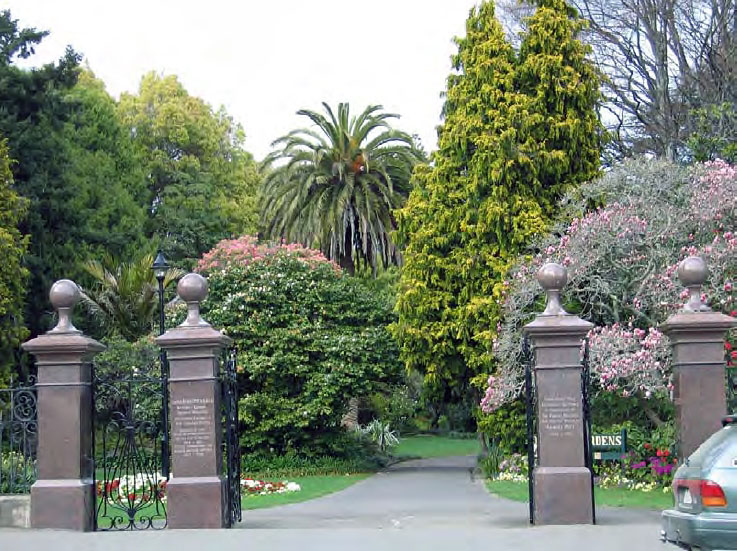
The Queens Gardens continued to develop. In 1905 a fernery was installed and in 1906 the Cyclopedia of New Zealand described the Gardens as being 'tastefully laid out' and 'a popular resort'. In 1912 the Trask Memorial Gates were erected at the Hardy Street entrance and the Pitt Memorial Gates were installed at the entrance off Bridge Street.
In 1915 the City Council was gifted a Turkish pontoon, captured at the Battle of the Suez Canal by the 12th Nelson Company. The pontoon was subsequently installed in the Gardens. Another trophy, a World War One German field gun, was installed alongside the pontoon after 1920. Photographs from the early 1920s appear to show two cannon alongside the pontoon. One of the cannons was probably the Nelson time signal cannon gifted to the Council in 1919 by Nelson resident John Graham and originally located at Britannia Heights.
In 1923 the Horticultural Society made a formal Rose Garden near the pontoon, with beds that encircled the cupid fountain and pool. In 1927 the fernery was developed with the assistance of the Horticultural Society, and the Council constructed a rustic bridge leading to it. Council minutes note ongoing work in the fernery over the next few years, including the bringing in of rocks in 1928, and the donation of ferns from a Brightwater resident in 1932. Large tree ferns already existed on the south side of the Eel Pond and so it is likely that the fernery development work was to extend and under-plant that area. Council minutes in 1927 refer to a summerhouse to be built near the fernery and the following year thanks are recorded in the minutes to the volunteers who helped with the summerhouse construction. The summerhouse was located near where the mill race from Mathew Campbell's mill entered the pond. According to local recollection, there was also a small bridge over the mill race at that point.
Around 1929, work on the construction of the first of two islands in the Eel Pond commenced. The island was located at the Bridge Street end of the eastern arm of the pond. By 1931 the Council had obtained an estimate to construct a second island but did not proceed immediately. The Depression was underway and Council funds were limited. However the Nelson Fern Society undertook replanting work in the fernery, and planted new ferns on the Gallery side of the pond and under the trees on the west end of the Bridge Street boundary. In 1935, the pontoon, field gun and possibly the cannon, were relocated to the land originally used by the Mathew Campbell School, next to the Bishop Suter Memorial Art Gallery. That same year, three hotbeds and frames were installed in the Gardens, for raising seedlings for the flowerbeds. The trophies were removed altogether over the next two decades. In 1942, the field gun was disposed of. The cannon was removed in 1943 and the pontoon was relocated to the RSA Hall in 1952. Shortly afterwards, in 1953, the Council completed work on the second island in the Eel Pond, which was constructed just west of the bridge.
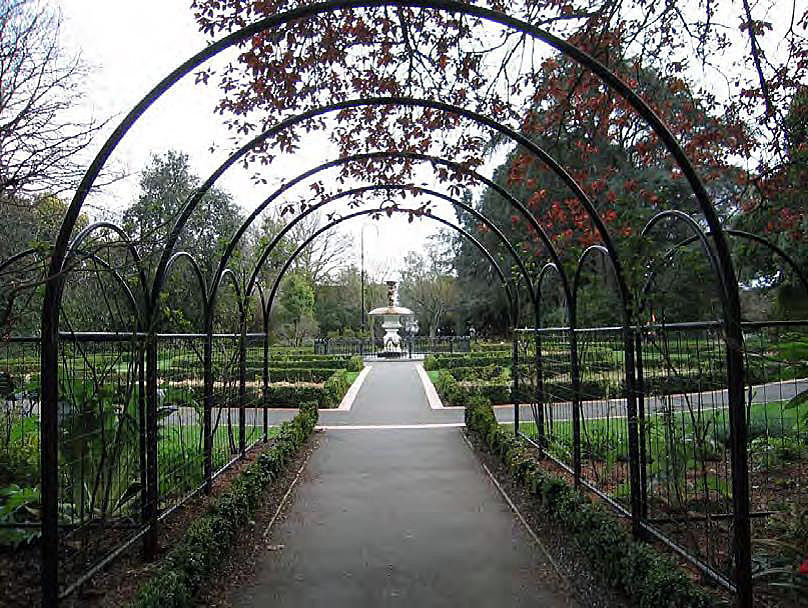
In the 1980s and 1990s, further changes were made. The bridge across the pond was found to be rotting and was replaced in 1986 with a replica of the original. The summerhouse was removed by the early 1990s and a gazebo, which stands on the south side of the pond near the Bishop Suter Memorial Art Gallery, was completed by the Nelson Rotary Club in 1993. In 1998 an iron pond sculpture 'Sentinel' by Nelson artist Dominque de Borrekens and Grant Scott, was installed in the Eel Pond. Information panels were added in 1999 and the rose gardens were replanted. A new trellis was added to the south side of the roses, a pergola was erected over the path between the roses and the bridge and terracotta tile edging was added to the paths. In 2002 feature lighting was added and in 2005 a water wheel, which symbolises 100 years of rotary, was added near the original mill race.