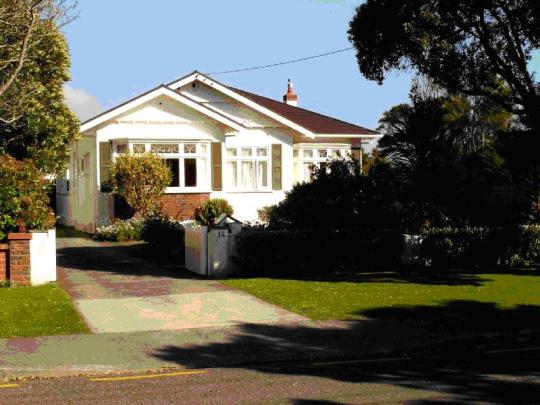
The land on which Walter and Lottie Nash's house was built was part of the Riddiford Estate. In October 1927 Lots 9, 10, 11, 12 of DP 3881 were sold to Walter Patrick Page, a builder. The new certificate of title issued to Page shows that St Albans Avenue and Glen Iris Grove were laid out at this time.
Two years later the area had been subdivided to create new lots for housing. Lot 7 DP 8552 Wellington Land District was created at this time. In April 1930 Page sold Lot 7 to Walter Nash, who had been elected as Member of Parliament for the Hutt in a by-election on 18 December 1929. He was to hold the seat till his death in 1968 - a total of 39 years.
WALTER NASH (1882-1968) and LOTTIE NASH (nee Eaton) (1880-1961):
Born in Kidderminster, Worcestershire, England, on 12 February 1882, Walter Nash was the fifth of six children of Alfred Arthur Nash and Amelia Randle. On leaving school Walter Nash worked for a time as office boy for a local solicitor, before moving with his family to Selly Oak, near Birmingham. On 16 June 1906 he married Lottie May Eaton at St Mary's Church in Selly Oak, and at about this time set up two shops: a tobacconists and a confectioners. In 1909 Nash and Lottie decided to immigrate to New Zealand, arriving with their young son Clement in Wellington in May of that year on the SS "Tainui". (The Nashes later had two more sons Leslie and James (Jim)). They set up home in Brooklyn, and Nash became the secretary of and a shareholder in a tailoring business, Jones and Ashdown.
Nash had always had a strong sense of Christian values, a legacy of his upbringing and particularly his mother Amelia's beliefs. During his time in Selly Oak he had become interested in Christian socialism. Soon after arriving in New Zealand he and his family joined St Matthew's Church in Brooklyn, where Nash was confirmed. He became involved in the church community, teaching Sunday School and was elected to the vestry. He also joined the Church of England Men's Society. Nash's belief that Christianity and socialism were inseparable were to be an important influence on Nash for the rest of his life.
In 1911 Nash became involved with the recently formed New Zealand Labour Party, assisting in their election campaign in Wellington. However, Jones and Ashdown was not doing so well, and by March 1913 Nash had lost nearly all the money he had invested in the company. The family moved to Palmerston North, where Nash became a successful commercial traveller for Miller and Ahern, a woollen merchant and cloth importer. In 1916 the family moved to New Plymouth where Nash established a co-operative tailoring company with Stratford tailor Bill Beasley. Unfortunately, the business was never successful and Nash left in 1919. While in New Plymouth, Nash set up the New Plymouth branch of the New Zealand Labour Party, and in 1919 was elected to the national executive.
In 1921 the family moved back to Wellington, establishing the Clarte Book Room (essentially a bookshop) and various agencies. In 1922 Nash was elected national secretary of the Labour Party, a position he was to hold until 1932. During this time Nash became increasingly interested in international relations. He became involved in a number of organisations including the New Zealand Council of the Institute of Pacific Relations (est. 1926) of which he was an inaugural member. In 1925 and again in 1928, he unsuccessfully stood as a candidate for the Hutt electorate. The incumbent was Thomas Wilford, who had held the seat since 1899. In 1929 Wilford resigned to become High Commissioner to London and Nash took the seat in a by-election, winning by a huge majority.
Walter and Lottie Nash decided to move to Lower Hutt, purchasing the section at 14 Albans Grove in April 1930. By this time their family had left the parental home. Four days before acquiring the property Nash submitted an application to build a concrete dwelling on the section, at an estimated cost of £1100. The house, a simple bungalow, was built by C. S. Witchen. The house included what were then quite modern features, such as a dining alcove, kitchenette, and sleeping porch. The hall was lined with oak (since removed). Photographs taken during the 1930s show unpainted window frames and a large rusticated brick fireplace in the living area (now removed).
The Nashes' move to Lower Hutt occurred at the height of the Great Depression. Unemployment in New Zealand had been on the rise since 1927, but during the years 1931-1932 it reached unprecedented levels. Traditional methods of coping with high unemployment through increased public works were no longer sustainable. Of this time Craig MacKenzie, a neighbour and friend of the Nashes, was to later write:
'On Sunday mornings, from across the road, Mary and I would sometimes watch the grim pilgrimage converging on Walter Nash's home. Unemployed victims of the Depression, discarded by the people they could no longer make a profit for - wending their way towards what they hoped would be help and relief from their seemingly endless struggle to make both ends meet.... During these years Walter Nash was doing what he could to relieve the suffering around him. His Sunday mornings were just a small part of the job. Starting about 8.30am. his visitors would pass down the street singly, in pairs or bigger groups, with small deputations occasionally forming at the gate. All, in despair at finding no solution to their problems, had come to see if Walter Nash could do anything for them. In touch with hospital boards, government departments, all sorts of relief and charitable organisations, he was usually able to put them in contact with the most likely source of help. Urgent cases, and there were many, meant digging into his own pocket. Indeed, Mrs Nash confided to Mary on more than one occasion that they were extremely worried as 'Wal' was handing out more money that their limited means could stretch to'.
These Sunday meetings were nicknamed by John Stanhope Reid, a friend and later an ambassador, as Nash's seances.
Lottie Nash also helped those who had been hit hard by the Depression. She organised a large sewing circle that would meet in the St Albans Grove home. When the Hawke's Bay Earthquake struck in 1931 and during World War II she gathered together a similar group of helpers.
As a local Member of Parliament Nash was a keen participant in the affairs of the Hutt. By 1932 he was a patron, president or vice-president of 66 sporting clubs. He was chairman of the Boy Scouts' committee, The Red Cross, Anglican Boys' Home Society and the amateur actors.
By 1933/34, prices for New Zealand's farm exports began to improve, and by the time the Labour Party was elected to government late in 1935 conditions were more favourable to the introduction of the new government's welfare and development policies. Nash was appointed Minister of Finance, Customs, Government Life Insurance, State Advances and Land and Income Tax. He was ranked third in the cabinet after Michael Joseph Savage and Peter Fraser.
In August 1936 Nash presented his first budget. He raised pensions, provided more money for education, but also increased income tax and land tax. Following its presentation a reporter from the New Zealand Free Lance visited the house at St Albans Grove. On arriving at the residence the reporter observed:
'Mr Nash lives at Lower Hutt, in an attractive bungalow in one of the most pleasantly laid-out streets. Lawns grow between footpath and road and trees set at regular intervals in the lawns give the thoroughfare an ordered attractiveness. It was not difficult to spot the Minister's house. Six bicycles and two motor-cars outside indicated that callers had been arriving since well before 10 o'clock and a man who was wheeling a bicycle away volunteered the information that there was a 'real house full there''.
Inside he found a sitting room full of visitors. The Minister was in his study and a secretary was in what was described as the morning room (possibly the sunroom in the early plans). While the reporter was talking to Lottie Nash, the doorbell rang. She confessed that 'Once...I used to make a cup of tea for everyone who called. I thought some of them might have come a long way. But I had to give it up; there were too many callers.' Apparently each Sunday morning was the same. The Minister would receive callers until noon and then depart for his office at Parliament. The article also gives us a rare glimpse of what the house looked like during the 1930s. There are images of the front of the house (with the garage in the background), the Minister with his library (assume the study), and the Nashes with two of their sons around the sitting room fireplace.
Other images of the Nashes at home during this time can be found in a collection held by the Alexander Turnbull Library. The collection is a series of portraits of Ministers in the Labour Government 'at home', usually in front of the fireside and accompanied by their wives. As well as the Nashes, there are images of the Prime Minster Michael Joseph Savage, Peter Fraser and Robert Semple. Little is known about this collection except that they date to the 1930s and the photographer is simply known as 'Dorothy'.
In October 1936 the Nashes left New Zealand bound for England. The purpose of the trip was for Nash to persuade Britain to accept bulk trading agreements. Unsuccessful with the trade negotiations, he undertook a side trip to Europe, and returned to England to attend, along with Savage, the coronation of George VI and the Imperial Conference which followed. He toured Britain on speaking trips and was awarded an honorary Doctor of Laws from the University of Cambridge. On his way home to New Zealand he visited Canada and the United States, meeting President Franklin D. Roosevelt. According to historian Barry Gustafson, this trip made him New Zealand's best-known politician in Britain. During the time the Nashes were overseas, their St Albans Grove home was occupied their son Jim and his new wife.
Once home, Nash helped implement a number of the Labour Government's reforms, including, as the minister in charge of social security, the introduction of the Social Security Act 1938. The act came into force after the 1938 election in which Labour's support increased from 46% of the vote to 56%. One of the biggest concerns of the government was New Zealand's overseas reserves of sterling, which had fallen by £30 million to under £8 million in three years. Nash again travelled to Britain in April 1939 but received a less than favourable offer of help. Within two days of his arriving home in September, New Zealand declared war on Germany. Not long after, the British government offered to buy New Zealand's entire export of meat and dairy products, and as a result New Zealand's overseas reserves were restored.
In 1940 Savage died and Fraser became Prime Minister. Nash was elected Deputy Prime Minister, retaining the finance portfolio. Between May and September 1941 he was acting Prime Minister while Fraser was in Britain. On Fraser's return, Nash was chosen to become New Zealand's resident minister in the United States. Walter and Lottie arrived in Washington in January 1942. Here Nash was to attend the Pacific War Council, chaired by Roosevelt. He returned to New Zealand in April 1943 to present the budget and fight the elections, which Labour won with a slightly reduced majority. By end of the year he was back in the United States. In July the following year he attended the United Nations Monetary and Financial Conference at Bretton Woods, New Hampshire, which resulted in the creation of the International Monetary Fund (IMF) and the International Bank for Reconstruction and Development.
In the years following the war Nash continued his role as international statesman, becoming involved in the discussions for the creation of the General Agreement on Tariffs and Trade (GATT). At home Labour's popularity was on the wane, and it won the 1946 election with a majority of only four seats. In the 1949 election, which was dominated by industrial strife, the New Zealand National Party ousted Labour. In December 1950 Fraser died and in the following January Nash was elected leader of the Labour Party. The years 1951 to 1954 were marked by continued industrial action, most notably the waterfront strike of 1951. Nash's impartial approach to the disputing arms of the labour movement did not win him much support among voters, and Labour failed to defeat National in the 1954 snap election.
In June 1956 Walter and Lottie celebrated their Golden Wedding anniversary. For two weeks Walter and Lotty were feted with events both public and private. Congratulatory messages came from all over New Zealand; there were so many that the Nashes agreed to have a special car sent from Wellington to carry them all, rather than burden the normal postal service. The Hutt Labour Representation Committee held a banquet in their honour at which more than 300 guests attended. At another banquet held in the Horticultural Hall, Lower Hutt, the couple entertained the guests with a re-enactment of their wedding, complete with clothes of the period. At the time the Nashes were spoken of as 'the father and mother of the Hutt Valley for many years'. It was also said that 'both had given so much of themselves to so many people, and it was unique in New Zealand that a golden wedding anniversary should arouse so much interest'. On the day of their anniversary the Nashes had a family celebration, with 16 people sitting down to dinner at their St Albans Grove home, but not before the Evening Post photographer had taken photographs of the couple and their family. Following a week of celebrations in Wellington, the Nashes travelled up to Auckland for a further week of public celebrations.
In the following year an increasingly unpopular National Party lost the elections and Nash became Prime Minister at the age of 75. Unfortunately, National had concealed a growing balance of payments crisis, leaving Labour with little option but to place controls on imports and decrease the purchasing power of the public. In June 1958 Arnold Nordmeyer, as Minister of Finance, introduced what would become known as the 'Black Budget', increasing taxation both directly and indirectly; the latter was carried out through the unpopular taxation on beer, cigarettes and petrol. Labour's popularity fell sharply.
Nash is reported to have lived much of his time as Prime Minister at a ministerial residence in Thorndon. However, it is unlikely that Nash spent much time there as he was frequently absent from the country, advocating the importance of international understanding, disarmament and peace to international conferences and individual leaders. One domestic issue which was to be unpopular with many Labour supporters was Nash's approach to the 1959 All Black tour to South Africa. The New Zealand Rugby Union excluded all players of Maori descent from the tour - an action that caused huge public protest. Nash refused to become involved but eventually supported the position of the rugby union advocating that to include Maori 'would be an act of the greatest folly and cruelty to the Maori race'. In the 1960 election National defeated Labour.
In December 1961 Lottie died. The funeral, held at St James, Lower Hutt, was attended by over 700 people included the Prime Minister Keith Holyoke, most of the National Cabinet Ministers and a very large contingent of Labour Members of Parliament. Obituaries recorded her involvement in the community including the YMCA, the YWCA, the Plunket Society (of which she spent 18 years as a working member) and the Newtown Residential Nursery. She was also patron the Returned Servicemen's Association (RSA) women's auxiliary and vice-president of the women's hospital auxiliary. As the funeral procession left the church, a 'Maori group' led by the Maori missioner for the Wellington areas (the Reverend Kingi Ihaka) 'sang a funeral lament'. Two truckloads of wreaths led the funeral procession to Karori Cemetery.
Following the defeat in the 1960 election, Nash retained the role of leader of the Labour party, but there was a growing desire for change within the party. When his preferred successor, Jerry Skinner, died in April 1962, Nash decided to stay as leader until the 1963 election. However, the Labour party caucus felt otherwise. On 26 February 1963 Nash resigned and Arnold Nordmeyer was elected as leader.
Nash continued as Member of Parliament for Hutt and remained a keen participant in the social and sporting life of his electorate. In 1962, Nash's sister Emily had joined her brother in New Zealand and had taken over the running of the St Albans Grove home. By this time the St Albans Grove home was filled with a lifetime of correspondence and papers. According to one biographer (unpublished):
'From his first years of service to the Party he had carefully husbanded the finances entrusted to him. He kept official papers under his own personal care and many of the first records of the party found their way, eventually, to the garage of his home at Lower Hutt, to be released only after his death. Many referred to him as an 'inveterate hoarder' as far as papers and books were concerned and as the years moved on, the garage was filled with correspondence, official papers and an amazing variety of books and publications. When the garage was full [,] the accumulation overflowed into the house and when Mr Nash took over the spare bedroom as his study this, too, gradually filled with books and papers. They spread to another bedroom and when Miss Emily Nash came to live with her brother in 1962, she shared her bedroom with ceiling high racks of books'.
The garage had been extended at the beginning of 1961 and this very likely coincided with Nash's move from the Prime Ministerial offices at Parliament. The amount of material stored in the garage was to further expand in 1963 when, on his retirement as Leader of the Opposition, Nash moved hundreds of personal files and papers into the building.
In 1965 the New Zealand public got to see just how large the collection was when Nash and his house became the feature article in the February edition of the New Zealand Women's Weekly. The article has two photographs one of the garage, overflowing with paper, and the other the study overcrowded with books and papers. The latter was so overcrowded that Nash had taken to working in the 'sunporch'.
So well known was this collection of papers that when Nash died, Sir Bernard Fergusson in an obituary for The Times wrote:
'The garage beside his house in Lower Hutt, just outside Wellington has long bulged with his vast accumulation of papers which he intended to edit. He always procrastinated about this, it seemed as though he were as convinced as everybody else that he would live forever and would have unlimited time for the task'.
In 1965 Nash was knighted. He also received the honour of being the first person to receive an honorary doctorate from Victoria University of Wellington. At the event to receive the latter Dr J Williams, Vice Chancellor of Victoria University said that 'When the history of the middle of the 20th Century comes to be written, Walter Nash will be remembered as one of the great Commonwealth statesmen.' Nash became prominent in the anti-Vietnam War movement as well as active in promoting the developing countries, particularly in Asia.
Nash died at Hutt Hospital on 4 June 1968. His body lay in state in Parliament Buildings before a state funeral at St James, Lower Hutt. He was buried beside his wife at Karori Cemetery.
The majority of Walter Nash's estate was left to CORSO, for:
'providing food for the hungry in overseas countries in accordance with the Freedom from Hunger Campaign, or should the campaign end, then in such a manner as the body controlling Corso [sic] might think fit to provide those who would otherwise be starving or seriously undernourished'.
CORSO was a an organisation close to Walter Nash's heart; as Minister of Finance in 1944 he had facilitated its formation, and keenly followed its progress.
Nearly $17,000 was raised initially from the estate to fund a hydrological survey in India administered by the Action for Food Production organisation. However, the St Albans Grove house came under the care of the Public Trustee so that that Emily Nash could remain in the house until her death, in May 1975. The house, as per Walter Nash's will, was then transferred to CORSO.
A year before he died Nash had proposed to establish a children's village in Vietnam to aid some of the many thousands of children who had become orphaned by the war. On his death it was decided that the project would continue as a tribute to Nash. With the support of the Prime Minister Keith Holyoake and the Leader of the Opposition, a public subscription was begun eventually leading to the provision of a children's ward at Qui Nhon provincial hospital in Vietnam.
The children's ward was intended to be the only public memorial to Nash. However, over the years others were erected. In 1975, a basketball stadium at Taita in the Hutt Valley was named after him. An article in the Dominion stated that the stadium had:
'been named after Sir Walter, one of the Hutt Valley Basketball Association's vice-presidents, who always showed a keen interest in the Association's affairs. The Executive Committee of the association recognising this man's genuine interest in the welfare of both the community and his country, felt it would be a fitting tribute to the memory of such a great humanitarian to name this important amenity after him'.
There is apparently also a small plaque beneath a totara near the War Memorial Library in Lower Hutt that simply states:
'Planted at the request of R. St Barbe Baker as a living memorial to the life and work of the Rt Hon Sir Walter Nash G.C.M.G; C.H. MP for Lower Hutt 1929-1968. A great citizen and humanitarian'.
POST NASH:
On 24 June 1976 the house was put up for auction, however it did not meet its reserved price. Not long after, on 13 September 1976, the house was sold to Harry Myers, a plastering contractor from Wainuiomata, and his wife Winifred Francis Myers. In 1979 there was a fire in the house. It is unclear just how much of the house was damaged. It is very likely that the original fireplace was replaced at this time. Other changes that may have happened at this time were the lowering of the ceilings and the removal of the oak panelling from the hallway. The entire cost of reinstating the house post the fire was $15,000.
Sometime in March of 1984 the Leader of the Opposition David Lange, John Terris (Member for Western Hutt), Trevor Young (Member for Eastern Hutt) and Sir Walter Nash's youngest son, Jim Nash visited the St Albans Grove home. Their photograph was taken in front of the house and later published in a local paper. In his letter to the owners to thank them for allowing Lange and his party to visit, Terris stated that 'We much appreciated your willingness to allow us access to this piece of New Zealand history.' Four months later Lange became Prime Minister with the election of the Fourth Labour Government.
In 2003 the house was sold to Malcolm and Tina Kerr who remain the current owners of the property. In 2007 the house to the west of Nash House was acquired by the Crown and removed to allow for an expansion to Hutt Valley High School.