This historic place was registered under the Historic Places Act 1993. The following text is the original citation considered by the NZHPT Board at the time of registration. Information in square brackets indicates modifications made after the paper was considered by the NZHPT Board.
The Early History of the Cottage and Grounds
The land on which Vogel House is now located is part section 25, Hutt District. In 1853 a Crown Grant for this section was issued to Edward Daniell. Captain Edward Daniell (1800-1866) had been an employee of the New Zealand Land Association from 1836 to 1839. He arrived in Wellington in 1839 and was a member of the Committee for First Settlement, the first governing authority for the newly established New Zealand Company settlement. Within three years he had acquired over 120 hectares of property mostly in what is now known as the Wellington suburb of Ngaio. In 1848 Daniell and his family moved out to their estate in the Hutt Valley. In 1864 Daniell sold part of section 25 to Mr Cudby, who in 1865 sold it to Georginia Kelham, the wife of James Kelham.
James Kelham was an employee in the London office of the New Zealand Company. In 1842 he and Georginia immigrated to New Zealand. James established himself as an accountant, and was later appointed the first Chairman of the Chamber of Commerce (1856-1858). In 1853 he was elected to represent the Town of Wellington in the first General Assembly, and in 1856 he represented Wellington City on the Wellington Provincial Council. In 1864 James purchased section 21 in the Hutt District, adjacent to the land that his wife Georginia was to purchase a year later. When James retired the couple moved into a house named Tredenham that had been constructed on section 21. James died in 1882, leaving the bulk of his estate to Georginia. Georginia sold the house and section 21 in 1890, but retained section 25. It is likely that not long after James' death, Georginia went to reside in the small cottage now known as the 'Gatehouse' on section 25. It is not known exactly when the cottage was built but some features, such as the decorative elements over some of the windows, suggest that the cottage may date to the 1870s. She remained there until her death in 1893, after which her estate was left to Nina Riddiford, the child of Nina Olive Kelham, the Kelhams only daughter who had married Daniel George Riddiford in 1884. Two trustees managed the property on behalf of Nina Riddiford - the Reverend Thomas Fancourt of Johnsonville and William Fitzherbert. One month after Georginia's death, the estate was sold to George Albert Chapman.
Chapman sold the property in 1904 to Ellen Alexander, wife of William Alexander, a clerk of Lower Hutt. From 1914 John Wilson leased the property, until it was sold to Mabel Jaggen, the wife of Norman Jaggen, in 1921. The property was again sold two years later to James Arnold, Lower Hutt engineer. There is some evidence that Arnold operated a small chicken farm and dairy on the property. In 1932 Arnold sold the property to James Vogel.
The Vogels
James (Jim) Vogel was the grandson of Premier Sir Julius Vogel (1835-1899) and the great grandson of Premier James Edward Fitzgerald. In 1932 he married Jocelyn Riddiford, the daughter of Vivian Riddiford of Woburn, Lower Hutt (1879-1934), and the great grand niece of Governor Sir George Grey.
The couple extended the property by acquiring a small piece of land from St James Church, while an area near Woburn Road was 'a gift of a Mr Bunny' a man who Jocelyn Vogel would have known as an Uncle. The property was acquired to build a house for the newlyweds and was a gift from Jocelyn Vogel's parents - not as a wedding present but more as a place to live. The area was long associated with wealthy settler families, and in particular Jocelyn Vogel's family the Riddifords, whose large estate known as Woburn (established in 1855) was to eventually lend its name to the entire suburb. The Vogels' house was one of a growing number of large Woburn homes, many of which still exist today, although not necessarily with their original curtilages.
The Vogels commissioned Christchurch architect Heathcote Helmore (1894-1965) to design the house in 1933. During his early career Helmore was articled to Cecil Wood and later Edwin Lutyens in London. After World War One he settled in Christchurch where in 1924 he joined in partnership with Guy Cotterill. It was a partnership that was to last until Helmore's death in 1965. Helmore and Cotterill gained a name for themselves for designing elegant houses for both the wealthy of Christchurch, particularly in the Papanui-Fendalton area, but also around the country, including Wellington and the Wairarapa. Both partners favoured the Colonial neo-Georgian style, but also utilised other styles such as Spanish Mission and Art Deco.
Carpenter Walter [Verran Dyer, of the firm Dyer and Halse] built the house and while construction took place, the couple lived in the cottage which had been renovated for their use. According to an article in the Weekly News, [Dyer] was the first person to receive an honorary degree from Massey University, and when he retired from the building trade he entered public life and was for many years chairman of Massey's Board of Governor's.
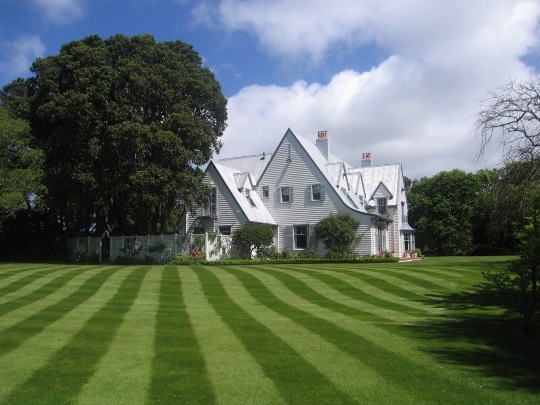
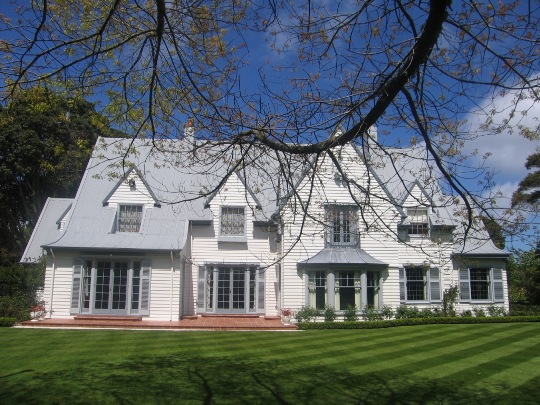
Helmore's design for the Vogels drew upon elements of the architect's preferred Colonial neo-Georgian style, popular with well-heeled New Zealanders of the 1920s and 30s, as well as English Domestic Revival architecture. When completed the two-storey house had over 15 rooms with a large entrance hall leading to a terrace overlooking the garden and a large dining room and living room on either side. There were rooms for servants and, probably quite novel for the time, a built-in double garage. Helmore continued his association with the house, as he was later to advise the Vogels on the redecoration of the dining room.
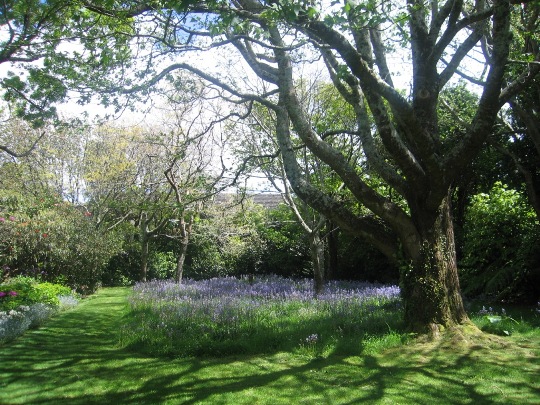
Surrounding the house was a formal garden that had been laid out by Arthur Porter from 1933 to 1940. At the time the house was built there had been only two or three trees around the cottage. A number of trees and shrubs were brought from the Riddiford estate at Woburn located in the area on the western side of Woburn Road and now substantially occupied by Hutt Valley High School and suburban developments. The cottage (today also referred to as the gatehouse) was used for the accommodation of domestic staff.
James Vogel took over an importing company in Lower Hutt. In 1937 he was elected to the Hutt Borough Council, from which he took a leave of absence during World War Two. During the war he served in the Middle East and was eventually promoted to lieutenant colonial, receiving an OBE in 1944. Following the war Vogel continued his business but also participated in the local community. He served as a Hutt City Councillor, chairman of the Transit Housing Citizens' Committee, a member of Hutt Valley Technical College board of managers, chairman of the local Air League branch, president of the local Returned Services Association and the Horticultural Society. In the 1946 national election he unsuccessfully ran against Walter Nash for the Hutt seat. He was also commissioner for the Hutt Valley and Bays Boy Scouts (1937-1949).
In late 1963 to early 1964 the Vogels decided to give the house and grounds (including the cottage or gatehouse) to the nation. Contrary to later reports the initial offer did not come with strict conditions for its future use. Instead the Vogel's offered the house for visiting VIPs 'but this is in no way an arbitrary condition if there is another use for it.' One of the reasons for this was to save the house from the bulldozers, as had been the fate of Riddiford family home of Woburn. As a condition of the gift the property, which was handed over fully furnished, was to remain intact. The government accepted the offer on 13 July 1965 with one of the conditions being that the Vogels could remain in the property until their deaths. There was to be no binding condition of use but the Vogel's were assured that the property would ‘as far as reasonably possible will be kept as an entity for public purposes.' During these discussions, Prime Minister Keith Holyoake and his wife Norma were entertained at least once at the Woburn Road house. The ‘Original Deed of Gift' was signed on 7 September 1965, and a ‘Original Supplementary Gift' was signed on 14 December 1965. The deed of gifts included a number of chattels including a painting by Goldie and two paintings by Barraud. Special legislation had to be passed to exempt property from any estate, gift or tax duties. This was done through the Finance Act of 1965. In the second reading of the bill the Minister of Finance H R Lake stated:
The gift which is subject to the life interest of the donors, has been prompted by the desire of Mr and Mrs Vogel to leave to the people of New Zealand their home in which they have lived since their marriage, as a recognition of the long and happy association which both their families have had with this country since its pioneering days. Both the Vogel and Riddiford names have been well known and respected from the earliest days of the colony, and the home of Mr and Mrs Vogel when it vests in the Crown following their life interest will always be a reminder of to the people of New Zealand of the influence those two pioneering families have had on the growth and development of this young country. The gift is not subject to any restrictive trusts, but Mr and Mrs Vogel have expressed the wish that, if possible, the property should be kept intact, as an entity, for some appropriate private purpose.
Much was also made of the fact that the property was gifted in the centennial year of parliamentary government in Wellington, given the role that the ancestors of the Vogels had played its formation.
As the Government did not expect that the property would come into their possession for a number of years, little thought was given to the future use of the building. At one point there was an idea that the house and grounds could be turned into a New Zealand Administration College, the extensive grounds providing ample room to construct the necessary buildings. However, in 1966 the Vogels decided to leave the house for family reasons and retire to their residence in the Marlborough Sounds. This left the Government searching for a use for the property.
The Vogels suggested that the Australian High Commission, who were looking for a temporary residency, would be a suitable tenant, and by mid 1966 the Government had entered into discussions with the Vogels over this proposed new use for the building. The Australian High Commission were known to be keen to secure the Vogel property as it adjoined the temporary American Embassy. The Americans were not the only foreign delegation in the neighbourhood - the United Kingdom Trade Commissioner lived at 22 Myrtle Street, a property which backed on to the Vogel Residence and had loaned from the Vogels a piece of land on the boundary of the two properties. Due to the change of use the Vogels took the opportunity to change the deeds of gift - this time many of the chattels, which were to be gifted to the Government, were now regarded as on loan. A new deed of gift was signed on 15 November 1966. The Vogels left the property on 30 November 1966.
The Australian High Commission
The first Australian High Commissioner to take up residence at the Woburn Road property was Sir Edwin Hicks. He and his wife, Lady Hicks, lived in the house until 1971 when a new high commissioner, Dame Annabelle Rankin, was appointed. On taking up the appointment, Rankin asked that a number of changes be made to the residence. These changes included the extension of the dining room by 2.74 metres towards the main lawn, the provision of a fire escape from the High Commissioner's bedroom, the replacement of a kauri bench in the kitchen and the construction of a canopy above the main entrance. The work was supervised by the Ministry of Works and mostly undertaken by T. W. Tregaskis and Company. The renovations (minus the fire escape, which the High Commissioner later asked not to be built) were completed in December 1972 and cost $12,595.96. Later, in 1973, a large brick entrance gate was built, again at the request of the High Commissioner, to improve the security of the grounds.
The last High Commissioner to live at the Woburn Road property was a Mr Moodie and his wife. They lived in the property until June 1976 when a new residency was completed in the Wellington suburb of Khandallah. As the Australian High Commission tenure drew to a close, thought was given to a new use and in particular the occupation of the house as a prime ministerial residence.
The Prime Ministerial / Ministerial Residence
The idea that the Woburn Road property would be suitable for a Prime Minster's residence was suggested at the time the Vogels handed the house over to the Government by way of deed of gift. At the time Prime Minister Holyoake did not require the property, and later Prime Ministers were not considered due to the lease agreement with the Australian High Commission. The exit of the High Commissioner in 1976 allowed the Government the opportunity to offer the property to the newly elected Prime Minister Robert (Rob) Muldoon (later Sir Robert). Muldoon was very happy to accept on the condition that the entire property would undergo a complete renovation. These renovations included the construction of a self-contained flat above an extended study and garage, the rearrangement of the remaining bedrooms to create guest and family suites and the provision of a conference room downstairs with associated cloakrooms. After discussions at Cabinet level and involving the Leader of the Opposition, it was decided that the project was too expensive to be undertaken all at once and that the work would be undertaken in two stages with the essential work being carried out first.
The first stage of the work commenced in August 1976. This involved the construction of the flat, the extension of the study to provide a conference venue, refitting of the kitchen and redecoration of the dining and reception areas. The latter was undertaken in expectation that the Queen would dine at the house on her visit to New Zealand in 1977. This redecoration included a complete refurnishing of the house as there was very few furnishings left and those that remained were in need of replacement. The only items that were identified as having any value were the eighteenth century grandfather clock that still stands in the entrance hall today, and a clothes press. The Ministry of Works supervised the work and the principal contractor was O.V. Smith Ltd. of Lower Hutt. The entire cost of the first stage of the work was $129,064.87.
In 1977 consideration was given to the future of the cottage. Three possibilities were proposed: maintain, restore or demolish. At the time the Muldoons' housekeeper occupied the house. Initially it was decided to undertake repairs including repiling and reroofing. A carport was added to the side of the building in 1978. In 1979 the shed behind the cottage was demolished to make way for a staff lunchroom and toilets for the public to use during garden parties. This work was completed by January 1980. The following year $16,000 was spent on renovations to the cottage.
Stage two of the work on the main house commenced at the end of 1978 and involved renovation of the bedrooms and the modification of the downstairs kitchen, servery and staff accommodation. A new bedroom was built in the roof space above the original maid's quarters and a porte-cochere added to main entrance. All the work was undertaken under the supervision of Ministry of Works and Development architect, John Rowe and cost c.$250,000.
Rob and Thea Muldoon moved into Vogel house at the beginning of 1977 and lived at the Woburn Road property for nearly seven years. During this time the property became officially known as Vogel House. The Muldoons entertained a number of people of note including the Queen and Prince Philip (1977) and the Prince and Princess of Wales (1983). The Muldoon's younger daughter was married in the garden. The downstairs facilities provided a suitable venue for confidential conferences, particularly at budget time. On one occasion there was a conference on the Closer Economic Relations (CER) Trade Agreement attended by Australia's Deputy Prime Minister Doug Anthony. During the Muldoon era local charities would use the lawn of the house for fundraising and horticultural and garden societies also visited the property.
Muldoon was a keen gardener and was particularly keen on orchids, which he reputedly used to grow in the flower room under the stairs of Vogel House. Another space well used by Muldoon was the study in the upstairs flat. It is said that Muldoon used this room to write his speeches. In later years Muldoon said of Vogel House:
'I always used to get back there by midday Sunday and found it very very comfortable. I'd walk around the garden, do my cabinet papers, tape a speech or two, something like that you know - I developed quite an attachment to the place'.
It was about this time that the New Zealand Historic Places Trust (NZHPT) became interested in the cottage. By this stage it was recognised that the building was one of the oldest remaining structures in the Lower Hutt area. In recognition of its architectural and historical significance the building was classified ‘C' under the Historic Places Act 1980.
In 1981 the Vogel family requested that the remaining chattels be returned to the family. (A number had already been returned at the request of Jocelyn Vogel when the house was used as the Australian High Commission.) The only notable chattel that was left in the house was the grandfather clock, which is currently located in the main entrance hall.
In 1983 Jocelyn Vogel visited the house (her husband had died in 1971). While there she inspected a scarlet oak that had been planted in the grounds of the house to commemorate 50 years since the commencement of the building of the house by the Vogels.
In 1984 National lost the snap election to Labour, and Robert Muldoon's nine years as Prime Minister came to an end. Many commentators regarded Muldoon as one of New Zealand's most formidable but divisive leaders. He was certainly Vogel House's most notable occupant.
The newly elected Prime Minister David Lange lived in the property only very briefly. He moved into Wellington after a few months, preferring to live closer to Parliament. However, he did on occasion entertain dignitaries at Vogel House. Vogel House and grounds also continued to be used as a venue for charity functions. In 1986 it was used for an exhibition of antique and architectural drawings entitled Past Tense, held as part of the International Festival of the Arts. During the exhibition Jocelyn Vogel again visited the house along with more than 10,000 members of the public. In 1990 National won the election. At this time the property was placed under review. The new Prime Minister James (Jim) Bolger did not require the property as a residence as the Prime Minister's Residence in Thorndon [Register No 1371 Category I] had recently been renovated for a Prime Ministerial residence. Vogel House was then offered to Douglas (Doug) Graham (later Sir Douglas), the Minister for Justice. Doug Graham and his wife Beverley lived in Vogel House for the next nine years. During this time Mrs Graham somewhat controversially converted the formal garden into a cottage garden. The Grahams also oversaw the removal of the brick wall from around the patio and the retiling of the patio with slate.
In 1999 the Grahams moved out and the house was offered to cabinet member Jim Anderton, at the time leader of the Alliance party and Deputy Prime Minister in the Labour-led coalition government from 1999-2002, who took up residence there with his wife Carole. The following year the Andertons opened the house to the public and over 12,000 visitors came through the gates. From about 2002 the Andertons instigated a programme of restoration to address areas of disrepair, and the house was gradually renovated, including work on the upstairs flat and main kitchen as well as the roof and exterior. In addition Mrs Anderton, a garden and landscape consultant, undertook to restore the formal gardens using the original landscaping plans. The Andertons remain the occupants of the house in 2008, and have overseen the restoration and renovation work to such a standard that Vogel House is intended to be used as a temporary residence for the Governor-General while Government House is being renovated and restored. The cottage is no longer used for staff accommodation and is currently rented. It was completely repiled in 2007.