Gold mining was responsible for the initial large scale European settlement of the West Coast and provided its early prosperity. As alluvial sources dwindled, hard rock mining of the 'mother lodes' took over and was important in extending the life of the industry for many decades.
Early attempts at gold mining in the remote and dangerous Big River area, between 1866 and 1870, were largely unsuccessful. The Grey River Argus reported in August 1870 that 'Big River has been rushed at different times repeatedly, but it has never been any good'. Big River's reputation was then as a poor, shallow diggings where only occasional rich patches and small nuggets could be found. The perseverance of some prospectors paid off, however. In February 1871, Shepherd and party discovered gold-bearing quartz, causing a large rush up Big River to the saddle dividing it from the Inangahua.
In April 1872 prospector, James Anderson, applied for a quartz mining lease on the dividing range between the right hand branch of Big River and Snowy River, approximately 20 miles from the junction of the Snowy and the Little Grey. The Anderson Quartz Mining Company, Big River, was soon formed. However, although 'Anderson's tunnel' initially produced ‘very fair' quartz results in 1872, extraction was hard and slow going. Tunnelling sped up with the introduction of a new explosive compound known as dynamite, which the mining company had been given to test, but the company struggled. For some years following little was heard of the Big River reefs.
In late 1881 prospectors began to return to try their luck at Big River. A pack track was created from Devils Creek to Big River, opening up a considerable amount of alluvial ground. This was the beginning of new roading developments that opened up a whole new reefing district.
In November 1881 two claims were established that led to renewed activity at the Big River Reefs. Well-known miner Hugh Duggan pegged out a 4.2 hectare Pioneer claim and Patrick Brennan from Inangahua applied for a 6.6 hectare lease. The following month the two men joined to form a single company, the Big River Extended Gold Mining Company. Samples of Big River quartz were sent to the New Zealand International Exhibition held in 1882 in Hagley Park, Christchurch, raising the investment profile of the company. Overall, the company's success at this time was variable, as a result of the difficult terrain and unpredictable results.
Other companies were also formed. By the end of 1882 the number of companies at Big River is reported as being in double figures. They tunnelled and sunk winzes (inclined or vertical shafts between mine levels), and had a mixture of great fortune and plenty of bad luck.
An eagerly anticipated road was built in 1884-85, greatly increasing the accessibility of the area and coinciding with a general down-turn in the mining industry. Machinery was brought into Big River, some of which came from other less profitable or failed mining ventures. Between 1886 and 1887 a battery for crushing quartz, associated equipment for extracting gold, an aerial tramway to carry quartz from the mine, holding paddocks (bins), fluming and a water race to supply the battery turbine were installed.
The battery, a 10 stamper, had come from the Golden Point claim which had shut down. It was originally powered by a water turbine but this was replaced by a Pelton wheel which provided more speed using a third as much water. Under normal conditions the battery could crush 10-12 tons of quartz in an eight hour shift.
The first trial crushing commenced in May 1887, with indifferent results. Water supply continued to be a problem to work the machinery. Work on creating a massive dam to remedy this issue was started in early 1888, coinciding with a significant quartz find that led to heightened excitement and high shareholder satisfaction.
The No. 1 Adit was started in mid-1888 and by 1890, the process of sinking shafts had begun and the No. 1 Adit was extended to join with the shafts.
In 1891 the Big River Company was formed. While essentially a West Coast concern, it differed from earlier companies in that it had a number of prominent businessmen from major cities in New Zealand among its shareholders. It soon revealed profitable crushings despite harsh winters where the machinery sometimes struggled or lay idle. In 1895 a 12kW Robey steam winder was installed, replacing the old water wheel. The first bath house is thought to have been built nearby around this time.
In 1897, the company decided to run a new process, using a cyanide plant to extract gold from the tailings. It was first operated by a separate enterprise but soon it was taken over and operated by the Big River Company itself. In 1908 the company bought the Sir Francis Drake Company's cyanide plant and it appears that this was incorporated into the previous plant.
In 1907, after the Big River Extended Company had exhausted all its capital, the New Big River Company was formed. This new company had almost immediate success and the mine produced huge dividends. By 1910-11, the peak of activity, the mine employed 55 men. New machinery was purchased in 1912-13, including a winding engine, boilers and compressor, to capitalise on the reserves of gold being found. The winder enabled the mine to be worked at greater depths with speed and efficiency. The compressor drove pneumatic rock drills and other equipment. In addition, in 1914 a sawmill was built nearby, at Golden Lead Creek, to provide timber for the mine and a coal-mine was sunk to fuel the boilers.
A replacement bath house was built around 1913 to the north-east of the winding engine house. Water for the bath house was heated from the boiler in the winding engine house. It allowed miners and their families who lived in settlement areas dotted around the entire mine site, to wash both themselves and, at times, their clothing. A carpenter's shop stood at the top end of the mine road, near the No. 1 Adit. Nearby, across from the winding engine house, a Blacksmith's Shop was built, providing services to maintain the repair machinery for the mine. Two adjacent store rooms held building materials such as timber and items such as candles for use in the mine. Gelignite, on the other hand, was stored some distance away, in a small hut near the bath house dam.
World War One brought mixed fortunes to the mine. Although sufficient gold bearing deposits were found, a labour shortage due to the war cut production significantly.
By 1922 the mine reached its greatest depth, 602 metres at level 12, briefly holding the record for the deepest in the entire country. However, fortunes dived throughout the 1920s and when the last known deposits were crushed in 1927 the mine closed.
The mine remained closed until 1931 when Big River Gold Mines Ltd bought the mine for ₤10,000 and set about attempting to restore its fortunes. Roads, buildings and mine shafts had to be repaired or reinstated before work could begin. The revived mine operation had some useful returns and some years even paid dividends but eventually, with the arrival of World War Two, a lack of skilled miners, difficulties in reopening lower levels and an industrial dispute closed the mine in 1942.
Despite its relatively modest size and its trials and tribulations, the Big River Quartz Mine was among the most successful in the Reefton Goldfields in terms of returns to shareholders, especially during its most profitable period between 1907 and 1924.
Over the years, Big River had been associated with many of the West Coast's best known practical miners, managers and mine administrators, including T H Lee, Jack McMahon and Billy Rodden. Shareholders included some prominent names, including Patrick Murray, Hugh Duggen, Michael Cullen, and Patrick Brennan - all significant names in Big River mining history. At times, the dividend payout to shareholders was notably high (₤112,800 during the period 1907 to 1924). For its relatively modest size, the Big River Quartz Mine reached a near optimum balance between plant size and ore reserves to maximise return on capital investment. During the depressed period of the early 1890s, it was a mainstay of the Reefton Goldfields and was a spectacular producer in 1907-17 when most of the old established mines had closed or were in decline.
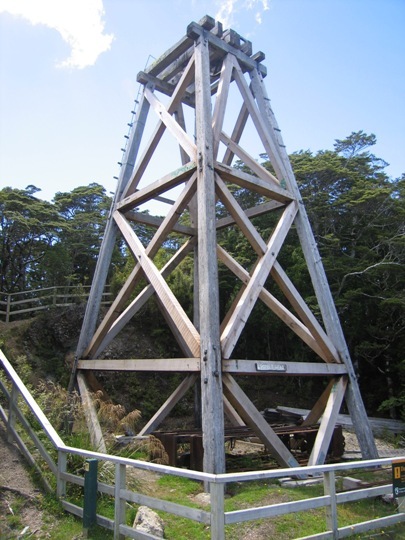
After its closure the mine and its associated sites were reclaimed by the bush. Scrappers took out much of the portable remains but a considerable amount still remained in situ when the New Zealand Forest Service assumed responsibility for the various sites. Since the early 1980s, under the Forest Service and from 1987 the Department of Conservation, a range of conservation interventions have taken place at the site. In 1982 and again in 2007, the bracing of the poppet head was replaced, though retaining the original legs and sheave wheel supports (at least from 1895). In 1999-2000 the winding engine house was reconstructed, using materials and a design based closely on photographs of the original building. The construction of a new channel for drainage to the east of the winding engine house allowed, concurrently, an archaeological investigation of that part of the site. In 2007, the semi-portable Robey engine at the sawmill site was restored. All major sites have been signposted and tracks have been cleared to them.
The following is further specific historical information about groups of features at the site:
No 1 ADIT:
Situated approximately 10 metres to the west of the winding engine house, the No 1 Adit was the main entrance to the mine for most of its working life. It was a busy thoroughfare with quartz being trucked out and timber trucked in. Truckers pushed out trucks filled with quartz, emptying them in the bins and returning the truck to the layby for the chambermen to refill.
Started in mid-1888 to work the ‘New Find', it was extended later that year to Cosgroves Block, 18 metres north east. This created a dogleg in the tunnel. When the shaft was sunk in 1890 the adit was extended to connect with it making a total length of 200m. An iron tramway was laid in April 1891 from the shaft to the aerial tramway. About half way along the adit there was a small layby where a truck from either direction could be run off the main track to let the other pass.
An earlier, unsuccessful, No. 1 Adit lies east of the engine shed and is barely distinguishable. It was never connected to the main workings.
POPPET HEAD, MINE SHAFT, MINE CAGES, PULLEY WHEELS AND MULLOCK HEAP:
The poppet head's purpose was to guide the mine cages up and down the shaft. Steel cables (also called ‘wire ropes') from the winding engine drums ran up the hill, over the sheave wheels at the top of the poppet head and down to the cages in the mine.
The first poppet head was erected when the shaft was first sunk in 1890. However it was replaced in 1895 by the current poppet head, when the original water driven winding engine was replaced with a steam driven engine. Originally fully clad in weatherboards, the poppet head stood more than 12 metres high above the mine shaft, with its sheave wheels at the top enclosed in a gabled weatherboard structure with a corrugated iron roof. The mine shaft began at 671 metres above sea level and reached an overall depth of 602 metres incorporating 12 levels by the time the mine closed. At each level the shaft opened into a chamber 3.6 metres wide, 3 metres high and approximately 4 metres in length. From the chamber to the gold-bearing reef were tunnels 2 metres high and 1.8 metres wide. There were two compartments for the cages and a third from below the No 1 Adit that contained a ladder, pipes and cables for compressed air, pumping, telephone and lighting. The cages ran on timber guides to keep them centralised. Over time, a large mullock heap was created out of waste rock from the mine.
Since the mine closed, the weatherboard cladding of the poppet head was removed and the corrugated iron roofing has gone - a section of it blew into a gully north-east of the poppet head. Rotted remains of the shaft guides and original timber bracing were removed during restoration by the New Zealand Forest Service in 1982, and further restoration work was undertaken by the Department of Conservation in 2007.
WINDING PLANT:
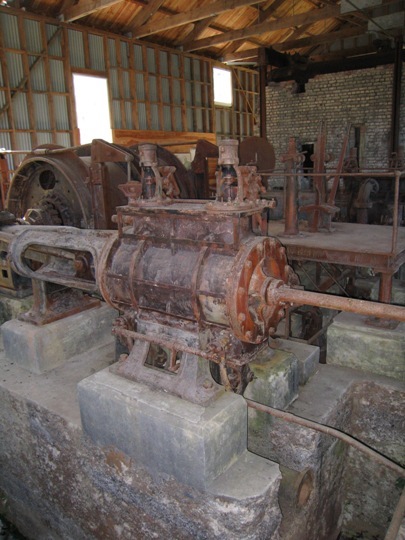
The engine (winder) house was the control centre for operations in the mine shaft. The steam powered winding engine lowered men and equipment into the mine and raised the gold-bearing quartz rock that was blasted from the reefs below the surface. Wire cables from the winding drums went up the hill to the sheave wheels at the top of the poppet head and down into the shaft. This particular arrangement differs from many other mine sites.
The first winding plant commissioned in 1891 was a reversible overshot water-wheel, 10.8 metres in diameter. It proved too slow for the lower levels soon to be worked so in 1894 a redundant Robey semi-portable steam engine was bought from the Fiery Cross Company and a new site prepared east of the No 1 Adit. Timber trestles were installed to guide the cables to the poppet head. Ultimately this winder could not work below 400m so the entire winder was replaced in mid-1908 by a new unit built by the Dispatch Foundry, in Greymouth. It was the first winder at Big River to have a clutch enabling the cages to be worked independently of one another. Big River's last winder was ordered in 1911 and was the ‘best of British' design - a Robey type EB coupled directing winding engine with two 500mm diameter cylinders of 900mm stroke. It could work to a depth of 900 metres. The winder was bought direct from the manufacturer, Robey and Co. of Lincoln, England for £1,778 while the cables cost another £323.
An early boiler on the site was replaced in 1912-13 by a boiler by Babcock & Wilcox Scotland, supplied by John Chambers and Son of Wellington for £1,198. A four-sided brick structure, it was reinforced by upright steel members with the furnace, water and heaters located below two very large twin boilers. Ancillary equipment included a Tangye feed pump and patent water heater. The boiler was of the fire tube type with a working pressure of 830 kPa and a rating of 137 kW. The standard Babcock and Wilcox boiler was half the size with just the single boiler. The steam boiler provided power for the winding engine and compressors and hot water for the mine bathhouse.
The boiler used the principle of hot water rising using a thermo-siphon technique. Water tubes were set at an angle above a coal fired furnace. As the water became heated to boiling point it rose and circulated to be evaporated into steam in a steam and water drum. The top part of the tall furnace chimney fell in the 1929 Murchison earthquake but the plant seemed to operate sufficiently without it.
At the opposite end of the engine house from the winding room was the Compressor and Generator room. It had an Ingersoll-Rand horizontal double-acting compressor, rock borer, generator and other power generating equipment.
In 1999-2000, the Department of Conservation reconstructed the winding engine house. Built of corrugated iron and timber, the design of the winding engine house is based on photographs of the original, although the building is not as long as it was originally - the compressor foundations stand on the north side, now outside the building. The new building serves a dual purpose of providing shelter for the remains of the winding plant and of providing an understanding of the original winding engine house, as it is more or less a reconstruction.
Timber cables trestles probably date from the first of the steam winding plants. The trestles guided the cable to the poppet head.
AERIAL ROPEWAY:
The aerial ropeway (or quartz aerial) carried uncrushed ore that emerged from the No. 1 Adit and was loaded into buckets at the top of the terminus of the aerial and transported to the battery nearly one kilometre away.
Designed by Reefton Engineer, W.E. Gardner, the aerial tramway that transported the quartz down to the battery was supposed to operate on the Otto principle - the loaded buckets going down would pull the empties back up. However, it always required further motive power, initially by horse and later, in 1920 by a Tangye 5x7 vertical compressor and air engine. Components were made by Andersons and Sons of Christchurch and the 1,900m steel rope (cable) came from England.
BATTERY, PELTON WHEEL, SMELTER, WATER RACE AND CONCRETE PICKUP:
The battery, its power source and attendant extraction and smelting facilities were integral parts of the Big River mine. The stamper battery crushed quartz rock, transported via the aerial ropeway, to obtain the gold it contained. The battery was housed inside a large corrugated iron and building. A Pelton water wheel drove the battery and associated equipment.
The Battery had been bought from the Golden Point claim and re-erected at Big River in 1886. The battery was originally housed in a complex which included gold extraction machinery. This building was largely replaced in 1915 when the stamper boxes of the battery were renewed, requiring the demolition of much of the building to gain access to them. Extraction equipment, such as blanket tables, berdan dishes and amalgamating plates were replaced at intervals.
The battery house was largely demolished in the 1950s or 1960s.
CYANIDE PLANT:
The process of gold extraction using cyanide was developed in the 1880s and widely used in New Zealand. However, typical of other Reefton mines, Big River Quartz Mine did not introduce it to their operations until the late 1890s. It supplemented the gold smelting operations. With the cyanide process, ore was ground as finely as possible in the battery to form a sand and then mixed with a solution of cyanide to dissolve the gold. The gold and cyanide solution was allowed to trickle through a porous mass of zinc, which acted as a chemical filter and collected the gold.
The first cyanide plant at Big River was installed in 1897 but this was replaced or extended in 1908 when the Big River Company bought the Sir Francis Drake Company's (Merrijigs) cyanide plant.
The Sir Francis Drake plant consisted of three leaching vats, 7 metres in diameter and 1.35 metres deep, and two 3.6 metre by 1.2 metre sumps, which held the potassium cyanide. The three vats were apparently converted to four smaller ones and may have incorporated some of the vats from the earlier plant. The plant also consisted of a boxed race which brought the sands from the battery, a bucket conveyor which loaded it into the plant and zinc boxes, wooden boxes filled with zinc wool of shavings that brought the gold-potassium cyanide solution back to a solid. The lot was housed in a shed which also incorporated equipment to clean the gold prior to its smelting.
No 2 ADIT (GOLDEN LEAD CREEK ADIT):
Completed in 1914 the No 2 Adit was used for taking timber and coal into the mine until the 1930s. Between 1914 and a temporary shutdown in 1927, coal was also trucked from the No. 2 extension and hauled up the shaft to exit at the No. 1 Adit. The No. 2 Adit was kept open after the 1930s as an escape route for the rest of the mine's life.
Near the No. 2 Adit there was a stable for horses. It was situated near the No. 2 Adit on the side where the tram went to the sawmill.
SAWMILL:
The sawmill enabled the mine to line the shafts of both its gold and coal mines without having to go to the expense of bringing it in from Reefton. The mill also provided rough sawn timber for building purposes. The mill operated from approximately 1914 to 1926. When first assembled the sawmill consisted of the semi-portable Robey ‘underslung' steam engine and its Dispatch-built winding frame from the mine, a breaking down saw and breast bench, all housed under a open pitched roofed structure. The Robey engine had been purchased second hand in 1894-95 from the Fiery Cross Company and, until it was relocated to the saw mill site, it had functioned as the winder engine for the mine. Several sawmill workers' huts were located nearby.
COAL MINE AND COAL MINE TRAMWAY:
Installation of the new winding plant in 1912-13 meant that a good coal supply was essential. Coal mine adits and shafts were opened over the years from 1914. Coal production, which averaged over 1000 tons per annum, saved the company a great deal of expense in the post World War One years. The coal mine is in fact some five separate workings spread along the tramline.
The coal tramway was part of the system to transport timber and coal into the mine via the No. 2 Adit located in the Golden Lead Creek basin. The coal and timber tramline started at the winding engine house, travelled along the No. 1 level to the shaft, down the shaft to No. 2 level, along the No. 2 level (which was driven another 1200 ft out to the surface), and from here the tramline followed the Golden Lead creek valley past the sawmill and associated small settlement site to the coal mines. Coal and timber was transported back up through the mine, coal going back up to the winding engine boiler and timber throughout the mine as required, with some timber also going to the carpenters shop near the winding engine house.
The coal tram line and access to the mine shaft was completed in 1914. The 2' gauge steel and timber stretched for more than one mile through the beech forest and went a further 105 chains through the No. 2 Adit to the mine shaft. A single pair of miners worked the coal mines to produce five tonnes per day. The coal was loaded into wooden trucks, and horses would haul the coal up the tramway.
WATER SUPPLIES:
Water was vital for the Big River Quartz Mine operations. There were frequent droughts in late summer and also winter when cold temperatures often froze normal supplies. To regulate water supplies, two dams were built. Big River Dam, first completed in 1888, fed the battery and gold saving equipment while the second, Underwood's Dam, was built in 1892 and supplied firstly the water winder and then the winding plant boiler. The water was fed by an impressive system of races.
The Big River Dam was repaired in 1919 and 1924 but was blown up by vandals in 1963 and is now in a derelict state. The dam was large wooden structure with tiers of squared timber faced with planks and it had a dam gate that controlled the flow of water into Big River. A concrete weir about 1.5 kilometres downstream fed into the race and where necessary, timber fluming which ran a further 900 metres to the steel tank above the battery. The dam was used to supply water to the battery and for up to six months in the event of a drought. The form of the Big River Dam appears to be an engineering curiosity, as it appears to have been based on the timber crib principle at least in the lower part.
Other water supplies included the battery race which, at least until the mid 1890s, lifted water from Murray Creek near the company boarding house and fed it to the tank at the head of the battery Pelton wheel feed pipe. A pair of dams to the south of the winding plant appear to have been built early in the history of the mine to supply water for general purposes, fed by creeks above Big River Dam.
SETTLEMENT AREAS:
Unlike some mining settlements, Big River never developed into a town proper. Workers and their families lived in houses and huts scattered around the main working areas. There were also at least three boarding houses. The settlement flat area to the east and south of the cyanide plant was formerly the site of a hotel and miners' huts. Only one miner's house (formed out of a relocated miner's hut and an existing cottage) survives on the flat. Now known as Rooney's Hut, it previously belonged to the McMahons, the eastern portion of which had been relocated from its earlier site which was closer to the winding engine house (it was then known as Bone's hut). The company boarding house (later a school house) was to the north, not far from the battery, just off the road to the winding plant.
About a kilometre to the east of the main settlement flat, a short distance from the aerial ropeway, was another collection of dwellings for mine workers and their families. Tin Town was the name given to a row of houses and huts located in this area. At one time, Tin Town had seven timber framed, corrugated iron clad houses, some with corrugated iron chimneys and others with brick ones. After closure of the mine in 1942, they were eventually stripped of their iron and left to collapse.
There are other smaller settlement areas which were the sites of one or more workers' huts. For example, there were several huts between the sawmill and No. 2 Adit site, and further along the tramway. None of these huts survive and for the most part the bush has regenerated. The hut sites are noted on Department of Conservation maps and interpretation signs. Both the Post Office and the School, respectively, appear to have moved around the site from building to building, depending on what was available.
A range of other buildings were situated near to the winding engine house, including a house for the winding plant manager, a blacksmith's shop and a carpenter's shop. The Blacksmith's role was to provide various services including sharpening and tempering picks and rock drill bits and forging specific equipment. The Carpenter's role included ore truck repairs, light engineering, and pipe preparation. The bath house, first built in the 1890s and replaced in c1913. It enabled the men to go home warm, dry and clean after work each day. It also provided families with bathing facilities on Sundays.
ROADS:
In the 1870s provisions for Big River had to be swagged on men's backs a considerable distance. When interest in the place revived in 1881, the Inangahua County Council (with a government subsidy) built a pack track through to Big River. In 1884-5 the pack track was replaced by a road proper.
There were a number of stables at Big River. In 1893 the stables on the settlement flat were replaced. The first motor car was used on the Big River road in 1914, a noted event.
Another road, the so-called ‘north road' was built around the end of World War One - it winds around from the winding plant to the sawmill and coal tram, and was used by drays.
The roads had wide horse benches on hairpin bends to allow lead horses to go right out to the point of the curve and head around on the widest arc. This allowed the last horses and the wagon to be able to negotiate through the tightest part of the curve. Many of the teams comprised up to 15 horses, usually set in pairs, and the wagon.
South of Big River, a pack track to Waiuta was made in three stages over about 20 years from 1892. As it was largely there to provide access for prospectors elsewhere and had little to do with the Big River Quartz Mine, it is not included in this registration.