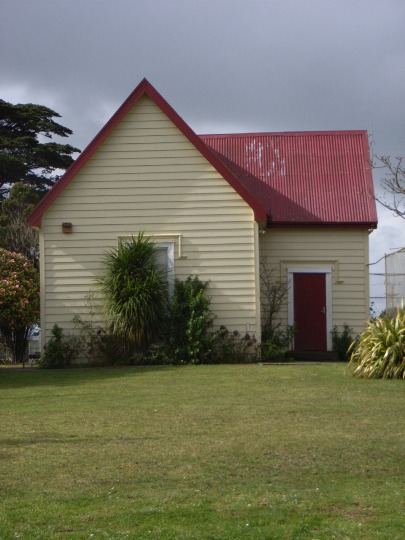
Constructed in 1883 in a rural settlement on the Awhitu Peninsula, Pollok School (Former) served local primary school pupils for over 120 years until its closure in 2005. It is now believed to be the oldest surviving school building on its original site on the Peninsula.
The settlement of Pollok was founded in circa 1865 on land originally purchased by the Crown from Ngati Te Ata in 1861. The venture was led by the Reverend James Milne Smith (?-1888) of the Pollokshaws United Original Secession Church congregation, an offshoot of the established Church of Scotland, Glasgow. Smith failed to realise his dream of a self-contained, self sufficient religious community, and left Pollok in 1882 after one of the township's two combined church and school buildings was destroyed by fire.
Following the Reverend Smith's departure, the Auckland Education Board purchased a 0.8 hectare site for a new school next to the remaining Presbyterian Church (1870). Two thirds of the cost of the purchase was met by local settlers.
The new weatherboard school, with single classroom and side porch, was constructed on the site by Waiuku-based builder Alexander Hammond (1855?-1938). Thought to have been designed by Henry Allright (1827-1906), then the architect for the Education Board, the building featured steeply pitched roof, finials, hood mouldings, and sash windows. The austere interior had close-boarded floors, walls and ceilings, a fireplace in the schoolroom and a wash basin in the porch. Two small earth closets were sited towards the rear of the site.
Formally opened on 11 July 1883, the school became a focal point of the farming community. Until the construction of a local hall in 1922, it also served as the primary venue for gatherings and meetings in the township.
Over time, the Pollok community developed the school and its grounds. In 1902 a flagpole was erected on the site, reflecting the community's loyalty to the Empire and an awareness of emerging national identity. A hard court was formed and two shelter sheds constructed at an unknown date.
The roll expanded and by 1938 the school had an assistant teacher. The nearby Presbyterian Church was used to provide further space for four years from 1947. This coincided with a period of Board-wide difficulties which included insufficient accommodation, a teacher shortage and rising school populations, which was resolved on the Peninsula by construction of Awhitu District School (1949).
The site of Pollok School was enlarged in the 1950s but plans to replace the seven-decade-old building were abandoned on grounds of cost. A prefabricated classroom and a toilet block were moved onto the site in the 1960s. Vacant in 1967 the original school building served as an activities and art room in 1969 and by 1987 as a library and audio visual room. By this time, a suspended ceiling had been installed and much interior wall space concealed by particle board linings.
In 1973, consolidation with Awhitu District School was successfully resisted, but changing government policy resulted in closure of Pollock School in 2005. Buildings other than a 1960s toilet block and the 1883 schoolroom were removed from the site. The 122-year-old building excluding the land was offered to the local community and, in 2008, remains vacant.
The tiny Pollok School (Former) has architectural value as a representative example of a little-altered, single classroom school constructed to an early Auckland Education Board design under the Education Act 1877. It may also have significance as a relatively early example of an educational building designed by Education Board Architect Henry Allright. It has particular value for reflecting the development of education on the Awhitu peninsula from the 1880s onwards and for demonstrating the reconciliation of initially separate religious communities in Pollok. The place has historical and social value for its association with the ongoing development of the rural community initially founded as a Presbyterian Special Settlement, and for its 35-year role as the venue of social events and meetings of the Pollok Roads Board and other community bodies.