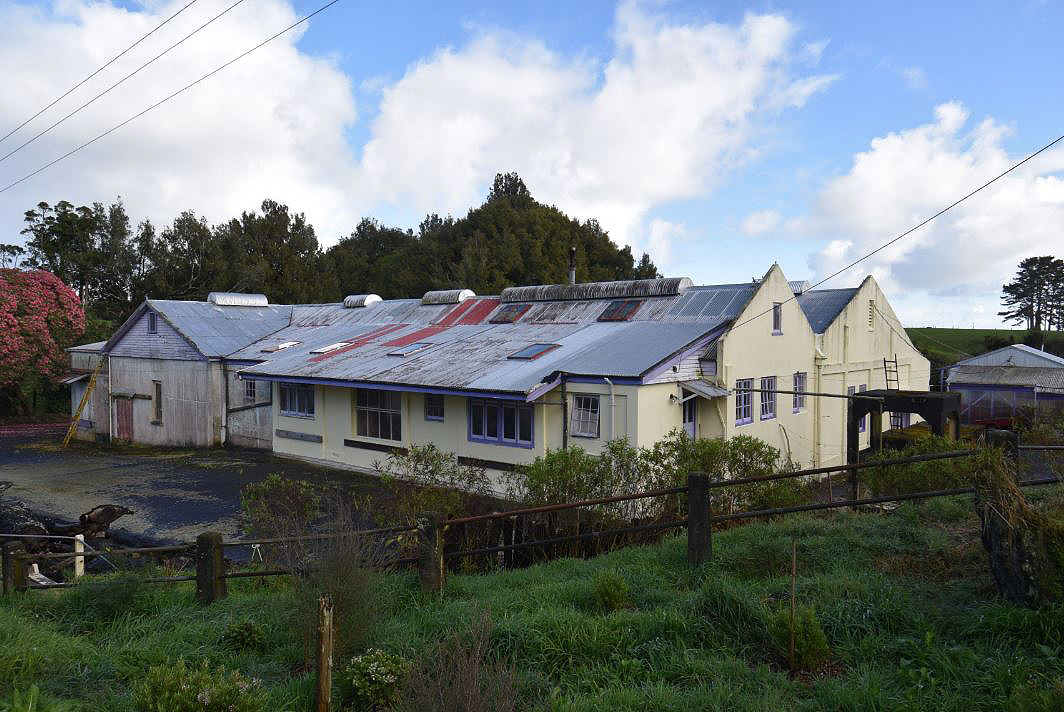
The Kaupokonui Cooperative Dairy Factory Complex (Former) consists of a factory, affiliated auxiliary buildings, and hydro-power scheme positioned either side of SH45, and has a close association with, and proximity to, the Kaūpokonui River. The dairy complex was constructed in increments between 1897 and the 1960s and is a rare, remarkably complete example of this important aspect of Taranaki’s industrial heritage.
There is archaeological evidence of Māori occupation at the mouth of the Kaūpokonui River dating back to the 14th century. The Kaūpokonui River is also said to be the home of a munificent taniwha who made sure that there was a plentiful supply of fish in the river for the settlements along it, including opposite the dairy factory complex site. The river has great cultural and spiritual importance to Ngāti Tū, as does the taonga fish species therein. Immigration and regional migration continued and by the early 19th century there were several iwi present in Taranaki with Ngā Ruahine and Ngāti Ruanui occupying southern Taranaki. During this period inter-tribal competition meant that life was far from peaceful, which was compounded by the ever present threat of invasion from the Waikato. When European incursion into the area began in a small way with whalers and traders from the late 1820s, yet another prospective source of conflict was thrown into the mix. This became a certainty with the forming of the Plymouth Company in early 1840. Although, the first few years of settlement at New Plymouth appear to have been relatively harmonious, by the end of the 1840s settlers were looking to extend their influence and the seeds of conflict between iwi and the Crown were well and truly sown.
The hostilities between some iwi and the Crown around the mid 19th century, and the resultant blanket land confiscations from the 1860s, have been a significant feature of the race relations and politics of the province for over 150 years. Conflict spread to south Taranaki as a result of Ngāti Ruanui’s active support of Te Āti Awa and Ngā Rauru in their mutual struggle against land sales in their respective rohe. This support was viewed by the government as an act of rebellion, and in late 1865 Major General Chute launched a campaign in south Taranaki characterised by a lack of discrimination between hapū who were ‘rebels’ and those who were not. During the temporary cessation of hostilities which resulted, there were blanket confiscations of land under the New Zealand Settlers Act of 1863, and prospective settlers were promised substantial land grants to try and entice them to the area, with only mild success. Eventually, over 350,000 acres of Ngā Ruahine and Ngāti Ruanui land was confiscated with no, or substantially inadequate, compensation.
From the early 1880s the government made another concerted effort to encourage settlement in south Taranaki, selling confiscated land relatively cheaply and investing in road and rail infrastructure. These measures were seen as a means of establishing a definite hold on the region. This policy was successful for the government to the point that railways around the region were established by 1885 and then extended to include a rail link between Pātea and Hāwera. As planned aided settlement and, once the bush had been cleared, dairying began mostly on a modest domestic scale.
The centrality of the dairy industry to the economy of Taranaki from the late 19th century is physically evident when travelling around the region because of the plethora of, now mainly disused, factory buildings in close proximity to main transport routes. Taranaki was ideally suited to agricultural industries because its moderate and wet climate promoted feed growth for grazing animals, such as cattle, consistently over much of the year. Despite the suitability of the area Taranaki was a latecomer to dairying, which meant that by the late 1880s the Crown company and Chew Chong’s Jubilee factories were the only two major concerns in the district.
However, from this point on dairying began to take hold and by 1894 Taranaki had the biggest concentration of dairy factories of any province in New Zealand. It took this title forward into the 20th century surpassing other areas with considerable dairying interests, such as the Waikato and Southland. This rapid growth of the dairy industry facilitated a dramatic turnaround in the economic outlook of farmers. Whereas up until the close of the 19th century their lot had been characterised by impoverishment, they now began to enjoy steady incomes and an associated increased standard of living. As a consequence of the growth of the dairy industry, and the spin-off industries it created, the population in Taranaki rose exponentially.
When the Kaupokonui Cooperative Dairy Co. Ltd. was established in 1897 it was with an air of considerable expectation locally. The foundation board of directors were James Jamieson Campbell (chairman), F.C. Candy, D. Clark, W. Coxhead, James Glenn and John Ryan, with the secretary being E.C. Barleyman, and the first factory manager was a F.W. Falconer. The idea of a cooperative venture had been discussed for several years and the proposed site for the factory on a section of Messrs Glenn’s land near Manaia was perfectly suited, being land with reasonable road access, an adequate water supply close at hand from the Kaūpokonui River, as well as being central to a growing number of dairy farms. In addition to catering for established farms, the presence of the factory at Kaūpokonui stimulated population growth. For example, settlement in Kaūpokonui in 1896-97 was negligible but by 1901 36 landowners were recorded in the area. These were primarily farmers, but also included factory workers, a bootmaker, and postmaster.
The development of Taranaki’s dairy industry coincided with a national move towards cooperative dairy companies, and by the close of the 20th century’s first decade it was estimated that, when travelling in south Taranaki, every five miles would bring you into a different cooperative’s sphere of influence. Cooperative ventures are a characteristic feature of New Zealand’s dairy industry. By 1900 over 40 percent of dairy factories were cooperatives, over the next two decades this number doubled, and by 1944 cooperatives made up 94 percent of the country’s dairy industry. A cooperative dairy company was defined as a company whose primary activity was the production of butter, cheese, and other dairy products, from milk and cream supplied by its farmer shareholders. The profit from the sale of these goods was then divided among the supplier shareholders, after processing and other expenses were subtracted, based on the amount of butterfat in the raw material each had provided in proportion to the company’s other suppliers.
The initial timber factory at Kaūpokonui was completed in 1898 and was a structure typical of contemporary dairy factories. The company made sure the factory, which became the central factory, could accommodate production to an extent worthy of that title. At Kaūpokonui the factory was described as ‘large, roomy, and strongly constructed, and the plant is up-to-date and complete.’ The factory featured cheese and butter-making machinery, giving the company the option of producing both or a majority of one product depending on the market value. It could therefore obtain the best possible return for its contributing farmers. By 1910 the original modestly sized timber factory had been extended, and a general store was built close by. All this contributed to the Kaūpokonui factory being touted as ‘one of the most complete in the colony.’
It is evident from the outset that the company aimed at becoming a major force in Taranaki’s and New Zealand’s dairy industry. Within ten years of its establishment an ambitious programme of purchasing and building meant that the company had numerous branch factories, securing its ascendancy in the district. These included the purchase of three former Crown Company factories between 1898 and 1901, the building of the Takatau Road creamery in 1898, and the construction of the Oeo Branch in 1901. In 1907 the company’s Kapuni factory was constructed, completing its eventual complement of eight branch factories. It was said that ‘throughout South Taranaki dairy factories and creameries present the most familiar of architectural effects,’ and the Kaūpokonui company was a significant contributor to this.
Another of the company’s activities which demonstrated its commitment to succeed was the early development of hydro-mechanical and hydro-power scheme associated with the Kaūpokonui factory. As well as having a climate perfectly suited to dairy farming, the proliferation of rivers and streams in Taranaki offered ample opportunity for the development of another characteristic regional industrial aspect; hydro-power generation. Just as there is plenty of physical evidence of the proliferation and importance of dairying in Taranaki, there are approximately 100 dam and weir installations remaining in the waterways, which validates the description of Taranaki as ‘the most electrically-minded province during the early years of power development in New Zealand.’
The dairy industry has traditionally been eager to adopt and develop new technologies and this was a major contributor to its growth and success in the early to mid 20th century. It is therefore not surprising that factories were frequently upgraded and expanded, and that the industry also embraced electricity. Some factories, such as the Kaūpokonui factory, even had their own hydro-power scheme from early in their history. It was only a few years after the Kaūpokonui factory was established that it was being powered by a hydro-scheme.
The source of this power was the adjacent Kaūpokonui River in which Climie and Fairhall, a local engineering and surveying firm, designed a weir and system of tunnels and channels in 1900. The weir enabled water to be diverted through a tunnel and race up to the factory, and later the powerhouse. By 1911 the energy generated by the scheme supplied the company with enough electricity to enable electric lighting in the factory and other on-site buildings, such as the powerhouse, manager’s cottage, general store, office, and stables. Hydro-electric capabilities were of particular importance to the Kaūpokonui factory and company as it gave them a distinct advantage over many of their competitors - it was only in the 1920s and 1930s that public rural electrification projects were established. While making an important contribution to the running of the factory, the weir had a negative ecological impact, because it became a barrier to the progress of piharau (an eel-like fish) and other fish along the river, trapping them at that point.
By 1910 the Kaupokonui Cooperative Dairy Co. Ltd. was reputedly the most prolific dairy company in New Zealand, and possibly the world, with its product accounting for approximately one eighth of New Zealand’s total export of cheese in 1908. However, the company suffered a setback on 23 December 1910 when the Kaūpokonui factory was devastated by fire. The blaze started in the boiler room around 1am and, fanned by strong winds, it spread quickly through the factory and nearby buildings. The timber factory and general store stood little chance because of highly flammable materials inside, as well as the fact that the Manaia fire crew was not at the scene until approximately 1:30am. Nineteen men were housed in the factory and adjacent living quarters, but no one was injured. The accommodation block was able to be saved when the fire crew arrived, mainly because of the proximity of water from the hydro-scheme race.
Unfortunately, timber dairy factories were highly vulnerable to fire. Other dairy companies, which would otherwise be considered the competition, recognised the likelihood of their business being disrupted or ruined by fire and this motivated generosity towards the Kaūpokonui company in the wake of the blaze. Because it was a large enterprise the company was able to share out some of the workload to its branch factories. However, in the immediate aftermath the Joll and Riverdale companies also offered to take in Kaūpokonui suppliers’ milk. The factory and store were insured which reduced the financial impact of the fire, although it was still a setback. However, the company seems to have taken it on the chin and within a few weeks a temporary factory had been set up in their newly constructed stables across the road from the factory site.
Because the risk of fire was heightened with timber buildings Kaūpokonui, and other factories affected by fire from this period onwards, was rebuilt using reinforced concrete. After the fire, the building was re-orientated so that the delivery bays were on the eastern side. The General Store was also rebuilt, but in a different location, across the road from the factory building. This building was significantly larger than its predecessor and was constructed in concrete too. The original store was reputedly the first dairy factory store in the Waimate district, and the new store took over this mantle on completion.
The Kaūpokonui company continued to be a major force in the New Zealand dairy industry ranking among the top five largest companies in terms of the number of factories it operated. When ruminating on the local importance of the factory in 1940, C. J. Roberts regretted that despite seeing it grow into a success, ‘none of the original settlers saw it reach its present magnitude, keeping hundreds of persons employed at varying periods from sun-up to sun-down.’
However, in 1941 operations at the factory were again interrupted because the weir, which had been diverting the water necessary to generate its power since 1900, was severely damaged by a flood. The original, and then rebuilt, weir were run-of-river structures which, unlike a dam, meant that the natural cycle of the river’s waterflow was allowed to continue although, as previously mentioned, this did not extend to many of its inhabitants. Also, because peak dairying periods coincided with the time the river was at its lowest, it is likely that the hydro-scheme would have diverted most, if not all of the available river water at these times. The new weir was designed by Lou Butler of Inglewood, constructed entirely of concrete, and connected to the existing series of tunnels. This flood followed one a decade earlier which washed out the tunnel under the factory and saw it diverted to the external powerhouse.
By 1947 the Kaūpokonui factory site covered approximately four acres including the factory building, the store, Post Office, motor truck depot, various staff dwellings, and the structures and sites associated with the electricity generation for these. Aside from the central factory complex, the company still had its eight branch factories, several stores, and dozens of connected staff dwellings as assets too. The Auroa Branch Factory was the only other site to have its own hydro-power scheme, but this was significantly smaller than the main factory’s. However, this was the beginning of a period of significant change for the Kaūpokonui company and factory, and was reflective of broader changes within the dairying industry as a whole.
The Kaūpokonui factory is said to have been ‘rebuilt’ in 1952, when actually it only underwent a modification and extension project, albeit a substantial one, including the addition of new gabled sections. The creation of a large single loading bay was in step with other factories, becoming a characteristic feature of dairy factory buildings around New Zealand. The increase in size of the Kaūpokonui factory building meant the company’s complex became comparable, in the scope and form of the buildings, to other significant contemporary complexes, such as Edendale in Southland.
This was the period when tanker collection was being introduced in New Zealand and it may be safely assumed this was the impetus behind this structural change to create a single loading bay. The milk tanker ‘revolutionised milk collection’ because delivery was no longer the domain of each farmer. When the onus for delivery was on the individual farmers the factory’s former series of small scale bays would have been used to accommodate several deliveries at the same time. However, tanker collection enabled the efficiency of bulk delivery and therefore only one large specifically designed bay became necessary. Tanker use also furthered the centralisation of the industry during this time period. The longer distances able to be covered by the tankers meant factory processing activities could be concentrated, which in turn lead to company mergers and the demise of most small factories and their associated support settlements. The history of the Kaūpokonui company during this period demonstrates it was no exception to this rule, with most of its branch factories being sold by 1961 and production centralised to the parent factory.
For most of the Kaūpokonui company’s history it only had two major rivals within the region; the Riverdale and Joll operations. At one point the rivalry between Kaupokonui and Joll had been publicly bitter. However by the 1960s, in the face of industry-wide centralisation, these two giants of the Taranaki dairy industry resolved to amalgamate. Merger with the Joll company had first been suggested in 1932 and then at various intervals, coming to nothing until 1962 when an overwhelming majority of Kaupokonui’s shareholders voted to join the companies and form Kiwi Cooperative Dairies Limited. Mergers continued over the subsequent years and by 2000 Kiwi and their only other major competitor, New Zealand Dairy Group, accounted for 95 per cent of the country’s dairy industry. In 2001 84 percent of the farmers in these companies agreed to combine their interests and as a consequence Fonterra Cooperative Group Limited was established.
After the Kaupokonui and Joll merger, Kiwi continued to use the Kaūpokonui factory for processing. The factory is said to have begun taking supplementary electricity from the South Taranaki Electric Power Board around 1961 because its private scheme could not accommodate an increased in demand. However, its scheme was not abandoned until dairy processing at the factory ceased. Despite further mergers and centralisation, the Kaūpokonui factory was operational up until 1975. The building did not stay vacant for long however, because in that same year Pacific Natural Gut String Co. Ltd. (PNGS) began manufacturing there.
Until the early 21st century German owned PNGS manufactured tennis racket strings at the factory and was a significant local employer. These strings were internationally renowned and in 2002 the company was presented with the prestigious New Zealand Exporter of the Year Award. However, the company which had been touted as ‘the best tennis string manufacturer in the world,’ had significant financial woes since the mid-1990s which threatened its survival and production had ceased at the factory by 2013. The nature of the production meant that no significant structural changes to the factory were necessary.
During the early period of dairy operations at the factory, the Kaūpokonui site was a social hub that facilitated interaction between the large group of people affiliated with it. This continued to a certain extent under PNGS, especially with instances in the 1990s when the large open plan space of the factory’s cheese curing section was used for indoor tennis and a local basketball tournament.
When it took over the factory premises PNGS did not resurrect the dairy company’s hydro-electric scheme. Despite the lapsing of the hydro-scheme the weir was of some use as the site of the Taranaki Regional Council’s flow monitoring station. However, the fish pass which was constructed as part of the weir does not live up to its name and for some time the weir has been considered a major impediment to fish movement. In particular, it blocks numerous species of freshwater fish, including two ‘classified as nationally vulnerable, and six are classified as being “in decline”.’ Two other weirs on the Kaūpokonui River were removed for similar reasons.