The Wairarapa with its fertile plains, dense forests, rich waterways and coastline has been an attractive place for settlement for centuries. The land has had a long history of occupation by Rangitane iwi as well as later arrivals such as Ngai Tahu, Ngati Ira and Ngati Kahungunu iwi who came to the Wairarapa in the eighteenth and nineteenth centuries.
Rangitane (also known as Rangitanenui, Tanenui-a-rangi and Rangitanenui-a-rangi) was the grandson of Whatonga, one of three chiefs who commanded the Kurahaupo waka to New Zealand. The people of Rangitane settled the lower North Island and the top of the South Island which led to the creation of various hapu groups and over time some separate iwi groups. After Rangitane came the people of Ngati Kahungunu whose ancestry traces back to the Takitimu waka which arrived in New Zealand captained by Tamatea Arikinui. Kahungnunu was a famous chief that had several wives and fathered many children. Like Rangitane, Ngati Kahungunu migrated south and established themselves in places like the Wairarapa. Migrations and marriages between the peoples that occupied the Wairarapa resulted in a complex web of whakapapa and political alliances.
Crown purchases in the Wairarapa:
In 1858 William Searancke (1817?-1904), land purchase agent for the Government, secured a number of major Crown land deeds in the Wairarapa, Manawatu and Horowhenua areas, including parts of the Tupurupuru Block in 1858 and 1859. Further Crown purchases and subsequent taking up of Crown land by settlers saw over three quarters of the land in the Wairarapa transferred out of Maori ownership. European settlement in the Wairarapa was also promulgated by the development of the Small Farms Association by Joseph Masters. His legacy would be of the establishment of the towns of the Wairarapa including Masterton (named in honour of Masters), Carterton, Greytown, and Featherston.
Tupurupuru, Maungaraki and Hinewaka:
The land block on which the majority of the hydroelectric power scheme is located is known as Tupurupuru. Tupurupuru was the name of an ancestor of the Te Whiti/Maungaraki area. Tupurupuru was a famous Maori warrior who was instrumental in the defeat of the taniwha Ngarara Huarau (also called Mokonui) who had made himself a lair above the Kourarau stream and terrorised the local people. It is said that the taniwha died in the Uwhiroa swamp. Another version of the Ngarara Huarau story describes the cliffs near Kourarau as the bones of the taniwha.
Kourarau means ‘many Koura’. Koura are endemic freshwater crayfish that inhabit the streams, lakes and wetlands of New Zealand. The Kourarau Steam and wetlands were a rich source food and sustained groups living in the vicinity and those travelling from the coast to the interior. Kevin Fearon in his history of Gladstone notes a number of pa sites, kainga and burial grounds that were dispersed around the district, including the Kourarau Pa was on the banks of the Kourarau Stream high on the Maungaraki hills and the Hinewaka Pa site above Surge Towner 2. It is noted by Fearon that people who were to be buried at Hinewaka were pulled up the hill using a sledge and horse. Weapons and toanga were buried in the wetlands and the place is also associated with the concept of mauri, as a place of mauri ora and mauri mate. The construction of the hydroelectric scheme was to disrupt mauri and brought into the conflict of Pakeha technology with traditional beliefs.
Sir Walter Buchanan:
In 1922 land was made available for the investigation and construction of the hydro scheme by Sir Walter Clarke Buchanan (1838-1924), a notable New Zealander for his success as a farmer, businessman, politician and philanthropist. Buchanan had bought the 10,000 acre Tupurupuru run for £21,000 in 1873 and worked hard to establish his farm and cattle business. He was heavily involved in politics, representing Wairarapa South (1881-87), and then Wairarapa (1887-89, 1902-5, and 1908-14); knighted in 1912; and appointed as a member of the Legislative Council in 1915. As a wealthy farmer, Buchanan was able to influence conservative politics through various means, including the media. He bought 800 shares in the founding of the Dominion newspaper that would be an agitator during the term of the Liberal government. Buchanan was supportive of the Kourarau Hydroelectric Power Scheme and would have the honour of opening the first power station in December 1923, several months before his death in July 1924.
William Henry Beetham:
A section of the land that makes up the upper dam and reservoir area was part of the Kourarau Station, owned by William Henry Beetham (1837-1925), an early European settler to the Wairarapa who along with his brothers established Brancepeth Station in 1856 and was a member of the firm Williams and Beetham.
By 1901 Brancepeth was one of the largest and wealthiest stations in the Wairarapa. It extended from what is now Ngaumu Forest in the south (towards Te Wharau) to the Taueru River in the north, and as far west as Kourarau. In an effort to avoid a government-imposed division of the run, the Beethams and Thomas Coldham Williams divided the Station and William Henry Beetham took over the Kourarau property in 1905. Beetham was also a supporter of the hydro project and had identified its use for hydroelectric purposes early on.
Hinewaka:
Further land was acquired from other land owners for the formation of the upper reservoir. Under the powers in the Electric-power Board’s Act 1925 and the Public Works Act 1928 approximately 11 acres of Section 2A Hinewaka Block (resurveyed as Lot 4 DP 8639) owned by Mitai Mikaera, was taken under proclamation and a new title issued to the Wairarapa Electric Power Board in 1930.
Early Development of Electrical Power in the Wairarapa:
The first study into the hydro potential of the Wairarapa formed part of the hydro resource report that Peter Seton Hay (1852/1853?-1907) of the Public Works Department presented to Parliament in1904. Hay noted the Tauherenikau and the Waiohine Rivers as possible sources of hydroelectric power. In November 1916 a group of people representing local authorities, industry and other organisations decided to a form a Wairarapa Hydro-Electric Investigation Committee. A number of sources were investigated with the Waiohine River deemed the most attractive.
In 1918 the government embarked on a plan for the generation of hydroelectric power and the Electric Power Board Act 1918 allowed for the establishment of a local body dedicated to the supply of power. It was envisioned that the state would generate the electricity and the power boards provide for the reticulation within their communities. A petition by the ratepayers of the boroughs and counties within the Wairarapa area proposing the establishment of the Wairarapa Electric Power District was made to the Government in 1920. The petition was accepted and the Wairarapa Electric Power Board was constituted on the 23 March 1920. The Board was made up of nine representatives of boroughs and counties within the Electric Power District: D. McLachlan (Masterton County), J.C. Cooper and R.J. King (Masterton Borough), T.V. Moore (Wairarapa South County), W.H. Booth (Carterton Borough), W. Benton (Featherston Borough), W.A. Huttton (Greytown Borough), J.W. Kershaw (Martinborough Town Board) and J. Martin (Featherston County). James Cooper was elected chairman.
Consultant engineers, H.F. Toogood and J.R.Templin, were employed to investigate the potential of the Waiohine River. The engineers submitted a favourable report for the development of a 3000 horsepower scheme. However, due to the scarcity of resources like labour, cement and capital the Government proposed that the Power Board abandon this scheme and rely on the 2000 horsepower that would be supplied by the state owned Mangahao Hydroelectric Power Scheme, due for completion in 1924.
The Power Board began raising the funds required to build the infrastructure to bring electricity to the households, businesses and industry within the Wairarapa Electric Power District. A loan of £260,000 was raised and a resident engineer sought.
On 8 March 1922 it was reported that the Power Board had appointed Harry Richard Climie (1884-1961) as resident engineer. Climie was an experienced electrical and civil engineer who had already been involved in a number of electricity reticulation and hydroelectric power schemes throughout New Zealand. He would leave the employment of the Board in 1924 and go on to design and construct other hydroelectric power schemes and led a distinguished career. Most notably he was appointed reconstruction engineer after the Hawke’s Bay earthquake in 1931, and became chief engineer for housing construction for the State Housing Department in 1937.
The Power Board decided to supplement the power that would come from Mangahao with its own hydroelectric stand-by plant. Climie proposed an ambitious scheme for harnessing the power of the Kourarau Steam; with its 219 metres of fall the stream had been identified by others for its potential. Climie estimated the cost of the scheme at £35,000 and his estimate would be close to the final cost.
Construction of Power Station A, lower dam and Power Station B:
Climie oversaw the design and construction of the hydro scheme and his family firm, H.W. Climie and Son, were involved with the project up to its completion in 1925. The hydro scheme was constructed in two phases with Power Station A and its generating infrastructure completed by 1923 and Power Station B in 1925. Permission was obtained by the Government for the Wairarapa Electric Power Board to construct electric works and erect electric lines in 1922. In that same year a licence to use water from the Kourarau Stream and its tributaries for the purpose of generating electricity was granted.
Contracts for the construction were let and excavations for the pipe line commenced in February 1922. Construction of Power Station A and the lower reservoir began with the forming of a dray road to access the lower dam site. The work was done by horses and teams of men. Six men were in each pit in the dam part before the scooping started. The time taken to complete the project took longer than expected due to a harsh winter and it was a testimony to the men who were camping in those conditions to get the work done.
Opening of the Kourarau Power House:
On 20 December 1923 a number of dignitaries and members of the public gathered to celebrate the switching on of Power Station A. J.C Cooper, Chairman of the Wairarapa Electric Power Board, presided and spoke about the ‘genesis of the scheme’ and also gave an indication of the power that the Kourarau scheme would generate for use by dairy plants, heating and home lighting.
George James Anderson (1860-1935), Minister of Labour and representing the Government, praised the need for communities to supply power as well as the government. He advocated the harnessing of the potential of New Zealand’s rivers for hydro-generation, with the closing comment: ‘Some people objected to the beauty of the Dominion falls being destroyed but utility must come before beauty.’
Sir Walter Buchanan in his speech made reference to the taniwha that had dwelt in the area and discussed the power of the ‘modern taniwha’ that would milk cows, freeze meat and build a huge dam. Henry Climie thanked the engineering staff and workman, the contractors and the companies that supplied the machinery and pipes. He also paid tribute to Sir Walter Buchanan for his advice.
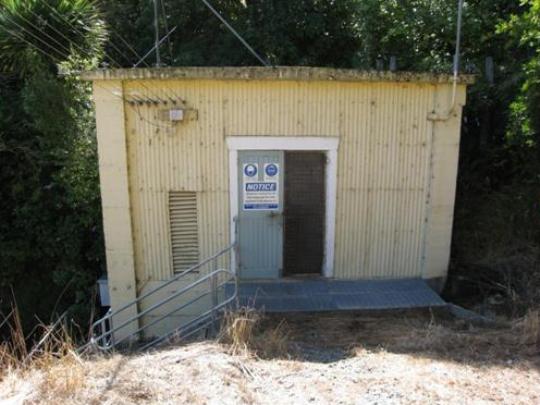
The proceedings ended with Sir Walter pushing the button that turned the water on and the Boving pelton wheel turbine began its slow revolutions until it reached capacity. A plaque commemorating this event is affixed to the wall of the operation room marking the 60th anniversary of the Kourarau Scheme in 1983. On that day 235 customers received power and ‘Kourarau became the first publically owned and operated hydro-electric power station in the Wellington Province.’
The hydro scheme played an important part in the guarantee of electricity supply to a number of important Power Board customers including the Waingawa freezing works (connected 1931, closed 1990) and the Masterton Hospital. In 1927 Masterton Hospital became the first substantial hospital in New Zealand to use electricity for all services and the availability of the two stand-by stations at Kourarau formed part of the decision making for the hospital to rely on electrical power for its services.
The Kourarau stations were pivotal in initiating the reticulation of electricity in the Wairarapa eighteen months before the arrival of power from Mangahao or Waikaremoana which came online in 1929. With power available from the developing national grid the Kourarau stations took on the role of reducing the Wairarapa Power Board’s peak demand on the State system until an agreement was reached to feed power from Kourarau into the national grid in 1930.
In December 1924 an extraordinary flood drowned the turbine and generator, with debris and silt blocking up the stream and damaging Power Station A. After only a year of electrical supply Wairarapa consumers were plunged into darkness for a number of months until power could be reinstated. Repair and prevention were costly at a time when the Power Board was generating little income and a resolution to issue a levy from people within the Power Board’s district was passed. The Board raised £6,550 for the works and the power station was raised six metres to resist future floods.
An unforeseen issue for the Kourarau Scheme was the issue of the pipes silting up and the build up of lime deposits that had the capacity to reduce output by 25 percent. The solution for cleaning the pipes was a device called a cage ‘hedgehog’ (imported from England). The hedgehog is described as a ‘leather bag resembling an open-ended rugby football with an external frame which carries a series of steel wire brushes under tension against the pipe interior applied by a steel spring ring’. The hedgehog is hoisted into the pipes at Windy Point, on the site of Te Wharau Road, and rammed into place. Water pressure from Power Station B is used to blow the hog down to the Power House A where it is lifted out by a crane. The de-liming operation continues to be carried out in the same manner today. Changes to the scheme to allow for the ability to clean the pipes were designed by the Wairarapa Electric Power Board Chief Engineer, Henry Keenan, in 1928.
Cultural and Social Impacts of Electricity:
In the early 1930s the Wairarapa Electricity Power Board published a handbook for electricity users that outlined the myriad of electrical appliances and their uses in the home. The handbook also highlighted the use of electricity in industries like dairy farming with electric milking machines, separators and hot water. The introduction of a continuous electrical supply for consumers created social change for those in the home and in business. The handbook extols the virtues of this cultural shift: ‘No other source of power is doing for mankind the multitude of duties undertaken by electricity’. The Wairarapa Electric Power Board Head Office building was built in 1925 and is located in Carterton. When the head office moved to Masterton it became the showroom for appliances and electrical equipment for consumers. A portent comment at the opening of the Kourarau Scheme was that once electricity was introduced there would be a continual thirst for its use; its use being a ‘contagious thing’ that would require sufficient supply to meet demand.
Catastrophic events, monopolies and restructuring:
The Kourarau Scheme has had to weather a number of catastrophic events over the years. The first being the 1924 flood that disabled the Power Station A. In 1934 a severe hurricane dislocated the whole of the distribution system, causing over £3,000 of damage. Due to healthy revenues the Power Board was able to meet the cost of the repairs and the staff to carry out the work.
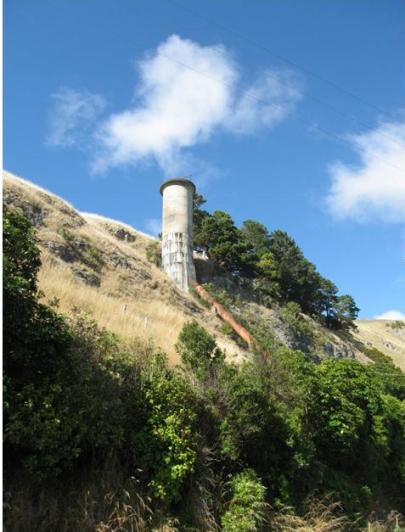
The Wairarapa experienced a magnitude 7.2 earthquake centred near Masterton on 24 June 1942. It caused substantial damage throughout the Wairarapa and Wellington regions. The concrete Surge Tower no. 1 bent over and began leaking during the upheaval. Repairs were required to strengthen it and Chief Engineer for the Wairarapa Electric Power Board, Henry Keenan, was involved in the plans to brace and strengthening the interior of the shaft using concrete and reinforcing steel. The headworks at the upper dam were also affected and cost the Board about £1,500 to repair.
A catastrophic flood in April 2005 saw the Kourarau Stream once again flood Power Station A, leaving it covered in silt and debris and the surrounding gardens devastated. Power Station B continued to operate while Power Station A was cleaned up and the workings dried out. The windows were blocked up, and large concrete blocks surround the operation room. While this detracts from the aesthetic values of the power station these works will hopefully ensure its survival into the future.
In 2006 work to stabilise the hillside was carried out after cracks appeared in the penstock and it was reported that water was coming down the hillside. The 75 year old concrete penstock was found to be in excellent condition but work was required to the area that was undermining the penstock’s footing. It was only the third time in its operational history that the scheme needed to be shut down so repairs could be made.
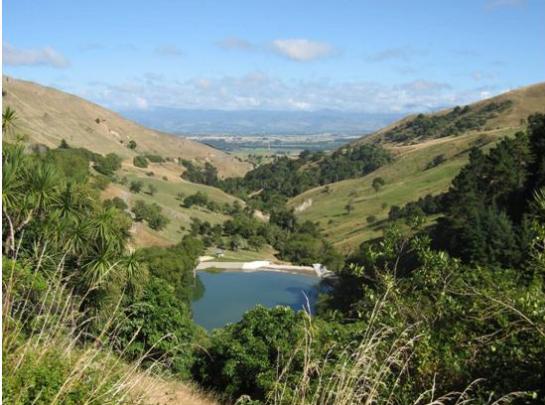
Over the years the upper dam and reservoir became a recreation site providing a place for residents to go fishing, rafting and kayaking. Trout were also released into the reservoir to increase angling opportunities. In 2010 an upgrade of the dam and spillway were undertaken with the construction of an auxiliary spillway to augment discharge capacity. Improvements were made to public access with a carpark adjacent to the reservoir.
During the economic reforms of the 1980s and 90s electricity distribution, generation and supply changed in the Wairarapa. The Wairarapa Electricity Power Board was formed into Wairarapa Electricity Limited in 1993, in accordance with the provisions of the Energy Companies Act 1992. Deregulation of the energy industry meant that that Wairarapa Electricity could sell to customers outside the region and customers could buy energy from other traders. It was at this time that the Kourarau Scheme was sold to the State Owned Enterprise, Genesis Energy Limited, who have utilised and maintained the scheme for over 15 years.
In January 2011 Genesis Energy announced that the Kourarau Hydroelectric Power Scheme would be transferred to the Tararua Foundation Incorporated, a charitable trust managed by Trust House Limited, in February 2011. In a press release Genesis Energy outlined the reason for the transfer, stating that ‘they were approached by a collective of Masterton based businessmen interested in returning Kourarau to community ownership in the Wairarapa region. These businessmen emphasised the significant historical value of Kourarau to the Wairarapa community as well as the long-term amenity, ecological and recreational value of the land and upper reservoir to the Community’. The ownership of the Kourarau Scheme has come full circle and its role as a renewable energy generator under community control will hopefully see its continued use into the twenty first century.