DonateMembershipVisit Heritage
  • Tūrangawaewae
    Places
  • Tira Māori
    Māori Heritage
  • Poutairangahia
    Archaeology
  • Rauemi
    Resources
  • Mō Tātou
    About Us
  • New Zealand Heritage List
  • Nominate and submit
  • Explore the List
  • National Historic Landmarks
  • Plaques
  • Rainbow List Project
  • Lost heritage
  • Visit Heritage
  • Our properties
  • Turnbull House Project
  • Collections
  • Shop
  • Tohu Whenua
  • Tira Māori
  • Conserving Māori heritage
  • Marae built heritage
  • Māori heritage on the List
  • Hinemihi—Te Hokinga Mai
  • What is archaeology?
  • Is there a site on my property?
  • What are my legal requirements?
  • Affecting an archaeological site
  • Declaring an archaeological site
  • Archaeology FAQs
  • Archaeology Digital Library
  • Archaeology guidelines and templates
  • Resources
  • Funding
  • Publications
  • Sustainable management guides
  • Disaster recovery
  • Podcasts & digital resources
  • Education Hub
  • Conservation plans
  • About
  • Board
  • Māori Heritage Council
  • Senior Staff
  • Offices
  • Contact us
  • Careers
  • Covenants
  • Fast-track
  • Corporate documents
  • Currently consulting on
  • Our submissions
  • News
  • Covid-19 response
Quick links
Rārangi Kōrero | The List
Explore the List
National Historic Landmarks
Ngā Manawhenua o Aotearoa me ōna Kōrero Tūturu
Quick links
Tapuwae
A Vision for Places of Māori Heritage
Funding for Māori Heritage
Resources
Quick links
Archaeological Authority Portal
Applying for an archaeological authority
Archaeology FAQs
Browse the most frequently asked questions about archaeological authorities and the archaeological process.
Quick links
Quick links
News
News Keep up to date with Heritage New Zealand Pouhere Taonga
Membership
Membership Find out more and sign up today
DonateMembershipVisit Heritage
  • Tūrangawaewae
    Places
  • Tira Māori
    Māori Heritage
  • Poutairangahia
    Archaeology
  • Rauemi
    Resources
  • Mō Tātou
    About Us
  • New Zealand Heritage List
  • Nominate and submit
  • Explore the List
  • National Historic Landmarks
  • Plaques
  • Rainbow List Project
  • Lost heritage
  • Visit Heritage
  • Our properties
  • Turnbull House Project
  • Collections
  • Shop
  • Tohu Whenua
  • Tira Māori
  • Conserving Māori heritage
  • Marae built heritage
  • Māori heritage on the List
  • Hinemihi—Te Hokinga Mai
  • What is archaeology?
  • Is there a site on my property?
  • What are my legal requirements?
  • Affecting an archaeological site
  • Declaring an archaeological site
  • Archaeology FAQs
  • Archaeology Digital Library
  • Archaeology guidelines and templates
  • Resources
  • Funding
  • Publications
  • Sustainable management guides
  • Disaster recovery
  • Podcasts & digital resources
  • Education Hub
  • Conservation plans
  • About
  • Board
  • Māori Heritage Council
  • Senior Staff
  • Offices
  • Contact us
  • Careers
  • Covenants
  • Fast-track
  • Corporate documents
  • Currently consulting on
  • Our submissions
  • News
  • Covid-19 response
Quick links
Rārangi Kōrero | The List
Explore the List
National Historic Landmarks
Ngā Manawhenua o Aotearoa me ōna Kōrero Tūturu
Quick links
Tapuwae
A Vision for Places of Māori Heritage
Funding for Māori Heritage
Resources
Quick links
Archaeological Authority Portal
Applying for an archaeological authority
Archaeology FAQs
Browse the most frequently asked questions about archaeological authorities and the archaeological process.
Quick links
Quick links
News
News Keep up to date with Heritage New Zealand Pouhere Taonga
Membership
Membership Find out more and sign up today
  • Places
  • Nominate and submit
  • National Historic Landmarks
  • Places
  • Nominate and submit
  • National Historic Landmarks
  • Tira Māori
  • Conserving Māori heritage
  • Marae built heritage
  • Tira Māori
  • Conserving Māori heritage
  • Marae built heritage
  • Archaeological authorities
  • Archaeology Digital Library
  • Archaeological authorities
  • Archaeology Digital Library
  • All resources
  • Publications
  • Funding
  • All resources
  • Publications
  • Funding
  • FAQs
  • FAQs
Follow us on:
Places
  • Places
  • Nominate and submit
  • National Historic Landmarks
Tira Māori
  • Tira Māori
  • Conserving Māori heritage
  • Marae built heritage
Archaeology
  • Archaeological authorities
  • Archaeology Digital Library
Resources
  • All resources
  • Publications
  • Funding
FAQs
  • FAQs
Follow us on
HomePrivacyTerms and conditionsAbout this site
© Heritage New Zealand Pouhere Taonga 2026.
 
Wilson’s Hydraulic Lime and Cement Works Ruins

Wilson Road, WARKWORTH

Private

Historic Place Category 1

List No. 82
Quick links:
List GalleryLocationDetails
Incorporating visible remains from the early 1880s onwards, the former Wilson’s Cement Works at Warkworth is nationally and internationally significant as the first factory to commercially produce Portland cement in Australasia, and possibly the Southern Hemisphere. The complex is also of high value for its connections with the earlier development and production of industrial-scale hydraulic lime in New Zealand. Both hydraulic lime and cement were important to the country’s construction industry, including as essential ingredients of concrete. Plain concrete, in particular, appears to have been more commonly used in New Zealand than most other countries in the nineteenth century. Reinforced concrete was also rapidly adopted in New Zealand at an internationally early stage.

Land beside the Mahurangi River is traditionally associated with Ngati Manuhiri. In 1841, the area was acquired by the Crown as part of the Mahurangi Purchase. European settlers soon recognised that local limestone might be useful for producing lime, a component of products that included mortar for construction work. By 1849 or 1850, stone-based lime was being locally produced. John Southgate is said to have manufactured a more water-resistant product, hydraulic lime, on the current cement works site in the early 1850s. In 1857, the site formed part of a large property obtained by two other producers, Auckland entrepreneurs Walter Combes and William Crush Daldy: at this time, it contained a lime kiln, a hut and a jetty.

In 1869, the property was purchased by Nathaniel Wilson (1836-1919), who through his commitment to improving production techniques became known as the ‘father’ of cement manufacture in New Zealand. Wilson initially pioneered the production of fine-ground hydraulic lime, which gained wide currency after establishment of the firm John Wilson and Company (with Nathaniel’s brothers, John and James) in 1878 because this material was easier to package and use. From the mid-1880s, the business also became the first in Australasia, and possibly the Southern Hemisphere, to develop and produce Portland cement in marketable quantities.

Surviving remnants of the period before cement production include a set of lime kilns and a concrete residence, both erected using hydraulic lime. The latter structure was one of several workers’ houses on the site, and probably built at a similar time to other showcase structures erected by the company from 1880 onwards to advertise their products in and around Auckland. In 1882, the complex also included a boiler stack, grinding equipment, storage sheds, tramways, and separate wharves for loading lime and discharging fuel. The lime was obtained from a large quarry immediately beside the main buildings.

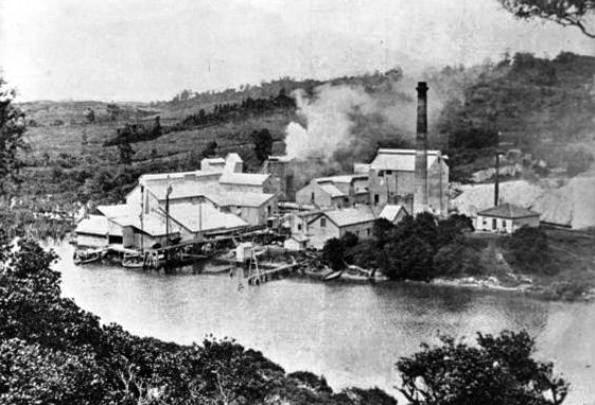
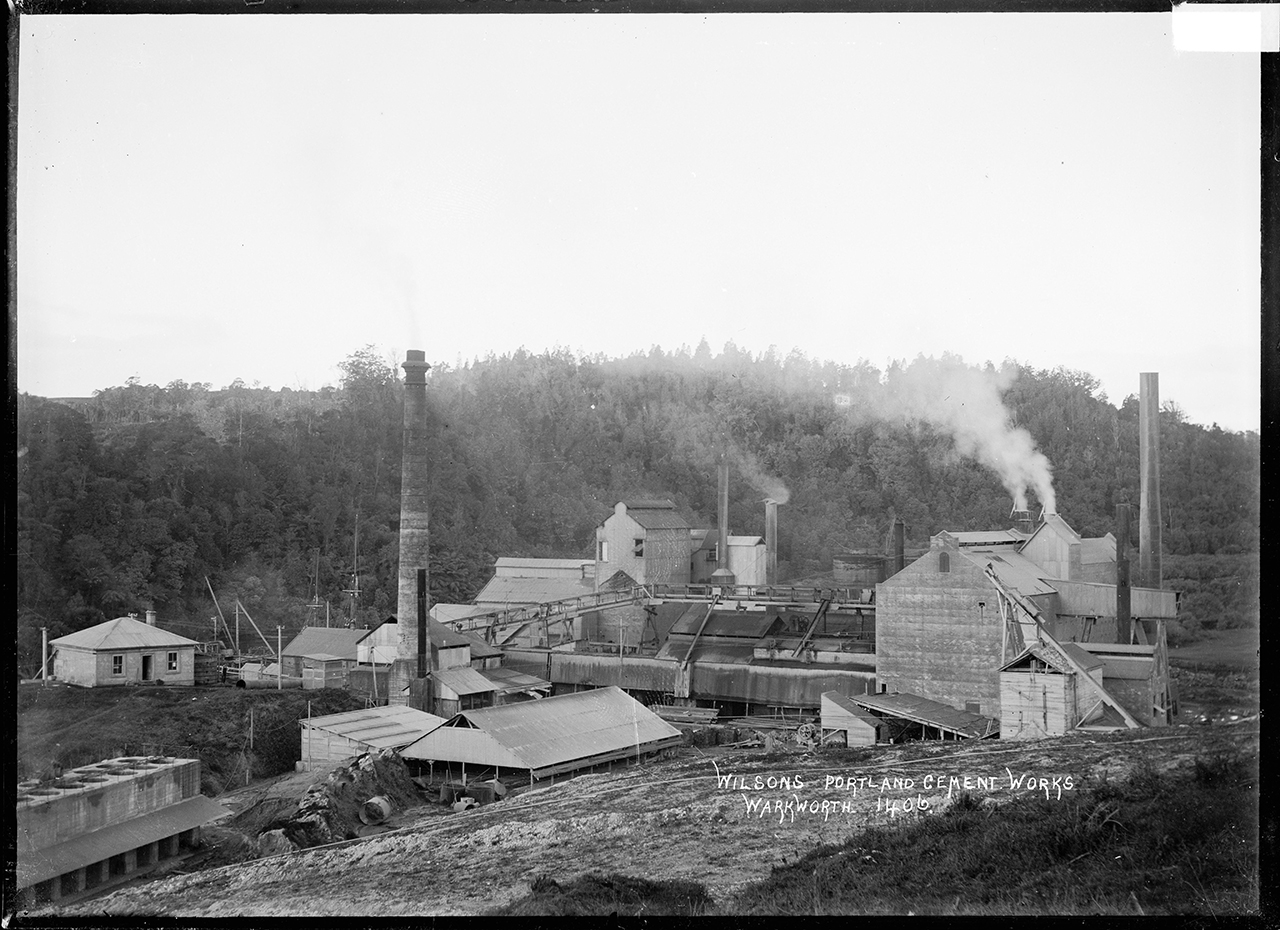
Wilsons’ developed its Portland cement in 1884, offering it for sale the following year. New purpose-built equipment included two large vertical kilns and a pug mill. Hydraulic lime production continued, including for structures such as the Pots Hill Reservoir, Sydney, which kept the works operating during a subsequent period of economic depression. In 1903-4, when the business became a public limited liability company, American-made rotary kilns were introduced to produce cement more effectively. At this time, the firm manufactured some 20,000 tons annually and employed 180 workmen.

Notable structures erected using Wilsons’ cement included Grafton Bridge (1907-10) in Auckland, which had the longest single concrete span in the world when built. In 1907-8, the company doubled the size of its plant and capacity at a cost of £30,000. In 1913, it was reported to have ‘the largest output of any cement manufactory in the Dominion’. As a visible reflection of this, an imposing 42-metre reinforced concrete chimney designed by the manager, T.H. Wilson, was erected in 1916. The outbreak of the First World War in 1914 and increasing competition in the marketplace, however, ultimately led to financial losses. In 1918, three major cement companies, including the Warkworth-based enterprise, amalgamated to form Wilsons (NZ) Portland Cement Company. Cement production subsequently shifted to a newer factory at Portland, near Whangarei, in 1924, followed by hydraulic lime production four years later. In 1930, most of the land was sold to Benjamin Hamilton, storekeeper of Warkworth.

During the Second World War (1939-45), the complex was damaged during a demolition exercise carried out by the Home Guard and United States military personnel. Full public ownership of the site occurred in 2003.

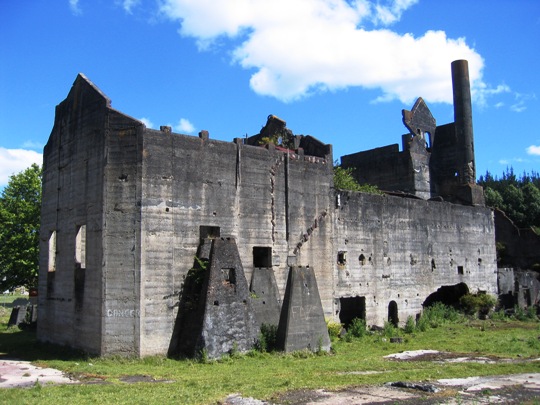
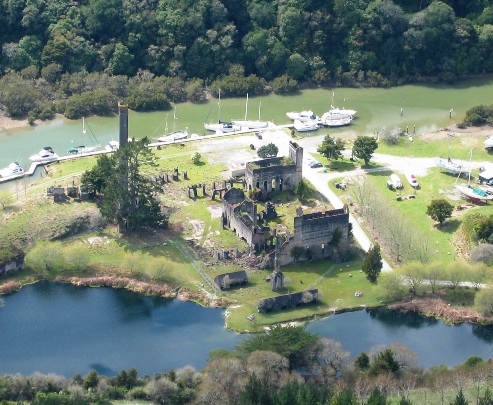
The surviving complex, including its associated quarry and tailings, can be considered to have aesthetic significance for its striking visual appearance and setting; archaeological significance for its potential to provide information about the development of the hydraulic lime and concrete industries in New Zealand; architectural significance as a rare purpose-built complex for the manufacture of lime and cement manufacture in the nineteenth- and early twentieth centuries; historical significance for its connections with the early development of these industries in New Zealand, with notable figures such as Nathaniel Wilson, and with the role of industrial enterprise and labour during this period; and technological and scientific significance as the birthplace of industrially-produced Portland cement in Australasia and possibly the Southern Hemisphere. The complex forms part of a wider landscape of significance, which includes the associated Manager’s House (Former) (List No. 2600).
Wilson’s Hydraulic Lime and Cement Works Ruins, Warkworth. CC BY-SA 2.0 Image courtesy of commons.wikimedia.org | russellstreet | 11/11/2012 | russellstreet - Wikimedia Commons
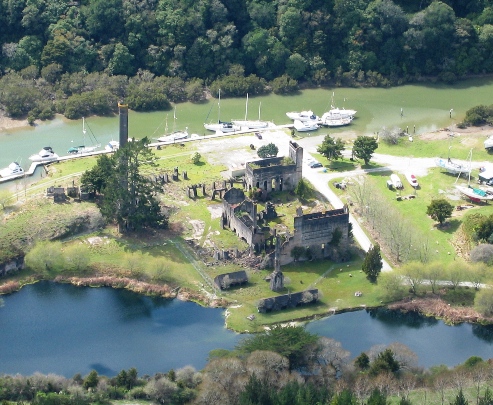
Wilson’s Hydraulic Lime and Cement Works Ruins, Warkworth. Aerial shot | 13/09/2005 | Rodney District Council
Wilson’s Hydraulic Lime and Cement Works Ruins, Warkworth. c.1910 Wilson Portland Cement Works, Rodney County. 1866-1948: Collection of post card negatives. Ref: 1/2-000597-G. Alexander Turnbull Library, Wellington, NZ | William Price | No Known Copyright Restrictions
Wilson’s Hydraulic Lime and Cement Works Ruins, Warkworth. CC BY-SA 2.0 Image courtesy of commons.wikimedia.org | russellstreet | 11/11/2012 | russellstreet - Wikimedia Commons
Wilson’s Hydraulic Lime and Cement Works Ruins, Warkworth. Aerial shot | 13/09/2005 | Rodney District Council
Wilson’s Hydraulic Lime and Cement Works Ruins, Warkworth. c.1910 Wilson Portland Cement Works, Rodney County. 1866-1948: Collection of post card negatives. Ref: 1/2-000597-G. Alexander Turnbull Library, Wellington, NZ | William Price | No Known Copyright Restrictions

List Entry Information

Overview

Status
Listed

List Entry Status
Historic Place Category 1

Access
Private/No Public Access

List Number
82

Date Entered
23rd June 1983

Date of Effect
23rd June 1983

City/District Council
Auckland Council

Region
Auckland Council

Extent of List Entry

Extent includes the land described as Secs 1-2 SO 379415 (RTs 405520-405521, NZ Gazette 2008, p.363), Lot 4 DP 204384 (RT NA131A/962), Lot 4 DP 157198 (NA94B/901), Lot 3 DP 54387 (NZ Gazette 1995, p.1788) and Allots 373-374 Parish of Mahurangi (Sec 62 Conservation Act 1987), North Auckland Land District, and the buildings and structures known as Wilson’s Hydraulic Lime and Cement Works Ruins thereon.

Legal description

Secs 1-2 SO 379415 (RTs 405520-405521, NZ Gazette 2008, p.363), Lot 4 DP 204384 (RT NA131A/962), Lot 4 DP 157198 (NA94B/901), Lot 3 DP 54387 (NZ Gazette 1995, p.1788) and Allots 373-374 Parish of Mahurangi (Sec 62 Conservation Act 1987), North Auckland Land District

Detailed List Entry

Construction Professional

Name

T. H. Wilson

Type

Engineer

Biography

No biography is currently available for this construction professional

Construction Details

Type

Addition

Description

Limestone Store

Period

c.1902-4

Start Year

1902

Type

Addition

Description

Brick kiln

Start Year

1903

Type

Addition

Description

Coal Mill building

Type

Addition

Description

Additions, including upper storey of Ball and Tube Mill

Period

1907-8

Start Year

1916

Type

Addition

Description

Main chimney, and extension to Limestone Store

Type

Addition

Description

Steel-built kiln

Period

Unknown

Type

Addition

Description

Up-and-over limestone crusher

Period

Unknown

Type

Addition

Description

Limestone drying chimney

Period

Unknown

Type

Addition

Description

Storage bins

Period

Unknown

Type

Addition

Description

Packing shed [floor surviving]

Period

Unknown

Type

Addition

Description

Cement store [floor surviving]

Period

Unknown

Type

Addition

Description

Abutments for ropeways or tramways

Period

Unknown

Type

Addition

Description

Wharf

Period

Unknown

Type

Partial Demolition

Description

Removal of rotary kilns and other plant for transfer to Portland

Period

1925-7

Type

Partial Demolition

Description

Partial demolition by Home Guard and US military personnel

Period

1940s

Type

Original Construction

Description

Lime kilns

Period

c.1878-83

Type

Addition

Description

Engineer’s House

Period

Pre-1882

Start Year

1894

Type

Addition

Description

Chimney (base surviving)

Type

Addition

Description

Vertical cylindrical kilns

Period

1894-9

Start Year

1898

Type

Addition

Description

Engine and boiler rooms

Type

Additional building added to site

Description

Ball and Tube Mill building

Period

c.1902-3

Reference

Public NZAA Number

R09/703

Completion Date

26th June 2015

Report Written By

Martin Jones

Information Sources

Thornton, 1982

Geoffrey G. Thornton, New Zealand's Industrial Heritage, A.H. & A.W. Reed, Wellington, 1982

Thornton, 1996

Geoffrey Thornton, Cast in Concrete: Concrete Construction in New Zealand 1850-1939, Auckland, 1996

New Zealand Herald

11 Nov 1903, p.6.

Dave Pearson Architects Limited, 2005

Dave Pearson Architects Limited, ‘Wilson’s Cement Works, Warkworth: A Conservation Plan,’ unpublished report, Auckland, 2005.

Geometria Limited, 2007

Geometria Limited, ‘Wilson Cement Works: Archaeological Assessment’, unpublished report, Auckland, 2007.

Marriot & La Roche, 2011

Marriott, Andrew and John La Roche, ‘The Cement Works of Northland’, in La Roche, John (ed.), Evolving Auckland: The City’s Engineering Heritage, Christchurch, 2011

Wilson, 1957

Wilson, Thomas Henry, History of the Birth and Growth of Wilson’s Portland Cement in New Zealand, Auckland, 1957.

Report Written By

This place was identified as significant under previous legislation with different information requirements. It remains significant under the current legislation. There is opportunity under our legislation and policies to add to this information. Further information about this place may be available from the Northern Regional Office of Heritage New Zealand Pouhere Taonga. Please note that entry on the New Zealand Heritage List/Rarangi Korero identifies only the heritage values of the property concerned, and should not be construed as advice on the state of the property, or as a comment of its soundness or safety, including in regard to earthquake risk, safety in the event of fire, or insanitary conditions. A fully referenced upgrade report is available on request from the Northern Region Office of Heritage New Zealand

Further Information

Current Usages

Uses: Civic Facilities

Specific Usage: Historic or recreation reserve

Former Usages

General Usage:: Manufacturing

Specific Usage: Manufacturing - other

Themes

Web Links

description: Engineering NZ Heritage

url: https://www.engineeringnz.org/our-work/heritage/heritage-records/mahurangi-cement-works/

Overview

Status

Listed

List Entry Status

Historic Place Category 1

Access

Private/No Public Access

List Number

82

Date Entered

23rd June 1983

Date of Effect

23rd June 1983

City/District Council

Auckland Council

Region

Auckland Council

Extent of List Entry

Extent includes the land described as Secs 1-2 SO 379415 (RTs 405520-405521, NZ Gazette 2008, p.363), Lot 4 DP 204384 (RT NA131A/962), Lot 4 DP 157198 (NA94B/901), Lot 3 DP 54387 (NZ Gazette 1995, p.1788) and Allots 373-374 Parish of Mahurangi (Sec 62 Conservation Act 1987), North Auckland Land District, and the buildings and structures known as Wilson’s Hydraulic Lime and Cement Works Ruins thereon.

Legal description

Secs 1-2 SO 379415 (RTs 405520-405521, NZ Gazette 2008, p.363), Lot 4 DP 204384 (RT NA131A/962), Lot 4 DP 157198 (NA94B/901), Lot 3 DP 54387 (NZ Gazette 1995, p.1788) and Allots 373-374 Parish of Mahurangi (Sec 62 Conservation Act 1987), North Auckland Land District

Status

Listed

List Entry Status

Historic Place Category 1

Access

Private/No Public Access

List Number

82

Date Entered

23rd June 1983

Date of Effect

23rd June 1983

City/District Council

Auckland Council

Region

Auckland Council

Extent of List Entry

Extent includes the land described as Secs 1-2 SO 379415 (RTs 405520-405521, NZ Gazette 2008, p.363), Lot 4 DP 204384 (RT NA131A/962), Lot 4 DP 157198 (NA94B/901), Lot 3 DP 54387 (NZ Gazette 1995, p.1788) and Allots 373-374 Parish of Mahurangi (Sec 62 Conservation Act 1987), North Auckland Land District, and the buildings and structures known as Wilson’s Hydraulic Lime and Cement Works Ruins thereon.

Legal description

Secs 1-2 SO 379415 (RTs 405520-405521, NZ Gazette 2008, p.363), Lot 4 DP 204384 (RT NA131A/962), Lot 4 DP 157198 (NA94B/901), Lot 3 DP 54387 (NZ Gazette 1995, p.1788) and Allots 373-374 Parish of Mahurangi (Sec 62 Conservation Act 1987), North Auckland Land District

Construction Information

Construction Professional

Name

T. H. Wilson

Type

Engineer

Biography

No biography is currently available for this construction professional

Construction Details

Type

Addition

Description

Limestone Store

Period

c.1902-4

Start Year

1902

startYearCirca

Type

Addition

Description

Brick kiln

Start Year

1903

startYearCirca

Type

Addition

Description

Coal Mill building

Type

Addition

Description

Additions, including upper storey of Ball and Tube Mill

Period

1907-8

Start Year

1916

Type

Addition

Description

Main chimney, and extension to Limestone Store

Type

Addition

Description

Steel-built kiln

Period

Unknown

Type

Addition

Description

Up-and-over limestone crusher

Period

Unknown

Type

Addition

Description

Limestone drying chimney

Period

Unknown

Type

Addition

Description

Storage bins

Period

Unknown

Type

Addition

Description

Packing shed [floor surviving]

Period

Unknown

Type

Addition

Description

Cement store [floor surviving]

Period

Unknown

Type

Addition

Description

Abutments for ropeways or tramways

Period

Unknown

Type

Addition

Description

Wharf

Period

Unknown

Type

Partial Demolition

Description

Removal of rotary kilns and other plant for transfer to Portland

Period

1925-7

Type

Partial Demolition

Description

Partial demolition by Home Guard and US military personnel

Period

1940s

Type

Original Construction

Description

Lime kilns

Period

c.1878-83

Type

Addition

Description

Engineer’s House

Period

Pre-1882

Start Year

1894

Type

Addition

Description

Chimney (base surviving)

Type

Addition

Description

Vertical cylindrical kilns

Period

1894-9

Start Year

1898

Type

Addition

Description

Engine and boiler rooms

Type

Additional building added to site

Description

Ball and Tube Mill building

Period

c.1902-3

Construction Professional

Name

T. H. Wilson

Type

Engineer

Biography

No biography is currently available for this construction professional

Construction Details

Type

Addition

Description

Limestone Store

Period

c.1902-4

Start Year

1902

startYearCirca

Type

Addition

Description

Brick kiln

Start Year

1903

startYearCirca

Type

Addition

Description

Coal Mill building

Type

Addition

Description

Additions, including upper storey of Ball and Tube Mill

Period

1907-8

Start Year

1916

Type

Addition

Description

Main chimney, and extension to Limestone Store

Type

Addition

Description

Steel-built kiln

Period

Unknown

Type

Addition

Description

Up-and-over limestone crusher

Period

Unknown

Type

Addition

Description

Limestone drying chimney

Period

Unknown

Type

Addition

Description

Storage bins

Period

Unknown

Type

Addition

Description

Packing shed [floor surviving]

Period

Unknown

Type

Addition

Description

Cement store [floor surviving]

Period

Unknown

Type

Addition

Description

Abutments for ropeways or tramways

Period

Unknown

Type

Addition

Description

Wharf

Period

Unknown

Type

Partial Demolition

Description

Removal of rotary kilns and other plant for transfer to Portland

Period

1925-7

Type

Partial Demolition

Description

Partial demolition by Home Guard and US military personnel

Period

1940s

Type

Original Construction

Description

Lime kilns

Period

c.1878-83

Type

Addition

Description

Engineer’s House

Period

Pre-1882

Start Year

1894

Type

Addition

Description

Chimney (base surviving)

Type

Addition

Description

Vertical cylindrical kilns

Period

1894-9

Start Year

1898

Type

Addition

Description

Engine and boiler rooms

Type

Additional building added to site

Description

Ball and Tube Mill building

Period

c.1902-3

Reference

Historical and Associated Iwi / Hapū / Whānau

Public NZAA Number

R09/703

Completion Date

26th June 2015

Report Written By

Martin Jones

Information Sources

Thornton, 1982

Geoffrey G. Thornton, New Zealand's Industrial Heritage, A.H. & A.W. Reed, Wellington, 1982

Thornton, 1996

Geoffrey Thornton, Cast in Concrete: Concrete Construction in New Zealand 1850-1939, Auckland, 1996

New Zealand Herald

11 Nov 1903, p.6.

Dave Pearson Architects Limited, 2005

Dave Pearson Architects Limited, ‘Wilson’s Cement Works, Warkworth: A Conservation Plan,’ unpublished report, Auckland, 2005.

Geometria Limited, 2007

Geometria Limited, ‘Wilson Cement Works: Archaeological Assessment’, unpublished report, Auckland, 2007.

Marriot & La Roche, 2011

Marriott, Andrew and John La Roche, ‘The Cement Works of Northland’, in La Roche, John (ed.), Evolving Auckland: The City’s Engineering Heritage, Christchurch, 2011

Wilson, 1957

Wilson, Thomas Henry, History of the Birth and Growth of Wilson’s Portland Cement in New Zealand, Auckland, 1957.

Other Information

This place was identified as significant under previous legislation with different information requirements. It remains significant under the current legislation. There is opportunity under our legislation and policies to add to this information. Further information about this place may be available from the Northern Regional Office of Heritage New Zealand Pouhere Taonga. Please note that entry on the New Zealand Heritage List/Rarangi Korero identifies only the heritage values of the property concerned, and should not be construed as advice on the state of the property, or as a comment of its soundness or safety, including in regard to earthquake risk, safety in the event of fire, or insanitary conditions. A fully referenced upgrade report is available on request from the Northern Region Office of Heritage New Zealand

Historical and Associated Iwi / Hapū / Whānau

Public NZAA Number

R09/703

Completion Date

26th June 2015

Report Written By

Martin Jones

Information Sources

Thornton, 1982

Geoffrey G. Thornton, New Zealand's Industrial Heritage, A.H. & A.W. Reed, Wellington, 1982

Thornton, 1996

Geoffrey Thornton, Cast in Concrete: Concrete Construction in New Zealand 1850-1939, Auckland, 1996

New Zealand Herald

11 Nov 1903, p.6.

Dave Pearson Architects Limited, 2005

Dave Pearson Architects Limited, ‘Wilson’s Cement Works, Warkworth: A Conservation Plan,’ unpublished report, Auckland, 2005.

Geometria Limited, 2007

Geometria Limited, ‘Wilson Cement Works: Archaeological Assessment’, unpublished report, Auckland, 2007.

Marriot & La Roche, 2011

Marriott, Andrew and John La Roche, ‘The Cement Works of Northland’, in La Roche, John (ed.), Evolving Auckland: The City’s Engineering Heritage, Christchurch, 2011

Wilson, 1957

Wilson, Thomas Henry, History of the Birth and Growth of Wilson’s Portland Cement in New Zealand, Auckland, 1957.

Other Information

This place was identified as significant under previous legislation with different information requirements. It remains significant under the current legislation. There is opportunity under our legislation and policies to add to this information. Further information about this place may be available from the Northern Regional Office of Heritage New Zealand Pouhere Taonga. Please note that entry on the New Zealand Heritage List/Rarangi Korero identifies only the heritage values of the property concerned, and should not be construed as advice on the state of the property, or as a comment of its soundness or safety, including in regard to earthquake risk, safety in the event of fire, or insanitary conditions. A fully referenced upgrade report is available on request from the Northern Region Office of Heritage New Zealand

Further Information

Current Usages

Uses: Civic Facilities

Specific Usage: Historic or recreation reserve

Former Usages

General Usage: Manufacturing

Specific Usage: Manufacturing - other

Web Links

description: Engineering NZ Heritage

url: https://www.engineeringnz.org/our-work/heritage/heritage-records/mahurangi-cement-works/

Current Usages

Uses: Civic Facilities

Specific Usage: Historic or recreation reserve

Former Usages

General Usage: Manufacturing

Specific Usage: Manufacturing - other

Web Links

description: Engineering NZ Heritage

url: https://www.engineeringnz.org/our-work/heritage/heritage-records/mahurangi-cement-works/

Location

Loading
Related listings
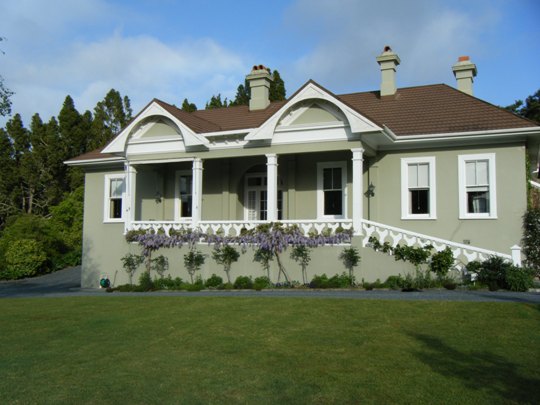
Manager's House (Former), 108 Wilson Rd, Warkworth. CC BY 4.0 Image courtesy of commons.wikimedia.org
Manager's House (Former)
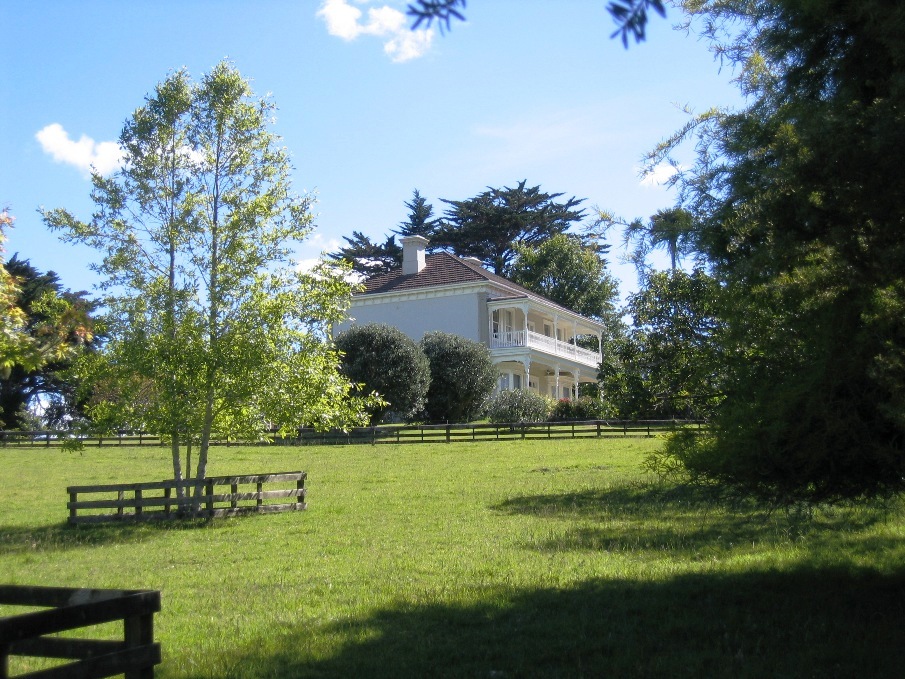
Riverina, Warkworth
Riverina
Riverina, Warkworth
Riverina
Manager's House (Former), 108 Wilson Rd, Warkworth. CC BY 4.0 Image courtesy of commons.wikimedia.org
Manager's House (Former)
Stay up to date with Heritage this month