Quick links


Quick links
Quick links
Quick links
Quick links
Quick links
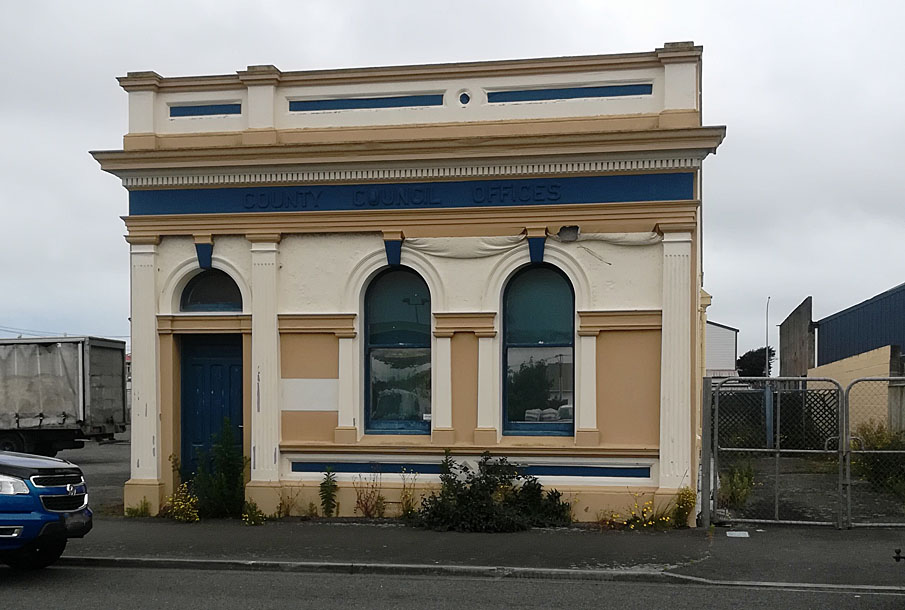
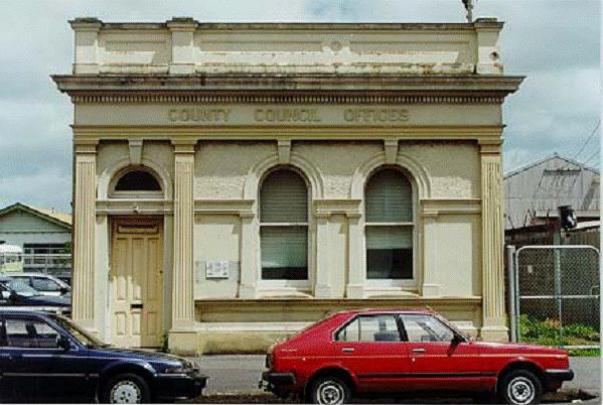
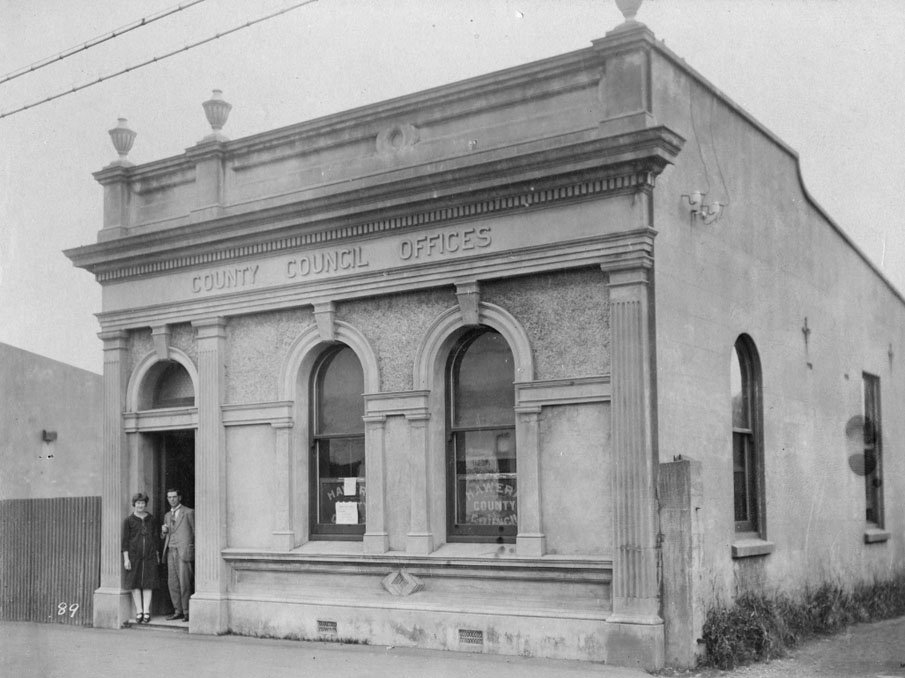
Hawera County Council Offices (Former)
33 Princes Street, HĀWERA
Private
Historic Place Category 2
List No. 862
Quick links:
List GalleryLocationDetails
33 Princes Street, HĀWERA
Private
Historic Place Category 2
List No. 862
List Entry Information
Status
Listed
List Entry Status
Historic Place Category 2
Access
Private/No Public Access
List Number
862
Date Entered
1st September 1983
Date of Effect
1st September 1983
City/District Council
South Taranaki District
Region
Taranaki Region
Extent of List Entry
Extent includes the land described as Subdivision 2 Lot 61 DP 32 (RT TNJ4/8), Taranaki Land District and the building known as Hawera County Council Offices (Former) thereon. The extent excludes the 2004 addition to the building, on the adjoining land parcel (Lot 1 DP 6156, Taranaki Land District).
Legal description
Subdivision 2 Lot 61 DP 32 (RT TNJ4/8), Taranaki Land District
Status
Listed
List Entry Status
Historic Place Category 2
Access
Private/No Public Access
List Number
862
Date Entered
1st September 1983
Date of Effect
1st September 1983
City/District Council
South Taranaki District
Region
Taranaki Region
Extent of List Entry
Extent includes the land described as Subdivision 2 Lot 61 DP 32 (RT TNJ4/8), Taranaki Land District and the building known as Hawera County Council Offices (Former) thereon. The extent excludes the 2004 addition to the building, on the adjoining land parcel (Lot 1 DP 6156, Taranaki Land District).
Legal description
Subdivision 2 Lot 61 DP 32 (RT TNJ4/8), Taranaki Land District
Construction Professional
Name
Pacey, Ernest Arthur
Type
Builder
Biography
Pacey took over his father’s contracting business in 1898 and by 1908 was described as having ‘erected a large number of buildings in the Hawera district’ He was the builder of the Hawera County Council Offices (Former) in 1912. Source: Hawera County Council Offices (Former)upgrade report 2020.
Name
Roe, Joseph Edward
Type
Architect
Biography
Joseph Edward Roe attended Wanganui Collegiate School from 1884 to 1886 and was working as a joiner in Wellington in 1893. He was practising as an architect in Masterton by 1899 and by 1902 was in practice there with William Crichton. The firm was responsible for the design of the Carterton Home for Aged Poor Men and Roe also designed several dairy factories. Roe was later in the employ of the Public Works Department, Cape Government, South Africa, where he undertook an extensive survey of the government’s buildings and acted as superintendent for several large building contracts. In April 1904, having just returned from South Africa, Roe announced his intention to commence work as an architect in Hāwera. Roe worked independently in Hāwera until January 1915, when he commenced partnership with Mr F.E. Greenman of Wellington. During his time in Hāwera, Roe designed a large number of buildings, with one commentator noting that ‘perhaps the great majority of the modern business premises and private residences have been built to his plans’. He specialised in the construction of reinforced concrete buildings, and continued to design dairy factories in places such as Normanby, Alton and Kāpuni). Other notable examples of Roe’s work include the Manaia Town Hall (1906) which burnt down in 1953; Waverley Town Hall (1908) - the front façade of which was essentially a mirror image of the Manaia Hall’s façade; Central Hotel (1913), now demolished; White Hart Hotel (formerly Empire Hotel) (1909); Nolan, Tonks and Co. Building on the corner of High and Regent Streets, Hāwera; and Barleyman’s Building (1913) on Princes Street, Hāwera. These latter two buildings are both substantial two-storeyed concrete buildings with a stucco finish designed for shops on the lower floor and offices or accommodation on the upper floor. In July 1916 Roe commenced practice in Whanganui and he is known to have designed two private residences (at Castlecliff and on Selwyn Street, Whanganui); public conveniences on Maria Place, Whanganui; and additions to the Brunswick Dairy Factory. Roe relocated to Whāngarei around March 1924 and was advertising his services in Mt Eden, Auckland from March 1927. He is not listed as an architect after 1933. Source: Upgrade Report, 2020
Construction Details
Start Year
2004
Type
Addition
Description
Southern addition added
Start Year
2004
Type
Modification
Description
Interior alterations
Start Year
1912
Type
Original Construction
Type
Addition
Description
Rear addition constructed
Period
1930s to 1940s
Construction Professional
Name
Pacey, Ernest Arthur
Type
Builder
Biography
Pacey took over his father’s contracting business in 1898 and by 1908 was described as having ‘erected a large number of buildings in the Hawera district’ He was the builder of the Hawera County Council Offices (Former) in 1912. Source: Hawera County Council Offices (Former)upgrade report 2020.
Name
Roe, Joseph Edward
Type
Architect
Biography
Joseph Edward Roe attended Wanganui Collegiate School from 1884 to 1886 and was working as a joiner in Wellington in 1893. He was practising as an architect in Masterton by 1899 and by 1902 was in practice there with William Crichton. The firm was responsible for the design of the Carterton Home for Aged Poor Men and Roe also designed several dairy factories. Roe was later in the employ of the Public Works Department, Cape Government, South Africa, where he undertook an extensive survey of the government’s buildings and acted as superintendent for several large building contracts. In April 1904, having just returned from South Africa, Roe announced his intention to commence work as an architect in Hāwera. Roe worked independently in Hāwera until January 1915, when he commenced partnership with Mr F.E. Greenman of Wellington. During his time in Hāwera, Roe designed a large number of buildings, with one commentator noting that ‘perhaps the great majority of the modern business premises and private residences have been built to his plans’. He specialised in the construction of reinforced concrete buildings, and continued to design dairy factories in places such as Normanby, Alton and Kāpuni). Other notable examples of Roe’s work include the Manaia Town Hall (1906) which burnt down in 1953; Waverley Town Hall (1908) - the front façade of which was essentially a mirror image of the Manaia Hall’s façade; Central Hotel (1913), now demolished; White Hart Hotel (formerly Empire Hotel) (1909); Nolan, Tonks and Co. Building on the corner of High and Regent Streets, Hāwera; and Barleyman’s Building (1913) on Princes Street, Hāwera. These latter two buildings are both substantial two-storeyed concrete buildings with a stucco finish designed for shops on the lower floor and offices or accommodation on the upper floor. In July 1916 Roe commenced practice in Whanganui and he is known to have designed two private residences (at Castlecliff and on Selwyn Street, Whanganui); public conveniences on Maria Place, Whanganui; and additions to the Brunswick Dairy Factory. Roe relocated to Whāngarei around March 1924 and was advertising his services in Mt Eden, Auckland from March 1927. He is not listed as an architect after 1933. Source: Upgrade Report, 2020
Construction Details
Start Year
2004
Type
Addition
Description
Southern addition added
Start Year
2004
Type
Modification
Description
Interior alterations
Start Year
1912
Type
Original Construction
Type
Addition
Description
Rear addition constructed
Period
1930s to 1940s
Historical and Associated Iwi / Hapū / Whānau
Completion Date
10th January 2020
Report Written By
Karen Astwood
Information Sources
Roberts, 1940
Roberts, Cyril John, Centennial History of Hawera and the Waimate Plains, Hāwera, Hawera Borough and County Councils, Manaia Town Board and Waimate County Council, 1940
Other Information
This place was identified as significant under previous legislation with different information requirements. It remains significant under the current legislation. There is opportunity under our legislation and policies to add to this information. Further information about this place may be available from the Central Regional Office of Heritage New Zealand Pouhere Taonga. A fully referenced upgrade report is available on request from the Central Region Office of Heritage New Zealand. Please note that entry on the New Zealand Heritage List/Rarangi Korero identifies only the heritage values of the property concerned, and should not be construed as advice on the state of the property, or as a comment of its soundness or safety, including in regard to earthquake risk, safety in the event of fire, or insanitary conditions.
Historical and Associated Iwi / Hapū / Whānau
Completion Date
10th January 2020
Report Written By
Karen Astwood
Information Sources
Roberts, 1940
Roberts, Cyril John, Centennial History of Hawera and the Waimate Plains, Hāwera, Hawera Borough and County Councils, Manaia Town Board and Waimate County Council, 1940
Other Information
This place was identified as significant under previous legislation with different information requirements. It remains significant under the current legislation. There is opportunity under our legislation and policies to add to this information. Further information about this place may be available from the Central Regional Office of Heritage New Zealand Pouhere Taonga. A fully referenced upgrade report is available on request from the Central Region Office of Heritage New Zealand. Please note that entry on the New Zealand Heritage List/Rarangi Korero identifies only the heritage values of the property concerned, and should not be construed as advice on the state of the property, or as a comment of its soundness or safety, including in regard to earthquake risk, safety in the event of fire, or insanitary conditions.
Former Usages
General Usage: Government
Specific Usage: Council/local government building
General Usage: Government
Specific Usage: Government office building
General Usage: Law Enforcement
Specific Usage: Administration Office
General Usage: Law Enforcement
Specific Usage: Law Enforcement - other
General Usage: Trade
Specific Usage: Shop
Former Usages
General Usage: Government
Specific Usage: Council/local government building
General Usage: Government
Specific Usage: Government office building
General Usage: Law Enforcement
Specific Usage: Administration Office
General Usage: Law Enforcement
Specific Usage: Law Enforcement - other
General Usage: Trade
Specific Usage: Shop
Location
Get the latest heritage news, features and events delivered
straight to your inbox.
