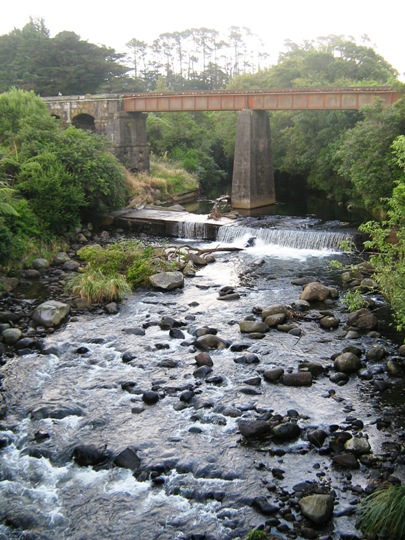
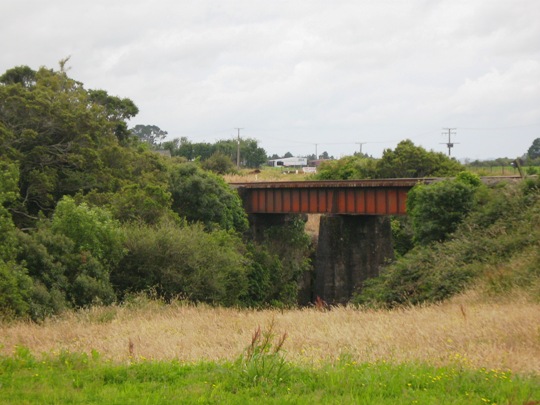
The Waipuku Stream Bridge was originally constructed in 1879 and subsequently modified as a result of floods and vandalism. This bridge has historic significance as a vestige of New Zealand’s peak rail construction period. The structure’s subsequent modifications, representing common materials of their era, are evidence of its ongoing importance within this railway which has contributed significantly to Taranaki’s society and economy.
In the 1870s, building a Taranaki railway was seen as way of furthering European settlement in the province. During this period New Zealand had its first surge of railway construction due to Julius Vogel’s (1835–99) public works and immigration policy. Constructed in this boom period, the railway south from New Plymouth was the North Island’s first extensive railway project and reached Stratford by 1879. The Waipuku Stream Bridge was built as part of Public Works Department railway project, which resulted in efficient transport but also increased settlement and communications.
The bridge’s original main contractor was David Glendinning of Auckland, who was awarded the bridge contract in mid-1878 and was responsible for several of the railway’s other bridges. A local mason, Alexander MacDonald appears to have been a sub-contractor, beginning work on the stone elements in early 1879. The current bridge features the distinctive masonry piers and arches of the original construction. Its original 80 foot (24.4m) long under-strutted timber truss was replaced 1911 with the current intermediate concrete pier and two 40 foot (12.2m) steel plate girder spans. Recesses for the truss’s struts can be seen in the face of the masonry piers. The bridge is 38m long and stands 9.5m above the stream bed.
The Waipuku Stream Bridge has had a colourful history of risk, including guards being stationed there during 1886 bush fires to protect this vital feature within the railway. It also seems to have been pushed ‘out of alignment’ during severe flooding in 1935, which destroyed several other bridges in the vicinity and ‘completely disorganised railways communication throughout Taranaki’. However, perhaps the biggest threat to the bridge was in 1966. Considerable repairs, estimated at £6,500, were required after two local men in their twenties ‘decided to blow up the bridge’. The blast was heard in Stratford and ‘ripped out a section of the bridge’. Luckily, the railcar which triggered the detonator did not derail and, although the people aboard were understandably shaken, no one was injured. The culprits were quickly arrested and duly convicted, maintaining they were only intent on property damage and not harming anyone.
The Waipuku Stream Bridge is among the oldest railway bridges on the New Zealand Heritage List/Rārangi Kōrero (the List) and was one of the first added to the List. It is comparable with other contemporary railway bridges on the List, including Railway Bridge (Blair), Category 2 historic place (List No.5207). Although on a larger scale, this South Island example also features an original masonry abutment and has been considerably modified. The Rimutaka Incline Rail Trail’s (List No.7511) Ladle Bend and Pakuratahi River bridges, constructed circa 1876, are similar in size and materials to the Waipuku Stream Bridge, except they are timber truss bridges. Unlike the Waipuku Stream Bridge, these examples are no longer used for their original purpose.
In the 1870s, building a Taranaki railway was seen as way of furthering European settlement in the province. During this period New Zealand had its first surge of railway construction due to Julius Vogel’s (1835–99) public works and immigration policy. Constructed in this boom period, the railway south from New Plymouth was the North Island’s first extensive railway project and reached Stratford by 1879. The Waipuku Stream Bridge was built as part of Public Works Department railway project, which resulted in efficient transport but also increased settlement and communications.
The bridge’s original main contractor was David Glendinning of Auckland, who was awarded the bridge contract in mid-1878 and was responsible for several of the railway’s other bridges. A local mason, Alexander MacDonald appears to have been a sub-contractor, beginning work on the stone elements in early 1879. The current bridge features the distinctive masonry piers and arches of the original construction. Its original 80 foot (24.4m) long under-strutted timber truss was replaced 1911 with the current intermediate concrete pier and two 40 foot (12.2m) steel plate girder spans. Recesses for the truss’s struts can be seen in the face of the masonry piers. The bridge is 38m long and stands 9.5m above the stream bed.
The Waipuku Stream Bridge has had a colourful history of risk, including guards being stationed there during 1886 bush fires to protect this vital feature within the railway. It also seems to have been pushed ‘out of alignment’ during severe flooding in 1935, which destroyed several other bridges in the vicinity and ‘completely disorganised railways communication throughout Taranaki’. However, perhaps the biggest threat to the bridge was in 1966. Considerable repairs, estimated at £6,500, were required after two local men in their twenties ‘decided to blow up the bridge’. The blast was heard in Stratford and ‘ripped out a section of the bridge’. Luckily, the railcar which triggered the detonator did not derail and, although the people aboard were understandably shaken, no one was injured. The culprits were quickly arrested and duly convicted, maintaining they were only intent on property damage and not harming anyone.
The Waipuku Stream Bridge is among the oldest railway bridges on the New Zealand Heritage List/Rārangi Kōrero (the List) and was one of the first added to the List. It is comparable with other contemporary railway bridges on the List, including Railway Bridge (Blair), Category 2 historic place (List No.5207). Although on a larger scale, this South Island example also features an original masonry abutment and has been considerably modified. The Rimutaka Incline Rail Trail’s (List No.7511) Ladle Bend and Pakuratahi River bridges, constructed circa 1876, are similar in size and materials to the Waipuku Stream Bridge, except they are timber truss bridges. Unlike the Waipuku Stream Bridge, these examples are no longer used for their original purpose.