

Māori settlement of Taranaki is thought to have occurred between 1250-1300 CE. The fertile soils and mild climate of the rohe supported lush forests and plentiful birdlife for food, as well as rich natural resources and proximity to the coast for fishing. For generations Taranaki Māori established kāinga and māra kūmara (kūmara gardens), and where they built imposing hilltop pā. Multiple iwi and their hapū have mana whenua of the area surrounding what is now the city of New Plymouth – Maniapoto, Ngāti Maru, Ngāti Mutunga, Ngāti Tama, Taranaki Iwi and Te Ātiawa.
Pākehā arrived in the region in 1828, establishing a trading station at Ngāmotu. Planned settlement of New Plymouth began in 1841, with immigrants from Devon and Cornwall to the fertile land beneath the slopes of Mount Taranaki. The New Zealand Wars of the 1860s had a devastating impact on tangata whenua. Large areas of land were confiscated from Taranaki Māori in arbitrary and punitive acts, leading to prolonged conflict. The wars prevented development of the city until the establishment of the port and railway in the mid-1880s, after which it gained steadily in population.
In the aftermath of the First World War, memorials to those who had served and died sprang up all over the country, funded by local communities who had lost sons, husbands, brothers, and friends. In 1923, five years after the ending of the war, a War Memorial Committee met in New Plymouth to appoint an architect and promote additional fundraising. The Committee resolved to appoint Frank Messenger, New Plymouth’s senior architect, to draw up plans and estimate costs. Inspired by the Whitehall Cenotaph in London, Messenger’s design was intended to be built from local stone - concerns about cost were raised. Local contractors Russell, McCracken and Handley were eventually appointed to construct the memorial, using grey andesite stone from a Mangorei quarry. Though more expensive, the use of local stone was seen as a more fitting tribute to New Plymouth’s fallen soldiers.
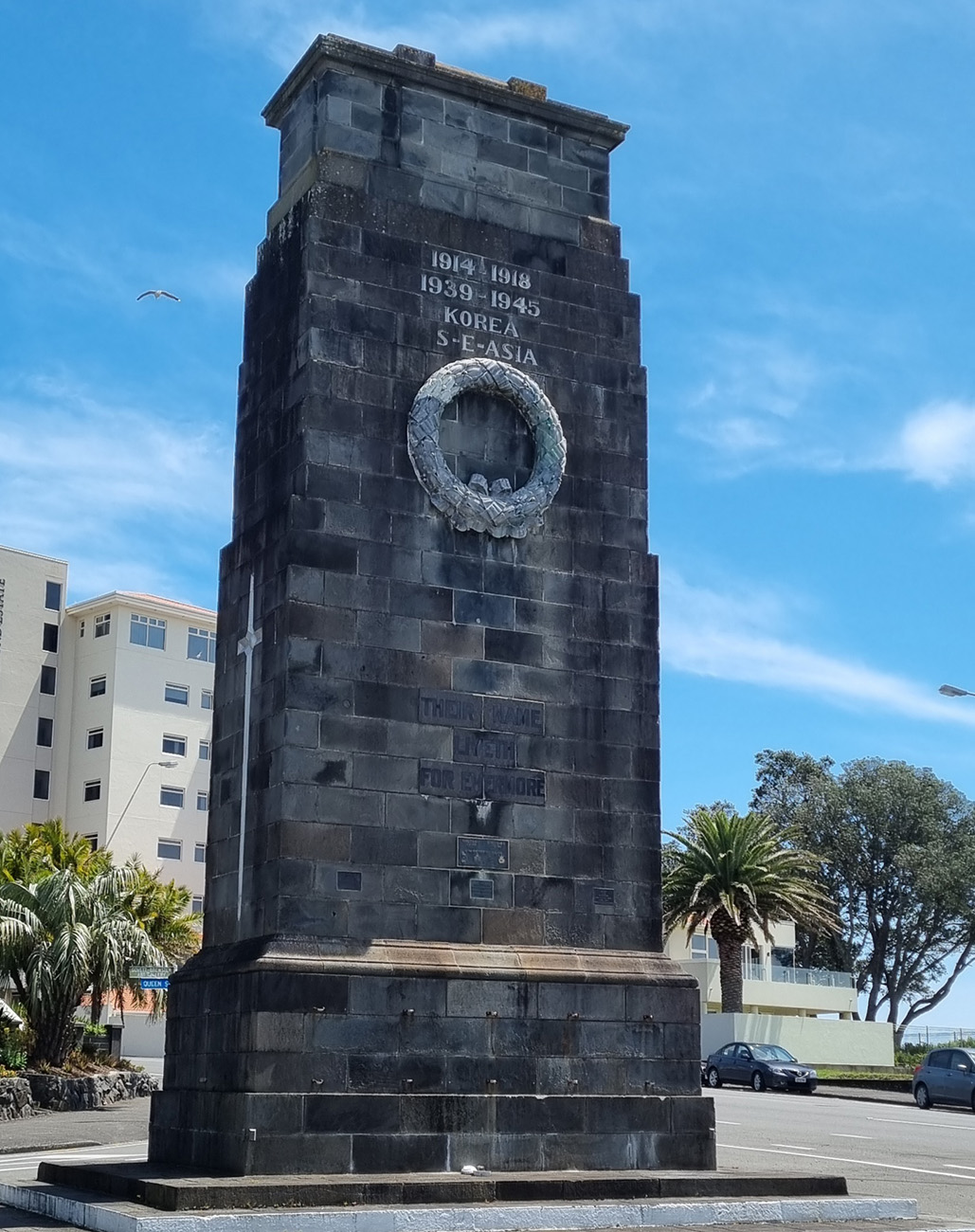
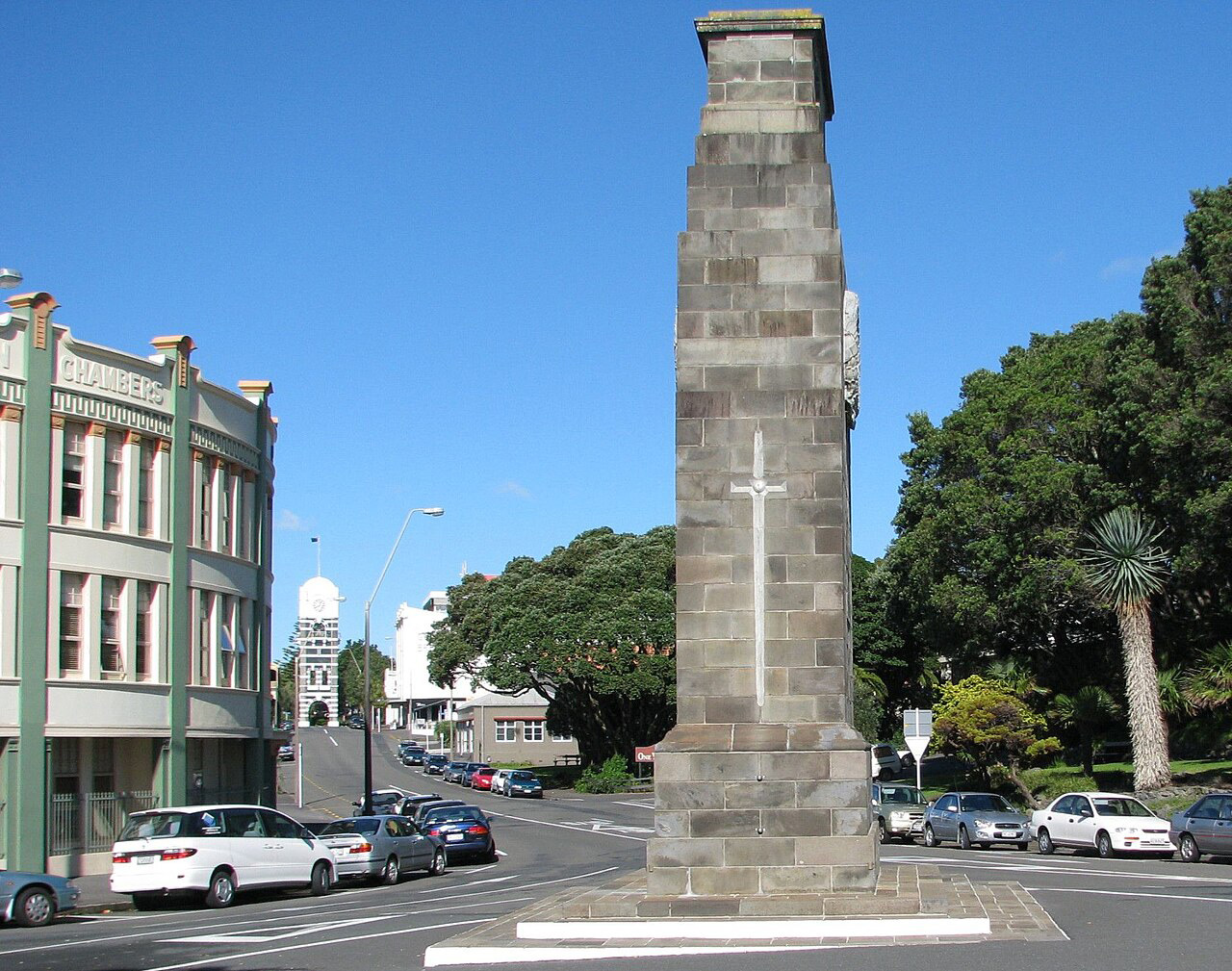
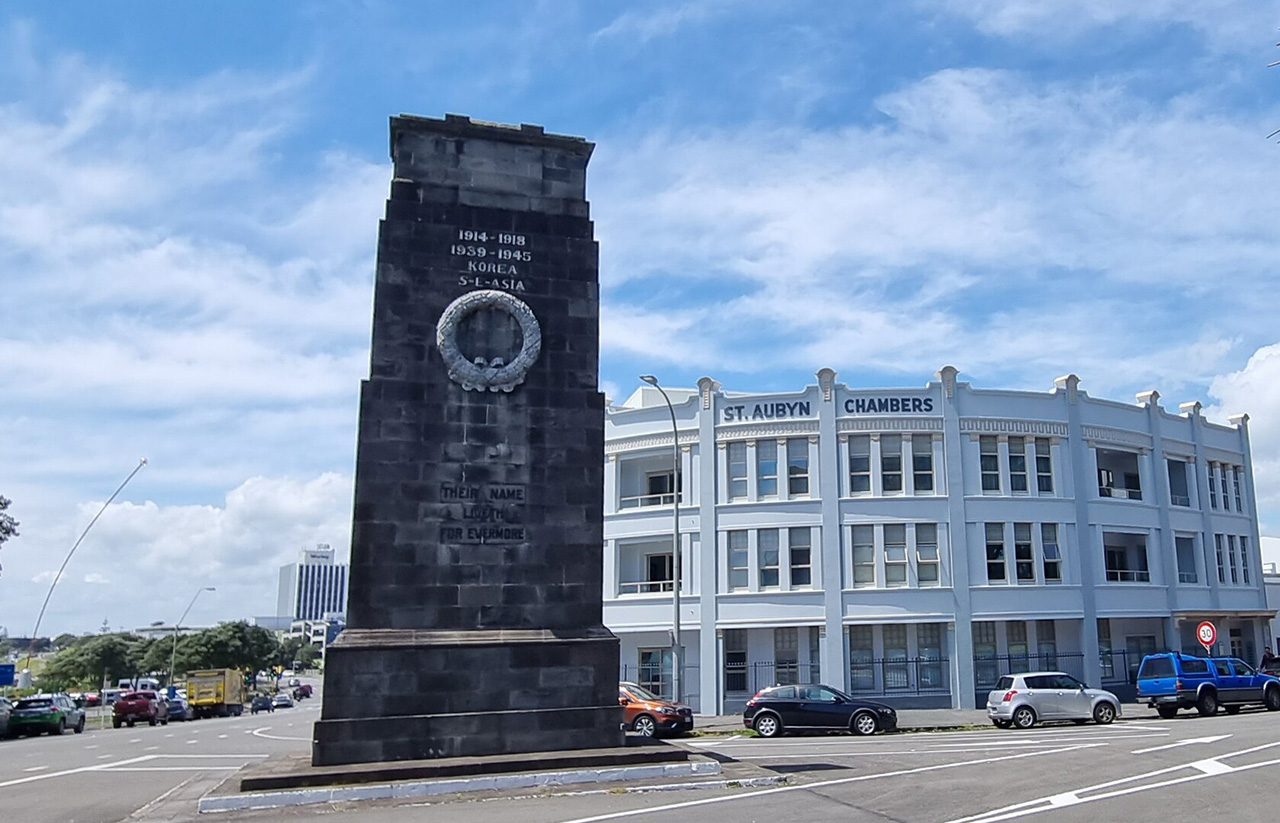
The Cenotaph is a deceptively simple rectangular monument, standing 33 feet (10 metres) high, on a stepped base 26 feet by 20 feet (8 metres x 8.5 metres). On top of the monument sits a symbolically empty casket. The narrower north and south faces contain Crusader crosses, whilst the wider east and west faces are adorned with carved stone wreaths by local stonemason W. F. Short, and the inscription “1914-1918, Their Name Liveth for Evermore”. The Cenotaph was unveiled on 16 September 1924 by Governor-General, Admiral Lord Jellicoe.
Since its unveiling, modest additions have been made. An additional inscription was added in the 1980s by sculptor Filipe Tohe to commemorate the Secord World War, the Korean War, and war in South-East Asia. Bronze anniversary plaques were added to the east face in 1995.
The Cenotaph has been a focus for ANZAC Day remembrance services since its unveiling.
List Entry Information
Status
Listed
List Entry Status
Historic Place Category 2
Access
Able to Visit
List Number
885
Date Entered
1st September 1983
Date of Effect
1st September 1983
City/District Council
New Plymouth District
Region
Taranaki Region
Extent of List Entry
Extent includes part of the land described as Legal Road, Taranaki Land District, and the structure known as Cenotaph thereon. Refer to the map tabled at the Rārangi Kōrero Committee meeting on 21 November 2024.
Legal description
Legal Road, Taranaki Land District
Status
Listed
List Entry Status
Historic Place Category 2
Access
Able to Visit
List Number
885
Date Entered
1st September 1983
Date of Effect
1st September 1983
City/District Council
New Plymouth District
Region
Taranaki Region
Extent of List Entry
Extent includes part of the land described as Legal Road, Taranaki Land District, and the structure known as Cenotaph thereon. Refer to the map tabled at the Rārangi Kōrero Committee meeting on 21 November 2024.
Legal description
Legal Road, Taranaki Land District
Construction Professional
Name
Short, William Francis
Type
Stonemason
Biography
William Short was a monumental mason and sculptor active in New Plymouth in the early twentieth century.
Name
Messenger, Francis (Frank) John
Type
Architect
Biography
Francis John Messenger was a New Plymouth architect. He practised from the 1890s until his death in 1945 and was responsible for a number of prominent buildings in Taranaki which cover a variety of building types. His work includes the verandah (1909) of New Plymouth's White Hart Hotel (1886, Cat I), extensions to St Mary's Church (Cat I), Shoe Store Building, 58 Rata Street (1910, Cat II), Inglewood Town Hall by Percival & Messenger (1913, Cat II), St Andrew's Anglican Church, Rata Street by Messenger, Griffiths & Taylor (1922-23, Cat II), the Cenotaph opposite St Aubyn Chambers (1924, Cat II) and the Taranaki Savings Bank Building, 89 Devon Street by Messenger, Griffiths and Taylor (1929-30, Cat II).
Name
J.G.M. Russell, J. McCracken, A. Handley
Type
Builder
Biography
Name
Filipe Tohe
Type
Sculptor
Biography
Construction Details
Start Year
1924
Type
Original Construction
Type
Addition
Description
Inscriptions added
Period
1980s
Start Year
1995
Type
Addition
Description
Commemorative bronze plaques added
Construction Professional
Name
Short, William Francis
Type
Stonemason
Biography
William Short was a monumental mason and sculptor active in New Plymouth in the early twentieth century.
Name
Messenger, Francis (Frank) John
Type
Architect
Biography
Francis John Messenger was a New Plymouth architect. He practised from the 1890s until his death in 1945 and was responsible for a number of prominent buildings in Taranaki which cover a variety of building types. His work includes the verandah (1909) of New Plymouth's White Hart Hotel (1886, Cat I), extensions to St Mary's Church (Cat I), Shoe Store Building, 58 Rata Street (1910, Cat II), Inglewood Town Hall by Percival & Messenger (1913, Cat II), St Andrew's Anglican Church, Rata Street by Messenger, Griffiths & Taylor (1922-23, Cat II), the Cenotaph opposite St Aubyn Chambers (1924, Cat II) and the Taranaki Savings Bank Building, 89 Devon Street by Messenger, Griffiths and Taylor (1929-30, Cat II).
Name
J.G.M. Russell, J. McCracken, A. Handley
Type
Builder
Biography
Name
Filipe Tohe
Type
Sculptor
Biography
Construction Details
Start Year
1924
Type
Original Construction
Type
Addition
Description
Inscriptions added
Period
1980s
Start Year
1995
Type
Addition
Description
Commemorative bronze plaques added
Historical and Associated Iwi / Hapū / Whānau
Completion Date
11th December 2024
Report Written By
Anna Renton-Green
Other Information
A fully referenced copy of the Summary Upgrade Report is available upon request from the Central Regional Office of Heritage New Zealand Pouhere Taonga Disclaimer Please note that entry on the New Zealand Heritage List/Rārangi Kōrero identifies only the heritage values of the property concerned, and should not be construed as advice on the state of the property, or as a comment of its soundness or safety, including in regard to earthquake risk, safety in the event of fire, or insanitary conditions. Archaeological sites are protected by the Heritage New Zealand Pouhere Taonga Act 2014, regardless of whether they are entered on the New Zealand Heritage List/Rārangi Kōrero or not. Archaeological sites include ‘places associated with pre-1900 human activity, where there may be evidence relating to the history of New Zealand’. This List entry report should not be read as a statement on whether or not the archaeological provisions of the Act apply to the property (s) concerned. Please contact your local Heritage New Zealand office for archaeological advice
Historical and Associated Iwi / Hapū / Whānau
Completion Date
11th December 2024
Report Written By
Anna Renton-Green
Other Information
A fully referenced copy of the Summary Upgrade Report is available upon request from the Central Regional Office of Heritage New Zealand Pouhere Taonga Disclaimer Please note that entry on the New Zealand Heritage List/Rārangi Kōrero identifies only the heritage values of the property concerned, and should not be construed as advice on the state of the property, or as a comment of its soundness or safety, including in regard to earthquake risk, safety in the event of fire, or insanitary conditions. Archaeological sites are protected by the Heritage New Zealand Pouhere Taonga Act 2014, regardless of whether they are entered on the New Zealand Heritage List/Rārangi Kōrero or not. Archaeological sites include ‘places associated with pre-1900 human activity, where there may be evidence relating to the history of New Zealand’. This List entry report should not be read as a statement on whether or not the archaeological provisions of the Act apply to the property (s) concerned. Please contact your local Heritage New Zealand office for archaeological advice
Current Usages
Uses: Commemoration
Specific Usage: Memorial - World War One
Uses: Commemoration
Specific Usage: Memorial - World War Two
Former Usages
General Usage: Commemoration
Specific Usage: Memorial - World War One
General Usage: Commemoration
Specific Usage: Memorial - World War Two
Themes
War Memorial
Web Links
description: The Memorials Register, New Zealand History Online, Ministry for Culture and Heritage.
Current Usages
Uses: Commemoration
Specific Usage: Memorial - World War One
Uses: Commemoration
Specific Usage: Memorial - World War Two
Former Usages
General Usage: Commemoration
Specific Usage: Memorial - World War One
General Usage: Commemoration
Specific Usage: Memorial - World War Two
Themes
War Memorial
Web Links
description: The Memorials Register, New Zealand History Online, Ministry for Culture and Heritage.
Location
Sign up to hear more
Get the latest heritage news, features and events delivered
straight to your inbox.
