

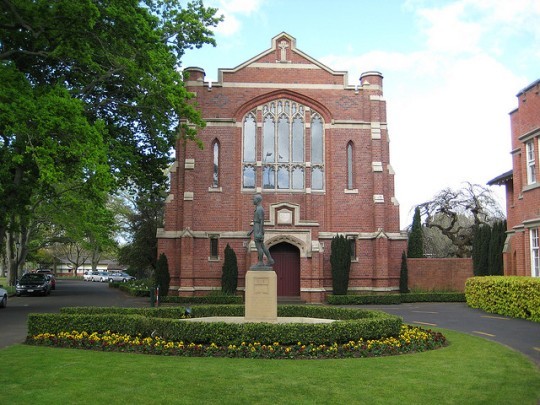
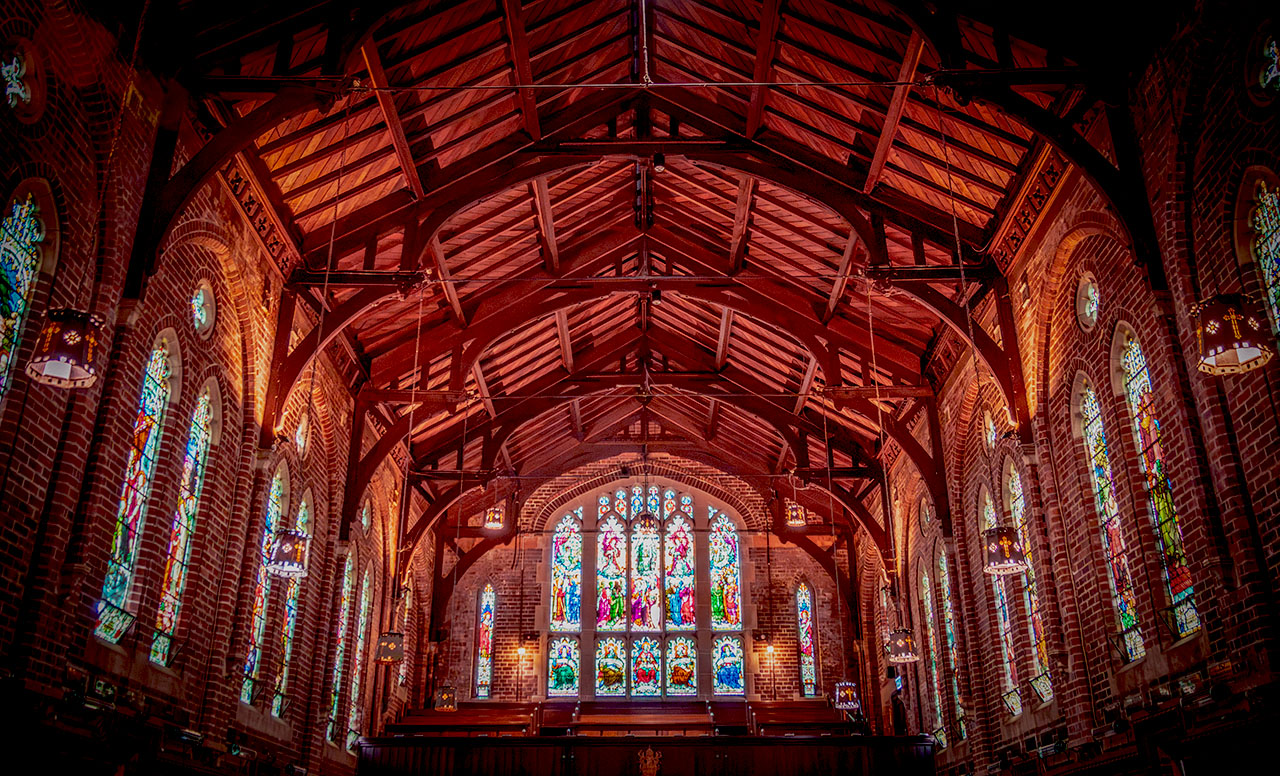
It is built of brick in a late Gothic style and features some very good quality brickwork and elegant stone window tracery. The interior is notable for its fine timber vaulted ceiling, and stained glass windows by A.L. Ward of Ladbroke Grove, London.
Designed by R. Atkinson Abbott, the chapel is especially notable, architecturally, for its pleasing proportions and good quality of construction.
It contains a memorial foundation stone to old boys killed in action in World War One. The building has very considerable historical significance as the chapel for one of the leading collegiate institutions in New Zealand.
List Entry Information
Status
Listed
List Entry Status
Historic Place Category 1
Access
Private/No Public Access
List Number
90
Date Entered
24th November 1983
Date of Effect
24th November 1983
City/District Council
Auckland Council
Region
Auckland Council
Legal description
Pt Land Claim 269A Fairburns Grant (RT NA268/84), North Auckland Land District
Status
Listed
List Entry Status
Historic Place Category 1
Access
Private/No Public Access
List Number
90
Date Entered
24th November 1983
Date of Effect
24th November 1983
City/District Council
Auckland Council
Region
Auckland Council
Legal description
Pt Land Claim 269A Fairburns Grant (RT NA268/84), North Auckland Land District
Construction Professional
Name
Abbott, Richard Atkinson
Type
Architect
Biography
Abbott (1883-1954) began his career in the office of C L N Arnold and became his partner in 1910. Abbott, whose career began prior to the passing of the New Zealand Institute of Architects Act in 1913, became registered under that Act. He is best known for the design of Auckland Grammar School (1913) which is one of the earliest Spanish Mission style buildings in New Zealand. He also designed several branch buildings for the Bank of New Zealand including the Upper Symonds Street branch (1937) and several buildings at King's College, Middlemore, including the Memorial Chapel (World War I), the Memorial Library (World War II) and the Assembly Hall (1954). Abbott was active in the New Zealand Institute of Architects, serving on its Council (1926-28), and on its Education Committee (1926-36). In addition he was Chairman of the Auckland branch of the Institute (1927-28). Abbott was born at Parnell, Auckland. He was educated at St John's College and King's College after which he joined the architectural firm established in the 1870s by Charles Le Nevre Arnold. Abbot became Arnold's partner in practice in 1910. After Arnold's retirement in 1927, Abbot remained in sole practice for a time, but was later joined by G.I. Hole. Abbott's first major achievement was in 1913 when he submitted the winning design for the Auckland Grammar School. The janitor's cottage was part of the design brief. Abbot became a Fellow of the New Zealand Institute of Architects in 1913. Five years later he prepared the winning site layout for the King's College site at Middlemore. In contrast to Auckland Grammar School, the buildings on the King's College campus were designed in a more conservative Gothic collegiate style. In addition to the main building at King's (Kings College Main Block, NZHPT Registration # 529, Category II historic place), Abbott designed the memorial church to Old Boys who died in the First World War (Kings College Chapel, NZHPT Registration # 90, Category I historic place); the library; a memorial to old boys killed in the Second World War; and the School's assembly hall. For over 25 years Abbot was the architect for the Bank of New Zealand in the Auckland region. He is also remembered as the designer of the One Tree Hill Obelisk (NZHPT Registration # 4601, Category I historic place), constructed on Maungakiekie, One Tree Hill in 1939-1940.
Name
Grinter, Albert George
Type
Builder
Biography
Albert (Bert) George Grinter (1882-1974) worked as a builder on his own account in the South Island from circa 1910 until 1922 when he set up business in Auckland. By 1945, when it was renamed A.G. Grinter and Son Limited, the firm diversified into the manufacture of joinery to meet its own needs and those of other builders. During the Second World War (1939-45), the company specialised solely in construction. Grinter undertook a wide range of construction work including schools, churches, hospitals and residential projects including private dwellings and blocks of state housing. In 1925-6 Bert Grinter won a contract for the construction of Stoneways, the Epsom residence of eminent Auckland architect William Gummer. In 1930, Grinter also erected a brick electricity substation for the Auckland Electric Power Board at The Drive in Epsom.
Construction Details
Start Year
1922
Finish Year
1925
Type
Original Construction
Construction Professional
Name
Abbott, Richard Atkinson
Type
Architect
Biography
Abbott (1883-1954) began his career in the office of C L N Arnold and became his partner in 1910. Abbott, whose career began prior to the passing of the New Zealand Institute of Architects Act in 1913, became registered under that Act. He is best known for the design of Auckland Grammar School (1913) which is one of the earliest Spanish Mission style buildings in New Zealand. He also designed several branch buildings for the Bank of New Zealand including the Upper Symonds Street branch (1937) and several buildings at King's College, Middlemore, including the Memorial Chapel (World War I), the Memorial Library (World War II) and the Assembly Hall (1954). Abbott was active in the New Zealand Institute of Architects, serving on its Council (1926-28), and on its Education Committee (1926-36). In addition he was Chairman of the Auckland branch of the Institute (1927-28). Abbott was born at Parnell, Auckland. He was educated at St John's College and King's College after which he joined the architectural firm established in the 1870s by Charles Le Nevre Arnold. Abbot became Arnold's partner in practice in 1910. After Arnold's retirement in 1927, Abbot remained in sole practice for a time, but was later joined by G.I. Hole. Abbott's first major achievement was in 1913 when he submitted the winning design for the Auckland Grammar School. The janitor's cottage was part of the design brief. Abbot became a Fellow of the New Zealand Institute of Architects in 1913. Five years later he prepared the winning site layout for the King's College site at Middlemore. In contrast to Auckland Grammar School, the buildings on the King's College campus were designed in a more conservative Gothic collegiate style. In addition to the main building at King's (Kings College Main Block, NZHPT Registration # 529, Category II historic place), Abbott designed the memorial church to Old Boys who died in the First World War (Kings College Chapel, NZHPT Registration # 90, Category I historic place); the library; a memorial to old boys killed in the Second World War; and the School's assembly hall. For over 25 years Abbot was the architect for the Bank of New Zealand in the Auckland region. He is also remembered as the designer of the One Tree Hill Obelisk (NZHPT Registration # 4601, Category I historic place), constructed on Maungakiekie, One Tree Hill in 1939-1940.
Name
Grinter, Albert George
Type
Builder
Biography
Albert (Bert) George Grinter (1882-1974) worked as a builder on his own account in the South Island from circa 1910 until 1922 when he set up business in Auckland. By 1945, when it was renamed A.G. Grinter and Son Limited, the firm diversified into the manufacture of joinery to meet its own needs and those of other builders. During the Second World War (1939-45), the company specialised solely in construction. Grinter undertook a wide range of construction work including schools, churches, hospitals and residential projects including private dwellings and blocks of state housing. In 1925-6 Bert Grinter won a contract for the construction of Stoneways, the Epsom residence of eminent Auckland architect William Gummer. In 1930, Grinter also erected a brick electricity substation for the Auckland Electric Power Board at The Drive in Epsom.
Construction Details
Start Year
1922
Finish Year
1925
Type
Original Construction
Historical and Associated Iwi / Hapū / Whānau
Information Sources
Auckland Star
Auckland Star
New Zealand Herald
New Zealand Herald, 12 July 1932, p. 6; 28 September 1933, p. 6.
Other Information
This place was identified as significant under previous legislation with different information requirements. It remains significant under the current legislation. There is opportunity under our legislation and policies to add to this information. Further information about this place may be available from the Northern Regional Office of Heritage New Zealand Pouhere Taonga. Please note that entry on the New Zealand Heritage List/Rarangi Korero identifies only the heritage values of the property concerned, and should not be construed as advice on the state of the property, or as a comment of its soundness or safety, including in regard to earthquake risk, safety in the event of fire, or insanitary conditions. This historic place was registered under the Historic Places Act 1980. The following text is the original citation considered by the NZHPT Board at the time of registration. Information in square brackets indicate modifications made after the paper was considered by the NZHPT Board.
Historical and Associated Iwi / Hapū / Whānau
Information Sources
Auckland Star
Auckland Star
New Zealand Herald
New Zealand Herald, 12 July 1932, p. 6; 28 September 1933, p. 6.
Other Information
This place was identified as significant under previous legislation with different information requirements. It remains significant under the current legislation. There is opportunity under our legislation and policies to add to this information. Further information about this place may be available from the Northern Regional Office of Heritage New Zealand Pouhere Taonga. Please note that entry on the New Zealand Heritage List/Rarangi Korero identifies only the heritage values of the property concerned, and should not be construed as advice on the state of the property, or as a comment of its soundness or safety, including in regard to earthquake risk, safety in the event of fire, or insanitary conditions. This historic place was registered under the Historic Places Act 1980. The following text is the original citation considered by the NZHPT Board at the time of registration. Information in square brackets indicate modifications made after the paper was considered by the NZHPT Board.
Former Usages
General Usage: Commemoration
Specific Usage: Memorial - World War One
General Usage: Religion
Specific Usage: Chapel
Themes
War Memorial
Former Usages
General Usage: Commemoration
Specific Usage: Memorial - World War One
General Usage: Religion
Specific Usage: Chapel
Themes
War Memorial
Location
Stay up to date with Heritage this month
