

Tuapeka Mouth grew up around the confluence of the Tuapeka and Clutha/ Mataau Rivers. Tuapeka Mouth was for many years the inland port of call for the river steamers that plied the turbulent waters of the Clutha/Mataau. With the population explosion in the early 1860s a town sprung up. With the growing settled population came families, and with families the need for education, the first school opening in 1870. The Education Act 1877 provided for free, secular, and compulsory education for all children aged between seven and thirteen, and soon afterwards Tuapeka Mouth had a new school designed by the Otago Education Board and built by Lawrence contractor Samuel Miller, opening in 1879. Tuapeka Mouth School’s roll grew steadily through the 1880s and 1890s. Around 1908 there were alterations when a new classroom was built. This ‘bright, airy room’ was used to house the junior school. Otago Education Board Records indicate that the school at that time had two classrooms, one 26 by 20 feet, the other 30 by 20 feet (7.9 by 6m, and 9.1 by 6m).
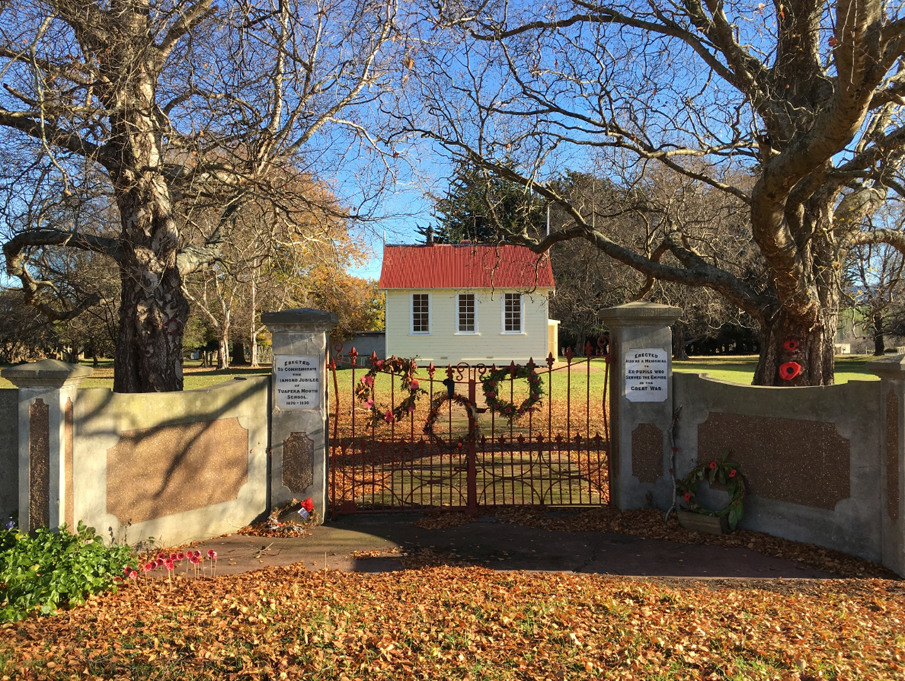
The school’s Diamond Jubilee was celebrated in 1930, and memorial gates erected to celebrate the occasion and commemorate the heroism of the local men who had served King and Country and to those who had lost their lives in the Great War and also to celebrate the jubilee. From this time on there was a decline reflecting the depopulation of the surrounding district. The School was closed on 31 January 1949, with pupils transferred to the Clutha Valley Primary School.
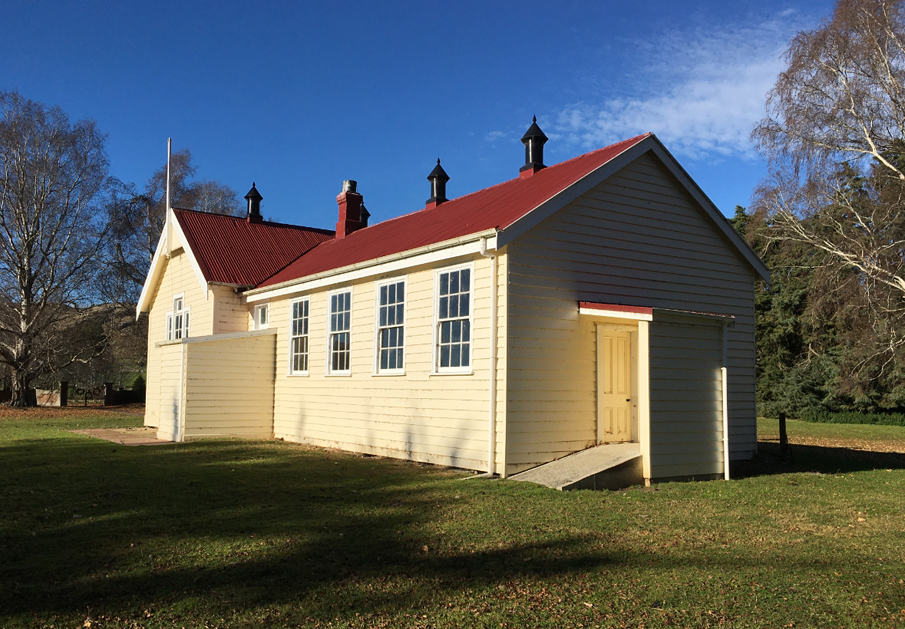
The site was used as a church camp in the late 1950s, and from that date until 1994, was run as a camp site. A concrete block addition was made to the west elevation of the school building in 1959 to provide service facilities for the camp ground. A meeting in October 2006 led by the Lawrence-Tuapeka Community Board canvassed views on the future of the school building, and a Trust was formed to facilitate future plans for the building.
In 2010 the Domain is available for large functions, and is used for the cavalcade, motor home rallies, vintage car rallies and visits from secondary school children. The Memorial Gates are still the site for Anzac Day services for the Tuapeka Mouth community.
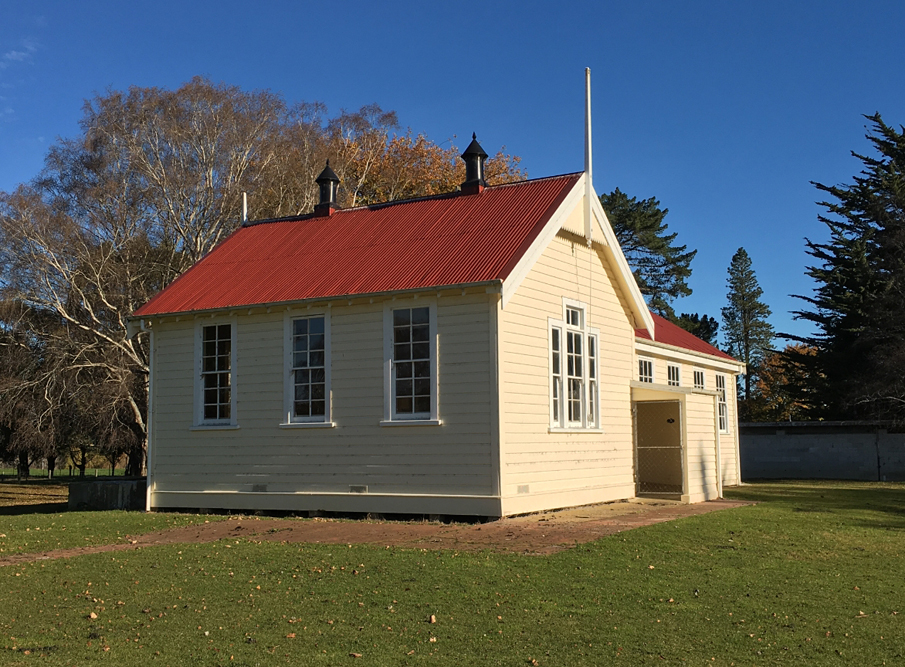
The Tuapeka Mouth School is a single storey timber building. The building is T-shaped in plan, with two transecting gables. It is timber framed, with weatherboard cladding, and a corrugated iron roof. Metal ventilators are mounted on the peak of the gables. The majority of the windows are paired six light double hung sashes. The windows on the gable end is a paired four light double hung sash window flanked by paired two light single width windows. Entry is through a lean-to porch on the north elevation. On the west elevation there is a single storey concrete block addition which provided kitchen and laundry facilities when the building was used as a camp. The majority of the interior wall and ceiling claddings are timber match lining, some horizontal and some vertical. The ceiling lining runs the length of the building. In some parts the wall below Dado level has been relined with Pinex and other modern materials. The floors are tongue and groove timber.
The Tuapeka Mouth School has architectural, historical and social significance. The building has architectural significance as a representative example of a ‘No.1 School Plan’ designed by the Otago Education Board in the mid 1870s. This standard plan, used for small schools, was found throughout Otago. Historically the building is a representative example of a nineteenth century school, and was the centre of many community activities. . The subsequent history of the school’s closure and reuse as a community facility demonstrates the building’s continued importance to the local community. The Memorial Gates are a significant reminder of the sacrifices this small rural community made during World War One, and also recall the significance of the school to the Tuapeka Mouth people.
List Entry Information
Status
Listed
List Entry Status
Historic Place Category 2
Access
Private/No Public Access
List Number
9264
Date Entered
2nd March 2011
Date of Effect
2nd March 2011
City/District Council
Clutha District
Region
Otago Region
Extent of List Entry
Extent includes the land described as Sec 204 Blk I Waitahuna West SD (Tuapeka Mouth Recreation Reserve) (NZG 1980 p.1873) Otago Land District, and the building known as Tuapeka Mouth School (Former) thereon, and its fittings and fixtures thereon. (Refer to map in Appendix 1 of the registration report for further information).
Legal description
Sec 204 Blk I Waitahuna West SD (Tuapeka Mouth Recreation Reserve NZ Gazette 1980 p.1873), Otago Land District
Location Description
The Tuapeka Mouth Domain Reserve is located on Tuapeka Mouth Road. The Reserve is bounded to the south by Thompsons Road and on the north by Pit Road.
Status
Listed
List Entry Status
Historic Place Category 2
Access
Private/No Public Access
List Number
9264
Date Entered
2nd March 2011
Date of Effect
2nd March 2011
City/District Council
Clutha District
Region
Otago Region
Extent of List Entry
Extent includes the land described as Sec 204 Blk I Waitahuna West SD (Tuapeka Mouth Recreation Reserve) (NZG 1980 p.1873) Otago Land District, and the building known as Tuapeka Mouth School (Former) thereon, and its fittings and fixtures thereon. (Refer to map in Appendix 1 of the registration report for further information).
Legal description
Sec 204 Blk I Waitahuna West SD (Tuapeka Mouth Recreation Reserve NZ Gazette 1980 p.1873), Otago Land District
Location Description
The Tuapeka Mouth Domain Reserve is located on Tuapeka Mouth Road. The Reserve is bounded to the south by Thompsons Road and on the north by Pit Road.
Why is this place significant?
Cultural Significance
Social Significance or Value The Tuapeka Mouth School building has been the centre for both education and social activities for the Tuapeka Mouth community since 1879. The community role in prize giving and fundraising were important local events, and the school was a place of social interaction as well as education for local children. The school’s subsequent use as a camping ground continued its social role. The current debate about its future shows its continuing importance to the community.
Historic Significance
Historical Significance or Value Education for small rural settlements was a central issue for nineteenth century New Zealand, and Tuapeka Mouth School has historical significance as a representative example of a nineteenth century school. Its history represents the story of the foundation of education in this small Otago settlement, both before and after the passing of the 1877 Education Act. The subsequent history of the school’s closure and reuse as a community facility demonstrates the facility’s continued importance to the local community. The Memorial Gates are a significant reminder of the sacrifices this small rural community made during World War One, and also recall the significance of the school to the Tuapeka Mouth people.
Physical Significance
Architectural Significance or Value Tuapeka Mouth School has architectural significance as a representative example of a ‘No.1 School Plan’ designed by the Otago Education Board in the mid 1870s. This standard plan, used for small schools, was found throughout Otago.
Why is this place Category 1 / Category 2?
Detail Of Assessed Criteria
(a) The extent to which the place reflects important or representative aspects of New Zealand history Attending school and being part of the education system is a universal experience for New Zealanders. The Tuapeka Mouth School, built shortly after the establishment of free compulsory secular education under the 1877 Education Act, represents the experience of many New Zealanders in rural schools in small country towns, and its design reflects the teaching methods of the time. Additions made to the school over time reflect the changing fortunes of the community, and the school’s later closure is part of the history of the decline in rural populations, which saw the closure of a number of small schools, including others in South Otago. (e) The community association with, or public esteem for the place The Tuapeka Mouth community has shown its high esteem for the school over its entire history. Locals raised money for the school during its period of operation, it was used as a camping ground, and the current debate about its restoration and future use, shows its continued importance. (g) The technical accomplishment or value, or design of the place. The design of the Tuapeka Mouth School represents a typical school plan designed by the Otago Education Board under architect John Somerville. The No. 1 Plan, used with local adaptations where necessary, was used in many small rural communities, and was added as required. (h) The symbolic or commemorative value of the place The Memorial Gates at Tuapeka Mouth School have commemorative value. They recall the sacrifice made to members of this small rural town in World War One, and also the significance of the school to the community with panels recalling its jubilee.
Why is this place significant?
Cultural Significance
Social Significance or Value The Tuapeka Mouth School building has been the centre for both education and social activities for the Tuapeka Mouth community since 1879. The community role in prize giving and fundraising were important local events, and the school was a place of social interaction as well as education for local children. The school’s subsequent use as a camping ground continued its social role. The current debate about its future shows its continuing importance to the community.
Historic Significance
Historical Significance or Value Education for small rural settlements was a central issue for nineteenth century New Zealand, and Tuapeka Mouth School has historical significance as a representative example of a nineteenth century school. Its history represents the story of the foundation of education in this small Otago settlement, both before and after the passing of the 1877 Education Act. The subsequent history of the school’s closure and reuse as a community facility demonstrates the facility’s continued importance to the local community. The Memorial Gates are a significant reminder of the sacrifices this small rural community made during World War One, and also recall the significance of the school to the Tuapeka Mouth people.
Physical Significance
Architectural Significance or Value Tuapeka Mouth School has architectural significance as a representative example of a ‘No.1 School Plan’ designed by the Otago Education Board in the mid 1870s. This standard plan, used for small schools, was found throughout Otago.
Why is this place Category 1 / Category 2?
Detail Of Assessed Criteria
(a) The extent to which the place reflects important or representative aspects of New Zealand history Attending school and being part of the education system is a universal experience for New Zealanders. The Tuapeka Mouth School, built shortly after the establishment of free compulsory secular education under the 1877 Education Act, represents the experience of many New Zealanders in rural schools in small country towns, and its design reflects the teaching methods of the time. Additions made to the school over time reflect the changing fortunes of the community, and the school’s later closure is part of the history of the decline in rural populations, which saw the closure of a number of small schools, including others in South Otago. (e) The community association with, or public esteem for the place The Tuapeka Mouth community has shown its high esteem for the school over its entire history. Locals raised money for the school during its period of operation, it was used as a camping ground, and the current debate about its restoration and future use, shows its continued importance. (g) The technical accomplishment or value, or design of the place. The design of the Tuapeka Mouth School represents a typical school plan designed by the Otago Education Board under architect John Somerville. The No. 1 Plan, used with local adaptations where necessary, was used in many small rural communities, and was added as required. (h) The symbolic or commemorative value of the place The Memorial Gates at Tuapeka Mouth School have commemorative value. They recall the sacrifice made to members of this small rural town in World War One, and also the significance of the school to the community with panels recalling its jubilee.
Construction Professional
Name
Miller, Samuel Augustus
Type
Builder
Biography
Samuel Augustus Miller (1830-1910)
Construction Details
Start Year
1870
Type
Other
Description
First Tuapeka Mouth School opened
Start Year
1879
Type
Original Construction
Description
Current building opened.
Start Year
1882
Type
Other
Description
Old School sold and removed from school grounds
Start Year
1908
Type
Addition
Description
Additional classroom constructed
Start Year
1930
Type
Addition
Description
Wall Memorial Gates erected
Start Year
1949
Type
Other
Description
School closed
Start Year
1959
Type
Addition
Description
Concrete block extension
Construction Materials
Timber, timber joinery, corrugated iron roof, concrete block, concrete, cast iron.
Construction Professional
Name
Miller, Samuel Augustus
Type
Builder
Biography
Samuel Augustus Miller (1830-1910)
Construction Details
Start Year
1870
Type
Other
Description
First Tuapeka Mouth School opened
Start Year
1879
Type
Original Construction
Description
Current building opened.
Start Year
1882
Type
Other
Description
Old School sold and removed from school grounds
Start Year
1908
Type
Addition
Description
Additional classroom constructed
Start Year
1930
Type
Addition
Description
Wall Memorial Gates erected
Start Year
1949
Type
Other
Description
School closed
Start Year
1959
Type
Addition
Description
Concrete block extension
Construction Materials
Timber, timber joinery, corrugated iron roof, concrete block, concrete, cast iron.
Maori History Tuapeka Mouth is located at the confluence of the Clutha/Mataau and Tuapeka Rivers. There are various suggestions about the origins of the name. According to Clutha District Council, Tuapeka is a shortened form of Te-huapeka which means ‘the fruitful branch’, though there seems to be some debate. One authority says it should be ‘Tuakipeta’ meaning cut down a branch of a tree for firewood. Later after the gold rushes, the name was applied to the whole district. Traditionally, the Waitaha people had authority over Murihiku, the southern part of the South Island. Around 1750 the Ngāti Māmoe, originally from the North Island’s East Coast, established themselves in Murihiku. They in turn fell under the sway of another tribe from the North Island’s East Coast, Ngāi Tahu. Archaeology suggests moa became extinct around 1500. Settlement focused on the coast. People journeyed inland to harvest eels, forest birds such as weka and kererū, and cabbage trees. They also travelled to sources of highly-valued pounamu in the headwaters of rivers draining into Lakes Wakatipu and Wānaka. While Maori travelled considerable distances seasonally to gather food sources, permanent villages were usually on the coast. There are no Maori archaeological sites recorded in the area around Tuapeka Mouth School. European Settlement Tuapeka Mouth was a settlement that grew up around the confluence of the Tuapeka and the Clutha/Mataau Rivers, and was originally part of the huge Greenfield pastoral estate. The Clutha/Mataau was an important route into Central Otago, and one which drew the attention of the Europeans exploring the Otago hinterland as yet unknown to them. The first European to see the site of the future settlement was Tautuku based whaler William Palmer, guided by Maori, as far as the confluence of Tuapeka River and Mataau/Clutha River. Pastoralism arrived when John Martin and James Smith acquired the Greenfield estate, stocking the land. This began a long association between the estate and the community that grew up at Tuapeka Mouth. With the population explosion of the gold rushes a town grew up at the junction of the two rivers. In 1862 the settlement was surveyed by Robert Grigor, with the town to be called Dalhousie (after a Governor-General of India). Tuapeka Mouth was for many years the inland port of call, the upper navigable limit, for the river steamers that plied the turbulent waters of the Clutha/Mataau. Miners worked the surrounding lands; cropping and dairy farming developed around the settlement, and a small timber industry grew up. A punt, opened in 1896, still operates today, one of the last surviving in the country. With the growing settled population came families, and with families the need for education. The educational scheme imagined by Otago’s Free Church colonists aimed at providing a public school in every parish, from which there would be access to high school and university. Though very little progress had been made by the foundation of the Education Board by the Provincial Government in 1856, education in Otago was growing steadily. In settled districts with a population of forty or more ‘main’ schools were established, and ‘side’ schools were provided whether the future of the settlement was less certain. Schools were established at nearby Lawrence and Waitahuna in 1862 and 1863 respectively. Education at Tuapeka Mouth The first efforts in establishing schooling in Tuapeka Mouth were likely those of settlers such as James Grieve who with his Presbyterian background was an advocate for education and a Sunday school teacher for fifty years. In March 1869 a public meeting was held in Mr Taylor’s store. The meeting decided to approach John Hughes, Member of the Provincial Council, to assist in the community’s aspirations to educate their youngsters. A committee was set up to select a site and canvass for subscriptions. After some delays the building was completed by the end of April, 1870. The first Tuapeka Mouth School was opened in May 1870 with 21 pupils. A soiree was attended by sixty guests. The supper was much praised and afterwards a public meeting held, with the first teacher Mr A.B. Matthews introduced. Mr Matthews congratulated the School Committee ‘in raising such a neat and comfortable building.’ He thought that the school ‘all the water which had been used during the evening would not be sufficient to extinguish the light which had been lit, or extinguish the good effects which the meeting would produce.’ The chair of the School Committee, Mr Ferguson, emphasised the importance of elementary education – ‘the key to unlock the treasures of the universe – a lever to uplift the earth,’ and supported the idea of compulsory education. Local minister Rev. W. Keall was less convinced about the merits of compulsory education, and considered ‘a purely secular education’ an impossibility: ‘Every teacher, no matter who he may be, must exert a religious influence’, adding that religious services previously held in the store, would from now on use the school building. The school was the social centre of the district, providing a venue for public entertainments, meetings and celebrations. This was not without its problems as there were complaints about broken windows and other damage as a result of the celebrations, and, for a time, permission was withdrawn for the use of the building for such revelries. The roll numbered thirty five by the mid 1870s and the premises became too cramped. A special committee meeting decided to replace the building. The Education Board had difficulty attracting tenders for the construction of the school. In December 1878 the Tuapeka Times reported that no tenders had been received and thought that ‘[e]ither the local contractors must have their hands full, of they could not have seen the advertisement.’ The local sawmill had begun operation and the correspondent hoped that this would encourage contractors, the need been dire as ‘two cases of fainting have occurred (of pupils, I should say) through want of proper ventilation.’ Education was a priority for central government too. The Education Act 1877 provided for free, secular, and compulsory education for all children aged between seven and thirteen, establishing schools for New Zealand children, and the administrative structure for education. The Department of Education was responsible for distributing grant funding to education boards. Twelve education boards (made up of nine members elected by school committees) defined school districts within their areas, and established and maintained schools within their districts. School committees were elected by a ballot of local householders, and had management of educational matters in their area. As the population in Otago became more settled so the Otago Education Board had a building programme for schools. In May 1879 school buildings were nearing completion at Taieri Ferry, Taieri Beach, Circle Hill, Stirling, Tuapeka Mouth, Moa Flat, Cromwell, St Bathans, Kyeburn, Sandymount, Highcliff and St Leonards. Records show that the building programme was based around some standard designs with variations according to local circumstances where necessary. The contracts for a group of schools refer to Drawing No. 1, indicating that the same base drawing was used for this group, which included Tuapeka Mouth School. The form of the building reflected the teaching methods, where children were ‘often taught in relays in order to accommodate as many as possible in the small space available.’ The tender for the construction of the second Tuapeka Mouth School was accepted by the Education Board on 1 March 1879, that of Samuel Augustus Miller (1830-1910) for £210 the winning tender. Miller was from nearby Lawrence, and had been a builder since 1844, and was also a councillor for the West East Ward of the Tuapeka County Council. The Tuapeka Mouth School was completed by mid June 1879. The local newspaper described it as ‘very commodious, and ‘a great improvement on the very small room now in use.’ The approaches to the school were gravelled. A soiree was to be held celebrating the new school. The old school building remained on its original site (around 100 metres south-west of the present building). The building provided extra space for functions, and housing for the public library. After some revelry a fire broke out, causing some damage to the building. The school committee applied to the Education Board to sell the old school building in February 1882. The building was sold for £15. The old school was incorporated into the residence of Dan McCorkindale. Tuapeka Mouth School’s roll grew steadily through the 1880s and 1890s. Three teachers were employed in the 1880s. In 1894 the Education Board supported the community’s desire for the grounds to be fenced and to provide gates. At the same time the window in the ‘older classroom’ was shifted from the southern side to the north, providing light and warmth to the building which had had no window openings to let in the sun. Around 1908 there were further alterations when a new classroom was built. This ‘bright, airy room’ was used to house the junior school. Otago Education Board Records indicate that the school at that time had two classrooms, one 26 by 20 feet, the other 30 by 20 feet (7.9 by 6 metres, and 9.1 by 6 metres). The school’s jubilee was celebrated in 1930, and memorial gates erected to celebrate the occasion and commemorate the heroism of the local men who had served King and Country, and to those who had lost their lives in the Great War. The event drew the community together. Special church services were held in the Catholic and Presbyterian Churches. The gates were dedicated on the final day of the celebrations by Mr S.W. Webber. The Gates were to beautify the school, and be a ‘visible reminder of these Jubilee Celebrations and as a tribute to the former scholars of the School.’ Member of Parliament F. Waite officially opened the gates. He told onlookers that the first pillar of the gates ‘reminded them that at school they were prepared for the battle of life’: character was formed enabling them to think for themselves. ‘School was not a thing simply of bricks and timber’, but was made up of past and present pupils and teachers, making it a ‘living force’ of the district. The second pillar, dedicated to the soldiers, was a ‘constant reminder of those who served on the battlefields of the world, and specially of those who died.’ He hoped that pupils passing through the gates would, ‘like the memorial pillars flanking the gateway, stand firm and foursquare, a credit to the school, and the nation.’ From this time on there was a declining roll reflecting the depopulation of the surrounding district. Between 1935 and 1944 the roll dropped from forty five to fourteen. The last teacher was Isabella Skinner. The Tuapeka Mouth School was closed on 31 January 1949, with pupils transferred to the Clutha Valley Primary School. Tuapeka Mouth Domain Reserve and Camp The site was used as a church camp in the late 1950s, and from that date until 1994, was run as a camp site. A concrete block addition was made to the west elevation of the school building in 1959 to provide service facilities for the camp ground. A meeting in October 2006 led by the Lawrence-Tuapeka Community Board canvassed views on the future of the school building. Submitters were in favour of the restoration of the Tuapeka Mouth School Building, and the possible removal of the concrete extension. In 2007 a community group was formed to restore the former school building and turn part of it into a museum, and the Tuapeka Mouth School Preservation Trust was formed to facilitate this work. In 2010 the Domain is available for large functions, and is used as a venue for the cavalcade, motor home rallies, vintage car rallies and visits from secondary school children. The Memorial Gates are still the site for Anzac Day services for the Tuapeka Mouth community. In 2010 100 people gathered at the former school, and the community, including the Clutha Valley Volunteer Fire Service and New Zealand Army personnel laid wreathes at the gates.
Maori History Tuapeka Mouth is located at the confluence of the Clutha/Mataau and Tuapeka Rivers. There are various suggestions about the origins of the name. According to Clutha District Council, Tuapeka is a shortened form of Te-huapeka which means ‘the fruitful branch’, though there seems to be some debate. One authority says it should be ‘Tuakipeta’ meaning cut down a branch of a tree for firewood. Later after the gold rushes, the name was applied to the whole district. Traditionally, the Waitaha people had authority over Murihiku, the southern part of the South Island. Around 1750 the Ngāti Māmoe, originally from the North Island’s East Coast, established themselves in Murihiku. They in turn fell under the sway of another tribe from the North Island’s East Coast, Ngāi Tahu. Archaeology suggests moa became extinct around 1500. Settlement focused on the coast. People journeyed inland to harvest eels, forest birds such as weka and kererū, and cabbage trees. They also travelled to sources of highly-valued pounamu in the headwaters of rivers draining into Lakes Wakatipu and Wānaka. While Maori travelled considerable distances seasonally to gather food sources, permanent villages were usually on the coast. There are no Maori archaeological sites recorded in the area around Tuapeka Mouth School. European Settlement Tuapeka Mouth was a settlement that grew up around the confluence of the Tuapeka and the Clutha/Mataau Rivers, and was originally part of the huge Greenfield pastoral estate. The Clutha/Mataau was an important route into Central Otago, and one which drew the attention of the Europeans exploring the Otago hinterland as yet unknown to them. The first European to see the site of the future settlement was Tautuku based whaler William Palmer, guided by Maori, as far as the confluence of Tuapeka River and Mataau/Clutha River. Pastoralism arrived when John Martin and James Smith acquired the Greenfield estate, stocking the land. This began a long association between the estate and the community that grew up at Tuapeka Mouth. With the population explosion of the gold rushes a town grew up at the junction of the two rivers. In 1862 the settlement was surveyed by Robert Grigor, with the town to be called Dalhousie (after a Governor-General of India). Tuapeka Mouth was for many years the inland port of call, the upper navigable limit, for the river steamers that plied the turbulent waters of the Clutha/Mataau. Miners worked the surrounding lands; cropping and dairy farming developed around the settlement, and a small timber industry grew up. A punt, opened in 1896, still operates today, one of the last surviving in the country. With the growing settled population came families, and with families the need for education. The educational scheme imagined by Otago’s Free Church colonists aimed at providing a public school in every parish, from which there would be access to high school and university. Though very little progress had been made by the foundation of the Education Board by the Provincial Government in 1856, education in Otago was growing steadily. In settled districts with a population of forty or more ‘main’ schools were established, and ‘side’ schools were provided whether the future of the settlement was less certain. Schools were established at nearby Lawrence and Waitahuna in 1862 and 1863 respectively. Education at Tuapeka Mouth The first efforts in establishing schooling in Tuapeka Mouth were likely those of settlers such as James Grieve who with his Presbyterian background was an advocate for education and a Sunday school teacher for fifty years. In March 1869 a public meeting was held in Mr Taylor’s store. The meeting decided to approach John Hughes, Member of the Provincial Council, to assist in the community’s aspirations to educate their youngsters. A committee was set up to select a site and canvass for subscriptions. After some delays the building was completed by the end of April, 1870. The first Tuapeka Mouth School was opened in May 1870 with 21 pupils. A soiree was attended by sixty guests. The supper was much praised and afterwards a public meeting held, with the first teacher Mr A.B. Matthews introduced. Mr Matthews congratulated the School Committee ‘in raising such a neat and comfortable building.’ He thought that the school ‘all the water which had been used during the evening would not be sufficient to extinguish the light which had been lit, or extinguish the good effects which the meeting would produce.’ The chair of the School Committee, Mr Ferguson, emphasised the importance of elementary education – ‘the key to unlock the treasures of the universe – a lever to uplift the earth,’ and supported the idea of compulsory education. Local minister Rev. W. Keall was less convinced about the merits of compulsory education, and considered ‘a purely secular education’ an impossibility: ‘Every teacher, no matter who he may be, must exert a religious influence’, adding that religious services previously held in the store, would from now on use the school building. The school was the social centre of the district, providing a venue for public entertainments, meetings and celebrations. This was not without its problems as there were complaints about broken windows and other damage as a result of the celebrations, and, for a time, permission was withdrawn for the use of the building for such revelries. The roll numbered thirty five by the mid 1870s and the premises became too cramped. A special committee meeting decided to replace the building. The Education Board had difficulty attracting tenders for the construction of the school. In December 1878 the Tuapeka Times reported that no tenders had been received and thought that ‘[e]ither the local contractors must have their hands full, of they could not have seen the advertisement.’ The local sawmill had begun operation and the correspondent hoped that this would encourage contractors, the need been dire as ‘two cases of fainting have occurred (of pupils, I should say) through want of proper ventilation.’ Education was a priority for central government too. The Education Act 1877 provided for free, secular, and compulsory education for all children aged between seven and thirteen, establishing schools for New Zealand children, and the administrative structure for education. The Department of Education was responsible for distributing grant funding to education boards. Twelve education boards (made up of nine members elected by school committees) defined school districts within their areas, and established and maintained schools within their districts. School committees were elected by a ballot of local householders, and had management of educational matters in their area. As the population in Otago became more settled so the Otago Education Board had a building programme for schools. In May 1879 school buildings were nearing completion at Taieri Ferry, Taieri Beach, Circle Hill, Stirling, Tuapeka Mouth, Moa Flat, Cromwell, St Bathans, Kyeburn, Sandymount, Highcliff and St Leonards. Records show that the building programme was based around some standard designs with variations according to local circumstances where necessary. The contracts for a group of schools refer to Drawing No. 1, indicating that the same base drawing was used for this group, which included Tuapeka Mouth School. The form of the building reflected the teaching methods, where children were ‘often taught in relays in order to accommodate as many as possible in the small space available.’ The tender for the construction of the second Tuapeka Mouth School was accepted by the Education Board on 1 March 1879, that of Samuel Augustus Miller (1830-1910) for £210 the winning tender. Miller was from nearby Lawrence, and had been a builder since 1844, and was also a councillor for the West East Ward of the Tuapeka County Council. The Tuapeka Mouth School was completed by mid June 1879. The local newspaper described it as ‘very commodious, and ‘a great improvement on the very small room now in use.’ The approaches to the school were gravelled. A soiree was to be held celebrating the new school. The old school building remained on its original site (around 100 metres south-west of the present building). The building provided extra space for functions, and housing for the public library. After some revelry a fire broke out, causing some damage to the building. The school committee applied to the Education Board to sell the old school building in February 1882. The building was sold for £15. The old school was incorporated into the residence of Dan McCorkindale. Tuapeka Mouth School’s roll grew steadily through the 1880s and 1890s. Three teachers were employed in the 1880s. In 1894 the Education Board supported the community’s desire for the grounds to be fenced and to provide gates. At the same time the window in the ‘older classroom’ was shifted from the southern side to the north, providing light and warmth to the building which had had no window openings to let in the sun. Around 1908 there were further alterations when a new classroom was built. This ‘bright, airy room’ was used to house the junior school. Otago Education Board Records indicate that the school at that time had two classrooms, one 26 by 20 feet, the other 30 by 20 feet (7.9 by 6 metres, and 9.1 by 6 metres). The school’s jubilee was celebrated in 1930, and memorial gates erected to celebrate the occasion and commemorate the heroism of the local men who had served King and Country, and to those who had lost their lives in the Great War. The event drew the community together. Special church services were held in the Catholic and Presbyterian Churches. The gates were dedicated on the final day of the celebrations by Mr S.W. Webber. The Gates were to beautify the school, and be a ‘visible reminder of these Jubilee Celebrations and as a tribute to the former scholars of the School.’ Member of Parliament F. Waite officially opened the gates. He told onlookers that the first pillar of the gates ‘reminded them that at school they were prepared for the battle of life’: character was formed enabling them to think for themselves. ‘School was not a thing simply of bricks and timber’, but was made up of past and present pupils and teachers, making it a ‘living force’ of the district. The second pillar, dedicated to the soldiers, was a ‘constant reminder of those who served on the battlefields of the world, and specially of those who died.’ He hoped that pupils passing through the gates would, ‘like the memorial pillars flanking the gateway, stand firm and foursquare, a credit to the school, and the nation.’ From this time on there was a declining roll reflecting the depopulation of the surrounding district. Between 1935 and 1944 the roll dropped from forty five to fourteen. The last teacher was Isabella Skinner. The Tuapeka Mouth School was closed on 31 January 1949, with pupils transferred to the Clutha Valley Primary School. Tuapeka Mouth Domain Reserve and Camp The site was used as a church camp in the late 1950s, and from that date until 1994, was run as a camp site. A concrete block addition was made to the west elevation of the school building in 1959 to provide service facilities for the camp ground. A meeting in October 2006 led by the Lawrence-Tuapeka Community Board canvassed views on the future of the school building. Submitters were in favour of the restoration of the Tuapeka Mouth School Building, and the possible removal of the concrete extension. In 2007 a community group was formed to restore the former school building and turn part of it into a museum, and the Tuapeka Mouth School Preservation Trust was formed to facilitate this work. In 2010 the Domain is available for large functions, and is used as a venue for the cavalcade, motor home rallies, vintage car rallies and visits from secondary school children. The Memorial Gates are still the site for Anzac Day services for the Tuapeka Mouth community. In 2010 100 people gathered at the former school, and the community, including the Clutha Valley Volunteer Fire Service and New Zealand Army personnel laid wreathes at the gates.
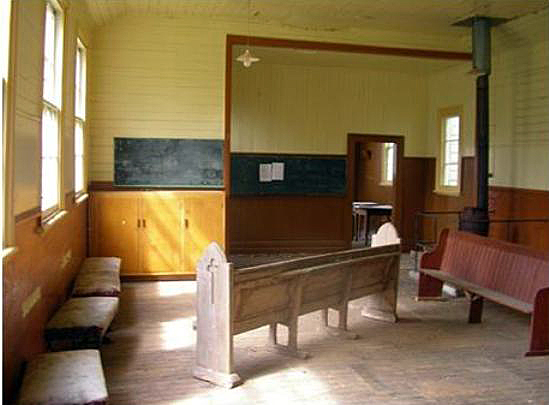
Setting The former Tuapeka Mouth School is located in the small South Otago town of Tuapeka Mouth. The School sits in the Tuapeka Mouth Domain Reserve, which is largely a grassed area surrounded by mature tree plantings. Access to the reserve is through the memorial gates at the north end of the reserve. The Memorial Gates The Memorial Gates are located to the east of the main school building, providing an entrance from Tuapeka Mouth Road. The Memorial Gates are constructed of brick with cement render and pebble dash decorative panels. The panels with the memorial text are marble and mounted on the gate posts. A wrought iron gate with fleur-de-lis tops on the vertical rails. The Tuapeka Mouth School (Former) The Tuapeka Mouth School is a single storey timber building. The building is T-shaped in plan, with two transecting gables. It is timber framed, with weatherboard cladding, and a corrugated iron roof. Metal ventilators are mounted on the peak of the gables. A flag pole is mounted on the gable end. The majority of the windows are paired six light double hung sashes. The windows on the gable end is a paired four light double hung sash window flanked by paired two light single width windows. Entry is through a lean-to porch on the north elevation. On the west elevation there is a single storey concrete block addition which provided kitchen and laundry facilities when the building was used as a camp. The Interior The interior of the school building is divided into what were classrooms. The majority of the wall and ceiling claddings are timber match lining, some horizontal and some vertical. The ceiling lining runs the length of the building. In some parts the wall below Dado level has been relined with Pinex and other modern materials. The floors are tongue and groove timber. A pot belly stove provides heating.
Setting The former Tuapeka Mouth School is located in the small South Otago town of Tuapeka Mouth. The School sits in the Tuapeka Mouth Domain Reserve, which is largely a grassed area surrounded by mature tree plantings. Access to the reserve is through the memorial gates at the north end of the reserve. The Memorial Gates The Memorial Gates are located to the east of the main school building, providing an entrance from Tuapeka Mouth Road. The Memorial Gates are constructed of brick with cement render and pebble dash decorative panels. The panels with the memorial text are marble and mounted on the gate posts. A wrought iron gate with fleur-de-lis tops on the vertical rails. The Tuapeka Mouth School (Former) The Tuapeka Mouth School is a single storey timber building. The building is T-shaped in plan, with two transecting gables. It is timber framed, with weatherboard cladding, and a corrugated iron roof. Metal ventilators are mounted on the peak of the gables. A flag pole is mounted on the gable end. The majority of the windows are paired six light double hung sashes. The windows on the gable end is a paired four light double hung sash window flanked by paired two light single width windows. Entry is through a lean-to porch on the north elevation. On the west elevation there is a single storey concrete block addition which provided kitchen and laundry facilities when the building was used as a camp. The Interior The interior of the school building is divided into what were classrooms. The majority of the wall and ceiling claddings are timber match lining, some horizontal and some vertical. The ceiling lining runs the length of the building. In some parts the wall below Dado level has been relined with Pinex and other modern materials. The floors are tongue and groove timber. A pot belly stove provides heating.
Historical and Associated Iwi / Hapū / Whānau
Public NZAA Number
G45/27
Completion Date
21st February 2011
Report Written By
Heather Bauchop
Information Sources
Archives New Zealand (Dun)
Archives New Zealand (Dunedin)
Hocken Library
Hocken Library, University of Otago, Dunedin
Mayhew, 1949
W.R. Mayhew, Tuapeka: The Land and Its People: A Social History of the Borough of Lawrence and its Surrounding Districts, Otago Centennial Historical Publications, Dunedin, 1949
Clutha District Council
Clutha District Council
Gillespie, 1930
Gordon Gillespie, Diamond Jubilee of Tuapeka Mouth School 1870-1930: Celebrated at Tuapeka Mouth, January 4th to 7th, Tuapeka Times, Lawrence, 1930
Other Information
A fully referenced registration report is available from the NZHPT Otago/Southland Area Office. Please note that entry on the New Zealand Heritage List/Rarangi Korero identifies only the heritage values of the property concerned, and should not be construed as advice on the state of the property, or as a comment of its soundness or safety, including in regard to earthquake risk, safety in the event of fire, or insanitary conditions.
Historical and Associated Iwi / Hapū / Whānau
Public NZAA Number
G45/27
Completion Date
21st February 2011
Report Written By
Heather Bauchop
Information Sources
Archives New Zealand (Dun)
Archives New Zealand (Dunedin)
Hocken Library
Hocken Library, University of Otago, Dunedin
Mayhew, 1949
W.R. Mayhew, Tuapeka: The Land and Its People: A Social History of the Borough of Lawrence and its Surrounding Districts, Otago Centennial Historical Publications, Dunedin, 1949
Clutha District Council
Clutha District Council
Gillespie, 1930
Gordon Gillespie, Diamond Jubilee of Tuapeka Mouth School 1870-1930: Celebrated at Tuapeka Mouth, January 4th to 7th, Tuapeka Times, Lawrence, 1930
Other Information
A fully referenced registration report is available from the NZHPT Otago/Southland Area Office. Please note that entry on the New Zealand Heritage List/Rarangi Korero identifies only the heritage values of the property concerned, and should not be construed as advice on the state of the property, or as a comment of its soundness or safety, including in regard to earthquake risk, safety in the event of fire, or insanitary conditions.
Current Usages
Uses: Commemoration
Specific Usage: Memorial - World War One
Uses: Commemoration
Specific Usage: Memorial gate/fence/wall/arch
Uses: Vacant
Specific Usage: Vacant
Former Usages
General Usage: Accommodation
Specific Usage: Camping Ground
General Usage: Education
Specific Usage: School
Themes
War Memorial
Current Usages
Uses: Commemoration
Specific Usage: Memorial - World War One
Uses: Commemoration
Specific Usage: Memorial gate/fence/wall/arch
Uses: Vacant
Specific Usage: Vacant
Former Usages
General Usage: Accommodation
Specific Usage: Camping Ground
General Usage: Education
Specific Usage: School
Themes
War Memorial
Location
Sign up to hear more
Get the latest heritage news, features and events delivered
straight to your inbox.
