Māori Occupation of the Catlins District
The Catlins is an isolated part of New Zealand but its bush was home to moa, and the rivers and sea provided easy access to mahinga kai. Although the local Māori population does not appear to have been large, one of the earliest occupation sites in the country is visible on the banks of the Tahakopa River at Papatōwai. Seasonal encampments are represented by the remains of many midden sites in the Catlins. These are most common along the coast and include middens from moa-hunter camps at Tahakopa Bay.
According to locals, ‘Māori history is very rich in the Catlins and the many Māori place names are evidence of this. For Māori these place names remind them of who they are and where they have come from’. For example, Papatōwai likely means Tōwai tree flat. The largest town in the Catlins, Ōwaka, means place of a canoe. Indeed many Māori from Waitaha, Ngāti Māmoe and Ngāi Tahu descent continue their ancestral interest and hold land in the Catlins. While Maclennan itself is named for a European settler, a 31cm adze was found beside Maclennan Bridge in 1977. What was later known as the Maclennan Range was known by Māori as Puke Māeroero, and the Maclennan River was Wai Māeroero. ‘Māeroero’ were ‘wild men’ who were believed to inhabit the depths of forests. The area around Maclennan, with its densely wooded landscape, was believed to be a favoured abode of the Māeroero.
The arrival of European whalers and sealers in the nineteenth century further attracted Māori to the district; in particular for work based at Tautuku and Waikawa. The small, exposed Tautuku Peninsula is still pre-dominantly Māori land.
Sawmilling and Settlement
European settlers to the Catlins arrived primarily to mill the densely wooded land, with the first sawmill established on the Owaka River around 1865. Access to markets rested solely on waterways. In 1877, 107 ships sailed from Catlins’ rivers loaded with timber bound for Dunedin and Christchurch. By the 1880s the Catlins had established itself as the main timber-producing area of Otago.
By the early 1890s, however, the timber in easily accessible coastal areas was exhausted. The need for a railway line to supplement shipping became acute.
The Catlins River Branch
The Catlins River branch is an illustration in microcosm of the importance of railway to rural New Zealand - ‘the Catlins branch is a fine example of the genre’. The contract for the Branch line was let in 1879 but construction was piecemeal and slow. In 1896 the line finally reached from Balclutha to Owaka. In 1899 calls began for the extension of the railway into the Tahakopa Valley to get timber to market. It was not until 1912 that works reached the Maclennan River. This was the most difficult part of the line’s construction with the steepest gradient and the sharpest curves. One of the curves was the sharpest on the South Island railway system. A station was planned at ‘Papatowai’, which described the area between Puaho Hill and Florence Hill. Once the railway station was operational, the location was renamed Maclennan to differentiate between townships.
By July 1912 a station site had been cleared. In April 1913 a tender was advertised for the erection of wooden station buildings at Papatōwai. The successful tenderer was Mr Rhodes and the contract was for £5,400. Works began in 1913 but by early 1914 progress on the station buildings was reportedly so slow as to exceed the contract deadline. Maclennan/Papatōwai was provided with a railway station, engine shed, goods shed, water service, turn-table, two loops and three back shunts
By April the station buildings were being ‘pushed on’ and the station yard had been metalled and loop lines put in. The loading bank was also finished but the station and goods sheds were still in the course of construction. In July it was announced the name of the station was being changed to ‘Maclennan’ to distinguish it from the Papatōwai settlement. It was named after Murdoch McLennan, the first European settler in the Tahakopa Valley. In October the station buildings were complete. Maclennan township had begun.
Sawmill Traffic
The major traffic from Maclennan was sawn timber from local sawmills. Survey plans show a number of bush trams in the area, many terminating at the railway station. Others brought timber to a mill in the bush and the sawn product was taken to rail by bullock wagons and, later, trucks. Until the 1940s about 16 sawmills operated in and around Tahakopa and Maclennan and around 28 throughout the Catlins. White’s Maclennan Sawmilling Company (1919-1935) was closest to Maclennan railway, sitting on the other side of the river. Neil Cook and Sons moved their mill from Tautuku to a site beside the Maclennan railway station in 1948. Once the timber was loaded on at Maclennan the steam trains were divided in two and pulled separately up the steep grade to the nearby settlement of Caberfeidh.
It was estimated in 1960 that one mill had, in its 50 years of operation, sawn about 50 million feet of timber. This was enough to build 12,000 houses or roughly half the housing population of Dunedin at the time.
Life at Maclennan Station
The railway was the life and soul of the community - not only significant for its transportation, but for its buildings. The first Maclennan School was established in one of the railway houses, while Bert King requested use of the railway station to start a Sunday School. The engineer in charge agreed and within a short time, 80 pupils were being taught by King and his assistant Elise Richardson.
The railway was constructed to transport timber but it also carried passengers and goods, which could include the mail, cans of cream, pigs, hens and dogs. At the height of the sawmilling era, sixteen trains went through Maclennan every week.
Truby King was a frequent visitor by train, disembarking at Maclennan and travelling to his nearby farm, Lauriston. He also had a substantial investment in the Tahakopa sawmill which linked to the railway at Maclennan. Patients from Seacliff Hospital sometimes travelled with Truby King to work at Lauriston. Once the line went through to Tahakopa, the doctor refused to disembark at Maclennan for refreshments. He waited until reaching Houipapa station where ‘he always maintained that he received better service at that station than he did at Maclennan’.
John Faddes had signed a lease to open the refreshment room at Maclennan. The NZ Railways lease dictated what could be sold and for what price – ‘Sandwiches, Ham or Beef… sixpence (6d)… Bread and butter threepence (3d) Bread and Cheese (3d) Bun roll or seed cake two pence (2d) Glass of fresh milk two pence (2d)…Cigars Havana sixpence (6d), Swiss two pence (2d) Cheroots four pence (4d)’ The two room refreshment stand was built to the east of the main station building.
Special trains were also put on for sports days, holidays and excursions. During the 1918 influenza epidemic the train made frequent trips taking patients to hospital. People were picked up anywhere along the line.
From late 1919 tickets were no longer issued at Maclennan so passengers had to wait for the arrival of the train and be issued with a ticket by the guard – ‘The guard had a book of tickets, a carbon paper to have a carbon copy of the issue’.
Christine Cassels remembers her father being stationmaster during the 1930s – the ’arrival and departure of the trains were such lively occurrence. The white billowy puff, the hiss as the train arrived and the black smoke after stoking before departure…the train…consisted of 1st and 2nd class passenger carriages, guard’s van at the rear, and the freight wagons behind the engine…There were depression years, and to supplement a meagre income, for a short period Dad bred ferrets in a L.A. wagon…’
Railway Structures
In November 1919 Maclennan was closed as an officered station and Tahakopa opened in its place. In January 1920 the railway station and other structures, including the engine shed and water tower, were shifted from Maclennan to Tahakopa.
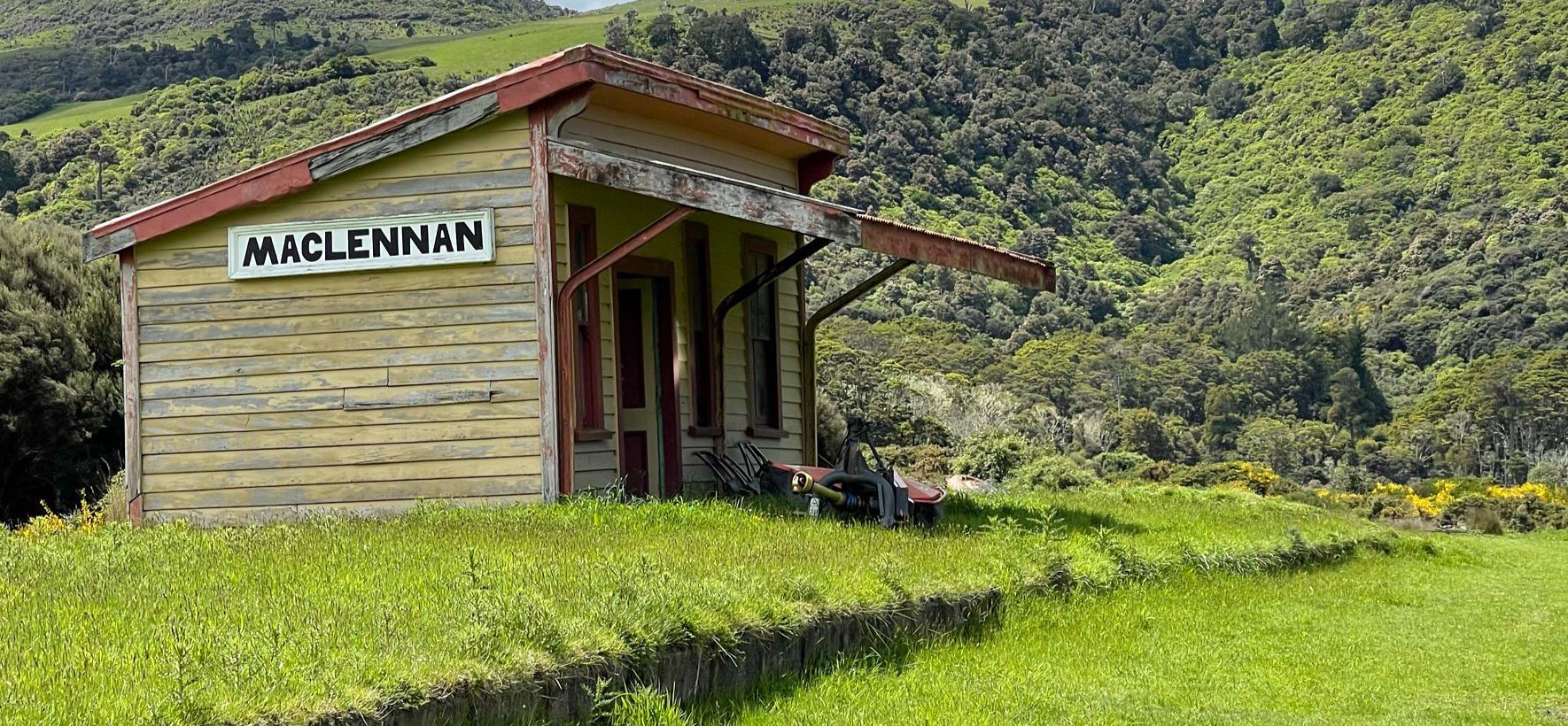
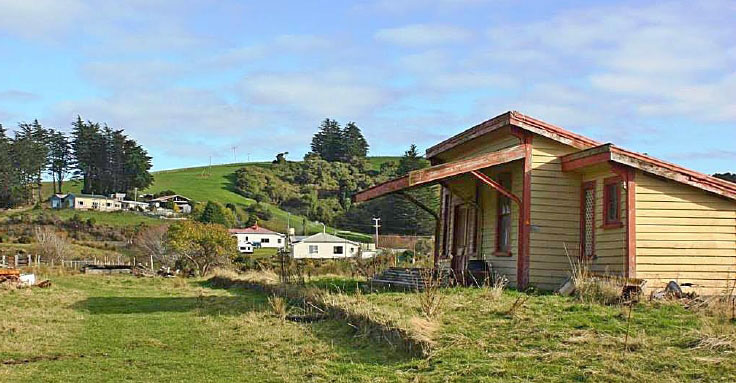
Although Maclennan was now a flag station, a new railway station was built in 1920. The building followed the Class A No. 3 pattern first prescribed by New Zealand Railways in 1914. One rail heritage expert noted that the Class A stations are now very rare and that the Maclennan station may be the only Class A structure remaining in New Zealand in its original context. The plan included a public lobby, ladies’ waiting room and a small lean-to with hallway and toilet. Adjoining the structure was a 200 foot (61 metres) platform with 3 foot (1 metre) ramps at either end.
Surfaceman, W. J. McMurray, was appointed as caretaker of the Maclennan rail buildings in December 1920. As caretaker he was allowed to live rent free in the neighbouring railway house. He held the key to the goods shed and made it available to settlers so they could pick up their deliveries. He was also furnished with a key to the telephone box in the station. This phone was still in use by 1945 when it was used to let Maclennan residents know of the end of the Second World War.
In 1924 a resident complained there was ‘no seating accommodation in the ladies’ waiting-room at Maclennan and that ladies have to sit in the public lobby’. Bench seating was quickly supplied.
In 1930 an eight foot verandah, costing around £54, was added to the platform as a shelter for ‘fish and cream traffic’. It was noted that over six weeks 41 cases of fish came through and 387 cans (2392 gallons) of cream. In 1945 15 metres were removed from the platform which was in poor repair.
Goods Shed
The wooden goods shed was 33 metres east of the station building. It had a large sliding door on the northern elevation allowing easy access to the wagons.
Stockyards
The fenced yards held stock before being loaded on the train. They were still in use in 2008.
Ganger’s Hut (Former)
There were once thousands of ganger’s huts providing shelter around the country for men working on the railway line, but few remain. One the earliest original structures at Maclennan, it was low roofed, windowless, with a primitive fire and chimney.
This ganger’s hut saw what perhaps no other had. A guard temporarily in charge at Maclennan brought his pregnant wife and two children with him, where they holidayed in the ganger’s hut. When the baby made a premature arrival, the children were put outside the hut for lack of room. The baby boy was named Maclennan.
Railway Houses
Railways supplied accommodation to some operating staff, especially in more remote locations like Maclennan. The houses were rented to employees. Six railway cottages were onsite by December 1914. The houses also served as a church, school and hospital. In 1960 electricity was put on in the remaining houses and an electric range supplied.
‘House no 475’, at 2281 Papatowai Highway, was described in 1964 as having five rooms, an iron roof, no electric light, a coal range and a detached wash house. In 1974 Archibald Flett, the storekeeper, purchased the house from NZ Railways. He sold it to Donald and Agnes Jenks in 1977.
The other railway house still extant (the middle house in Figure 3) was purchased by Junetta Maybee in 1972. It passed through various hands until it was purchased by the current owners in 1983.
Maclennan Community Buildings Boarding House
Maclellan’s boarding house was likely opened by James and Isabella McIntyre, nee Lockerbie. By 1914 James owned much of the land that would become the Maclennan township. The boarding house was likely built around this time. A photograph attributed to around 1914 appears to show the structure on site.
Maclennan was in need of accommodation for rail workers, sawmillers and, later, rail passengers and tourists. Trains crews were based at Maclennan for four years. The local Public Works office also shifted to Maclennan in 1914. Passengers needed accommodation - trains often left Maclennan at 5.50 am and arrived back at 9.35 pm. Indeed Truby King almost missed the train one morning - waking late he was seen ‘in his underclothes running down from the Maclennan Boarding House to catch his train’.
In 1916 James McIntyre died leaving Isabella with six children. She continued to run the boarding house, even after her remarriage to Donald Little in 1924. Indeed the new school teacher, Jim Leckie, wrote that the boarding house in 1928 was ‘excellent’.
Maclennan School and Teacher’s Residence
In 1912 the community approached the Otago Education Board (OEB) for a school for the 23 children living in the area. The Board agreed to provide a teacher for the school, but the school house was to be provided by the Public Works Department. Lessons took place in two rooms in ‘Cottage No.6 ’, the platelayer’s cottage. In June 1914 school was closed when diphtheria broke out in the district and the cottage was transformed into a temporary hospital.
In 1914 two acres of land was purchased from John and Isabella McIntyre for a purpose built weatherboard school. Tenders were advertised and in early 1915 the Board announced that James Cross’s tender of £273 10s was accepted. The architect was Otago Education Board (OEB) architect, James Rodger. In May 1915, following a request from the School Committee, the OEB changed the school’s name from Papatowai to Maclennan Public School.
From its construction the school was used for community events, including basket socials, meetings and church services from 1915. In April 1916 it also became the Sunday School. In 1919 the school hosted an event welcoming returned servicemen home.
In the 1930s a playshed was added to the site. Another wing was also added to the school.
Like everything else in Maclennan, the school was connected to the rail. Pupils were even carried by train to woodwork classes at Owaka. In 1916 the School Committee organised a train trip to Dunedin for the children, hamper supplied, in lieu of prizes.
Maclennan centred around the busy railway station and …sawmill…Children going home from school leaned on the railings of the overhead bridge to watch, teased by puffs of black smoke sent aloft by friendly engine drivers.
In 1956 the school closed and pupils were sent to Tahakopa.
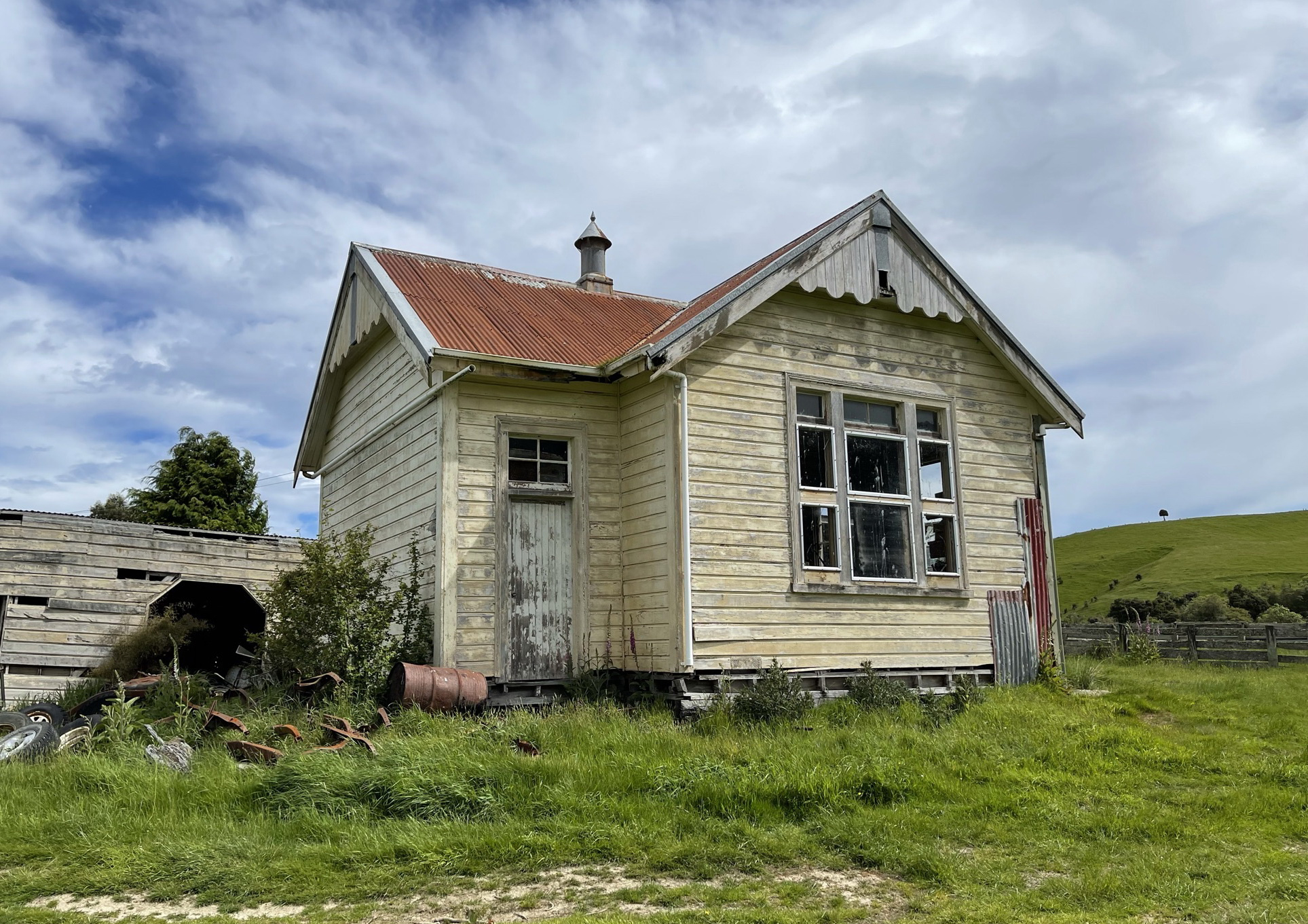
The Teacher’s Residence was built under the auspices of the OEB. Most rural schools were provided with a teacher’s residence. It was likely built after 1928 as the new school teacher stayed in the boarding house. It is visible in a 1930s image and may have been built not long after the arrival of the new teacher.
The house was built by local sawmiller, Bill McCoombe, of whom it was said that he never owned a set square or a level. It had three bedrooms, or two bedrooms and a separate lounge. There was no hall and the ceilings were tongue and groove rimu. One of the bedrooms was in the annexe which had its own lockable entrance door. This was used by visitng pupil teachers. The exterior was originally cream with a red roof. The original verandah showcased lattice work but this was later removed. The house passed out of Crown ownership in 1974 and was purchased by Peter Hill. He added a small lean-to at the rear to extend the kitchen/living area, re-piled the house and made various other repairs. The holiday house is still not connected to electricity and the original model of coal range meets the household’s needs.
Maclennan Community Hall
The Hall was built as a war memorial for community use. Isabella McIntyre donated half an acre of land for a hall site which sat alongside the school. A grand bazaar was advertised in 1923 in aid of construction costs. The Hall was complete by July 1924 when the ‘Maclennan bachelors held their first annual ball in the Maclennan Hall… the function proved an unqualified success’. The Maclennan Hall Committee ran the hall, hosting socials and farewells and the regular ‘Euchre Tournament and dance’ evenings.
The Maclennan General Store and Storage Shed
William Lawson opened Maclennan’s General Store. It was first mentioned in 1915. Ebenezer and Jenny Lockerbie ran the Maclennan store from 1920 when they purchased part of Section 10 from Isabella McIntryre.
They also had a large shed across the road to store merchandise. The land for the storage shed was purchased from Lawson by Lockerbie, the storekeeper, in 1923.
The new school teacher described the store in 1928 – ‘…I made my first call at the hub of the hamlet – the general store. Following a beam of light from the doorway, the now jaded motor-cyclist entered a building dimly lit by a guttering oil lamp and, stooping low to avoid the pots and pans and other merchandise suspended from the ceiling, met the staff, two men whose genuine amiability, followed by a social cup of tea supplied by the housewife, made me feel immediately at home in a strange land’.
In 1935 Archibald Flett purchased the store and shed.94 In 1959 the shed was taken for Electricity purposes, and in 1977 it was sold to the Jenks.
Flett ran the store for over 30 years until Agnes Jenks bought it in 1977. In 1983 the store was taken over by Grant and Margaret Martin and in 1987 by Deane and Bronwyn Shute. Peter Hill remembers the store as a one-stop-shop. It was a bank, post office, liquor store and carried a vast range of stock. In 1988 the shop closed and was converted into a holiday home.
The End of the Line
Once the accessible forest was cleared, the line no longer had a purpose to sustain it. Roads were now robust and in 1958 passenger services ceased. By 1964 the engine shed, some railway houses and neighbouring sawmills had gone. There was still some traffic in fertiliser, timber and livestock but not enough to sustain the line. In 1971 the Catlins River Branch line closed. The community and rail buildings were eventually sold into private hands. Even the local store finally closed its doors. Some buildings were repurposed for accommodation, storage or farming use.
The town was founded on the rail but the story of the line is more than a story about transport. It is also ‘the life-line, the community centre, the tie that drew the people together… In this sense we will be the poorer for losing the railway’.