Early history
The northern shores of the Waitematā Harbour are of significance to several iwi, having been explored and occupied since early human arrival in Aotearoa New Zealand. According to oral traditions, Te Arawa waka (canoe) under Tama Te Kapua investigated the Waitematā on its way to Tauranga Moana. The Tainui canoe also landed at Te Hau Kapua (Torpedo Bay) in present-day Devonport before arriving at its eventual heartland in the Waikato. Horticultural activity is likely to have occurred on fertile soils at Devonport and around Pupuke Moana (Lake Pupuke) at modern-day Takapuna, and high-quality fishing grounds existed around adjoining shores. Exploitation of kai moana (seafood) is indicated by archaeological features fronting Oneoneroa (Shoal Bay) and Ngātaringa Bay on the Bayswater peninsula. Shell midden on the foreshore to the north of O’Neill’s Point Cemetery suggests at least some activity in the immediate vicinity. The area was heavily contested, with several pā being created on volcanic maunga at Devonport and elsewhere in the broader locality.
Subsequent to formal European colonisation in 1840, the Crown obtained the North Shore area as part of the Mahurangi Block. In 1843, lands between Devonport and Lake Pupuke were surveyed into farm lots, and two years later one of these, Allotment 13, was acquired by Robert Hunt (c.1790-1874). Hunt was one of several purchasers in the immediate vicinity who had come to Auckland from the Hokianga as refugees during the Northern War (1844-5), and been allowed to obtain land using property held in the north as collateral. During the early colonial period, the area between Devonport and Lake Pupuke was described as ‘a sadly waste plain of sterile pipe-clay which grows nothing but dwarf manuka and fern’. Hunt’s land was, however, part of a tract that was especially rich in kāpia or kauri gum – a valuable commodity exported for use as varnish – and continued to be exploited for this purpose until at least the 1890s.
In 1848, Hunt transferred Allotment 13 to prominent local resident Allan O’Neill (1801-1886), who held a number of important provincial positions including Provincial Surveyor and member of Auckland Provincial Council. In 1888, the land passed to O’Neill’s son James Frederick O’Neill (1858-1933), a member of the Lake Road Board. The land’s rural nature contrasted with that of nearby Devonport, which had emerged as a colonial settlement in the 1840s and 1850s; developed as a notable ship-building centre; and expanded rapidly after steam ferry services with Auckland were established in the 1880s.
In December 1889, James O’Neill offered the western part of Allotment 13 to Devonport Borough Council for use as a public cemetery.
The need for a new Devonport cemetery
A new Devonport cemetery was being considered due to the perceived unhealthiness of the settlement’s existing burial ground at Takarunga (Mt Victoria). When initially established, the latter had lain outside Devonport’s main residential areas. Early colonial cemeteries such as Mt Victoria were often created without consideration about how urban expansion might occur. As burial grounds became surrounded by housing, public health concerns due to in-ground seepage into nearby water sources or disease from perceived airborne ‘miasma’ were frequently raised.
From the late 1850s, there was a general move in New Zealand to create larger, second-generation facilities well outside settlement areas. Catering for the living as well as the dead, these were often designed to encourage public recreation, remembrance and moral education through their monuments, layout, setting and other aspects. Such cemeteries were increasingly encouraged by nineteenth-century legislation, the most important being the 1882 Cemeteries Act. For the first time in New Zealand’s colonial history, this established consistent approaches to the creation, siting, design and maintenance of cemeteries, and also required local authorities to provide sufficient facilities. In Auckland, a series of major, second-generation cemeteries were respectively created to the west, east and south of the expanding city at Waikumete (1886), Pūrewa (1889) and Waikaraka (1890). Together with another cemetery at Birkenhead, land at O’Neill’s Point would provide parallel facilities to the north.
Created in 1852, Devonport’s Mt Victoria Cemetery had been the first formal European burial ground on the North Shore but by the 1870s calls were being made for its replacement. Particular concerns were expressed that it was ‘in the most populous part of the borough, on rising ground…with houses on the lower level drawing their water supply from wells’. Issues linked with health and physical well-being can be seen as especially important in Devonport, which gained popularity during the late nineteenth century as a ‘healthy’ seaside suburb and destination with a strong sporting culture and expanding military ties. With the late 1880s creation of major naval and other military facilities at Calliope (1888), North Head (1885-9) and Fort Takapuna (1886), projections of strength linked with imperial power can be regarded as especially prominent.
In 1885-9, Devonport Borough Council attempted to create a new cemetery further away from central Devonport, at Narrow Neck. However, this site’s position within the borough boundaries contravened the 1882 Act and also aroused popular opposition for being too close to the town. A site at O’Neill’s Point circumvented objections by being located just outside the borough boundaries, in an area that remained predominantly rural. Extending into the Waitematā Harbour, the aesthetic qualities of the peninsula were also such that it was proposed that ‘the most beautiful cemetery in New Zealand could be made’.
Creation and early use of O’Neill’s Point Cemetery
Occupying 3.4 hectares (8.5 acres) directly overlooking Shoal Bay, the site offered by O’Neill held numerous advantages in relation to health and other attractiveness for public use. In addition to its appealing waterfront position away from residential land, it contained relatively dry ground that both faced the sun and drained towards the harbour – dissipating, it was thought, both airborne miasma and in-ground seepage. As initial preparation, the Council’s foreman of works Charles Savage oversaw burning, clearing, harrowing and fencing of the land in 1890. By-laws controlling a variety of matters, including those linked with health and aesthetic appeal were also established. These included rules governing the depth of graves; construction of coffins and covering of vaults ‘to prevent the escape of any noxious exhalation or evaporation in the Cemetery’; and protection of ‘Buildings, Monuments, Shrubberies, Plantations, and Enclosures’ from destruction or damage. Plots of different size and class were formulated, enabling social status among the living to be replicated at burial.
Reflecting desires for a planned landscape, competing designs for the layout of the cemetery were sought. In March 1891, a proposal by Auckland engineer John Francis Boylan (1850-1922) was accepted. Boylan had previously won a competition to design the discontinued cemetery at Narrow Neck, and other of his works on the North Shore had included creating parts of the Colonial Sugar Refining Company complex at nearby Birkenhead. His plan for O’Neill’s Point contained greater burial space relative to trees and roads than an alternative under consideration, suggesting that beautification was to be balanced by practical issues such as the longevity of cemetery use.
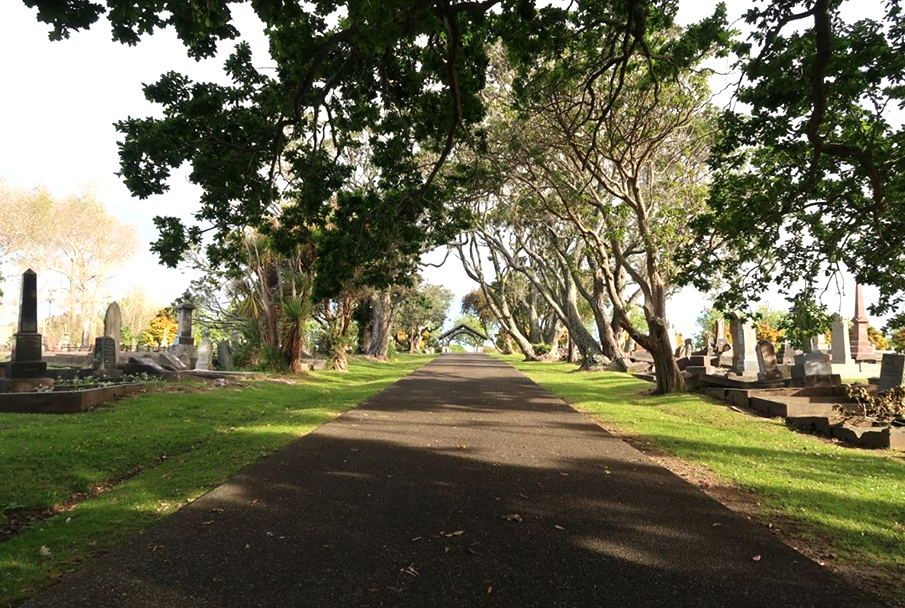
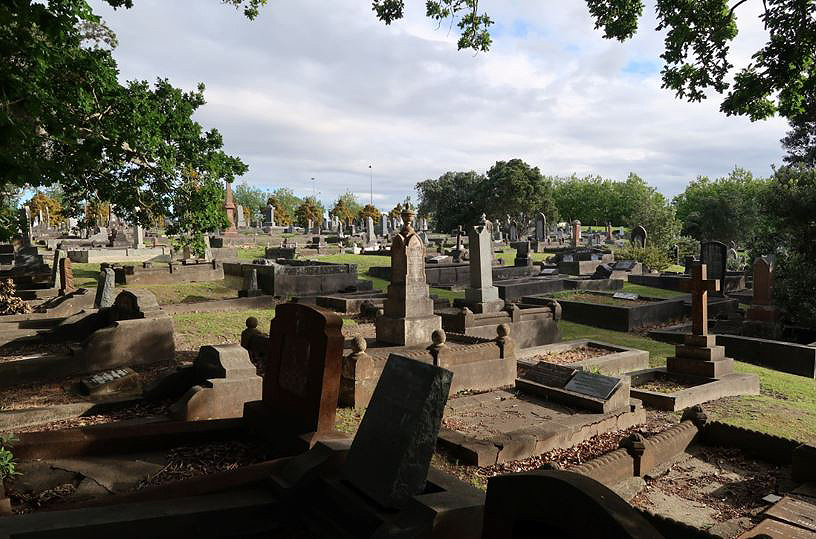
Burial was initially restricted to the eastern part of the cemetery. A rectilinear grid containing plots and walks was laid out to the east of a wide entrance avenue, enabling visitor perambulation as well as access for burial. The main avenue was evidently lined by native trees or shrubs from the outset, with plantings occurring elsewhere – possibly including pine trees near the property boundary to the northwest of the main avenue. Like Devonport’s earlier burial ground, the cemetery was divided into three sections according to religious affiliation – Anglican, Catholic and Unsectarian. It opened for interments in August 1891, at which time the Mt Victoria graveyard was closed.
Although largely intended for the inhabitants of Devonport, the new cemetery received residents from elsewhere on the North Shore and Auckland. Funeral corteges frequently arrived from a considerable distance in elaborate displays of mourning. One of the first burials, that of Thomas Sibbin who died of injuries sustained while playing rugby, ‘was attended by over 450 persons on foot, while several vehicles and horsemen were also in attendance’. Sibbin’s hearse had travelled from Auckland Hospital to Devonport via ferry, accompanied by 300 mourners, and after being met at the wharf by another large crowd was processed by road to the place of burial.
Other early burials included those of Thomas (1803-1892) and Mary Poynton (1812-1891), significant figures in the establishment and initial growth of Catholicism in New Zealand. Having settled in the Hokianga in 1828 to participate in the Pacific kauri trade, they became the first laity to officially represent the institutional church in this country, and after receiving Bishop Jean Baptiste Pompallier at his arrival in New Zealand in January 1838 the country’s first official Catholic Mass was celebrated in their house. Other early interments included two sailors from the French warships Dubourdieu and Duguay-Trouin, the latter described as the flagship of the French squadron in the Pacific; and in 1902 John Palmer (1837-1902), Archdeacon of South Melanesia who had worked extensively in the Pacific including the Banks Islands in northern Vanuatu and Norfolk Island, was similarly interred.
Cemetery facilities expanded in the late 1890s and early 1900s. Boylan pegged out further graves in 1895, and in 1897 a Gothic Revival mortuary chapel designed by notable Auckland architect and Devonport resident Edward Bartley, was erected west of the main avenue. After a fire damaged empty land to the west of the main avenue in 1900, the Council resolved to plough and plant this part of the property with oats. In 1903, it was surveyed for additional plots, creating a much enlarged burial area. Incorporating smaller plot sizes, its appearance varied from the pre-existing cemetery, although it retained a rectilinear grid layout with intervening paths.
From 1910, the rural situation of the cemetery reduced following construction of a new wharf at O’Neill’s Point. A regular ferry service between the wharf and central Auckland encouraged greater use of the cemetery from across the harbour as well as residential development. A tram service past the cemetery, connecting the ferry terminal and Takapuna, also facilitated access. During the First World War (1914-18), an influx of servicemen to the area additionally occurred.
Cemetery use during and after the First World War
During the global conflict and its immediate aftermath, the cemetery became the final resting place for many Pasifika, Māori and Pākehā servicemen. Most were based at Narrow Neck camp, established in 1915 for training members of the Tunnelling Company, Māori troops and reinforcements from what were then referred to as ‘British Islands in the Pacific.’ The latter recruits consisted mostly of servicemen from the Cook Islands and Niue, but also from Tahiti, Fiji, Samoa, Tonga, and Kiribati and Tuvalu (the latter at that time known by British authorities as the Gilbert and Ellice Islands). Considerable numbers stayed at the camp on their way to or returning from service on the overseas front. Initially, Māori and Pasifika troops served together as part of the 3rd Māori Contingent. Created beside an earlier establishment, Fort Takapuna, Narrow Neck camp became central to the contribution of indigenous peoples in New Zealand and the wider Pacific to the British imperial war effort.
Māori soldiers enlisted for a variety of reasons, which included obligations perceived as inherent in Te Tiriti o Waitangi. After heavy casualties among Māori forces in the Gallipoli campaign in 1915, military authorities sought reinforcements from the Pacific Islands. Over 1000 men from the latter volunteered to enlist during the conflict. Of the more than 2500-strong Māori contingent and its reinforcements sent overseas, some 470 were of Pacific Island origin.
Pasifika servicemen volunteered at a time when New Zealand’s empire in the Pacific was reaching its height. The country’s imperial expansion had steadily increased during the early 1900s, with annexation of the Cook Islands and Niue in 1901, invasion of Samoa on Britain’s behalf at the outbreak of the First World War in 1914, and subsequent joint administration of Nauru with Australia and Britain. New Zealand’s greatest imperial reach occurred in 1926, when Britain transferred to it the government of Tokelau. The arrival of men at Narrow Neck from many Pacific locations presaged by several decades the large-scale migration of Pasifika peoples to New Zealand as a workforce following the Second World War (1939-45) – although both reflect New Zealand turning to its Pacific neighbours at times of need.
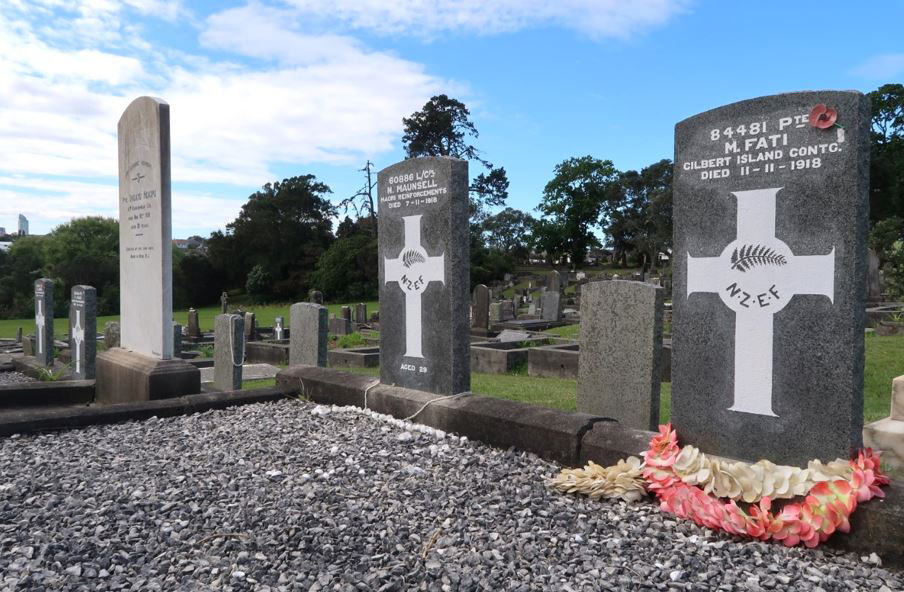
Pacific Island recruits were vulnerable to conditions and afflictions not encountered in their homelands. The first Pasifika serviceman buried in O’Neill’s Point Cemetery was Private Vilipate (1893-1915) from Niue – also the first from his country to die while enlisted with the New Zealand Expeditionary Force (NZEF) – who contracted pneumonia at Narrow Neck in December 1915. Others from the camp to be interred included Sergeant Beni Banaba (1890-1917), a member of an important chiefly family from Manihiri in the Cook Islands who had served in Egypt and Palestine in 1916-17. Several died during the influenza pandemic at the end of the war, including servicemen from Tuvalu, the Cook Islands and Fiji. Those from Tuvalu - Privates Mannao (or Manuao) Fati (1880-1918) and Tonuia (1898-1918) - and Fiji-born Private Laliqapata Ilitomasi (1891-1918) collectively formed a substantial proportion of the 25-strong Gilbert and Ellice Islands Contingent.
A number of Māori colleagues were similarly afflicted by the pandemic and laid to rest at the cemetery. Of the latter, four – Te Hapa Ihia (c.1893-1918), Tame Tahi (d.1918), Kiri Toto (c.1895-1918) and Rupena Hihi (c.1895-1918) – had been engaged in passive resistance by refusing to obey orders after being forcibly conscripted from among iwi in the Waikato-Maniapoto district in 1918. Their position reflected deeply-held views on objection to military service within parts of Māoridom, and especially among Kīngitanga iwi, whose lands had been invaded and confiscated by British colonial authorities just fifty years earlier. The campaign of resistance to military service was led by the Kīngitanga woman of mana, Te Puea Hērangi (1883-1952). Grief felt by the families and people of those who died of influenza while engaged in resistance was compounded by their burial at O’Neill’s Point rather than being returned to traditional lands for interment.
Although a global phenomenon, the influenza pandemic disproportionately affected indigenous peoples in the Pacific including Islanders and Māori. Over a tenth of the 107 Pacific Island servicemen in the New Zealand Expeditionary Force who died from disease or action are buried at O’Neill’s Point.
A number of Pākehā servicemen were similarly interred. Influenza victims included a nurse, Isabelle Maude (or Maud) Manning (1870-1918), who had volunteered to look after the particularly large number of cases among Pasifika and Māori troops at Narrow Neck camp. Some 66 people, including civilians, were buried at the cemetery in November 1918 – when the pandemic was at its height. No affliction in New Zealand history has killed so many people in so short a time. At this time, military camps were the most dangerous places to reside.
From at least 1915, the country’s first Inspector of Old Soldiers’ Graves – Edith Statham (1853-1951) – formed an interest in the cemetery, campaigning for the care of its military burials. Statham had previously been secretary of the graves committee of the Victoria League, an organisation dedicated to promoting closer ties within the British Commonwealth. For more than two decades from April 1921, the League arranged annual ANZAC Day events at the site to remember those who had served and died. Services were also held on Armistice Day. By 1923, formal military headstones were erected, and the Takapuna Women’s Progressive League campaigned for tidying up the entire cemetery. By the 1930s, the Auckland Returned Soldiers’ Association were tending soldiers’ graves before each ANZAC and Armistice Day commemoration.
Those buried at O’Neil’s Point Cemetery after the war included Walter Gudgeon (1841-1920), the first New Zealand governor of the Cook Islands who oversaw annexation of the islands with Governor-General Ranfurley in 1901 and promoted British imperial ideology. In 1924, the cemetery saw the burial of Major Henry Peacock (1871-1924), who had commanded the first contingent of 500 Māori soldiers to leave New Zealand in the war and who had been responsible as camp commandant for training both Māori and Pasifika forces. In 1929, the unveiling of a monument on his grave was attended by approximately 300 Māori representing ‘every hapu from North Cape to the Bluff’. Graveside orators included Tuiti Makitanara, Member of Parliament for the Southern Māori District, who spoke on behalf of South Island iwi. Other interments connected with the Māori and Pacific Island contingents included that of Wesleyan missionary, William Gittos (1829-1916), who had given religious services to recruits before his death in 1916.
Many individuals who lived locally were also interred during this period. These included prolific Auckland architect Edward Bartley (1839-1919), who had designed numerous important structures in the region as well as the cemetery’s mortuary chapel; surveyor Robert Eyre (d.1920), reported to have laid out the township of Tauranga, been first government surveyor on the Thames goldfields and created the Taranaki confiscation lines; and Charles Burrell Stone (1841-1920), reputedly the first male Pākehā born in Auckland and owner of the city’s largest shipping business.
Robert, Archibald and John Logan, who founded the renowned boatbuilding business of Logan Brothers – which exported yachts to Australia, South Africa and the Pacific region from 1898 – were likewise interred. Archibald Logan (1865-1940) has been considered ‘the pre-eminent yacht designer in the southern hemisphere’ in the early twentieth century and ‘the outstanding figure in New Zealand yachting’ at this time. The Logans additionally produced whaling boats and other craft for use in Samoa, Tonga and other Pacific Islands, as well as vessels for the Northern Steamship Company and other shipping firms.
George Bourne (1875-1924), a notable press photographer who took the first aerial photograph in New Zealand was also laid to rest there as was newspaper magnate Sir Henry Brett (1843-1927). In 1926, the cemetery formed the final resting place for Lieutenant Wāta Te Wahahuia (or Walter Callaway) (1874-1926) of Ngāi Te Rangi, who is credited with being the first Māori soldier to serve in the South African War (1899-1902), and who composed a haka that became the battle cry for all New Zealand contingents: ‘Kia kaha nu Tereni, Wha whai maea mo to Kuini to Kianga, Ake Ake Ake’ (‘Be strong New Zealand, Fight bravely for your Queen, for your country, Ever! Ever! Ever!’).
Later history
By the early 1930s, the cemetery was becoming full. Proposals to extend the facility, and later to build a crematorium, were opposed by the Takapuna authorities – in whose jurisdiction the surrounding land lay. Ongoing acts of public remembrance included Apostolic Delegate J. Panico and Bishop James Liston laying a wreath at the grave of Thomas and Mary Poynton in 1938 – which formed part of New Zealand Catholic Centenary commemorations. Later military interments encompassed local airmen who died in New Zealand during the Second World War. In 1951 Edith Statham, who had campaigned for the upkeep of military graves at O’Neill’s Point several decades earlier, was buried in the cemetery.
The dwindling number of burial plots probably contributed to the mortuary chapel being removed before 1959. In 1970, the cemetery was calculated to contain over 5400 burials, with approximately half being from Devonport, a quarter from Takapuna and the remainder from elsewhere. Two years later, ownership was transferred to the City of Takapuna. In 1974, the 36.4 hectare (90 acre) North Shore Memorial Park, incorporating a crematorium, opened near Greenhithe to cater for all North Shore suburbs – which had expanded significantly after the Harbour Bridge opened in 1959.
The cemetery subsequently received occasional burials, but predominantly formed a place of remembrance. Reflecting its ongoing value to the community, a lych-gate was added to the main entrance in 1983. Military graves have been maintained by the New Zealand Government on behalf of the Commonwealth War Graves Commission, and the cemetery continues to be used for public commemoration of ANZAC Day. Throughout its existence, civic upkeep of the cemetery has been vigorously encouraged by the local community, reflecting its importance as an ongoing repository of memory and identity.