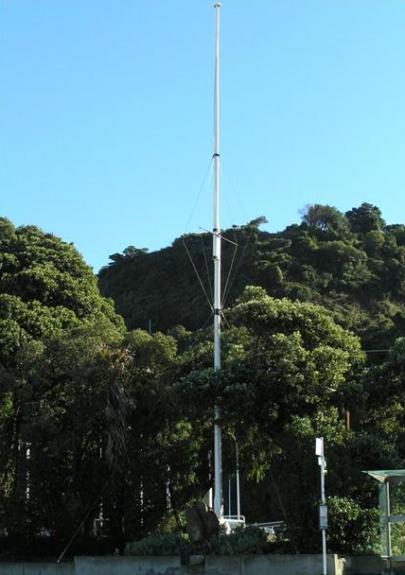
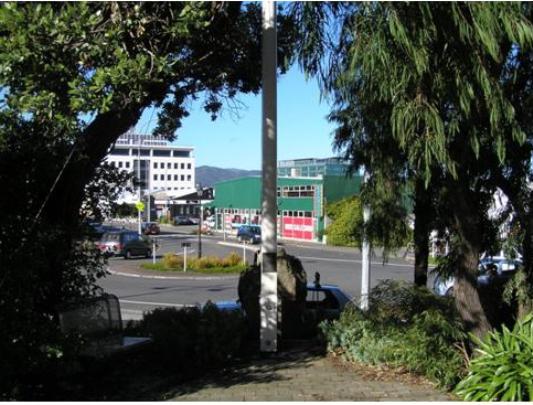
The Maori discovery and settlement of the Wellington region is connected with several prominent figures in New Zealand’s history. Ancestral figures such as Kupe, and Toi are both associated with the area. Wellington Harbour, Te Whanganui a Tara (the great harbour of Tara), was named after the chief of Ngai Tara, and his people as well as Ngati Ira from Hawke’s Bay were the earliest iwi to settle in the Wellington region. At various times Rangitane, Ngati Kahungunu, Ngati Mamoe and Ngai Tahu have also occupied parts of the Wellington region which sometimes resulted in inter-tribal conflicts. However, for the Ngati Ira based at Pito-one the biggest upheaval occurred in the 1820s when they were displaced by northern iwi, Ngati Mutunga and Te Ati Awa. Twenty years later Te Puni was the paramount chief of local Te Ati Awa who occupied a pa on the waterfront at Pito-one. Te Puni encouraged European settlement in the area and as such the first European settlement in Wellington was located close to the pa, and after initially being called Britannia this eventually became known as Petone.
The first of these European settlers arrived in late 1839 to buy land and scope out the New Zealand Company’s Port Nicholson settlement. The Petone site for the settlement was a poor choice mainly because it was subject to frequent flooding. Therefore, many of these early immigrants moved to a new site in Thorndon, but some battled on at Petone. Because of flooding the town could not progress substantially until stopbanks were constructed in 1900, although by this time it had already begun its development into a major New Zealand industrial and manufacturing centre; a dominating characteristic that Petone would retain throughout the twentieth century.
It was the advent of the railway and the associated workshops which are credited as the catalyst for Petone’s industrial development. The Petone railway workshops were opened in 1877 on the New Zealand Railways main line from Wellington which was begun in 1872 and reached Petone two years later. The workshops were located west of the Petone Railway Station below Korokoro Hill, a site now bisected by Western Hutt Road/State Highway 2. Initially a private workshop built at Wellington’s Pipitea Point was used by Railways, but the Government was mindful that it would eventually need to find a site to build its own workshop, and among the proposed sites was Evans Bay, which would have had to be accessed with a branch line. However, Petone offered the best location adjacent to the exiting railway line and in 1876 a start was made on construction. Most of the workshop’s facilities in use during World War One were built between 1877 and 1881, but with plenty of available space in the immediate surrounds these were gradually added to as demand necessitated. The railway workshops marked the beginning of Petone’s industrial, and corresponding economic development, and were quickly followed by a meat works and woollen mill.
The importance of the railways to the World War One war effort and the general running of a country was also widely acknowledged in New Zealand and internationally at the time. Speaking on ANZAC Day 1916 in Hornsby, Australia, the New South Wales Minister for Railways noted that as a result of the initial surge of railwaymen enlisting by 1916 railway workers were prohibited from enlisting to ensure that the railways could still function at the required level. In New Zealand the situation was similar with passenger numbers increasing exponentially because of the necessity of transporting thousands of troops to training grounds, camps, and to points of overseas departure. With the Trentham Camp being on the Wairarapa Line, the Petone Railway Station would have witnessed many of these trains taking soldiers there and then back to Wellington where they departed for war.
In particular, the Petone railway workshops played a vital role in the Railway Department’s contribution to the war effort during World War One. The Petone workshop not only helped to maintain existing trains and equipment, but also manufactured the army’s Maxim machine-guns, converted carriages to cater for transporting the wounded, and made the stretchers that Trentham Camp inhabitants slept on. The workshop employees were also visibly patriotic during the war, with the staff contributing to charitable institutions involved in the war effort, such as the Red Cross, and through other demonstrations like their impromptu parade down Jackson Street in May 1915 upon receipt of word of a military success in the Dardanelles.
It was late in 1915 that the Petone railway workshops staff were approached by the New South Wales Railways and Tramways Department, through the General Manager of the New Zealand Railways Department, to partake in a trans-Tasman interaction with their Hornsby counterparts. This was to involve the swapping of a New Zealand flag with an Australian Red Ensign from Hornsby; an exchange that was meant to be evocative of the spirit of camaraderie demonstrated by those New Zealand and Australian railwaymen who had fought together as part of the ANZAC force at Gallipoli. The idea to honour their colleagues in this fashion originated with the Hornsby workers who planned to give troops a grand send-off from their station. The Hornsby men wanted to garland and decorate the station with various flags for the occasion and rather than purchase a New Zealand flag they proposed the exchange and also that an unfurling ceremony be arranged to take place at the same time. At Hornsby their existing station flagpole was also to be replaced especially for the occasion.
Progress on making the New Zealand flag, exchanging it, and then building the flagpole, was fairly swift once the decision to go ahead was made and the Petone Railway Patriotic Committee formed in January 1916. The plans for the memorial not only required the Petone Workshop employees to pay for the flag, to construct the flagpole and provide materials for the original picket fence surrounding the flagpole garden, but also involved various other arms of the Railways Department. For example, the District Engineer’s staff were in charge of erecting the flagpole and the station staff were later placed in charge of maintaining the gardens.
The exchange of the flags had taken place by late February 1916 and the flagpole was constructed a few weeks later, in time for the original unfurling date of 4 March. However, it was not erected until 8 April 1916 because it was decided to delay the unfurling ceremonies until the first ANZAC Day on 25 April. By mid April plans were well under way on both sides of the Tasman for the respective ANZAC Day Hornsby and Petone ceremonies. Invitations had been sent out and the technical aspects of the day were being considered with station decorations being organised as well as refreshments, and fund and morale-raising functions. Given that the Petone Workshops had manufactured a range of equipment for the Defence Department it was considered appropriate that the Trentham Camp Band play at the unfurling. However, the existing train schedules are not convenient for them, so the Railways Department put on a special train to transport them to and from the camp.
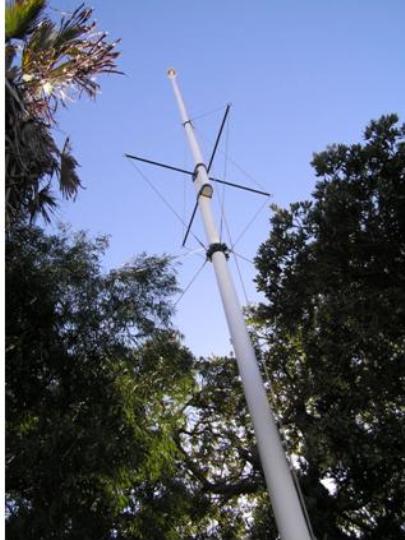
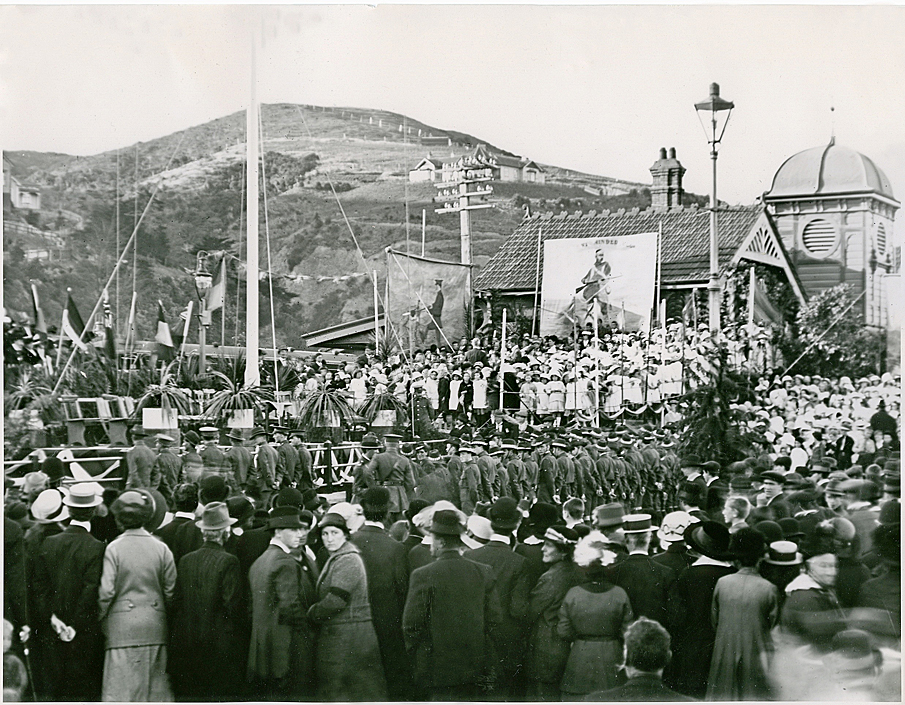
This first ANZAC Day ceremony at Petone was described as ‘one of the most memorable days in the history of Petone’ and was attended by hundreds of railway workers and their families, Petone residents and people who had travelled to the ceremony from central Wellington. Indeed, both the Hornsby and Petone ceremonies drew large attendances from the wider community. The event was also attended by high profile dignitaries including Prime Minister W.F. Massey (1856-1925), Sir Joseph Ward (1856-1930), the area’s member of parliament T.M. Wilford (1870-1939), Mayor Ewan, and fittingly, W.H. Herries (1859 -1923) who was the Minister for Railways, as well as his fellow Ministers for Agriculture, Customs, Education, Internal Affairs, Native Affairs and Public Works. The son of Mr T. Stone, the chairman of the Hornsby memorial committee, was there as the representative of the Hornsby railway men. At Petone, the Australian Red Ensign provided by the Hornsby workers was unfurled by the Prime Minister on the crossbar of the flagpole opposite a New Zealand flag that had been made by the Petone Workshops Trimmers Department and was unfurled by Ward. The Union Jack took precedence on the main mast of the flagpole and was hoisted by the Minister of Railways.
In 1916 the ANZAC Memorial Flagpole became a poignant reminder of Petone’s and the Railways Department’s recent individual and collective losses as a result of World War One. In total 37 New Zealand Railways employees were killed at Gallipoli. The unfurling ceremony on ANZAC Day 1916 at Petone, and the memorial flagpole, would have taken on further significance for the workshop employees because of their personal connection to Major Norman Frederick Hastings. Hastings was a veteran of the South African War and a popular foreman fitter at the Petone Workshop. Unbeknownst to his workmates there at the time, Hastings died of wounds sustained at Chunuk Bair in August 1915. It was in late March 1916 that a Court of Enquiry reported that Hastings, who had been listed as missing believed dead, had died of his wounds. Despite the uncertainty around his status in late 1915 and early 1916, honouring Hastings is thought to have been a key motivator for the Petone Workshop employees in organising the construction of the ANZAC Memorial Flagpole.
New Zealand memorials to those who died in World War One, like Petone’s ANZAC Memorial Flagpole, started to be erected while the war was still taking place. Since the men who died during the war were buried overseas, for the majority of the affected families and communities this meant that a war memorial became a surrogate grave at which they could go through the rituals associated with death in the absence of access to the person’s actual burial site. Most memorials were constructed within a decade of the cessation of World War One, and these were mainly in the form of a monument. This was because many felt that functional community structures such as libraries, halls, and bridges, were inappropriate as the community should not benefit when the purpose of a memorial was to recognise the sacrifice of others.
Until the construction of the Petone War Memorial in 1921, the flagpole was Petone’s only publicly accessible and prominently positioned war memorial. At the unfurling ceremony the Prime Minister commented on the fact that the efforts of the railwaymen in organising its construction was particularly public spirited in this respect. The situation was similar in Hornsby and when the community found out about the railway men’s initiative they were keen to come on board and broaden the meaning of the planned ANZAC Day activities at the respective railway stations to include the wider community and not just the railway workers and their families.
The commemorative nature of the flagpole not only had significance to those in the vicinity of Petone, and to Railways Department employees and families, as a tribute to those local men who had died during World War One, but it also had national and trans-Tasman resonances as an ANZAC memorial. The ANZAC legend was forged at Gallipoli in Turkey, which was a devastating campaign and one that solidified the horror of the war in the psyches of those back in New Zealand and Australia due to the incomprehensible death toll. Over the nine months of fighting about one quarter of the New Zealanders involved in the campaign died. In the broader context of World War One, these losses were meagre in comparison with those in France and Belgium. However, there was the feeling that in the Gallipoli campaign the ANZAC forces were thrown into an impossible situation and showed immense selfless courage in battling against the odds. At the Hornsby ceremony, the actions of the ANZACs at Gallipoli were likened to those of the Spartans at Marathon, and said to have awakened ‘a national martial spirit.’
The situation which faced the ANZAC forces at Gallipoli evoked a sense of national pride amongst the ANZAC countries. This is evident in the ANZAC Day commemorations that have taken place since 1916 and at which the ANZAC Memorial Flagpole played a prominent role in New Zealand. Importantly, the legacy of Gallipoli and the ANZACs has been singled out as a key component in the evolution of the national identities of both New Zealand and Australia. Petone’s ANZAC Memorial Flagpole became a symbol of the strengthened bond between New Zealand and Australia created through the ANZAC campaign at Gallipoli. This relationship was solidified by the collective grief and pride of the citizens of the ANZAC countries and was widely recognised and espoused from early in the history of ANZAC commemorations, with the former Prime Minister of Australia Sir Joseph Cook (1860-1947) stating at the Hornsby 1916 ANZAC Day ceremony that he interpreted ANZAC as meaning ‘Australia and New Zealand are comrades.’ Aside from the exchange of flags, the physical construction of the Petone flagpole reinforced this idea as it was symbolically constructed by bonding Kauri and Australian hardwood together.
ANZAC Memorial Flagpole: a survival story
The Petone railway workshops were one of six early North Island shops which were the result of the fragmented nature of the railway system in the late nineteenth and early twentieth centuries. However, by the 1920s the network was more cohesive and with many of the existing workshops needing major machinery upgrades a 1924 commission recommended a comprehensive modernisation programme. Petone workshops were a casualty of this and were closed in 1929 because it was more cost effective to built completely new workshops at Hutt than upgrade Petone’s existing facilities. This was one of the reasons why the Hutt Valley Branch line between Petone and Waterloo was constructed. Thereafter, the Petone workshops, with its over 900 employees, were closed, and later mostly demolished to make way for the Todd Motors assembly plant.
After the inaugural ANZAC Day ceremony the commemorative events at the Petone Railway Station ceased, with the exception of a ceremony at the flagpole held in 1918 by Petone workshops employees who were concerned not to loose sight of the events at Gallipoli, and also one the following year. A ceremony had not occurred the previous year presumably because the workshop staff were not given time off to commemorate ANZAC Day, which was a source of tension given that other sectors of the Railways Department were. Despite being instigated in 1916, ANZAC Day did not become an official public holiday until 1920 and this could account for the loss of momentum in regard to a consistent annual ANZAC event at the ANZAC Memorial Flagpole. The flagpole’s obsoleteness was compounded in 1922 when it was surpassed as Petone’s war memorial. The new trooper statue then became the focus of the town’s ANZAC Day commemorations.
The construction of the Petone War Memorial saw the ANZAC Memorial Flagpole become largely redundant. This lack of use was the basis for a proposal by the local council, who required a flagpole, to relocate the one at the railway station. This idea was floated in 1934 and seems to have been mainly driven by the mayor, David McKenzie, because it was abandoned after his death in October despite the Railways Department agreeing to it. Instead in 1935 the council decided that because the railway station was the gateway to the town that it should be the focus of a beautification scheme. As such the council leased the land surrounding the flagpole at a peppercorn rental and instigated a planting and beautification programme, with the flagpole remaining the responsibility of the Railways Department. In 1994 relocation of the flagpole was again mooted, this time by the Petone Community Board who thought it would be appropriate to move the flagpole to Petone’s Memorial Park. However, the strength of public opinion in opposition suspended any such move.
The ANZAC Day tradition started in 1916 was reinvigorated in the early 1950s and ceremonies were held annually at the flagpole for the next twenty years. The raised profile of the flagpole meant that during this period maintenance of the monument and the surrounds was again a focus, and the growth in interest also saw the Railways Department add a plaque and wreath holder to the base of the flagpole in 1953, and a further plaque was erected in 1961. The resurgence of the ANZAC activities at the flagpole from the 1950s seems to also have spurred the creation of another committee, the Petone Railway ANZAC Committee, to replace that which would have ceased when the Petone railway workshops closed.
After this late twentieth century lull, commemorative use of the flagpole began to gather momentum again after a partial restoration during a heritage initiative by local businesses involved in the Jackson Street Programme. On ANZAC Day 1995 a ceremony was held at the flagpole and a plaque unveiled detailing a long list of groups who had assisted with the partial restoration. However, it was not until 2005, after a significant flagpole restoration project, that the flagpole again began to be used for annual ANZAC commemorations, organised by the Petone Community Board. At this time the tradition established at the first ANZAC Day ceremony of flying the Australian ensign was reinstituted to emphasise trans-Tasman links.
Recently, the ANZAC Memorial Flagpole has also been used to commemorative other events. In 2004 a ceremonial unfurling took place in honour of the opening of the new Petone Railway Station, and earlier in 2002 a flag was flown at half-mast as a mark of respect at the death of the Queen Mother (1900-2002). In 2005 the Prime Minister’s Department began notifying the Petone Community Board of official occasions when the New Zealand flag was to be flown at half-mast at the ANZAC Memorial Flagpole. That year this occurred on three occasions: to honour those killed in the series of coordinated terrorist bombings in London, and to mark the deaths of former Prime Minister David Lange (1942-2005), and Green Party Co-Leader and Member of Parliament, Rod Donald (1957-2005). Subsequently many half-mast observances have taken place commemorating Dame Te Atairangikaahu (August 2006), Sir Edmund Hillary (11-12 and 21-22 January 2008), the victims of the Samoan tsunami (9 October 2009), Lieutenant Tim O’Donnell who died in Afghanistan (4 and 11 August 2010), and also the Pike River Coal Mine Disaster (25 November and 2 December 2010).