Waverley
Historical background
The Waverley Town Hall is located in Waverley which was established as a military settlement called Wairoa in 1866. Waverley's military origins are evident in the symmetrical layout and names of the streets. Bear Street, where the Town Hall is situated, was named after Lt. John Bear, 10th Company, Taranaki Military Settlers.
Wairoa was sited on land confiscated from Ngati Ruanui under the New Zealand Settlements Act 1863. The way for European settlement was paved in January 1866 when two pa in the vicinity, Ototuku and Putahi, were destroyed by a force led by Maj. Gen. T. Chute. At Moturoa, near Ototuku, in November 1868 Ngati Ruanui leader Riwha Titokowaru achieved a notable victory over colonial forces under the command of Col. G.S. Whitmore.
The township's name was officially changed to Waverley on 7 February 1876. The measure was designed to distinguish the township from others with the same name, especially Wairoa in Hawke's Bay. Many of the township's early European settlers were from Scotland, and it seems they chose the name Waverley to commemorate Sir Walter Scott, whose novels had become known as the Waverley Novels.
Until 31 October 1876, the township was part of Wellington Province. Since then local government has been administered by a succession of different authorities. From late 1876 to March 1910, Patea County Council was the governing authority, although from September 1881 Waverley was a town district with its own town board. In 1910 Waverley became an independent town district, and in 1955 the town board became the Waverley Town Council. In 1987 Waverley Town Council merged with Patea Borough Council and Patea County Council to form Patea District Council. Under the major restructuring of local government in 1989, Patea District Council ceased to exist, and Patea District merged with adjoining northern districts to form the South Taranaki District. From this time, local government has been administered by the South Taranaki District Council (STDC).
Geography and economy
Waverley is situated on the fertile coastal lowlands that extend from the South Taranaki Bight to the Rangitikei River. It lies some eight kilometres from the coast and serves a well-established rural district known for a variety of farming enterprises, notably cattle, sheep, dairying, forestry and cropping. A major industry from 1971 to 1988 was the mining of ironsands on the coast at Waipipi for export to Japan. An important element of the operation was the rehabilitation of scrub-covered dunes into pasture, and a projected sale of coastal sections there is expected to benefit the local economy.
The Waverley district is also well known for the breeding and training of thoroughbred horses. One of its most famous horses was Kiwi, winner of the 1983 Melbourne Cup. Waverley Racing Club meetings were first held in 1879 and have always attracted people to the town. The annual Waverley A & P Show is another popular event.
At the 2006 census, Waverley's population stood at 861, down only marginally - by 42 - from the 2001 figure.
Waverley Town Hall
Development of the hall
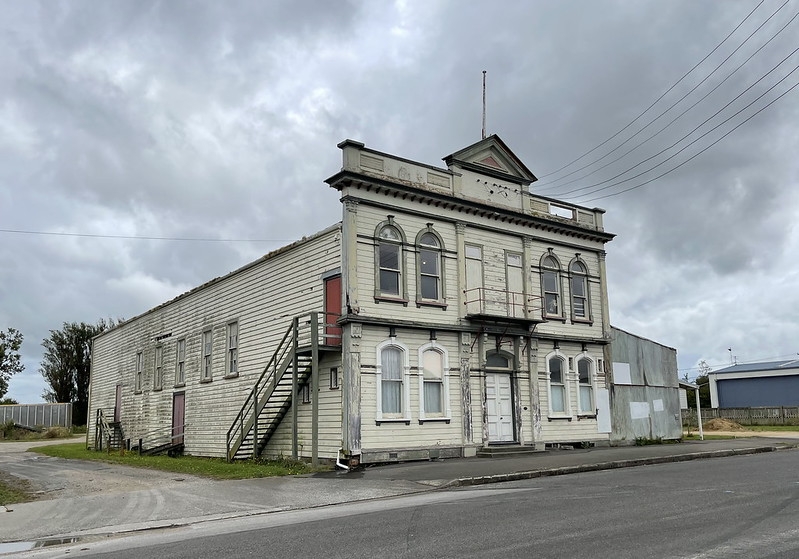
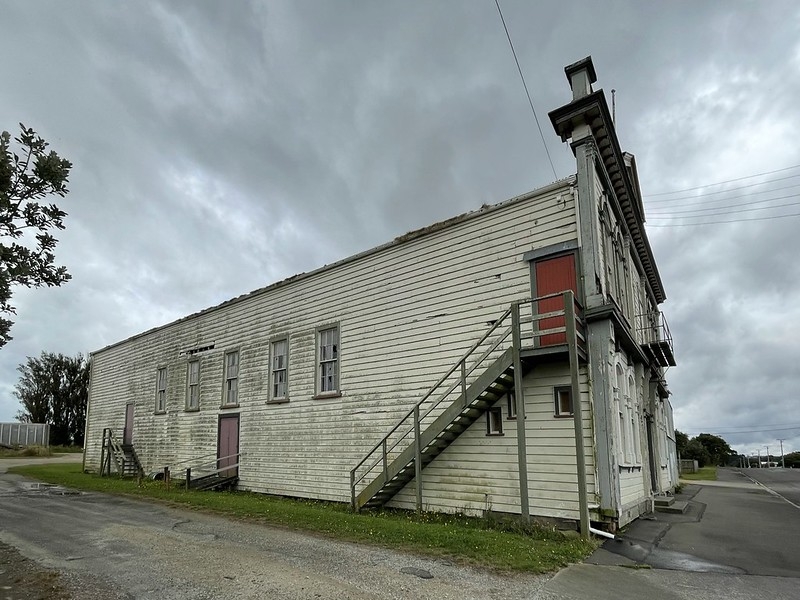
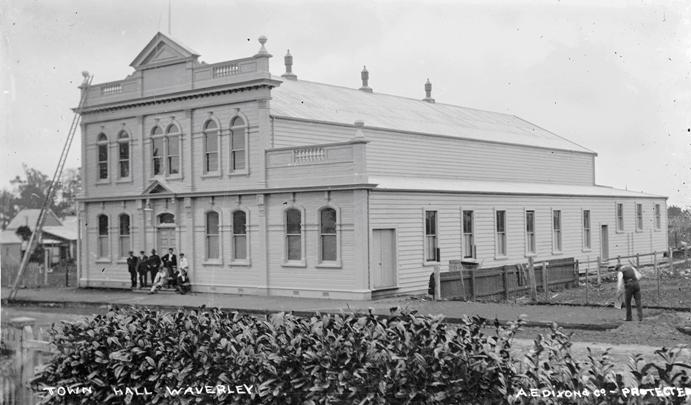
The Waverley Town Hall was built in 1908 and was opened on 21 August that year. It was designed by Hawera architect J.E. (Joseph Edward) Roe and constructed by Waverley contractors Macfarlane and Price. The original plans have not been located, but an early photo showing the east elevation (front façade) and the north elevation (right side of the hall) is held at the Alexander Turnbull Library. There is also a detailed description of the layout and of materials used in the construction in a newspaper article on the opening of the hall. The completed building cost over £2,000.00.
The hall is the third town hall to be built in Waverley. The first was financed and built from public subscription and was officially opened in September 1871. This hall was in Weraroa Road, the main street, but was soon deemed too small and a new hall was built in 1879. The old hall continued to be used by various groups. It was eventually pulled down, and a fire station was built on the site. The second hall was owned and run by a town hall committee and seems to have been on the same site in Bear Street as the present hall. It was destroyed by fire around 1906, and before long moves were under way to have a new hall.
People in the town and district raised finance by taking up shares in a company known as the Waverley Town Hall Company. Little is known about this company, apart from the names of some of its directors, and no records pertaining to it have been located. The company owned and operated the hall from 1908 until 1 January 1948 when the Waverley Town Board took over 'the ownership and control of the Waverley Town Hall and its contracts and contents'. In 1987 ownership passed to the Patea District Council and in 1989 to the current owner, South Taranaki District Council.
In late March 2007, as part of plans to develop an alternative community space in Waverley, the South Taranaki District Council considered a proposal to dispose of the hall. However, in the face of local opposition to this proposal, including a petition to 'Save the Waverley Town Hall' mounted by a group of local residents that gathered over 200 signatures, South Taranaki District Council voted 7 -3 to take the decision on the future of the Town Hall back to the community for further consultation. With the goal of retaining the hall in mind, members of the local community are now in the process of organising a committee to consider how this might be done.
Use of hall
Over the years the hall has been used for a wide variety of activities and events. These have ranged from public meetings and civic receptions to concerts, plays, school functions, movie shows, balls and all manner of social gatherings.
In 1908 a 'Citizen's Ball' was held to mark the opening of the hall. Trains from the north and south brought people from along the coast and a party came by coach from Wanganui. Dancing continued until 4 o'clock in the morning.
In the hall's early years, people arrived for balls and other functions on horseback, changing into their finery in the dressing rooms and back into riding dress to go home.
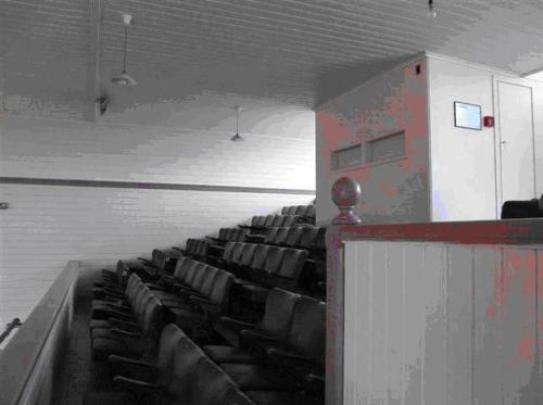
Movies were shown every Saturday night from the 1910s to the mid-1970s. Many people had permanent bookings for seats in the gallery. When popular films were screened these people would be rung to see if they were attending. If they weren't, other people would immediately purchase the seats for the evening.
Visiting performers have included the renowned magician, juggler and entertainer 'The Great Benyon', and wrestling matches have featured world title-holder Pat O'Connor.
The hall was used as a temporary epidemic hospital during the influenza epidemic in late 1918 and was at the heart of activities associated with the local war effort during the two World Wars. Examples include meetings and working bees of the Waverley Ladies' Patriotic League during the First World War, as an assembly point for the Home Guard in the Second World War, functions and meetings related to the war effort in the Second World War, and as an emergency hospital in the Second World War (trialled but not utilised). It has also been the assembly point for ANZAC Day gatherings since 1916.
In more recent times it was used as the welfare distribution centre for the Waitotara district when devastating floods struck the west coast of the lower North Island in February 2004.
The hall was also the venue for Waverley School's 50th anniversary celebrations (1924) and 60th jubilee celebration (1934) and the main venue for the school's centenary (1973) and 125th anniversary celebrations (1998). For the latter events a large marquee was connected to the hall.
Changing social patterns have seen many of the clubs that regularly used the hall go into recess or actually fold. The biggest user, the Waverley Drama Club, has recently folded. The hall is nonetheless still used for community events, meetings, school performances and private functions.
Alterations/Maintenance of the hall
Minor decorative changes to the front façade and the addition of a new lean-to and small toilet are the only modifications to the exterior of the hall. The absence of the Town Hall Company records has made it virtually impossible to say when the two additions were carried out. It must, though, have been by at least the 1920s as none of the people spoken to in Waverley can remember the hall without the additions. The small toilet area has been added to the back of the building (north-west corner), and the lean-to, which contains the kitchen, is attached to the supper room.
Some modifications have been made to the central section at the upper level of the front façade. These involve the replacement of two original windows with the two doors that occupy this part of the façade, and the addition of the small balcony that runs in front of the doors. The construction of the balcony necessitated the removal of a small arch below the original windows. Because the doors and balcony provided the only access between the gallery and the projection box until the 1970s, it is highly likely that they date from when the box was constructed - probably around 1913. The original windows must, therefore, have been removed to make way for the doors, one of which was connected to the gallery and the other to the projection box, and the balcony was necessary to facilitate movement between the two doors. The demise of picture screenings in the 1970s saw spotlights installed in the box and an internal door inserted between it and the gallery.
Two very small, narrow windows from the men's cloakroom have been cut into the lower right section of the façade in front of the primary structure: one between the windows and one to the right of the window nearer the lean-to.
Other changes to the front façade include the removal of three obelisks: one from either end of the parapet at the upper level and one from the outer edge of the lower-level parapet in front of the principal lean-to structure of the supper room. Balusters have also been removed or blocked in at the centre of the lower parapet and at the centre sections of the upper-level parapet. Decorative brackets have been removed too from either side of the upper-level arch.
Modifications to the interior of the hall have also been minor. Apart from the modernising of the cloakrooms, these include the moving of the ticket box from the right to the left side of the entrance lobby in 1964; and the removal of the wall separating the third dressing room from the supper room in the 1970s to provide a little stage suitable for the needs of small gatherings.
The hall appears to have been under-maintained in recent years. Reports commissioned in late 2005 by the South Taranaki District Council from a builder and a structural engineer indicate that the hall is need of repair but both comment that it is nonetheless in reasonable condition.