The area of Hakatere is known for its geological accumulations, where large areas are covered with irregular heaps of angular materials forming the terminal moraines of ancient glaciers. An extensive deposit of such angular material stretches from the area of Hakatere Station through to Potts River.
Hakatere is the Maori word for the Ashburton River and is also the name that has been given for the high country run area some 23 kilometres north of Mt Somers in the Ashburton District. The Hakatere (Ashburton River) is a Statutory Acknowledgement area under Schedule 17 of the Ngai Tahu Claim Settlement Act 1998. The river was a major mahinga kai for Canterbury Ngai Tahu and is associated with whakapapa and traditional trails. Te Arowhenua Marae has manawhenua for the general area.
There has been considerable Maori occupation and transient use of the wider area around Hakatere Station over a long period. An archaeological midden site is located on the true right of the Ashburton River South Branch, more than five kilometres north-west of the location of the accommodation buildings at Hakatere Station. However, this single site is unlikely to represent the full extent of archaeological deposits in the area, as little recording has taken place in this area.
Whereas the early years of European settlement in the New Zealand economy was based on whaling and native timber processing, the introduction of sheep and cattle allowed a largely pastoral economy to develop. Wool became the chief earner of export income once European settlement became organised. Until the advent of refrigerated shipping in the 1880s, the main pastoral exports were wool, skins and hides, leather and pelts, tallow, non-perishable by-products, potted and salted meat, and livestock. In 1879, 27,777 tons of wool was exported from New Zealand, most of it to mills in Great Britain. Wool remained a significant commodity. Some of the largest sheep runs were in Canterbury. Hakatere Station became one of these.
Provision had been made for the establishment of pastoral runs in Canterbury in mid 1851, opening the way for what has been described as Canterbury’s ‘sheep farming bonanza’. Experienced pastoralists from Australia, the Wairarapa and Marlborough quickly took up the opportunity to acquire large tracts of land in the area. Relative newcomers to sheep farming joined them, locating suitable areas of unoccupied land, applying for grazing licences and beginning to raise stock. The initial runs occupied areas close to the coast in North Canterbury, Banks Peninsula and inland from Timaru. Later arrivals were forced to seek runs further and further inland as unoccupied land became scarce. The last large holdings in Canterbury had been taken up by 1864.
The first Europeans known to at least partially explore the Hakatere Station area were C G Tripp and J B A Acland in 1855. The pair obtained a pastoral lease in South Canterbury that included level land near the Orari River and most of the foothills and flanks of the Mount Peel range. In 1855/6 the Tripp-Acland partnership also took up Mt Somers and Mt Possession runs. The taking up of high hill country in the ‘Waste Lands’ outside the official boundaries of the Canterbury settlement by Acland and Tripp was a pioneering move, initially regarded as eccentric, being an undertaking that no other pastoral lessee had contemplated. A rush to obtain high country runs followed in the wake of Tripp and Acland’s example. In 1857 1,000,000 acres of high country was applied for with the result that by 1860, Samuel Butler famously had to go right to Mesopotamia, in the very shadow of the Main Divide, to obtain land.
The area on the Ashburton side of what would soon become Hakatere Station was explored by Thomas Henry Potts and his brothers’-in-law, F G P Leach and Henry Phillips junior in 1857. Leach applied for the Lake Heron area and Potts took up runs 181 and 189 of Hakatere Station in 1857. Over the next three years Potts added runs 256, 293 and 350. Runs 374 and 384 were added some time later.
Hakatere took in the country between the Rangitata River and the Ashburton River, above Mt Possession. At one stage, it went up the Rangitata River as far as the Lawrence River, and up to the Head of the Ashburton River.
Like many early runs, Hakatere was initially worked as a cattle station before converting to sheep. And, like many run holders, Potts did not live on the run himself, although he was recognised as an ‘expert cattle man’. Rather, he established a homestead on the Potts River for his manager, Harry Phillips junior. The homestead remained at this site until circa 1870, when it was relocated to ‘a site on the Ashburton’. It is believed that this new homestead site was located approximately half a mile (800 metres) from the present Hakatere Station Accommodation Buildings, on the Hakatere Heron Road. A timber dwelling there was demolished in the 1960s.
At least one accommodation hut was in existence at the Hakatere corner site prior to the construction of the Stone Cottage in 1862. In an account of 1862, swagger, Jesson Davis, walked through snow from Mesopotamia to Hakatere, arriving during the night to a hut at Hakatere. This was not the Stone Cottage, but another, since Jim Bradford, who was one of the men staying at the hut when Davis arrived in a state of collapse, is recorded as being in the process of building the Stone Cottage at that time.
Despite speculation to the contrary, it is unlikely that the Stone Cottage ever served as the station homestead. Mt Possession shepherd, George Lambie, and his wife Elizabeth lived in the Stone Cottage as ‘married quarters’ some time between 1864 and 1869. Between the years 1870 and 1892 the Stone Cottage continued to be lived in by those in the role of head shepherd. From 1892, the Stone Cottage appears to have become station hand accommodation.
The station homestead, no longer extant, on the other hand, was lived in by the various managers. The first manager to live there was the successor of Harry Phillips, Ferdinand George Cradock. Cradock had arrived in New Zealand in 1860 and went straight to Hakatere as a cadet. By 1870 he was manager. Cradock was succeeded in 1888 by Thomas Scott Johnston who, it appears, also lived in the homestead.
In about 1870 Hakatere was changed over from cattle to sheep. This would have given impetus to further development of the station buildings. Over time, farm buildings developed at Hakatere Corner included the Singlemen’s or Shearers’ Quarters for accommodation and a separate wool scouring operation. A woolshed was built further up the Hakatere Heron Road in the nineteenth century but this no longer survives.
The Hakatere Wool Scouring Works were purchased by W T Webster in 1890. It appears that this was already an established business, though it is not clear when the works were first operated. They would have been closely associated with the Hakatere Station sheep operations, being located on the property in land that is now adjacent to the small parcel containing the station’s historic accommodation buildings. Although it no longer survives, there are good descriptions and some surviving photographs which give insight to the appearance and operations of the Wool Scouring Works building. It was described in 1903 as containing a sorting table, from which the wool passed to warm water tanks, and then to a new type of wool press, the Williams’ patent box. As many as fourteen hands were employed during the main period for the wool scouring, between December and March. Wool scouring appears to have continued at Hakatere Station through to at least the second decade of the twentieth century.
Potts sold Hakatere Station to the New Zealand Loan and Mercantile Company in 1883. Shortly afterwards, in 1892, the Loan and Mercantile Company also purchased Mt Possession and then worked the two stations together.
Although Johnston was appointed manager of the new combined station and moved from Hakatere to the homestead at Mt Possession, most activity remained based at Hakatere. The head shepherd, William Lambie (son of George and Elizabeth) continued to live at Hakatere Station. Johnston left his management position in 1904, whereupon head shepherd William Lambie succeeded as manager and moved to the Mt Possession homestead. F J Savill purchased the combined runs in 1906 but had to give up the Hakatere lease in 1911 and the Mt Possession one in 1917. Hakatere was then again split from Mt Possession, being divided into a new Mt Potts Station and a ‘rump’ Hakatere Station. The old Hakatere homestead thus briefly became the station homestead again, before the rump was reincorporated with Mt Possession in the early 1960s. In more recent decades, the name Mt Possession was used to refer to the overall farming operation as well as the area around the homestead, while the name Hakatere was applied to the land and buildings centred at Hakatere Corner on the junction where the various Hakatere Station buildings remain.
An account of 1908 outlined how the 200,000 acre Mt Possession run engaged seasonal gangs of musterers, shearers and wool washers at Hakatere. Mr and Mrs Thomas Scott were based at Hakatere at this stage, and a religious service is recorded as taking place in the station dining room, with Mr W Lambie in attendance.
Sam Chaffey took over Hakatere Station in 1926. Under Chaffey’s long regime (1926-1961) a number of changes took place. The old homestead on the Hakatere Heron Road resumed its role as head shepherd’s house, and remained so until its demolition in the 1960s. The wool scour building was demolished, probably some time after the 1920s. A new Cookshop was erected in the 1940s, possibly partly built using a relocated building. The Stone Cottage became largely used for storage. A second (replacement) woolshed was built probably in the 1940s and is located approximately 200 metres diagonally across the road from the accommodation buildings. At some time during Chaffey’s management, the south and west exterior walls of the Stone Cottage were rebuilt.
Sam Chaffey is noted for attracting musterers to the Ashburton Gorge area through the instigation of dog trials at Hakatere Station. The first of these legendary trials were held on the hills above the Hakatere Cookshop in June 1946. They continued through the decades, the last being held at Hakatere in 2007. Unique as a type in New Zealand, the entry qualifications for participation in the dog trials were that the entrants must have mustered locally in the wild and rugged Ashburton Gorge area.
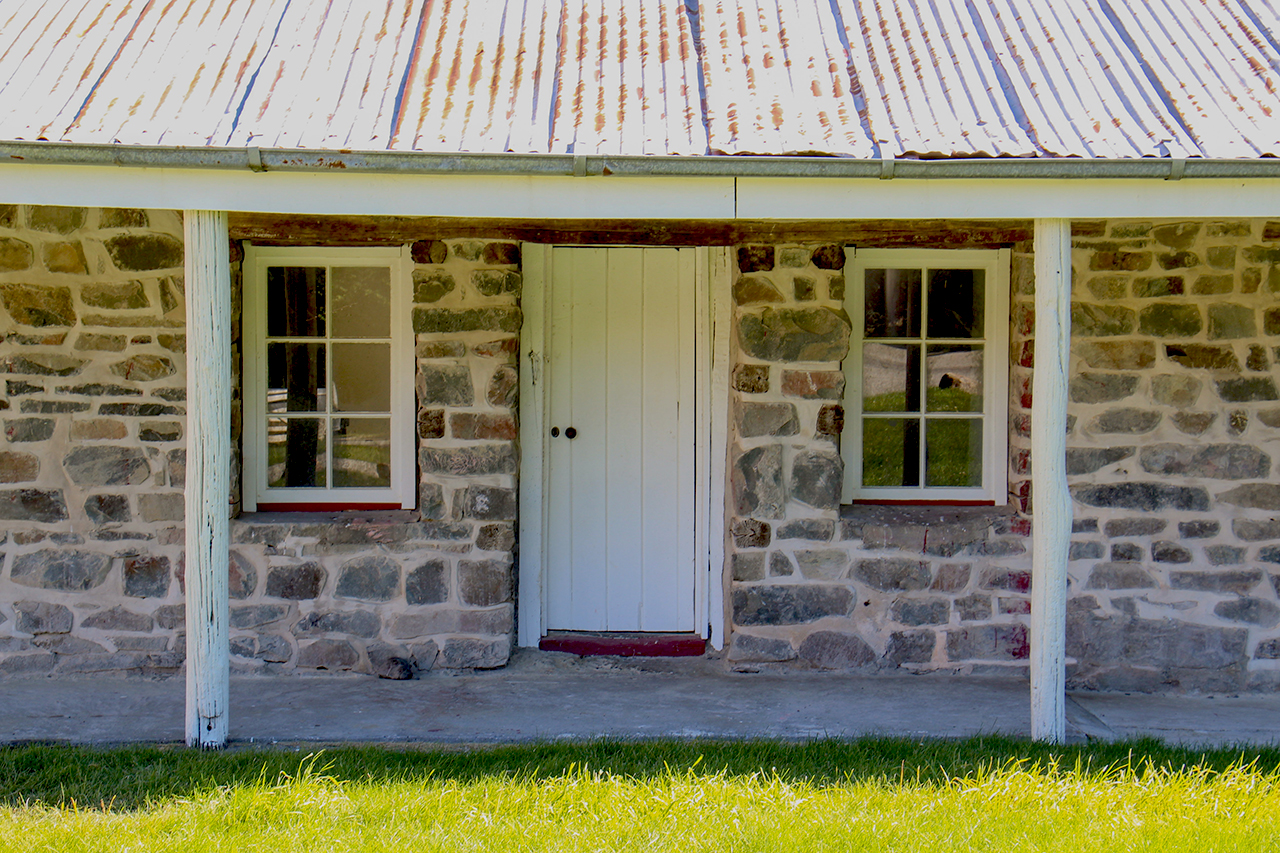
Stone Cottage (Married Quarters, also known as Stone Hut)
The original 1862 Stone Cottage had a central living room flanked by bedrooms on either side. A photograph dated 1934 identifies that by this time the northern end bay of the verandah has been enclosed. It remained enclosed at least until the mid 1950s.
By the early 1940s, the Stone Cottage was still being used intermittently to accommodate musterers and shearers. It also served at this time as a mail depot for the stations of ‘the Gorge’. There were two postal bins on the verandah. Groceries would also be left here for collection.
At an unknown date the south and west elevations appear to have been rebuilt. The south elevation may have originally appeared differently, perhaps with a rear verandah or a short lean-to. A photograph of a building at the Hakatere site from the nineteenth century shows such a building, but it is not clear if this might have been the Stone Cottage or another, perhaps a core component of the neighbouring timber building that has transformed into the present Singlemen’s Quarters.
In the post Second World War years, alterations were carried out to make the old building more habitable for its occasional occupants. In the mid 1950s, the central room was lined, a lean-to concrete and weatherboard bathroom was added at the rear, and a chiller was built into the reconstructed south-east corner. The chiller kept all the mutton from kills on the property. By about 1960, the Stone Cottage appears to have been used only for storage. The chiller continued in use until the mid 1970s.
Singlemen’s Quarters (Shearers’ Quarters)
Although the construction date of the Singlemen’s Quarters is not known, a suggested likely period for its earliest phase of construction is the early 1870s, as the conversion of the Hakatere Station from a cattle to a sheep station in around 1870 would have necessitated the provision of extra accommodation for shearers. However, they may have been built or at least extended later, for example, when Hakatere and Mt Possession were first run together in 1892 and sheep of both stations were shorn at Hakatere.
As noted above, it may be that the original portion of the Singlemen’s Quarters was merely a rectangular timber building with a gable roof, which now comprises the central projecting bay of the much larger timber structure. Alternatively the original portion of the Singlemen’s Quarters may have been the central bay cookshop, flanked by two or three large bunkrooms.
During the 1940s this cookshop was closed during winter because of the smaller number of hands employed on the station. The head shepherd’s wife would feed the remainder at their home. From the late 1940s, the original cookshop space in the Singlemen’s Quarters was subdivided into multiple bedrooms. In the late 1950s further bedrooms were added at the east end. Finally, in the mid to late 1970s, the west end was extended and remodelled to accommodate a lounge. At times the Singlemen’s Quarters would accommodate around 14 shearers.
Cookshop (Cookhouse)
In the 1940s a new Cookshop was established in a weatherboard building located to the west of the Stone Cottage. It has been suggested that a two-roomed hut formerly known as Gallagher’s Hut, which had been located beside Lambies Stream (where it crosses the Gorge Road), was moved to Hakatere to become the new Cookshop but this has not been verified. Certainly the building known as the Cookshop incorporates a variety of stages of construction.
The building was extended substantially in the late 1940s or early 1950s when a dining room was added to the eastern end. An addition was also made to the northern elevation in the 1960s or 1970s. A verandah on the north elevation was enclosed some time after the 1960s.
From the 1940s onwards the Cookshop became a social hub. Station workers would be fed in dining room and in the evenings would often stay on, inevitably talking about dogs. Dances were held in the dining room following yearly dog trials. These great annual ‘Gorge Get Togethers’ were particularly social affairs. The Red Cross used the kitchen as catering for fundraising on the day of the trials, and over 50 would stay on for the evening dance.
Breakfast would usually begin at 5am, sometimes even as early as 3am, the men would then set out for work during the day, and dinner was ready by 6pm (even if they didn’t eat it until later). When working in the woolshed, the permanent employees and crutchers would have lunch at the Cookshop too. Former cook, Joyce Grieve, recalls that mutton was always on the menu while beef was not, despite the station having cattle. By the 1960s the kitchen had an old army diesel burner, an electric stove and an old fashioned ‘Everhot’ cooking range. The sitting room, with its open fireplace, was just for the family, not the station hands.
The Cookshop was often managed by married couples. However, sometimes station hands were cooking for themselves. Occasionally the Cookshop would be occupied by those associated with the large shearing contractors, and their own dedicated cook would use the kitchen and occupy the house. Permanent staff were at the Cookshop, on and off, until about the 1980s.
Contextual Analysis
Geoffrey Thornton has observed that because New Zealand was founded, at least in European terms, on agrarianism, old farm buildings have become a memorial to the early colonial economy. Not only do they form part of a cultural landscape, but they are a visual reminder of our age-old dependence on farming for food. Different buildings served different functions on stations, demonstrating fitness for purpose of the various designs. The predominant construction material was timber, though stone and cob were also used.
Farms, including high country stations, almost always had dedicated accommodation for staff. Singlemen’s (or ‘Men’s’) quarters, Shearers’ quarters and, more rarely, Cadet quarters tended to be in separate blocks. Singlemen’s quarters were often combined with the cookshop. Sometimes there was separate accommodation for the cook, head shepherd or various married staff. In nineteenth century New Zealand, staff quarters were often crude and uncomfortable, sometimes little more than basic shelter for communal living of the farm workers. Work was hard, the days long, the food rations often monotonous.
Examples of cookshops, singlemen’s, shearers’ and married quarters are found throughout New Zealand. Combined cookshop-singlemen’s accommodation buildings are found at Moa Flat (stone and plaster, NZHPT Record No. 7625), Otekaieke in North Otago (stone), Benmore in the Mackenzie country, Shag Valley Station in the Waihemo district (stone, NZHPT Record No. 7616 c1868), Totara Estate in North Otago (stone), Kekerengu in Marlborough (cob), Windsor Park (Windsor, stone), Matapiro in Hawke’s Bay (timber), Puketoro near Tokomaru Bay (timber).
It is considered that the Stone Cottage (Married Quarters) building at Hakatere is a rare example of its construction utilising the combination of stone and cob. The form of the building is akin to other high country accommodation buildings of the second half of the nineteenth century, such as the larger Acheron Accommodation House in Molesworth Station (Hurunui District) which dates to 1862-3 and at Omarama’s Benmore Station both Robert Campbell’s stone cottage and the Head Shepherd’s stone cottage (1860s, NZHPT Record No. 7805).
Thornton notes that the Hakatere Singlemen’s Quarters are representative in that they are of built of timber (this being the most widely used building material) and that they are one of many examples of men’s quarters or shearers’ quarters in timber throughout both the North Island and South Island. Ones on the NZHPT Register, for example, include Brancepeth 1869 (NZHPT Record No. 7649), Shag Valley Buildings (Record No. 7616), Kawarau Station Buildings in Bannockburn (Record No. 7619). However, Thornton points out that the Hakatere Station Quarters building, with its very long timber building bisected by a protecting wing, is quite distinctive in its layout. There are other examples of long timber (and stone) accommodation buildings, but not with the projecting central wing. The plan of stone Cookshop/Mens’ Quarters at Benmore Station in Omarama for example, is a long rectangular building with bedrooms and a dining room (NZHPT Record No. 7805). As discussed earlier, the sequence of construction of the Hakatere Singlemen’s Quarters is not entirely clear and it appears to have been built in a piecemeal fashion.
The 1940s Cookshop building, like the Singlemen’s Quarters, has been constructed in a piecemeal fashion, being added to and extended over several decades and potentially incorporating an earlier hut relocated to this site. Cookshops or cookhouses are found throughout New Zealand and there are a number on the NZHPT Register. Leefield Station in Marlborough has a cob cookshop that was converted to become the Shearers’ Quarters (Record No. 2930). The 1940s timber cookshop at Hakatere is relatively unremarkable but it attests to the social history of high country stations and the need to feed relatively large numbers of men working there. Its kitchen is typical of a 1940s family type kitchen, albeit on a larger scale, something of which there is little of in public ownership in New Zealand.
Although the wool scour building no longer survives, the association of the Hakatere Station with this early industry adds to a wider understanding of the place. As part of the wool export business, wool scouring industries were established in New Zealand from the 1870s. Sheep were shorn without having been washed first and the wool subsequently had to be scoured (cleaned) before sale. Iron boilers were used to heat the water with added soap to make a scouring liquid, into which the unclean wool was placed in vats and agitated by men using long sticks. The wool fleeces were then lifted onto a draining tray, rinsed in cold water and dried before being pressed into bales. Wool scouring works were generally operated by independent owners who operated on the outskirts of towns, though some of the more remote and larger stations had their own wool scours. Scouring is recognised as paying handsomely when compared to the price unscoured wool fetched. However, most wool exported from New Zealand in 1882 was still ‘in the grease’.
Extant station wool scours are particularly rare. A relocated wool scour is situated at Benmore Station (Record No. 2414) in Otago and there is one at Lake Coleridge. The Hakatere Station wool scour appears to have been run as an independent business, though obviously it would have operated in close conjunction with the sheep run itself. Any archaeological remains of the wool scour have the potential to elucidate further about the operation, but they sit outside of the extent of registration for the Hakatere Station Accommodation Buildings. Nevertheless they form part of the wider cultural landscape of the Hakatere Station Accommodation Buildings historic place registration.