The Anglican Church in Otago:
In the early 1840s a Maori mission was set up on Ruapuke Island, the earliest known Anglican mission work in Otago and Southland. In 1844 Bishop Selwyn visited whaling stations and Maori communities on the Southern Coast. Selwyn visited Otakou in January 1844 where he baptised children, distributed books and left a Maori who he had baptised at Moeraki to minister to the Anglican Maori at Otakou. An Anglican clergyman Reverend J.A. Fenton arrived at Port Chalmers in January 1852 and held services in the courthouse while a church was built. Fenton was responsible for Otago’s 400 Anglicans. Otago was under the jurisdiction of the Bishop of Christchurch until the Diocese of Dunedin was formed in 1868.
The building St Peter’s Church represents the period of development in the Anglican Church which saw the consolidation of communities and a steady building programme which saw many new churches constructed in small towns. This is the period described by historian H.T. Purchas as the Macrocarpa period where small church buildings sprung up alongside towns where the church building itself grows dear to its community and the work of established religion, education, fund raising and outreach goes on. This was a period where church building accelerated for the Anglican Church throughout New Zealand, when urban centres grew and small centres consolidated. That the community came together, drawing together to donate the land and organise the building of the church shows the importance of the church as an institution both historically and currently.
Caversham:
Koterakiatea, the flat area between St Clair and Caversham, was a rich area of swampy land at the base of the hillside Whakaherekau and Ko-raka-a-runga-te-raki, (Lookout Point). It was separated from the head of the harbour by Te Rara, a rib of land running south to north.. Pakeha settled around the foot of the hills, initially farming, with prominent English (and Anglican) settler William Henry Valpy (1793-1852) naming his farms Caversham (after his wife’s birthplace) and Forbury, the names later applying to two of the suburbs that developed in South Dunedin. European settlers were less charitable about the low lying area which Caversham bordered. South Dunedin was, as the University of Otago’s Caversham Project put it, ‘a self-enclosed physical space, bordered by hills and the ocean. The area was mostly boggy and close to sea-level, occupied by a few scattered farms and market gardens, though small settlements sprung up to service the passing gold rush traffic. Cheap land led to the development of housing and industry. Houses ranged from the workers’ cottages on one-sixteenth of an acre sections, to larger more generous dwellings. It was in this context that St Peter’s began in Caversham, an enclave alongside the main road south to the goldfields, by 1905 engulfed as a suburb of the growing city.
St Peter’s was the first church to be built in Caversham, reflecting the higher proportion of English immigrants than was generally the case in Dunedin. The history of St Peter’s Anglican Church, Caversham officially begins at 6 pm on 4 January 1864. The Otago Daily Times advertised a ‘Gathering of interested Churchmen in a room of the Edinboro’ Castle Hotel, Caversham under the chairmanship of the Reverend E.G. Edwards, Vicar of St. Paul’s, Dunedin.’ Monetary support and the donation of Clapcott’s acre, situated close by the old Caversham Gasworks and abutting Main South Road ensured that St Peter’s Church was quickly erected. The consecration of the new church is recorded in the Otago Witness.
There were difficulties in finding a vicar for the new church but eventually Reverend T.L. Stanley was appointed in 1869. Perhaps it was not much to his liking as he stayed for only one year and a further four year interregnum followed. The laity, it seems, rose to the challenge of such a long interregnum and were thanked by Bishop Nevill for carrying on with the services. Reverend E.J. Penny relieved the ‘drought’, followed by Reverend C.J. Martin and Reverend Wm. Ronaldson.
During this period, Caversham experienced a marked growth in population; the number of houses rose from 650 in 1877 to 805 in 1882. Discussions with people in Caversham, Kew, Kensington, St Kilda and South Dunedin identified growing congregation. A larger church was needed. The site of the first St Peter’s made the church difficult to access and Reverend Ronaldson soon suggested relocation along with a new and better building. The results were encouraging, and it was decided to purchase a new site. This, however, was dependent on the sale of the land donated by Henry Clapcott and his agreement to changing his deed of gift. Old St Peter’s was sold for £150 and was removed to Mornington to become St Mary’s Church.
On 10 August 1881, St Peter’s Vestry appointed a ‘Committee to Undertake the Building of the New Church’. The site chosen was on land originally granted to John Law Baker. It was purchased from Charlotte Ward Baker of Middlesex, England for the sum of £550. Perhaps there was some doubt as to whether the funds could be raised to build the new church, but an unexpected increase in subscriptions meant that a sum of £400 had collected by August 1881.
The Plans and the Architect:
Plans for a church to accommodate not less than 300 were commissioned from architect Henry Frederick Hardy, a Dunedin architect who made a prominent contribution to the city’s architecture.
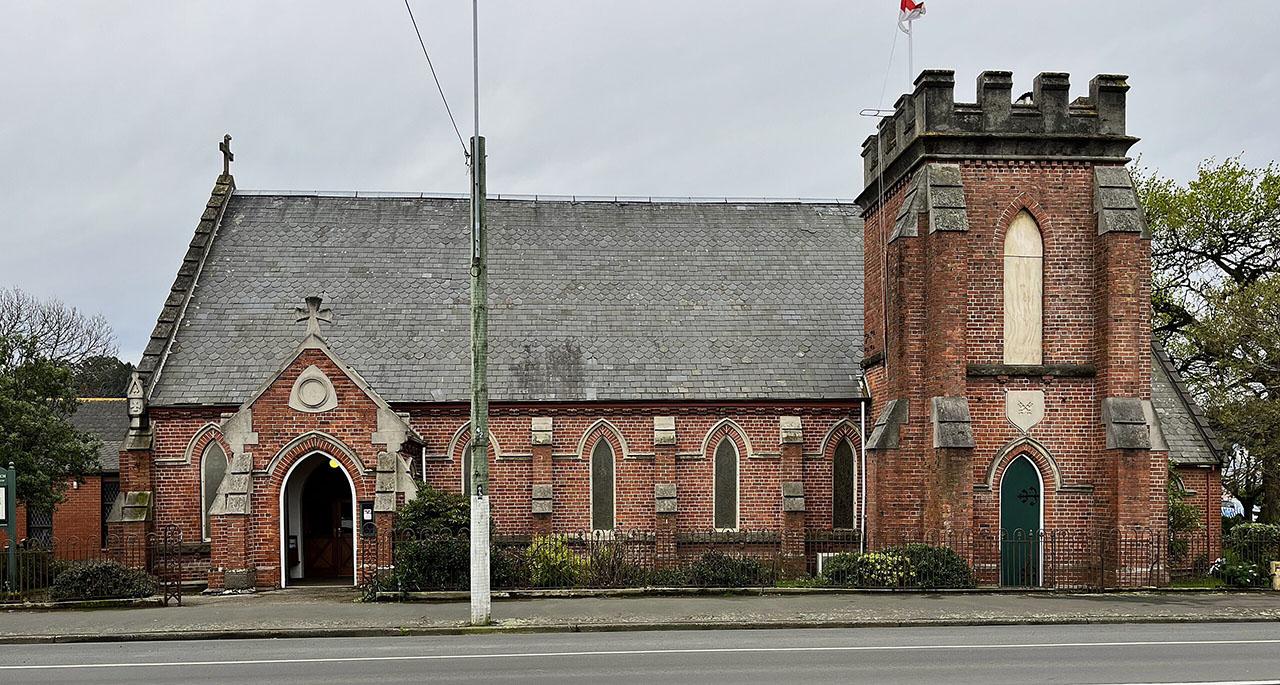
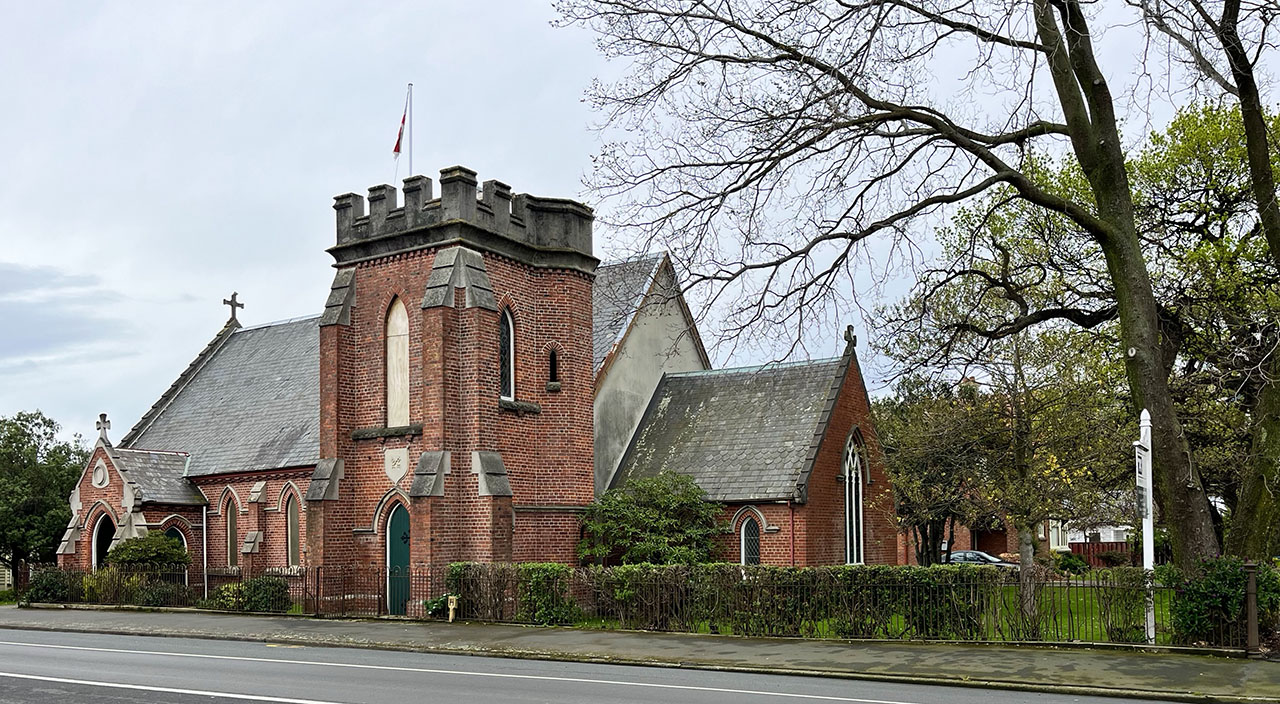
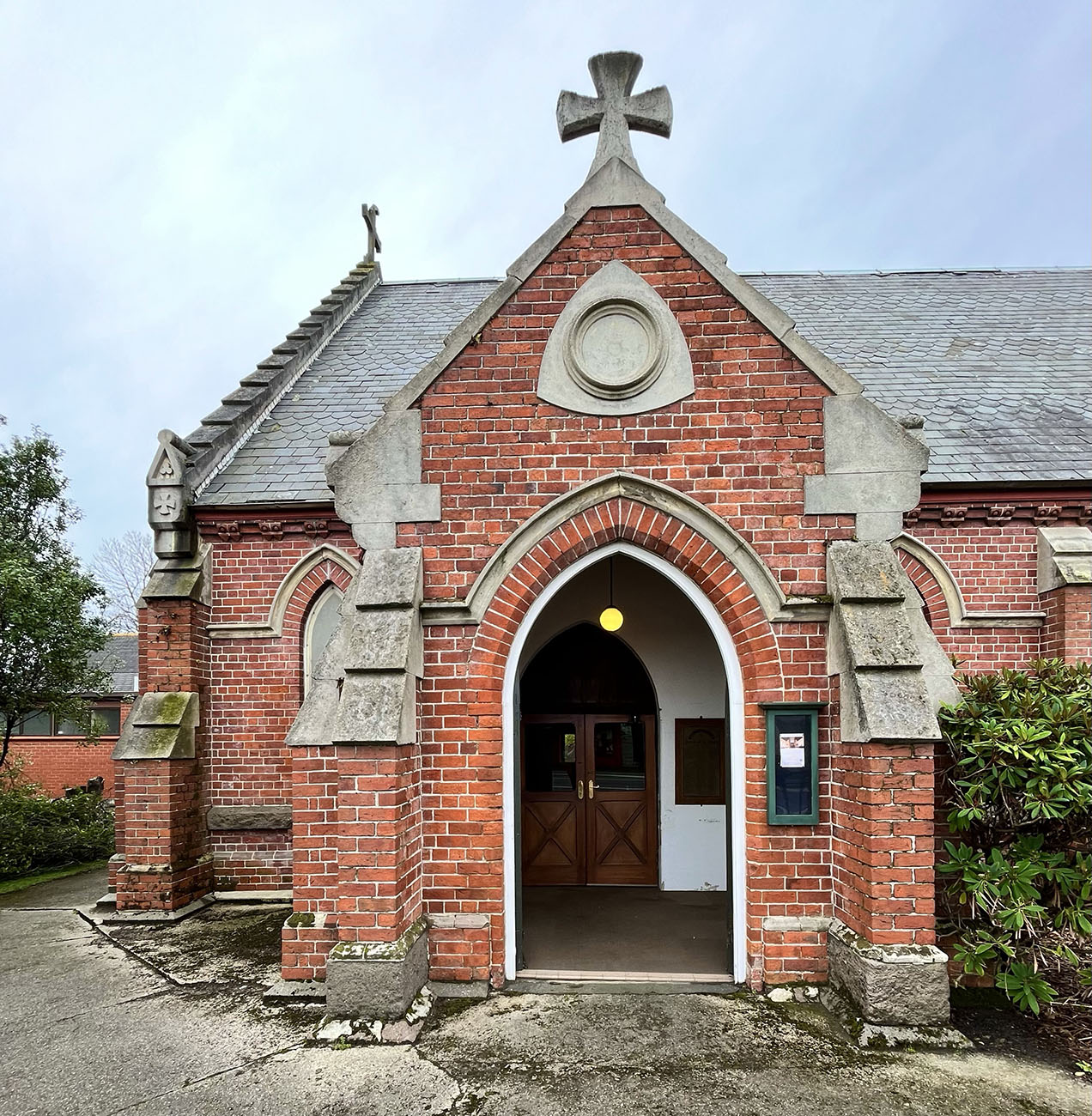
For the Anglican Church, theologians of the Victorian period maintained that spirituality was the chief concern of the church and that ‘expression of this spirituality’ was an essential part of the services and of the church buildings. The timber vaulted ceilings, windows, altars and other decorative forms within the church were important expressions of the theology and practice of the time. These elements in St Peter’s, the carved pulpit, altar rails and other religious furniture, are significant manifestations of the spiritual philosophy and practice of the Victorian period. The decoration of the exterior of the Church itself is restrained, with contrasting stone facings and the window details providing the focus.
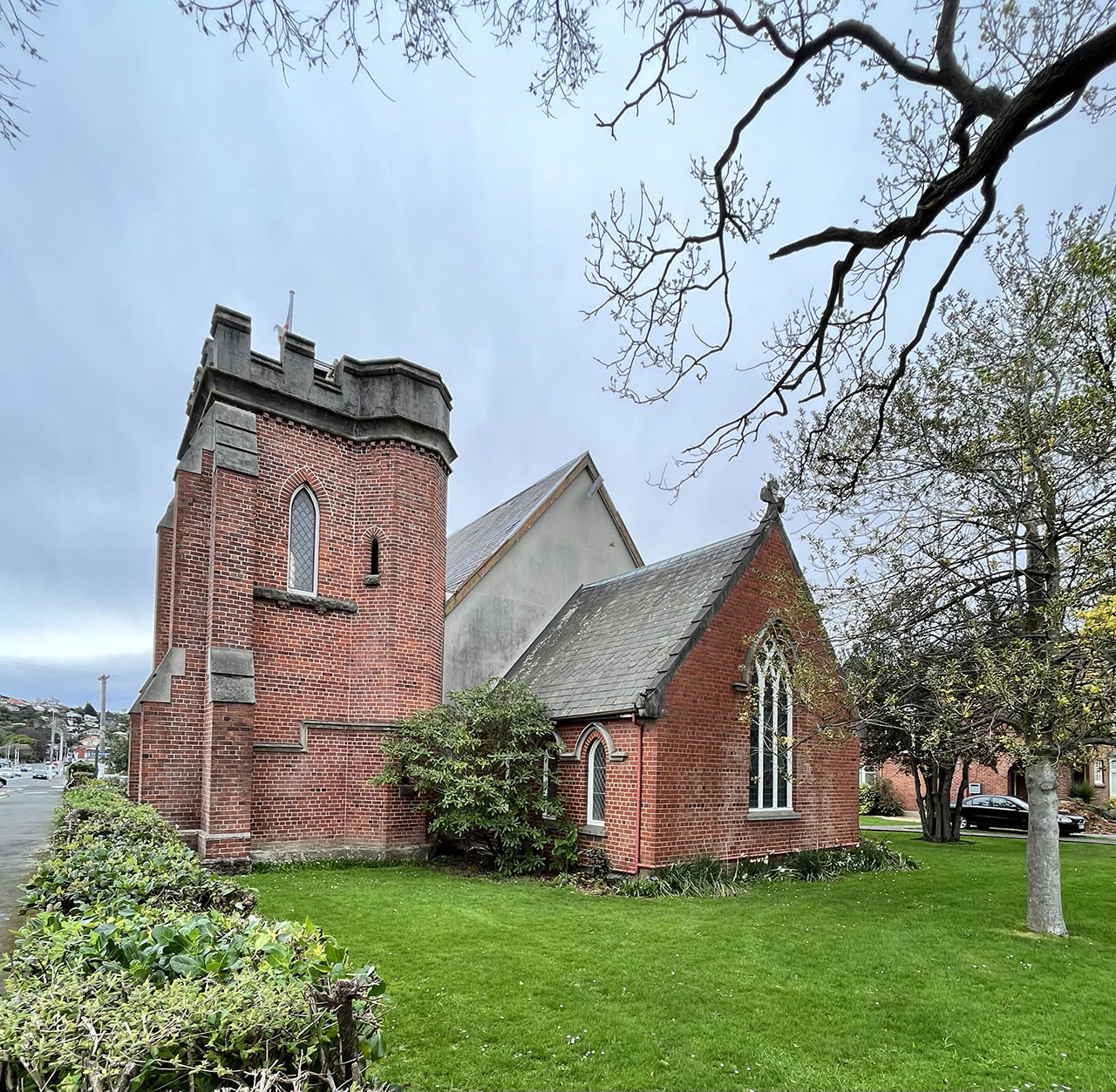
Despite Johns and Evans being the architect’s choice of building firm, Thomas Newton put in the lowest bid (£1,825) and was awarded the tender to build in brick. The tender was for building the nave only, which was to seat about 300 people. The architect’s drawing shows St Peter’s was planned as a Latin Cross, complete with transepts and chancel. An elegant tower with a spire was planned for the front of the church. However, the transepts were never built leaving it more like a two-cell church of the British Norman or Anglo Saxon period. As for the spire, construction problems prevented its erection.
Building the Church:
Hardy’s specifications for St Peter’s survive. Concrete for the foundations included Knight Bevan’s cement, imported from London firm Knight, Bevan and Sturge. After the concrete came two feet of blue-stone rubble laid in mortar composed of Chain Hills sand and McDonald’s Waihola lime. Fancy bricks were purchased from local brickwork Smith and Fotheringham, although it is not clear if they also supplied the plain bricks. Slates were specified for the roof. Kauri was used extensively in the church and Hardy specifies this timber as bearers for the floor, floor-boards, roof ribs, roof lining, king posts and struts.
The foundation stone was laid on 11 February 1882 with the blessing of the Bishop. After the application of the plumb, level and square by members of the Masonic Fraternity, the District Grand Master completed the ceremony by knocking the stone into place. About 600 people witnessed the ceremony. Clearly, the Bishop declared the church was being built principally for those who are called the working classes and he rejoiced that it was so - that it was not intended only for the wealthier class, but for all (a sentiment that has lost none of its power for the congregation over the past 127 years).
In October 1881 the Church Building Committee were dissatisfied with progress. On 29 May a resolution is recorded drawing the attention of the architect to ‘the State of the Tower and certain other portions of the Church being evidently in a defective state...’ and ‘That the treasurer be instructed not to pay any more money to the Contractor’. Less than a month later, the inspection committee consulted the architect of St Joseph’s Cathedral, Francis William Petre, about the state of the church, particularly whether the foundations were sufficiently robust to carry the weight of the tower. The inspection committee was vindicated in a long reply from Petre. Apparently the tower had moved six inches from the perpendicular towards the nave, this being due to the nature of the soft soil on which the church was being built. Petre advised against the planned spire, which was never built.
Despite the difficulties, the church was completed and Bishop Nevill delivered the opening sermon. On 29 September 1882, Michaelmass, a congregation of 300 assembled. It was raining heavily and it is to be hoped that the leaks in the east window, roof and vestry windows reported earlier been fixed. Bishop Nevill dedicated the church in the name of the Blessed Apostle St Peter. On this rather damp day, began 128 years of prayer, sacraments and praise.
The People’s Church:
The founders of St Peter’s included some significant individuals. Reverend William Ronaldson, the first vicar of ‘new’ St Peter’s, was born in London in 1823. Fifteen year old Ronaldson joined the ‘Roxburgh Castle’ as seaman. In 1844 he was in New Zealand where he later worked for the Church Missionary Society at Putiki as a catechist schoolmaster. He returned to London and was ordained priest by the Bishop of London (1855). In 1855, Ronaldson was the first clergyman appointed to the Wairarapa district CMS mission at Papawai before moving to Motueka and Picton. He arrived in Otago in 1877. After three years at St John’s Church, Milton, he took up the position at St Peter’s, where he remained until 1890, overseeing the building of the present church. During this time he was Diocesan Secretary on three occasions and Clerical Secretary of the General Synod. In Otago, he was Diocesan Secretary and Bishop Chaplain for the ministry to Maori. As well as being a licensed minister for the Maori and English settlers in the Wairarapa, he was appointed to the Christian Missionary Society Maori College of St. Thomas at Papawai, centre of the Maori Parliament.
King and the Anglo-Catholics:
The second vicar of the newly built St Peter’s laid the foundations of Anglo-Catholicism, the traditions and theology of which are a feature of St Peter’s in 2011. Reverend Bryan Meyrick King, being the son of Reverend Bryan King who was notorious for his efforts to introduce Anglo-Catholicism into an east end London church, had a close connection to that movement. Many of the practices King’s father had introduced in London are now regarded as normal: lighted candles on a vested altar; a robed choir singing psalms; preaching in a surplice rather than a black gown. Yet in the mid-nineteenth century these were regarded as ‘Ritualism’, smacked of ‘Popery’. After a commercial career King studied theology under his father and then sailed for Western Australia. He was ordained as a priest by the Bishop of Perth in 1879, finally arriving in New Zealand in 1885. His first appointment was as curate at St Martin’s, North-East Valley, Dunedin, before becoming vicar of St Peter’s in 1892. He was appointed Canon in 1897. Canon King continued at St Peter’s until 1911. He died in 1915.
Many of the members of the parish were interesting people. In addition to Canon Bryan Meyrick King, Captain John Easther (d.1917) was a sea captain in the Royal Navy and as commander of the paddle-steamer ‘Avon’ during the New Zealand Wars; he narrowly escaped an early death. Easther was a member of the St Peter’s building committee and for 30 years was warden and vestryman.’ Pywell’s parish history describe the very valuable contribution he made at St Peter’s: ‘Again and again he shouldered hard tasks, making representatives or conducting negotiations of one sort or another, and he came out victorious in many a conflict, a credit to the famous services which in his professional capacity he represented.’
Others, like Alfred Luther Beattie (‘Loco Beattie’) show the important links to local industry. Born in Yorkshire, Beattie trained at the railway foundry in Leeds. Following a spell as assistant manager, he must have decided to try his luck in New Zealand. Landing at Port Chalmers on the ‘Helen Denny’ in 1876, Beattie at once joined the Railway Department of Otago, later becoming assistant engineer. It is likely he was recruited for the newly opened Hillside Workshops. After leaving the province, he went on to become Chief Mechanical Engineer of the New Zealand Railway Department and it was during the years 1900-1913 that ‘Loco Beattie’ became famous for his innovative locomotive designs.
Around 1912 the parish built a new vicarage for the minister. The architects were Donald and Dunning, who worked out of the Express Buildings in Bond Street. The builder was Thomas Herd. The vicarage was built in Arts and Craft style, in brick to match the adjoining church. William Henry Dunning was a Tasmanian-born architect who worked in South Africa before coming to Dunedin in 1908 to assist with the New Zealand Express Company building, a very large Chicago style reinforced concrete ‘skyscraper’. Dunning designed a number of fine Arts and Crafts houses in Dunedin, as well as Ross Home for the Elderly in North Road. Dunning worked with the young James Fletcher, designing his showcase home in High Street, Dunedin. Dunning’s practice was carried on by his son Cecil on the death of his father in 1933. At the same time they bought a small nineteenth century cottage next to the Church. The gardener lived in this cottage and it has also provided a home for low income parishioners as well as a small income for the parish.
By the late 1950s the Parish wished to extend the Church. Having liquidated the old building debt in 1941, attention turned to finishing the Church, extending the existing sanctuary, in brick to match the existing building, and the interior was renovated. The work was completed in May 1962.
Memorial Windows:
St Peter’s is notable for its memorial stained glass windows. These were made by Dunedin glass artist John Brock, who designed at least thirty-two stained glass windows for many denominations for Canterbury churches at his studio in Dunedin for over fifty years including a number of memorial windows to soldiers who died in the World Wars. Memorials in the church commemorate significant individuals, including Officer W. (Bill) H. Hodgson (DFC), and another his brother Jim Hodgson. Educated in Dunedin, Bill Hodgson was a radio technician before joining the RAF in 1940. After flying training in New Zealand and England he was posted to RAF No 85 squadron at Debden in Essex in May 1940 gaining the nickname ‘Ace Hodgson’ and was awarded the Distinguished Flying Cross, but was killed in a crash at Debden airfield. Bill had flown 150 operational sorties and played a significant role in defending the skies over England in The Battle of Britain, his actions commemorated in a 1986 memorial. Bill’s brother, Jim, second lieutenant in the New Zealand army, was hit and killed by an army truck near Balclutha in 1943. In the memorial windows at St Peter’s, Bill is depicted in his flying officers uniform, kneeling and looking up at Christ, and Jim is portrayed with an angel who is pointing the way to heaven.
The Role of St Peter’s:
On the 27 August 2008, a group of long-standing parishioners met to share their memories of St Peter’s, their reminiscences showing St Peter’s important role in the community and the long standing relationships and links to the Church. Parishioners like Dawn Bachop (nee Molloy) who moved to Caversham in 1943 with her family, and Jocelyn Malcolmson (nee Lennox) who remembers St Peter’s in the 1930’s, and Lil Bedford, who is 90 years old, and has spent her whole life at St Peter’s, show the ongoing love and commitment to the place.
St Peter’s has been, and remains, a social hub for Caversham: ‘Life revolved around the church; choir theatre groups, Sunday School. There were lots of young people’; ‘St Peter’s has always been here. There was a lot going on for families - concerts and musicals’; ‘There was an orchestra and 40 children in the Sunday School’. All commented on the support and lifelong friendships which developed through belonging to the Mothers Union, Young Wives, Ladies Guild and (later) the Association of Anglican Women.
The spiritual importance of St Peter’s was also clear - a spiritual home, a place to support people in all the knocks and trials of life. Everyone agreed that St Peter’s has ‘something’. A simple, beautiful building and a prayerful atmosphere contribute to the spirituality of the place.
Social Role: St Peter’s and the Caversham Project:
In the late nineteenth century, Dunedin’s southern suburbs became ‘the most industrialised and working class urban area of New Zealand’. One hundred years later, the Southern Suburbs became the subject of intense study by the Department of History at the University of Otago - the Caversham Project - which over the last 30 years has built up the largest social historical database in Australasia. Christianity and gender are an integral part of the Caversham Project, which covers the years 1880 to 1940.
Despite the province of Otago being founded by the Free Church of Scotland, Anglicans were almost equal in numbers to Presbyterians in the Southern Suburbs according to the census figures of 1891. As part of the Caversham Project, historian Associate Professor John Stenhouse analysed the social make-up of fifteen South Dunedin churches including St Peter’s, Caversham. It is the female attendees, who are the most interesting. In 1893, New Zealand was the first country in the world to give women the right to vote. Whereas the national average for signing the petition was just under 25%, the rate in the Southern Suburbs was an amazing 57% making these women ‘a world-leading, first wave feminist community.’ The reason, says Stenhouse, is linked to class, religion and neighbourhood with religiously-active women from established working class areas such as Caversham spearheading the support for suffrage. Thus, it may be said that the women of St Peter’s and the Protestant churches of the Southern Dunedin Suburbs played a vital role in the early acceptance of voting rights.
St Peter’s Church provides a place of Christian worship. It has always been Anglican, but all denominations are welcomed. A bell is rung to signal to the wider community both the start of Sunday worship and the consecration of the bread and wine. Weddings, baptisms and funerals take place on a regular basis. St Peter’s often attracts people from other churches as a wedding venue because of its picturesque qualities, although one could say the sense of it being a holy place is even more compelling. Although the church was built for the people of the Parish of Caversham, the congregation is now drawn from a much bigger area.
The main local community outreach is the provision of the Parish Centre, consisting of the church hall and connecting link. These spaces are hired by community groups. Parishioners take an active role in many of these groups, in particular the Stroke Club. There have been other outreaches in the past, in particular teaching of the Christian faith in local schools. The current vicar, Father Carl Somers Edgar, held the posts of Prisoners Chaplain and Police Chaplain until quite recently. There is a history of active involvement with the elderly of the parish and Father Carl is the St. Barnabas Home Chaplain.
A special relationship exists between St Peter’s and the Orthodox Church. Under Bishop Nevill, the first Orthodox service in Dunedin was held at St Peter’s and the Church has have provided funding support for the Antiochian Orthodox Church for some years. The parish also supports the Antiochian Orthodox parish family. The Coptic Orthodox Church initially held their services at St Peter’s about 10 years ago and the congregation pray regularly for both churches.
In 2011 St Peter’s remains a place of worship and community centre for the Caversham and South Dunedin, and wider afield.