Beside the Manawatu River in what was the Makerua Swamp, there are archaeological sites indicative of Maori settlement and activity in the area, including Ngati Raukawa graves, ovens and midden. Indeed, Opiki continues the name of a kainga which was located there previously. Historical records indicate that local Maori lived in and around the Makerua Swamp from at least the mid nineteenth century. The swamp area was external to negotiations between Ngati Raukawa, Rangitane, and the government in the 1860s, because it lay between the boundaries of the Horowhenua, Rangitikei-Manawatu, and Te Ahuaturanga blocks. The ‘great swamp’ encompassed an area stretching from present day Linton almost as far south as Shannon, and inland from the Tararua Ranges to the Manawatu and Oroua Rivers.
In general, New Zealand harakeke/flax fibre produced by Maori began being exported during the 1820s. In the Manawatu/Horowhenua region most of this activity seems to have been centred further southwest in the Moutoa Swamp and Foxton. It is unclear how extensive Makerua Swamp flax production was in the mid 1800s because it appears that conditions were more suited to raupo than harakeke. The relatively limited nature of the Makerua Swamp industry during this period is inferred by 1880s land sales advertisements not promoting any economic potential in terms of flax production.
It was when mechanised processes were introduced in the 1860s that New Zealand’s flax industry started to really grow. By 1918 flax fibre exports made up approximately five per cent of New Zealand’s exports. New Zealand did not produce hemp on the scale or to the quality of places such as Philippines and East Africa, but had several boom periods when demand outweighed supply from those places.
Flaxmills began to be established in the wider Manawatu/Horowhenua region in the late 1860s, coinciding with early earnest European settlement. Described as being a ‘major source of wealth,’ the regional flaxmilling industry produced fibre for items such as course textiles and rope, which was particularly important for shipping. While the regional industry had several boom periods between the 1860s and the turn of the twentieth century it was not until the early twentieth century that the Makerua Swamp’s local industry matured. In 1886 the completion of the Wellington-Manawatu Railway to Longburn, which went around the swamp, boosted the Manawatu/Horowhenua industry because it increased access and export opportunities. In the 1890s William Akers progressively purchased and leased land from local Maori in the Makerua Swamp at Opiki. However, most of the mills in the swamp were only established around the turn of the twentieth century. In 1902 the Makerua Estate Company Limited was formed, which included high profile Wellington businessman John Plimmer (1812-1905) and experienced flaxmiller Alfred Seifert (1877-1945), who purchased 12,343 acres of swampland. Raupo was cleared from the area and drainage systems implemented to promote flax growth, and then the company began subdividing and selling off its holdings.
Demand for flax products was high during World War One and the Makerua Swamp had developed into the largest commercial flax swamp in New Zealand by then. The swamp’s peak production was between 1910 and 1918, and there were many companies who were milling flax from the swamp at this time, including the Seifert family. Their seven-stripper Miranui mill was thought to be the largest in the Southern Hemisphere. Even so, the Tane Hemp Company Limited’s four-stripper flaxmill at Opiki (then known as Rangitane), constructed in 1915, was one of New Zealand’s largest. This company was established by a group of shareholder directors, including Managing Director Herman Seifert (1866-1948), Hugh Akers (1877-1932), along with his brother Arthur (1888-1944) and uncle Edwin (1852-1934). Demand for the hemp was reflected through the building of public and private roads through the swamp during this period, creating greater access for people and goods.
Production was soon progressing well, with the green flax being supplied by the Akers brothers, and processed at the Tane mill and the neighbouring Rangitane mill, which the Tane Hemp Company Limited also owned. Resultantly, the company determined to build a bridge over the Manawatu River to provide a direct transport link to the Rangiotu railway station. Previously people and goods were transported across the Manawatu River using platforms and cages attached to wires, or punts, which were impractical given the quantities of product generated by the mills. The other option was inefficient and involved using tramways and roads to take product to Linton’s railway station. Therefore, a suspension bridge was constructed for the company between March 1917 and January 1918. This was primarily beneficial to the Tane Hemp Company, but also useful for the Akers brothers’ and Louis Seifert’s other operations. As such these parties contributed to its construction cost of £2821. The group also formed an agreement which detailed access rights and the division of maintenance costs.
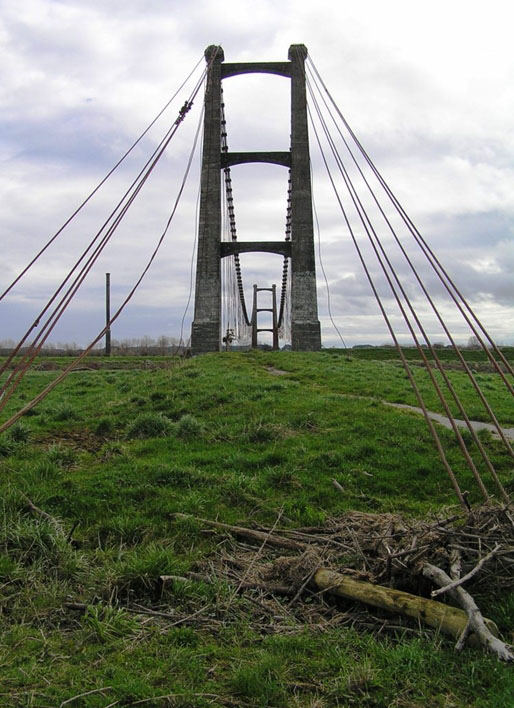
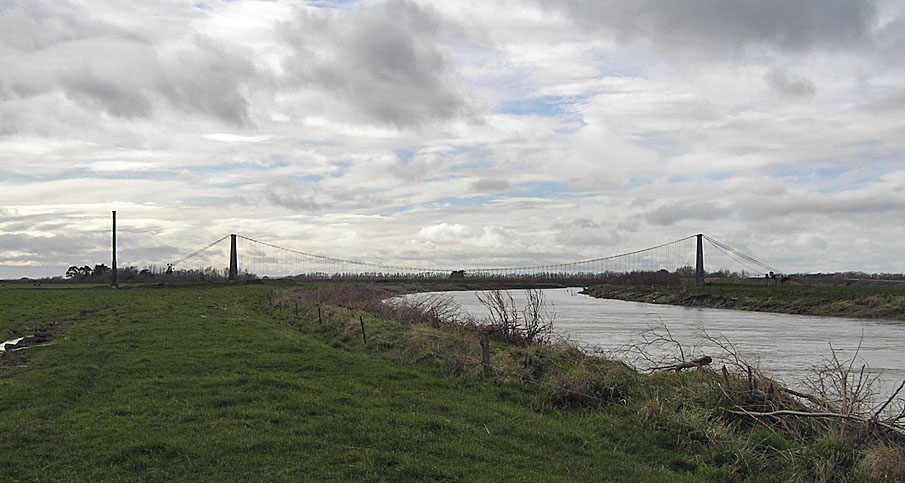
Designed and built by well-known Pahiatua bridge-builder Joseph Dawson (1843-1923), the bridge’s 145.4 metre timber deck span was suspended from wire rope catenaries stretching over and between high concrete towers. Dawson was born in Tasmania, coming to Christchurch at age 26 where he was engaged as a carpenter apprentice. After gaining experience erecting railway bridges he moved to the Wairarapa, living in several places before finally settling in Pahiatua in 1889. Here he farmed, but also designed and built bridges. Dawson earned a reputation for ‘the economy and very sound construction of his work, as well as speed of erection.’ He specialised in suspension bridges, patenting his ‘Dawson system,’ and constructing about 15 structures by the time his Opiki bridge was completed.
Dawson appears to have been self-taught success in the engineering field. At this time the newly formed New Zealand Society of Civil Engineers was advocating for greater regulation of engineers and the resulting Engineers Registration Act (1924) signalled the end for talented amateurs and self-taught bridge builders, like Dawson, being able to complete large scale works such as the Tane Hemp Company Suspension Bridge. Unfortunately, it seems that all of his road bridges have been demolished, with the only remnants being those of his Opiki bridge, as well as the towers of a smaller 1914 structure across the Rangitikei River.
It is highly likely that the team constructing the suspension bridge at Opiki, supervised by foreman Nathaniel Malcolm, were mostly hands from the Tane mill. This seems particularly probable especially during the winter months of 1917, as this was always an off-season for flax milling, being too wet to harvest the flax. Evidence of other cost savings and efficiencies were the suspension rods being fabricated by the mill’s blacksmith, Ernest Henderson, and the suspension cables being recycled from gold-mining operations in Waihi. The company’s suspension bridge was newsworthy because it had the longest main span of any bridge in New Zealand when it was built.
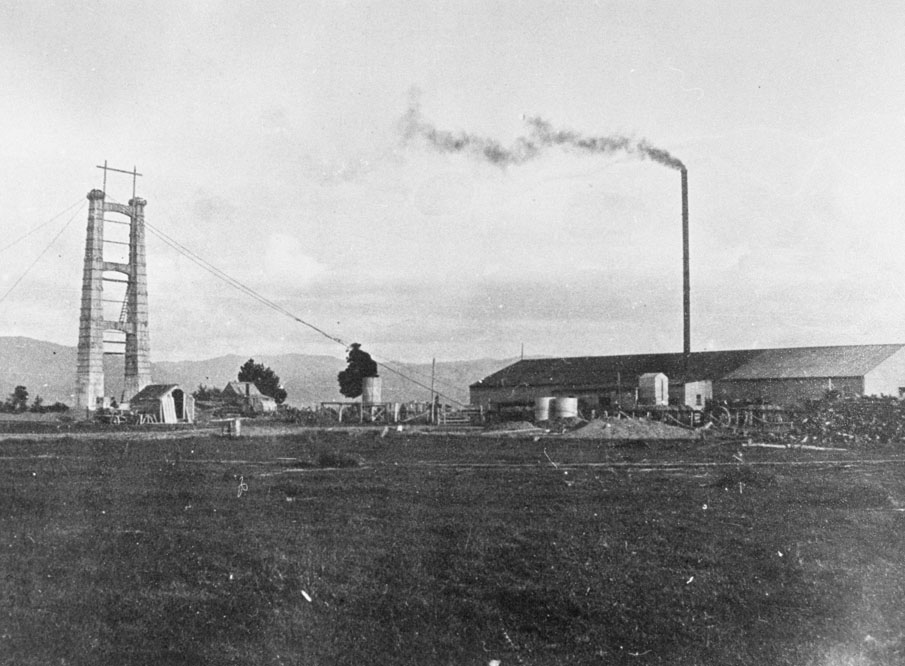
The company must have intended to be operating its mill for quite some time in order to make their impressive suspension bridge fiscally viable. However, the Tane Hemp Company Limited, and the majority of its immediate neighbours, closed their flaxmills between 1921 and 1922. This was the result of a post-war slump in the market, and because much of the flax became infected by a virulent yellow leaf disease which seems to have started making its way through the Makerua Swamp by early 1918. At this time it was estimated that 1500 acres of the property that the company leased from Hugh Akers (1877-1932) were affected. Akers predicted that ‘unless the disease is grappled with and beaten it will seriously affect the future of the industry.’ However, in addition to the recently completed bridge the company had also upgraded their mill facilities. Its new concrete chimney, the smokestack for the steam engine that powered the mill, replaced the mill’s original metal one. The mill was said to be unique in New Zealand because of its concrete chimney.
By 1920 the situation for the local flax industry was getting progressively worse and the major landowner flaxmillers in the Makerua Swamp - Akers, John Liggins, and Alfred and Herman Seifert - began considering subdividing and draining the land for farming. At this time they even approached the County Council seeking funding help to build a road through their land which would provide a more direct, less winding route from Shannon to Palmerston North. The County Council was also offered, but did not accept, the suspension bridge for £3,000.
Within two years the Tane Hemp Company Limited’s mill had closed and the building was demolished, with the exception of its tall concrete chimney. By 1934 the region’s formerly lucrative flax industry had dwindled to only four operative mills, all of them in the Foxton area.
When the Tane flaxmill closed the principal local landowner, and former Tane Hemp Company Limited shareholder, Hugh Akers, took over the mill’s former site, including the bridge. It then seems that the Makerua Drainage Board, of which Akers was a member, began draining the swampland with financial support from the County Council. In 1925 the drainage scheme was nearly complete and it was reported that:
‘A few years ago [Mr Hugh Akers property] was heavy flax; then it was hit hard by ‘yellow leaf’; to-day it is one of the most beautiful tracts of grassland one could see anywhere on earth.’
When the newly drained land was subdivided Akers received more and more requests from people wanting to use his private bridge. In order to maintain the bridge a toll was charged to users, with the exception of emergency vehicles and visitors of the Akers family. A bridge-keeper’s house was constructed at the west end of the bridge in 1925, in preparation for the start of toll-charging in February 1926.
The Akers family, through Hugh’s father William, had been involved in flaxmilling near Tokomaru since the early twentieth century, but the family had owned land in the Manawatu since the 1870s. William even went on a world tour in 1910 to make ‘a special study of all of the rivals of New Zealand hemp, especially Manila.’ By the 1890s, when William began leasing and buying land at Opiki, Hugh had his own sheep run near Ashhurst. Upon his death in 1932, it was said that there ‘was no better known figure in the district than the late Mr Hugh Akers, who has been associated with the progress of the Manawatu for the past forty years.’
By the 1930s the deviation road through the former Makerua Swamp had been constructed and by 1934 was being considered for highway designation. The Automobile Association campaigned for this change, and in 1937 the Minister for Public Works, Robert Semple (1873-1955), agreed to the proposal. Apparently the suspension bridge had not been maintained to a level which satisfied the Public Works Department, who planned to replace it. There was also public lobbying for the toll to be removed as soon as the highway was established. On one occasion in 1938 Semple himself encountered the frustration of having to pay the toll. He was reportedly indignant about it, but the toll-keeper stood firm. Infuriated, Semple is reported to have shouted: ‘This antique structure from a comic opera must go! We will build a new one immediately – we will not have toll bridges in this country.’ Semple did not live to see his plan realised. For another three decades the bridge remained notable as being the only privately owned toll highway bridge in New Zealand.
Meanwhile, the chimney, not used for several decades, temporarily gained a new lease on life. During World War Two the structure was used by the Opiki Home Guard’s Signal Division to relay smoke messages from as far away as Shannon. However, after the war the chimney went back to being a static monument to the local flaxmill industry.
It was said that Opiki became well-known for its bridge, the structure being a local landmark, with Palmerston North pleasure drivers often specifically bringing visitors out to see it. This was a novelty, but could also be an adrenalin rush on windy days when the deck swayed around ‘with gay abandon.’ By the 1960s traffic using the bridge had increased to the point where it made sense to introduce toll concession tickets.
As well as the demands placed on the structure by the motoring public, there was another reason why plans to replace the bridge began in earnest in the early 1960s. At this time the local Catchment Board was building stopbanks along the northern side of the Manawatu River. While this flood protection was good for the surrounding farms, engineers showed that a moderate flood would submerge the bridge, potentially causing its failure. Then in 1965 the National Roads Board agreed to subsidise the construction of a new two-lane concrete bridge. The suspension bridge remained in use, with tolls in place, until 1969 when the Horowhenua County Council opened its new bridge nearby, which did not have an associated toll or a three ton weight-limit like the old structure.
It was soon after the opening of the new bridge that the deck of the suspension bridge was removed in 1970 as a public safety measure and to forestall vandalism, as well as a flood-damage prevention measure in case the heavy beams dislodged. However, the towers and flaxmill chimney were not thought problematic, so Alan Akers (son of Hugh) retained these elements. Like the flaxmill, the fabric from the bridge was recycled in buildings and structures on the Akers’ farms. The Manawatu Catchment Board also advocated for the removal of the bridge-keeper’s house because it interrupted their flood control scheme.
The New Zealand Historic Places Trust (NZHPT) first recognised the significance of the structures in late 1970s. More recently, in 2003 the NZHPT Manawatu Branch Committee installed a cairn and plaque next to the main highway which describes local flaxmilling history and the Tane Hemp Company Limited’s remnant structures’ place in it. At the time this was further elaborated upon in Molly Akers’ book Suspended Access: the history of the privately owned Opiki toll bridge, which the Manawatu Branch Committee published.