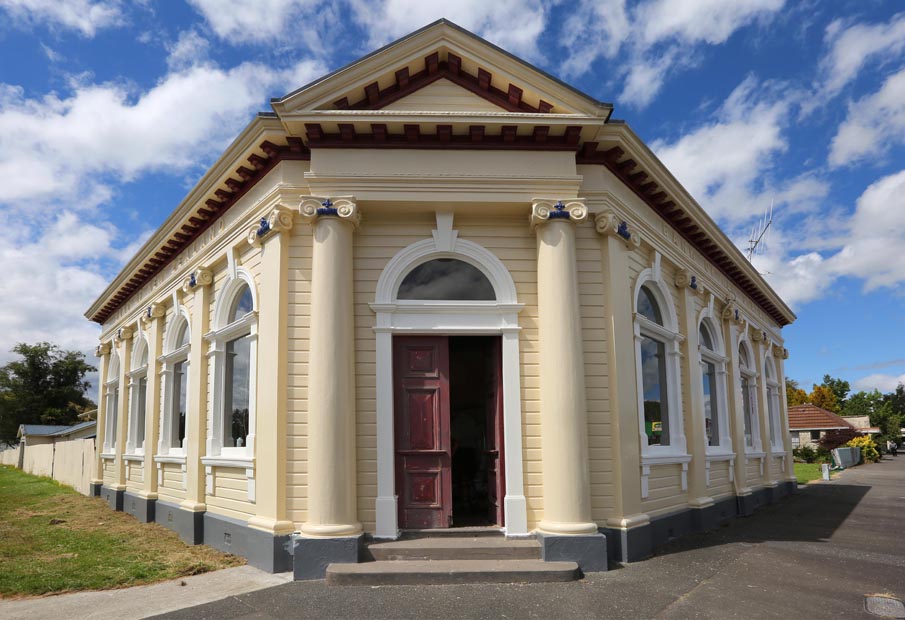
Constructed on a corner site purchased from Karioi Station Manager Edward McDonnell by the Bank of New Zealand (BNZ) in 1899, the site is intimately connected with the history of banking in the Waimarino County. The hitching rail is located outside of, and is thought to have been constructed at the same time as the second bank building erected in the area.
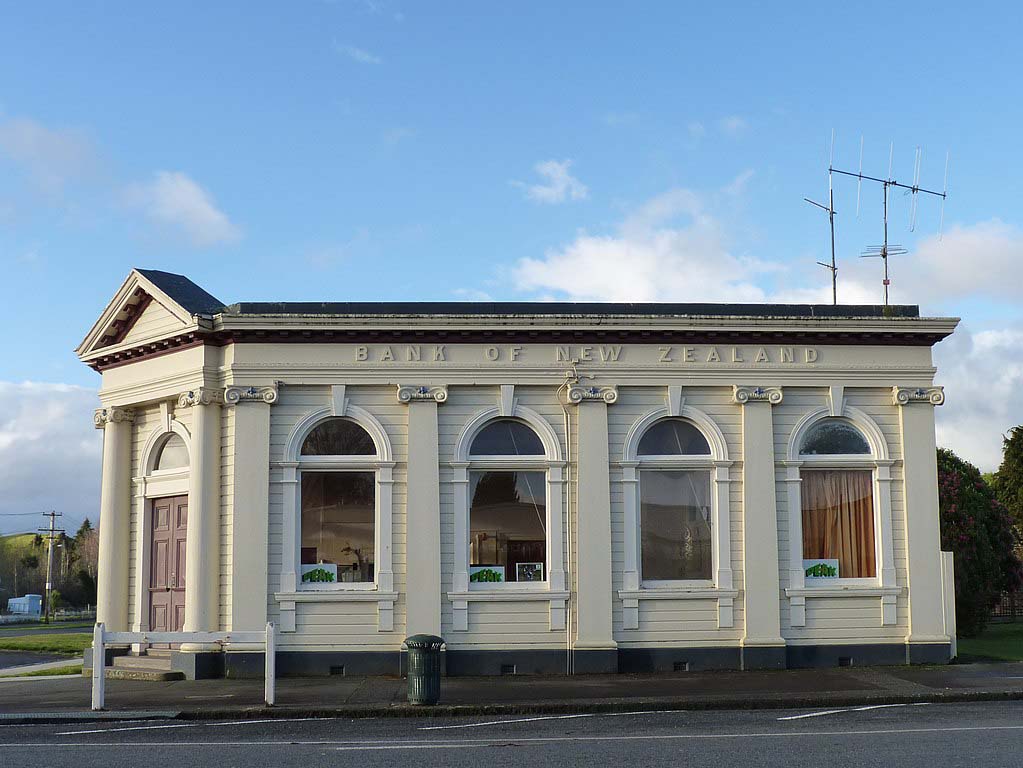
The second BNZ bank building is a substantial brick and plaster structure that was designed by the notable Wellington architect Joshua Charlesworth and opened on St Patrick's Day, 17 March 1911. It replaced the first bank which had been erected in 1903. A small, plain weather board structure, it was felt that the first bank did not adequately reflect the town's prosperous image following its population growth after the opening of the main trunk line in 1908.
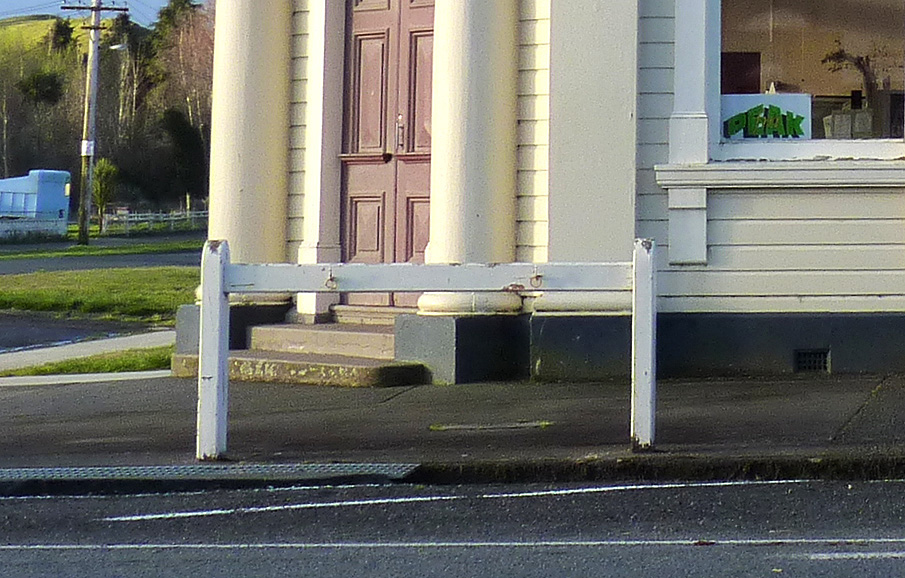
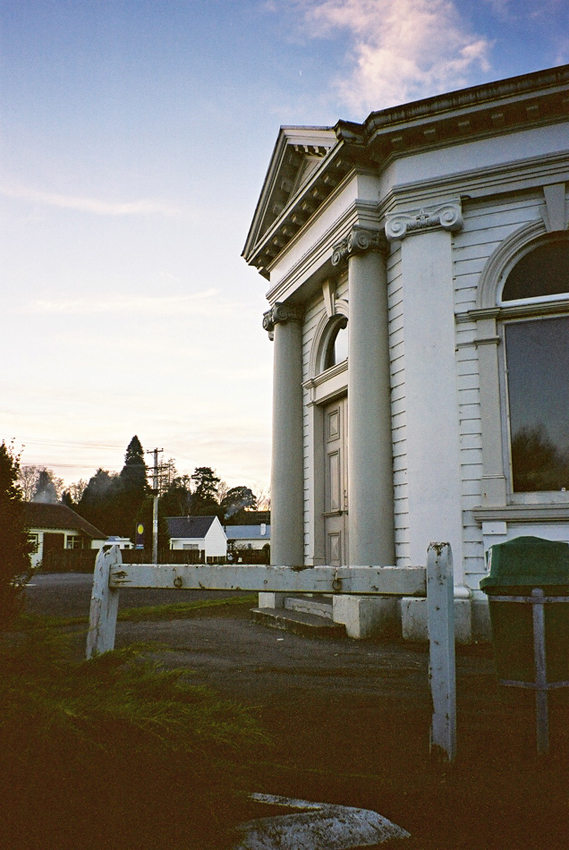
Compared with the elegance of the bank building, the hitching rail is a very plain, utilitarian structure. It is constructed from totara and consists of two upright posts connected by a horizontal rail. Horses would have been tied to the two iron rings located on the horizontal rail while customers did their banking at the BNZ.
The Hitching Rail is in remarkably good condition. It survived the great Raetihi fire of 1918. One of the vertical posts has been repaired twice: once when the timber began to rot and the second time when it was hit by a car. It is now partially obscured by a roadside planting which provides some protection from similar incidents in the future.
List Entry Information
Status
Listed
List Entry Status
Historic Place Category 2
Access
Able to Visit
List Number
964
Date Entered
11th December 2003
Date of Effect
11th December 2003
City/District Council
Ruapehu District
Region
Horizons (Manawatū-Whanganui) Region
Extent of List Entry
Registration includes the structure and site on which it stands
Legal description
Sec 52 Blk IV, Township of Raetihi (RTs 96/252 and 974/62), Wellington Land District
Status
Listed
List Entry Status
Historic Place Category 2
Access
Able to Visit
List Number
964
Date Entered
11th December 2003
Date of Effect
11th December 2003
City/District Council
Ruapehu District
Region
Horizons (Manawatū-Whanganui) Region
Extent of List Entry
Registration includes the structure and site on which it stands
Legal description
Sec 52 Blk IV, Township of Raetihi (RTs 96/252 and 974/62), Wellington Land District
Why is this place significant?
Historic Significance
Historical Significance or Value The Hitching Rail located outside of the Bank of New Zealand at Raetihi is a well-preserved reminder of the bygone era of horse transport. It is connected with the second Bank of New Zealand building constructed at Raetihi, which is significant as the first substantial commercial building in the Waimarino County and as the one of the oldest commercial structures remaining standing in Raetihi. The simple structure demonstrates the lengths to which the BNZ went to provide for the needs of its customers. Highly valued by the local community, the Hitching Rail is an integral part of the heritage of the Waimarino County.
Why is this place Category 1 / Category 2?
Detail Of Assessed Criteria
(a) The extent to which the place reflects important or representative aspects of New Zealand history: The Hitching Rail at Raetihi is a relatively rare example of the hitching rails that were common during the era of horse transport. (b) The association of the place with events, persons, or ideas of importance in New Zealand history: The Hitching Rail is intimately associated with the BNZ at Raetihi, which was given a Category II rating by the NZHPT. (c) The potential of the place to provide knowledge of New Zealand history: The Hitching Rail is a physical reminder of the era of horse transport and, as such, provides knowledge of New Zealand's past. (e)The community association with, or public esteem for, the place: The Hitching Rail is highly esteemed by the local community. It has been carefully preserved and has prompted the construction of a copy on the opposite side of the road. (f) The potential of the place for public education The Hitching Rail is located on the main street of Raetihi and is therefore fully accessible to members of the public. (g)The technical accomplishment or value, or design of the place: The simplistic design of the rail is unlike any other registered hitching rail.
Why is this place significant?
Historic Significance
Historical Significance or Value The Hitching Rail located outside of the Bank of New Zealand at Raetihi is a well-preserved reminder of the bygone era of horse transport. It is connected with the second Bank of New Zealand building constructed at Raetihi, which is significant as the first substantial commercial building in the Waimarino County and as the one of the oldest commercial structures remaining standing in Raetihi. The simple structure demonstrates the lengths to which the BNZ went to provide for the needs of its customers. Highly valued by the local community, the Hitching Rail is an integral part of the heritage of the Waimarino County.
Why is this place Category 1 / Category 2?
Detail Of Assessed Criteria
(a) The extent to which the place reflects important or representative aspects of New Zealand history: The Hitching Rail at Raetihi is a relatively rare example of the hitching rails that were common during the era of horse transport. (b) The association of the place with events, persons, or ideas of importance in New Zealand history: The Hitching Rail is intimately associated with the BNZ at Raetihi, which was given a Category II rating by the NZHPT. (c) The potential of the place to provide knowledge of New Zealand history: The Hitching Rail is a physical reminder of the era of horse transport and, as such, provides knowledge of New Zealand's past. (e)The community association with, or public esteem for, the place: The Hitching Rail is highly esteemed by the local community. It has been carefully preserved and has prompted the construction of a copy on the opposite side of the road. (f) The potential of the place for public education The Hitching Rail is located on the main street of Raetihi and is therefore fully accessible to members of the public. (g)The technical accomplishment or value, or design of the place: The simplistic design of the rail is unlike any other registered hitching rail.
Construction Details
Start Year
1899
Type
Other
Description
Land purchased by the BNZ from Edward Daniell
Start Year
1905
Type
Other
Description
First BNZ opened in Raetihi
Start Year
1910
Type
Other
Description
New BNZ designed by Joshua Charlesworth and construction begins
Start Year
1911
Type
Original Construction
Description
Hitching Rail in place
Type
Other
Description
One vertical upright repaired due to rot
Period
pre-1978
Type
Other
Description
Hitching rail hit by car and repaired
Period
pre-1978
Construction Materials
The Hitching Rail is constructed from totara and features two iron rings in its top rail. It is set in place on the footpath by concrete.
Construction Details
Start Year
1899
Type
Other
Description
Land purchased by the BNZ from Edward Daniell
Start Year
1905
Type
Other
Description
First BNZ opened in Raetihi
Start Year
1910
Type
Other
Description
New BNZ designed by Joshua Charlesworth and construction begins
Start Year
1911
Type
Original Construction
Description
Hitching Rail in place
Type
Other
Description
One vertical upright repaired due to rot
Period
pre-1978
Type
Other
Description
Hitching rail hit by car and repaired
Period
pre-1978
Construction Materials
The Hitching Rail is constructed from totara and features two iron rings in its top rail. It is set in place on the footpath by concrete.
Constructed outside of the Seddon Street frontage of the Bank of New Zealand building at Raetihi, the Hitching Rail is now partially obscured by a roadside planting of low-lying bushes. It is constructed from native timber and consists of two upright posts connected by a horizontal rail, which has two iron rings attached. The upright posts stand at 1050 millimetres high and are 100 millimetres wide. The top of each post is rounded into an arch. The horizontal rail is rectangular in shape and is located 790 millimetres from the ground. It is 2045 millimetres long. The two iron rings are located on the horizontal rail and are 530 millimetres and 475 millimetres in from the vertical posts.
Constructed outside of the Seddon Street frontage of the Bank of New Zealand building at Raetihi, the Hitching Rail is now partially obscured by a roadside planting of low-lying bushes. It is constructed from native timber and consists of two upright posts connected by a horizontal rail, which has two iron rings attached. The upright posts stand at 1050 millimetres high and are 100 millimetres wide. The top of each post is rounded into an arch. The horizontal rail is rectangular in shape and is located 790 millimetres from the ground. It is 2045 millimetres long. The two iron rings are located on the horizontal rail and are 530 millimetres and 475 millimetres in from the vertical posts.
Historical and Associated Iwi / Hapū / Whānau
Completion Date
11th December 2003
Report Written By
Rebecca O'Brien
Information Sources
Ruapehu Bulletin
Ruapehu Bulletin
Waimarino Bulletin
Waimarino Bulletin
BNZ Archives
Bank of New Zealand (BNZ) Archives
Other Information
A fully referenced version of this report is available from the Central Region of the New Zealand Historic Places Trust. Please note that entry on the New Zealand Heritage List/Rarangi Korero identifies only the heritage values of the property concerned, and should not be construed as advice on the state of the property, or as a comment of its soundness or safety, including in regard to earthquake risk, safety in the event of fire, or insanitary conditions.
Historical and Associated Iwi / Hapū / Whānau
Completion Date
11th December 2003
Report Written By
Rebecca O'Brien
Information Sources
Ruapehu Bulletin
Ruapehu Bulletin
Waimarino Bulletin
Waimarino Bulletin
BNZ Archives
Bank of New Zealand (BNZ) Archives
Other Information
A fully referenced version of this report is available from the Central Region of the New Zealand Historic Places Trust. Please note that entry on the New Zealand Heritage List/Rarangi Korero identifies only the heritage values of the property concerned, and should not be construed as advice on the state of the property, or as a comment of its soundness or safety, including in regard to earthquake risk, safety in the event of fire, or insanitary conditions.
Current Usages
Uses: Civic Facilities
Specific Usage: Historic Property
Former Usages
General Usage: Transport
Specific Usage: Hitching Post
Current Usages
Uses: Civic Facilities
Specific Usage: Historic Property
Former Usages
General Usage: Transport
Specific Usage: Hitching Post