Early history of the site
The site of the future butter factory lies at the base of basalt ridge above Whangarei Harbour, an area long occupied by Maori. Lava from the Hurupaki eruption formed an elevated ridge conducive to human settlement above the harbour and low lying swampy land. The coastal areas of the Whangarei Harbour were long occupied by Maori, evidenced by a range of features including pits, terraces, shell middens, cultivation sites, burials and pa.
The site of the future butter factory lies within an area of significance to Maori being a pa, and a place to haul up waka. Directly opposite were two named sites. The first of which, Pihio Pa, occupied a steep-sided, long ridge above the harbour affording defence and the option to disappear if necessary into the hinterland. Approximately 100 metres to the north was He Unga Waka, where waka could land enabling the occupants to climb up to the pa.
The current Town Basin area and inland to Kamo, Ketenikau and Parihaki, was the territory of the Ngati Kahu People. Tipene had his village at Pihoi on the high land above the present Town Basin and extending along the north side of the harbour. In colonial times the wider location was the site of meetings between rangatira and missionaries and the place where the first chapel was built in the Whangarei area. In 1839, the missionary printer William Colenso and the then British Resident at the Bay of Islands, James Busby, visited the Whangarei area on the vessel Black Joke. On 8 December 1839, Colenso went up the harbour in the ships boat and stayed with Tipene at his pa at Pihoi. Colenso paid five visits to Whangarei and in April 1840, a timber chapel was built by Maori that Colenso identifies as Abraham, Steven and the chiefs.
The Bank Street site
William Carruth, a Scots settler, purchased just over 390 hectares from Ngati Kahu in 1839, encompassing much of the future commercial area of Whangarei. Pihoi Pa and He Unga Waka were extensively modified by the development of the colonial town and from the mid nineteenth century the swampy scrub land between the basalt ridge and harbour was gradually cleared, drained and filled. European settlers named what is currently Bank Street ‘Scoria Hill’ because of the volcanic nature of the ridge.
Carruth sold a portion of the holding to John George Petingale and Edward Dent and family in 1846. By 1850, there were four European settler families with homes on the west bank of the Hatea River: the Petingales, Dents, Mairs and Holmans . In 1855, Edward Dent bought land from Pertingale and established a store at the intersection of present day Cameron and Bank Streets. A road ran up Scoria Hill to what is now Bank Street.
General storekeeper James Harrison, who went on to become a significant businessman and entrepreneur in the Whangarei district, bought the property in 1879. Born in Durham, England, Harrison had migrated to New Zealand in 1872, initially settling in Coromandel, and then moving with his wife Hannah to Whangarei in circa 1875. The couple’s sons had joined the business by 1898, and possibly as early as 1886.
Harrison’s business ventures also extended to brickmaking, flax milling, a blood and bone works, and a dairy factory in production at Kauri, north of Whangarei. Harrison brought a number of hand-operated cream separators from Britain which he gave to local suppliers. In return, they provided cream for butter manufacture, a notably different system from the communal cream skimming stations that traditionally supplied butter factories.
This was a period of rapidly increasing butter manufacture; there were four local dairy factories in production in Whangarei by November 1905, with Harrison and Sons shipping just over eight tons in October. Dairy produce was to remain one of New Zealand’s three major exports during the first half of the twentieth century.
Construction of the Butter Factory (1905)
In 1905, Harrison commissioned construction of a new building. The design intended to provide for retail and manufacturing activities incorporating a butter factory on the bottom storey.
Attributes commending the Bank Street site included the availability of good quality basalt building stone. The basalt was a durable, fireproof and thermally stable construction material that was able to keep the building cool during the summer - vital for butter production. A ready supply of clean artesian water was available from a spring on the property, and a nearby stream enabled transportation of the finished product by punt to the Hatea River for loading from the harbour onto refrigerated vessels destined for Auckland. The location was also comparatively close to road junctions from the rural hinterland; and to the Bank Street railway station providing for local freight, although the line was not completed to Auckland until 1925.
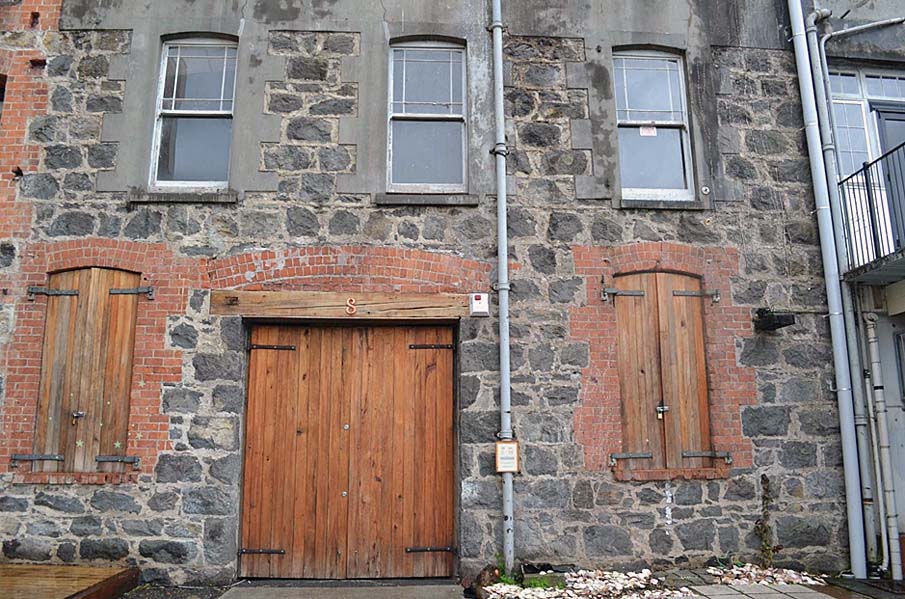
Construction of the butter factory was the work of local Whangarei building contractor Richard Keyte, who may also have been the designer. He used the natural materials that were available, the basalt that was laid in regular courses and the beams and columns constructed of Northland kauri. The use of basalt was uncommon in Whangarei but the construction of the building was influenced by the natural supply of stone at the building site.
The building had two street frontages, Bank Street and the rear onto Butter Factory Lane. The bottom storey functioned as a butter factory while the rest of the building was used as a furniture factory and retail showroom.
The Bank Street façade, designed with an eye for street appeal for retailing, was muted neoclassical in appearance with decorative details, columns and classical forms. The Bank Street entrance functioned as a showroom for furniture that was manufactured in the building.
The rear of the building was Italianate in style with simple windows and the two top storeys brick cement rendered to a smooth finish. There was a contrast in design between the front of the building for retail and the rear of the building (Butter Factory Lane) for manufacture.
Subsequent use and modifications (1906 - 2014)
The butter factory premises was the venue of at least one gathering of the temperance organisation, Band of Hope, notice being given of a in April 1906 meeting to be held in Harrison and Sons‘ new building. In early January of 1906, James Harrison and Sons were making arrangements for pulping fruit, installing the necessary plant into ‘the Mananui Building in Bank Street’. Only days later there were complaints of an unpleasant odour at the foot of Dent Street , caused by the liquid from Messrs Harrison and Sons’ butter factory.
Following completion of the Bank Street factory equipped with the most up to date appliances, Harrison closed his Kauri Dairy Factory and made his butter in Whangarei. The brand name of the butter was Mana and hence the name Mananui Building. Mana operated as a brand from 1902 to 1907. Barely a year after the completion of the new butter factory, the Mana butter brand went out of existence. Encouraged by the success of dairy factories established by entrepreneurs, forty per cent of the colony’s 150 dairy factories were farmer owned and directed cooperatives by 1890. A decade later cooperatives outnumbered individually owned factories.
In 1907, four factories were operating in or around Whangarei. The Whangarei Co-Op Dairy Company was established in 1907 and it brought the manufacturing plant from Harrison’s factory. By 1907, the bottom storey of the building was no longer being used as a butter factory and butter production in Whangarei was now consolidated in the Whangarei Co-Op Dairy Company. The model for dairy manufacturing had changed from that of an individual owner to the cooperative system.
Butter production ceased in the building because of these changes to the social and economic model.
The building was then exclusively used by Harrison for the manufacture and sale of furniture. The bottom storey that had been used as the butter factory was now used as the loading bay of timber for the factory.
The furniture manufactured by J. Harrison and Sons was in the showroom upstairs and manufactured by the firms’ workmen from kauri, rimu, oak and other New Zealand and imported timbers. The company advertised that they had a fine array of furniture in all the latest designs and varieties. They also stressed the special care that they took in selecting their timber which came from a mill of good standing.
Closure of furniture factory and extension to building
In the 1920s, the furniture factory closed. This may have been because of the death of James Harrison in 1928, or because of increased competition as the railway line to Auckland (completed in 1925) meant that goods from the larger centre could be easily transported. After the closing of the furniture factory the building was used as a drapery and clothing store and belonged to the Harrison Brothers. In 1936, an extension was made to the north of the former butter factory to accommodate a tearooms and bakery. The ovens were located in the basement of the new extension and a dumb waiter delivered the baked goods to the tearooms. The new extension was built of brick, cement rendered outside, hard finish plaster internally, rimu floors and beams and external steel windows. The Balmoral tearooms were an important venue for social gatherings in Whangarei. The tearooms were used for public events especially those associated with gatherings of women. In 1936, there were at least three recorded social events. The mayoress and Whangarei women’s organisations entertained Mrs R. Semple who was visiting Whangarei with her husband Robert Semple, Minister of Public Works and Transport. The Public Works Department used the tearooms twice in 1936 when the wives of staff farewelled Mrs Hills and Mrs Shankland who departed the district when their husbands were transferred.
As the building was now functioning as a drapery and clothing store, the addition of tearooms meant that the shopping experience was augmented with a cup of tea and a scone. This combination of shopping and tearooms was popular and examples of this are the Farmers Department Store (Former) and the George Courts Store (Former) in Auckland.
The building was bought by the Furnishing and Furniture Company, Fabers, in 1941 ending a 36 year association with the Harrison family. A former owner Peter Faber found the building not particularly well-suited to furniture retail because of the multiple levels with furniture having to be moved around between the floors, but commented that, ‘it kept me fit, it is probably why I have lasted so well’.
In 1960, the building became the venue of the first night club to open in Whangarei, an establishment known as the Casa Fontana. Strengthening of the roof and remodelling of the Bank Street shop fronts were undertaken in 1968 to give the building a more modern appearance, work that resulted in the removal of all the lead light glass from the front of the building.
When Fabers sold in 1990, the premises became a carpet warehouse. Extensive renovations under new owners brought the building up to earthquake code. A wine bar currently (2014) operates in the space formerly occupied by the butter factory and the top storey is used as by the Whangarei Youth theatre for a rehearsal space. The former Balmoral tearoom is currently a café.