

In 1874 the corner site, a government reserve, was selected for the Balclutha Athenaeum. In 1879 the Government took over the Athenaeum as the town’s courthouse. The building served as the courthouse for over thirty years, although complaints about its deterioration led to increasingly loud calls for a replacement. In 1913 the Government agreed to replace the building with a wooden courthouse. The community was outraged that a structure of insufficient architectural quality should be imposed on a town of Balclutha’s standing. The Government withdrew the design.
In 1924 John Mair, innovative Government Architect, was directed to design a new courthouse for Balclutha in brick. Although it included some traditional and classical elements, the architectural styling was relatively clean and simple, heralding Mair’s revitalisation of public architecture along Modernist lines. It was Mair’s first courthouse design in a career that encompassed many of New Zealand’s most notable government buildings. The Courthouse opened in 1926.
The building was well maintained over the following decades. In 2011 the Courthouse was closed following concerns over earthquake strengthening. In 2013 the Balclutha Courthouse (Former) closed permanently and its services were moved to Dunedin.
List Entry Information
Status
Listed
List Entry Status
Historic Place Category 2
Access
Private/No Public Access
List Number
9690
Date Entered
10th December 2015
Date of Effect
21st January 2016
City/District Council
Clutha District
Region
Otago Region
Extent of List Entry
Extent includes part of the land described as Sec 1 SO 23469, (RT OT18B/1151), Otago Land District and the building known as the Balclutha Courthouse (Former) thereon. (Refer to maps in Appendix 1 of the List entry report for further information).
Legal description
Sec 1 SO 23469, (RT OT18B/1151), Otago Land District
Location Description
Corner of Paisley and Renfrew Streets, Balclutha
Status
Listed
List Entry Status
Historic Place Category 2
Access
Private/No Public Access
List Number
9690
Date Entered
10th December 2015
Date of Effect
21st January 2016
City/District Council
Clutha District
Region
Otago Region
Extent of List Entry
Extent includes part of the land described as Sec 1 SO 23469, (RT OT18B/1151), Otago Land District and the building known as the Balclutha Courthouse (Former) thereon. (Refer to maps in Appendix 1 of the List entry report for further information).
Legal description
Sec 1 SO 23469, (RT OT18B/1151), Otago Land District
Location Description
Corner of Paisley and Renfrew Streets, Balclutha
Why is this place significant?
Historic Significance
Historic Significance or Value: The Balclutha Courthouse (Former) has historical significance. The courthouse was one of the few public faces of Government in small town New Zealand. The role of courthouses in local communities was of great importance; not used simply for the occasional court sitting, but for a variety of public purposes - including registration of births, deaths and marriages, inquests, and elections. The Courthouse was significant as the centre for administration and justice in Balclutha and surrounding rural communities. It is a significant surviving element in the history of the district. From 1939 the Courthouse also formed a law and order precinct with the Police station and residence adjacent on Paisley Street and, later, with the new Police Station on Renfrew Street.
Physical Significance
Aesthetic Significance or Value The Balclutha Courthouse (Former) has aesthetic significance. On a prominent corner site, its simple solidity speaks to firm, unadulterated justice. As little remains of Balclutha’s heritage buildings, the Courthouse’s aesthetic has heightened significance. Archaeological Significance or Value The Balclutha Courthouse (Former) has potential archaeological value as the site of the township’s first Athenaeum, which was constructed on site 1874-1875. Architectural Significance or Value The Balclutha Courthouse (Former) has architectural significance. It was the first courthouse to be designed by John Mair who was appointed Government Architect in 1923. Mair moved government architecture from traditional, revivalist lines to Modernist architectural ideas. Not only is Mair’s original design for the Courthouse’s exterior largely intact, but the interior also remains largely intact.
Why is this place Category 1 / Category 2?
Detail Of Assessed Criteria
a) The extent to which the place reflects important or representative aspects of New Zealand history The courthouse represents the historic importance and presence of law enforcement in small town New Zealand. Historically, towns such as Balclutha were geographically isolated, separated from other settlements by long distances that could only be travelled on foot, on horseback or by coach. In this context the courthouse was an important symbol of government and civilization. It was also one of the few public faces of government in small town New Zealand. b) The association of the place with events, persons, or ideas of importance in New Zealand history Balclutha Courthouse (Former) is associated with Government architect John Mair who oversaw the transformation of public architecture between 1923 and 1941. Single-handedly he moved government architecture away from traditional, classical architecture to more modem, simple lines. This is Mair’s first attempt at a courthouse in line with this new philosophy. (g) The technical accomplishment or value, or design of the place Balclutha Courthouse (Former)’s design is important as Mair’s first. It shows classical detailing but also a transition towards Modernist lines, which became Mair’s greatest contribution to public architecture. (k) The extent to which the place forms part of a wider historical and cultural area The Balclutha Courthouse (Former) forms part of a wider historical area. From at least 1939, with the police station alongside, the Courthouse has been part of central space where the community looks for its law and order.
Why is this place significant?
Historic Significance
Historic Significance or Value: The Balclutha Courthouse (Former) has historical significance. The courthouse was one of the few public faces of Government in small town New Zealand. The role of courthouses in local communities was of great importance; not used simply for the occasional court sitting, but for a variety of public purposes - including registration of births, deaths and marriages, inquests, and elections. The Courthouse was significant as the centre for administration and justice in Balclutha and surrounding rural communities. It is a significant surviving element in the history of the district. From 1939 the Courthouse also formed a law and order precinct with the Police station and residence adjacent on Paisley Street and, later, with the new Police Station on Renfrew Street.
Physical Significance
Aesthetic Significance or Value The Balclutha Courthouse (Former) has aesthetic significance. On a prominent corner site, its simple solidity speaks to firm, unadulterated justice. As little remains of Balclutha’s heritage buildings, the Courthouse’s aesthetic has heightened significance. Archaeological Significance or Value The Balclutha Courthouse (Former) has potential archaeological value as the site of the township’s first Athenaeum, which was constructed on site 1874-1875. Architectural Significance or Value The Balclutha Courthouse (Former) has architectural significance. It was the first courthouse to be designed by John Mair who was appointed Government Architect in 1923. Mair moved government architecture from traditional, revivalist lines to Modernist architectural ideas. Not only is Mair’s original design for the Courthouse’s exterior largely intact, but the interior also remains largely intact.
Why is this place Category 1 / Category 2?
Detail Of Assessed Criteria
a) The extent to which the place reflects important or representative aspects of New Zealand history The courthouse represents the historic importance and presence of law enforcement in small town New Zealand. Historically, towns such as Balclutha were geographically isolated, separated from other settlements by long distances that could only be travelled on foot, on horseback or by coach. In this context the courthouse was an important symbol of government and civilization. It was also one of the few public faces of government in small town New Zealand. b) The association of the place with events, persons, or ideas of importance in New Zealand history Balclutha Courthouse (Former) is associated with Government architect John Mair who oversaw the transformation of public architecture between 1923 and 1941. Single-handedly he moved government architecture away from traditional, classical architecture to more modem, simple lines. This is Mair’s first attempt at a courthouse in line with this new philosophy. (g) The technical accomplishment or value, or design of the place Balclutha Courthouse (Former)’s design is important as Mair’s first. It shows classical detailing but also a transition towards Modernist lines, which became Mair’s greatest contribution to public architecture. (k) The extent to which the place forms part of a wider historical and cultural area The Balclutha Courthouse (Former) forms part of a wider historical area. From at least 1939, with the police station alongside, the Courthouse has been part of central space where the community looks for its law and order.
Construction Professional
Name
Mair, John Thomas
Type
Architect
Biography
John Thomas Mair (1876-1959) was born in Invercargill and began his career with the New Zealand Railways on the staff of the Office Engineer, George Troup. In 1906 he travelled to the United States of America where he studied architecture at the University of Pennsylvania. He then worked in the office of George B. Post in New York before travelling to England where he was admitted as an Associate of the Royal Institute of British Architects. He became a Fellow in 1940. On his return to New Zealand he entered private practice, one of his first buildings being the Presbyterian First Church, Invercargill (1915), a prominent building of Romanesque character. He then practised in Wellington, carrying out largely domestic commissions. In 1918 he was appointed Inspector of Military Hospitals by the Defence Department, and in 1920 he became architect to the Department of Education. Following the retirement of John Campbell in 1922, Mair was appointed Government Architect, a position which he held until his retirement in 1942. During this period he was responsible for a variety of buildings, including the Courthouse, Hamilton, the Post Office in High Street, Christchurch, Government Life Office and the Departmental Building, both in Wellington, and the Jean Batten Building, Auckland. Such buildings show a departure from tradition, with the emphasis on function, structure and volume as opposed to a stylistic treatment of the building fabric. A Fellow of the New Zealand Institute of Architects, Mair was made a Life Member in 1942. His son John Lindsay Mair also practised as an architect.
Name
Hamilton, John Leitch (1881-1927)
Type
Builder
Biography
No biography is currently available for this construction professional
Construction Details
Start Year
1926
Type
Original Construction
Description
Building opened
Type
Additional building added to site
Description
Additions made including garage, steps and ramp
Period
c.1950s-1960s
Start Year
2011
Type
Other
Description
Courthouse closed
Construction Materials
Brick, Concrete foundations, Clay tile roof
Construction Professional
Name
Mair, John Thomas
Type
Architect
Biography
John Thomas Mair (1876-1959) was born in Invercargill and began his career with the New Zealand Railways on the staff of the Office Engineer, George Troup. In 1906 he travelled to the United States of America where he studied architecture at the University of Pennsylvania. He then worked in the office of George B. Post in New York before travelling to England where he was admitted as an Associate of the Royal Institute of British Architects. He became a Fellow in 1940. On his return to New Zealand he entered private practice, one of his first buildings being the Presbyterian First Church, Invercargill (1915), a prominent building of Romanesque character. He then practised in Wellington, carrying out largely domestic commissions. In 1918 he was appointed Inspector of Military Hospitals by the Defence Department, and in 1920 he became architect to the Department of Education. Following the retirement of John Campbell in 1922, Mair was appointed Government Architect, a position which he held until his retirement in 1942. During this period he was responsible for a variety of buildings, including the Courthouse, Hamilton, the Post Office in High Street, Christchurch, Government Life Office and the Departmental Building, both in Wellington, and the Jean Batten Building, Auckland. Such buildings show a departure from tradition, with the emphasis on function, structure and volume as opposed to a stylistic treatment of the building fabric. A Fellow of the New Zealand Institute of Architects, Mair was made a Life Member in 1942. His son John Lindsay Mair also practised as an architect.
Name
Hamilton, John Leitch (1881-1927)
Type
Builder
Biography
No biography is currently available for this construction professional
Construction Details
Start Year
1926
Type
Original Construction
Description
Building opened
Type
Additional building added to site
Description
Additions made including garage, steps and ramp
Period
c.1950s-1960s
Start Year
2011
Type
Other
Description
Courthouse closed
Construction Materials
Brick, Concrete foundations, Clay tile roof
Māori History The Māori name for the Balclutha area is Iwikatea, meaning bleached bones, in memory of a local Māori tribal battle where the bones of the vanquished were left to whiten in the sun. The Māori name for the neighbouring Clutha River is Mata-Au (or Matau) meaning current or eddy in an expanse of water. Under the Ngāi Tahu Claims Settlement Act 1998 the river was renamed the ‘Clutha River/Mata-Au’. Ngāi Tahu and Kāi Tahu ki Otago explorers followed the Mata-Au inland. Atholl Anderson’s maps of the area show a traditional route was established from the coast to the interior on the river’s north bank, passing where Balclutha now sits. In time, river campsites and seasonal inland settlements became established. The river was abundant with fish, eel, and duck while the land supplied moa and pigeon. Several archaeological finds relating to Māori artefacts and settlement have been identified around Balclutha and Kaitangata. The Catlins was also populated with Māori as moa were plentiful and readily hunted, and the timber from the forest was used for canoes. Hunting camps were located at Papatowai and near the Tahakopa River mouth. By the early days of European exploration there was at least one settlement of 250-300 Māori close to the Mata-Au’s banks. There are no recorded Māori archaeological sites on the piece of land on which the Courthouse sits. The Balclutha Athenaeum Balclutha's name reflects the Scottish origin of the town's settlement. The name comes from the Scottish Gaelic ‘Baile Cluaidh’, which translates to ‘Town on the Clyde’. The town's founding father, James McNeil from Dumbartonshire, Scotland, arrived in 1853. He established a farm on the site of the present town. In partnership with the Provincial Government, McNeil established a ferry service across the Clutha in 1857; as a result the town was initially called Clutha Ferry. In 1864 the Balclutha township was surveyed and laid out. Section 16 Block IV, on the corner of Renfrew and Paisley Streets, was set aside as a public reserve. In 1874 a public meeting was held in Balclutha for the purpose of establishing an Athenaeum. Discussing several options for a possible site, the gathering decided on the ‘original Government Athenaeum Reserve’ on the corner of Renfrew and Paisley Streets. In September 1874 tenders for the erection of the Athenaeum were advertised. The tender of Alexander Bain, £614, was accepted. Although work soon got underway, it was delayed due to differences of opinion between the builder and the Public Works Inspector. Eventually the works progressed and on Sunday 13 June 1875 the Athenaeum was officially opened. A letter to the editor described the building as a ‘heavy, ugly, Egyptian structure…’ The Athenaeum as courthouse As early as 1876 the Athenaeum Committee decided to offer the building to the Government as a courthouse. As the Government did not immediately accept the offer, the Balclutha Borough Council rented the building as Council Chambers. In 1879 it was announced that the Athenaeum had ‘been taken over by the Government to be used as a courthouse. The Government had handed over to the [Athenaeum] Corporation the old courthouse, which was to be removed to a site in the main street and fitted up as an Athenaeum’. The situation remained unchanged for 34 years. An increasing number of complaints, however, were heard about the state of the courthouse building. It was said to be too small and was the ‘source of continual complaints by the Magistrates, Solicitors, and the public generally’. The campaign for a courthouse In January 1913 the Public Works Office in Dunedin issued tenders for a new Balclutha courthouse. It was to be built in wood. The community was outraged that the courthouse would be wooden and ‘not a very handsome or adequate structure at that’. They ‘strongly expressed’ the desire that plans be delayed until the Court could be built in brick or concrete. They also questioned if the planned courthouse was ‘big enough for rapidly growing business.’ ‘…the town was a growing one…people were putting up substantial and up-to-date buildings, and the Government buildings should be of equal character.’ In the face of community antipathy, the Government acquiesced. The local campaign for a new courthouse continued in 1914. A member of the press described the building: ‘…a dilapidated building on a back street…Right opposite the Passage of Creaks’ Bangs and Groans is a large window which cannot be closed tight, and from here comes an incessant rattle… With all the concerted noises it is frequently impossible to hear a word of what is being said. Bench, Bar, Press, Police and Public are wrapped in heavy overcoats, with turned-up collars…To break the monotony an extra fierce gust of wind loosens some plaster off the ceiling to fall with a clatter on the floor - or on the head of someone…’ Prime Minister Massey visited Balclutha in May 1914 and was toured through the dilapidated courthouse to emphasise the community’s case. This was not an uncommon tactic: many small towns took advantage of politicians’ visits to lobby for funds for a new courthouse. The new magistrate in Balclutha supported the cause by claiming he had been in ‘courthouses in various parts of the world – in Zululand and Matabeleland and elsewhere, - but never before had he seen such a courthouse. The conditions were extraordinary in a town of Balclutha’s importance.’ The community outcry over a courthouse may seem excessive from a modern standpoint, but the role of courthouses in local communities was of great importance. ‘…almost every town of any size had its own courthouse, along with a police station, post office and general store. Justice was not only dispensed locally but also to be done locally.’ A local courthouse was not simply used for the occasional court sitting, but for a variety of public purposes. Courthouses could also be a temporary town police station; the local offices for registration of births, deaths and marriages; coroner’s inquest court; a court for special commission sittings; Warden’s Court; and the ‘centre of action at each general election’. The old courthouses played a major role in their communities. The courthouse, then, was significant in small town New Zealand. Perhaps the smaller the community, the more significant its public buildings. The courthouse is intertwined with the community’s identity. The strong, solid structure represents the people it served and the cornerstones of our civilization. The campaign finally appeared to be successful. On 12 February 1915 tenders were advertised for a new courthouse to be built in concrete. The official estimated cost of the build was £1150. In the meantime, the courthouse was in such poor repair that temporary accommodation was required. The only suitable place in Balclutha was deemed to be the old Library and Reading Room in the Municipal Chambers. The Court moved into the new premises in April 1915. That same month, the successful tenderer for the new courthouse informed the Public Works District Engineer that he would be unable to take up the contract. On 3 May 1915 fresh tenders were called for. The first two successful tenderers each later declined to take up the contract and in July new tenders were again called for. The Government stalled on accepting a tender and in November announced they had decided not to proceed with the courthouse and all tenders were to be refused. In response, the District Engineer advised the Ministry that the old, unoccupied courthouse was ‘rapidly deteriorating, and depreciating in value’. Indeed the local newspaper descibed it as an ‘eyesore’. He advised selling the building. The Ministry agreed to sell the building and on 24 February 1916 tenders for the removal of the building were issued. On 18 May the courthouse sold to D. Munro for £25; the structure was soon demolished and the site cleared. For the next seven years, the courthouse remained in the Library and Reading Room and the town waited ‘for the Government to fulfil its promise to erect a new and suitable building. They still wait. No doubt some day in the dim distant future the edifice of the legal profession’s dreams will stand where to-day appears a mute testament to official lethargy and red tapeism’. Although the 1890s to 1900s was the ‘golden age’ of New Zealand courthouse building, there was a renewed burst of building activity in the 1920s and early 1930s. So, in 1923 when the St Bathan’s Courthouse closed, the Government again raised the matter. The Ministry of Justice suggested to the Public Works Department that the St Bathan’s Courthouse be removed to Balclutha. The District Engineer found the solution ill-advised. The Courthouse Design Finally on 18 November 1924, the Government Architect John Mair, wrote to the Dunedin District Engineer for information regarding the site as he had been instructed to design a new courthouse for Balclutha. John Mair (1876-1959) was born in Invercargill. He trained with William Sharp, engineer, architect and surveyor. Mair was then employed by the architectural branch of New Zealand Railways, and from 1904 to 1905 worked with architect George Troup, in the design of Dunedin’s railway station. Studying at the University of Pennsylvania from 1906 to 1908, he then worked with architect George B. Post in New York. In 1909 he went to London, where he became an Associate of the Royal Institute of British Architects. Late that year Mair returned to Invercargill. From 1910 to 1918 Mair's work was mainly domestic. In 1918 he was engaged by the Defence Department as inspector of military hospitals, a position he held until 1920 when he became architect to the Department of Education. In 1923 Mair was appointed Government Architect. From 1923 to 1941 he was responsible for most of the government buildings erected in New Zealand, many of them involving ‘significant departures from tradition and precedent in both style and construction methods. During his tenure, Modernist architectural precepts displaced the revivalist styles favoured for public buildings in the past. Construction methods also began to utilise concrete and structural steel instead of brick and timber’. By 17 March 1925 Mair had finalised the plans and specifications for the new Balclutha Courthouse. The design included some classical elements and detailing, including corner pilasters. The lines, however, were generally cleaner and more simple, heralding Mair’s transition towards Modernist principles. Balclutha Courthouse was likely the first courthouse he designed. Mair designed probably six courthouses in the course of his career: Foxton a brick courthouse built in 1929; Maungaturoto also 1929 but built in wood; Patea built in 1930 in wood; Hamilton built in 1931 in concrete (List No. 4207, Category 2 historic place); Putaruru in wood, 1935; Blenheim built in 1937 of stone (List No. 1509, Category 2 historic place); and Ashburton in 1938. The new Balclutha Courthouse Courthouse tenders were advertised in 8 April 1925. Of the four tenders, J.L. Hamilton’s was accepted as the lowest. John Leitch Hamilton (1881-1927), a Dunedin contractor, tendered £2742. The contract was signed on 6 June 1925 and the agreed date of completion was 25 November 1925. Mair’s single story courthouse included concrete foundations, concrete piles, steel window sashes and pressed bricks. The timber was largely rimu but totara was also used. The building had eleven inch (28 centimetres) cavity brickwork exterior walls and 4.5 inch (11 centimetres) internal brick partitions. Reinforced concrete bands were included and the roof plate was bolted to these bands. The roof was clay tiles. The site included outhouses and a ‘store shed’. Interestingly Hamilton had to charge extra for excavating and concreting an old well on site, as well as reinforcing rods over the old well, perhaps a remnant from the Athenaeum or neighbouring settlement. The interior of Mair’s first courthouse included a Public Office Magistrate’s Room, Witness Room and Court Room. A strong room was also added at a cost of £55.5 shillings. The floors of the courtroom were covered in ‘cork lino & feltline so as to render fairly noiseless’. The dock doubled as a witness box. Interior fittings such as the magistrate’s bench and witness box were also made by the contractor. Cove ceilings and panelled doors with opaque glass were also included. On 15 February 1926 the District Engineer was advised that the building would be finished ‘in about a week’s time’. The Justice Department, however, was asked not to occupy the building for a few weeks longer as it would be ‘damp for some time’. When the Public Works queried why the contract overran by three months, Hamilton explained that ‘the delay on the Balclutha courthouse was caused by not being able to get Bricklayers to start with; then I had to go down on my knees to get Plasterers and had to pay them anything they asked. Hoping you will take a lenient view of this…’ The Courthouse finally opened on 16 May 1926. John Mair requested a photograph of the completed building in April 1926. It was not until 19 July that he was sent a Webster postcard, the Justice Department being unprepared to spend extra money to have a photograph taken for the architect. A law and order area In 1939 the Courthouse became part of a larger law and order area when a new police station was added to the site. Policing in Balclutha dated from 1861. By 1875 there was a ‘police camp’ in the old Clutha ferry building. It probably included a cottage, stable and lock-up. By the time the new police station was built in 1939, it had been shifted to the Paisley Street site next to the Courthouse. It served not only as a station but as the residence of Balclutha’s sole constable. It was a weatherboard construction with a tile roof and architecturally resembled a house rather than a police station. By 1990 a new police station had been erected in Renfrew Street. The old police station was then used for Court administration. Later modifications The Courthouse was repainted in 1936 and in 1945/1946. In 1948 water was found to be seeping into the Court. Renovations, including interior painting, were carried out in 1950. By 1954 there were cracks in the plaster work in the Court room due to the exterior walls cracking front and back. The 1960s saw a series of maintenance works on the courthouse. In 1961 the ceiling and guttering was replaced. Electrical heating, replacing oil heaters, was installed in 1964. In 1966 copper spouting was replaced with purpose-made spouting and flashing. In 1967 all exterior wall surfaces were waterproofed. At some point, the chimneys were removed. The Courthouse also underwent a comprehensive examination from a structural engineer. Exterior cracking was found to be due to settlement. The Engineer reported that: ‘…the building is generally in a sound condition…The cracking in the walls may be considered of no structural consequence…The building has an indefinite life…’ If the end of the nineteenth century was the golden age of small courthouses, then the end of the twentieth century was their death knell. To reduce costs, small town courthouses were closed. In 1978 alone, 24 courthouses were closed. Despite ‘spirited opposition’ from the communities, the closures went ahead: ‘[a]s a sop to public opposition, the majority of the courthouses were later sold or given on favourable terms to local councils to be put to community use’. Courthouses, then, are indicative of the history of the country’s population and transport patterns. Courts sprang up around the country as New Zealand’s population grew and new settlements formed. Closures of small town’s courthouses in the latter years of the twentieth century indicated the population’s move to larger urban centres and improvements in transportation which made centralisation of services permissible. In December 2011 the Ministry of Justice announced the Balclutha Courthouse would be temporarily closed while remedial earthquake strengthening was carried out. It was one of several courthouses closed due to strengthening concerns. The announcement heralded the most major reform to the use of courthouses throughout the country since the reforms of 1978-1979. In December 2013 the Minister of Courts announced the Balclutha Courthouse would close permanently and its services moved to Dunedin. It was one of seven courts closed due to earthquake concerns. In response, anger grew within the Balclutha community, which had fought hard to retain the courthouse. They expressed frustration over the Ministry’s perceived lack of ‘genuine consultation’ with Balclutha residents and argued that the cost of earthquake strengthening was simply a ‘smokescreen’ for cutting services. As retired Balclutha Court Registrar, Jim Taylor, argued: ‘Not only should justice be done, it should be seen to be done’. The local circuit Judge noted that the ‘effect on the Balclutha community has been significant’. The Acting Police Sergeant at Balclutha also expressed his disappointment as did the South Otago Justice of Peace Association. Clutha District Mayor, Bryan Cadogan, perhaps summed up the community’s feelings best when he said they were ‘absolutely gutted’.
Māori History The Māori name for the Balclutha area is Iwikatea, meaning bleached bones, in memory of a local Māori tribal battle where the bones of the vanquished were left to whiten in the sun. The Māori name for the neighbouring Clutha River is Mata-Au (or Matau) meaning current or eddy in an expanse of water. Under the Ngāi Tahu Claims Settlement Act 1998 the river was renamed the ‘Clutha River/Mata-Au’. Ngāi Tahu and Kāi Tahu ki Otago explorers followed the Mata-Au inland. Atholl Anderson’s maps of the area show a traditional route was established from the coast to the interior on the river’s north bank, passing where Balclutha now sits. In time, river campsites and seasonal inland settlements became established. The river was abundant with fish, eel, and duck while the land supplied moa and pigeon. Several archaeological finds relating to Māori artefacts and settlement have been identified around Balclutha and Kaitangata. The Catlins was also populated with Māori as moa were plentiful and readily hunted, and the timber from the forest was used for canoes. Hunting camps were located at Papatowai and near the Tahakopa River mouth. By the early days of European exploration there was at least one settlement of 250-300 Māori close to the Mata-Au’s banks. There are no recorded Māori archaeological sites on the piece of land on which the Courthouse sits. The Balclutha Athenaeum Balclutha's name reflects the Scottish origin of the town's settlement. The name comes from the Scottish Gaelic ‘Baile Cluaidh’, which translates to ‘Town on the Clyde’. The town's founding father, James McNeil from Dumbartonshire, Scotland, arrived in 1853. He established a farm on the site of the present town. In partnership with the Provincial Government, McNeil established a ferry service across the Clutha in 1857; as a result the town was initially called Clutha Ferry. In 1864 the Balclutha township was surveyed and laid out. Section 16 Block IV, on the corner of Renfrew and Paisley Streets, was set aside as a public reserve. In 1874 a public meeting was held in Balclutha for the purpose of establishing an Athenaeum. Discussing several options for a possible site, the gathering decided on the ‘original Government Athenaeum Reserve’ on the corner of Renfrew and Paisley Streets. In September 1874 tenders for the erection of the Athenaeum were advertised. The tender of Alexander Bain, £614, was accepted. Although work soon got underway, it was delayed due to differences of opinion between the builder and the Public Works Inspector. Eventually the works progressed and on Sunday 13 June 1875 the Athenaeum was officially opened. A letter to the editor described the building as a ‘heavy, ugly, Egyptian structure…’ The Athenaeum as courthouse As early as 1876 the Athenaeum Committee decided to offer the building to the Government as a courthouse. As the Government did not immediately accept the offer, the Balclutha Borough Council rented the building as Council Chambers. In 1879 it was announced that the Athenaeum had ‘been taken over by the Government to be used as a courthouse. The Government had handed over to the [Athenaeum] Corporation the old courthouse, which was to be removed to a site in the main street and fitted up as an Athenaeum’. The situation remained unchanged for 34 years. An increasing number of complaints, however, were heard about the state of the courthouse building. It was said to be too small and was the ‘source of continual complaints by the Magistrates, Solicitors, and the public generally’. The campaign for a courthouse In January 1913 the Public Works Office in Dunedin issued tenders for a new Balclutha courthouse. It was to be built in wood. The community was outraged that the courthouse would be wooden and ‘not a very handsome or adequate structure at that’. They ‘strongly expressed’ the desire that plans be delayed until the Court could be built in brick or concrete. They also questioned if the planned courthouse was ‘big enough for rapidly growing business.’ ‘…the town was a growing one…people were putting up substantial and up-to-date buildings, and the Government buildings should be of equal character.’ In the face of community antipathy, the Government acquiesced. The local campaign for a new courthouse continued in 1914. A member of the press described the building: ‘…a dilapidated building on a back street…Right opposite the Passage of Creaks’ Bangs and Groans is a large window which cannot be closed tight, and from here comes an incessant rattle… With all the concerted noises it is frequently impossible to hear a word of what is being said. Bench, Bar, Press, Police and Public are wrapped in heavy overcoats, with turned-up collars…To break the monotony an extra fierce gust of wind loosens some plaster off the ceiling to fall with a clatter on the floor - or on the head of someone…’ Prime Minister Massey visited Balclutha in May 1914 and was toured through the dilapidated courthouse to emphasise the community’s case. This was not an uncommon tactic: many small towns took advantage of politicians’ visits to lobby for funds for a new courthouse. The new magistrate in Balclutha supported the cause by claiming he had been in ‘courthouses in various parts of the world – in Zululand and Matabeleland and elsewhere, - but never before had he seen such a courthouse. The conditions were extraordinary in a town of Balclutha’s importance.’ The community outcry over a courthouse may seem excessive from a modern standpoint, but the role of courthouses in local communities was of great importance. ‘…almost every town of any size had its own courthouse, along with a police station, post office and general store. Justice was not only dispensed locally but also to be done locally.’ A local courthouse was not simply used for the occasional court sitting, but for a variety of public purposes. Courthouses could also be a temporary town police station; the local offices for registration of births, deaths and marriages; coroner’s inquest court; a court for special commission sittings; Warden’s Court; and the ‘centre of action at each general election’. The old courthouses played a major role in their communities. The courthouse, then, was significant in small town New Zealand. Perhaps the smaller the community, the more significant its public buildings. The courthouse is intertwined with the community’s identity. The strong, solid structure represents the people it served and the cornerstones of our civilization. The campaign finally appeared to be successful. On 12 February 1915 tenders were advertised for a new courthouse to be built in concrete. The official estimated cost of the build was £1150. In the meantime, the courthouse was in such poor repair that temporary accommodation was required. The only suitable place in Balclutha was deemed to be the old Library and Reading Room in the Municipal Chambers. The Court moved into the new premises in April 1915. That same month, the successful tenderer for the new courthouse informed the Public Works District Engineer that he would be unable to take up the contract. On 3 May 1915 fresh tenders were called for. The first two successful tenderers each later declined to take up the contract and in July new tenders were again called for. The Government stalled on accepting a tender and in November announced they had decided not to proceed with the courthouse and all tenders were to be refused. In response, the District Engineer advised the Ministry that the old, unoccupied courthouse was ‘rapidly deteriorating, and depreciating in value’. Indeed the local newspaper descibed it as an ‘eyesore’. He advised selling the building. The Ministry agreed to sell the building and on 24 February 1916 tenders for the removal of the building were issued. On 18 May the courthouse sold to D. Munro for £25; the structure was soon demolished and the site cleared. For the next seven years, the courthouse remained in the Library and Reading Room and the town waited ‘for the Government to fulfil its promise to erect a new and suitable building. They still wait. No doubt some day in the dim distant future the edifice of the legal profession’s dreams will stand where to-day appears a mute testament to official lethargy and red tapeism’. Although the 1890s to 1900s was the ‘golden age’ of New Zealand courthouse building, there was a renewed burst of building activity in the 1920s and early 1930s. So, in 1923 when the St Bathan’s Courthouse closed, the Government again raised the matter. The Ministry of Justice suggested to the Public Works Department that the St Bathan’s Courthouse be removed to Balclutha. The District Engineer found the solution ill-advised. The Courthouse Design Finally on 18 November 1924, the Government Architect John Mair, wrote to the Dunedin District Engineer for information regarding the site as he had been instructed to design a new courthouse for Balclutha. John Mair (1876-1959) was born in Invercargill. He trained with William Sharp, engineer, architect and surveyor. Mair was then employed by the architectural branch of New Zealand Railways, and from 1904 to 1905 worked with architect George Troup, in the design of Dunedin’s railway station. Studying at the University of Pennsylvania from 1906 to 1908, he then worked with architect George B. Post in New York. In 1909 he went to London, where he became an Associate of the Royal Institute of British Architects. Late that year Mair returned to Invercargill. From 1910 to 1918 Mair's work was mainly domestic. In 1918 he was engaged by the Defence Department as inspector of military hospitals, a position he held until 1920 when he became architect to the Department of Education. In 1923 Mair was appointed Government Architect. From 1923 to 1941 he was responsible for most of the government buildings erected in New Zealand, many of them involving ‘significant departures from tradition and precedent in both style and construction methods. During his tenure, Modernist architectural precepts displaced the revivalist styles favoured for public buildings in the past. Construction methods also began to utilise concrete and structural steel instead of brick and timber’. By 17 March 1925 Mair had finalised the plans and specifications for the new Balclutha Courthouse. The design included some classical elements and detailing, including corner pilasters. The lines, however, were generally cleaner and more simple, heralding Mair’s transition towards Modernist principles. Balclutha Courthouse was likely the first courthouse he designed. Mair designed probably six courthouses in the course of his career: Foxton a brick courthouse built in 1929; Maungaturoto also 1929 but built in wood; Patea built in 1930 in wood; Hamilton built in 1931 in concrete (List No. 4207, Category 2 historic place); Putaruru in wood, 1935; Blenheim built in 1937 of stone (List No. 1509, Category 2 historic place); and Ashburton in 1938. The new Balclutha Courthouse Courthouse tenders were advertised in 8 April 1925. Of the four tenders, J.L. Hamilton’s was accepted as the lowest. John Leitch Hamilton (1881-1927), a Dunedin contractor, tendered £2742. The contract was signed on 6 June 1925 and the agreed date of completion was 25 November 1925. Mair’s single story courthouse included concrete foundations, concrete piles, steel window sashes and pressed bricks. The timber was largely rimu but totara was also used. The building had eleven inch (28 centimetres) cavity brickwork exterior walls and 4.5 inch (11 centimetres) internal brick partitions. Reinforced concrete bands were included and the roof plate was bolted to these bands. The roof was clay tiles. The site included outhouses and a ‘store shed’. Interestingly Hamilton had to charge extra for excavating and concreting an old well on site, as well as reinforcing rods over the old well, perhaps a remnant from the Athenaeum or neighbouring settlement. The interior of Mair’s first courthouse included a Public Office Magistrate’s Room, Witness Room and Court Room. A strong room was also added at a cost of £55.5 shillings. The floors of the courtroom were covered in ‘cork lino & feltline so as to render fairly noiseless’. The dock doubled as a witness box. Interior fittings such as the magistrate’s bench and witness box were also made by the contractor. Cove ceilings and panelled doors with opaque glass were also included. On 15 February 1926 the District Engineer was advised that the building would be finished ‘in about a week’s time’. The Justice Department, however, was asked not to occupy the building for a few weeks longer as it would be ‘damp for some time’. When the Public Works queried why the contract overran by three months, Hamilton explained that ‘the delay on the Balclutha courthouse was caused by not being able to get Bricklayers to start with; then I had to go down on my knees to get Plasterers and had to pay them anything they asked. Hoping you will take a lenient view of this…’ The Courthouse finally opened on 16 May 1926. John Mair requested a photograph of the completed building in April 1926. It was not until 19 July that he was sent a Webster postcard, the Justice Department being unprepared to spend extra money to have a photograph taken for the architect. A law and order area In 1939 the Courthouse became part of a larger law and order area when a new police station was added to the site. Policing in Balclutha dated from 1861. By 1875 there was a ‘police camp’ in the old Clutha ferry building. It probably included a cottage, stable and lock-up. By the time the new police station was built in 1939, it had been shifted to the Paisley Street site next to the Courthouse. It served not only as a station but as the residence of Balclutha’s sole constable. It was a weatherboard construction with a tile roof and architecturally resembled a house rather than a police station. By 1990 a new police station had been erected in Renfrew Street. The old police station was then used for Court administration. Later modifications The Courthouse was repainted in 1936 and in 1945/1946. In 1948 water was found to be seeping into the Court. Renovations, including interior painting, were carried out in 1950. By 1954 there were cracks in the plaster work in the Court room due to the exterior walls cracking front and back. The 1960s saw a series of maintenance works on the courthouse. In 1961 the ceiling and guttering was replaced. Electrical heating, replacing oil heaters, was installed in 1964. In 1966 copper spouting was replaced with purpose-made spouting and flashing. In 1967 all exterior wall surfaces were waterproofed. At some point, the chimneys were removed. The Courthouse also underwent a comprehensive examination from a structural engineer. Exterior cracking was found to be due to settlement. The Engineer reported that: ‘…the building is generally in a sound condition…The cracking in the walls may be considered of no structural consequence…The building has an indefinite life…’ If the end of the nineteenth century was the golden age of small courthouses, then the end of the twentieth century was their death knell. To reduce costs, small town courthouses were closed. In 1978 alone, 24 courthouses were closed. Despite ‘spirited opposition’ from the communities, the closures went ahead: ‘[a]s a sop to public opposition, the majority of the courthouses were later sold or given on favourable terms to local councils to be put to community use’. Courthouses, then, are indicative of the history of the country’s population and transport patterns. Courts sprang up around the country as New Zealand’s population grew and new settlements formed. Closures of small town’s courthouses in the latter years of the twentieth century indicated the population’s move to larger urban centres and improvements in transportation which made centralisation of services permissible. In December 2011 the Ministry of Justice announced the Balclutha Courthouse would be temporarily closed while remedial earthquake strengthening was carried out. It was one of several courthouses closed due to strengthening concerns. The announcement heralded the most major reform to the use of courthouses throughout the country since the reforms of 1978-1979. In December 2013 the Minister of Courts announced the Balclutha Courthouse would close permanently and its services moved to Dunedin. It was one of seven courts closed due to earthquake concerns. In response, anger grew within the Balclutha community, which had fought hard to retain the courthouse. They expressed frustration over the Ministry’s perceived lack of ‘genuine consultation’ with Balclutha residents and argued that the cost of earthquake strengthening was simply a ‘smokescreen’ for cutting services. As retired Balclutha Court Registrar, Jim Taylor, argued: ‘Not only should justice be done, it should be seen to be done’. The local circuit Judge noted that the ‘effect on the Balclutha community has been significant’. The Acting Police Sergeant at Balclutha also expressed his disappointment as did the South Otago Justice of Peace Association. Clutha District Mayor, Bryan Cadogan, perhaps summed up the community’s feelings best when he said they were ‘absolutely gutted’.
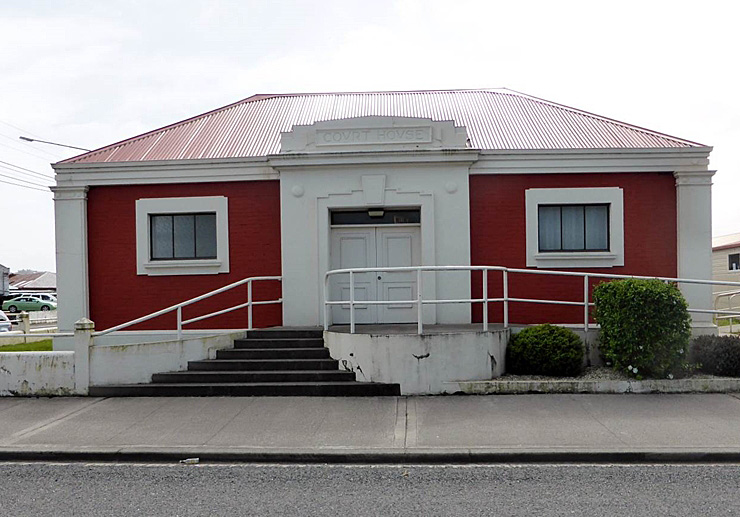
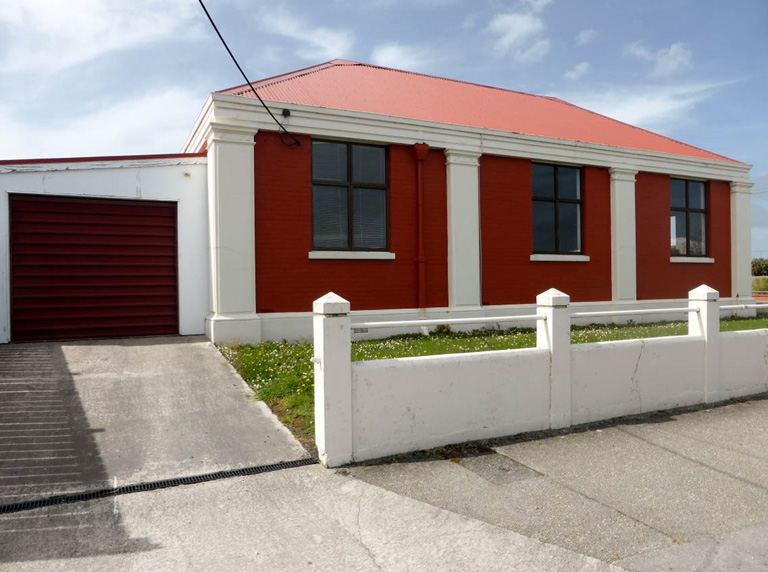
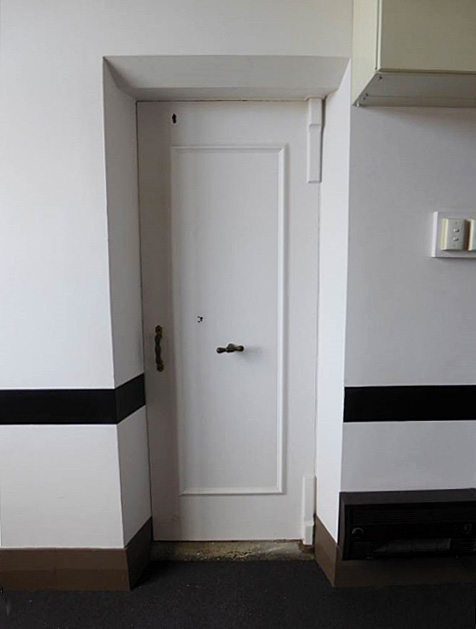
Current Description The Balclutha Courthouse (Former) sits prominently on the corner of Renfrew and Paisley Streets. The Courthouse is set behind a simple, low concrete fence and surrounded by groomed lawns, with low bushes softening the Paisley Street frontage. While its presence is unassuming, it sits sturdily on its corner site projecting an official air. The fence directs the visitor round the building to a small flight of steps on the Paisley Street entrance. The steps lead up to a semi-circular porch in front of the double entrance doors. A ramp on the right hand side also leads up to the small porch. The brick exterior has been painted red and is relieved by white concrete framing around the windows and doors. The wooden double doors are substantially framed with white painted concrete which includes simple Art Deco shapes. It is topped by a pediment on which is imprinted ‘Court House’. The hipped iron roof behind is painted red. The quoins are pilasters topped with simple ornamental detailing. A frieze which is broken into bands tops the pilasters and runs around the entire structure. The eastern elevation faces the 1939 police station which later became the Court’s administrative building. Two pilasters break the elevation into three equal sections, two of which contain windows. One section may have had its window removed. The window sills are white but are not framed with concrete in the manner of the front elevation. All the Courthouse’s original windows have been replaced with aluminium joinery. The rear northern elevation is partially obscured by the addition of a small toilet lean-to and a new garage. The remainder of the original rear wall and back door are visible from within the garage. There do not appear to have been any windows set into the rear elevation. Also at the rear and to the side of the Courthouse is a small brick structure which is a later addition. It includes women’s and men’s toilets at the rear of the structure, facing the fence. The front elevation of the building, facing Paisley Street, contains a storage shed. The western elevation faces Renfrew Street. Like the eastern elevation it is broken into three sections by white pilasters. There are three windows placed sequentially between the pilasters. The garage has been added to the extreme left. The interior of the Courthouse is accessed through the entrance doors facing Paisley Street. On entering the building the visitor is faced with a small entrance space which runs horizontally. To the left is a door leading to the anterooms. To the right is a door to the Courtroom. The Courtroom includes a small gallery space behind a carved wooden rail where members of the public sat. To the left is the original witness box. The Judge’s bench runs across the back wall and in front is the clerk’s bench. These wooden rails and benches are original. Two windows on the eastern elevation light the room. The original cove ceiling remains intact. In addition to the foyer door, there are two other doors which lead out to the corridor and anterooms. One door was for the judge; the other for witnesses, lawyers, the defendant etc. There are three anterooms off a corridor which leads straight down the building from the entrance foyer to the rear exit door. All the wooden doors appear original. Some have panels of paned glass. The first anteroom is opposite the entrance door to the Courtroom used by witnesses. It is small and contains no in-built furniture. The second anteroom along the corridor is the largest and includes the strongroom/safe. This may have been an administrative area prior to the old police station’s availability for administration services. The wall between the corridor and this room has been removed to create a larger space. The safe is a small narrow room with concrete walls and rows of pigeon hole shelving. Another small anteroom opens off the corridor opposite the Judge’s entrance to the Courtroom. It was probably the Judge’s quarters. It includes small kitchen facilities. The corridor ends with a small porch and toilet to the right, behind the Courtroom. These facilities are a later addition. The original back door now leads to the garage. Although the design of the anterooms is simple, they still speak to the original form and function of the Court’s interior. Mair’s original design is largely intact. The safe/strong room and the Courtroom, with its wooden railings, Judge’s Bench and witness box are particularly strong original design elements. The kitchenette, lean-to toilet, and garage are all mid to late twentieth century additions which do not contribute to the significance of the building.
Current Description The Balclutha Courthouse (Former) sits prominently on the corner of Renfrew and Paisley Streets. The Courthouse is set behind a simple, low concrete fence and surrounded by groomed lawns, with low bushes softening the Paisley Street frontage. While its presence is unassuming, it sits sturdily on its corner site projecting an official air. The fence directs the visitor round the building to a small flight of steps on the Paisley Street entrance. The steps lead up to a semi-circular porch in front of the double entrance doors. A ramp on the right hand side also leads up to the small porch. The brick exterior has been painted red and is relieved by white concrete framing around the windows and doors. The wooden double doors are substantially framed with white painted concrete which includes simple Art Deco shapes. It is topped by a pediment on which is imprinted ‘Court House’. The hipped iron roof behind is painted red. The quoins are pilasters topped with simple ornamental detailing. A frieze which is broken into bands tops the pilasters and runs around the entire structure. The eastern elevation faces the 1939 police station which later became the Court’s administrative building. Two pilasters break the elevation into three equal sections, two of which contain windows. One section may have had its window removed. The window sills are white but are not framed with concrete in the manner of the front elevation. All the Courthouse’s original windows have been replaced with aluminium joinery. The rear northern elevation is partially obscured by the addition of a small toilet lean-to and a new garage. The remainder of the original rear wall and back door are visible from within the garage. There do not appear to have been any windows set into the rear elevation. Also at the rear and to the side of the Courthouse is a small brick structure which is a later addition. It includes women’s and men’s toilets at the rear of the structure, facing the fence. The front elevation of the building, facing Paisley Street, contains a storage shed. The western elevation faces Renfrew Street. Like the eastern elevation it is broken into three sections by white pilasters. There are three windows placed sequentially between the pilasters. The garage has been added to the extreme left. The interior of the Courthouse is accessed through the entrance doors facing Paisley Street. On entering the building the visitor is faced with a small entrance space which runs horizontally. To the left is a door leading to the anterooms. To the right is a door to the Courtroom. The Courtroom includes a small gallery space behind a carved wooden rail where members of the public sat. To the left is the original witness box. The Judge’s bench runs across the back wall and in front is the clerk’s bench. These wooden rails and benches are original. Two windows on the eastern elevation light the room. The original cove ceiling remains intact. In addition to the foyer door, there are two other doors which lead out to the corridor and anterooms. One door was for the judge; the other for witnesses, lawyers, the defendant etc. There are three anterooms off a corridor which leads straight down the building from the entrance foyer to the rear exit door. All the wooden doors appear original. Some have panels of paned glass. The first anteroom is opposite the entrance door to the Courtroom used by witnesses. It is small and contains no in-built furniture. The second anteroom along the corridor is the largest and includes the strongroom/safe. This may have been an administrative area prior to the old police station’s availability for administration services. The wall between the corridor and this room has been removed to create a larger space. The safe is a small narrow room with concrete walls and rows of pigeon hole shelving. Another small anteroom opens off the corridor opposite the Judge’s entrance to the Courtroom. It was probably the Judge’s quarters. It includes small kitchen facilities. The corridor ends with a small porch and toilet to the right, behind the Courtroom. These facilities are a later addition. The original back door now leads to the garage. Although the design of the anterooms is simple, they still speak to the original form and function of the Court’s interior. Mair’s original design is largely intact. The safe/strong room and the Courtroom, with its wooden railings, Judge’s Bench and witness box are particularly strong original design elements. The kitchenette, lean-to toilet, and garage are all mid to late twentieth century additions which do not contribute to the significance of the building.
Historical and Associated Iwi / Hapū / Whānau
Iwi: Ngāi Tahu
Hapu: Unknown
Completion Date
29th May 2015
Report Written By
Susan Irvine
Information Sources
Taylor, 1952
W A Taylor, Lore and History of the South Island Maori, Christchurch, 1952
Carson, c.2013
Carson, Terry. Built for justice: visits to old North Island courthouses, Auckland, Alibi Press c.2013
Singe, 1992
Miles Singe, Authority to protect: a story of policing in Otago, [Dunedin], P.G. Wiersma and the authors, 1992.
Other Information
A fully referenced New Zealand Heritage List report is available on request from the Otago Southland Area Office of New Zealand Heritage. Please note that entry on the New Zealand Heritage List/Rārangi Kōrero identifies only the heritage values of the property concerned, and should not be construed as advice on the state of the property, or as a comment of its soundness or safety, including in regard to earthquake risk, safety in the event of fire, or insanitary conditions.
Historical and Associated Iwi / Hapū / Whānau
Iwi: Ngāi Tahu
Hapu: Unknown
Completion Date
29th May 2015
Report Written By
Susan Irvine
Information Sources
Taylor, 1952
W A Taylor, Lore and History of the South Island Maori, Christchurch, 1952
Carson, c.2013
Carson, Terry. Built for justice: visits to old North Island courthouses, Auckland, Alibi Press c.2013
Singe, 1992
Miles Singe, Authority to protect: a story of policing in Otago, [Dunedin], P.G. Wiersma and the authors, 1992.
Other Information
A fully referenced New Zealand Heritage List report is available on request from the Otago Southland Area Office of New Zealand Heritage. Please note that entry on the New Zealand Heritage List/Rārangi Kōrero identifies only the heritage values of the property concerned, and should not be construed as advice on the state of the property, or as a comment of its soundness or safety, including in regard to earthquake risk, safety in the event of fire, or insanitary conditions.
Former Usages
General Usage: Law Enforcement
Specific Usage: Administration Office
General Usage: Law Enforcement
Specific Usage: Courthouse
Former Usages
General Usage: Law Enforcement
Specific Usage: Administration Office
General Usage: Law Enforcement
Specific Usage: Courthouse
Location
Stay up to date with Heritage this month
