Maori History
The Otago East Coast Te Arai o te Uru has a long history of Māori occupation. Onewhenua sits at the mouth of the Waihemo/Shag River and is possibly the earliest moa hunters’ camp found in Otago. The Arai Te Uru is an ancestral canoe of the Kāti Māmoe people who came before Kāi Tahu but were preceded by earlier peoples. The kōrero stands that the Arai te Uru was wrecked at Matakaea (Shag Point) on its return from Hawaiiki. Hape ka Taurake, the navigator of the Arai te Uru waka and his slave Puketapu are now commemorated in the landscape, a column at the end of the Waihemo and a hill dominating the modern-day township of Palmerston respectively.
Kāi Tahu whānui developed a complex series of trails throughout Te Wai Pounamu connecting kāinga with one another and to mahinga kai and other significant tribal resources. These Ara Tawhito (traditional travel routes) became the arteries of economic and social life and formed the relationships between people and places. The township of Palmerston is along the Murihiku ara tawhito. Mahinga kai and pā kāinga are dotted around the landscape that Palmerston sits in.
Palmerston
In February 1851 Charles Kettle made the first official exploration of the Palmerston area. In 1852 the district was opened up for sheep runs. Palmerston township began as a camp site in 1862 at the beginning of a route through the Shag Valley to the Kyeburn Valley and the Central Otago gold diggings. The town was surveyed in 1864 and named Palmerston, probably after the British Prime Minister of the day.
Palmerston Railway
In 1870 Julius Vogel announced his ‘Great Public Works Policy’ which included a railway line between Christchurch and Dunedin. On 7 September 1878 the Main South Line, which passed through Palmerston, was officially opened.
After the Main South Line was completed, a branch line was laid between Palmerston and Dunback. Construction began in March 1880 and followed the line of the Shag River. On 29 August 1885 it was officially opened. Palmerston, then, became a divisional station, at the boundary of two sections of railway.
Passenger transport from Palmerston included a train to Dunedin each morning and evening. After the opening of the freezing works at Pareora, livestock was regularly sent from Palmerston as well as from local farms. In 1900 the new Makareao Branch, which was built to transport limestone, added significantly to the traffic on the Palmerston line. Due to the degree of heavy local traffic, two locomotives were based in Palmerston. The locomotives were housed in an engine shed, often referred to as a locomotive, or loco, shed.
Engine Shed 1881-1947
Although the Main Line was completed in 1878, it was not until July 1881 that tenders for an engine shed were advertised. The tender was issued by E.R. Ussher, the District Engineer, and plans and specifications could be seen at the Stationmaster’s Office in Palmerston. The shed was to be 120 feet long and 33 feet wide (36.5 x 10 metres) with two pits running the length of the structure, which enabled engineers to go under the locomotives to service them.
In August 1882 the Otago Witness reported that ‘several necessary improvements’ had been made to Palmerston rail yard, perhaps including the completion of the engine shed. While the exact date of construction is unclear, by 1890 there was an engine shed, a goods' shed almost opposite it, and a coal shed to the north.
In the following decades the engine shed had a number of maintenance issues, not the least of which was the frequent flooding caused by the neighbouring creek overflowing. The shed could be flooded by as much as two feet of water.
In 1925 a Royal Commission of Inquiry into Railways recorded 110 intermediate locomotive depots like Palmerston. The depots varied markedly in size; from Christchurch which accommodated 66 locomotives to tiny depots with only one engine and two staff. The Royal Commission recorded that two engines were based at Palmerston, along with five engine drivers, six firemen, four cleaners and four shed hands. Palmerston was still a busy depot. Although only two locomotives were based there, the staff would have also driven and serviced locomotives based at other depots, particularly Dunedin and Oamaru. Staff were required to work shifts at the depot 24 hours a day, six days a week. In summer with heavy stock and farm produce traffic, some staff could work seven days a week.
The senior locomotive driver was the head of the depot. Shed hands would clean and service the engines, dropping ash and cleaning the firebox, as well as loading the tenders with coal and water as part of preparing the locomotive for service. They would also keep the yard coal bin full, and keep up stocks of firewood used for start-up when the locomotive was cold. Indeed shed hands were the ‘housekeepers’ for the depot in general. Some of the six firemen were likely qualified drivers, at least for goods trains, and would move between their two designations as required.
Palmerston Locomotive Depot 1948-
Engine sheds were vulnerable to fires and in January 1948 the 1881 Palmerston engine shed was destroyed by fire. Flames reached 60 feet (18.3 metres) into the air and a number of other rail buildings and residences were threatened.
As an engine shed was integral to local rail operations, the District Mechanical Engineer decided the following month that ‘in view of the fact that by using the site of the former [shed] it will be possible to make the best use of the existing pits it is considered that the new building should be erected on the old site. A two-road shed 80 feet long will be sufficient...’
The design was to be based on the Chief Civil Engineer’s plans for a standard two-road engine shed: Plans 18858 and 18859. The new shed, only 80 feet long (24 metres), was to be built at the south end of the 1881 pits. The shed would be 33 feet wide (10 metres), the same width as the original shed. No concrete floor or pits were required as the former ones would be used. Also, second-hand bridge timber was used for the 7 x 7 inch (17 x 17 cm) studs and for the larger sizes of timber in the roof trusses. The roof would be malthoid.
In June 1948 however, the Chief Civil Engineer wrote to the Dunedin District Engineer with a brand new design. He wrote that in all ‘new engine sheds the fire risk should be minimised and more attention given to cleanliness’. For that reason ‘a new typical plan, No. 61689, has been issued’. The new engine shed design provided for a ‘low level concrete wall and a corrugated asbestos cement roof on purlins spaced close enough to avoid the use of sarking....several fires in engine sheds have originated in the malthoid roof. There is no doubt that this type of roof is a definite fire hazard in engine sheds. On account of the fire hazard, it is also considered advisable not to use sarking for a corrugated asbestos cement roof’. Palmerston’s new engine shed was the first in New Zealand to be built to this new, fire-proofing design.
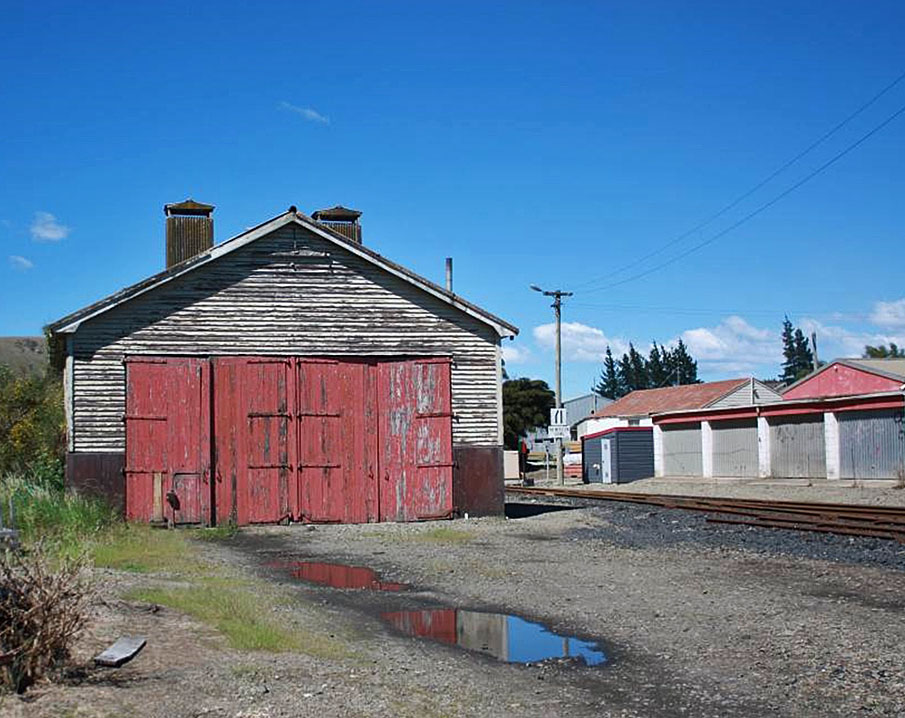
The specifications for the new engine shed design included framing in oregon. The spouting and downpipe were also wooden. Surplus reinforcing steel from the Waltham Road Overbridge construction in Christchurch was forwarded to the Hillside Workshops in Dunedin for use in the new shed. The concrete foundation walls were to be to a height of 5 feet 6 inches (1.67 metres). Weatherboards sat on top. Four sets of double windows ran down the side elevations facing west and east. The elevation facing north contained a set of high and wide wooden doors which allowed locomotives access to the shed. The end elevation facing south had a set of double windows. A workbench 12 feet long and 3 feet wide (1.5 x 1 metres), tool lockers and cupboards as required by the Senior Driver at Palmerston were also provided. The cost of construction was estimated at £3490, which included interior fittings.
Work began on 30 August 1948 and was carried out by staff attached to the District Civil Engineer’s Office. As part of the works, the drainage of the 1881 pits was altered. The pits were originally designed to drain into the creek that ran past the shed on the east elevation. When the creek rose, it flowed back into the pits and the shed had flooded many times during heavy rains. To solve the problem, the 1881 pits were sealed off and a hand pump supplied for drainage purposes. Twelve metres of the 1881 pits, which now lay outside the engine shed to the north, were demolished and filled in with ashes. Although not specifically mentioned in the documentary evidence, inspection of the shed reveals that the original rails were also reused.
Finally, the shed was painted in two coats of red oxide, and the windows glazed and painted. In December 1950 the Foreman of Works, H.W. Trion, advised that the ‘Palmerston Locomotive Depot’ was completed.
From 1949 New Zealand Railways began the transition from steam to diesel. In 1954 New Zealand Railways operated 647 steam locomotives, compared to 71 diesel and electric machines. By 1965 there were still 317 steam locomotives, but more than 350 diesels. Diesel locomotives were not housed in sheds, except at major terminals where servicing was carried out. As diesel locomotives could go further than steam, refuelling and servicing bases were only required at main centres. In the age of diesel locomotives, engine sheds disappeared. In 1925 the Royal Commission had recorded 110 intermediate depots like Palmerston. The last of these steam depots closed in 1971.
As railway services were cut back throughout the country, not only engine sheds but other associated structures began to disappear. This was particularly true in the case of branch lines and intermediate stations, such as Palmerston, where steam locomotives were based. After about 1950 there were few local depots like Palmerston. The last small depots disappeared about 1960, when passenger services ceased on branch lines. Goods sheds and engine sheds ceased to have a useful purpose and over time they disappeared from the railway landscape.
Railway experts believe only three such sheds exist in New Zealand. The other two sites are a restored shed at Reefton and a Paekakariki shed (a replica) which is part of a heritage site. The Palmerston engine shed, then, ‘is thus a rare survivor on a national basis…Original steam locomotive sheds are truly an endangered species.’
The 1960s saw passenger services ceased on branch lines, and a commuter railcar was used as a substitute for the Palmerston to Dunedin service. From that date until 1976, the return railcar service ran from Palmerston to Dunedin, Monday to Friday, as well as the daily evening railcar between Christchurch and Dunedin. The railcar was likely kept in the engine shed overnight for security reasons. When the service was withdrawn in 1976 it was replaced by NZ Railway Road services. The bus was also sheltered in the shed overnight, again for security, but also to protect against ‘fearsome frosts’.
When the Road Services bus route closed, the local track gang used the engine shed to store track machinery. It may also have been used for maintaining these machines. The rails running to the shed were removed around the mid-1980s and the building was leased out to the local sawmiller for storage soon after.
The New Zealand Rail Heritage Trust notes that the greatest change in the physical appearance of New Zealand’s railways occurred around 1990-1993: ‘the ordinary items suddenly becoming rare or non-existent’. Yet it is these ‘ordinary’ structures which are a significant part of the historic picture of New Zealand’s rail system, ‘in particular rural railway stations, and other structures that technology and changing operating practices have now made obsolete’. In the days when steam locomotives were the prime source of power on New Zealand’s railways there were locomotive depots based at many points on the network. This important aspect of New Zealand’s history has all but disappeared. Palmerston’s engine shed is one of the last remnants of New Zealand’s age of steam.