Ōhinemutu (“the ending of the girl”) was named by the ancestor and explorer Īhenga of the Te Arawa waka, and commemorates the burial of his beloved daughter Hinetekākara at Muruika peninsula, later to become the site of a fortified pā. For centuries, Muruika was a strategic pā of Te Arawa on the shores of Rotorua. Ngāti Whakaue took possession of Muruika in the time of their ancestor Pukaki.
The Ngāti Whakaue rangatira Pango invited the first missionaries to Ōhinemutu in 1831, when the first Christian service was held at Muruika on 30 October conducted by Reverend Henry Williams and Thomas Chapman. A nearby mission station was built by Thomas Chapman in 1835 at Te Koutu and destroyed during the invasion of Te Waharoa a year later, and the mission station eventually relocated to Te Ngae. Thomas Chapman and Ihāia Te Ahu continued to lead services around the region, including in a chapel at Ōhinemutu.
In 1880 an area of the pā was gifted for the construction of a church. After the tapu on Muruika was lifted by the tohunga Tūhoto Āriki, the church was built and consecrated as Te Hāhi o te Whakapono (“The Church of the Faith”, or St Faith’s, in tribute to a Christian martyr of the third century AD) by the first Vicar of Ōhinemutu, Ihāia Te Ahu, in 1885.
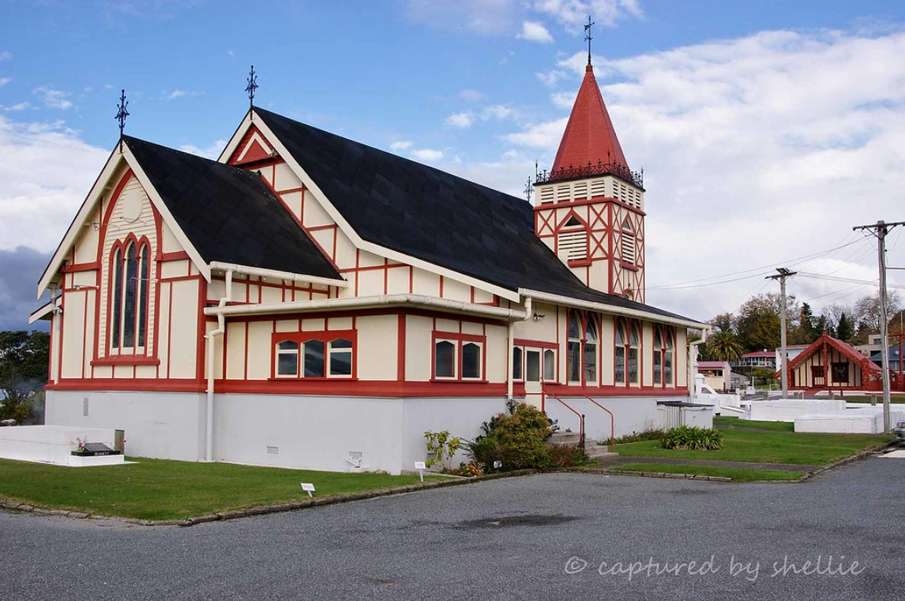
A new church building was opened in 1914 and owes its rich Māori interior style to Frederick Augustus Bennett, the first Māori Bishop of Aotearoa, who died in 1950 and was buried in a vault beside the altar. The cemetery houses the remains of many significant figures in the life of the church and of the wider region, as well as memorials such as an anchor stone commemorating the peace between Te Arawa and Ngāiterangi. Many tūpuna participated in the interior decoration, with contributions from celebrated tohunga whakairo (master carvers) such as Tene Waitere and Te Wheoro Poni and many others from the church whānau. Generations of clergymen, parishioners, and artists have continued to add to the spiritual life of the congregation and its expression in the various tāonga of the church grounds.
The church has become a significant place to the Anglican diocese of Aotearoa, in particular, to its parishioners, the people of Ōhinemutu, and the descendants of those who founded the church.

List Entry Information
Status
Listed
List Entry Status
Wāhi Tūpuna/Tīpuna
Access
Able to Visit
List Number
9705
Date Entered
22nd February 2017
Date of Effect
20th March 2017
City/District Council
Rotorua District
Region
Bay of Plenty Region
Extent of List Entry
Extent includes the land described as Rutau A Block (RT 275738), Ohui Block (RT SA 631/32), Waikareao Block (RT SA 631/31), Rangaranga 2A Block (RT SA 631/33), part of the land described as Legal Road, South Auckland Land District, and the church, its cemetery, graves and memorials, Te Iroiro waka, and the Te Ao Marama hall thereon.
Legal description
Rutau A Block (RT 275738), Ohui Block (RT SA 631/32), Waikareao Block (RT SA 631/31), Rangaranga 2A Block (RT SA 631/33), Legal Road, South Auckland Land District.
Location Description
Directly opposite Te Papaiouru Marae (Tamatekapua), Ōhinemutu GPS Co-ordinates 38°07’39.60” S, 176°14’54.40” E (WGS 84) 38 07 39.61684 S 176 14 54.39735 E (NZGD 2000)
Status
Listed
List Entry Status
Wāhi Tūpuna/Tīpuna
Access
Able to Visit
List Number
9705
Date Entered
22nd February 2017
Date of Effect
20th March 2017
City/District Council
Rotorua District
Region
Bay of Plenty Region
Extent of List Entry
Extent includes the land described as Rutau A Block (RT 275738), Ohui Block (RT SA 631/32), Waikareao Block (RT SA 631/31), Rangaranga 2A Block (RT SA 631/33), part of the land described as Legal Road, South Auckland Land District, and the church, its cemetery, graves and memorials, Te Iroiro waka, and the Te Ao Marama hall thereon.
Legal description
Rutau A Block (RT 275738), Ohui Block (RT SA 631/32), Waikareao Block (RT SA 631/31), Rangaranga 2A Block (RT SA 631/33), Legal Road, South Auckland Land District.
Location Description
Directly opposite Te Papaiouru Marae (Tamatekapua), Ōhinemutu GPS Co-ordinates 38°07’39.60” S, 176°14’54.40” E (WGS 84) 38 07 39.61684 S 176 14 54.39735 E (NZGD 2000)
Statement of Wāhi Tapu / Tīpuna / Tapu Area Values
Te Hāhi o te Whakapono / St Faith’s Anglican Church Ōhinemutu is of ancestral significance to Ngāti Whakaue and wider Te Arawa. It is integral to their identity through its association to Īhenga, Hinetekākara and the naming of Ōhinemutu, to the many tūpuna who lived at Muruika pā and gifted the land for the church, to those who participated in the consecration, construction, ornamentation and the spiritual life of the successive church buildings, and to those who were laid to rest in its urupā. The settlement of Ōhinemutu dates back to the arrival of the Te Arawa around the fourteenth century AD. Ōhinemutu was named by the ancestor and explorer Īhenga of the Te Arawa waka, and commemorates the burial of his beloved daughter Hinetekākara at Muruika peninsula, where he sang a lament that included the words ‘O Hine Mutu’ (“the ending of the girl”). Īhenga laid Hinetekākara’s remains at Muruika and placed a large stone over the top to mark a rāhui (prohibition) on the tapu area. Some eleven generations later, in the time of Pukaki, Ngāti Whakaue took possession of Muruika pā after the battle of Paitau. The Ngāti Whakaue rangatira Pango Ngawene invited the first missionaries to Ōhinemutu in 1831, when the first service was held and the first Sabbath observed in the Rotorua region. A raupo chapel was built at nearby Te Koutu in 1835 but destroyed during the inter-tribal war a year later. In 1880 an area of Muruika pā was gifted for the construction of a church. After the tapu on Muruika was lifted by the tohunga Tūhoto Āriki, the church was built and consecrated as Te Hāhi o te Whakapono (“The Church of the Faith”) by the first Vicar of Ōhinemutu, Ihāia Te Ahu, in 1885. A new church building was opened in 1914 and owes its rich Māori interior style to Frederick Augustus Bennett, the first Māori Bishop of Aotearoa, who died in 1950 and was buried in a vault beside the altar. Many tūpuna participated in the interior decoration, with whakairo contributions from the likes of Tene Waitere, Te Wheoro Poni, Kiwi Te Amohau, and John Taiapa and tukutuku panels made by many of the church whānau.
Statement of Wāhi Tapu / Tīpuna / Tapu Area Values
Te Hāhi o te Whakapono / St Faith’s Anglican Church Ōhinemutu is of ancestral significance to Ngāti Whakaue and wider Te Arawa. It is integral to their identity through its association to Īhenga, Hinetekākara and the naming of Ōhinemutu, to the many tūpuna who lived at Muruika pā and gifted the land for the church, to those who participated in the consecration, construction, ornamentation and the spiritual life of the successive church buildings, and to those who were laid to rest in its urupā. The settlement of Ōhinemutu dates back to the arrival of the Te Arawa around the fourteenth century AD. Ōhinemutu was named by the ancestor and explorer Īhenga of the Te Arawa waka, and commemorates the burial of his beloved daughter Hinetekākara at Muruika peninsula, where he sang a lament that included the words ‘O Hine Mutu’ (“the ending of the girl”). Īhenga laid Hinetekākara’s remains at Muruika and placed a large stone over the top to mark a rāhui (prohibition) on the tapu area. Some eleven generations later, in the time of Pukaki, Ngāti Whakaue took possession of Muruika pā after the battle of Paitau. The Ngāti Whakaue rangatira Pango Ngawene invited the first missionaries to Ōhinemutu in 1831, when the first service was held and the first Sabbath observed in the Rotorua region. A raupo chapel was built at nearby Te Koutu in 1835 but destroyed during the inter-tribal war a year later. In 1880 an area of Muruika pā was gifted for the construction of a church. After the tapu on Muruika was lifted by the tohunga Tūhoto Āriki, the church was built and consecrated as Te Hāhi o te Whakapono (“The Church of the Faith”) by the first Vicar of Ōhinemutu, Ihāia Te Ahu, in 1885. A new church building was opened in 1914 and owes its rich Māori interior style to Frederick Augustus Bennett, the first Māori Bishop of Aotearoa, who died in 1950 and was buried in a vault beside the altar. Many tūpuna participated in the interior decoration, with whakairo contributions from the likes of Tene Waitere, Te Wheoro Poni, Kiwi Te Amohau, and John Taiapa and tukutuku panels made by many of the church whānau.
General Nature Of Wāhi Tapu / Tīpuna / Tapu Area
Te Hāhi o te Whakapono / St Faith’s Anglican Church Ōhinemutu stands on Muruika Peninsula, which juts out into the southern end of Lake Rotorua towards Mokoia Island. It opens southwards to face Te Papa-i-Ouru marae and Ōhinemutu village. In front of the entrance there is a small cemetery filled with white vaults housing generations of the church whānau, which are used instead of interment due to the abundant geothermal activity in the area. The church graveyard contains around 30 headstones belonging to ministers of the church, important chiefs of Ngāti Whakaue and members of their families. Graves from an older period remain unnamed and unmarked. The cemetery is located near the former site of one of the gateways into Muruika pā. To the eastern side of the church, a lawn slopes down to the lakefront, where the remains of a 150-year old waka taua, Te Iroiro, stand raised from the ground. Immediately to the western side there is a carpark separating the church from the Te Ao Marama building, which serves as a church hall and office after four decades spent hosting the Rotorua Māori Arts and Crafts centre from the 1920s to the 1960s. The wāhi tūpuna stops just north of the church, but the narrow peninsula stretches away well over a hundred metres through the rows of vaults of the Māori Returned Services League cemetery to its end point. The church, a notable feature of the Rotorua lakefront, was built in the Elizabethan style of architecture fashionable around Rotorua at the time, with Gothic detailing and Victorian filigree ironwork on the tower. Its interior is filled with traditional Māori art such as whakairo (carvings), kōwhaiwhai (traditional patterns), taniko (weaving) and tukutuku panels. The pews, altar, pou, and framing on the inside are covered with whakairo, and there are painted kōwhaiwhai patterns on friezes around the church as well as adorning the heke in the Galilee chapel. Chapels were added to both the east and west sides of the church in the 1960s, with the Galilee chapel on the east side housing the famous sandblasted “Māori Jesus” figure on a large bay window overlooking the lake. The replica flags of Gilbert Mair’s “Flying Column” of Te Arawa fighters hang inside the entranceway of the church (the originals are now housed by Rotorua Museum).
General Nature Of Wāhi Tapu / Tīpuna / Tapu Area
Te Hāhi o te Whakapono / St Faith’s Anglican Church Ōhinemutu stands on Muruika Peninsula, which juts out into the southern end of Lake Rotorua towards Mokoia Island. It opens southwards to face Te Papa-i-Ouru marae and Ōhinemutu village. In front of the entrance there is a small cemetery filled with white vaults housing generations of the church whānau, which are used instead of interment due to the abundant geothermal activity in the area. The church graveyard contains around 30 headstones belonging to ministers of the church, important chiefs of Ngāti Whakaue and members of their families. Graves from an older period remain unnamed and unmarked. The cemetery is located near the former site of one of the gateways into Muruika pā. To the eastern side of the church, a lawn slopes down to the lakefront, where the remains of a 150-year old waka taua, Te Iroiro, stand raised from the ground. Immediately to the western side there is a carpark separating the church from the Te Ao Marama building, which serves as a church hall and office after four decades spent hosting the Rotorua Māori Arts and Crafts centre from the 1920s to the 1960s. The wāhi tūpuna stops just north of the church, but the narrow peninsula stretches away well over a hundred metres through the rows of vaults of the Māori Returned Services League cemetery to its end point. The church, a notable feature of the Rotorua lakefront, was built in the Elizabethan style of architecture fashionable around Rotorua at the time, with Gothic detailing and Victorian filigree ironwork on the tower. Its interior is filled with traditional Māori art such as whakairo (carvings), kōwhaiwhai (traditional patterns), taniko (weaving) and tukutuku panels. The pews, altar, pou, and framing on the inside are covered with whakairo, and there are painted kōwhaiwhai patterns on friezes around the church as well as adorning the heke in the Galilee chapel. Chapels were added to both the east and west sides of the church in the 1960s, with the Galilee chapel on the east side housing the famous sandblasted “Māori Jesus” figure on a large bay window overlooking the lake. The replica flags of Gilbert Mair’s “Flying Column” of Te Arawa fighters hang inside the entranceway of the church (the originals are now housed by Rotorua Museum).
Ko Te Arawa te waka Ko Te Arawa te Iwi Ko Tamatekapua te tangata Around 1340AD, the Te Arawa waka left the ancient homeland of Hawaiki for the land known as Aotearoa, captained by chief Tamatekapua and navigated by the revered tohunga (priest) Ngātoroirangi. Born into an āriki line (high born) and growing to possess many qualities, Tamatekapua was regarded as the man of supreme knowledge amongst his generation. After a long and arduous journey at sea, the Te Arawa finally made landfall at Maketū in the Bay of Plenty, where Tamatekapua established his first pa. Tamatekapua had two sons; the eldest was Tuhoromatakaka followed by younger brother Kahumatamomoe. He first settled at Maketū with the rest of his people but later moved to Moehau in the Coromandel where he eventually died and was buried, followed many years later by his son Tuhoromatakaka. Tamatekapua’s grandsons Īhenga and Tamaihutoroa were also born in Moehau but later returned to Maketū and extended their influence over the district. Īhenga followed in the footsteps of his predecessors, exploring the region and naming many of Rotorua’s landmarks such as Mount Ngongotaha and Te Roto-Whaiti-i-kite-ai-a-Īhenga (Lake Rotoiti). As Īhenga had been away at Moehau until after the death of his father, he was not the first to be established at Te Rotoruanui-a-Kahumatamomoe (Lake Rotorua). Ika, a crew member of the Te Arawa waka had already established himself at Rotorua when Īhenga arrived there, followed by his son Marupunganui and grandson Tuarotorua. After the death of Tuhoromatakaka at Moehau, it was Īhenga who was tasked with travelling to Maketū to carry news of his father’s death to Kahumatamomoe and their people. While there, Īhenga noticed a young woman attending to their food and over time his yearning for her grew. He persistently asked his uncle who the young maiden was until eventually Kahumatamomoe replied that she was Hinetekākara, his own daughter. In due course Īhenga and Hinetekākara married, and they had a daughter, named Hinetekākara after her mother. The Naming of Ōhinemutu One of the places famously named by Īhenga was Ōhinemutu, named for the tragic circumstances which befell his beloved daughter Hinetekākara. Īhenga often travelled to Moehau, for it was the place where he grew up, the resting place of his father Tuhoromatakaka and also the place where his brothers remained. Whenever Īhenga was away, Hinetekākara stayed at Parawai, but one time when Īhenga returned to Rotorua, he was unable to find her. Searching around the lake’s edge he wandered in vain until he happened upon a small beach north of the present Ngongotaha town ship. There, he realised that Hinetekākara had been the victim of murder as he found her remains hanging from a tumu (marker post) in the lake. Īhenga named that place Hākai-Puku alluding to the defilement of Hinetekākara’s body. Overcome with grief, Īhenga sang a lament at Muruika with the words ‘Ōhinemutu’ (“the ending of the girl”) from which the place takes its name. It is said that Īhenga laid Hinetekākara’s remains at Ōhinemutu, and placed a large boulder on the peninsula just north of the present Te Hāhi o te Whakapono / St Faith’s Anglican church, to mark a rāhui (prohibition) on the tapu area. Īhenga and his son Tamaihutoroa grew suspicious of some of the people who had come back to the mainland from Mokoia, those of a tribe called Tuarotorua who had taken residence at Waitetī just out of Ngongotaha. Īhenga and Tamaihutoroa gathered their ope taua (war party) and attacked the Tuarotorua people at their pā named Whanakenake in Waitetī where they killed two chiefs named Waingāhē and Te Waipoporo. A second skirmish occurred shortly after and again the people of Tuarotorua were defeated, avenging the death of Hinetekākara. Those who remained returned at once to Mokoia Island. Muruika – Ngāpuhi Invasions – Christianity Welcomed By the turn of the eighteenth century, a pā called Muruika had already long been established on the peninsula at the northern end of Ōhinemutu, with its southern gateway where Te Hāhi o te Whakapono / St Faith’s church now stands. Many battles were fought for the possession of Muruika and its surrounds in the preceding centuries. In the final years of the tūpuna Pukaki, who was an eleventh-generation descendant of Tama te Kapua, Ngāti Whakaue enlisted the aid of Ngāti Uenukukopako and Ngāti Rangiwehiwehi and defeated Tūhourangi in the battle of Paitau to dispossess them of Ōhinemutu and Muruika pā. There were five main ceremonial gateways into Muruika named Tiki, Te Rorooterangi, Huka, Haukiwaho and Hua. Tiki used to stand in front of the area where Te Hāhi o te Whakapono/St Faith’s Church stands today, and is now held in the Auckland Museum. The ancestral meeting house in Muruika was named Te Kaweka-taramea. Early depictions show the density of whare and buildings at Muruika, and the palisades and gateways notable for the profusion of carved figures. The remains of the palisaded and defensive works of the pā survived until the beginning of the twentieth century, in spite of rising lake levels which partially submerged the peninsula. The lake levels frequently rose and fell in the late 1880s as a result of volcanic activity, particularly the Tarawera eruption of 1886, and they are referred to in tradition as the Maringiringi floods. Although Muruika was the traditional mainstay of Ngāti Whakaue, the year 1823 saw the people flee Muruika temporarily for Mokoia Island or more distant parts of the region due to an impending Ngāpuhi invasion. After the invasion period subsided, the Ngāti Whakaue people returned to Muruika, encouraged by Ngāti Whakaue chiefs Korokai and Ngahihi. The battles with Ngāpuhi led to the introduction of Christianity amongst the Te Arawa people as many were taken north as captives. Those who were spared eventually came into contact with the missionaries there and many eventually settled amongst Ngāpuhi. This was the case for Ahipape, the mother of the tohunga whakairo Tene Waitere (who carved the pulpit of the church), who was only 9 years old when she was taken north by Ngāpuhi. Others returned home to Rotorua carrying news of Te Rongopai (the Gospel). In August of 1831, Pango Ngawene, the great chief and tohunga of Ngāti Whakaue, sent an invitation to the missionaries in the north, requesting that one of them come and live amongst his people at Ōhinemutu. Already in 1828, Pango had led a group of Te Arawa to the Bay of Islands to request that a missionary be sent to Rotorua. Initially, the missionaries decided that Archdeacon Henry Williams and Reverend Thomas Chapman would at the very least visit the community, and so they prepared to sail south. On Tuesday 18 October, Williams and Chapman left the Bay of Islands on the Mission vessel named Karere. After landing at Tauranga on 23 October, they set out on the road for Maketū, accompanied by a number of Tauranga chiefs. On Thursday 27 October, the travelling party arrived in the lakes district and were transported by canoe to Mokoia Island, where a great welcome took place. The following morning on Friday 28 October they left the island and travelled to the mainland, arriving at Ōhinemutu. All of the traditional formalities took place at the pā and the two men preached to the newfound audience. It was the first service ever to be held in the Rotorua Lakes District. On Sunday 30 October, the Sabbath day was observed, and the missionaries hoisted a flag to signal that it was “Sunday”, the first time that this day and the European concept of a seven-day week was acknowledged in this part of the country. Highly satisfied with their time amongst the Arawa people, Henry and Chapman made preparations for their departure but before they left, the chiefs of Ōhinemutu asked the missionaries to help them select a site for a new mission station, which they would build when the opportunity arose. The site selected at Te Koutu was on the south-western bank of the lake on a rising slope, at a convenient distance from the pā. In 1835 a chapel made of raupō was included as part of the Mission Station constructed by Chapman, but in 1836 the buildings were destroyed during inter-tribal wars between hapū of Te Arawa and an alliance of Ngāti Hauā and Ngāiterangi led by Te Waharoa. This invading ope besieged the pā at Ōhinemutu, the gateway of which stood around where the church stands today, but could not penetrate its fortress-like defences. An attack followed by a feigned retreat managed to draw a sortie from the Te Arawa defenders who ran into an ambush, and approximately sixty of them were said to have been killed, but the pā was not taken. The mission station was re-established on Mokoia Island in 1838, and moved to Te Ngae two years later. For the following seven years, Chapman practised an itinerant ministry around the settlements of Lake Rotorua, and as far afield as Maketū and Ōpōtiki. Ihāia Te Ahu was his “right hand man” and by the late 1840s was taking services on behalf of Chapman. Ōhinemutu was the largest of these settlements and services were held there in a whare karakia from 1849 at the latest. The period of peace in the district, the spread of Christianity and adoption of European technology led to a number changes for the area. The pā at Muruika fell into disuse as a military fortification, and Ōhinemutu took on aspects of a European village with its new crops, church and cemetery. At the same time, Ngāti Whakaue reasserted their traditional culture by building the wharenui Tama te Kapua between 1864 and 1873 on Te Papa i Ouru marae. The melding of the old world and the new would later be symbolically upheld by the construction of three successive church buildings to stand at the old entrance of Muruika pā, facing Tama te Kapua. The First Te Hāhi o te Whakapono / St. Faith’s Church: 1885 This era of the St Faith’s Church is associated with Ngāti Whakaue chief Paora Te Amohau, the Reverend Ihaia Te Ahu and Tūhoto Ariki. On 11 October 1880, a meeting took place at The Lake House Hotel of Ōhinemutu where the principal chiefs gathered to discuss a proposal to set aside a piece of land upon which the first [permanent] church would stand. Chief Paora Te Amohau had always been a supporter of the church and was present at this meeting. The site proposed was near the promontory of the Muruika peninsula, an extremely sacred area since it was the place where the remains of Ngāti Whakaue rangatira had long before been interred. All who attended the meeting, including the chiefs, agreed unanimously that this sacred part of Muruika would be the site of the new church. Tūhoto Ariki, a famous Te Arawa tohunga was sought out for the task of removing the tapu from the land proposed for the church and he did so through a series of chants, karakia and incantations. It is said that through his karakia, Tūhoto drove the intense tapu from the land and bound it all within a large flax bush which grew on the western side of the peninsula. For a long time, the flax bush was considered extremely tapu and anyone who knew of its significance knew not to approach it. After that, fundraising began for the construction of a new Te Hāhi o te Whakapono / St Faith’s Church, which was very much desired by Reverend Ihāia Te Ahu, the residing Reverend at the time. Reverend Te Ahu became a very important figure in Rotorua. He was of Ngāpuhi descent and as a boy he travelled with Reverend Thomas Chapman to Ōhinemutu where Chapman was setting up the first mission station. Ordained as a deacon in the 1860s, Ihaia Te Ahu was often left responsible for the religious instruction of the whole district through some very turbulent times. During the 1860 land wars, he was left with the care of the entire Maketū-Rotorua Diocese and again in the 1870s during the ‘Te Kooti rebellion’ he was responsible for the entire Rotorua Lakes District. He was duly recognised by the people in a hymn that included the lines: Naumai e tama, ka haere taua’ Ki a Ihaia kia monitatia’ ‘Come my son, let us go to Ihaia’ ‘To be immersed in the mysteries of the faith’ Reverend Ihaia Te Ahu was a devout leader within the Ministry and he led out the fundraising for the second St Faith’s Church. He appealed to the English residents of Rotorua for funds, as well as to the tourists and visitors to the town. He would state that as the building would be available for English services as well as Māori that it would be of benefit to the whole community. With that and the donations collected at different church services, funds were soon raised and the first steps could be taken to erect a small humble church. Building began in June 1884 and the church was consecrated on Sunday 15 March 1885. The first Te Hāhi o te Whakapono Church was a simple structure but was built of heart kauri. It served a large and devoted parish which extended from the hills north of Lake Rotorua to Tokaanu, the settlement at the southern end of Lake Taupo more than 140 kilometres away. By the turn of the century it was obvious that the original church no longer had the capacity to house all of the regular worshippers, and soon plans were being drawn up for a larger church. The Second Te Hāhi o te Whakapono / St Faith’s Church: 1910 This era is associated with Bishop Frederick Augustus Bennett 1871-1950. His grave is located in the sanctuary of the church. In 1910, the first church was moved to make way for a new and larger one, and for some time they both stood there at the Muruika peninsula until the original church was moved to an adjacent site, where it was used as a Sunday school and a church hall until it was destroyed by a storm in 1936. The second church was built in the mock Tudor style by architect E. La Trobe Hill who chose the style of the church in conscious imitation of Rotorua’s most famous building at the time the Tudor stylised Bath House in the Government Gardens (listed as a Historic Place). This style was not common for New Zealand churches. However according to Dave Pearson, Conservation Architect, the buildings are more along the lines of the mock Elizabethan style rather than Tudor. Frederick Augustus Bennett was the Vicar at this time and it was due to his influence that the interior of the church was decorated with Māori art. Bennett was born in 1871 at Ōhinemutu and educated in Nelson at the Bishop’s School where he received much of his preparation for entering the ministry. He was ordained a deacon in 1896 and a priest the following year in 1897. Bennett moved back to Rotorua in 1905 as superintendent of the Māori Mission and in order to raise funds for the buildings he established a Māori concert party. The church was dedicated in 1914 and consecrated in 1918. Bennett left Ōhinemutu in 1917 and was made Bishop of Aotearoa in 1928 at Waiapu Cathedral. He died in 1950 and is buried beneath the Sanctuary of the church. St Faith’s makes a conscious effort to translate Christianity into Māori terms. Like a Māori meeting-house, the interior is lined with panels of fine tukutuku (lattice work) carved pillars, and painted rafters. Stafford attributes the carvings of the second St Faith’s Church to two prominent Te Arawa carvers Kiwi Te Amohau and Te Wheoro Poni. In a Waiapu Church Gazette, 1927, Te Wheoro Poni, grandson of Pango Ngawene, in his 81st year is described as a loyal member of the church and has acted as a lay reader for over 50 years. After spending many years in the Hawke’s Bay, he returned home to Rotorua around 1897 and threw his heart and soul into the building of a church at Ōhinemutu. As far as the Māori work was concerned he was the ‘main pivot’ around which the whole scheme revolved. He was further described as being ‘particularly gifted, being a direct descendant of the old tohunga, not only tohunga in ancient lore, but tohunga also in the old arts and crafts of the people. He died in 1927 and his remains are buried just outside the church. In 1926 Te Kiwi Amohau from Ngāti Tunohopu went onto carve ‘Tunohopu’ one of the most important Ngāti Whakaue houses at Ōhinemutu. Another carved feature in the church includes a black-stained pulpit made by tohunga whakairo, master carver Tene Waitere of Ngāti Tarawhai and Tuhourangi descent. Under the pulpit are five carved figures representing atua, Māori gods holding up ‘the word of God’ the pulpit. They act as reminders of the past, of the old ancient Māori world. In between the carved panels are taniko panels created by using dyed and plain muka fibre that has been finger woven to create various patterns and designs. The tukutuku (lattice work) on the walls feature many different patterns like poutama, stairway to heaven, roimata toroa, tears of the albatross, patikitiki, the flounder, ngā purapura whetu, the multitude of stars and many others. The tukutuku panels on the front of the altar features the pātikitiki, the flounder pattern with crosses in the centre. St Faith’s Church Extensions: 1967 This era is associated with Reverend Manuhuia Bennett, John Taiapa and Don Stafford. The 1960s was a time of growth and expansion for the Ōhinemutu pastorate. The church numbers had grown in size under the direction of Reverend Manuhuia Bennett and parishioners from Western Heights, Selwyn Heights, Kawaha Point and Ngongotaha were now part of the congregation. The increase in membership led to the decision to add onto the church two new wings, the east and west chapels. The exterior of the building retained much of its Elizabethan-style architecture with the interior including a new choir-room, sacristy, and chapel. The six carved pillars were made by tohunga whakairo (master carver) Hone (John) Te Kauru Taiapa, a graduate of the first Rotorua School of Māori Arts and Crafts which was based in Te Ao Marama Church hall. New tukutuku wall panels were created by church whānau as well as additional carvings. A variety of windows have been used including the Tudor, arched, lancet and rose. The leaded lancet windows of the nave feature Māori designs. A triangular stain glass window, unveiled in 1937 commemorates the missionary Seymour Mills Spencer (1812-1898) who was a well-known figure in the district for converting many Arawa people to Christianity. He rode his white horse Charger and sheltered under a large umbrella. Another window has a green fern frond (te parekawakawa) a traditional symbol of mourning and a cross which commemorates those who died in the First and Second World Wars. One of the most photographed features in St Faith’s Church is the sand-blasted window depicting Jesus adorned in a kiwi feathered cloak with taniko-woven borders. The window is cleverly positioned so that the Christ figure appears to walk on the waters of Rotorua lake. The design was created by Margaret Lesley Martin (nee Sewell) in 1966 and was included as part of the church extensions added at that time. Margaret was living in Sydney at the time and used her daughters as models for hands and feet. She forwarded the art works to her brother Patrick Sewell who was active in the church at that time. The artwork was then sent to Johnson Glass Services Ltd in Auckland where Ian McPhee who worked for Johnson Glass transferred the design to glass. The Mowbray Art on Glass technique employed in the creation of the window was ‘unique in the world’ at that time. Work on leadlight windows led the innovative firm to the technique which has been used to create the engraved design. After the extensions were completed, the church was re-dedicated in 1967. Reverend Manuhuia Bennett the son of the first Bishop of Aotearoa Frederick Augustus Bennett was born in Rotorua in 1916. Following in the footsteps of his father, Manuhuia became a chaplain to the 28th Māori Battalion during the Second World War. He was ordained the third Bishop of Aotearoa and became a strong advocate on social justice issues and education. Bishop Manuhuia Bennett was instrumental in mobilising his congregation throughout the years to fundraise for the up keep of St Faith’s Church. He had many devout parishioners who supported and lobbied for funding for the church buildings most especially Rotorua historian Don Stafford. Bishop Manuhuia Bennett retired in 1981 and passed away in 2001. Te Ao Marama Church Hall In 1912 the original Te Ao Marama meeting house stood in the position now occupied by Whakaturia dining room. It was owned by the Bennett family. The carvings on the exterior of the wharenui were attributed to Anaha Te Rāhui, Reverend Piri Munro and Te Wheoro Poni. Te Ao Marama is named after the eponymous ancestor who was the child of Te Tiwhaoterangi (the son of Te Rorooterangi) and his second wife Wahanga a rangi. In 1926 the Rotorua Māori Arts and Crafts was established based in Te Ao Marama. Many distinguished master carvers such as brothers Pine and Hone Taiapa trained there. The programmes were engineered by Apirana Ngata to have the government pay for the students and teaching staff while iwi raised funds for their own wharewhakairo (carved meeting houses), wharekai (dining hall) to be carved and built. Since its closure as a school in 1937, Te Ao Marama had been used for a variety of iwi and church functions such as whariki making, choir practices, hui, and fundraising initiatives such as "Housie". Reverend Manuhuia Bennett also had his office in the building in the late 1950s . Following the destruction by fire of the original Whakaturia (dining hall) plans and funding were finalised to build a new wharekai on the site of Te Ao Marama at right angles to Tamatekapua. After a dispute during the construction in 1985, it was decided to dismantle Te Ao Marama to make way for a larger Whakaturia. Plans to integrate Te Ao Marama into the new building were rejected so the carvings were placed in storage until the building of the new Te Ao Marama was completed. A team of St Faith’s Women’s Fellowship, led by Mattie Bird actively fundraised for the construction of the new hall, whilst architect Gerald Stock was involved in the 1990 repairs and maintenance of St Faith’s Church, he was also given the job of completing drawings, arranging pricing and supervising the new church hall. The building was designed to accommodate carvings from the first Te Ao Marama. On the 20th November 1993 the building was consecrated by the Bishop of Aotearoa, the Right Reverend Te Whakahuihui Vercoe. Graves There are many generations of St Faith’s clergy, dignitaries, whānau and friends buried in marked and unmarked graves around the church. These graves include several important figures such as Paora Te Amohau, Chief of Ngāti Tunohopu of Ngāti Whakaue, Paora Te Amohau Chief of Ngāti Tunohopu of Ngāti Whakaue, and a memorial to Reverend Seymour Mills Spencer. Captain Gilbert Mair, member of the Armed Constabulary who led Te Arawa against Te Kooti in 1870’s, is also buried here, and replicas of the flags of his “Flying Column” of Te Arawa fighters, classified by hapū, fly inside the church front entrance. Bishop Frederick Augustus Bennett had two wives. His first wife, Hannah Te Unuhi Mary Bennett died in 1909 and is buried in the first grave outside the church door. The Light of the World window is also dedicated to her memory. His second wife, Arahia Rangioue Bennett who died in 1971 is buried near the north wall of the church. Anchor stone Within the cemetery is an anchor stone set into the ground. This anchor stone named ‘Te Maungarongo Hurumanu’ was installed in 1937 to mark peace between Ngaiterangi of Tauranga Moana and Te Arawa tribes. Te Iroiro waka To the eastern side of the church, a lawn slopes down to the lakefront, where the remains of a 150-year old waka taua, Te Iroiro, stand raised from the ground. Once used to ferry the bodies of rangatira to burial grounds, it has lain here since 1930. Interior The pulpit, along with the altar and rail, date to the building of the second St Faith's which was dedicated in 1914. In keeping with tradition, it is placed on the left side of the church. This style of carved pulpit was a project undertaken by Bishop F. A. Bennett - the master carver who created it was Tene Waitere. The figures holding the pulpit aloft represent atua, or gods of Te Ao Māori. The intricate and fragile taniko work was created using muka fibre, and adorns the sides of the pulpit. American missionaries Seymour Mills Spencer and his wife Ellen spent their lives in service to the people of Tarawera. Reverend Spencer travelled widely on his white horse named Charger sheltering under a large umbrella. This is depicted in the small stained glass window above the organ alcove which was installed in 1937. The marble baptismal font is unique in that it has the words from Luke 18 : 16 engraved in Maori: 'Tukua nga tamariki nonohi kia haere mai ki ahau’. It dates to the second St Faith's building. The traditional flying eagle lectern is not in use. The painted design elements that form a frieze around the walls. and adorn heke in the Galilee Chapel are called kowhaiwhai and were painted freehand. This stained glass window represents the four evangelists, Matthew, Mark, Luke and John. Each window is dedicated to an important whanau in the history of the church. The six flags you can see as you turn to leave our church are replicas of those placed here in 1924 by six veterans who had fought with Captain Gilbert Mair almost 60 years before. The originals were carried by the Arawa Flying Column under Mair's command during the New Zealand Wars 1865 - 1872. The fragile originals are now in the care of Rotorua Museum. This simple modern window commemorates Arawa people who gave their lives during the First and Second World Wars. The stylized green fronds are Māori emblems of mourning which have been overlaid with a cross. Rotorua artist June Grant created the thoughtful memorial to Aotearoa's first three Maori Bishops: Right Reverend Frederick Augustus Bennett 1928 - 1950; Right Reverend Wiremu Netana Panapa, 1951 - 1968 and Right Reverend Manuhuia Augustus Bennett. 1968 - 1981.
Historical and Associated Iwi / Hapū / Whānau
Iwi: Te Arawa
Hapu: Ngāti Whakaue
Public NZAA Number
U16/19
Completion Date
14th February 2017
Report Written By
Tamoe Ngata, Shirley-Marie Whata-Coffin, Dr Xavier Forde
Information Sources
Stafford, 1967
D Stafford; Te Arawa: A History of the Arawa People, Reed Books, 1967
Other Information
A fully referenced report is available from the Maori Heritage team of the National Office in Wellington. Please note that entry on the New Zealand Heritage List/Rarangi Korero identifies only the heritage values of the property concerned, and should not be construed as advice on the state of the property, or as a comment of its soundness or safety, including in regard to earthquake risk, safety in the event of fire, or insanitary conditions.
Historical and Associated Iwi / Hapū / Whānau
Iwi: Te Arawa
Hapu: Ngāti Whakaue
Public NZAA Number
U16/19
Completion Date
14th February 2017
Report Written By
Tamoe Ngata, Shirley-Marie Whata-Coffin, Dr Xavier Forde
Information Sources
Stafford, 1967
D Stafford; Te Arawa: A History of the Arawa People, Reed Books, 1967
Other Information
A fully referenced report is available from the Maori Heritage team of the National Office in Wellington. Please note that entry on the New Zealand Heritage List/Rarangi Korero identifies only the heritage values of the property concerned, and should not be construed as advice on the state of the property, or as a comment of its soundness or safety, including in regard to earthquake risk, safety in the event of fire, or insanitary conditions.
Location
Stay up to date with Heritage this month