Early history
The Clutha River/Mata-au was an important route for early Polynesian settlers into Central Otago who utilised it both for its freshwater resources and as a means of transport and communication between the east and west coastal areas of the South Island from the 12th century onwards. The closest recorded Māori site to Alexandra was found approximately midway between Alexandra and Clyde, between the Clutha/Mata-au and State Highway 8, and comprised ‘fairly extensive middens containing ashes, flints and bones.
The earliest European settlers included sheep farmers, establishing sheep runs along the mountains ranges on either side of the Clutha River/Mata-au valley (initially christened the Molyneux by the earliest surveyors) and then developing extensive sheep stations.
Gold is discovered
With the discovery of the first payable gold deposits near Lawrence in May 1861 by Gabriel Read, miners and people keen to make a living from the gold prospects began to arrive in increasing numbers into Central Otago. With further gold deposits found in the Clutha River/Mata-au in the Cromwell Gorge by Hartley and Reilly in 1862, the flood of people, equipment and the services needed to supply them increased dramatically, creating the ‘Dunstan rush’. All along the river valley, small communities of miners and services established themselves; early settlements such as Cromwell, Clyde, Alexandra and Roxburgh survived to become towns and service centres. By 1864 a number of substantial claims were being worked along and in the Manuherikia down to its junction with the Clutha/Mata-au.
As the miners’ tents were replaced with more permanent buildings, and the supplies brought from Dunedin and the eastern coast expanded, Alexandra took on an air of permanency, becoming a borough in 1867 and, by 1900, a well-established town.
Vallance Cottage is located on the original Alexandra town belt, on what was a mining reserve and later surveyed as a ‘hospital reserve’ although the hospital was never built. Both sides of the river valley at this point were mining reserve land in the 1860s and 1870s. A chair crossing over the river was also located further upstream from the cottage site, so that by the early 1900s, the Vallance family at the cottage had access to the south side of the Manuherikia gold workings.
William and Jean Vallance
William Vallance was born in New Cumnock, Ayshire, Scotland in 1864; one of twelve children. Prior to sailing to New Zealand in 1888, William had worked as a shepherd like his father and also spent some time in his youth in the Scottish coal mines. He sailed on the ship Tainui, arriving in Dunedin in 1888 and soon made the journey into Central Otago. For the next ten or so years, William moved around the Alexandra area, working in farming at Bald Hill Flat (Fruitlands), goldmining in the Ida Valley, rabbiting at the Ida Valley Station and then returning to Bald Hill Flat to work a sluicing claim for a number of years. By 1896-7 he had settled in Alexandra and was probably working as a dayman for the borough council.
On 5 May 1897 William married Jane Hyland at the Falconer’s Hotel in Bald Hill Flat. The marriage celebrations were held in the local schoolhouse. Jane Hyland, who was known as Jean for most of her life, was born in Dunedin in 1876 to Maurice and Elizabeth Hyland. Jane worked as a domestic for her uncle and aunt (Mr James and Catherine (nee Courtney) Falconer) at their hotel, where she likely met William Vallance.
The cottage
Family accounts indicate that the cottage was built sometime around 1896/97, before the couple married. However, an article in the Dunstan Times in May 1900 mentions the meeting of the Alexandra Borough Council and an application: ‘From Mr William Vallance, asking permission to build on the town belt opposite Mr R. Finlay’s residence – Permission granted during the pleasure of the Council.’
The reference to the town belt suggests this is the location of the present cottage on Samson Street (William is not known to have owned any other properties), which raises the question of whether William Vallance was asking for retrospective permission to build (i.e. his cottage was already erected) or the traditional date given for the cottage is slightly earlier than the actual date. An alternative explanation may also be that this referred to the later extension to the cottage, although that would appear to be slightly too early according to family records.
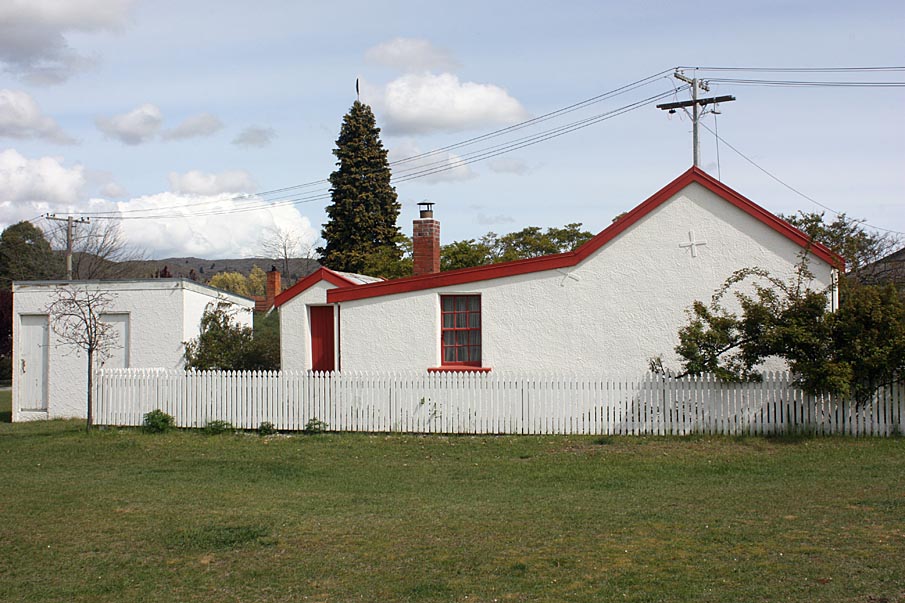
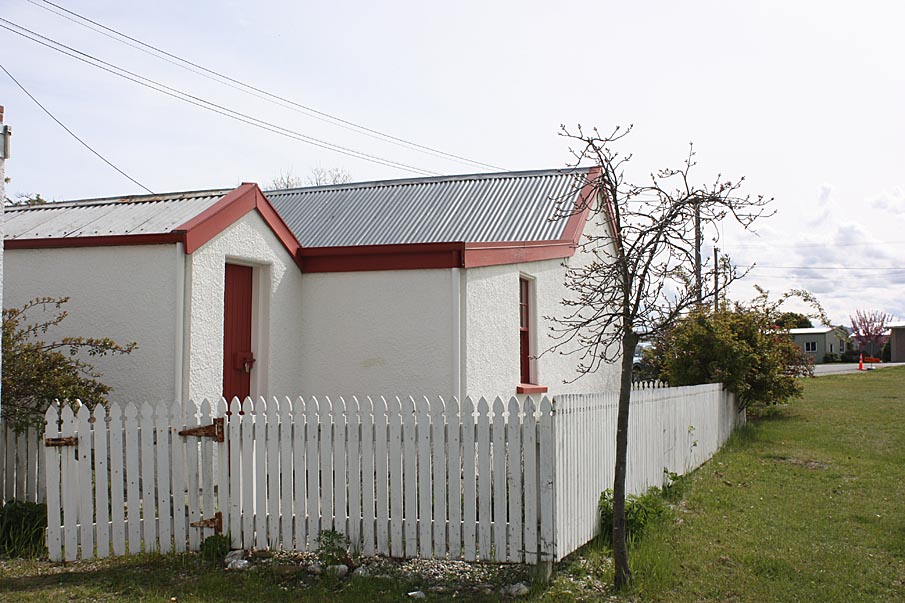
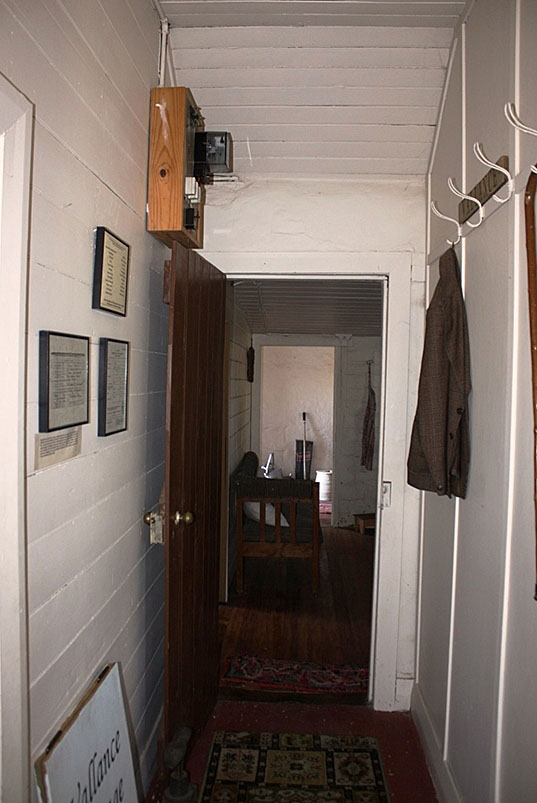
The cottage was hand-built by William from sun-dried mud brick. Its original plan was a two-roomed cottage with a central front (north) entrance doorway and passage. This type of two-roomed arrangement is a development of a very traditional form of Scottish domestic architecture referred to in Scottish vernacular as a ‘But an Ben’. In its earliest form the external door led directly into the kitchen and living area (the’ but’) and then leading off the ‘but’ was the ‘ben’ or bedroom. As cottages with a centrally-placed external door between the two rooms became more common, the terms ‘but’ and ‘ben’ became confused, but the principal of the two distinct spaces remained the same.
It is probable that the east room was the bedroom and the west room was the kitchen and living area. William and Jean’s first four children would likely have shared these two rooms with their parents until William extended the cottage. The family history records that, with the birth of Irene in 1908, it appears that the family had finally outgrown their original home.
Family Life
William and Jean moved into their two-roomed cottage in Samson Street, Alexandra after their marriage in 1897 and two years later in 1899, William (Jnr), the first of their eight children was born. The children were William, (Rosina) May, Jessie, Douglas, Irene, Florence (Floss), Hazel and Ernest. Irene, Ernest and Douglas died before reaching fifty; William was seventy-five when he passed away, and Hazel, May, Jessie and Floss all reached well into their eighties and nineties.
After they settled and began to raise their family in Alexandra, William Snr found work excavating the railway cuttings for the new Otago Central Railway line from Ranfurly, and later worked on the Chatto Creek section to Alexandra that was completed in 1906. William also continued his mining interests by working on some of the gold dredges in the river and on the gold diggings opposite the cottage at the Tucker Hill claim on the south bank of the Manuherikia River.
The early family life of William and Jean would have been very basic with no services such as gas or piped water. Jean was remembered as doing her washing under a tree with water boiled in a copper outside the house prior to the construction of the wash house sometime before 1909. With its construction, a piped water supply was added and the copper moved inside; a bath and basin were built in and the whole doubled as the coal store as well. Fresh food such as milk and meat were kept in a food safe hung up in a nearby tree. With the birth of their slightly later children (there was a three year gap after Douglas was born in 1905), more room was needed.
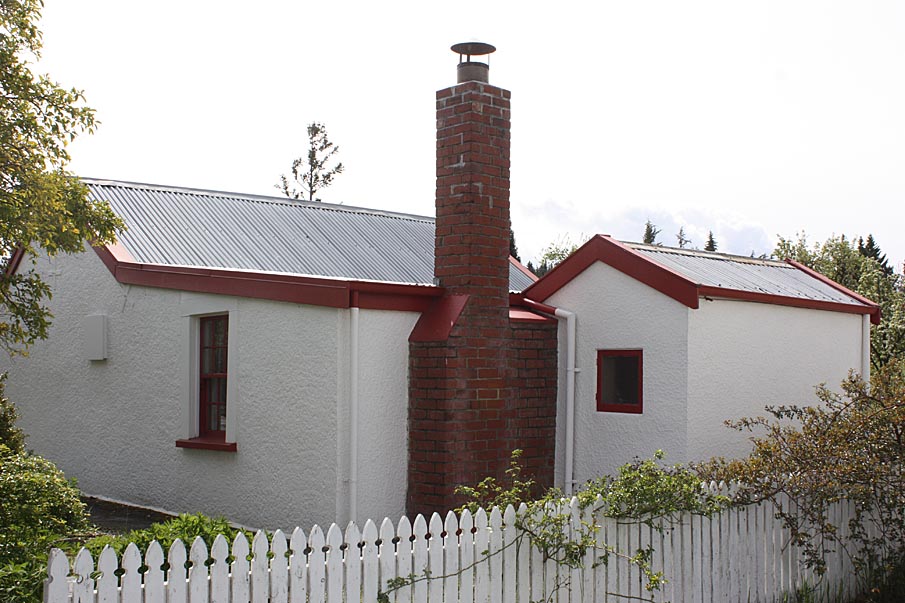
Family accounts suggest that the next three rooms to the south were added on by William sometime around 1909 (a 1955 extract refers to two of his children, Jessie and Douglas, helping to puddle clay and straw with their bare feet ready for William to make the bricks; Douglas is quoted as being four years old and was born in 1905). These rooms were a kitchen/parlour, a pantry/scullery and a second bedroom; all contained under a lean-to roof and similarly constructed of mud brick. The kitchen contained a Shacklock coal range with an integral boiler on the side. Hot and cold water was carried into the house from the cold pipe and copper in the wash house. Hazel Vallance recalls the cottage as being painted white (or whitewashed) in her childhood.
A wash house was also built either prior to the extension or presumably soon after on the south side of the cottage. The wash house contained a traditional copper for heating water (for washing and bathing) and had a bath and basin; it had the only (cold) water supply to the house site. A separate, unpainted small WC shed was also constructed; this was presumably a long drop as the only water supply on the site was to the wash house. The WC is said to have nearly been destroyed in a storm during the 1950s.
At an unknown date, a timber shed sleep-out was constructed by William on the east side of the cottage to provide more sleeping space for the children. This was still present in family holiday photos taken in the 1970s/1980s. Anne Lee notes that the wooden sleep-out was later 'lent' to a film crew but was never returned.
Family recollections note that the garden area had a large apricot tree outside the front (north) door and large plum, apricot and nectarine trees in the orchard east of the cottage. Early photographs of the cottage show it with a series of small beds along the front with a large hedge along the southern boundary and bushes and trees scattered along the eastern side, which opened out onto a paddock with trees and possibly other fruit trees. The cottage also had a very open, timber scantling fence to the front (as seen in one early image).
Later Years
Hazel was widowed at twenty-eight and returned to live with, and take care of her ageing parents whilst raising her only son, Teone. Many of William and Jean’s twenty-four grandchildren spent time holidaying at the cottage (Teone being the only grandchild to actually live there) and recall its basic but homely character. Family photographs from the 1970s and 80s show family members camping around the cottage, which for many was known simply as ‘Aunty Hazel’s’.
Hazel Wesley looked after her aging parents (Jean would have been about 64 and William 76) until her mother’s death in 1954/5 and William’s in 1963. Hazel recalled that during the late 1940s or early 50s, a burst tap during winter caused part of the wash house walls to collapse, suggesting that like the cottage, the wash house walls were built of mud bricks. Mr Mussan, a neighbour and builder, repaired the wall. Also during another 1950s winter, a further wall to the wash house collapsed “inside” and was rebuilt by a bricklayer. About three years later, another wall was close to collapse so the wall (and possibly the whole wash house) was replaced in brick masonry.
Hazel lived alone in the cottage until sometime in the early-mid 1970s, at which point she moved into a pensioner’s cottage in Alexandra. The cottage and its garden were thereafter used as a family holiday location. By the 1980s, the cottage was in danger of collapse due to its gradual decline and increasing structural issues which included the bowing out of the original west wall, water ingress through the leaking iron roof and general decay of the earth walls and overall interior condition.
In the early 1980s, the Vallance family gifted the lease of the cottage to Central Otago District Council with the intention that the Council would preserve the building and garden, providing a significant example of an early settler’s home demonstrating the pared-down way of life for many Alexandra mining families at the turn of the 20th century. The cottage fell into further decline and by 1993-4 was under a demolition order by the Council, having been subject to bouts of vandalism which had damaged the interior fabric of the building.
Descendent Jill Grant recalls how just before Easter 1994 she had a call from the Community Board chair to say that they were about to demolish the cottage as it had been vandalised and wrecked. She went over to the cottage wondering whether there was something the Museum could resurrect, but the interior walls had been damaged, the floors were rotten and had collapsed, the roof leaked and the contents of the cottage had been stolen.
The Vallance family and local supporters of the cottage started a campaign to save the building, and in April 1994 the Vallance Cottage Restoration Committee was established to raise funds and supporters for its repair. The restoration project began in November 1994 and used volunteers to strip out the damaged and decayed building fabric.
The mud brick wash house at the rear of the cottage no longer existed and with the remaining funds from the restoration, the Committee hired two retired carpenters to undertake a rebuild of it. There were growing numbers of visitors and school groups and the site needed a toilet and washing facility. The builders did a great job of creating an authentic appearance of the former wash house, but the project ran out of money and, accordingly, plumbing and drainage was never installed. The repairs were completed in 1996 and Vallance Cottage opened to weekend visitors and school groups by appointment on 6 October 1996. The opening day was marked by a gathering of the Vallance family including two of William and Jean’s children, Florence (Floss) and Hazel. The cottage site was initially managed by the Alexandra Historical Society followed by the Central Stories Museum and Art Gallery, but due to issues with the condition of the kitchen floor and, once again, decaying timberwork on the exterior and parts of the interior, the cottage was closed to visitors in 2009. An open-day was held on 18th January 2015 to highlight the need for a new group of guardians to maintain and care for the cottage. In 2014-15 funds were raised to undertake the repairs and these were completed in June 2015. In 2017, Vallance Cottage remains in the ownership of the Central Otago District Council who opens the cottage to visitors by appointment.