Māori Occupation of the Southland Plains
The Southland Plains were formed when the canoe of Aoraki capsized. Aoraki and his brothers were forced to climb onto the back of it to avoid drowning. This canoe became the South Island (Te Waka o Aoraki). The stern of the waka, being broad and flat, formed the Southland Plains. Throughout generations of occupation, Ngāi Tahu whanui developed a complex series of trails throughout Te Waipounamu connecting kainga with one another and to mahinga kai and other significant tribal resources. These traditional travel routes became the arteries of economic and social life and formed the relationships between people and places. The area was regularly visited and occupied by Waitaha, followed by Kāti Mamoe and Ngāi Tahu, collectively referred to today as Ngāi Tahu Whanui.
Tainui Māori knew that waro (coal) had heating properties and used it for cooking. The concept of mining was also familiar to Māori who quarried rock such as argillite in times prior to European colonisation.
Coal Mining in New Zealand
New Zealand’s coal mining history dates back to 1849 when the first coal was cut from Saddle Hill, Dunedin. Nineteenth century coal mines were privately owned and operated, with men going underground to dig out the coal with picks and shovels. The industry contributed to many sectors of the economy - from household heating to transport and manufacturing.
‘In the developing colony, early industries, the distribution networks of rail and shipping and households, all relied on coal as their energy source. Entire communities grew up dependent on coal as their economic base…'
Between 1900 and 1914 the country’s coal production doubled to 2.25 million tonnes. It is estimated New Zealand still has coal reserves in excess of 15 billion tonnes.
Ohai Coal and the railway
Coal was discovered at Ohai in the 1870s. The Nightcaps Coal Company was formed in 1880, consolidating various workings in the Ohai area.
In 1878 the small farming township of Wairio was chosen as a new rail terminus given its proximity to the government coal reserve. The township evolved from the breakup of the Annandale run around 1880. The government surveyed the land into deferred-payment sections, laid out a villlage and railway, and gave it the name ‘Wairio’: ‘Wai’meaning water and ‘rio’ dried up. The quality land was soon taken up by settlers and Wairio became a busy farming centre with a school, store, blacksmith, hall, hotel and racecourse.
The Nightcaps Coal Company acted quickly following the announcement of the government’s proposed line and built a railway extension from their mine to the Wairio terminus to get government trains direct to the mine. In March 1882 the government line to Wairio, with the further extension to the Nightcaps Coal Company mine, was formally opened. Wairio was in the unique position of having twin termini to service two separate railway lines.
By 1885 New Zealand Railways had built all the necessary rail structures were built at Wairio, including an administration office and engine shed, a goods shed, and accommodation for railway officials.
The formation of the Ohai Railway Board
While the transport system remained stagnant for the next twenty years, the coal mining industry did not. More mines opened in the Ohai district and were beset by roads that were ‘unspeakably bad’. With all its resources the Ohai district could not benefit as long as it lacked convenient and quick transport to the markets. The situation became critical in 1912-1913 when a number of coal leases were granted in the Ohai field. Ohai settlers and coal miners banded together to agitate for the government to provide more railway lines in the district. The advent of the First World War, however, saw all government expenditure devoted to the war effort.
The light at the end of the tunnel came unexpectedly with the passing of The Local Railways Act in 1914. The Act enabled the creation of Railway Districts and Railway Boards to run the District. A Railway District could be created if a quarter of the ratepayers signed a petition requesting it. Railway Boards could then be formed to borrow the necessary funds and construct private railways.
Seizing the opportunity, Ohai ratepayers generated the necessary petition. Overcoming opposition from the Wairio Railway and Coal Company, in May 1916 the Ohai Railway District was proclaimed. This opened the way for the formation of the Ohai Railway Board (ORB) under the 1914 Act.
The first members of the Board, elected in August 1916, were three farmers, four runholders and, surprisingly, only one coal owner. The ORB was now in the business of establishing a private railway line to the Ohai coalfields.
The Wairio to Ohai Line
After its constitution, the ORB set up office at Otautau. Their first task was the difficult compensation negotiations with the Wairio Railway and Coal Company for the tramway they had built in 1914 from Moretown to the Wairio terminus. In June 1917 almost £20,000 was paid to the Company, leaving the ORB coffers dry.
In 1918 the Board started planning the third permanent line from Wairio. It would leave the government line at Wairio, and then continue north along the valley to Ohai. To finance the line, members of the Board obtained a bank overdraft providing their personal backing. It was to be the only railway line built under the Local Railways Act 1914.
Ignoring opposition from the Nightcaps Coal Company to the proposed route, tenders for earthworks were called for in March 1919. A contract was signed with William Baird, Invercargill, in July. On 1 September 1920 the line was opened for coal traffic with Tinkers seven kilometres past Wairio. The line was busy. In February 1922 an average of 53 loaded wagons left Wairio daily for the markets.
In September 1922 the Board accepted a tender from Messrs Hoare & Co, Kaitangata, to extend the line from Tinkers to Ohai. In December 1924, the line was completed. The total cost of construction was £203,000.
The Board were extremely proud of their efforts:
'The Enterprise and courage and vision by the promotors of this railway are beyond all praise. They stepped in and carried through a scheme of national importance….In any future comprehensive history of Southland and her rise to power and wealth, the Ohai Railway Board must always receive distinguished notice for the good work of pioneering it has done, in opening up to the Dominion the largest undeveloped coal measures in its boundaries…'
The ORB also claimed that no other public work ‘of whatever magnitude will be a greater factor or have an influence in and upon the development and welfare of the country’.
Wairio Station Yard
New Zealand Railways and the ORB were distinct entities. Although they shared the yard each body had its own facilities.
The layout of the Wairio Station yard and its structures were constantly in flux. New buildings were constructed but many more were reused from another yard. The ORB’s first effort was a weighbridge and office built in 1919.
The 1920s saw a construction boom. Several cottages were added, including one for a typist in 1928. In 1922 a ‘two roomed iron house’ was shifted to Wairio for use as a tool house.
In April 1923 the construction of a new engine shed began. It was in use by September. It accommodated two FA engines and included a coal loading crane and sand dryer.
In August 1924 the ORB accepted D.C. Sutherland’s tender of £468 for a new Wairio office, designed by the Engineer, in connection with the newly purchased weighbridge. The office was complete in November 1924 and found ‘convenient and comfortable’. It contained a weighbridge room, clerk’s room and manager’s room.
Although the line was built to serve the coal mines, from 1924 the ORB also operated a passenger service. This made it almost unique in the history of private lines in New Zealand. The Wellington & Manawatu Railway Company offered passenger services, as did the Dun Mountain Railway, although it was more akin to a tramway and only ran between 1861 and 1872. Generally speaking private lines were advocated by the community to serve as passenger transport or by private companies to get access to markets.
The ORB purchased a clerestory-roofed passenger car for the service – it was nicknamed the ‘Red Terror’. The 1924 ORB rules included passenger fares, although it has been written that as the only independent railway in New Zealand to run at a profit all passenger services were run free of charge. By 1926 only children under the age of three were free. The ORB also ran a freight service, carrying the likes of milk and cream, parcels, newspapers, bicycles, dogs (9d each) and corpses (15/-each). The passenger service ran for 40 years, replaced with buses in 1975.
In February 1925 the tool house was shifted next to the Guard’s room and the ground formerly occupied by the 1919 offices was used for siding alterations. By the end of 1925 alterations and extensions at the yard by way of sidings and loops had been completed. The problem of traffic congestion was relived for a time.
In 1927 the ORB agreed to the Engineer’s proposal that the old engine shed be extended 10 feet. In August Ramsay and Gaines tender of £96 was accepted.
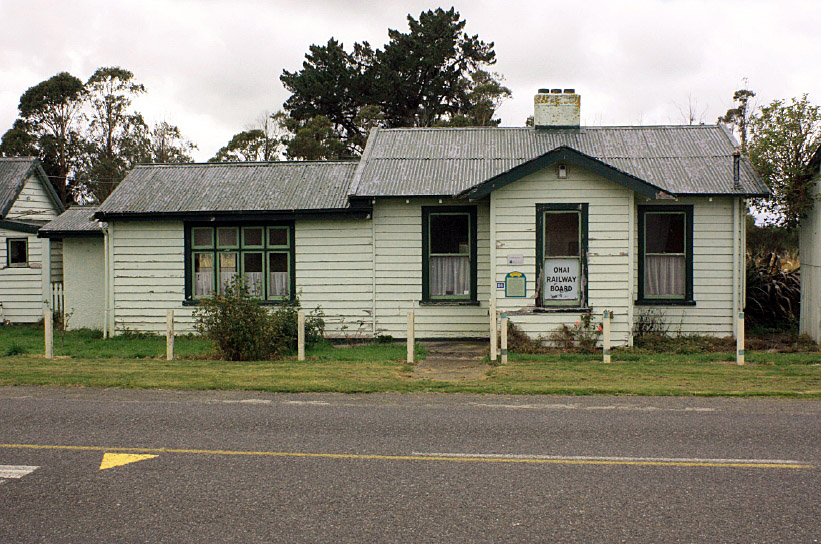
In October 1927 the ORB made the landmark decision to move the Board’s office to Wairio. The building was designed by the Chief Engineer to the Board, F. Williams, and in November 1927 a request for tenders was issued. The Board accepted the cheapest tender, for £764, from James Wilson, Ohai.
The specifications showed the building was to have concrete foundations with weather board walls, painted white. The roof was specified as No.26 gauge corrugated iron. It included a Board Room, passage, two offices (manager’s and typist’s), and men’s and women’s conveniences. The architraves were red pine; the doors ‘for offices and conveniences’ were imported oregon, the window frames were totara. The Board Room entrance double doors were to swing either way with top glass panels obscured. Tiled fire surrounds were provided for both offices. The fire place in the Board Room was clinkor brickwork. All woodwork was to be oiled. The wall lining was tongue and groove. The strong room was to be constructed in concrete.
Furniture, including the six foot Board table and leather bucket chairs, was ordered from William Smith & Co. Ltd. They also supplied the linoleum for the offices and conveniences, as well as the carpet for the Boardroom – ‘Talbot Wilton & of real good quality’. In early 1928 the Board offices were completed.
In 1929 a new engine shed, capable of housing and servicing two engines, was built next to the 1923 shed. The work was supervised by James Wilson with the work done by ‘the Board’s men’. It was built wholly of iron. Railway rails, set in concrete, were used for the uprights.
The Depression and Beyond
Over the years there were calls for the government to take over the line but it was always shown that it was a ‘very efficient undertaking and nothing could be gained by incorporating the railway into the N.Z.R. system’. Figures showed a spectacular growth in coal traffic. In 1919 the ORB’s lines, carried 17,463 tons of coal; in 1939 207,020 tonnes; in 1944 it peaked at 285,861 tons.
The ORB’s construction programme during the 1930s was largely constrained to the opening of the Birchwood extension in 1934. The line was now 19 kilometres in length. By this time both the other lines had closed as the mines they served had been worked out.
During the Depression the ORB donated to a number of local causes. For example, in 1933 donations were made to the Nightcaps Ambulance, the Ohai Plunket Society, the Nightcaps Public Library, the Nightcaps Unemployment Relief Committee, the Nightcaps Poultry Society, and the Wairio Unemployment Relief Committee.
In 1941 a goods shed was moved from Nightcaps yard to Wairio to serve as a locomotive repair shed. A lean-to was added to it for a machine and work shed. In 1942 electricity was installed at a cost of around £117.
By 1946 the engine shed and workshops required extension to meet the requirements of ‘stabling, servicing and repairing when the X 446 Locomotive and 204 H.P. Diesel Locomotive’ were delivered. W.J. Sym, a Christchurch consulting engineer, prepared specifications for the extension of the workshop. In February 1947 J. Matheson was hired with the contract set at £410.
In the meantime it was necessary to enlarge the existing engine shed to provide housing and servicing facilities for two steam engines and a diesel. Matheson prepared the plan, using the timber from the boxing and forms used in the workshop extension to extend the engine shed. The necessary iron was found by using up what was on site and dismantling the annex to the engine shed which would no longer be required when the shed was extended.
Also in May 1947 it was decided to build a new sand dryer. A dryer had been obtained from Hillside workshops and the new dryer would be housed in concrete close to the engine shed. Matheson included this building in his plans for the engine shed extension.
In 1956 a diesel locomotive was employed on the line – the age of steam was over. It made three round trips between Wairio and Ohai every day. In 1964 five trips were being made daily.
In 1976 the ORB celebrated their 50th anniversary. The only local private railway in New Zealand, they employed twelve people, handled 200,000 tonnes of coal a year, and were debt-free with assets of more than $1 million dollars.
In November 1989 the functions of the ORB were taken over by the Southland District Council. The ORB had the distinction of being in operation for 75 years.
In 1992 the Board assets were sold to NZ Rail. From 2000 the Ohai Railway Board Heritage Trust ran a Museum from the buildings. Unfortunately the Trust eventually disbanded and the Museum closed.
While the buildings remain unused, the Wairio Branch line is still in active use carting coal from Ohai. It is the last sole remaining branch line in Southland and one of only a few such lines remaining. It is certainly the longest running private line in New Zealand.