Whanganui and Pūtiki-wharanui
The Whanganui region, dominated by the river of the same name, has a long history of Māori occupation. Te Awa o Whanganui has great cultural importance and was a major food resource and transport route. Its catchment area is recognised as the rohe of Te Āti Haunui-a-Pāpārangi, named after the ancestor Haunui-a Pāpārangi. His descendants intermarried with Ngā Paerangi, the original inhabitants of the lower Whanganui River area. The three siblings Hinengākau, Tamaūpoko and Tūpoho are the guardian tūpuna (ancestors) of the river; Tūpoho is often associated with its lower reaches.
Pūtiki Wharanui a Tamatea Pokai Whenua (shortened to Pūtiki-wharanui or Pūtiki) fishing pā was established centuries ago on the lower river’s southern bank, near the future site of the Cobham (State Highway 3) bridge. Its people became known as Ngāti Tūpoho and were closely associated with Ngāti Tūmango and Ngāti Ruakā; these groups defended the kainga from attacks by various northern taua in the early nineteenth century. By the 1830s Pūtiki-wharanui was ‘the developing window for Whanganui iwi on the wider world … a point of contact with visiting Europeans’. The first Pākehā that Whanganui Māori met were traders, in 1831 and then 1834.
It was five years before the next recorded visit from a European. Missionary Henry Williams of the Anglican Church Missionary Society (CMS) had arrived in the Bay of Islands in 1823, and by the mid-1830s he felt confident that the Anglican mission could be expanded to other parts of the North Island. In December 1839 he was warmly welcomed at Pūtiki for a six-day visit.
The people had been introduced to Christianity in 1836 or 1838 by lay-reader Wiremu Eruera Te Tauri, a rangatira of Ngāti Tūwharetoa hapū Ngāti Te Rangi-ita who married Ripeka, the daughter of Pūtiki chief Te Mawae and Ripeka. Williams noted that ‘many Whanganui Māori were involved in Christian practices, had embraced literacy, and were keen to acquire books.’ Māori worshipped from a small raupō whare at Pūtiki, and Williams promised to send them a permanent missionary.
Pūtiki Mission Station
Williams directed the establishment of a mission station at a site offered by Pūtiki rangatira, adjacent to Pūtiki pā. Reverend John Mason was appointed the first missionary in June 1840, and built the first permanent church, a brick building opened in 1842. This same year saw the first burial in the associated urupā. Sadly, Mason was the second person to be interred in the urupā after he drowned in January 1843. A few months later, his replacement Reverend Richard Taylor arrived, and remained attached to the Pūtiki mission until his death in 1873; his son Basil took over leadership of the mission in 1860. Richard Taylor is recognised as one of New Zealand’s significant early missionaries, and he and his family made a great contribution to the Whanganui district.
Richard Taylor oversaw the formal gifting of the mission station land to the Church of England in February 1843. The deed of gift was signed by Pūtiki rangatira Hori Kingi Te Anaua, Te Mawae and Hoani Wiremu Hipango. Taylor replaced Mason’s raupō whare with a new mission house (replaced again in 1870), and built a small hospital, a school and a school-master’s house nearby. He arranged construction of the mission station’s second (1844) and third (1857) churches, after the first two were damaged by earthquakes.
The fourth church, opened on Christmas Day 1887, was built under the leadership of Reverend Alfred O. Williams, grandson of mission station founder Henry Williams. The Williams family’s strong association with Pūtiki continued when Alfred Williams’ son, Canon Wilfrid G. Williams, succeeded his father as missionary in 1913. Reverend Samuel Williams (Henry William’s son) funded the second mission school.
St Paul’s Memorial Church
The fourth church was a match-lined timber construction, located where the urupā extends today. In 1929 the parish decided that a new church was needed, and they set about fundraising for a building that would ‘long stand as a worthy monument to the work and influence of those founders of Christianity in the Whanganui District … as a striking example of the high ideals of the Māori race, expressed in their ancient arts and crafts, which have now found their fruition in the Gospel of Christ.’
Canon Wilfrid G. Williams, by then Superintendent of the Māori Mission, was a major driver and supporter of the project. Many people with connections to the mission’s history donated, including a substantial contribution of £750 from the H. and W. Williams Memorial Trust. The strength of feeling behind the financial donations was matched by the efforts of those who offered physical contributions to the building’s interior furnishings and liturgical equipment.
Design and Construction
While no original plans for St Paul’s Memorial Church have been discovered, it can be inferred that local builder Arthur J. Cutler based the church on a design from the offices of Frederick de Jersey Clere’s firm Clere & Clere. Eminent ecclesiastical architect Clere had, since 1883, been the Diocesan Architect for the Anglican Church, populating central New Zealand with his often-timber Gothic Revival churches. Just prior to the St Paul’s Memorial Church commission, Arthur Cutler had built the Clere & Clere-designed St Mary’s Church at Maxwell, just north of Whanganui. The two churches share design similarities, including identical windows, although Cutler added a square tower to St Paul’s Memorial Church, more reminiscent of the Norman churches of his English homeland.
The foundation stone was laid by the Right Reverend Frederick Augustus Bennett (1871-1950), the first Bishop of Aotearoa and New Zealand’s first Māori bishop, on 23 February 1936. Bennett’s connection to the mission station dated back to 1892, when he resided at the mission house and two years later built the Pūtiki Mission School. Construction of the church was completed around August 1936, after which work on the interior decorations began.
Toi Māori
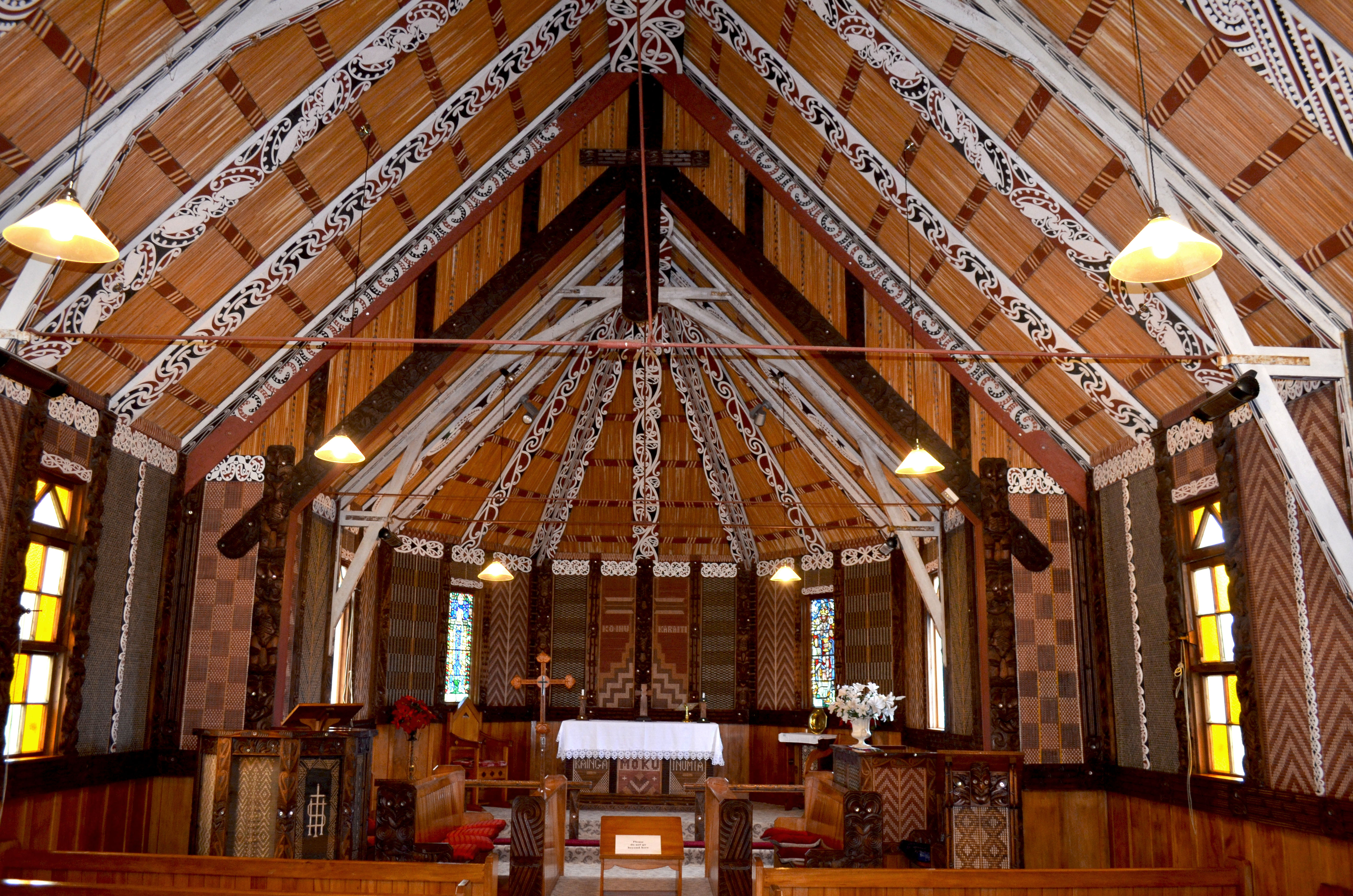
While the exterior of the building conformed to the typical appearance of European churches, special plans were afoot for the interior decoration. Sir Apirana Ngata (Ngāti Porou), the eminent Māori leader, politician and scholar, believed that the recovery of traditional Māori forms of decorative art – Toi Māori – would play an important part in Māori social and economic revival. During the 1920s Ngata was involved in the construction of decorated wharenui (meeting houses) at marae nationwide and he directed the interior decoration at St Mary’s, a highly ornamented Māori Anglican war memorial church commemorating Ngāti Porou troops at Tikitiki (Category 1, List. No. 3306, opened 1926). In 1927 he formalised this cultural support by opening the School of Māori Arts and Crafts at Rotorua. Ngata had had difficulty finding tohunga whakairo (master carvers) to work on St Mary’s, and noted the near-demise of tukutuku (ornamental lattice-work) in some regions. To arrest the loss of traditional practices, the school trained Māori artists and instructors in customary art and architecture by working directly on Māori buildings.
After the school closed in 1938 the trainees and instructors continued to work privately; by the late 1950s the school and its alumni had completed 42 projects, achieving Ngata’s goal by spreading their knowledge through the communities they worked in. Pineamine (Pine) Taiapa (Ngāti Porou), one of the school’s first students, became one of its principal teachers – training approximately 34 whakairo (carving) students, two kōwhaiwhai (painted scrollwork) students, two kākaho (toetoe stem) students and over 100 tukutuku students by the late 1940s.
While the school operated, Ngata decided what projects it would work on, the general plan of each new building, and the styles of tukutuku and whakairo to be used. As well as meeting houses and marae dining halls, the school worked on six whare karakia (churches). Ngata was prominent in the Anglican Church, and was instrumental in getting the Māori Anglican Bishopric established. Through these connections he became aware of the planned new church at Pūtiki and proposed that his school should be commissioned. It is considered that he personally designed the interior decorative scheme of St Paul’s Memorial Church.
The team of artisans used the old mission school building (demolished in late 1937) as their workshop. The whakairo carvers were directed by Pine Taiapa, and included Hoani (John) Metekingi from Pūtiki, who carved the beautiful memorial font and baptistery canopy. The kōwhaiwhai was painted by Oriwha Tahupotiki (Edward Oliver) Haddon, a talented artist, Methodist missionary, pharmacist and broadcaster who had been trained in traditional knowledge by Tohu Kakahi of Parihaka; he was assisted at St Paul’s Memorial Church by Jack Kingi. Mr Tawhai Takoko supervised the kākaho work. Ngata directed the tukutuku and tāniko (fine finger weaving) work, carried out by women from Pūtiki (some who trained in Wellington and brought the knowledge home), Wellington and the East Coast; Lady Ngata contributed two panels of whariki work. Ngata furthered the art of tukutuku at St Paul’s Memorial Church by incorporating designs from other traditional art forms, such as tāniko weaving, to stimulate interest in that art form. In 1939, Maxwell Smart, Director of the Whanganui Regional Museum, wrote that ‘…so enthused were they by the revival of carving in Whanganui, that several young Maori residents of Putiki have become quite skilled in the work and have since adopted it as their permanent occupation.’
The total cost of the church was just over £2520. Many donations were made in memory of those who had worked for, worshipped in and supported the Pūtiki mission since its earliest days. These took form in a wealth of memorial furnishings, including a carved entrance porch, baptistery canopy and font, pulpit, lectern, altar, organ screen, choir stalls, altar rails, memorial windows. Other contributions were vestments and fair linen made by parishioners and supporters. Just prior to its completion, Ngata said ‘[St Paul’s Memorial Church] will be the most beautiful example of the application of Maori art to church decoration in the country.’
Consecration
The church was consecrated with great ceremony on Sunday 5 December 1937. The service was led by the Right Reverend H. St Barbe Holland (the Bishop of Wellington), and Right Reverend Bennett, the Bishop of Aotearoa; attendees included many representatives of families and clergy with long-standing connections to the mission station, dignitaries including Sir Apirana and Lady Ngata, and those involved in its construction. Loud-speakers outside ensured that those beyond the 150 invited to sit inside could follow the proceedings. Each of the special memorial furnishings was consecrated by the Bishop of Aotearoa before the church itself was pronounced consecrated. The service crested as Hoani Metekingi carved the Cross of Consecration on the altar while the congregation sang the hymn ‘When I survey the wondrous cross’. Those commemorated by the furnishings were paid tribute in the Bishop of Wellington’s sermon, where he spoke of the unity between Pākehā and Māori that the church building symbolised.
Social, cultural and spiritual importance
Over the years, St Paul’s Memorial Church has been visited by many thousands of people, as the collection of over 15 visitor books, and features in many New Zealand guidebooks, attest. The Governor-General Lord Galway was one of the first dignitaries to visit, on 21 December 1937. Since then many more Governors-General have appreciated the church in person. Royalty, including HRH Queen Elizabeth the Queen Mother, and HRH Prince Edward, have also visited. This is on top of the thousands of parishioners who have worshipped, and celebrated weddings, christenings and the lives of those who have passed away, within the church building.
Pūtiki Parish Hall
On 25 October 1953 a new church hall was dedicated during the celebrations of the 113th anniversary of the Pūtiki Mission. Built adjacent to St Paul’s Memorial Church, the hall provided additional space for the parish’s social, spiritual and cultural activities, and reflected Reverend (later Sir) Kingi Ihaka’s aim to extend the church’s mission to younger people. As well as being the space for entertainment associated with church activities, for decades it housed the Sunday School and the local kindergarten; it was also the practice room of the Pūtiki Māori Club. A venue for public meetings (including the regular meetings of the Putiki Township Council), it was also the local polling booth for elections for many years. A kitchen was added to the hall in 1962.
In 1972 the interior decoration of the hall was led by artist Cliff Whiting (Te Whanau-a-Apanui), who was then the Whanganui district education adviser on Māori arts and crafts. Dr Whiting became highly esteemed for his art and contribution to education and conserving and extending New Zealand’s cultural heritage, and was awarded the Order of New Zealand in 1998. An expert in traditional Toi Māori, Whiting also explored the use of modern materials to further these art forms.
His work in the church hall included tukutuku, kākaho, and a modern interpretation of kōwhaiwhai. This project was his first experiment with using hardboard for the backing and horizontal laths of tukutuku panels, a response to new materials and the realities of the social situations confronting marae. It was also among his early explorations of contemporary stylisation of kōwhaiwhai, brought to prominence on a large scale in a mural format, which would become a feature of some of his most celebrated art works. At the hall’s dedication, Rangi Pohika said ‘That modern decoration is not seen anywhere among other tribes, and so through the creative mind of the designer, the Whanganui people should take pride of being the first.’
The community took part in the decoration, and the opportunity for new generations of Whanganui Māori to learn these traditional arts provided continuity with Ngata’s work in 1937. This social empowerment and fostering of artistic talent was very important to Whiting throughout his life. The decoration of the Pūtiki Parish Hall was one of the earliest of his many marae community art projects.
Conservation
The recent conservation of St Paul’s Memorial Church has continued that opportunity to extend knowledge of Toi Māori. Since 2014 the building has been insulated, rewired and made safe with new fire protection and heating systems; decramastic roof tiles (added in 1978) were removed and the original roofing iron removed and replaced. Accessibility was improved with a new entrance ramp that incorporated historic stones from previous church buildings. Attention then turned to the interior decoration, with
Dean Whiting (Cliff’s son) and Jim Schuster guiding Whanganui Te Wānanga o Aotearoa tutors and students on conservation of the tukutuku panels. Conservation continues with a focus on the tāniko and kōwhaiwhai.
Memorials
Prayer desk – commemorating Reverend Arona Te Hana, first Māori missionary-in-charge 1876-1882 presented by Lord and Lady Bledisloe, in association with Mrs Hoani Makimerini, a relative of Te Hana.
Copy of oil painting of 1857 church by George Sherriff. The original painting, presented by the Sherriff family, is cared for by the Sarjeant Gallery.
Illuminated Anzac Memorial Cross – in memory of the district’s WW1 and WW2 dead. Made by Reverend W.S. Darby; unveiled on 22 December 1963.
Carved arch in entrance porch – commemorating Wiremu Eruera Te Tauri, who introduced Christianity to Whanganui Maori; gift of Sir George Shirtcliffe of Wellington.
Carved baptistery canopy – commemorating Reverend Henry Williams, founder of the Pūtiki Mission Station, presented by his granddaughters Mrs A. Russell and Miss Hilda Williams; designed by A.J. Cutler.
Baptismal font and copper jug - gift of Mrs Heeni Scott and Mrs Ani Katene in memory of Miss Mangu Tahana, soloist of the Pūtiki Choir; carved by Hoani Metekingi.
Pulpit – commemorating Reverend Richard Taylor, missionary 1843-1869, his son Reverend Basil Taylor, missionary 1869-1876, and their wives, donated by members of the Taylor family. The tāniko panels were made by Ani Katene, Maiangi Marumaru, Maori Bailey, and Ruby Whakarau of Pūtiki; Lady Ngata is said to have contributed two panels of whariki work, woven in silk tapestry fibre, to the rear of the pulpit.
Pulpit lectern – in memory of Mr White, a lay reader during the 1950s.
Lectern (freestanding) – commemorating Rev. Alfred O. and Mrs Williams, missionary 1885-1920; gift of their sons and daughter.
Choir stalls – commemorating Archdeacon Samuel Williams, ‘maintainer of the second Pūtiki Mission School, and the founder of the H. and W. Williams Memorial Trust’; given by the Williams’ family.
Organ screen – commemorating Reverend T.H. Katene, assistant missionary 1912-1918, gift of his wife, Mrs Ani Katene of Pūtiki, who wove the tukutuku panels.
Altar rails – commemorating Reverend John Mason, first missionary to Pūtiki 1840-1843, presented by Mrs John Martin of Martinborough.
Altar – in memory of Henry D. Bates, ‘a pupil of the first Mission School and generous supporter of the Māori work’, presented by Mrs H.D. Bates. Tukutuku panels on altar ‘Kainga – moku-inumia’ ‘are a contraction of that portion of the Prayer of Consecration at Holy Communion, meaning “eat and drink this in remembrance of me”’.
Credence table – in memory of Reverend Thomas Grace (missionary from 1882-1885), gift of the Bishop of Wellington, Right Reverend H. St Barbe Holland; carved by a carver arranged by Sir Apirana Ngata with inset tāniko panel by Mrs Eruini of Maketu.
‘Bishop’s Chair’ - carved by and gift of Mrs A.E. Barton in memory of her mother Laura Harper (née Taylor, Richard Taylor’s daughter).
Ceremonial cross – in memory of Wiremu Te Tauri (d.1959), grandson of Wiremu Eruera Te Tauri.
Wrought iron flower stands – in memory of Mr and Mrs Fisher, supporters of the church.
Stained glass memorial window - to Rev. A.O. and Mrs Williams, unveiled 1946; work of D. Marion Grant of London. One of only two known examples of her work in New Zealand. Shows the robes of Christ embroidered with tāniko design and the inscription ‘Ko Ihu Karaiti [Jesus Christ]’, which echoes that on the tukutuku panels above the altar’.
Stained glass window - in memory of Mrs Heeni Scott and Mrs Ani Katene, sisters who worked for the church; installed in 1957 and made by Powell & Sons (Whitefriars) Ltd.
Stone-cut window - commemorating the Pūtiki Mission School (NB the centenary dates on the window are incorrect). Installed in 1978 and made by Wanganui Glass. Based on the Holman Hunt Painting ‘The Light of the World’. ‘A print of this painting used to hang in the Mission School from the late 19th century until the school closed. The pupils were often asked to write a story about it.’
Stone-cut window – in memory of Nancy Donald, a staunch parishioner and member of the St Paul’s Ladies’ Guild; gifted by her sons in the early 1990s and made by Wanganui Glass.