

The building is closely connected with Father Anthony Halbwachs, the first resident Catholic priest in Wairarapa, who established five churches, including St Joseph’s, in a whirlwind of activity between 1876 and 1884. By the 1860s Tīnui was established as a small sheep farming settlement, land between the Whareama and Tīnui rivers east of Masterton having been purchased by the Crown from Ngāti Kahungunu and Rangitāne the previous decade. It is testament to Halbwachs’ initiative that, despite the dominance of Anglicanism in the area, the Catholic church was the first of the village’s two churches to be built. Prior to its construction, services for various denominations were held in the town hall. Mr Nathan donated the land in 1880 and fundraising events secured enough money for work to begin.
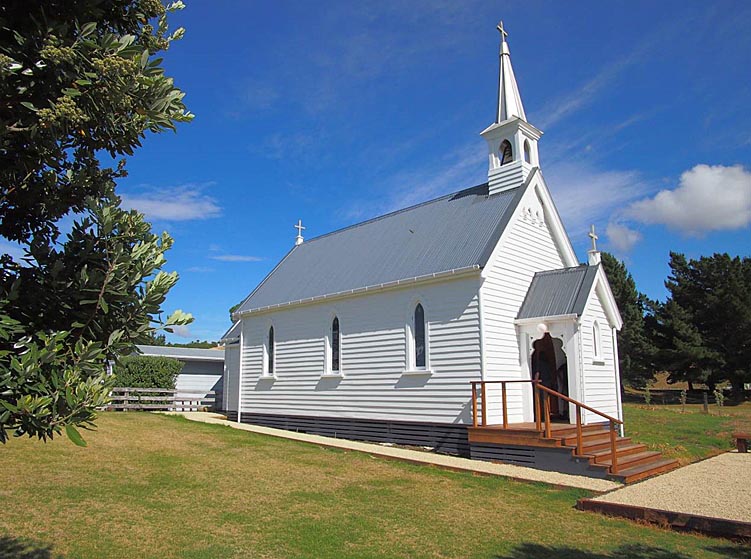
Noted Wellington architect Thomas Turnbull designed the Carterton, Masterton and Featherston Catholic churches and is almost certainly responsible for those in Greytown and Tīnui. St Joseph’s followed much the same plan as the Greytown church: New Zealand Gothic in style and clad in shiplap weatherboards, a small entrance porch at the centre front leads into a nave with six lancet windows, and a sacristy beyond. The steep roof is topped by a small spire, and horizontal tongue and groove native timber lines the plain interior. When the first monthly service was held on 26 June 1881 the church was still unfinished. By the late 1970s parish life had become largely concentrated in Masterton and St Joseph’s only hosted services four or five times a year.
In 1981, St Joseph’s church was moved from Tīnui to Riversdale Beach, a holiday resort developed by Masterton businessman Basil Bodle in the 1950s. Bodle’s gift of sections to the Catholic Church and the Anglican Parish of Tīnui was realised when Anglican vicar Roger Burt and his Catholic counterpart Father Bernard Miles agreed to move St Joseph’s there for regular use for services and life events.
Concern at the prospect of St Joseph’s being sold for alternative use prompted community members to form the St Joseph’s at Riversdale Beach Charitable Trust in 2017. The trust has a memorandum of understanding with the Catholic Archdiocese, to refurbish and maintain the building and manage use of the church. The building was restored in 2018 to the designs of Wellington architect Nick Bevin. In addition to church services for different denominations, the building still hosts important life events like weddings and baptisms and has become a popular tourist spot. Of the five churches established by Father Halbwachs, St Joseph’s has undergone the least modification despite its relocation.
List Entry Information
Status
Listed
List Entry Status
Historic Place Category 2
Access
Private/No Public Access
List Number
9736
Date Entered
20th February 2020
Date of Effect
11th March 2020
City/District Council
Masterton District
Region
Wellington Region
Extent of List Entry
Extent includes the land described as Pt Lot 1 DP 19803 (RT WN875/74), Wellington Land District and the building known as St Joseph’s Church (Catholic) (Refer to map in Appendix 1 of the List entry report for further information).
Legal description
Pt Lot 1 DP 19803 (RT WN875/74), Wellington Land District
Location Description
Map Grid ref: NZTM E1857974; N 5446922 (taken at the church altar)
Status
Listed
List Entry Status
Historic Place Category 2
Access
Private/No Public Access
List Number
9736
Date Entered
20th February 2020
Date of Effect
11th March 2020
City/District Council
Masterton District
Region
Wellington Region
Extent of List Entry
Extent includes the land described as Pt Lot 1 DP 19803 (RT WN875/74), Wellington Land District and the building known as St Joseph’s Church (Catholic) (Refer to map in Appendix 1 of the List entry report for further information).
Legal description
Pt Lot 1 DP 19803 (RT WN875/74), Wellington Land District
Location Description
Map Grid ref: NZTM E1857974; N 5446922 (taken at the church altar)
Why is this place significant?
Cultural Significance
Social Significance or Value The 1981 relocation of the building to a new home of Riversdale Beach and the subsequent creation of a community trust, spurred by fears it could be sold into private ownership, highlight the social value of this place to the local community. The responsibility of the trust for its day-to-day management, refurbishment and maintenance indicates a close community attachment to this place. Spiritual Significance or Value St Joseph’s Church (Catholic) possesses spiritual significance as a site of worship in two settlements since 1881. Its continuing spiritual life in its current location confirms the continued importance of religious worship and the use of religious buildings for significant events in small communities.
Historic Significance
Historical Significance or Value St Joseph’s Church (Catholic) represents the solid foundation of the Catholic Church in Wairarapa and is directly associated with Father Anthony Halbwachs, a key figure in this story. As the last of five churches built by Halbwachs over a four-year period, it is the culmination of an intense and sustained period of church building and exemplifies the drive of Halbwachs to establish the church and reach all areas of his large parish. Halbwachs was noted for his ability to work with all religions and communities, and the use of the church by other denominations is testament to this capacity, as well as the need for religious pragmatism in early settler communities with small populations. As a Catholic church, the building represents the history of particular religious and ethnic groups living in the area.
Physical Significance
Architectural Significance or Value St Joseph’s Church (Catholic) has architectural significance as a representative example of a small rural church in the Gothic revival style prevalent in the nineteenth century. The restrained quality of the design and detailing are typical of this architectural style. Little altered, the building’s authenticity and integrity make it particularly able to demonstrate these qualities. It was most likely designed by leading Wellington architect Thomas Turnbull, who was responsible for a series of important churches and other buildings in Wellington and elsewhere, including Wairarapa.
Why is this place Category 1 / Category 2?
Detail Of Assessed Criteria
(a) The extent to which the place reflects important or representative aspects of New Zealand history St Joseph’s Church (Catholic) reflects the establishment of organised religion in colonial New Zealand through the building of permanent churches. Its relocation demonstrates the impact of shifts in religious practices in the mid-late twentieth century, such as the concentration of services in larger town at the expense of outlying rural areas and the subsequent redundancy of churches in those places. At the same time, its ongoing use as a church symbolises the endurance of religious faith. (b) The association of the place with events, persons, or ideas of importance in New Zealand history Father Anthony Halbwachs is of major local significance to the Wairarapa region for his role in the establishment of the Catholic Church in the region. As the last of five churches built by Halbwachs, St Joseph’s Church (Catholic) is firmly associated with this important figure in Wairarapa history. (e) The community association with, or public esteem for the place The substantial efforts by the Riversdale Beach community to preserve the church as a site of worship and the assumption of responsibility for its management and maintenance by a community trust demonstrates significant local public esteem for this place. Fears that it would be converted to a new use and subsequent action to prevent this shows a particular community attachment to its religious function. The Trust’s 2018-2019 refurbishment of the building and installation of new features such as stained glass windows, a bell and bronze Stations of the Cross plaques, donated by community members, is a physical testament of the importance of St Joseph’s Church to the people who live and holiday at Riversdale Beach. (k) The extent to which the place forms part of a wider historical and cultural area As one of five churches built by Father Anthony Halbwachs in Wairarapa between 1878 and 1881 (all of which are extant), St Joseph’s Church (Catholic) is part of a distinct group of buildings that together reflect the intensity of efforts to establish the Catholic Church in the region.
Why is this place significant?
Cultural Significance
Social Significance or Value The 1981 relocation of the building to a new home of Riversdale Beach and the subsequent creation of a community trust, spurred by fears it could be sold into private ownership, highlight the social value of this place to the local community. The responsibility of the trust for its day-to-day management, refurbishment and maintenance indicates a close community attachment to this place. Spiritual Significance or Value St Joseph’s Church (Catholic) possesses spiritual significance as a site of worship in two settlements since 1881. Its continuing spiritual life in its current location confirms the continued importance of religious worship and the use of religious buildings for significant events in small communities.
Historic Significance
Historical Significance or Value St Joseph’s Church (Catholic) represents the solid foundation of the Catholic Church in Wairarapa and is directly associated with Father Anthony Halbwachs, a key figure in this story. As the last of five churches built by Halbwachs over a four-year period, it is the culmination of an intense and sustained period of church building and exemplifies the drive of Halbwachs to establish the church and reach all areas of his large parish. Halbwachs was noted for his ability to work with all religions and communities, and the use of the church by other denominations is testament to this capacity, as well as the need for religious pragmatism in early settler communities with small populations. As a Catholic church, the building represents the history of particular religious and ethnic groups living in the area.
Physical Significance
Architectural Significance or Value St Joseph’s Church (Catholic) has architectural significance as a representative example of a small rural church in the Gothic revival style prevalent in the nineteenth century. The restrained quality of the design and detailing are typical of this architectural style. Little altered, the building’s authenticity and integrity make it particularly able to demonstrate these qualities. It was most likely designed by leading Wellington architect Thomas Turnbull, who was responsible for a series of important churches and other buildings in Wellington and elsewhere, including Wairarapa.
Why is this place Category 1 / Category 2?
Detail Of Assessed Criteria
(a) The extent to which the place reflects important or representative aspects of New Zealand history St Joseph’s Church (Catholic) reflects the establishment of organised religion in colonial New Zealand through the building of permanent churches. Its relocation demonstrates the impact of shifts in religious practices in the mid-late twentieth century, such as the concentration of services in larger town at the expense of outlying rural areas and the subsequent redundancy of churches in those places. At the same time, its ongoing use as a church symbolises the endurance of religious faith. (b) The association of the place with events, persons, or ideas of importance in New Zealand history Father Anthony Halbwachs is of major local significance to the Wairarapa region for his role in the establishment of the Catholic Church in the region. As the last of five churches built by Halbwachs, St Joseph’s Church (Catholic) is firmly associated with this important figure in Wairarapa history. (e) The community association with, or public esteem for the place The substantial efforts by the Riversdale Beach community to preserve the church as a site of worship and the assumption of responsibility for its management and maintenance by a community trust demonstrates significant local public esteem for this place. Fears that it would be converted to a new use and subsequent action to prevent this shows a particular community attachment to its religious function. The Trust’s 2018-2019 refurbishment of the building and installation of new features such as stained glass windows, a bell and bronze Stations of the Cross plaques, donated by community members, is a physical testament of the importance of St Joseph’s Church to the people who live and holiday at Riversdale Beach. (k) The extent to which the place forms part of a wider historical and cultural area As one of five churches built by Father Anthony Halbwachs in Wairarapa between 1878 and 1881 (all of which are extant), St Joseph’s Church (Catholic) is part of a distinct group of buildings that together reflect the intensity of efforts to establish the Catholic Church in the region.
Construction Professional
Name
Crawford, Heath
Type
Designer
Biography
Designer of stained glass window, St Joseph Chruch, Riversdale, Wairarapa ca. 2018. No biography is currently available for this construction professional
Name
Turnbull, Thomas
Type
Architect
Biography
Thomas Turnbull (1824-1907) was born and educated in Scotland and trained under David Bryce, Her Majesty's Architect. He travelled to Melbourne in 1851 and after nine years there moved to San Francisco. He arrived in New Zealand in 1871 and soon established a thriving business. His son William, a distinguished architect in his own right, became a partner in the firm in 1891. Turnbull was a member of the Royal Institute of British Architects. He was a pioneer in the design of buildings to withstand earthquakes and he was responsible for breaking down prejudice against the use of permanent materials for building construction. He specialised in masonry construction for commercial purposes but was also responsible for some fine houses. Among his most important buildings were the Willis Street churches of St Peter (1879) and St John (1885), the former National Mutual Building (1883-84), the General Assembly Library (1899) and the former Bank of New Zealand Head Office (1901), all in Wellington.
Construction Details
Start Year
1881
Type
Original Construction
Start Year
1981
Type
Relocation
Construction Materials
Timber, metal roof, stained glass
Construction Professional
Name
Crawford, Heath
Type
Designer
Biography
Designer of stained glass window, St Joseph Chruch, Riversdale, Wairarapa ca. 2018. No biography is currently available for this construction professional
Name
Turnbull, Thomas
Type
Architect
Biography
Thomas Turnbull (1824-1907) was born and educated in Scotland and trained under David Bryce, Her Majesty's Architect. He travelled to Melbourne in 1851 and after nine years there moved to San Francisco. He arrived in New Zealand in 1871 and soon established a thriving business. His son William, a distinguished architect in his own right, became a partner in the firm in 1891. Turnbull was a member of the Royal Institute of British Architects. He was a pioneer in the design of buildings to withstand earthquakes and he was responsible for breaking down prejudice against the use of permanent materials for building construction. He specialised in masonry construction for commercial purposes but was also responsible for some fine houses. Among his most important buildings were the Willis Street churches of St Peter (1879) and St John (1885), the former National Mutual Building (1883-84), the General Assembly Library (1899) and the former Bank of New Zealand Head Office (1901), all in Wellington.
Construction Details
Start Year
1881
Type
Original Construction
Start Year
1981
Type
Relocation
Construction Materials
Timber, metal roof, stained glass
The first peoples arrived in the Wairarapa region in the late 1300s and settled in Palliser Bay on the south coast. Early iwi migrant groups were Waitaha and Ngāti Māmoe, both of whom subsequently left Wairarapa for Te Waipounamu/South Island. Rangitāne, Ngāti Kahungunu and Ngāti Ira followed. Rangitāne and Ngāti Kahungunu came from Heretaunga in Hawke’s Bay, while Ngāti Ira hailed from Ūawa/Tolaga Bay. Ngāti Ira moved on to Te Whanganui-a-Tara/Wellington, leaving Rangitāne and Ngāti Kahungunu to establish permanent roots in the region. During the ‘musket wars’ period of the 1820s and 1830s, Wairarapa was invaded by external iwi groups, including Te Āti Awa of Taranaki. Rangitāne were forced into the Puketoi and Tararua mountain ranges, while Ngāti Kahungunu moved north to Nukutaurua on the Māhia Peninsula. The migration path to Māhia was along the east coast of Wairarapa, past present-day Riversdale Beach and Rangiwhakaoma/ Castlepoint. Rangitāne and Ngāti Kahungunu returned for good in the early 1840s after peace with Te Āti Awa was made. Tīnui Not long after this, Pāhekā explorers began scoping out the region for settlement and land sales to the Crown occurred the following decade. Land between the Whareama and Tīnui rivers was purchased by the Crown from Ngāti Kahungunu and Rangitāne in the mid-1850s. This land was then sold on to Pākehā settlers and by the 1860s Tīnui, approximately 20 kilometres inland from Castlepoint, was established as a small sheep farming settlement. Shortage of flat land in Wellington, and a lack of ready employment due to absentee land ownership, had led settlers to look further afield to Wairarapa. Here they hoped to be able to purchase small affordable sections. And for those looking for work, there was plenty to be had in clearing the bush or working on the construction of the rail line. By 1880 the railway line was completed as far as Masterton and the road to Castlepoint was in a travelable condition. By the end of the year, a weekly coach service connected Masterton and Tīnui. Father Halbwachs Frenchman Father Anthony Halbwachs arrived in Wairarapa at the beginning of June 1876 and was the first resident Catholic priest in the district. At college in France and Ireland he had made friends with Francis Redwood, who was to become Bishop of the Archdiocese of Wellington in 1874, and seems likely that Redwood encouraged Halbwachs to join him in New Zealand. Halbwachs professed his readiness to serve in the poorest and neediest of places. The large Wairarapa parish, with its difficult roads and lack of any established churches was certainly this kind of challenge. Halbwachs’ appointment was also an astute move on Redwood’s part. German-speaking Polish immigrants were settling in the Wairarapa and constituted the largest defined group of Catholics in the region. A small and dispersed number of Irish made up the rest of the region’s Catholic population. Halbwachs’ proficiency in both German and English and his time spent studying in Ireland made him an excellent choice for the task of connecting with and building a congregation from these communities. Church-building At the time of Halbwachs’ arrival, the road over the Remutaka Range was still very rough, and he arrived to a parish with no church buildings, or residence for a priest. Previous infrequent Catholic services had been held at local halls or private residences. There is no doubt that the assignment was a challenging one, but Halbwachs met it with great energy and zeal. Over the course of his seven-and-a-half year stay in the district, Father Halbwachs built two presbyteries and five churches. The first church was St Mary’s in Carterton (1878), followed by St Patrick’s in Masterton (1879; List No.1319), Sacred Heart in Greytown (1880), St Teresa’s in Featherston (1881) and St Joseph’s in Tīnui (1881). Noted Wellington architect Thomas Turnbull designed the Carterton, Masterton and Featherston churches and is almost certainly responsible for those in Greytown and Tīnui. This intense and sustained period of building exemplifies the drive of Father Halbwachs to establish the Catholic Church in the region and to reach all areas of his large parish. St Joseph’s Church Before the appointment of Halbwachs, the Wairarapa region was connected to the Hutt Valley parish. Father Seon of this parish made regular trips over the Remutaka Range to visit Catholics and to say Mass. There is no record of whether his wanderings took him as far as Tīnui and Castlepoint, though he certainly went as far as Carterton. Halbwachs was diligent in his care and duty to reach all Catholics, and although the Catholic population was small, and the region large, he did his best to reach all he could. In the Tīnui area were Irish Catholics who worked on the sheep farms, and at least as early as 1878 there is mention of Halbwachs travelling to Tīnui and Castlepoint to give an Easter Mass. Services of various denominations were held at the Tīnui town hall. Anglicanism was the dominant religion in the area and the Catholic population was small. It is testament to Halbwachs’ initiative that it was a Catholic Church that was the first to be built in the town ̶ the Anglican Church of the Good Shepherd did not follow until 1902. While working on the churches at Featherston and Greytown, Halbwachs began preparing for a church in Tīnui. The first task was to raise money and he held a bazaar, a common form of church fundraising at the time, a few days before Christmas in 1878. Around 1880, land for a church was donated by a Mr. Nathan, presumably Joseph Nathan, owner of the Tīnui General Store and a successful local businessman. By the end of the year, additional fundraising events and donations from the Pickett family raised enough money for work to begin. In May 1881 the New Zealand Times reported: ‘The Roman Catholic church is rapidly approaching completion…The building belongs to the Gothic style of architecture, with the usual admixture of the "New Zealand.” It is really a very pretty little structure, and is built on much the same plan as the Greytown Roman Catholic church.’ Funding issues appear to have held up its completion though when the first service was held on 26 June 1881 the church was unfinished. With loan repayments on Halbwachs’ other churches still outstanding, the economic downturn proved a strain on Father Halbwachs’ already limited means, and the small Tīnui congregation would have been feeling the pinch. Whether the building ever had an official opening is unclear. There are no reports in the local newspaper of any grand events, only an account, tinged with disappointment, of a service held on 11 September: ‘the attendance was not very encouraging, as the larger portion of the congregation were Protestants’. While the number of Catholics appears to have been less than was hoped for, the presence of Protestants shows general community support for the church. Church and community in Tīnui Over the years St Joseph’s church was used for weddings, baptisms, funerals and other events, as well as regular services. It seems that services were held just once a month, or perhaps even less frequently, as the priest had a circuit of churches to work at in his parish. Nevertheless Halbwachs set a precedent from the outset of inclusion and cooperation with all members of the communities within his parish, Catholic and non-Catholic alike. He was rewarded with broad community support, and early accounts in local newspapers often comment on his wide popularity. The economic depression which began in the late 1870s had left Halbwachs struggling to service the debt still owing on St Patrick’s in Masterton, the grandest of his building projects. In spite of his great energy, or perhaps because of his tendency to bite off so much, in June 1882 Halbwachs announced he would be leaving the region. He did not in fact deliver his final address until December 1883, before departing for Reefton in the South Island. Between 1884 and 1981, St Joseph’s was served by six priests, and it seems that services were never more than monthly. Travelling priests on missions also visited the church. After Masterton became an independent parish in 1901 its priest Dean John McKenna was better able to spread his energy around his parish, though reaching the outlying areas such as Tīnui was still a challenge. As described by the Masterton correspondent to the Catholic magazine Tablet in 1903, a ‘sick-call to [Tīnui or the nearby beach settlement of Whakataki] on a winter's night with torrent-banks awash, roads swept away and bridges tottering, forms one of the Masterton pastor's not least arduous duties’. Moving the Church In the post-World War Two period, better roads and higher car ownership made travel between Tīnui and Masterton easier. Parish life was concentrated in Masterton, with fewer services being held in Tīnui. At the same time, nearby Castlepoint was growing in popularity as a holiday spot, and Riversdale Beach was developed by Masterton businessman Basil Bodle as a holiday settlement. Bodle put the first 41 sections on sale in 1955 and the resort proved popular and in 1957 a further 58 sections were sold. During the busy holiday periods there was demand for church services in Riversdale Beach. Initially services were held during the summer and Easter periods, either at the YMCA camp, outdoors or in residents’ homes. To provide for more permanent services, Bodle gifted one section to the Catholic Church and two to the Anglican Parish of Tīnui. The intent of this gift was realised in 1979 when Anglican vicar Roger Burt approached his Catholic counterpart Father Bernard Miles with a proposal to move St Joseph’s to Riversdale Beach. By then St Joseph’s hosted services four or five times a year and two churches in the small settlement was deemed unnecessary. Agreement was reached and the move took place on 25 March 1981. The spire and porch were removed for the journey and the 30 kilometre trip between Tīnui and Riversdale Beach was completed in six hours. A New Life in Riversdale Beach St Joseph’s was officially re-opened in its new home of Riversdale Beach with a special blessing service led by Father Miles on 13 December 1981. Since then, the church has been used regularly for Christmas and Easter services by both Catholic and Anglican communities, and periodically for christenings and weddings. In the 2000s, rising house prices driven by Wellington buyers looking for coastal holiday homes, and the redevelopment of campgrounds, sparked fears about the changing character of the township. Concern at the prospect of St Joseph’s being sold for alternative use prompted a group of residents and holiday home owners to meet and discuss their hopes for the future of the building. This culminated in the creation of the St Joseph’s at Riversdale Beach Charitable Trust in 2017. The trust has a memorandum of understanding with church owner the Roman Catholic Archbishop of the Archdiocese of Wellington, and the Catholic Parish of Wairarapa, and its purpose is to refurbish and maintain the building and manage use of the church, including for religious services of different denominations. The building was restored in 2018 to the designs of Wellington architect Nick Bevin, with work carried out by various contractors and volunteers coordinated by (and including) the trustees of the St Joseph’s at Riversdale Beach Charitable Trust. In addition to church services the building still hosts important life events like weddings and baptisms and has become a popular tourist spot.
The first peoples arrived in the Wairarapa region in the late 1300s and settled in Palliser Bay on the south coast. Early iwi migrant groups were Waitaha and Ngāti Māmoe, both of whom subsequently left Wairarapa for Te Waipounamu/South Island. Rangitāne, Ngāti Kahungunu and Ngāti Ira followed. Rangitāne and Ngāti Kahungunu came from Heretaunga in Hawke’s Bay, while Ngāti Ira hailed from Ūawa/Tolaga Bay. Ngāti Ira moved on to Te Whanganui-a-Tara/Wellington, leaving Rangitāne and Ngāti Kahungunu to establish permanent roots in the region. During the ‘musket wars’ period of the 1820s and 1830s, Wairarapa was invaded by external iwi groups, including Te Āti Awa of Taranaki. Rangitāne were forced into the Puketoi and Tararua mountain ranges, while Ngāti Kahungunu moved north to Nukutaurua on the Māhia Peninsula. The migration path to Māhia was along the east coast of Wairarapa, past present-day Riversdale Beach and Rangiwhakaoma/ Castlepoint. Rangitāne and Ngāti Kahungunu returned for good in the early 1840s after peace with Te Āti Awa was made. Tīnui Not long after this, Pāhekā explorers began scoping out the region for settlement and land sales to the Crown occurred the following decade. Land between the Whareama and Tīnui rivers was purchased by the Crown from Ngāti Kahungunu and Rangitāne in the mid-1850s. This land was then sold on to Pākehā settlers and by the 1860s Tīnui, approximately 20 kilometres inland from Castlepoint, was established as a small sheep farming settlement. Shortage of flat land in Wellington, and a lack of ready employment due to absentee land ownership, had led settlers to look further afield to Wairarapa. Here they hoped to be able to purchase small affordable sections. And for those looking for work, there was plenty to be had in clearing the bush or working on the construction of the rail line. By 1880 the railway line was completed as far as Masterton and the road to Castlepoint was in a travelable condition. By the end of the year, a weekly coach service connected Masterton and Tīnui. Father Halbwachs Frenchman Father Anthony Halbwachs arrived in Wairarapa at the beginning of June 1876 and was the first resident Catholic priest in the district. At college in France and Ireland he had made friends with Francis Redwood, who was to become Bishop of the Archdiocese of Wellington in 1874, and seems likely that Redwood encouraged Halbwachs to join him in New Zealand. Halbwachs professed his readiness to serve in the poorest and neediest of places. The large Wairarapa parish, with its difficult roads and lack of any established churches was certainly this kind of challenge. Halbwachs’ appointment was also an astute move on Redwood’s part. German-speaking Polish immigrants were settling in the Wairarapa and constituted the largest defined group of Catholics in the region. A small and dispersed number of Irish made up the rest of the region’s Catholic population. Halbwachs’ proficiency in both German and English and his time spent studying in Ireland made him an excellent choice for the task of connecting with and building a congregation from these communities. Church-building At the time of Halbwachs’ arrival, the road over the Remutaka Range was still very rough, and he arrived to a parish with no church buildings, or residence for a priest. Previous infrequent Catholic services had been held at local halls or private residences. There is no doubt that the assignment was a challenging one, but Halbwachs met it with great energy and zeal. Over the course of his seven-and-a-half year stay in the district, Father Halbwachs built two presbyteries and five churches. The first church was St Mary’s in Carterton (1878), followed by St Patrick’s in Masterton (1879; List No.1319), Sacred Heart in Greytown (1880), St Teresa’s in Featherston (1881) and St Joseph’s in Tīnui (1881). Noted Wellington architect Thomas Turnbull designed the Carterton, Masterton and Featherston churches and is almost certainly responsible for those in Greytown and Tīnui. This intense and sustained period of building exemplifies the drive of Father Halbwachs to establish the Catholic Church in the region and to reach all areas of his large parish. St Joseph’s Church Before the appointment of Halbwachs, the Wairarapa region was connected to the Hutt Valley parish. Father Seon of this parish made regular trips over the Remutaka Range to visit Catholics and to say Mass. There is no record of whether his wanderings took him as far as Tīnui and Castlepoint, though he certainly went as far as Carterton. Halbwachs was diligent in his care and duty to reach all Catholics, and although the Catholic population was small, and the region large, he did his best to reach all he could. In the Tīnui area were Irish Catholics who worked on the sheep farms, and at least as early as 1878 there is mention of Halbwachs travelling to Tīnui and Castlepoint to give an Easter Mass. Services of various denominations were held at the Tīnui town hall. Anglicanism was the dominant religion in the area and the Catholic population was small. It is testament to Halbwachs’ initiative that it was a Catholic Church that was the first to be built in the town ̶ the Anglican Church of the Good Shepherd did not follow until 1902. While working on the churches at Featherston and Greytown, Halbwachs began preparing for a church in Tīnui. The first task was to raise money and he held a bazaar, a common form of church fundraising at the time, a few days before Christmas in 1878. Around 1880, land for a church was donated by a Mr. Nathan, presumably Joseph Nathan, owner of the Tīnui General Store and a successful local businessman. By the end of the year, additional fundraising events and donations from the Pickett family raised enough money for work to begin. In May 1881 the New Zealand Times reported: ‘The Roman Catholic church is rapidly approaching completion…The building belongs to the Gothic style of architecture, with the usual admixture of the "New Zealand.” It is really a very pretty little structure, and is built on much the same plan as the Greytown Roman Catholic church.’ Funding issues appear to have held up its completion though when the first service was held on 26 June 1881 the church was unfinished. With loan repayments on Halbwachs’ other churches still outstanding, the economic downturn proved a strain on Father Halbwachs’ already limited means, and the small Tīnui congregation would have been feeling the pinch. Whether the building ever had an official opening is unclear. There are no reports in the local newspaper of any grand events, only an account, tinged with disappointment, of a service held on 11 September: ‘the attendance was not very encouraging, as the larger portion of the congregation were Protestants’. While the number of Catholics appears to have been less than was hoped for, the presence of Protestants shows general community support for the church. Church and community in Tīnui Over the years St Joseph’s church was used for weddings, baptisms, funerals and other events, as well as regular services. It seems that services were held just once a month, or perhaps even less frequently, as the priest had a circuit of churches to work at in his parish. Nevertheless Halbwachs set a precedent from the outset of inclusion and cooperation with all members of the communities within his parish, Catholic and non-Catholic alike. He was rewarded with broad community support, and early accounts in local newspapers often comment on his wide popularity. The economic depression which began in the late 1870s had left Halbwachs struggling to service the debt still owing on St Patrick’s in Masterton, the grandest of his building projects. In spite of his great energy, or perhaps because of his tendency to bite off so much, in June 1882 Halbwachs announced he would be leaving the region. He did not in fact deliver his final address until December 1883, before departing for Reefton in the South Island. Between 1884 and 1981, St Joseph’s was served by six priests, and it seems that services were never more than monthly. Travelling priests on missions also visited the church. After Masterton became an independent parish in 1901 its priest Dean John McKenna was better able to spread his energy around his parish, though reaching the outlying areas such as Tīnui was still a challenge. As described by the Masterton correspondent to the Catholic magazine Tablet in 1903, a ‘sick-call to [Tīnui or the nearby beach settlement of Whakataki] on a winter's night with torrent-banks awash, roads swept away and bridges tottering, forms one of the Masterton pastor's not least arduous duties’. Moving the Church In the post-World War Two period, better roads and higher car ownership made travel between Tīnui and Masterton easier. Parish life was concentrated in Masterton, with fewer services being held in Tīnui. At the same time, nearby Castlepoint was growing in popularity as a holiday spot, and Riversdale Beach was developed by Masterton businessman Basil Bodle as a holiday settlement. Bodle put the first 41 sections on sale in 1955 and the resort proved popular and in 1957 a further 58 sections were sold. During the busy holiday periods there was demand for church services in Riversdale Beach. Initially services were held during the summer and Easter periods, either at the YMCA camp, outdoors or in residents’ homes. To provide for more permanent services, Bodle gifted one section to the Catholic Church and two to the Anglican Parish of Tīnui. The intent of this gift was realised in 1979 when Anglican vicar Roger Burt approached his Catholic counterpart Father Bernard Miles with a proposal to move St Joseph’s to Riversdale Beach. By then St Joseph’s hosted services four or five times a year and two churches in the small settlement was deemed unnecessary. Agreement was reached and the move took place on 25 March 1981. The spire and porch were removed for the journey and the 30 kilometre trip between Tīnui and Riversdale Beach was completed in six hours. A New Life in Riversdale Beach St Joseph’s was officially re-opened in its new home of Riversdale Beach with a special blessing service led by Father Miles on 13 December 1981. Since then, the church has been used regularly for Christmas and Easter services by both Catholic and Anglican communities, and periodically for christenings and weddings. In the 2000s, rising house prices driven by Wellington buyers looking for coastal holiday homes, and the redevelopment of campgrounds, sparked fears about the changing character of the township. Concern at the prospect of St Joseph’s being sold for alternative use prompted a group of residents and holiday home owners to meet and discuss their hopes for the future of the building. This culminated in the creation of the St Joseph’s at Riversdale Beach Charitable Trust in 2017. The trust has a memorandum of understanding with church owner the Roman Catholic Archbishop of the Archdiocese of Wellington, and the Catholic Parish of Wairarapa, and its purpose is to refurbish and maintain the building and manage use of the church, including for religious services of different denominations. The building was restored in 2018 to the designs of Wellington architect Nick Bevin, with work carried out by various contractors and volunteers coordinated by (and including) the trustees of the St Joseph’s at Riversdale Beach Charitable Trust. In addition to church services the building still hosts important life events like weddings and baptisms and has become a popular tourist spot.
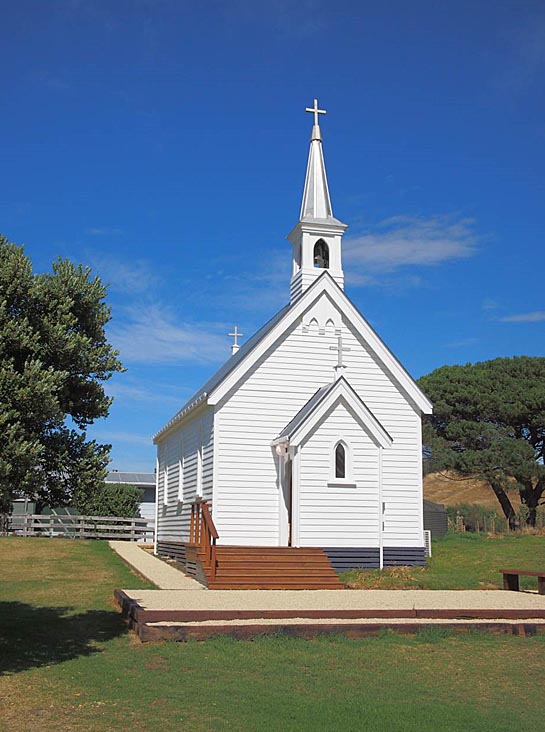
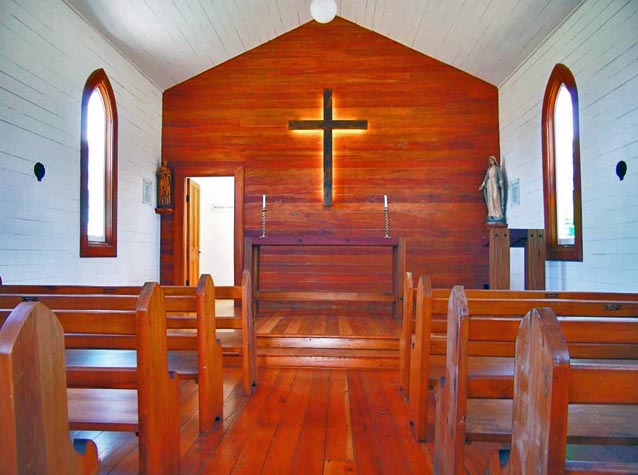
St Joseph’s Church (Catholic) is located on a flat, triangular section at the north end of Riversdale Beach, a small holiday settlement on Wairarapa’s east coast. The north-facing Gothic revival timber church is three blocks from the beach and is surrounded by open land on three sides, its spire a visible landmark in the low-rise settlement. Understated landscaping comprised of native plants complements the church’s clean, simple form. The church was restored by the St Joseph’s at Riverdale Beach Charitable Trust in 2018 and has been little altered since construction in 1881. It is the least-modified of Halbwachs’ five Wairarapa churches. The church is clad in shiplap weatherboards and is comprised of three parts: an entrance porch, nave and sacristy. The porch has a single lancet window at the front and is surmounted by a Latin cross. It is accessed by a short flight of timber steps leading to a landing at the side entrance, both of which were built in 2018. The narrow entranceway is decorated by restrained mouldings which form an archway at the top. The nave has three hinged lancet windows on each side, all of which are filled with stained glass scenes that reference traditional Catholic symbols and scenes inspired by the local community and landscape; these were designed by Heath Crawford and installed in 2018, and all were donated by local community members. The steeple at the apex of the corrugated metal gable roof has four lancet-shaped openings near the base (which houses a new bell cast by the Marinelli Bell Foundry of Italy) and a spire topped by a Latin cross. Simple mouldings echoing the lancet shapes sit within the apex below the tower. A third Latin cross is positioned above the sacristy at the rear, which has a lancet window filled with plain glass on the east elevation and an external four-panelled door on the west. Within the entrance porch, which has exposed timber trusses, double lancet-shaped doors open into a nave fully lined with horizontal tongue-and-groove timber. With the exception of the south wall behind the altar, all timber boards have been painted white, creating a pleasant contrast with the varnished floor boards, south wall and window frames. A new backlit timber cross is fixed to the south wall. Placed on the walls of the nave are the Stations of the Cross, 14 plaques representing the journey of Jesus Christ through Jerusalem on the day of his crucifixion. These new plaques, based on a 200-year-old design, were cast by the Marinelli Bell Foundry. Simple timber pews, some original and others replicas made during the 2018 restoration, line the nave. On either side of the altar are two Italian carved timber statues of the Virgin Mary and St Joseph, both of which were donated to the church in 2018. The sacristy is similarly lined with painted horizontal tongue-and-groove timber. Light is emitted through a single lancet window comprised of four plain glass panes. This space has been converted into a gallery with displays of historic photographs and associated interpretation.
St Joseph’s Church (Catholic) is located on a flat, triangular section at the north end of Riversdale Beach, a small holiday settlement on Wairarapa’s east coast. The north-facing Gothic revival timber church is three blocks from the beach and is surrounded by open land on three sides, its spire a visible landmark in the low-rise settlement. Understated landscaping comprised of native plants complements the church’s clean, simple form. The church was restored by the St Joseph’s at Riverdale Beach Charitable Trust in 2018 and has been little altered since construction in 1881. It is the least-modified of Halbwachs’ five Wairarapa churches. The church is clad in shiplap weatherboards and is comprised of three parts: an entrance porch, nave and sacristy. The porch has a single lancet window at the front and is surmounted by a Latin cross. It is accessed by a short flight of timber steps leading to a landing at the side entrance, both of which were built in 2018. The narrow entranceway is decorated by restrained mouldings which form an archway at the top. The nave has three hinged lancet windows on each side, all of which are filled with stained glass scenes that reference traditional Catholic symbols and scenes inspired by the local community and landscape; these were designed by Heath Crawford and installed in 2018, and all were donated by local community members. The steeple at the apex of the corrugated metal gable roof has four lancet-shaped openings near the base (which houses a new bell cast by the Marinelli Bell Foundry of Italy) and a spire topped by a Latin cross. Simple mouldings echoing the lancet shapes sit within the apex below the tower. A third Latin cross is positioned above the sacristy at the rear, which has a lancet window filled with plain glass on the east elevation and an external four-panelled door on the west. Within the entrance porch, which has exposed timber trusses, double lancet-shaped doors open into a nave fully lined with horizontal tongue-and-groove timber. With the exception of the south wall behind the altar, all timber boards have been painted white, creating a pleasant contrast with the varnished floor boards, south wall and window frames. A new backlit timber cross is fixed to the south wall. Placed on the walls of the nave are the Stations of the Cross, 14 plaques representing the journey of Jesus Christ through Jerusalem on the day of his crucifixion. These new plaques, based on a 200-year-old design, were cast by the Marinelli Bell Foundry. Simple timber pews, some original and others replicas made during the 2018 restoration, line the nave. On either side of the altar are two Italian carved timber statues of the Virgin Mary and St Joseph, both of which were donated to the church in 2018. The sacristy is similarly lined with painted horizontal tongue-and-groove timber. Light is emitted through a single lancet window comprised of four plain glass panes. This space has been converted into a gallery with displays of historic photographs and associated interpretation.
Historical and Associated Iwi / Hapū / Whānau
Completion Date
12th December 2019
Report Written By
Cindy Jemmett, Elizabeth Cox, Kerryn Pollock and Blyss Wagstaff
Information Sources
McGlone, Vincent J.
Fruits of toil: a history of the Catholic Church in the district of the Wairarapa, New Zealand, 1845-1956, Carterton, Roydhouse & Son, 1957.
Bay Heritage Consultants
http://masterton.spydus.co.nz/cgi-bin/spydus.exe/FULL/OPAC/ARCENQ/8733710/56099803,18.
Other Information
A fully referenced Heritage New Zealand List report is available from the Central region office of Heritage New Zealand.
Historical and Associated Iwi / Hapū / Whānau
Completion Date
12th December 2019
Report Written By
Cindy Jemmett, Elizabeth Cox, Kerryn Pollock and Blyss Wagstaff
Information Sources
McGlone, Vincent J.
Fruits of toil: a history of the Catholic Church in the district of the Wairarapa, New Zealand, 1845-1956, Carterton, Roydhouse & Son, 1957.
Bay Heritage Consultants
http://masterton.spydus.co.nz/cgi-bin/spydus.exe/FULL/OPAC/ARCENQ/8733710/56099803,18.
Other Information
A fully referenced Heritage New Zealand List report is available from the Central region office of Heritage New Zealand.
Current Usages
Uses: Civic Facilities
Specific Usage: Wedding Venue
Uses: Religion
Specific Usage: Church
Current Usages
Uses: Civic Facilities
Specific Usage: Wedding Venue
Uses: Religion
Specific Usage: Church
Location
Stay up to date with Heritage this month
