Early history
The Hobsonville Peninsula is of significance to Te Kawerau a Maki, who occupied the area before European arrival. Place names reflecting the area’s importance as an ancestral and cultural landscape include Te Waiarohia o Ngariki, Tahingamanu and Te Taungaroa – the latter referring to land in the northern part of the peninsula available for resting after a long journey or during times of food-gathering. Major inlets and water sources were important to groups occupying the area during fishing and food gathering expeditions, with numerous archaeological midden sites recorded along the peninsula foreshore. Lands on the peninsula were also suitable for planting kūmara. Permanent kāinga and pā generally appear to have been located outside the peninsula, across the harbour channels to the east and north. Both before and after European arrival, these channels formed access routes between the upper Waitematā Harbour and lands to the northwest.
Early colonial activity in the area is likely to have included kauri logging and gumdigging. In 1853, Taiarua and Tinana of Ngāti Whātua transferred the peninsula to the Crown as the Waipareira block. The following year a 139-acre portion, Waipareira No.21, was granted to Rice Owen Clark (1816-1896), a relatively well-to-do immigrant from England who was a brother to notable British engineers Edwin and J. Latimer Clark. R.O. Clark had arrived in New Zealand in 1841 with ambitions as an industrial entrepreneur, but after marrying Louisa Felgate in Wellington in 1849 became the subject of the colony’s first Supreme Court case for bigamy – which he was acquited of. R.O. and Louisa Clark subsequently relocated to Auckland, farming Waipareira No.21 before diversifying into ceramic production using quarried clay on their land.
Initially manufacturing field tiles to drain and improve the farm’s potential, the family business may have formally begun commercial production in 1864 and by the 1870s was operating from additionally acquired property in Limeburner’s Bay. Other pottery works were established nearby, including Joshua Carder’s Waitemata Pottery (mid-1860s), and Carder Brothers’ complex at Scott Point (1872). Although these busniesses manufactured a range of ceramic products – including paving tiles, flower pots and earthenware ginger beer bottles – drain and sewer pipes appear to have been a particular speciality, with Joshua Carder exporting these to locations in the South Pacific from 1870, and Carder Brothers sending them to ‘all parts of New Zealand’ by 1872. By the mid-1870s, Hobsonville had developed into a thriving community of some 25 to 30 houses, with a mixed economy based on pottery production and farming.
Pressure evidently developed among its inhabitants, said to have been mainly young in age, for purpose-created facilities for education, religious devotion and burial. Prior to 1875, religious services in Hobsonville were held in private houses, and a temporary school established in April 1875 similarly occupied a two-roomed residence attached to a carpenter’s shop near Clark’s works. Moves to create a burial ground and combined church and school occurred at a time when New Zealand had its highest recorded rate of infant mortality, and general interest in child welfare – including education – increased. Traditionally poor in its provision of education, Auckland Province’s first public or common schools were established in 1872, and by early 1875 107 full-time and 34 part-time common schools were in existence.
Creation of Hobsonville cemetery, church and school (1875-6)
As the first settler in the area and a major employer, R.O. Clark took a leading role in creating new facilities. Demonstrating both philanthropic and pragmatic approaches, he evidently supplied an acre of land within his Waipareira No.21 property for a Protestant graveyard by mid-1875, and also generated funds by charging community members for use of his scow for transporting farm produce to Auckland, utilising this profit for construction of a combined church and school on the land.
Physically and symbolically located at the centre of the settlement, the provided site was positioned on the crest of a ridge overlooking Clark’s works at Limeburners Bay, and at a junction between roads leading south to the works, east to Carder Brothers’ complex at the end of Scotts Road, and north to the main public wharf for connections with Auckland. The northern part of the property was evidently reserved for burial, the earliest recorded instance of which occurred in June 1875, being that of newborn child. An infant son of pottery works owner Walter Carder might have been buried there a few months earlier. R.O. and Louisa Clark’s own fifteen-year old son, Charles George Clark, was probably interred there in late 1875.
The southern part of the site, nearest the road junction, formed the location for a new church and school building. Construction of a small timber structure appears likely to have mostly taken place in early 1876. It was probably substantially complete when the Auckland Education Board approved funds for school furniture in June and July 1876. Additional work may have continued into 1877.
The structure was erected by Mr Danby – believed to be John Danby (1849-1923), an Albertland settler of Primitive Methodist faith who had purchased land in the district in 1871. Danby married a daughter of pottery works owner Joshua Carder in 1879, and later became a businessman, borough councillor and Sunday School leader in Thames. The new building was of simple, gabled design with a rectangular ground plan measuring some 9.15 x 5.5m (30 x 18 feet) and broadly orientated with its main axis orientated east-west. Its walls were externally clad with horizontal, overlapping weatherboards, and incorporated three pairs of opposing sash windows of twelve-pane type. The roof had a steep pitch and narrow eaves, and was shingled. The building interior was unlined. A small, gabled entrance porch was situated at the west end.
The building’s simple, Gothic-influenced design was similar to other schoolhouses and meeting houses of this period linked with low-church, Protestant faiths. Services subsequently held in the building included those by Presbyterian and possibly Primitive Methodist congregations. Conceptually, use of the building as a church and school was interconnected, respectively providing moral and practical instruction. Its construction broadly coincided with the arrival of a resident Presbyterian minister in the district, Robert Sommerville, who had previously been chairman of Devonport’s District Education Committee – overseeing enlargement of the Devonport school in 1875. A contributor to the fund for church construction, Sommerville was the first Auckland businessman to have been trained and ordained to the Presbyterian ministry, and also became notable as a Moderator of the General Assembly in 1883.
The school initially operated on a part-time basis under the auspices of the Auckland Education Board. In 1877, 23 children were on the Hobsonville roll: fourteen boys and nine girls. Also in 1877, a public library opened inside the building, with R.O. Clark as librarian. Reflecting its value to the wider community, library trustees included a cross-section of Hobsonville society, including local farmers, pottery works owners, potters and labourers.
Ongoing use as a church, school and library (1878-1894)
On 28 November 1877, the 1877 Education Act introduced free, secular education for all Pākehā children between the ages of seven and thirteen, and made attendance compulsory if living less than two miles by public road from a school. Almost immediately, Clark formally conveyed the land and building to five trustees, consisting of his son R.O. Clark II, Joshua Carder, Thomas Scott, William Sinton and Joshua Occleston (or Ockleston) – all described as farmers. The property was ‘to be used occupied and enjoyed as a place of public religious worship for the service of God by all Protestants residing in the District within a radius of Two miles from the land hereby conveyed and for a Protestant School for the said District…’. The building was to be employed for services at least four times per year and was not to be used ‘for dancing or other frivolous amusement’. The cemetery was similarly for ‘the interment of protestants having been resident or who should die within the aforesaid radius…’
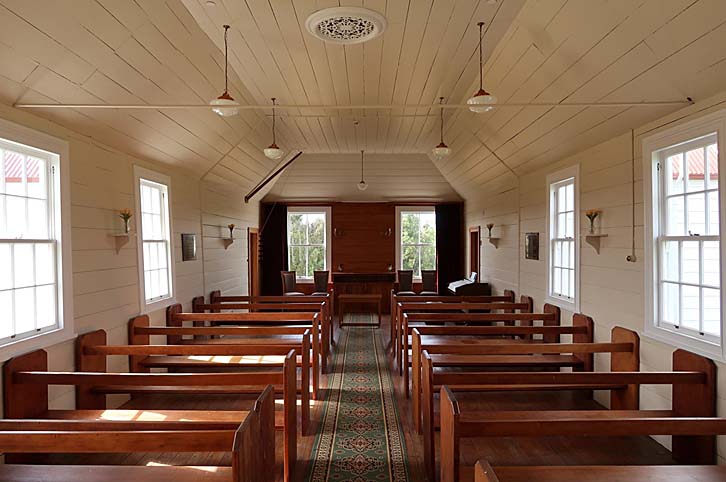
Improvements to the property following its transfer included internal lining for the main building in 1879, the addition of a water tank (since removed) in 1880 and construction of a post and wire fence with associated ditch around the property by 1881. In 1883 the building was painted, and repairs, including to closets and the water tank, were undertaken in 1889. In 1885, the school became full-time.
Multi-purpose use expanded to include employment as a room for gatherings of the Hobsonville Band of Hope – an organisation connected with the temperance movement; a polling station for elections to the Waitemata County Council and the House of Representatives; and a venue for school committee elections. Respective leaders of the school committee included R.O. Clark, another potter George Vazey (who owned Vazey’s works at Hobsonville between the mid-1870s and late 1880s) and building trustee Thomas Scott.
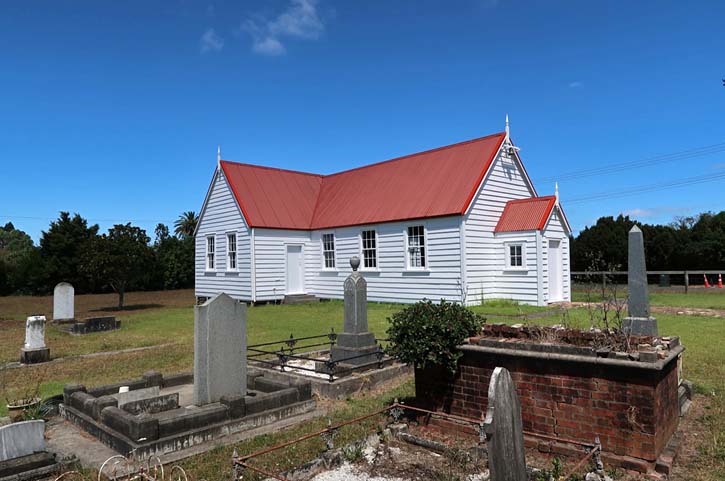
Through these uses, the place gained connections with notable aspects of women’s history. Considered advanced internationally in allowing parent participation in educational affairs, the 1877 Education Act enabled women to stand on school committees, and an early example in Auckland was Barbara McLeod, elected to the Hobsonville School Committee in 1881: the vote of local householders took place inside the building. In 1893, the building was also used as a polling station during the first parliamentary elections in which women exercised the vote – the earliest occasion internationally in which a self-governing country had provided this right. The relatively elevated social status of women connected with Hobsonville’s business community may be indicated by a substantial graveyard monument to Emma Vazey – the wife of manufacturer George Vazey and a daughter of Joshua Carder – who was commemorated by a large brick tomb, prominently placed near the building’s front porch after her death in 1883. Women as well as men were engaged in Hobsonville’s brick and tile manufacture.
During the economic depression of the late 1880s and early 1890s, several of pottery works closed and that of R.O. Clark’s son R.O. Clark II became pre-eminent. In 1890, New Zealand’s first Liberal government was elected, committed to improving the lives of the less privileged, and in 1894 passed the Schools Attendance Act which sought to strengthen the number of children attending classes. At Hobsonville, a larger, purpose-built school separate from the church was planned with a capacity for 50 pupils. This opened in early 1895, as the economic recession began to lift.
Expansion and use as a Presbyterian Church (1895-1967)
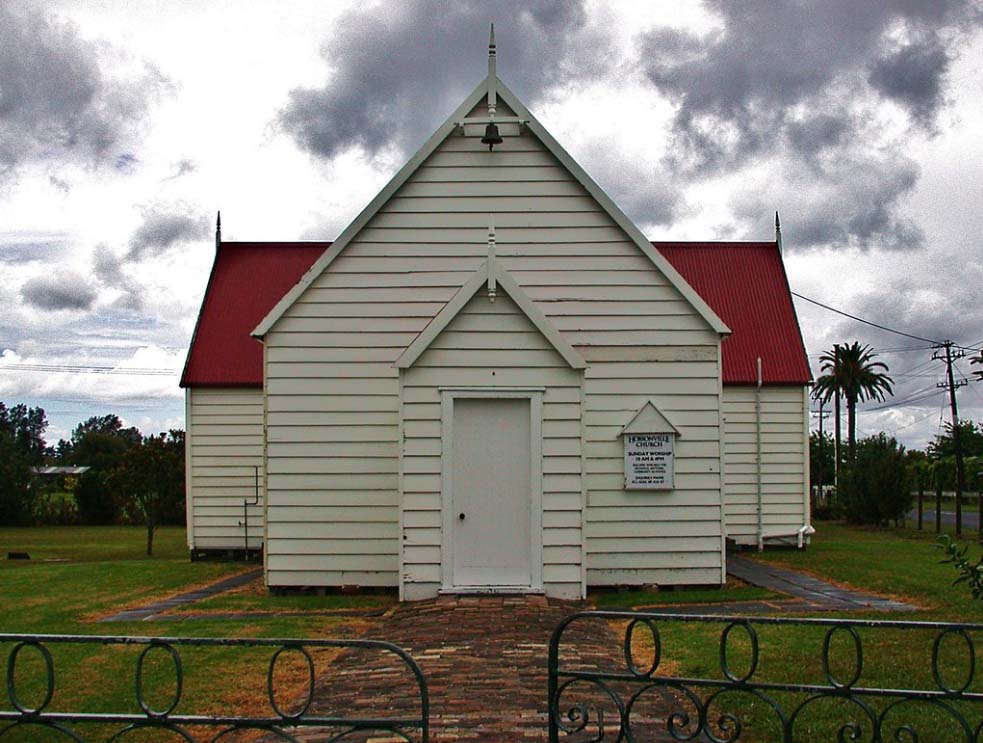
Following relocation of school activities, the community soon raised funds to enlarge the 1870s building as a church, which may have been undertaken by late 1895. The building was lengthened eastwards, and had two transepts added – one evidently for use by a minister and the other for Sunday School classes. The latter was initially without a ceiling and otherwise unlined. Reflecting its more specific religious function, the changes provided the building with a more distinctive and impressive church-like appearance.
Several individuals connected with the building were buried in the graveyard in 1895 and 1896, including R.O. Clark, Joshua Carder and Joshua Ockleston. As the economy continued to improve, R.O. Clark II’s firm won gold medals for socket glazed pipes and other products at the Auckland Industrial and Mining Exhibition in 1898, and also developed new products such as the ultimately unsuccessful ceramic blocks used to build his nearby residence Ngaroma (1897-1902) and other buildings. By the early 1900s, Clark’s works was ‘one of the largest producers in the colony of bricks, pipes, tiles and other clay products…’ In 1905, R.O. Clark II also died, after which the company underwent a brief period of further expansion under R.O. Clark III before consolidating under the management of another of R.O. Clark II’s sons, Thomas Edwin Clark.
By 1911, Sunday School classes were said to have averaged 70 to 80 children. In 1918, the church was used to welcome soldiers home from the First World War (1914-18). Two grandsons of R.O. Clark, P.L. and H.L. Midgley, respectively died at Gallipoli and of wounds received in France, and were commemorated in the graveyard. Community concerts were occasionally held, with timbers for a stage stored in the rafters of the Sunday School room. Further improvements to the building included lining and ceiling the latter space, and replacing roof shingles with corrugated iron. Another economic depression saw the Clark’s works finally close in 1931 – by which time the family had become prime shareholders in a new combined company based at New Lynn known as the Amalgamated Brick and Pipe Company Limited, which later became notable as Crown Lynn and then Ceramco.
Decline of Hobsonville’s pottery industry broadly coincided with the establishment and growth of the Hobsonville air base a short distance to the north – subsequently used during conflict in the Pacific in the Second World War (1939-45). In 1940, the church property was formally transferred to the Presbyterian Church, when Hobsonville church merged with St Andrew’s Church, Henderson. During the 1950s and 1960s, some families from the air base attended the church, when the initial porch was replaced by a larger structure. After further reorganisation by the Presbyterian authorities, the church closed in 1967. For a period, the building was used by an Air Scout group, with maintenance carried out by community members. In 1971, land beside Scott Road that had been used as part of the church property was found to be formally within the road reserve and although still retained within the fenced site, a corresponding strip was added to the northern part of the property.
In 1998, the land was transferred to Hobsonville Church and Settlers’ Cemetery Preservation Society (Inc.), a community group with close connections to the area that sought to maintain and restore the building. Restoration work by the society had begun in 1995, when notable industrialist Sir Tom Clark (1916-2005) and Valmai Ockleston (1909-2001), respectively descendants of founding church members R.O. Clark and Joshua Ockleston, planted two commemorative kahikatea at the entrance to the property – assisted by other descendants David Harre and Geoff Ockleston. Works in the late 1990s included repiling, replication of the earlier porch in place of the later modification, and reinstatement of a narrow doorway from the porch to the main body of the church.
The building is still in use as a community venue for weddings and other events (2019). Its graveyard also remains in use, with a cremation wall added in 2007.