

Born in Christchurch in 1917, Sutton was educated at the Canterbury College School of Art in the 1930s. He returned to teach at the School of Fine Arts in 1939 and remained there for 40 years. As a practising artist and teacher, Sutton was influential in promoting a nationalist style of painting combining local responses to landscape with international method. In 1963 Sutton’s colleague at the School of Fine Arts, Tom Taylor, a sculptor with architectural training, designed Sutton a combined home and studio at 20 Templar Street.
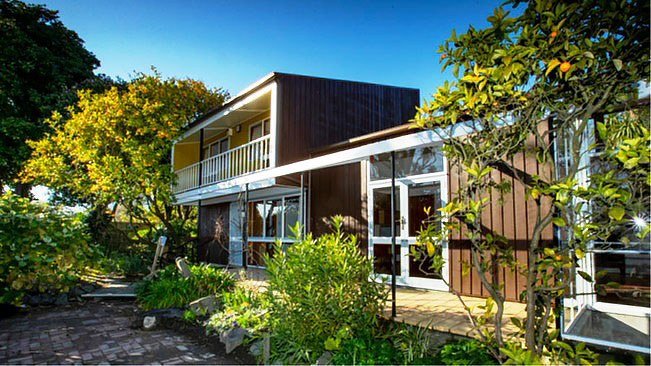
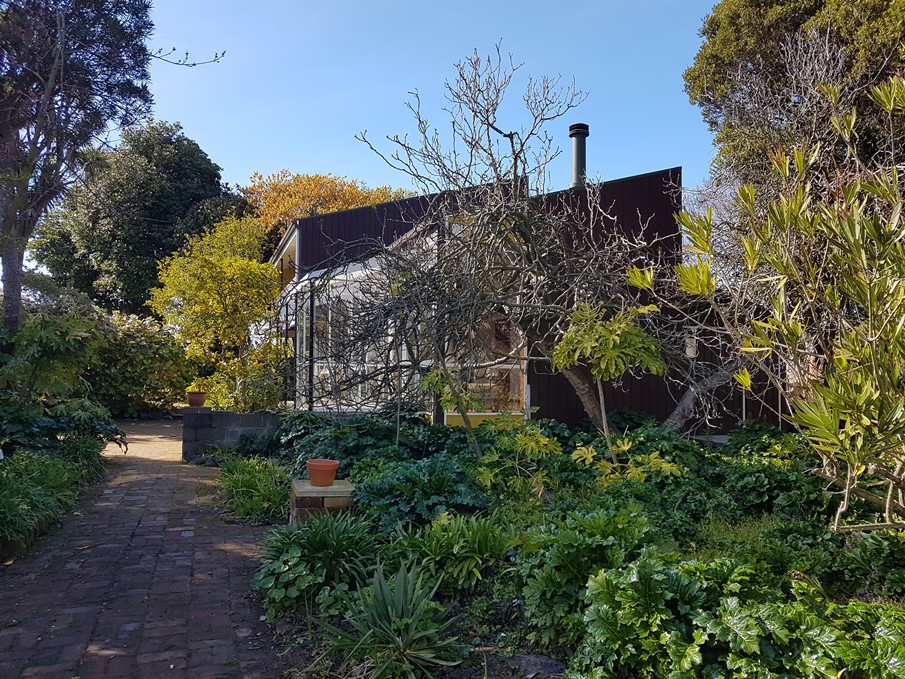
The location, orientation and light-filled design of the house enables access to and views of the established lush garden. Containing more than 30 specimen trees, a large brick courtyard, rock features and edging and paths laid by Sutton, the garden is integrally connected to the house. Stylistically the modernist house is a one and two storeyed timber structure with a mono-pitched roof. Its main façade fronts north, at right angles to the street, and has a two-storeyed living block at the east end and a spacious single storied studio/living room with projecting glasshouse at the west end. The form, spaces, materials, structural elements, ceilings, walls, joinery, doors, fittings, hardware, stairs, balustrades and steps, built-in furniture, finishes, flooring and design elements, including in-built tapa cloth and plaster cast inset in the studio, retain a high degree of authenticity. The design and layout of the Sutton House and Garden is largely intact and is little changed since its early design and development.
Sutton created many of his mid to late career works in the studio at the house, including his landscape painting of the 1960s to 1980s in which he employed a greater level of abstraction on large canvases, facilitated by the open interior space of the studio. He remained at the house until his death in 2000. In 2002, Neil Roberts, at that time senior curator at the Christchurch Art Gallery, purchased the house from Sutton’s estate and in around 2006 updated the upstairs bathroom and made other minor changes at the south rear of the house. Although the building suffered minimal damage in the 2010 and 2011 earthquakes, the surrounding riverside neighbourhood sustained significant land damage and the property was included within the residential ‘red zone’. While other such ‘red zoned’ buildings were acquired by the Crown and demolished the Sutton House was, through pressure by heritage advocates and the existence of a heritage covenant on the place, retained by the vested owner, Land Information New Zealand. In 2019-2020, repaired and restored, its ownership was transferred to the Christchurch City Council and it is leased to the Sutton Heritage House and Garden Charitable Trust.
List Entry Information
Status
Listed
List Entry Status
Historic Place Category 1
Access
Private/No Public Access
List Number
9845
Date Entered
17th February 2022
Date of Effect
9th March 2022
City/District Council
Christchurch City
Region
Canterbury Region
Extent of List Entry
Extent includes part of the land described as Pt RS 33 (RT 958751), Canterbury Land District and the building known as Sutton House and Garden, including street-fronting concrete block fence thereon, and the following chattels: Easel and Portrait Chair.
Legal description
Pt RS 33 (RT 958751), Canterbury Land District
Status
Listed
List Entry Status
Historic Place Category 1
Access
Private/No Public Access
List Number
9845
Date Entered
17th February 2022
Date of Effect
9th March 2022
City/District Council
Christchurch City
Region
Canterbury Region
Extent of List Entry
Extent includes part of the land described as Pt RS 33 (RT 958751), Canterbury Land District and the building known as Sutton House and Garden, including street-fronting concrete block fence thereon, and the following chattels: Easel and Portrait Chair.
Legal description
Pt RS 33 (RT 958751), Canterbury Land District
Why is this place significant?
Cultural Significance
Cultural Significance or Value Sutton House and Garden has cultural significance, in its reflection of artistic achievements created in and associated with the place. From the outset, this association has been valued by many in arts circles, including all its owners – the late Bill Sutton, the renowned Canterbury artist for whom the house was designed, subsequent owner Neil Roberts, himself a former fine arts student of Sutton’s and art gallery curator, and now the Sutton House and Garden Charitable Trust who operate the place for artists in residence. Little changed since the time when Sutton lived there and created so much of his art, the house is intimately connected with most of Sutton’s celebrated works – both landscapes and portraiture. Social Significance or Value Sutton House and Garden has social significance in that it brings people together and matters to existing communities because of its special characteristics and associations. Sutton is well known for welcoming students, colleagues and other artist friends to this place, and regularly and generously hosting social gatherings. Still today, in the twenty first century, many have fond memories of visiting Bill Sutton at his house, with its in-progress art works and exotic lush garden. When the house was at risk of demolition as part of the programme of clearing residential ‘red zone’ properties following the Canterbury Earthquakes of 2010 and 2011, the house was saved due to strong community and councillor advocacy, backed by an existing conservation covenant in place. The Sutton House and Garden has been restored and passed on to the Christchurch City Council and is run by the Sutton House and Garden Charitable Trust in a way that allows the place to continue as a space and opportunity for people to form bonds with each other. The trust operates an Artist in Residence programme, holds open days at the property and periodically makes it available as a community meeting place. In addition, the Burgundian Romanesque plaster cast built into the wall of the studio forms a memorial to a connection with Bill’s involvement at the Art School, both as a student and a teacher.
Historic Significance
Historical Significance or Value Sutton House and Garden has historical value in its direct association with nationally renowned artist, Bill Sutton, described as one of Christchurch’s most significant modernist artists and a key figure in twentieth century landscape painting in New Zealand. Sutton’s landscapes, many created in the Templar Street studio, have a firm place in New Zealand’s history of art and fits into our maturity in understanding of the land as part of our national identity. Along with fellow Canterbury artists, such as Rita Angus, he developed a distinctive interpretation of the landscape. His vision became more abstract as he gave a new identity to the imagery within the Canterbury landscape. Works like his Plantation series provided social commentary, confronting how large pine plantations were drastically affecting the landscape. His works fit into the wider development of post-impressionism, regionalism, internationalism, abstraction and post-modernism. The survival and retention of Sutton House and Garden is part of the story of the drastic events and unprecedented rapid change due to the Canterbury Earthquakes of 2010-2011, notably in the immediate surrounds of Richmond and Avonside.
Physical Significance
Aesthetic Significance or Value Sutton House and Garden has aesthetic qualities that are considered especially pleasing, both in the modernist design of the home studio and in its relationship with the tranquil garden filled with exotic plantings and dappled light. The visual contrasts, use of colour, the modest scale of the house and the surrounding enclosed lush garden, in what is now the edge of open park-like space close to Ōtākaro /Avon River, appeals to the senses. There is a strong sense of place associated with the life of artist, Bill Sutton. This is demonstrably valued, as evidenced when there was community outcry when the house was threatened with demolition. Its retention elicits an emotional response in the context of it being a rare symbolic survivor within an area hit especially hard by the Canterbury earthquakes of 2010-2011. Architectural Significance or Value Sutton House and Garden has architectural significance. Designed by an artist with architectural training, Tom Taylor, for fellow artist and close colleague, Bill Sutton, the compact house was created specifically for Sutton to reside, make his art and host social gatherings. Its integrated purpose-designed studio/living room is particularly notable. Its natural lighting, space and high ceiling were designed for the purpose of painting, which no doubt enabled Sutton to produce the larger canvasses that he became known for. Whereas houses typically would have their main façade fronting the street, Taylor designed the house at Templar Street so that the main façade faced north (side-on to the street), opening onto a patio which bordered what became Sutton’s garden, filled with native and exotic plantings. The architectural style successfully combines conventions of the traditional with the modern, reflecting Sutton’s own art practice. It blends elements akin to a colonial cottage with the functional requirements of an artist’s studio. While its vertical tongue and groove timber features reference earlier traditional forms, the building consciously employs modernist features such as (de Stihl-like) vertical and horizontal lines, mono-pitch roofs, plain east elevation and box-like rear. The interior contributes to the architectural significance, evidencing the period of construction through its design and materials. The form, spaces, materials, structural elements, ceilings, walls, joinery, doors, fittings, hardware, stairs, balustrades and steps, built-in furniture, finishes, flooring and design elements retain a high degree of authenticity. The architecture has achieved recognition by architectural experts, including in Jeremy Hansen’s edited Modern: New Zealand Homes from 1938 to 1977 (2013).
Why is this place Category 1 / Category 2?
Detail Of Assessed Criteria
(a) The extent to which the place reflects important or representative aspects of New Zealand history Sutton House and Garden relates to aspects of New Zealand art history, being the purpose-built home, studio and garden of one of New Zealand’s important twentieth century artists, Bill Sutton. This place is particularly able to reflect those aspects of New Zealand’s history because it is easily readable as the place designed for Sutton by fellow artist and colleague, Tom Taylor. It is well documented that Sutton produced most of his celebrated work – both landscapes and portraiture – during his 37 years there. He recorded the landscape in all its diversity, exploring equally diverse styles and techniques. Works such as the Plantation series of 1986-1987, created in his studio, are strong, richly textured and coloured landscapes, painted on an epic scale, capturing the geographic essence of Canterbury, changed by people and the forces of nature. His paintings of the Canterbury landscape have come to be seen as expressing regional, if not national, characteristics. The fact that Sutton House and Garden has been retained – a solitary survivor in what was otherwise a cleared swathe of formerly occupied residential suburban Richmond - is a tangible reflection of the trauma and tensions of the Canterbury Earthquakes of 2010 and 2011, a major natural disaster in what is New Zealand’s second largest city, and response. As with other areas of post-quake clearance, including in the Christchurch Central Business District and around the Ōtākaro /Avon River corridor, there is an opportunity to better understand the earlier Māori and colonial history of the area and interaction with the land and river. (b) The association of the place with events, persons, or ideas of importance in New Zealand history The place is directly associated with artist, calligrapher, teacher and social commentator, Bill Sutton. In later decades, from his home studio at Templar Street, Sutton’s landscapes became more abstract as he gave a new identity for the imagery of Canterbury. Sutton was a key figure in twentieth century landscape painting in New Zealand. Sutton’s connection with Canterbury and its landscape led him to produce iconic paintings such as Dry September (1949), Nor’wester in the Cemetery (1950), and the Four Seasons series (the latter being produced in the studio at his house at Templar Street, 1968-1969/70). Taylor’s achievement was to design a home for Sutton that embodied the artist’s needs and personality, his strengths and contradictions. It was designed very much for Bill Sutton – for an artist by an artist - a bachelor’s house with the studio taking up the main space. As a long-time teacher of sculpting at the School of Fine Arts at the University of Canterbury, Tom Taylor inspired numerous other New Zealand sculptors, including Bing Dawe, Neil Dawson, Grahame Bennett, Chris Booth, Pauline Rhodes and Phil Price. (e) The community association with, or public esteem for the place The Sutton House and Garden is associated with community public esteem. The arts community has special association with the place, many artists and those who appreciated Sutton’s works visited and socialised at the house for the 37 years that he lived there. Appreciation continued after his death, with the place being maintained by owner, Christchurch Art Gallery curator Neil Roberts. After the place was threatened with demolition following the Canterbury Earthquakes of 2010 and 2011, action by the community to retain the place led to it being restored and retained. Summary of Significance or Values As the home studio and garden of one of New Zealand’s most important twentieth century landscape artists, the Sutton House and Garden has special significance. Designed for an artist by an artist, it is easily readable as the purpose-built combined house and studio designed for the artist by sculptor Tom Taylor, Sutton’s colleague at the University of Canterbury School of Fine Arts. The natural lighting, space and high ceiling of the purpose- designed studio/living room allowed Sutton to produce the larger landscape canvasses that he is so well-known for. The lush ‘modern garden’ designed and planted by Sutton was an extension of his living space and its evolving design reflected his personality and connection to nature in a way that reflects his approach to making art. Most of Sutton’s celebrated works – both landscapes and portraiture – were produced during his 37 years at 20 Templar Street. The interior and exterior of the dwelling and the integrated garden have high integrity and authenticity and convey with immediacy the way of life of one of New Zealand’s most important artists, providing valuable context with insight into his work. The place has become a rare survivor within the Christchurch residential ‘red zone’ where almost all buildings have now been demolished.
Why is this place significant?
Cultural Significance
Cultural Significance or Value Sutton House and Garden has cultural significance, in its reflection of artistic achievements created in and associated with the place. From the outset, this association has been valued by many in arts circles, including all its owners – the late Bill Sutton, the renowned Canterbury artist for whom the house was designed, subsequent owner Neil Roberts, himself a former fine arts student of Sutton’s and art gallery curator, and now the Sutton House and Garden Charitable Trust who operate the place for artists in residence. Little changed since the time when Sutton lived there and created so much of his art, the house is intimately connected with most of Sutton’s celebrated works – both landscapes and portraiture. Social Significance or Value Sutton House and Garden has social significance in that it brings people together and matters to existing communities because of its special characteristics and associations. Sutton is well known for welcoming students, colleagues and other artist friends to this place, and regularly and generously hosting social gatherings. Still today, in the twenty first century, many have fond memories of visiting Bill Sutton at his house, with its in-progress art works and exotic lush garden. When the house was at risk of demolition as part of the programme of clearing residential ‘red zone’ properties following the Canterbury Earthquakes of 2010 and 2011, the house was saved due to strong community and councillor advocacy, backed by an existing conservation covenant in place. The Sutton House and Garden has been restored and passed on to the Christchurch City Council and is run by the Sutton House and Garden Charitable Trust in a way that allows the place to continue as a space and opportunity for people to form bonds with each other. The trust operates an Artist in Residence programme, holds open days at the property and periodically makes it available as a community meeting place. In addition, the Burgundian Romanesque plaster cast built into the wall of the studio forms a memorial to a connection with Bill’s involvement at the Art School, both as a student and a teacher.
Historic Significance
Historical Significance or Value Sutton House and Garden has historical value in its direct association with nationally renowned artist, Bill Sutton, described as one of Christchurch’s most significant modernist artists and a key figure in twentieth century landscape painting in New Zealand. Sutton’s landscapes, many created in the Templar Street studio, have a firm place in New Zealand’s history of art and fits into our maturity in understanding of the land as part of our national identity. Along with fellow Canterbury artists, such as Rita Angus, he developed a distinctive interpretation of the landscape. His vision became more abstract as he gave a new identity to the imagery within the Canterbury landscape. Works like his Plantation series provided social commentary, confronting how large pine plantations were drastically affecting the landscape. His works fit into the wider development of post-impressionism, regionalism, internationalism, abstraction and post-modernism. The survival and retention of Sutton House and Garden is part of the story of the drastic events and unprecedented rapid change due to the Canterbury Earthquakes of 2010-2011, notably in the immediate surrounds of Richmond and Avonside.
Physical Significance
Aesthetic Significance or Value Sutton House and Garden has aesthetic qualities that are considered especially pleasing, both in the modernist design of the home studio and in its relationship with the tranquil garden filled with exotic plantings and dappled light. The visual contrasts, use of colour, the modest scale of the house and the surrounding enclosed lush garden, in what is now the edge of open park-like space close to Ōtākaro /Avon River, appeals to the senses. There is a strong sense of place associated with the life of artist, Bill Sutton. This is demonstrably valued, as evidenced when there was community outcry when the house was threatened with demolition. Its retention elicits an emotional response in the context of it being a rare symbolic survivor within an area hit especially hard by the Canterbury earthquakes of 2010-2011. Architectural Significance or Value Sutton House and Garden has architectural significance. Designed by an artist with architectural training, Tom Taylor, for fellow artist and close colleague, Bill Sutton, the compact house was created specifically for Sutton to reside, make his art and host social gatherings. Its integrated purpose-designed studio/living room is particularly notable. Its natural lighting, space and high ceiling were designed for the purpose of painting, which no doubt enabled Sutton to produce the larger canvasses that he became known for. Whereas houses typically would have their main façade fronting the street, Taylor designed the house at Templar Street so that the main façade faced north (side-on to the street), opening onto a patio which bordered what became Sutton’s garden, filled with native and exotic plantings. The architectural style successfully combines conventions of the traditional with the modern, reflecting Sutton’s own art practice. It blends elements akin to a colonial cottage with the functional requirements of an artist’s studio. While its vertical tongue and groove timber features reference earlier traditional forms, the building consciously employs modernist features such as (de Stihl-like) vertical and horizontal lines, mono-pitch roofs, plain east elevation and box-like rear. The interior contributes to the architectural significance, evidencing the period of construction through its design and materials. The form, spaces, materials, structural elements, ceilings, walls, joinery, doors, fittings, hardware, stairs, balustrades and steps, built-in furniture, finishes, flooring and design elements retain a high degree of authenticity. The architecture has achieved recognition by architectural experts, including in Jeremy Hansen’s edited Modern: New Zealand Homes from 1938 to 1977 (2013).
Why is this place Category 1 / Category 2?
Detail Of Assessed Criteria
(a) The extent to which the place reflects important or representative aspects of New Zealand history Sutton House and Garden relates to aspects of New Zealand art history, being the purpose-built home, studio and garden of one of New Zealand’s important twentieth century artists, Bill Sutton. This place is particularly able to reflect those aspects of New Zealand’s history because it is easily readable as the place designed for Sutton by fellow artist and colleague, Tom Taylor. It is well documented that Sutton produced most of his celebrated work – both landscapes and portraiture – during his 37 years there. He recorded the landscape in all its diversity, exploring equally diverse styles and techniques. Works such as the Plantation series of 1986-1987, created in his studio, are strong, richly textured and coloured landscapes, painted on an epic scale, capturing the geographic essence of Canterbury, changed by people and the forces of nature. His paintings of the Canterbury landscape have come to be seen as expressing regional, if not national, characteristics. The fact that Sutton House and Garden has been retained – a solitary survivor in what was otherwise a cleared swathe of formerly occupied residential suburban Richmond - is a tangible reflection of the trauma and tensions of the Canterbury Earthquakes of 2010 and 2011, a major natural disaster in what is New Zealand’s second largest city, and response. As with other areas of post-quake clearance, including in the Christchurch Central Business District and around the Ōtākaro /Avon River corridor, there is an opportunity to better understand the earlier Māori and colonial history of the area and interaction with the land and river. (b) The association of the place with events, persons, or ideas of importance in New Zealand history The place is directly associated with artist, calligrapher, teacher and social commentator, Bill Sutton. In later decades, from his home studio at Templar Street, Sutton’s landscapes became more abstract as he gave a new identity for the imagery of Canterbury. Sutton was a key figure in twentieth century landscape painting in New Zealand. Sutton’s connection with Canterbury and its landscape led him to produce iconic paintings such as Dry September (1949), Nor’wester in the Cemetery (1950), and the Four Seasons series (the latter being produced in the studio at his house at Templar Street, 1968-1969/70). Taylor’s achievement was to design a home for Sutton that embodied the artist’s needs and personality, his strengths and contradictions. It was designed very much for Bill Sutton – for an artist by an artist - a bachelor’s house with the studio taking up the main space. As a long-time teacher of sculpting at the School of Fine Arts at the University of Canterbury, Tom Taylor inspired numerous other New Zealand sculptors, including Bing Dawe, Neil Dawson, Grahame Bennett, Chris Booth, Pauline Rhodes and Phil Price. (e) The community association with, or public esteem for the place The Sutton House and Garden is associated with community public esteem. The arts community has special association with the place, many artists and those who appreciated Sutton’s works visited and socialised at the house for the 37 years that he lived there. Appreciation continued after his death, with the place being maintained by owner, Christchurch Art Gallery curator Neil Roberts. After the place was threatened with demolition following the Canterbury Earthquakes of 2010 and 2011, action by the community to retain the place led to it being restored and retained. Summary of Significance or Values As the home studio and garden of one of New Zealand’s most important twentieth century landscape artists, the Sutton House and Garden has special significance. Designed for an artist by an artist, it is easily readable as the purpose-built combined house and studio designed for the artist by sculptor Tom Taylor, Sutton’s colleague at the University of Canterbury School of Fine Arts. The natural lighting, space and high ceiling of the purpose- designed studio/living room allowed Sutton to produce the larger landscape canvasses that he is so well-known for. The lush ‘modern garden’ designed and planted by Sutton was an extension of his living space and its evolving design reflected his personality and connection to nature in a way that reflects his approach to making art. Most of Sutton’s celebrated works – both landscapes and portraiture – were produced during his 37 years at 20 Templar Street. The interior and exterior of the dwelling and the integrated garden have high integrity and authenticity and convey with immediacy the way of life of one of New Zealand’s most important artists, providing valuable context with insight into his work. The place has become a rare survivor within the Christchurch residential ‘red zone’ where almost all buildings have now been demolished.
Construction Professional
Name
Thomas (Tom) John Taylor (b.1925-d.1994)
Type
Designer
Biography
No biography is currently available for this construction professional
Construction Details
Start Year
2006
startYearCirca
Type
Modification
Description
Upstairs bathroom modified; south-easternmost room with washhouse extended; storeroom converted to an office.
Start Year
2019
Finish Year
2020
Type
Refurbishment/renovation
Description
Replacement garage door; installation of internal wheelchair ramp within former garage space; removal of foil insulation; insertion of two gates in the north-east corner of the boundary fence; insertion of dropped ceiling in kitchen; replacement of rotten timbers, repair of fibrous plaster wall and ceiling linings, installation of structural bracing; removal of damaged northern section of concrete block street-fronting wall.
Start Year
1963
Type
Original Construction
Construction Materials
Timber, concrete, glass, corrugated steel, brick.
Construction Professional
Name
Thomas (Tom) John Taylor (b.1925-d.1994)
Type
Designer
Biography
No biography is currently available for this construction professional
Construction Details
Start Year
2006
startYearCirca
Type
Modification
Description
Upstairs bathroom modified; south-easternmost room with washhouse extended; storeroom converted to an office.
Start Year
2019
Finish Year
2020
Type
Refurbishment/renovation
Description
Replacement garage door; installation of internal wheelchair ramp within former garage space; removal of foil insulation; insertion of two gates in the north-east corner of the boundary fence; insertion of dropped ceiling in kitchen; replacement of rotten timbers, repair of fibrous plaster wall and ceiling linings, installation of structural bracing; removal of damaged northern section of concrete block street-fronting wall.
Start Year
1963
Type
Original Construction
Construction Materials
Timber, concrete, glass, corrugated steel, brick.
Historical and Associated Iwi / Hapū / Whānau
Public NZAA Number
M35/2098
Completion Date
18th February 2022
Report Written By
Robyn Burgess
Information Sources
Hansen, 2013
Hansen, Jeremy (ed.), Modern: New Zealand Homes from 1938-1977, Auckland, 2013
Blundell, 2021
Blundell, Sally, ‘Last House Standing: The living legacy of W. A. Sutton’, Christchurch Art Gallery Te Puna o Waiwhetū, Bulletin B.204
Hoddinott, 2021
Hoddinott, Wendy, Sutton House Garden and Setting Conservation Plan, Christchurch City Council, 2021
Roberts, Coley, Fusco, Hearnshaw and Unger, 2003
Neil Roberts, John Coley, Cassandra Fusco, Vickie Hearnshaw and Pat Unger, W.A. Sutton: A Retrospective, Christchurch Art Gallery, 2003
Spoonley, 1973
Spoonley, P. (Ed.), View From a Painter’s Studio. In Practical Guide to Home Landscaping, Reader’s Digest Services Pty Ltd: Australia, (2nd ed., 1973, pp. 30–31)
Tau, 2016
Te Maire Tau, Grand Narratives, Canterbury Earthquake Recovery Authority, 2016
Unger, 2008
Unger, Pat, Bill’s Story: A Portrait of W.A. Sutton, Canterbury University Press, 2008
Unger, 1994
Unger, Pat, W.A. Sutton, Painter, Hazard Press, 1994
Other Information
Disclaimer Please note that entry on the New Zealand Heritage List/Rārangi Kōrero identifies only the heritage values of the property concerned, and should not be construed as advice on the state of the property, or as a comment of its soundness or safety, including in regard to earthquake risk, safety in the event of fire, or insanitary conditions. Archaeological sites are protected by the Heritage New Zealand Pouhere Taonga Act 2014, regardless of whether they are entered on the New Zealand Heritage List/Rārangi Kōrero or not. Archaeological sites include ‘places associated with pre-1900 human activity, where there may be evidence relating to the history of New Zealand’. This List entry report should not be read as a statement on whether or not the archaeological provisions of the Act apply to the property (s) concerned. Please contact your local Heritage New Zealand Pouhere Taonga office for archaeological advice. A fully referenced New Zealand Heritage List/Rārangi Kōrero report is available on request from the Canterbury/West Coast Office of Heritage New Zealand Pouhere Taonga.
Historical and Associated Iwi / Hapū / Whānau
Public NZAA Number
M35/2098
Completion Date
18th February 2022
Report Written By
Robyn Burgess
Information Sources
Hansen, 2013
Hansen, Jeremy (ed.), Modern: New Zealand Homes from 1938-1977, Auckland, 2013
Blundell, 2021
Blundell, Sally, ‘Last House Standing: The living legacy of W. A. Sutton’, Christchurch Art Gallery Te Puna o Waiwhetū, Bulletin B.204
Hoddinott, 2021
Hoddinott, Wendy, Sutton House Garden and Setting Conservation Plan, Christchurch City Council, 2021
Roberts, Coley, Fusco, Hearnshaw and Unger, 2003
Neil Roberts, John Coley, Cassandra Fusco, Vickie Hearnshaw and Pat Unger, W.A. Sutton: A Retrospective, Christchurch Art Gallery, 2003
Spoonley, 1973
Spoonley, P. (Ed.), View From a Painter’s Studio. In Practical Guide to Home Landscaping, Reader’s Digest Services Pty Ltd: Australia, (2nd ed., 1973, pp. 30–31)
Tau, 2016
Te Maire Tau, Grand Narratives, Canterbury Earthquake Recovery Authority, 2016
Unger, 2008
Unger, Pat, Bill’s Story: A Portrait of W.A. Sutton, Canterbury University Press, 2008
Unger, 1994
Unger, Pat, W.A. Sutton, Painter, Hazard Press, 1994
Other Information
Disclaimer Please note that entry on the New Zealand Heritage List/Rārangi Kōrero identifies only the heritage values of the property concerned, and should not be construed as advice on the state of the property, or as a comment of its soundness or safety, including in regard to earthquake risk, safety in the event of fire, or insanitary conditions. Archaeological sites are protected by the Heritage New Zealand Pouhere Taonga Act 2014, regardless of whether they are entered on the New Zealand Heritage List/Rārangi Kōrero or not. Archaeological sites include ‘places associated with pre-1900 human activity, where there may be evidence relating to the history of New Zealand’. This List entry report should not be read as a statement on whether or not the archaeological provisions of the Act apply to the property (s) concerned. Please contact your local Heritage New Zealand Pouhere Taonga office for archaeological advice. A fully referenced New Zealand Heritage List/Rārangi Kōrero report is available on request from the Canterbury/West Coast Office of Heritage New Zealand Pouhere Taonga.
Former Usages
General Usage: Accommodation
Specific Usage: Artist's Residence
General Usage: Accommodation
Specific Usage: Garden - private
General Usage: Accommodation
Specific Usage: House
General Usage: Civic Facilities
Specific Usage: Studio - art
Themes
Modern Movement
Former Usages
General Usage: Accommodation
Specific Usage: Artist's Residence
General Usage: Accommodation
Specific Usage: Garden - private
General Usage: Accommodation
Specific Usage: House
General Usage: Civic Facilities
Specific Usage: Studio - art
Themes
Modern Movement
Location
Stay up to date with Heritage this month
