Hundertwasser Public Toilets

60 Gilles Street, KAWAKAWA

Historic Place Category 1

List No. 9867

Quick links:
Kawakawa is situated in the rohe of Ngāti Hine. The rohe of Ngāti Hine is composed of hilly terrain, fertile valleys and large tracts of swampland. The main river is Te Awa Tapu o Taumerere and numerous creeks and swamps criss-cross the landscape. Into this landscape of swamp and hills settled the descendants of Hineāmaru, the ancestor of Ngāti Hine iwi.

In 1859 Maihi Paraone Kawiti (son of Ngāpuhi rangatira Te Ruki Kawiti) had asked the Governor (Gore Brown) to have the Kawakawa area settled by Pākehā and a town established. The Governor replied that he was pleased that Māori had agreed to sell the land around Kawakawa but favoured Kerikeri as the site of a town in the Bay of Islands. However, this decision was changed when coal was discovered in Kawakawa in the early 1860’s.

The Hundertwasser Public Toilets were created in 1999 and they are in the centre of town on the North Island main arterial route, State Highway 1, through Kawakawa. The building is nationally and internationally significant. This is the only public building to a Hundertwasser design in New Zealand which the architect/artist had direct involvement with its creation.

Hundertwasser has an international reputation as an architect, and has buildings in Europe, North America, Japan, and New Zealand. The buildings share common architectural features with the use of what he called tree tenants, spontaneous vegetation, and uneven floors. His buildings testify to his commitment to diversity instead of monotony, for unregulated irregularities, for living in harmony with nature, for beauty and for joy.
The public toilets started as a utilitarian concrete block structure built in 1969. The Kawakawa business community approached Hundertwasser (known locally as Fredrick) to have a building designed by the artist which would have a positive economic and artistic impact upon the town. It would make Kawakawa a destination, rather than a thoroughfare to places further north. The transformation of the building into something of beauty and a designed building which was in harmony with nature personally appealed to him as well as contributing to the community in which he now lived.

Renovation of the building was partly a community effort. The head builder and contractor were Mike Brouwers with assistance from Richard Smart and Doug Shepherd with contributions by Peter Yeates and Mike Woodman. The local Bay of Islands College students prepared the ceramic tiles, the bricks were from a former Bank of New Zealand building, recycled bottles were used, and the construction was completed by community volunteers.
The building is covered with solid plaster that is flowing in its form, recycled glass bottles are used in the building to allow light but at the same time provide privacy. The effect of the exterior building is flowing, colourful and playful it is human-centric. The roof is a living roof which includes flax, native grasses and its tree tenants. There are light and ventilation ducts on the roof that are glass with large golden balls encasing the vents. The roof has in profile two gentle curves with the centre of the roof demarcating the male and female toilets.

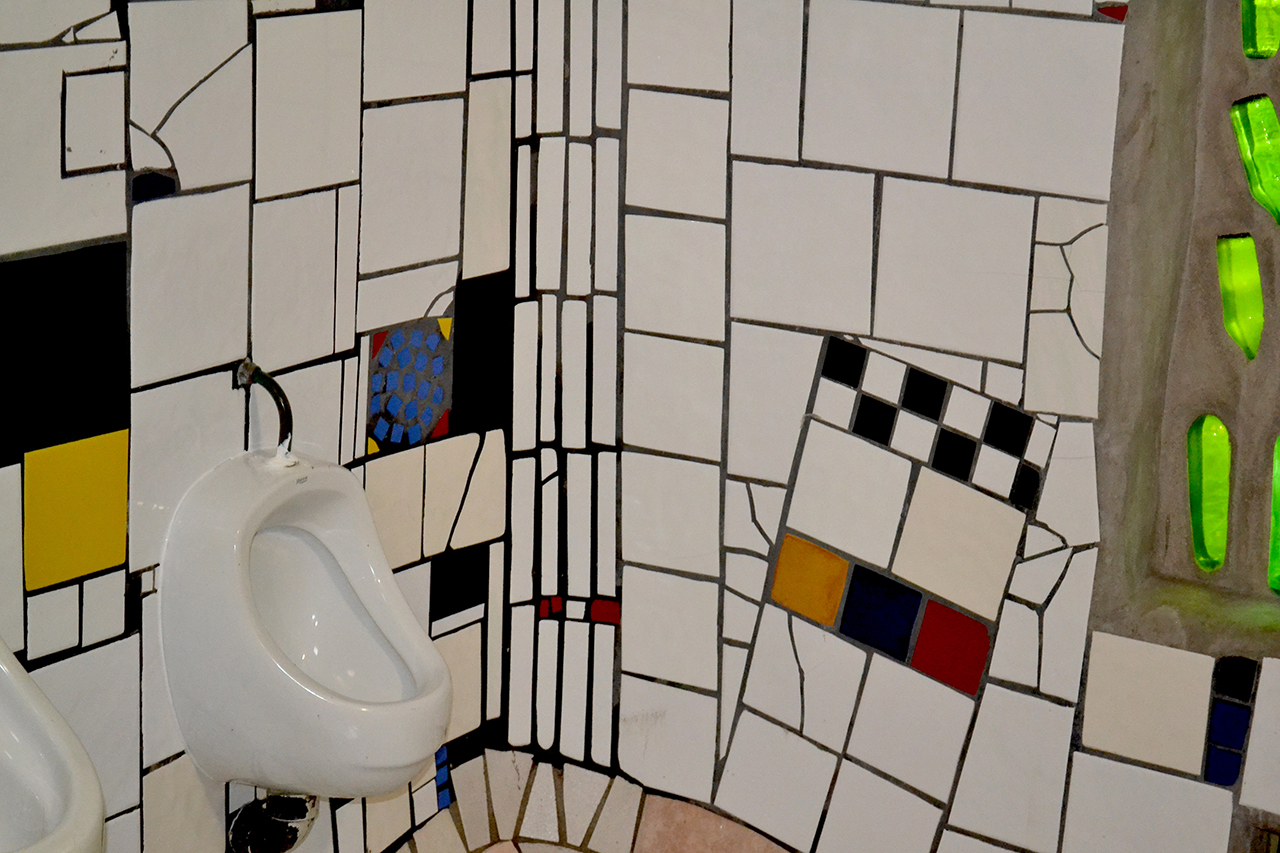
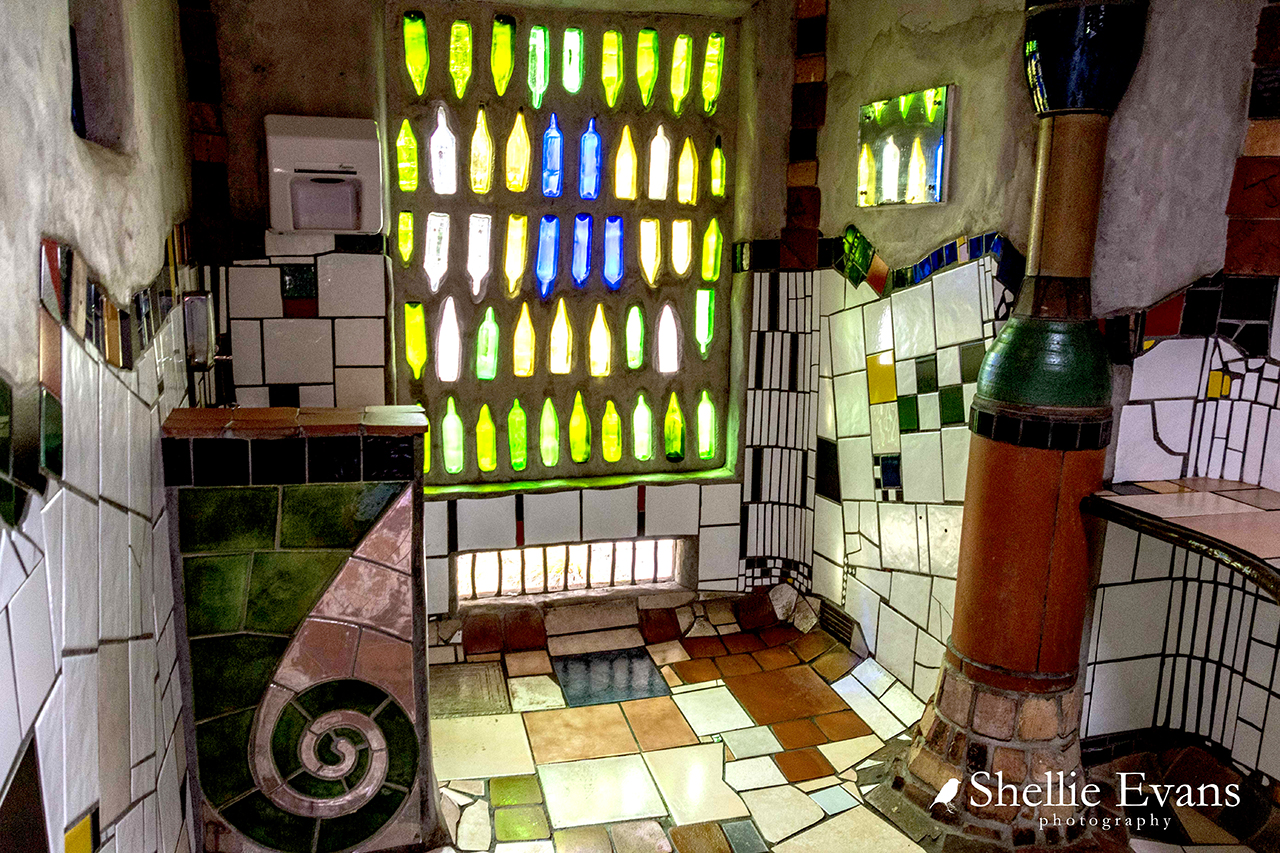
The interior of the building is a riot of colour, undulating surfaces, and curves while still functioning as a public toilet. The floors are a mix of large and small coloured tiles which are irregular in size and the floor is not flat but undulating. The walls are also not perpendicular but tiled and curve in a slight sinuous curve. Light comes into the building through the coloured bottle glass windows.

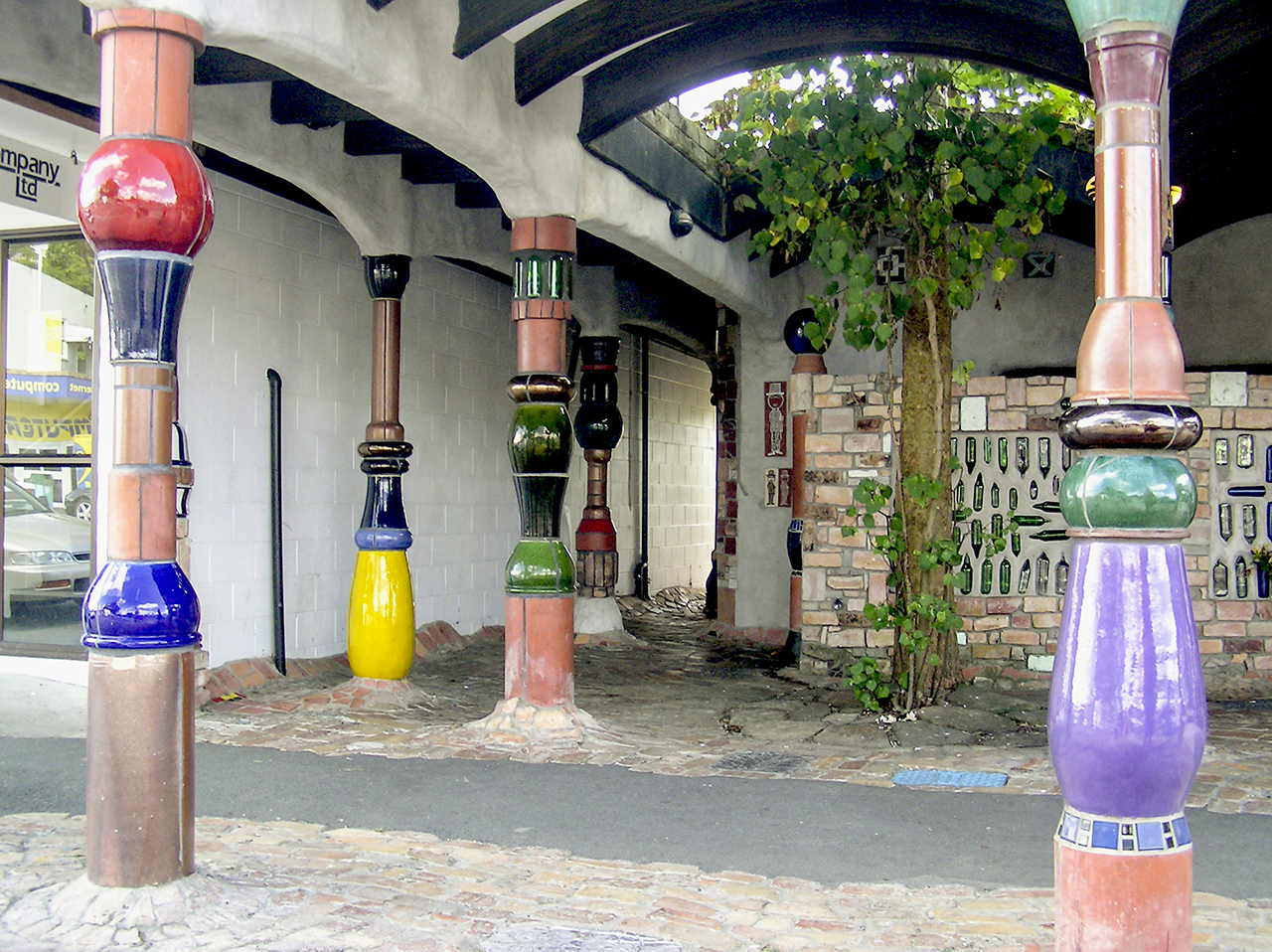
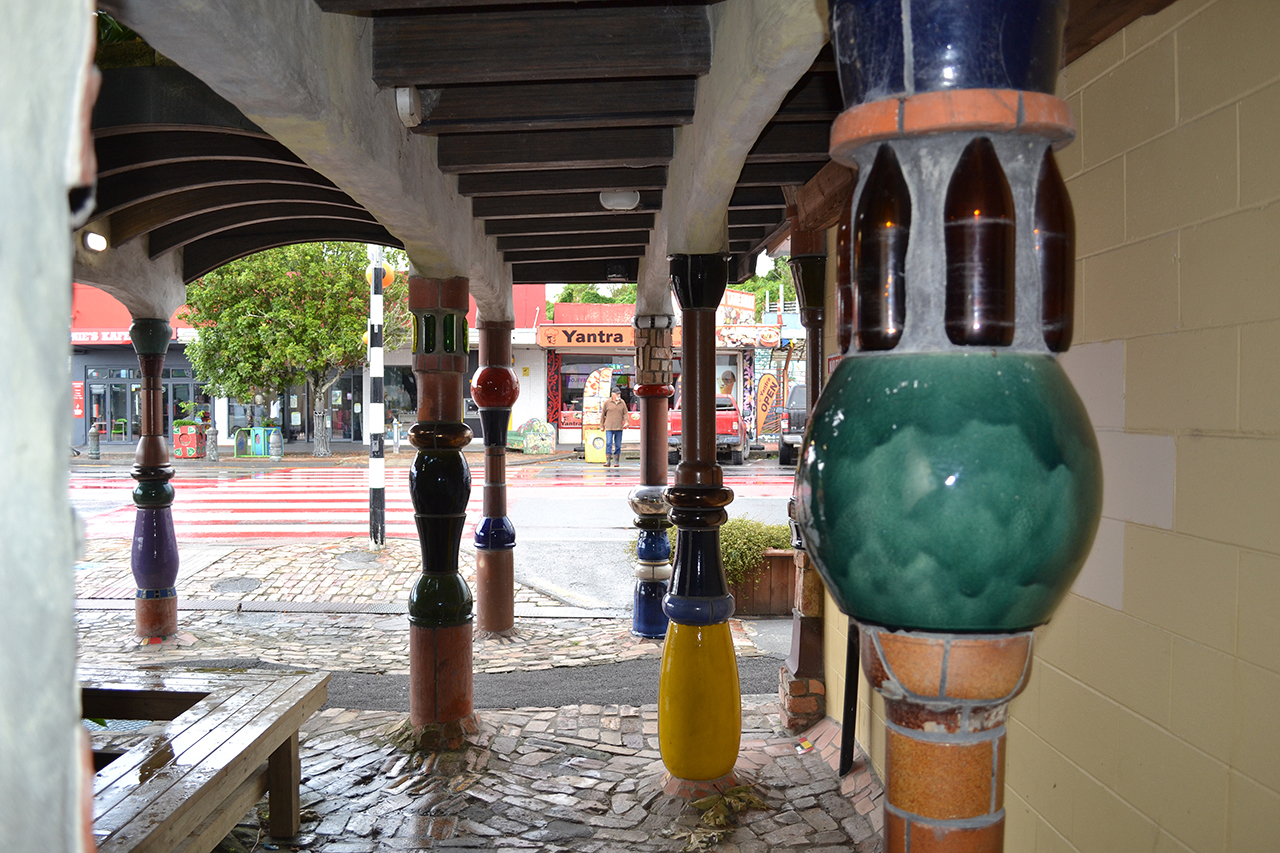
Colourful columns extend a veranda over the public footpath at the front of the building. There is a cobbled walkway which enters the building made from recycled bricks. There are also artworks of engraved clay tablets which show the outlines of trees and leaves in the walkway.

The building has not changed in form since it was constructed and remains in its original state as imagined by the visionary artist/architect. The building is a manifestation of the philosophy that the building should be a peace accord with nature. This is articulated by using recycled materials and the use of a living roof. It also expresses the vision that harmony with beauty and harmony with nature makes us really feel good; it brings joy. It is a joyful building to be in and explore. It is unique in New Zealand as it is the only public building that Hundertwasser was directly involved with.
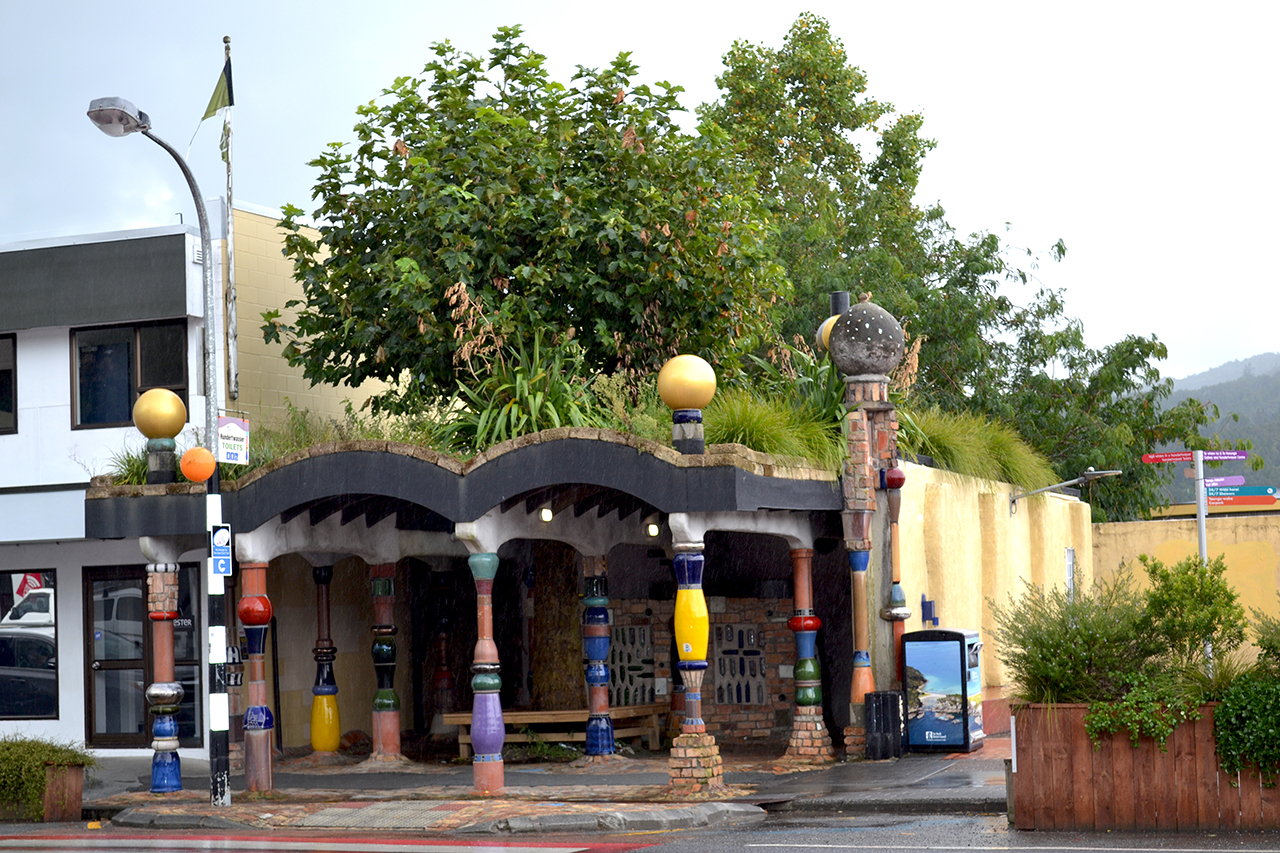
Hundertwasser Public Toilets, Kawakawa | Bill Edwards | 26/02/2023 | Heritage New Zealand Pouhere Taonga
Hundertwasser Public Toilets, Kawakawa. CC BY-SA 4.0 Image courtesy of commons.wikimedia.org | Gillfoto | 01/03/2006 | Gillfoto - Wikimedia Commons
Hundertwasser Public Toilets, Kawakawa | Bill Edwards | 26/02/2023 | Heritage New Zealand Pouhere Taonga
Hundertwasser Public Toilets, Kawakawa. Interior | Bill Edwards | 26/02/2023 | Heritage New Zealand Pouhere Taonga
Hundertwasser Public Toilets, Kawakawa. CC BY-NC-ND 2.0 Image courtesy of www.flickr.com | Shellie Evans – flyingkiwigirl | 05/03/2019 | Shellie Evans

List Entry Information

Overview

Status

Listed

List Entry Status

Historic Place Category 1

Access

Able to Visit

List Number

9867

Date Entered

29th June 2023

Date of Effect

20th July 2023

City/District Council

Far North District

Region

Northland Region

Extent of List Entry

Extent includes the land described as Lot 1 DP 46977 (RT NA35B/1242) and Legal Road, North Auckland Land District and the building known as Hundertwasser Public Toilets thereon. Extent includes the attached verandah canopy and posts and associated cobblestone paving. (Refer to map in Appendix 1 of the List entry report for further information).

Legal description

Lot 1 DP 46977 (RT NA35B/1242) and Legal Road, North Auckland Land District

Status

Listed

List Entry Status

Historic Place Category 1

Access

Able to Visit

List Number

9867

Date Entered

29th June 2023

Date of Effect

20th July 2023

City/District Council

Far North District

Region

Northland Region

Extent of List Entry

Extent includes the land described as Lot 1 DP 46977 (RT NA35B/1242) and Legal Road, North Auckland Land District and the building known as Hundertwasser Public Toilets thereon. Extent includes the attached verandah canopy and posts and associated cobblestone paving. (Refer to map in Appendix 1 of the List entry report for further information).

Legal description

Lot 1 DP 46977 (RT NA35B/1242) and Legal Road, North Auckland Land District

Significance

Why is this place significant?

Cultural Significance

Social Significance or Value The building has high social significance as its genesis came from the community. There was a direct request to the architect/artist by the Kawakawa Community Board to design a building that would have a positive economic impact upon tourism and the community. The building was built with great deal of voluntary labour including the local High School, artisans and artists from the community. The building has led to a figure quoted as 1 million visits per year and other buildings in the main street applying Hundertwasser motifs to encourage visitation and spending. The economic and social impact of the building has greatly contributed to wealth of the community not only in dollars but to an artistic vision that is apparent when you look at other buildings in the town.

Historic Significance

Historical Significance or Value The building is associated with an international artist and architect who lived and contributed to New Zealand when it was undergoing social change becoming nuclear free and the growth of the conservation movement. This is the only publicly accessible building in which the architect had a direct contribution to its construction, it is unique in New Zealand. Public toilets as visible public spaces a trend in the later twentieth century and this is a tourist attraction in its own right.

Physical Significance

Aesthetic Significance or Value The building is designed to invoke joy and beauty and form an accord with nature. The bold use of colour, uneven surfaces, curves are there to invoke a feeling of surprise and discovery. There are multicoloured tiles and sculptures that mean the sense of discovery is a journey and unfolds as you enter the building. The living roof is central to the philosophy that the building forms an accord with nature. Architectural Significance or Value The building is nationally and internationally significant. This is the only public building to a Hundertwasser design in New Zealand which the architect/artist had direct involvement with its creation. Hunderwasser has an international reputation as an architect, and has buildings in Europe, North America, Japan and New Zealand. The buildings share common architectural features with the use of what he called tree tenants, spontaneous vegetation, uneven floors. His buildings testify to his commitment to diversity instead of monotony, for unregulated irregularities for living in harmony with nature, for beauty and for joy. The building is unique it is a living entity that looks after the environment and the people who use it.

Why is this place Category 1 / Category 2?

Detail Of Assessed Criteria

This place was assessed against the Section 66(3) criteria and found to qualify under the following criteria a, b, c, e, g, h, and j. The assessment concludes that this place should be listed as a Category 1 historic place. (a) The extent to which the place reflects important or representative aspects of New Zealand history. The building aligns with environmentalism in New Zealand this is reflected in the use of recycled materials, community engagement, the use of a living roof. The revitalisation of Kawakawa through tourism - making the building the nations most visited public toilet. But importantly showcasing how architecture and art can be used to make a functionalist toilet block into an attraction and having positive economic benefit to the community. (b) The association of the place with events, persons, or ideas of importance in New Zealand history Hundertwasser was not born in New Zealand and as an international architect/artist choose to make New Zealand his home. There are three public buildings in Northland inspired by his design criteria. The idea of using recycled materials, low environmental impact, living roofs is finding credence with a larger segment of the population as we contemplate a low carbon future. His ideas on building design by using environmental principles was ahead of his time. (c) The potential of the place to provide knowledge of New Zealand history. The building expresses a fundamental optimism and joy using colour, organic shapes and choice of materials. The building provides a sense of time of nascent environmentalism when these ideas will become more important to our nation. As people explore the building they will come to understand the principles of the architect. (d) The community association with, or public esteem for the place the place is held in high public esteem by the community. It was commissioned by the community to provide stimulation to tourism and have positive economic benefits. The community were engaged in the building of the place and Kawakawa buildings have adopted many of the design motifs of Hundertwasser in the main street. The community has also commissioned another building and park in the memory of Hundertwasser that was opened in October 2020. (e) The potential of the place for public education. The building is on State Highway 1 and is highly visible because of the connection with the Hundertwasser gardens it forms an area which tells a story of the architect and artist. (g) The technical accomplishment, value, or design of the place Hundertwasser Public Toilets has special value for its technical design because of the use recycled materials, living roof, curves rather than straight lines, use of colour and use of environmental principles. (h) The symbolic or commemorative value of the place This is the only public building in New Zealand which the architect had a direct relationship with, the other buildings were built after his passing. (j) The importance of identifying rare types of historic places. There are only three examples of public Hundertwasser buildings in New Zealand. This is rarest of the subset as he was involved in the creation of the building there is only one. It is unique in New Zealand. Summary of Significance or Values Hundertwasser was an internationally renowned artist and architect and has buildings around the globe including Europe, North America, Japan, and New Zealand. This is the only public building in New Zealand that he had direct involvement with it is unique. The other public buildings in New Zealand were built after his death. The buildings share common architectural features with the use of what he called tree tenants, spontaneous vegetation, uneven floors. His buildings testify to his commitment to diversity instead of monotony, for unregulated irregularities for living in harmony with nature, for beauty and for joy. The building is unique it is a living entity that looks after the environment and the people who use it. The Kawakawa Public toilets are also associated with national movements in New Zealand being nuclear free and the raising of a national conservation ethos because of the use of living plants and recycled materials as part of the structure of the building. This ethos is becoming more mainstream as New Zealand looks at a low carbon future and the building may give lessons to future architects and designers. The Hundertwasser Public toilets were built by the community for the community to stimulate economic and artistic growth. The legacy of the building is that it has lived up to its promise and is now a tourist attraction with a reportedly one million visitors per year. The building has not only provided income from tourists, but Kawakawa has adopted many of the building techniques that Hundertwasser used, and the result is a changed face to the small town. The community hold their public toilets in high esteem as evidenced by the way the community had an active part in building and decorating the public toilets. The building is a manifestation of the philosophy of the artist/architect that the building should be a peace accord with nature. This is articulated by using recycled materials and the use of a living roof. It also expresses the vision that harmony with beauty and harmony with nature makes us really feel good; it brings joy. It is a joyful building to be in and explore. It is unique in New Zealand as it is the only public building that he was directly involved with.

Why is this place significant?

Cultural Significance

Social Significance or Value The building has high social significance as its genesis came from the community. There was a direct request to the architect/artist by the Kawakawa Community Board to design a building that would have a positive economic impact upon tourism and the community. The building was built with great deal of voluntary labour including the local High School, artisans and artists from the community. The building has led to a figure quoted as 1 million visits per year and other buildings in the main street applying Hundertwasser motifs to encourage visitation and spending. The economic and social impact of the building has greatly contributed to wealth of the community not only in dollars but to an artistic vision that is apparent when you look at other buildings in the town.

Historic Significance

Historical Significance or Value The building is associated with an international artist and architect who lived and contributed to New Zealand when it was undergoing social change becoming nuclear free and the growth of the conservation movement. This is the only publicly accessible building in which the architect had a direct contribution to its construction, it is unique in New Zealand. Public toilets as visible public spaces a trend in the later twentieth century and this is a tourist attraction in its own right.

Physical Significance

Aesthetic Significance or Value The building is designed to invoke joy and beauty and form an accord with nature. The bold use of colour, uneven surfaces, curves are there to invoke a feeling of surprise and discovery. There are multicoloured tiles and sculptures that mean the sense of discovery is a journey and unfolds as you enter the building. The living roof is central to the philosophy that the building forms an accord with nature. Architectural Significance or Value The building is nationally and internationally significant. This is the only public building to a Hundertwasser design in New Zealand which the architect/artist had direct involvement with its creation. Hunderwasser has an international reputation as an architect, and has buildings in Europe, North America, Japan and New Zealand. The buildings share common architectural features with the use of what he called tree tenants, spontaneous vegetation, uneven floors. His buildings testify to his commitment to diversity instead of monotony, for unregulated irregularities for living in harmony with nature, for beauty and for joy. The building is unique it is a living entity that looks after the environment and the people who use it.

Why is this place Category 1 / Category 2?

Detail Of Assessed Criteria

This place was assessed against the Section 66(3) criteria and found to qualify under the following criteria a, b, c, e, g, h, and j. The assessment concludes that this place should be listed as a Category 1 historic place. (a) The extent to which the place reflects important or representative aspects of New Zealand history. The building aligns with environmentalism in New Zealand this is reflected in the use of recycled materials, community engagement, the use of a living roof. The revitalisation of Kawakawa through tourism - making the building the nations most visited public toilet. But importantly showcasing how architecture and art can be used to make a functionalist toilet block into an attraction and having positive economic benefit to the community. (b) The association of the place with events, persons, or ideas of importance in New Zealand history Hundertwasser was not born in New Zealand and as an international architect/artist choose to make New Zealand his home. There are three public buildings in Northland inspired by his design criteria. The idea of using recycled materials, low environmental impact, living roofs is finding credence with a larger segment of the population as we contemplate a low carbon future. His ideas on building design by using environmental principles was ahead of his time. (c) The potential of the place to provide knowledge of New Zealand history. The building expresses a fundamental optimism and joy using colour, organic shapes and choice of materials. The building provides a sense of time of nascent environmentalism when these ideas will become more important to our nation. As people explore the building they will come to understand the principles of the architect. (d) The community association with, or public esteem for the place the place is held in high public esteem by the community. It was commissioned by the community to provide stimulation to tourism and have positive economic benefits. The community were engaged in the building of the place and Kawakawa buildings have adopted many of the design motifs of Hundertwasser in the main street. The community has also commissioned another building and park in the memory of Hundertwasser that was opened in October 2020. (e) The potential of the place for public education. The building is on State Highway 1 and is highly visible because of the connection with the Hundertwasser gardens it forms an area which tells a story of the architect and artist. (g) The technical accomplishment, value, or design of the place Hundertwasser Public Toilets has special value for its technical design because of the use recycled materials, living roof, curves rather than straight lines, use of colour and use of environmental principles. (h) The symbolic or commemorative value of the place This is the only public building in New Zealand which the architect had a direct relationship with, the other buildings were built after his passing. (j) The importance of identifying rare types of historic places. There are only three examples of public Hundertwasser buildings in New Zealand. This is rarest of the subset as he was involved in the creation of the building there is only one. It is unique in New Zealand. Summary of Significance or Values Hundertwasser was an internationally renowned artist and architect and has buildings around the globe including Europe, North America, Japan, and New Zealand. This is the only public building in New Zealand that he had direct involvement with it is unique. The other public buildings in New Zealand were built after his death. The buildings share common architectural features with the use of what he called tree tenants, spontaneous vegetation, uneven floors. His buildings testify to his commitment to diversity instead of monotony, for unregulated irregularities for living in harmony with nature, for beauty and for joy. The building is unique it is a living entity that looks after the environment and the people who use it. The Kawakawa Public toilets are also associated with national movements in New Zealand being nuclear free and the raising of a national conservation ethos because of the use of living plants and recycled materials as part of the structure of the building. This ethos is becoming more mainstream as New Zealand looks at a low carbon future and the building may give lessons to future architects and designers. The Hundertwasser Public toilets were built by the community for the community to stimulate economic and artistic growth. The legacy of the building is that it has lived up to its promise and is now a tourist attraction with a reportedly one million visitors per year. The building has not only provided income from tourists, but Kawakawa has adopted many of the building techniques that Hundertwasser used, and the result is a changed face to the small town. The community hold their public toilets in high esteem as evidenced by the way the community had an active part in building and decorating the public toilets. The building is a manifestation of the philosophy of the artist/architect that the building should be a peace accord with nature. This is articulated by using recycled materials and the use of a living roof. It also expresses the vision that harmony with beauty and harmony with nature makes us really feel good; it brings joy. It is a joyful building to be in and explore. It is unique in New Zealand as it is the only public building that he was directly involved with.

Construction Information

Construction Professional

Name

Brouwers, Mike

Type

Builder

Biography

Name

Smart, Richard

Type

Designer

Biography

Name

Yeates, Peter

Type

Artist

Biography

Ceramicist - Hundertwasser Public Toilets, Kawakawa

Name

Hundertwasser, Frederick

Type

Architect

Biography

Friedrich Stowasser, better known as Hundertwasser (German: hundred water), in 1979. Born of a Jewish family in 1928, he survived the Second World War by hiding out in Vienna. After a long-standing career in avant-garde art, where he became more famous on the Continent rather than in Anglo-Saxon countries, he died on board the QE2 while sailing from his adopted New Zealand on a trip back to Europe. In 1968 he changed his given name to Friedensreich ("abundance of peace"), and since then added the words "Regentag (Rainy day) and "Dunkelbunt" ("Dark multi coloured') to his surname. He is buried in New Zealand, in his garden of the Happy Dead, under a tulip tree. Hundertwasser's art was incredibly inventive and provided the world with some of the best art and architecture in the last decades of the 20th century. Hundertwasser spent his whole career championing the curve of organic nature against the straight line. From the mid 70s, all his marvellous buildings - such as Hundertwasser House in Vienna (1985) and the hot springs village of Blumau in Styria (1990-97) - were ergonomically curved and ecologically integrated with humus toilets supplying compost to roof gardens. From engaging in performance art in favour of mass nudity in the 60s, Hundertwasser became more and more involved in ethnic issues in the 70s (especially after he moved to New Zealand in 1973, where he became involved with Maori culture). Frederick Hundertwasser first visited New Zealand in the 1970's to mount a public exhibition of his work. He was so captured by the country that he resolved to make it his second home, purchasing an isolated rural property on the Waikino peninsula on the Waikare Inlet east of the Kawakawa. Initially he was to spend only a few months of each year in the Bay of Islands, with the majority of his time still spent in Europe - Vienna in particular. But in recent years Hundertwasser spent more and more time at his New Zealand home. Apart from the Koru flag he designed in 1983 as an alternative standard for Aotearoa, his 1990 TVNZ appearance as part of the "Living Treasures" series, and his public toilets in Kawakawa, Hundertwasser's international profile was always far higher than his New Zealand profile. http://www.bay-of-islands-nz.com/hundertwasser.shtml accessed July 2012

Construction Details

Start Year

1969

startYearCirca

Type

Original Construction

Description

Kawakawa Public Toilets

Start Year

1999

Type

Modification

Description

Hundertwasser design

Start Year

1999

Type

Addition

Description

Front verandah canopy, posts, living roof

Construction Materials

Cobblestone flooring Bottle glass windows Mosaic tiling Ceramic tiles Recycled bricks Copper handiwork

Construction Professional

Name

Brouwers, Mike

Type

Builder

Biography

Name

Smart, Richard

Type

Designer

Biography

Name

Yeates, Peter

Type

Artist

Biography

Ceramicist - Hundertwasser Public Toilets, Kawakawa

Name

Hundertwasser, Frederick

Type

Architect

Biography

Friedrich Stowasser, better known as Hundertwasser (German: hundred water), in 1979. Born of a Jewish family in 1928, he survived the Second World War by hiding out in Vienna. After a long-standing career in avant-garde art, where he became more famous on the Continent rather than in Anglo-Saxon countries, he died on board the QE2 while sailing from his adopted New Zealand on a trip back to Europe. In 1968 he changed his given name to Friedensreich ("abundance of peace"), and since then added the words "Regentag (Rainy day) and "Dunkelbunt" ("Dark multi coloured') to his surname. He is buried in New Zealand, in his garden of the Happy Dead, under a tulip tree. Hundertwasser's art was incredibly inventive and provided the world with some of the best art and architecture in the last decades of the 20th century. Hundertwasser spent his whole career championing the curve of organic nature against the straight line. From the mid 70s, all his marvellous buildings - such as Hundertwasser House in Vienna (1985) and the hot springs village of Blumau in Styria (1990-97) - were ergonomically curved and ecologically integrated with humus toilets supplying compost to roof gardens. From engaging in performance art in favour of mass nudity in the 60s, Hundertwasser became more and more involved in ethnic issues in the 70s (especially after he moved to New Zealand in 1973, where he became involved with Maori culture). Frederick Hundertwasser first visited New Zealand in the 1970's to mount a public exhibition of his work. He was so captured by the country that he resolved to make it his second home, purchasing an isolated rural property on the Waikino peninsula on the Waikare Inlet east of the Kawakawa. Initially he was to spend only a few months of each year in the Bay of Islands, with the majority of his time still spent in Europe - Vienna in particular. But in recent years Hundertwasser spent more and more time at his New Zealand home. Apart from the Koru flag he designed in 1983 as an alternative standard for Aotearoa, his 1990 TVNZ appearance as part of the "Living Treasures" series, and his public toilets in Kawakawa, Hundertwasser's international profile was always far higher than his New Zealand profile. http://www.bay-of-islands-nz.com/hundertwasser.shtml accessed July 2012

Construction Details

Start Year

1969

startYearCirca

Type

Original Construction

Description

Kawakawa Public Toilets

Start Year

1999

Type

Modification

Description

Hundertwasser design

Start Year

1999

Type

Addition

Description

Front verandah canopy, posts, living roof

Construction Materials

Cobblestone flooring Bottle glass windows Mosaic tiling Ceramic tiles Recycled bricks Copper handiwork

Historical Narrative

Early History of Kawakawa Kawakawa is situated in the rohe of Ngāti Hine. The rohe of Ngāti Hine is composed of hilly terrain, fertile valleys and large tracts of swampland. The main river is Te Awa Tapu o Taumerere and numerous creeks and swamps criss-cross the landscape. Into this landscape of swamp and hills settled the descendants of Hineāmaru, the ancestor of Ngāti Hine iwi. Kawakawa is at confluence of the Waiōmio and Waiharakeke streams. There are many archaeological sites situated downstream of Kawakawa that are associated with Māori settlement of the area; these include pā, gardens, terraces and middens. In 1859 Maihi Paraone Kawiti (son of Ngāpuhi rangatira Te Ruki Kawiti) had asked the Governor (Gore Brown) to have the Kawakawa area settled by Pākehā and a town established. The Governor replied that he was pleased that Māori had agreed to sell the land around Kawakawa but favoured Kerikeri as the site of a town in the Bay of Islands. However, this decision was changed when coal was discovered in Kawakawa in 1861. When the specimens of coal were sent to Auckland for tests it revealed that the coal was of the best quality and excellent for both steam and gas making. The District Land Commissioner Henry Tacy Kemp negotiated the purchase of 24,000 acres of land around Kawakawa from its Māori owners. The town of Kawakawa was built around coal and the first railway in the North Island was constructed in 1868 to carry coal to the nearby Taumarere Wharf and Landing on the Kawakawa River. Commercial mining for coal stopped at the beginning of the 20th century due to repeated flooding of the coal mines and farming and tourism became the principal economic activity of the area. Kawakawa Public Toilet Site The toilets are situated on the main street of Kawakawa which is State Highway 1 and has a railway line running centrally through the Highway. Both sides of the Main Street are lined with shops and the toilets are placed centrally in the town A title for part of Te Wharau Block, known as Lot 2 DP 21503, was issued to William Stewart, an agent from Auckland, and Augustus Hall, Kawakawa butcher, in 1929 before being sold to Robert Reyland, Kawakawa bootmaker, the same year. By 1951 the property had been transferred to Ernest David Taylor, Kawakawa garage proprietor who undertook a subdivision which created Lot 1 DP 46977 in 1959. In 1961 the land was an undeveloped parcel with large industrial buildings to the north and east. The land then came under Public ownership when Lot 1 was acquired by the Chairman Councillors and Citizens of the Town District of Kawakawa in 1969. By 1975 a small public toilet building with men’s and women’s conveniences had been constructed on the site. The structure was set back from the road with a small garden at the front. Prior to the 1960s public toilets were generally built ‘out of sight or hidden amongst shrubberies’ but concerns about safety and the difficulty of locating these hidden facilities led to a change in public attitudes and from this period new facilities were constructed in highly visible locations which was reflected in the placement of the new toilets on the main street of the small township. There was an active movement by the Community Board not only to improve the buildings but also to have a building that would have a positive impact upon the economy of the small town. Friedensreich Hundertwasser (15 December 1928- 19 February 2000) Friedensreich Regentag Dunklebunt Hundertwasser, born Friedrich Stowasser, is internationally recognised for his art, architecture, writing and environmental protection. He was born in Vienna to a Catholic Father and a Jewish Mother which was extremely difficult during the Nazi Regime. To avoid persecution, they posed as Christians and Friedrich joined the Hitler Youth to cement the deception. After the Second World War he trained at the Academy of Fine Arts in Vienna and his artistic career ascended from his beginnings as a hunger artist (Hungerkunstler) in the circle of the avant garde in Paris in the 1950s to the international art world. Milestones in his ascent included the 5th Sao Paulo Art Biennial, Brazil 1959; the Venice Biennale 1962; and the Documenta III in Kassel, Germany 1964; his solo exhibition at the Toyoko Gallery 1961; major museum retrospectives such as one at the Kestner Gesellschaft in Hanover Germany 1964 and numerous other exhibitions in art institutions in Europe and the United States. Architecture should elevate and not subdue man. It is good to walk on uneven floors and regain our human balance. The straight line leads to the downfall of our civilisation. This philosophy would influence the creation of the Public Toilets in Kawakawa in the southern hemisphere many years later. In 1967 Hundertwasser purchased the old salt freighter San Giuseppe T built in 1910. Over the next 7 years Hundertwasser not only got his Captain license but was also extended, remodelled, and the ship was renamed the Regentag. These extensive changes became his architectural apprenticeship and working within the curves and shapes of a wooden ship reinforced his affinity with the nonlinear built environment. In Hundertwasser’s architecture the floors roll and buckle to imitate the swell of the earth, trees grow in or out of the buildings, and most surfaces are decorated with mosaics or recycled glass. Hundertwasser buildings make statements against conventional architecture that separates the built and natural environment. This was in direct contrast to the earlier modernist movement which is perhaps best summed up by Adolf Loos a pioneer of modernist architecture (1870-1933) who proclaimed that ornamentation on buildings was a crime. Hundertwasser believed that buildings should make you happy, be beautiful, work with nature and inspire the people that live in them. He railed against uniformity and believed that architecture could provide aesthetic solutions to social problems and called the uniform buildings “slave cages.” Hundertwasser began working as an architect at the age of 55 and he treated buildings by decorating them to be in harmony with nature. He had an international career spanned multiple countries with works being created in Austria, Israel, Spain, Netherlands, United States, Switzerland, Japan and New Zealand. The international artist was invited to New Zealand in 1973 for an exhibition of his work at the Auckland Art Gallery entitled Paintings and Graphics by Hundertwasser. He stayed in New Zealand after the opening, and after buying a Morris Mini explored and travelled New Zealand meeting local people, swimming in the sea as much as possible. His first stay had lasted 148 days, and he was enthralled with the people and the country. In 1974, on his second visit to the country, he produced a poster for Conservation Week/ Te Wiki Taiki Ao Turoa which won the competition. Hundertwasser visited again in that year continued to travel around New Zealand and was gaining a more realistic appraisal of the country and commented on erosion, deforestation, lack of architectural beauty in new homes, and commercially driven farming. Hundertwasser brought a 200-ha property in the Kaurinui Valley near to Kawakawa and used the farm to expand his ethos that we must restore to nature territories which man has illegally occupied. During his lifetime it was reforested with over 150,000 trees planted. He worked closely with his neighbours and the community to realise his vision of a place in a peace treaty with nature. Hundertwasser also established links with the Kawakawa community through his efforts to preserve the historic Post Office (which was demolished) and his involvement with the Bay of Islands Vintage Railway. In 1983 Hundertwasser designed a new New Zealand flag which was based on the koru fern which combined Hundertwasser recurring artistic motif of the spiral with “that combines New Zealand’s age-old heritage of nature and the heritage of Māori history with the growing future of a new nation”. Modifying Kawakawa Public Toilets The Kawakawa business community approached Hundertwasser in 1998 (known locally as Fredrick) to have a building designed by the artist which would have a positive economic and artistic impact upon the town. It would make Kawakawa a destination, rather than a thoroughfare to places further north. The public toilet block which was a 1969 utilitarian structure was to get redesigned by Hundertwasser and incorporate many of his design features. The original building had little aesthetic merit being a concrete block structure. The transformation of the building into something of beauty and a designed building which was in harmony with nature personally appealed to him as well as contributing to the community in which he now lived. The building belonged to the Far North District Council and so they managed the project. To explain the vision to the community, Hundertwasser and his collaborator Richard Smart, who managed the Hundertwasser property, and was also involved with architecture, sculpture, and painting, created a 1:20 model which became the basis of the revamped Kawakawa toilets. Renovation of the building was partly a community effort and the work was commenced in 1999. The head builder and contractor were Mike Brouwers with assistance from Richard Smart and Doug Shepherd with contributions by Peter Yeates and Mike Woodman. The local Bay of Islands College students prepared the ceramic tiles, the bricks were from a former Bank of New Zealand building, recycled bottles were used, and the construction was completed by community volunteers. The project was managed by the Far North District Council, and the project leader was Sue Hodge. In an interview with Ms Hodge, she expressed her ongoing fear of costs for the project as Hundertwasser would make changes if aspects of the project did not fit his artistic vison. If he was not happy with aspects of the building it would be pulled down and started again. But he would pay for those changes so his artistic integrity would be preserved. Reimagined Toilets Hundertwasser’s philosophy was to modify rather than tear down modern buildings. He approached functionalist buildings with improvements that would reduce their environmental impact and beautify their appearance. This is what happened to the utilitarian Kawakawa concrete block public toilet. Hundertwasser approached the building as an architectural doctor curing the ailments of unsustainable, uniform structures. At his farm in Kaurinui in 1976 he had produced a bottle house with help from Graeme Butler and neighbours the Fagan and Shepherd families. Recycled bottles are also used in the back of the Kawakawa Public Toilet which emit light but, because of the selection of coloured bottles, also provide privacy. Another of the design elements that Hundertwasser employed in his buildings was the use of a living roof. Artist and ceramicist Peter Yeates who had helped with the Rentag contributed a roof element. Hundertwasser selected and planted two trees on the roof - “the tree tenant pays rent in a more valuable currency than a human tenant” - through supplying oxygen, regulating climate, absorbing sound, “dispensing beauty,” acting as curtains, hosting butterflies and birds, and improving the mood. All of this, to Hundertwasser, is “a symbol of reparation towards nature” through the integration of natural and inhabited environments. The trees selected were a Plane tree for the Front (southern end) of the building and a Tulip tree for the (northern) rear end. Bright colours and non-uniformity are design elements in Hundertwasser buildings, and these were employed at Kawakawa. There is a playful golden orb on the roof, recycled bricks from the dismantled Kawakawa BNZ Bank and donated bottles are used at the entrance and elsewhere in the building. The columns at the front of the building were created by Hundertwasser by assembling brightly coloured Asian ceramics. The students of the Bay of Islands College in consultation with the architect/artist prepared ceramic tiles that were used throughout the building. The floor of the building is cobblestone and, true to his philosophy that it is important to walk on an uneven surface, the cobbles are laid in an undulating form on an uneven surface. The building is quirky, colourful, undulating, and playful. The wakamanawa (blessing) was performed by Ngati Hine kaumatua Kevin Prime. Noma Shepherd, his neighbour, read his message at the opening of the building which sums up the artistic and architectural vison of Hundertwasser. “That even small things can bring beauty into our life…. It is harmony with beauty and harmony with nature, which makes us feel good. Beauty has an important function. Beauty is always underestimated.” This is the only example by Hundertwasser design on a public building in Aotearoa New Zealand during his lifetime that he actively contributed to. On July 10, 2000, the Hundertwasser Public Toilets were awarded the Premier Creative Places Award at the local Government New Zealand Annual conference. One year after the opening of the building Friedensreich Hundertwasser died and was buried in his garden – in his garden of the Happy Dead – under a Tulip tree. The legacy of Hundertwasser in Kawakawa continues with the Hundertwasser Park opening in 2020 but more importantly the Main street has adopted many of his design motifs. The toilets have had a positive economic and artistic impact upon the town and are now internationally recognised as a tourist attraction as the Kawakawa community hoped they would become. It has been estimated that they attract 1 million visits per year.

Early History of Kawakawa Kawakawa is situated in the rohe of Ngāti Hine. The rohe of Ngāti Hine is composed of hilly terrain, fertile valleys and large tracts of swampland. The main river is Te Awa Tapu o Taumerere and numerous creeks and swamps criss-cross the landscape. Into this landscape of swamp and hills settled the descendants of Hineāmaru, the ancestor of Ngāti Hine iwi. Kawakawa is at confluence of the Waiōmio and Waiharakeke streams. There are many archaeological sites situated downstream of Kawakawa that are associated with Māori settlement of the area; these include pā, gardens, terraces and middens. In 1859 Maihi Paraone Kawiti (son of Ngāpuhi rangatira Te Ruki Kawiti) had asked the Governor (Gore Brown) to have the Kawakawa area settled by Pākehā and a town established. The Governor replied that he was pleased that Māori had agreed to sell the land around Kawakawa but favoured Kerikeri as the site of a town in the Bay of Islands. However, this decision was changed when coal was discovered in Kawakawa in 1861. When the specimens of coal were sent to Auckland for tests it revealed that the coal was of the best quality and excellent for both steam and gas making. The District Land Commissioner Henry Tacy Kemp negotiated the purchase of 24,000 acres of land around Kawakawa from its Māori owners. The town of Kawakawa was built around coal and the first railway in the North Island was constructed in 1868 to carry coal to the nearby Taumarere Wharf and Landing on the Kawakawa River. Commercial mining for coal stopped at the beginning of the 20th century due to repeated flooding of the coal mines and farming and tourism became the principal economic activity of the area. Kawakawa Public Toilet Site The toilets are situated on the main street of Kawakawa which is State Highway 1 and has a railway line running centrally through the Highway. Both sides of the Main Street are lined with shops and the toilets are placed centrally in the town A title for part of Te Wharau Block, known as Lot 2 DP 21503, was issued to William Stewart, an agent from Auckland, and Augustus Hall, Kawakawa butcher, in 1929 before being sold to Robert Reyland, Kawakawa bootmaker, the same year. By 1951 the property had been transferred to Ernest David Taylor, Kawakawa garage proprietor who undertook a subdivision which created Lot 1 DP 46977 in 1959. In 1961 the land was an undeveloped parcel with large industrial buildings to the north and east. The land then came under Public ownership when Lot 1 was acquired by the Chairman Councillors and Citizens of the Town District of Kawakawa in 1969. By 1975 a small public toilet building with men’s and women’s conveniences had been constructed on the site. The structure was set back from the road with a small garden at the front. Prior to the 1960s public toilets were generally built ‘out of sight or hidden amongst shrubberies’ but concerns about safety and the difficulty of locating these hidden facilities led to a change in public attitudes and from this period new facilities were constructed in highly visible locations which was reflected in the placement of the new toilets on the main street of the small township. There was an active movement by the Community Board not only to improve the buildings but also to have a building that would have a positive impact upon the economy of the small town. Friedensreich Hundertwasser (15 December 1928- 19 February 2000) Friedensreich Regentag Dunklebunt Hundertwasser, born Friedrich Stowasser, is internationally recognised for his art, architecture, writing and environmental protection. He was born in Vienna to a Catholic Father and a Jewish Mother which was extremely difficult during the Nazi Regime. To avoid persecution, they posed as Christians and Friedrich joined the Hitler Youth to cement the deception. After the Second World War he trained at the Academy of Fine Arts in Vienna and his artistic career ascended from his beginnings as a hunger artist (Hungerkunstler) in the circle of the avant garde in Paris in the 1950s to the international art world. Milestones in his ascent included the 5th Sao Paulo Art Biennial, Brazil 1959; the Venice Biennale 1962; and the Documenta III in Kassel, Germany 1964; his solo exhibition at the Toyoko Gallery 1961; major museum retrospectives such as one at the Kestner Gesellschaft in Hanover Germany 1964 and numerous other exhibitions in art institutions in Europe and the United States. Architecture should elevate and not subdue man. It is good to walk on uneven floors and regain our human balance. The straight line leads to the downfall of our civilisation. This philosophy would influence the creation of the Public Toilets in Kawakawa in the southern hemisphere many years later. In 1967 Hundertwasser purchased the old salt freighter San Giuseppe T built in 1910. Over the next 7 years Hundertwasser not only got his Captain license but was also extended, remodelled, and the ship was renamed the Regentag. These extensive changes became his architectural apprenticeship and working within the curves and shapes of a wooden ship reinforced his affinity with the nonlinear built environment. In Hundertwasser’s architecture the floors roll and buckle to imitate the swell of the earth, trees grow in or out of the buildings, and most surfaces are decorated with mosaics or recycled glass. Hundertwasser buildings make statements against conventional architecture that separates the built and natural environment. This was in direct contrast to the earlier modernist movement which is perhaps best summed up by Adolf Loos a pioneer of modernist architecture (1870-1933) who proclaimed that ornamentation on buildings was a crime. Hundertwasser believed that buildings should make you happy, be beautiful, work with nature and inspire the people that live in them. He railed against uniformity and believed that architecture could provide aesthetic solutions to social problems and called the uniform buildings “slave cages.” Hundertwasser began working as an architect at the age of 55 and he treated buildings by decorating them to be in harmony with nature. He had an international career spanned multiple countries with works being created in Austria, Israel, Spain, Netherlands, United States, Switzerland, Japan and New Zealand. The international artist was invited to New Zealand in 1973 for an exhibition of his work at the Auckland Art Gallery entitled Paintings and Graphics by Hundertwasser. He stayed in New Zealand after the opening, and after buying a Morris Mini explored and travelled New Zealand meeting local people, swimming in the sea as much as possible. His first stay had lasted 148 days, and he was enthralled with the people and the country. In 1974, on his second visit to the country, he produced a poster for Conservation Week/ Te Wiki Taiki Ao Turoa which won the competition. Hundertwasser visited again in that year continued to travel around New Zealand and was gaining a more realistic appraisal of the country and commented on erosion, deforestation, lack of architectural beauty in new homes, and commercially driven farming. Hundertwasser brought a 200-ha property in the Kaurinui Valley near to Kawakawa and used the farm to expand his ethos that we must restore to nature territories which man has illegally occupied. During his lifetime it was reforested with over 150,000 trees planted. He worked closely with his neighbours and the community to realise his vision of a place in a peace treaty with nature. Hundertwasser also established links with the Kawakawa community through his efforts to preserve the historic Post Office (which was demolished) and his involvement with the Bay of Islands Vintage Railway. In 1983 Hundertwasser designed a new New Zealand flag which was based on the koru fern which combined Hundertwasser recurring artistic motif of the spiral with “that combines New Zealand’s age-old heritage of nature and the heritage of Māori history with the growing future of a new nation”. Modifying Kawakawa Public Toilets The Kawakawa business community approached Hundertwasser in 1998 (known locally as Fredrick) to have a building designed by the artist which would have a positive economic and artistic impact upon the town. It would make Kawakawa a destination, rather than a thoroughfare to places further north. The public toilet block which was a 1969 utilitarian structure was to get redesigned by Hundertwasser and incorporate many of his design features. The original building had little aesthetic merit being a concrete block structure. The transformation of the building into something of beauty and a designed building which was in harmony with nature personally appealed to him as well as contributing to the community in which he now lived. The building belonged to the Far North District Council and so they managed the project. To explain the vision to the community, Hundertwasser and his collaborator Richard Smart, who managed the Hundertwasser property, and was also involved with architecture, sculpture, and painting, created a 1:20 model which became the basis of the revamped Kawakawa toilets. Renovation of the building was partly a community effort and the work was commenced in 1999. The head builder and contractor were Mike Brouwers with assistance from Richard Smart and Doug Shepherd with contributions by Peter Yeates and Mike Woodman. The local Bay of Islands College students prepared the ceramic tiles, the bricks were from a former Bank of New Zealand building, recycled bottles were used, and the construction was completed by community volunteers. The project was managed by the Far North District Council, and the project leader was Sue Hodge. In an interview with Ms Hodge, she expressed her ongoing fear of costs for the project as Hundertwasser would make changes if aspects of the project did not fit his artistic vison. If he was not happy with aspects of the building it would be pulled down and started again. But he would pay for those changes so his artistic integrity would be preserved. Reimagined Toilets Hundertwasser’s philosophy was to modify rather than tear down modern buildings. He approached functionalist buildings with improvements that would reduce their environmental impact and beautify their appearance. This is what happened to the utilitarian Kawakawa concrete block public toilet. Hundertwasser approached the building as an architectural doctor curing the ailments of unsustainable, uniform structures. At his farm in Kaurinui in 1976 he had produced a bottle house with help from Graeme Butler and neighbours the Fagan and Shepherd families. Recycled bottles are also used in the back of the Kawakawa Public Toilet which emit light but, because of the selection of coloured bottles, also provide privacy. Another of the design elements that Hundertwasser employed in his buildings was the use of a living roof. Artist and ceramicist Peter Yeates who had helped with the Rentag contributed a roof element. Hundertwasser selected and planted two trees on the roof - “the tree tenant pays rent in a more valuable currency than a human tenant” - through supplying oxygen, regulating climate, absorbing sound, “dispensing beauty,” acting as curtains, hosting butterflies and birds, and improving the mood. All of this, to Hundertwasser, is “a symbol of reparation towards nature” through the integration of natural and inhabited environments. The trees selected were a Plane tree for the Front (southern end) of the building and a Tulip tree for the (northern) rear end. Bright colours and non-uniformity are design elements in Hundertwasser buildings, and these were employed at Kawakawa. There is a playful golden orb on the roof, recycled bricks from the dismantled Kawakawa BNZ Bank and donated bottles are used at the entrance and elsewhere in the building. The columns at the front of the building were created by Hundertwasser by assembling brightly coloured Asian ceramics. The students of the Bay of Islands College in consultation with the architect/artist prepared ceramic tiles that were used throughout the building. The floor of the building is cobblestone and, true to his philosophy that it is important to walk on an uneven surface, the cobbles are laid in an undulating form on an uneven surface. The building is quirky, colourful, undulating, and playful. The wakamanawa (blessing) was performed by Ngati Hine kaumatua Kevin Prime. Noma Shepherd, his neighbour, read his message at the opening of the building which sums up the artistic and architectural vison of Hundertwasser. “That even small things can bring beauty into our life…. It is harmony with beauty and harmony with nature, which makes us feel good. Beauty has an important function. Beauty is always underestimated.” This is the only example by Hundertwasser design on a public building in Aotearoa New Zealand during his lifetime that he actively contributed to. On July 10, 2000, the Hundertwasser Public Toilets were awarded the Premier Creative Places Award at the local Government New Zealand Annual conference. One year after the opening of the building Friedensreich Hundertwasser died and was buried in his garden – in his garden of the Happy Dead – under a Tulip tree. The legacy of Hundertwasser in Kawakawa continues with the Hundertwasser Park opening in 2020 but more importantly the Main street has adopted many of his design motifs. The toilets have had a positive economic and artistic impact upon the town and are now internationally recognised as a tourist attraction as the Kawakawa community hoped they would become. It has been estimated that they attract 1 million visits per year.

Physical Description

Current Description Context Hundertwasser Public Toilets are located on the North Island main arterial route, State Highway 1, through Kawakawa, which is now used by the Bay of Islands Vintage Railway Trust. Located at the eastern end of the main shopping street in the town, the place is prominently located facing a pedestrian crossing leading directly to the structure. Hundertwasser Park is located immediately behind the place with a paved walkway providing access from the park to the toilets. The town is a small Northland town but because of the economic benefits associated with the visits to the public toilets many design elements of Hundertwasser have been incorporated into buildings in the town which produces a homage to the architect. Site The site is rectangular in plan and incorporates the main toilets building, a small area of open space at the rear and part of a public footpath at the front which incorporates the front canopy and its supporting posts. The paved open space at the rear includes an oak tree. The footpath in front of the toilet building is paved with the same cobblestones as the main floor and extends to the edge of the road. Exterior The roof is a living roof which includes flax’s, native grasses and its tree tenants. Unfortunately, the tulip tree was cut down by a maintenance contractor who did not understand the significance of the tree. There are light and ventilation ducts on the roof that are glass with large golden balls encasing the vents. The roof has in profile two gentle curves with the centre of the roofs demarcating the male and female toilets. Colourful columns extend a veranda over the public footpath at the front of the building. There is a cobbled walkway which enters the building made from recycled bricks. There are also artworks of engraved clay tablets which show the outlines of trees and leaves in the walkway. The building is covered with solid plaster that is flowing in its form, recycled glass bottles are used in the building to allow light but at the same time provide privacy. The effect of the exterior building is flowing, colourful and playful it is human-centric. Interior The interior of the building is a riot of colour, undulating surfaces, curves while still functioning as a public toilet. The floors are a mix large and small coloured tiles which are irregular in size and floor is not flat but undulating. In the male toilet the Hundertwasser flag motif in green and white tiles greets the user. The walls are also not perpendicular but tiled and curve in a slight sinuous curve. Light comes into the building through the coloured bottle glass windows. The hardware of the toilets is standardised. The pans, sinks and urinals are made of white porcelain and stainless steel; the toilet pans have wooden seats. The ceilings have exposed wooden beams and the walls above the tiles are plastered. There is a metal gate to close the toilets off which is patterned with botanical motifs. The effect of the interior is to enter an eccentric and magical world. Comparisons There are several public toilets of the Heritage New Zealand Pouhere Taonga List. These include the “Taj Mahal” Public Toilets in Central Wellington List No.1434 Category 2 they have been given that name because of the distinctive domes at each end. The Edwardian Bus Shelter and Toilet adjacent to Grafton Bridge List No. 561 Category 2 built in 1910 is an ornate Edwardian building. The Women’s Rest Room in Napier List No.1180 Category 1 is a highly unusual utilitarian First World War memorial designed to benefit women as well as one of the few buildings to survive the Napier earthquake. Public toilets have been designed to be functional and hygienic but there are no listed toilets that has been created as artworks. Hundertwasser created many public art pieces and designed multiple buildings during his career. Of these designs three public buildings in New Zealand have been completed and Hundertwasser Public Toilets is the only one of these to have been completed during his lifetime. Two further designs have been completed posthumously the Te Hononga Hundertwasser Memorial Park Kawakawa opened in October 2020 and Hundertwasser Art Centre, Whangarei which, although initially conceived of in 1993 was finally built and opened in 2022.

Current Description Context Hundertwasser Public Toilets are located on the North Island main arterial route, State Highway 1, through Kawakawa, which is now used by the Bay of Islands Vintage Railway Trust. Located at the eastern end of the main shopping street in the town, the place is prominently located facing a pedestrian crossing leading directly to the structure. Hundertwasser Park is located immediately behind the place with a paved walkway providing access from the park to the toilets. The town is a small Northland town but because of the economic benefits associated with the visits to the public toilets many design elements of Hundertwasser have been incorporated into buildings in the town which produces a homage to the architect. Site The site is rectangular in plan and incorporates the main toilets building, a small area of open space at the rear and part of a public footpath at the front which incorporates the front canopy and its supporting posts. The paved open space at the rear includes an oak tree. The footpath in front of the toilet building is paved with the same cobblestones as the main floor and extends to the edge of the road. Exterior The roof is a living roof which includes flax’s, native grasses and its tree tenants. Unfortunately, the tulip tree was cut down by a maintenance contractor who did not understand the significance of the tree. There are light and ventilation ducts on the roof that are glass with large golden balls encasing the vents. The roof has in profile two gentle curves with the centre of the roofs demarcating the male and female toilets. Colourful columns extend a veranda over the public footpath at the front of the building. There is a cobbled walkway which enters the building made from recycled bricks. There are also artworks of engraved clay tablets which show the outlines of trees and leaves in the walkway. The building is covered with solid plaster that is flowing in its form, recycled glass bottles are used in the building to allow light but at the same time provide privacy. The effect of the exterior building is flowing, colourful and playful it is human-centric. Interior The interior of the building is a riot of colour, undulating surfaces, curves while still functioning as a public toilet. The floors are a mix large and small coloured tiles which are irregular in size and floor is not flat but undulating. In the male toilet the Hundertwasser flag motif in green and white tiles greets the user. The walls are also not perpendicular but tiled and curve in a slight sinuous curve. Light comes into the building through the coloured bottle glass windows. The hardware of the toilets is standardised. The pans, sinks and urinals are made of white porcelain and stainless steel; the toilet pans have wooden seats. The ceilings have exposed wooden beams and the walls above the tiles are plastered. There is a metal gate to close the toilets off which is patterned with botanical motifs. The effect of the interior is to enter an eccentric and magical world. Comparisons There are several public toilets of the Heritage New Zealand Pouhere Taonga List. These include the “Taj Mahal” Public Toilets in Central Wellington List No.1434 Category 2 they have been given that name because of the distinctive domes at each end. The Edwardian Bus Shelter and Toilet adjacent to Grafton Bridge List No. 561 Category 2 built in 1910 is an ornate Edwardian building. The Women’s Rest Room in Napier List No.1180 Category 1 is a highly unusual utilitarian First World War memorial designed to benefit women as well as one of the few buildings to survive the Napier earthquake. Public toilets have been designed to be functional and hygienic but there are no listed toilets that has been created as artworks. Hundertwasser created many public art pieces and designed multiple buildings during his career. Of these designs three public buildings in New Zealand have been completed and Hundertwasser Public Toilets is the only one of these to have been completed during his lifetime. Two further designs have been completed posthumously the Te Hononga Hundertwasser Memorial Park Kawakawa opened in October 2020 and Hundertwasser Art Centre, Whangarei which, although initially conceived of in 1993 was finally built and opened in 2022.

Reference

Historical and Associated Iwi / Hapū / Whānau

Completion Date

14th April 2023

Report Written By

Bill Edwards

Information Sources

Hirsch, 2022

Hirsh, A.J., Hundertwasser in New Zealand, Auckland, 2022.

Other Information

A fully referenced copy of the Listing report is available upon request from the Northern Regional Office. Disclaimer Please note that entry on the New Zealand Heritage List/Rārangi Kōrero identifies only the heritage values of the property concerned, and should not be construed as advice on the state of the property, or as a comment of its soundness or safety, including in regard to earthquake risk, safety in the event of fire, or insanitary conditions. Archaeological sites are protected by the Heritage New Zealand Pouhere Taonga Act 2014, regardless of whether they are entered on the New Zealand Heritage List/Rārangi Kōrero or not. Archaeological sites include ‘places associated with pre-1900 human activity, where there may be evidence relating to the history of New Zealand’. This List entry report should not be read as a statement on whether or not the archaeological provisions of the Act apply to the property (s) concerned. Please contact your local Heritage New Zealand office for archaeological advice.

Historical and Associated Iwi / Hapū / Whānau

Completion Date

14th April 2023

Report Written By

Bill Edwards

Information Sources

Hirsch, 2022

Hirsh, A.J., Hundertwasser in New Zealand, Auckland, 2022.

Other Information

A fully referenced copy of the Listing report is available upon request from the Northern Regional Office. Disclaimer Please note that entry on the New Zealand Heritage List/Rārangi Kōrero identifies only the heritage values of the property concerned, and should not be construed as advice on the state of the property, or as a comment of its soundness or safety, including in regard to earthquake risk, safety in the event of fire, or insanitary conditions. Archaeological sites are protected by the Heritage New Zealand Pouhere Taonga Act 2014, regardless of whether they are entered on the New Zealand Heritage List/Rārangi Kōrero or not. Archaeological sites include ‘places associated with pre-1900 human activity, where there may be evidence relating to the history of New Zealand’. This List entry report should not be read as a statement on whether or not the archaeological provisions of the Act apply to the property (s) concerned. Please contact your local Heritage New Zealand office for archaeological advice.

Further Information

Current Usages

Uses: Civic Facilities

Specific Usage: Public Lavatory

Uses: Civic Facilities

Specific Usage: Statue/public art

Current Usages

Uses: Civic Facilities

Specific Usage: Public Lavatory

Uses: Civic Facilities

Specific Usage: Statue/public art

Location

Loading
Stay up to date with Heritage this month