Transit of Venus Observation Site

Burdons Road, BURNHAM

Historic Place Category 1

List No. 9872

Quick links:
The Transit of Venus Observation Site historic reserve, Burdons Road, Burnham, contains the rare tangible remains of an internationally significant observation station established in late 1874 by British scientists specifically to record two rare astronomical events, the 1874 and 1882 Transit of Venus. Observations at this site contributed to global understanding of the distance from the Earth to the Sun, as well as longitude and the difference between New Zealand Standard Time and Greenwich Mean Time.

Communities throughout the world have a long-held interest in the night sky. In the Pacific, centuries of celestial navigation nurtured a sophisticated understanding of the sun, moon and stars to track the course of a vessel and mark the passage of time. Once Māori settled in Aotearoa, the tradition of tātai arorangi or Māori astronomy was applied to everyday tasks, including gardening and hunting. The names and associated traditions of celestial objects visible to the eye were encoded in all sorts of ways through customs, chant, song, storytelling, carving and weaving. This extensive experiential knowledge was used by Māori for hundreds of years prior to the first visit of Captain James Cook to Aotearoa/New Zealand in 1769. Three months before his arrival, Cook had observed the Transit of Venus in June 1769 from Tahiti, as part of an international scientific project to try to define (with limited success) a measurement between the Earth and Sun. It was not until the late nineteenth century that another opportunity came around to attempt for more accurate measurements through observing, from different places around the world, the 1874 and 1882 sequence of the Transit of Venus. New Zealand territory was considered an ideal place for this and in 1874 several nations set up stations, including the British who established the key observation site at Burnham near Christchurch.

Led by Major H.S. Palmer, in October 1874 the British expedition team set up the Burnham Transit of Venus Observation Site near an Industrial School on a government reserve. Wires were laid connecting the observatory station with the Burnham telegraph offices, located at the Burnham Railway Station, allowing communication between other observation substations in New Zealand. Prefabricated observatory huts, instruments and other apparatus, brought out from England, were installed at Burnham on brick and concrete piers and platforms that were constructed on site. Despite extensive preparations for observations, on the day of the Transit of Venus on 9 December 1874, cloudy weather conditions meant only partial observations were made at Burnham. They were not ideal but still proved to be internationally useful. The Burnham site was used with more success for the next transit, which occurred eight years later, on 7 December 1882. Leading the 1882 expedition party at Burnham, Colonel G.L. Tupman and his team made successful observations and were able to establish, for the first time, the difference between Greenwich Mean Time and New Zealand Standard Time, delineated as the ‘Burnham Fundamental’.

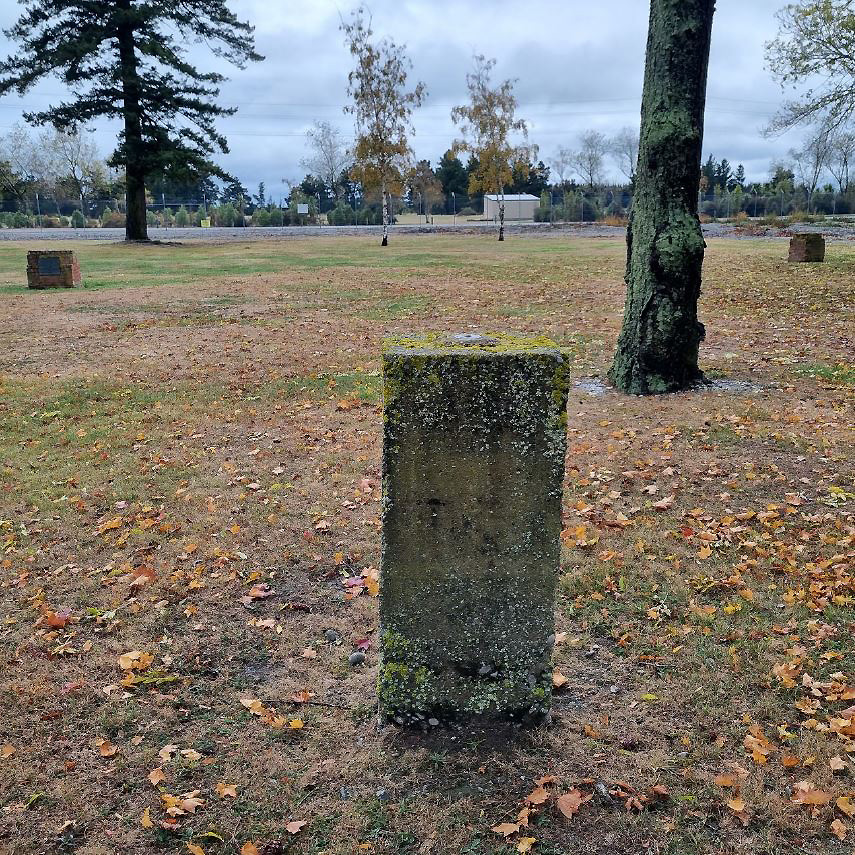
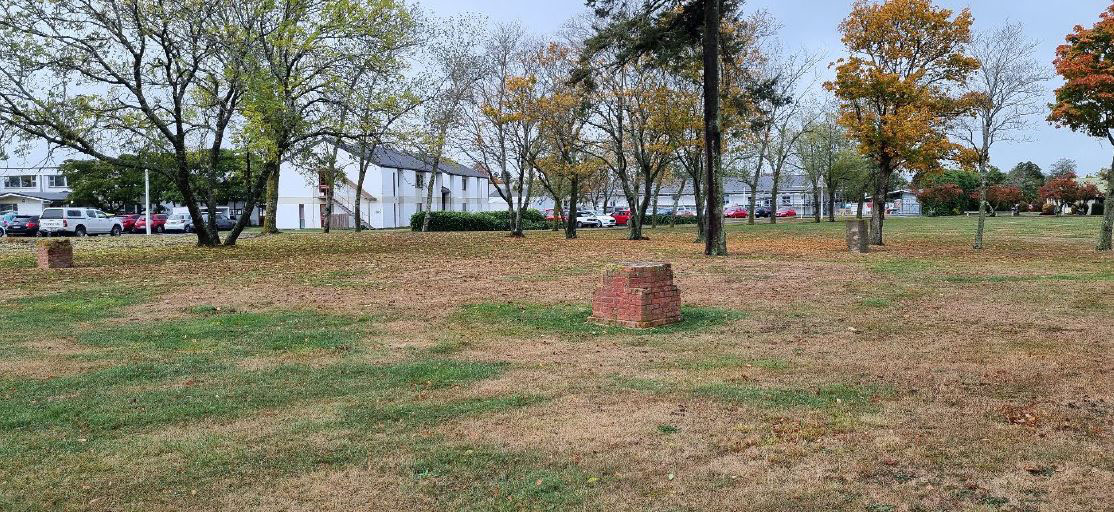
Grassed and sparsely treed, the Transit of Venus Observation Site is a flat area of 3,968 square metres, trapezoid in plan, situated alongside Burdons Road within the confines of the Burnham Military Camp. Obvious tangible features remaining at the site are three piers (also called pillars), two of brick and one of concrete, and there is archaeological potential for other related features below ground. Local Christchurch builders, the England Brothers, are the likely contractors involved in erecting the piers. One of the brick piers contains a bronze commemorative plaque stating, ‘At this site on 7th December 1882 an English Survey Party Under Colonel Tupman successfully observed the Transit of the Planet Venus to determine the distance of the Earth from the Sun. This pillar is now a reference mark for precise levelling. Erected by the Lands and Survey Department 1965.’

In recognition of its important astronomical and surveying history, the site became formally protected as a historic reserve in 1920. At that time, a detailed site survey was carried out which showed one observatory hut was still on the site, along with five pillars and two platforms. However, by the mid twentieth century, that hut had gone, and the site had become overgrown. A clean-up in 1964-1965 and perhaps again after 1984, appears to have resulted in the removal of some broken pier remnants. Standing in an open grassy area, the three standing piers and site is cared for by the New Zealand Defence Force, as the historic reserve sits within the restricted confines of their Burnham Military Camp.
Transit of Venus Observation Site, Burdons Road, Burnham, Canterbury | R Burgess | 12/04/2024 | Heritage New Zealand Pouhere Taonga
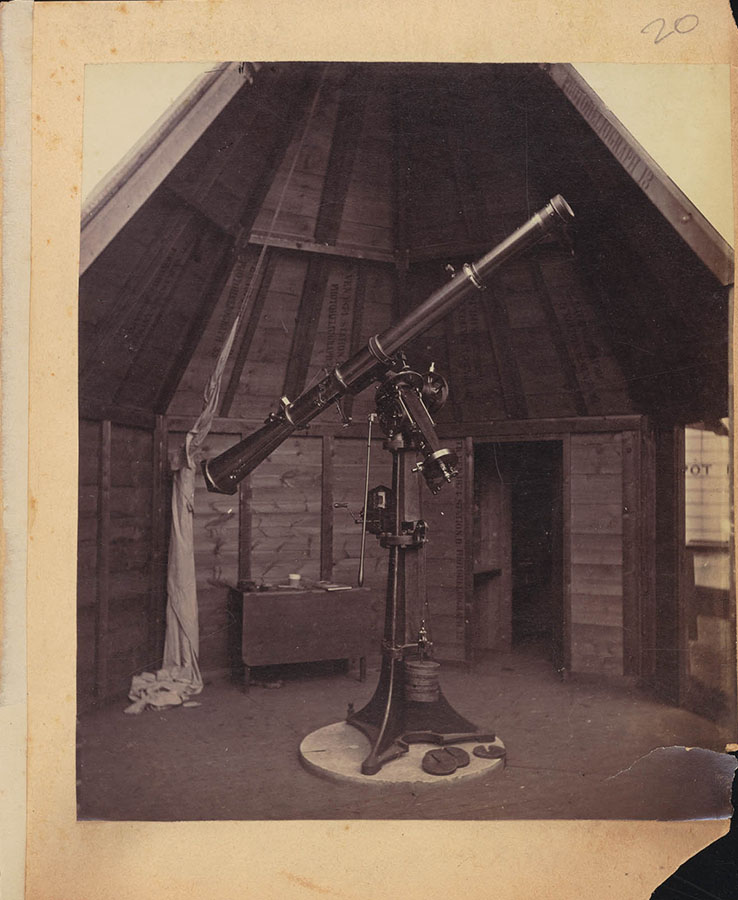
Transit of Venus Observation Site, Burdons Road, Burnham, Canterbury. CC BY NC Dallmeyer photoheliograph, RGO 6/276: 20 Image shows the interior of Station D photoheliograph enclosure during trials in Greenwich The stencil on the timber interior of the hut states ‘Station D’ which shows this was destined for New Zealand | Cambridge University Library

List Entry Information

Overview

Status

Listed

List Entry Status

Historic Place Category 1

Access

Private/No Public Access

List Number

9872

Date Entered

20th February 2025

Date of Effect

12th March 2025

City/District Council

Selwyn District

Region

Canterbury Region

Extent of List Entry

Extent includes the land described as RS 41026 (RT CB424/176, NZGZ 5 May 1983, p. 1384), Canterbury Land District and the structures associated with the Transit of Venus Observation Site thereon. (See the extent map in section 1 of the listing report)

Legal description

RS 41026 (RT CB424/176, NZGZ 5 May 1983, p. 1384), Canterbury Land District

Location Description

The reserve is located on the south side of Burdons Road, between Robin Road to the east and Avery Road to the west.

Status

Listed

List Entry Status

Historic Place Category 1

Access

Private/No Public Access

List Number

9872

Date Entered

20th February 2025

Date of Effect

12th March 2025

City/District Council

Selwyn District

Region

Canterbury Region

Extent of List Entry

Extent includes the land described as RS 41026 (RT CB424/176, NZGZ 5 May 1983, p. 1384), Canterbury Land District and the structures associated with the Transit of Venus Observation Site thereon. (See the extent map in section 1 of the listing report)

Legal description

RS 41026 (RT CB424/176, NZGZ 5 May 1983, p. 1384), Canterbury Land District

Location Description

The reserve is located on the south side of Burdons Road, between Robin Road to the east and Avery Road to the west.

Significance

Why is this place significant?

Cultural Significance

Cultural Significance or Value The Transit of Venus Observation Site has cultural significance, especially to the astronomical community. The 1874 and 1882 Transits of Venus attracted enormous public attention, popularising astronomy and spurring local astronomers to systematically observe their patch of southern sky. This site in Burnham was the key structured focal point for the British expedition’s Transit of Venus observations in New Zealand and is directly associated with distinctive disciplined actions of importance to astronomers world-wide. The Burnham expedition teams’ (1874 and 1882) collaboration, methodology, and subsequent dissemination of careful recordings were not only recognised as significant in the nineteenth century but remained in the consciousness of the scientific and surveying communities to such an extent that in the early decades of the twentieth century, they lobbied for the Transit of Venus Observation Site in Burnham to be protected in perpetuity as a historic reserve.

Historic Significance

Historical Significance or Value The Transit of Venus Observation Site has historical significance. New Zealand played an important role in international scientific collaborations associated with the 1874 and 1882 Transits of Venus, as its location meant it was an excellent prospect for observing the rare set of events. Even though cloudy weather foiled most observations in 1874, and in 1882 the transit ingress phase took place before local sunrise, New Zealand observations (and, in particular, those at the primary station, Burnham) played an important role in the global quest to determine Earth’s distance to the Sun. Because of slow communications, it took time for all the data to be collected from around the world and computed but the end result in ascertaining the Astronomical Unit length was fairly accurate. Observations at Burnham also established longitude and, in 1882, for the first time, the difference between New Zealand Standard Time and Greenwich Mean Time. The establishment of the site as a historic reserve in 1920 makes it one of New Zealand’s early historic reserves, and likely the first created specifically in recognition of its astronomical and surveying history. As the Philosophical Institute’s president said at the time when it was agreed to preserve the Burnham site, ‘That is the spot where the correct latitude and longitude of the Dominion was established – the initial point of survey data throughout New Zealand’.

Physical Significance

Archaeological Significance or Value The Transit of Venus Observation Site has archaeological significance. Key known periods of activity at the site date from the mid-1870s. When the British Transit of Venus expedition set up an observation station near the newly established Burnham Industrial School in 1874, they set out structures and markers above and below ground. A hub of activity in 1874, and again in 1882, the observation station itself was a busy place for the scientists. Although some above-ground remnants have been cleared away, at different times in the twentieth century, the Transit of Venus Observation Site has been largely undeveloped. Further information may be learned, for example through non-invasive archaeological techniques, about the extant standing piers and their below-ground foundations as well as sunken platforms and other markers or artefacts potentially buried. Technological Significance or Value The Transit of Venus Observation Site has technological significance. It is a place where specialist knowledge and apparatus were used to take specific measurements and observations pertinent to understanding our place on Earth and Earth’s place in the Solar system. Part of a wider network of international sites, Burnham was the base point for ascertaining timings of the observations across the country, with the telegraphic communication and time-signals transmitted from the site’s standard clock being referred to directly as ‘Burnham Time’. The place reflects significant technical accomplishment, especially compared with other transit observation sites set up within New Zealand territory. The surviving piers and their placement, representing measurement points, are important remnants of this type of astronomical technology.

Why is this place Category 1 / Category 2?

Detail Of Assessed Criteria

As part of the network of sites across the world where the Transit of Venus was observed in 1874 and 1882, the Transit of Venus Observation Site at Burnham is of outstanding significance as it reflects an aspect of New Zealand history – our important place in an international scientific programme of recording those rare transits – better than other places in the country with substantially the same association. The site has outstanding significance for its roles in three types of accurate measurement. Scientific observations from this place, using astronomical equipment mounted on piers erected on this site, contributed to global nineteenth century understanding of Earth-Sun distance. At the same time, the latitude and longitude of this site was so accurately determined that it is hailed as the starting point for accurate survey of the whole country. It is also the place where the difference between Greenwich Mean Time and New Zealand Standard Time was first established, in 1882, delineated as the ‘Burnham Fundamental’. Designated in 1920 as one of New Zealand’s early historic reserves, the Transit of Venus Observation Site at Burnham is a rare remaining example of a transit observation station, its remnant piers providing a tantalising symbol of a brief but significant scientific expeditionary hub. This place was assessed against the criteria set out in section 66(3) of the Heritage New Zealand Pouhere Taonga Act 2014 and found to qualify as a Category 1 historic place under the following criteria. (a) The extent to which the place reflects important or representative aspects of New Zealand history. The Transit of Venus Observation Site reflects New Zealanders’ strong historical interest in astronomy. Māori already had long experiential connection with tātai arorangi (Māori astronomy) by the time colonial settlers brought their own amateur astronomy to Aotearoa/New Zealand in the nineteenth century. Supported by New Zealand officials, the arrival of the British expert scientific expedition teams to observe the Transit of Venus in 1874, and again in 1882, came at a time when New Zealand government-sponsored science was only in its infancy. The Transit of Venus events created a burgeoning popular interest in the night sky. The number of amateur astronomers grew, astronomical societies were formed, and permanent observatories constructed. Reductions from the 1882 observations, using the parallax method, arrived at Earth-Sun distance of 92.7 million miles (149.186 million kilometres). This proved to be the most accurate calculation made to date. Current calculations in the twenty first century by NASA determine that the Earth’s average distance to the Sun is about 93 million miles (150 million kilometres). (b) The association of the place with events, persons, or ideas of importance in New Zealand history. The rare Transit of Venus phenomenon has a remarkable association with events important to Aotearoa/New Zealand’s history. Prior to the 1874 and 1882 transits, the previous pairs of Transit of Venus (1761 and 1769) involved significant effort by eighteenth century astronomers and explorers, notably Captain James Cook, whose visit to the South Pacific was a direct result of his direction to observe the Transit of Venus in Tahiti in 1769. It was after this event in Tahiti that Captain Cook sailed further as part of his first voyage to Aotearoa/New Zealand and had some of the first meaningful interaction with Māori. This pivotal moment in New Zealand’s history changed the course of history for Māori and is part of the founding history of Pākehā occupation of New Zealand. The pending 1874 and 1882 Transits of Venus caused a major stir in the nineteenth century – analogous to the space race of the twentieth century - where major powers and nations vied for the best remote spots on Earth to observe the rare phenomenon. The aim was to answer one of the most important things in astronomy, namely the distance between the Earth and the Sun. That value – named the astronomical unit – would enable astronomers to map the positions of celestial bodies and determine the size of the universe. New Zealand and its offshore islands provided a sought-after opportunity in this global quest. The members of the British Expedition Party contributed to important scientific and surveying advancements in the country. Major-General Henry Spencer Palmer’s work during the 1874 Transit of Venus expedition helped establish crucial longitude measurements, and his subsequent recommendations led to more accurate and uniform surveying systems in New Zealand, influencing the nation’s mapping and land development. Lieutenant Leonard Darwin, son of Charles Darwin and an accomplished photographer, was responsible for taking the several surviving images of the 1874 transit. He was assisted by Canterbury surveyor Edward Percy Sealy, a skilled photographer who contributed to the expedition at short notice. Lieutenant-Colonel George Lyon Tupman, who had organised the five 1874 British Transit of Venus expeditions, led the 1882 expedition in New Zealand, establishing the difference between Greenwich Mean Time and New Zealand Standard Time. This expedition also marked growing acceptance of women's roles in scientific expeditions, as Tupman was assisted by his wife and Lieutenant Coke's wife. (e) The community association with, or public esteem for the place Despite restricted access due to security within Burnham Military Camp grounds, an existing astronomical-interest community has a current association with the Transit of Venus Observation Site, as does Department of Conservation who is responsible for it as a historic reserve. The New Zealand Defence Force itself also has an association and takes its role in maintaining the site seriously. It can be expected that personnel living and working at Burnham Military Camp encounter the historic reserve on a regular basis and its standing piers within the flat open space may well be a place of curiosity and contemplation. Astronomers and science writers make a point of visiting the site and there is media interest at times of special astronomical interest, such as the 2004 and 2012 Transits of Venus and the 150th anniversary in 2024 of the 1874 transit. (g) The technical accomplishment, value, or design of the place As the remains of a sophisticated coordinated programme of recording a rare astronomical event, the authentic standing structures on this site mark the precise survey measurements and have technical value. Events that took place at this site, and the set up to record those events, including establishing the correct time, have been acclaimed by experts in the field. The pier with the 1965 plaque is identified as a place of precise levelling. The brick piers have a high degree of authenticity and demonstrate that astronomy and astronomical history is not confined to grand observatory structures. (h) The symbolic or commemorative value of the place The site has symbolic and commemorative significance. As a historic reserve, the place symbolises the extensive effort to improve scientific understanding of our planet, through observations made here of the 1874 and 1883 Transits of Venus. A plaque added by the Department of Lands and Survey to one of the brick piers in 1965 specifically recognises the recording of the second nineteenth century Transit of Venus, in 1882, and how it serves as a mark for precise levelling. The place has become valued for its commemorative function and, leading up to the 2004 and 2012 Transit of Venus, being the first since the nineteenth century events and the last in our lifetimes, there was some media interest in the Burnham site due to the historical commemorative link. The 150th anniversary celebrations of the 1874 Transit of Venus again bring into focus this and other global expedition sites. (i) The importance of identifying historic places known to date from an early period of New Zealand settlement This site is a rare surviving remnant of an observation station set up in New Zealand in the late nineteenth century to observe a very rare type of event (the Transit of Venus). For the history of astronomy and science in general, this is a rare historic place.

Why is this place significant?

Cultural Significance

Cultural Significance or Value The Transit of Venus Observation Site has cultural significance, especially to the astronomical community. The 1874 and 1882 Transits of Venus attracted enormous public attention, popularising astronomy and spurring local astronomers to systematically observe their patch of southern sky. This site in Burnham was the key structured focal point for the British expedition’s Transit of Venus observations in New Zealand and is directly associated with distinctive disciplined actions of importance to astronomers world-wide. The Burnham expedition teams’ (1874 and 1882) collaboration, methodology, and subsequent dissemination of careful recordings were not only recognised as significant in the nineteenth century but remained in the consciousness of the scientific and surveying communities to such an extent that in the early decades of the twentieth century, they lobbied for the Transit of Venus Observation Site in Burnham to be protected in perpetuity as a historic reserve.

Historic Significance

Historical Significance or Value The Transit of Venus Observation Site has historical significance. New Zealand played an important role in international scientific collaborations associated with the 1874 and 1882 Transits of Venus, as its location meant it was an excellent prospect for observing the rare set of events. Even though cloudy weather foiled most observations in 1874, and in 1882 the transit ingress phase took place before local sunrise, New Zealand observations (and, in particular, those at the primary station, Burnham) played an important role in the global quest to determine Earth’s distance to the Sun. Because of slow communications, it took time for all the data to be collected from around the world and computed but the end result in ascertaining the Astronomical Unit length was fairly accurate. Observations at Burnham also established longitude and, in 1882, for the first time, the difference between New Zealand Standard Time and Greenwich Mean Time. The establishment of the site as a historic reserve in 1920 makes it one of New Zealand’s early historic reserves, and likely the first created specifically in recognition of its astronomical and surveying history. As the Philosophical Institute’s president said at the time when it was agreed to preserve the Burnham site, ‘That is the spot where the correct latitude and longitude of the Dominion was established – the initial point of survey data throughout New Zealand’.

Physical Significance

Archaeological Significance or Value The Transit of Venus Observation Site has archaeological significance. Key known periods of activity at the site date from the mid-1870s. When the British Transit of Venus expedition set up an observation station near the newly established Burnham Industrial School in 1874, they set out structures and markers above and below ground. A hub of activity in 1874, and again in 1882, the observation station itself was a busy place for the scientists. Although some above-ground remnants have been cleared away, at different times in the twentieth century, the Transit of Venus Observation Site has been largely undeveloped. Further information may be learned, for example through non-invasive archaeological techniques, about the extant standing piers and their below-ground foundations as well as sunken platforms and other markers or artefacts potentially buried. Technological Significance or Value The Transit of Venus Observation Site has technological significance. It is a place where specialist knowledge and apparatus were used to take specific measurements and observations pertinent to understanding our place on Earth and Earth’s place in the Solar system. Part of a wider network of international sites, Burnham was the base point for ascertaining timings of the observations across the country, with the telegraphic communication and time-signals transmitted from the site’s standard clock being referred to directly as ‘Burnham Time’. The place reflects significant technical accomplishment, especially compared with other transit observation sites set up within New Zealand territory. The surviving piers and their placement, representing measurement points, are important remnants of this type of astronomical technology.

Why is this place Category 1 / Category 2?

Detail Of Assessed Criteria

As part of the network of sites across the world where the Transit of Venus was observed in 1874 and 1882, the Transit of Venus Observation Site at Burnham is of outstanding significance as it reflects an aspect of New Zealand history – our important place in an international scientific programme of recording those rare transits – better than other places in the country with substantially the same association. The site has outstanding significance for its roles in three types of accurate measurement. Scientific observations from this place, using astronomical equipment mounted on piers erected on this site, contributed to global nineteenth century understanding of Earth-Sun distance. At the same time, the latitude and longitude of this site was so accurately determined that it is hailed as the starting point for accurate survey of the whole country. It is also the place where the difference between Greenwich Mean Time and New Zealand Standard Time was first established, in 1882, delineated as the ‘Burnham Fundamental’. Designated in 1920 as one of New Zealand’s early historic reserves, the Transit of Venus Observation Site at Burnham is a rare remaining example of a transit observation station, its remnant piers providing a tantalising symbol of a brief but significant scientific expeditionary hub. This place was assessed against the criteria set out in section 66(3) of the Heritage New Zealand Pouhere Taonga Act 2014 and found to qualify as a Category 1 historic place under the following criteria. (a) The extent to which the place reflects important or representative aspects of New Zealand history. The Transit of Venus Observation Site reflects New Zealanders’ strong historical interest in astronomy. Māori already had long experiential connection with tātai arorangi (Māori astronomy) by the time colonial settlers brought their own amateur astronomy to Aotearoa/New Zealand in the nineteenth century. Supported by New Zealand officials, the arrival of the British expert scientific expedition teams to observe the Transit of Venus in 1874, and again in 1882, came at a time when New Zealand government-sponsored science was only in its infancy. The Transit of Venus events created a burgeoning popular interest in the night sky. The number of amateur astronomers grew, astronomical societies were formed, and permanent observatories constructed. Reductions from the 1882 observations, using the parallax method, arrived at Earth-Sun distance of 92.7 million miles (149.186 million kilometres). This proved to be the most accurate calculation made to date. Current calculations in the twenty first century by NASA determine that the Earth’s average distance to the Sun is about 93 million miles (150 million kilometres). (b) The association of the place with events, persons, or ideas of importance in New Zealand history. The rare Transit of Venus phenomenon has a remarkable association with events important to Aotearoa/New Zealand’s history. Prior to the 1874 and 1882 transits, the previous pairs of Transit of Venus (1761 and 1769) involved significant effort by eighteenth century astronomers and explorers, notably Captain James Cook, whose visit to the South Pacific was a direct result of his direction to observe the Transit of Venus in Tahiti in 1769. It was after this event in Tahiti that Captain Cook sailed further as part of his first voyage to Aotearoa/New Zealand and had some of the first meaningful interaction with Māori. This pivotal moment in New Zealand’s history changed the course of history for Māori and is part of the founding history of Pākehā occupation of New Zealand. The pending 1874 and 1882 Transits of Venus caused a major stir in the nineteenth century – analogous to the space race of the twentieth century - where major powers and nations vied for the best remote spots on Earth to observe the rare phenomenon. The aim was to answer one of the most important things in astronomy, namely the distance between the Earth and the Sun. That value – named the astronomical unit – would enable astronomers to map the positions of celestial bodies and determine the size of the universe. New Zealand and its offshore islands provided a sought-after opportunity in this global quest. The members of the British Expedition Party contributed to important scientific and surveying advancements in the country. Major-General Henry Spencer Palmer’s work during the 1874 Transit of Venus expedition helped establish crucial longitude measurements, and his subsequent recommendations led to more accurate and uniform surveying systems in New Zealand, influencing the nation’s mapping and land development. Lieutenant Leonard Darwin, son of Charles Darwin and an accomplished photographer, was responsible for taking the several surviving images of the 1874 transit. He was assisted by Canterbury surveyor Edward Percy Sealy, a skilled photographer who contributed to the expedition at short notice. Lieutenant-Colonel George Lyon Tupman, who had organised the five 1874 British Transit of Venus expeditions, led the 1882 expedition in New Zealand, establishing the difference between Greenwich Mean Time and New Zealand Standard Time. This expedition also marked growing acceptance of women's roles in scientific expeditions, as Tupman was assisted by his wife and Lieutenant Coke's wife. (e) The community association with, or public esteem for the place Despite restricted access due to security within Burnham Military Camp grounds, an existing astronomical-interest community has a current association with the Transit of Venus Observation Site, as does Department of Conservation who is responsible for it as a historic reserve. The New Zealand Defence Force itself also has an association and takes its role in maintaining the site seriously. It can be expected that personnel living and working at Burnham Military Camp encounter the historic reserve on a regular basis and its standing piers within the flat open space may well be a place of curiosity and contemplation. Astronomers and science writers make a point of visiting the site and there is media interest at times of special astronomical interest, such as the 2004 and 2012 Transits of Venus and the 150th anniversary in 2024 of the 1874 transit. (g) The technical accomplishment, value, or design of the place As the remains of a sophisticated coordinated programme of recording a rare astronomical event, the authentic standing structures on this site mark the precise survey measurements and have technical value. Events that took place at this site, and the set up to record those events, including establishing the correct time, have been acclaimed by experts in the field. The pier with the 1965 plaque is identified as a place of precise levelling. The brick piers have a high degree of authenticity and demonstrate that astronomy and astronomical history is not confined to grand observatory structures. (h) The symbolic or commemorative value of the place The site has symbolic and commemorative significance. As a historic reserve, the place symbolises the extensive effort to improve scientific understanding of our planet, through observations made here of the 1874 and 1883 Transits of Venus. A plaque added by the Department of Lands and Survey to one of the brick piers in 1965 specifically recognises the recording of the second nineteenth century Transit of Venus, in 1882, and how it serves as a mark for precise levelling. The place has become valued for its commemorative function and, leading up to the 2004 and 2012 Transit of Venus, being the first since the nineteenth century events and the last in our lifetimes, there was some media interest in the Burnham site due to the historical commemorative link. The 150th anniversary celebrations of the 1874 Transit of Venus again bring into focus this and other global expedition sites. (i) The importance of identifying historic places known to date from an early period of New Zealand settlement This site is a rare surviving remnant of an observation station set up in New Zealand in the late nineteenth century to observe a very rare type of event (the Transit of Venus). For the history of astronomy and science in general, this is a rare historic place.

Construction Information

Construction Details

Start Year

1874

Type

Original Construction

Description

Erection of prefabricated huts and construction of piers and platforms.

Start Year

1875

Finish Year

1920

Type

Demolished - Other

Description

Huts dismantled after 1874 and reassembled in 1882; Huts removed over time

Start Year

1965

Type

Other

Description

Brass plaque added to one of the brick piers.

Construction Materials

Brick, concrete, brass

Notable Features

Related moveable items held elsewhere (not included in the List entry) Instruments brought out for the transit observations were removed and all, or almost all, were returned to England. Careful record keeping ensured the movement of each piece was clearly noted, though less is known about the instruments for the 1882 expedition. A number of the instruments used in New Zealand are held in the National Maritime Museum in Greenwich, for example, a brass level screwed onto a mahogany mount, known to have been used with a transit instrument taken to Station D (New Zealand) for the Transit of Venus 1874 expedition https://www.rmg.co.uk/collections/objects/rmgc-object-203128 (Object ID ZBA0635), a portable altazimuth telescope (Object AST0988), made by Troughton & Simms 1866, 1870) https://www.rmg.co.uk/collections/objects/rmgc-object-11150 , and portable transit telescope, made by Troughton and Simms, (Object ZBA1731), which was a Telescope for Reversible Transit Circle, from 1874 expedition, labelled Transit D (referring to Station D, Christchurch). https://www.rmg.co.uk/collections/objects/rmgc-object-243411 . Not many images from the 1874 transit expeditions are known to survive. Of the photographs of the Transit of Venus taken at Burnham in 1874, taken by the New Zealand expedition’s chief photographer, Leonard Darwin, and Canterbury photographer, Edward Sealy, some glass plates are now held at the Astronomy Division of the United Kingdom’s Science and Technology Facilities Council (STFC) and another image is in private ownership. One of Sealy’s photographs of the Transit of Venus, taken on 9 December 1874, with the photoheliograph at Burnham, had been given to the Canterbury Museum in 1875, but as at 2017 this was not able to be located by the museum’s collection team..

Construction Details

Start Year

1874

Type

Original Construction

Description

Erection of prefabricated huts and construction of piers and platforms.

Start Year

1875

Finish Year

1920

Type

Demolished - Other

Description

Huts dismantled after 1874 and reassembled in 1882; Huts removed over time

Start Year

1965

Type

Other

Description

Brass plaque added to one of the brick piers.

Construction Materials

Brick, concrete, brass

Notable Features

Related moveable items held elsewhere (not included in the List entry) Instruments brought out for the transit observations were removed and all, or almost all, were returned to England. Careful record keeping ensured the movement of each piece was clearly noted, though less is known about the instruments for the 1882 expedition. A number of the instruments used in New Zealand are held in the National Maritime Museum in Greenwich, for example, a brass level screwed onto a mahogany mount, known to have been used with a transit instrument taken to Station D (New Zealand) for the Transit of Venus 1874 expedition https://www.rmg.co.uk/collections/objects/rmgc-object-203128 (Object ID ZBA0635), a portable altazimuth telescope (Object AST0988), made by Troughton & Simms 1866, 1870) https://www.rmg.co.uk/collections/objects/rmgc-object-11150 , and portable transit telescope, made by Troughton and Simms, (Object ZBA1731), which was a Telescope for Reversible Transit Circle, from 1874 expedition, labelled Transit D (referring to Station D, Christchurch). https://www.rmg.co.uk/collections/objects/rmgc-object-243411 . Not many images from the 1874 transit expeditions are known to survive. Of the photographs of the Transit of Venus taken at Burnham in 1874, taken by the New Zealand expedition’s chief photographer, Leonard Darwin, and Canterbury photographer, Edward Sealy, some glass plates are now held at the Astronomy Division of the United Kingdom’s Science and Technology Facilities Council (STFC) and another image is in private ownership. One of Sealy’s photographs of the Transit of Venus, taken on 9 December 1874, with the photoheliograph at Burnham, had been given to the Canterbury Museum in 1875, but as at 2017 this was not able to be located by the museum’s collection team..

Historical Narrative

Tātai Arorangi - Māori Astronomy Centuries of celestial navigation throughout Te Moana nui a Kiwa (Pacific Ocean) nurtured a sophisticated navigation system using the passage of celestial bodies - the sun, moon and stars - to track the course of a vessel and mark the passage of time. This expertise utilised a complete understanding of their vessels and in some cases a kapehu whetū (Māori star compass). Underpinned by multigenerational mātauranga to recognise the swells, currents, winds, clouds, ocean temperature, the migration patterns of birds and marine life, even the smells of the ocean, navigators steered their waka along ara moana (ocean pathways) across Pacifica eventually reaching Aotearoa/New Zealand. The ara moana leading to Aotearoa was known as the Ara i te Uru (pathway to the south-west). Discovered by Kupe, the instructions for the route to Aotearoa was memorialised in the instructions Kupe gave to his people (some say his grandson or nephew Nukutawhiti) when he arrived back to Hawaiki. The instructions were to keep the sun and Venus to the right of his prow until he sighted Te Ika a Maui (the Milky Way, also known as Māngōroa) lying across the horizon. When he saw that, he would be at the latitude of Aotearoa. Some of the known Māori celestial names for Venus, the brightest celestial object after the sun and moon, illustrate phases: Meremere-tū-ahiahi (evening rising Venus), Kōpū (morning rising Venus) and Tāwera (morning rising Venus when Venus is abandoned by Kōpūnui/Jupiter). Once settled in Aotearoa, the tradition of tātai arorangi or Māori astronomy was put to great use. The extensive knowledge of the night sky was applied to practices such as food production, house building and sea navigation. Communities had a good working understanding of tātai arorangi through its application to everyday tasks like gardening and hunting, while deeper knowledge resided with tohunga kōkōrangi and tohunga tātai arorangi, the ‘teachers and specialists’. The names and associated traditions of the celestial objects visible to the eye were encoded through tikanga (customs/traditions), tauparapara (chant), waiata (song), pūrakau (storytelling), whakairo (carving) and raranga (weaving). Naturally occurring astronomical events can be found in Te Reo Māori to describe the characteristics, behaviours and interactions of people and references to stars are found in lamentations for the dead, songs or phrases. For example, the whakataukī, Mehemea ko Kōpū e rere ana i te pae translated to mean ‘like Venus as it appears over the horizon in the morning’ and is applied to an attractive person. Associative Te Reo names and phrases continue to be used today. For example, Tāwhaki, one of the tipua (demi gods) who sought celestial knowledge, is the name given to a space platform project at Kaitorete Spit, a long finger of land running south-west from Te Pātaka a Rākaihautū/Banks Peninsula, about 40 kilometres south of the Transit of Venus Observation Site at Burnham. This experiential knowledge of the stars, moon and sun was used for hundreds of years in Aotearoa/New Zealand prior to the visit of Captain James Cook in the Endeavour in late 1769. A Rare Astronomical Event A Transit of Venus, where the planet Venus can be viewed as a black dot moving across the face of the sun, occurs in pairs eight years apart separated by long gaps of between 105 and 121 years. Transits of Venus had been observed in 1639, 1761 and 1769. Famously, Captain James Cook in the Endeavour had observed the Transit of Venus across in the Sun in June 1769 while in King George’s Land (Tahiti) before heading on to explore the southern seas. In October that same year he reached Aotearoa/New Zealand. On 9 November 1769, Cook helped his astronomer, Charles Green, observe the Transit of Mercury, at Te Whanganui-o-Hei (Mercury Bay), Coromandel Peninsula. The results of Cook’s and other expeditions’ observing the eighteenth-century Transits of Venus had limitations, however, and questions remained unanswered. One of world astronomy’s great goals during the nineteenth century therefore remained trying to measure the true distance between Earth and the Sun. This would be of practical importance. An accurate knowledge of the Sun’s distance would be essential for perfecting lunar and planetary tables and, therefore, the science of navigation, as well as finding the true longitudes of places on the Earth’s surface. With plenty of lead-in time, astronomers and observatories were primed to try again for accurate measurements of the Transits of Venus in 1874 and 1882, and this time they had the added technology of photography and less complex transport options than in the eighteenth century. The British Admiralty was at the forefront. Astronomer Royal for England, Sir George Airy, began putting together an expeditionary programme in 1872, and in 1873 he engaged Captain George Lyon Tupman of the Royal Marine Artillery to be its chief coordinator. Tupman set up a hub at Greenwich, London, with prefabricated observatory huts, observation equipment and models for the five British teams to train before being dispatched to their designated stations, A to E, around the world, as follows: - Station A: Egypt - Station B: Hawaiian (Sandwich) Islands - Station C: Rodriguez Island - Station D: New Zealand - Station E: Kerguelen Island. The planned spread of expedition locations, at widely separated latitudes, was to obtain good baselines for the triangulation of Venus against the backdrop of the sun. New Zealand’s Favourable Location New Zealand was anticipated to be an ideal location for observing the entire transit of 9 December 1874 as, weather permitting, it would be visible during daylight hours. This attracted not only the British, but also American, French and German expeditionary teams to the New Zealand mainland and adjacent islands. The Americans set up at Queenstown and on Chatham Island. The French and Germans established their transit stations in the subantarctic, the French on Campbell Island and the Germans had theirs at Port Ross, Auckland Island. The British, Station D, New Zealand In the two years leading up to the 1874 Transit of Venus, Professor Airy in Greenwich liaised closely with New Zealand leaders and officials, including Julius Vogel, William Fox, Governor Sir G. F. Bowen and James Hector to ensure appropriate site selection and support. At the suggestion of Julius von Haast from the Canterbury Museum, and James Hector, of the Colonial Museum in Wellington, Airy settled on the vicinity of Christchurch as the intended location for the New Zealand Station D. Meteorological information provided by, amongst others, politician John Hall, showed this would be a promising contender for good weather conditions for the observation. The British expedition party to New Zealand, made up of Major Henry Spencer Palmer (Royal Engineers, Chief Astronomer), Lieutenant Leonard Darwin (Royal Engineers, Assistant Astronomer and Photographer), Lieutenant H. Crawford (Royal Navy, Assistant Astronomer) and three non-commissioned officers, left Plymouth, England, on 27 June 1874 aboard the clipper, Merope, along with 331 government sponsored emigrants. After arriving in Lyttelton on 27 September 1874, the expedition team was brought to Christchurch by train, staying at the Christchurch Club while they looked for a suitable observation site. Seven or eight potential sites were visited in and around Christchurch, including Hagley Park, but none was quite suitable. Finally, by early October 1874, a site at Burnham, on the Canterbury Plains, located some 18 miles (30 kilometres) south-west from Christchurch was determined to have the best prospect. Burnham had been established by Richard Bethell, an English immigrant who had bought a large tract of farmland in 1861 and named his property Burnham after his family estate in England. Richard Bethell was not the first person present on the Canterbury Plains, however. For more than 500 years Māori had traversed the plains with its large tracts of sandy-yellow native tussock, intersected by meandering rivers and pockets of native bush. Kā Pākihi Whakatekateka a Waitaha Kā Pākihi Whakatekateka a Waitaha (Canterbury Plains) stretches from the Rakahuri (Ashley River) down to the Waitaki River and inland to the foothills of Ka Tiritiri o te Moana (the Southern Alps). The plains once provided an abundant food store for Waitaha, followed by Ngāti Mamoe and then Ngāi Tahu who travelled the plains on hunting and kai gathering expeditions. The major rivers provided access routes for Māori travelling from the eastern coast inland to passes leading across the southern alps to Tai Poutini (West Coast). Known trails across the plains connected pā with the closest to Burnham being the Whakaepa Pā located on a bluff south of the Waikirikiri near present day Coalgate. Māori from Kaiapoi and Taumutu seasonally joined their relatives at Whakaepa Pā to undertake kai gathering expeditions to Waikawa (Lake Lyndon) and to travel through to Arahura on the West Coast. In 1848, the Crown purchased the Plains from Ngāi Tahu as part of the nearly 14,000,000-acre Canterbury purchase. This controversial sale changed land tenure and enabled the establishment of colonial settlement and large farming estates such as Burnham. The Burnham Site In 1871, the Canterbury Provincial Government had purchased the land from Richard Bethell and established an Industrial School, within the government reserve. The government initially intended to house children from the Canterbury Orphanage and Reformatory but, as established from the early 1870s, the Burnham Industrial School became more of a school for young offenders. The Industrial School had only opened in 1873, a year before the British transit party came and selected the site close by for its observatory. The Burnham site had stable gravels, a good climate and was handy to the railway ‘for conveyance of the apparatus from Lyttelton, easy telegraphic communication, and an uninterrupted view of the sky and horizon’. The Burnham Railway Station, on the main North-South telegraph line, stood about 730 metres to the south-east of the transit observation site. The railway was used to transport the 60-80 tons of English equipment and supplies, which included four prefabricated huts and associated astronomical instruments from Greenwich. Building materials, including thousands of bricks, some cement, sand and timber, were also delivered by rail in the first weeks of October. The observatory site, about an acre in size, was marked out and excavations for the piers began in early October 1874. Local contractors, paid for by the government, assisted Palmer by constructing the instrument piers. Records from the Canterbury Railways regarding materials brought to the site in early October 1874 mention, on several occasions, the England Brothers, and it is surmised that this building partnership was involved in their construction. Already accustomed to government contracts, the England Brothers would have been familiar with the wider Burnham site, as they’d been brought in to finish construction of the Industrial School building earlier that year, in February 1874. Canterbury Railways records relating to the Transit of Venus expedition, dated October 1874, detail all manner of packages and building items brought to the site, including bricks from Heathcote and ‘England Bros.’ timber, lime and ironwork. The foundations for the telescopes and huts were built three feet (0.91 metres) taller than originally planned to mitigate any ‘mirages’ from the area’s frequent warm winds that might affect observations. Piers and stands erected on the observatory site enclosure were: four brick piers, for the four chief instruments (Photoheliograph, Altazimuth, Transit and 6-inch Equatorial); small brick columns/columns for raising the two larger huts (Photoheliograph and Equatorial); and small brick pier standing a few feet north of the Transit Hut for a collimating telescope. The prefabricated huts were erected, and instruments installed on their piers, ready for testing, by the end of October 1874. The observatory site, enclosed by a five-foot (1.5 metre high) paling fence, contained four observatory huts - one square and three hexagonal - and four square military tents which were used for storage. The detail of each hut and associated astronomical instruments and clocks, and their intended operations was as follows: The Transit Hut, a square hut, likely with a canvas roof, housed ‘…a transit instrument for the purpose of determining accurate time, and a transit clock which will be the standard of time. All chronometers of the expedition, whose rates are determined daily by comparison with the transit clock are also in this hut, so that they will be available at any time for determining the difference of longitude by transportation of chronometers. The transit instrument is by Troughton and Simms, of London. It is 3 ½ inches aperture, 40 inches focal length, and is mounted on massive piers of Portland stone. These piers rest on a base stone of the same material, which is supported, like the base stones of all the instruments, on a massive brick pier sunk to a depth of 6 or 7ft where it rests upon a bed of concrete. The brick piers are isolated by leaving a few inches open space around them, and in this way no tremor can be transmitted to the instruments, either by movements in the huts or in the vicinity.’ The Altazimuth Hut was hexagonal in shape and had a dome shaped roof that could be revolved to any required position. It contained ‘the Altazimuth, also by Troughton and Simms, which has circles of 16in diameter; the horizontal and vertical circles being each fitted with four reading-microscopes. A Dent’s clock also stands in the hut, and is regulated by daily comparisons with the transit clock. The Altazimuth is used for determining latitudes by observations of stars and also for observing azimuth and zenith distances of the moon in any part of the sky for the purpose of determining longitude’. The hut’s interior also had brackets for lamps, thermometers and barometers. The Equatorial Hut was also hexagonal in shape and housed the equatorial telescope that Palmer would use for the eye observations of the Transit of Venus. ‘It is a refracting telescope of six inches aperture, by Troughton and Simms, equatorially mounted, and driven by a clock, which moves the instrument in the opposite direction to the earth at such a rate of speed as to keep the instrument fixed on any one particular star. The telescope is fitted with an Airey’s [sic] solar diagonal eye piece, which is designed to obviate the danger of the eye lenses cracking from the sun’s heat; and it is also furnished with a beautiful apparatus called a double-image micrometer, which will be used during the transit for measuring the position of Venus on the sun’s edge. It can also be utilised when Venus is wholly on the sun for measuring the distance between her edge and the near edge of the sun so long as that distance does not exceed her own diameter. In these two ways a large number of very good measures of the planet’s position on the sun’s face will be obtained irrespectively of the true contact, and as the exact time of each observation will be noted, it will be possible by comparison of the measurements to infer the time of contact with great precision from them alone should this be necessary’. A Dent’s clock also stood in this hut so that the times of the successive phases of the transit could be accurately noted and registered. The Photoheliograph Hut, a hexagonal hut with an attached darkroom, housed the Dallmeyer photoheliograph, described as having ‘the appearance of a large telescope about 9ft in length, which, instead of having an eye-piece, has a photographic camera at the eye end. Like the principal telescope, it is equatorially mounted, and driven by clockwork. There are two different methods of taking photographs on the day of the transit. The first of these, which is the invention of M. Janssen, is used just at the times of “ingress”, or apparent entry of Venus on the sun’s surface, and “egress”, or departure from the surface, which are the two phases most suitable for observation. By this (Janssen’s) method the instrument takes fifty small photographs round the edge of one circular plate at intervals of a second. Each photograph will not be more than one inch in length by half an inch in width, but it will include all that is required, viz., that small portion of the sun’s edge, across which Venus is just moving. When Venus gets too far from the edge for this method, single photographs will be taken at intervals of about two or three minutes, on square six inch plates. This gives a perfect image of the sun four inches in diameter.’ The use of photography was an important part of the 1874 observation programme and was the reason photographer, Leonard Darwin, son of naturalist Charles Darwin, was in the expedition team. At short notice, at the suggestion of Haast, the party also brought in Edward Sealy, a surveyor and amateur photographer from Timaru, to assist. Sealy arrived at the Burnham observation station just four days before the transit. Other features outside the observatory enclosure were set up, for checks of measurement and communications. One was ‘the meridian mark’, erected some 91.75 chains (6,054 feet, that is 1.8 kilometres) to the south of the Transit Hut and comprising ‘a plate of iron mounted on a brick pier at a height of about 7ft from the ground perforated for the night illumination, which is adjusted with the utmost nicety to the true meridian. Another feature, set up on small wooden stands some 400 feet [122 metres] eastward from the Equatorial Hut, was the model Transit of Venus. Devised by Airy back in England for observers to practice on, this artificial model was described as ‘… a simple but ingenious contrivance and affords an excellent means of testing the properties of irradiation as exhibited by different telescopes to different observers and under varying conditions of sunlight. … The observers will practise with this between now and the day of transit and it will also be available for the instruction of any gentlemen who intend to take part in the transit observations and who may attend at the observatory to acquire a knowledge of the details.’ The Telegraph and Ancillary Stations Branch telegraph wires were carried, on posts, from the main telegraph line at Burnham to the observatory enclosure. The telegraph wires at the Transit Hut were then used to transmit time signals to other points of observation in New Zealand, and also to determine the difference of the longitude. Telegraphic clock comparisons could be made with for five substations for observation, all of which had direct telegraphic communication with the Burnham observatory. The substations associated with Burnham were at Grahamstown (near Thames), Auckland, Wellington, Dunedin and Naseby. Time-signals transmitted from the standard clock at Burnham to these subsidiary observatories (substations) was directly referred to as ‘Burnham Time’. The Burnham party also exchanged time signals with other observation expedition parties, including the Americans in Queenstown and even with the French ship, Vire, before its departure for the Campbell Island French party observation site. Engaged Community Throughout New Zealand, there was considerable interest in the 1874 Transit of Venus, and an excited public was provided with information in newspapers, particularly focusing on eye-protection since observing the transit involved looking at the Sun. Shopkeepers and jewellers advertised special glasses and dark glass fittings for telescopes to enable viewings. The Burnham expedition leaders were called on for engagements including a banquet hosted by the Philosophical Institute of Canterbury on 8 October 1874, presided over by Haast, and where both Palmer and Darwin spoke. Palmer explained how the scientific endeavours of observing the transit would have a practical result apart from its scientific interest of fixing the distance of the Earth from the Sun (by means of which all astronomical distances would be fixed) – it would, he said, enable perfect the Lunar Theory and therefore be important to shipping and commerce generally and improve navigation and communication. Darwin commented that ‘the other colonies would do well to imitate New Zealand in making the Scientific Institutions of the country keep pace with the growth of the national wealth’. The Canterbury Provincial Government was delighted to be involved and provided considerable assistance. This included ‘the construction of instrument piers and other observatory works, the telegraphic connections and free use of wires, and the expense of forming subsidiary stations’. A wing was cleared in the Industrial School to provide accommodation for the officers, while other ranks were put up in a cottage near the observation station. By the end of October 1874, Palmer was looking to hire a ‘plain cook’ to cook for four officers at the Transit of Venus Officers’ Mess at Burnham. Leading up to the 9 December transit date, the busy Burnham site was also an attraction for visitors, especially those associated with observation sites elsewhere. These included the Chief Commissioner of Crown Lands in Otago, John Turnbull Thomson, and Chief Surveyor of Otago, James McKerrow, who received instructions for their observation site in Dunedin, as well as representatives from the French frigate Vire, supporting the Transit of Venus observations at Campbell Island. Other visitors included Canterbury settlers, Bishop Harper, Mrs J. Studholme, Mrs Leonard Harper and John Acland and his wife, all of whom were keen on making observations from their own properties. For the actual observation period, the station had two foot-police to guard against intrusions and two mounted police as messengers in case of emergency such as fire. The Day: 9 December 1874 On the morning of 9 December, Palmer and his team were met with cloudy weather in New Zealand at the critical phases of the 1874 transit. Nevertheless, every phenomenon that could be seen was carefully observed. While bad weather prevented observations of the first contact, the clouds then thinned so that Venus could be seen at about 3/8ths of her diameter onto the Sun. Darwin managed to get about 13 weak photographs, enough to measure. Sealy took at least one wet-plate photograph, too, before the clouds thickened. At the time, Palmer was deeply disappointed, feeling that his observation results were of little value. Observations were little better globally. After the 1874 Event In the years following the 9 December 1874 observation event and leading up to the 1882 Transit of Venus, several important things occurred relating to the Burnham site. Palmer continued to make important measurements and arranged for the site to be secured before he carried out an additional task in early 1875, an assessment of the state of survey in New Zealand. It wasn’t until 1877 that the real value of Palmer and his team’s Transit of Venus observations was realised. Throughout the rest of December 1874 and through to 8 January 1875, Palmer continued to take observations to determine absolute longitude of the Burnham station, as well as the difference of longitude between Burnham and the American station at Queenstown. Establishing a fixed line of reference for the surveys, the terminal points were accurately marked, by surveyor Walter Kitson, with ‘small stone pillars’. In October 1876 the Lyttelton Times reported that a Transit of Venus pillar built of brick and set in concrete had been demolished and its material used to repair a chimney. Initially there was great alarm and, as an imperial matter, it was thought the destroyer might have to be prosecuted under the Trigonometrical station and Survey Marks Act 1868. The brick pillar was one of Palmer’s more distant ones, some two kilometres to the south-west, on Rural Section No. 12663, and ‘held a lamp which was used as a reference point for meridian’. However, because it was not a trigonometrical station, strictly speaking, and was said to have been erected on private property soon after the observing party had completed their transit observations, no punishment was pursued. Before he left the Burnham site, Palmer was at pains to ensure the main observation site was left in the best way possible for its reuse for the next Transit of Venus, to occur in 1882. Many items, including the four observatory huts, carefully dismantled, were stored in a shed but the Base Stones relating to the Transit instrument, Equatorial instrument, Photoheliograph and Altazimuth instrument were left in their places on their brick piers and covered. Palmer arranged that the Base Stones be examined annually to ensure their surfaces don’t suffer weather damage and everything was kept in its true position. He also requested trees be planted round the observatory enclosure, so that in eight years’ time, they’d have grown sufficiently to provide a welcome shelter from the strong winds. The astronomical observation instruments themselves were returned to Greenwich in 1875. Items stored in the shed – dismantled huts, ladders, lamps, scaffold, water barrels, construction tools, packing cases etc – were identified as property of the British Admiralty but in the care of the Superintendent of Canterbury. The numerous piers and stands left in situ at Burnham, on the other hand, were considered property of the General Government of New Zealand. Major Palmer’s Report on the State of the Surveys in New Zealand The high calibre and precise survey measurements carried out by Palmer as part of his Burnham station duties led to an unexpected additional task while he was in New Zealand. At the end of December 1874, the New Zealand Government asked Palmer to provide ‘a reliable professional opinion upon the state of the surveys in New Zealand, with a view to the initiation of a thorough system of trigonometrical surveys’. The Government was keen for a whole ‘survey of the country and to gradually but speedily eliminate the errors and discrepancies that of the previous inadequate and make-shift process of surveys’. Once his special Transit of Venus duties were complete, Palmer obliged, potentially because he wanted to salvage some good from what he’d thought had been a less than successful expedition. For around six weeks, starting 20 January 1875, Palmer toured the colony, examining maps, field-books and other office documents at all but one of the chief Provincial Survey Offices. While some were adequate, he found many surveys imperfect, and in parts wholly inaccurate. Palmer’s report, presented to the Government in May 1875, was especially scathing with respect to surveys of Native and Confiscated Land, many of which had been slovenly made and were defective, ‘at a frightful cost to the Natives’. Palmer’s report recommended that surveying should be centralised in one department, that the Government should set up a national triangulation programme, a uniform map projection should be adopted and surveyors should be required to pass an examination to be recognised as qualified. While Palmer’s recommendations were not taken up entirely, his findings were pivotal and led to a national triangulation system of survey and a new government position of Surveyor-General. The first to hold this national position in the newly established Survey Department, appointed on 1 May 1876, was John Turnbull Thomson, who’d visited Palmer’s Burnham observation site in 1874. Delayed Recognition In 1877, after the eye-observations at all the stations had been reduced and compared, it was found that Palmer’s observations, rather than being of little value, were in fact of great importance and, back in England, Airy highly commended him for the observations of the preliminary phenomena. Transit of Venus, 1882 For the 1882 Transit of Venus, over 40 expeditions were dispatched around the world to make observations from the Americas, Europe, southern Africa, Australia and New Zealand. Only the British and Americans returned to New Zealand in 1882. The British once again established themselves at the Burnham site, though they had enlisted New Zealand observers around the country instead of formal ancillary stations. The Americans set up in the Auckland Domain. The Transit of Venus that would take place on 7 December 1882 in New Zealand was different from that of 1874 in that it was to be only partly visible, with the Sun rising when planet Venus’s transit across its disc would already be about two-thirds complete. By the end of October 1882, the ‘old observatory station’ at Burnham was being put in order ready for British observation party, this time led by Colonel Tupman, who had been the chief coordinator of the 1874 British transit expedition parties. When Tupman and his fellow representative from the Royal Society, Lieutenant G.E. Coke, arrived at the site in early November 1882, they were pleased to see ‘the piers, wooden huts and other fittings’ left at the site by Palmer were in good state of preservation, ready for reuse. Concern that the ‘stones fixed to the ground’ from 1874 might have been disturbed by recent construction associated with the Industrial School were unfounded and everything was confirmed to be in its true position. As before, the Industrial School assisted the transit party as directed, including furnishing cottages for their use. Back in England, overall responsibility for the 1882 British expeditions rested with Edward Stone, the Radcliffe Observer at Oxford, and it is thought that Stone arranged the logistics for Burnham’s Transit D instrumentation (and subsequent return to Greenwich). Unlike the 1874 observations, the 1882 observations at Burnham were done without photography, and therefore it seems fewer observatory huts were required. The Day: 7 December 1882 On the day, after an initial light cirrus cloud present at sunrise cleared, the latter stages of observation were perfectly clear. Assisting Tupman in the Burnham observations were Coke (and his wife), Tupman’s wife (Rebecca), John Gell and Mr White, both from the New Zealand Telegraph Department and Bombardier Wilson. Mr Hamilton of the Lyttelton Times newspaper was also present, providing insight into the Burnham activities on 7 December 1882: ‘Bombardier Wilson, Colonel Tupman’s body guard, retinue, factotum, and assistant rolled into one, and the carpenter began their work very soon after 4 am, taking the roofs off the two huts in which the equatorials are mounted, and clearing the decks for action generally. Forces were divided as follows between the two observatories: - In the one in which stands the larger, or 6in telescope, were Colonel Tupman at the instrument, Mrs Tupman at the chronometer counting the seconds with a regularity and accuracy which long practice has given her, and Mr Gell, the telegraphist sent from Wellington to work the galvanometer, to give clerical assistance in writing down times of contact, &c, and the few remarks which it was possible for the observer to make during the actual transit, and for the appearances which met his gaze immediately before it. Bombardier Wilson as an extra assistant. In the second were stationed Lieutenant and Mrs Coke and Mr White, the general telegraphist to the observatory.’ Their observations were quickly deemed a success. Time-signals were distributed from Tupman’s party in Burnham to South Island observers, and from Survey Observatory in Wellington to several North Island observers and Nelson. The correct longitude of the stations was established through the exchange of signals between Burnham and Auckland, Burnham and Wellington, Wellington and New Plymouth, Wellington and Bidwell's, Wairarapa. Tupman also exchanged time-signals by cable with Sydney, and subsequently the gaps in the exchange of time-signals between Sydney and Greenwich were completed, meaning there was now an unbroken line of longitude determination, binding the various stations together. In short, this was the first time the difference between Greenwich Mean Time and New Zealand Standard Time was accurately established, named the ‘Burnham Fundamental’. After the 1882 Transit of Venus, the instruments were once again removed. In early 1883, the ‘the veritable chronograph used by Colonel Tupman in observing the transit of Venus’ was temporarily on display at the Colonial Museum in Wellington. However, for quite some time many other features remained at the Burnham site. By the end of 1883, conclusions derived from the 1882 Transit of Venus observations around the world, using the parallax method, were that the Earth-Sun distance was 92.7 million miles. Continued Interest Scientists continued to keep an eye on the Burnham site, including those involved with the Canterbury Philosophical Institute such as Dr Coleridge Farr, a physics professor and engineer who’d undertaken a magnetic survey of New Zealand in the early twentieth century. Four times a year astronomer Frank Hitchings would give a lecture to the boys at the Burnham Industrial School on astronomical matters and he would always check out the former observatory site grounds. From as early as 1902, it was recognised that the site was ‘an historical spot’ needing preserving. Thomas Archey, director of the Burnham Industrial School for nearly 20 years from 1899 did what he could to protect it, and had it fenced. In 1909, the Minister of Education was shown ‘some interesting scientific relics’ at the Burnham site, ‘in the form of the buildings and brick foundations for astronomical instruments used by the party of astronomers from England who witnessed the transit of Venus there in 1874’. They included ‘two small buildings, like summer-houses, of hexagonal shape, and four brick foundations of pedestal form which were used for telescope foundations,’ the most interesting relic being ‘a flat concrete disc which marks the meridian’. On visiting the site in 1913, Anglo-American astronomer, lecturer and science journalist, Miss Mary Proctor, was pleased to see a carefully preserved memento of the 1874 transit expedition, in the form of ‘the stones and formation work on which the instruments were placed at the time of the transit of Venus’. When William Henry Skinner, Commissioner of Crown Lands, inspected the site in early September 1918, he found ‘a small patch of ground, about one acre surrounding the observatory hut and the permanent pillars set up for carrying various instruments’. An experienced surveyor and historian, Skinner was also president of the Philosophical Institute and, through previous work in Taranaki in the early twentieth century, had involvement some of New Zealand’s first historic reserves. Along with Hitchings, Farr and others from the Philosophical Institute, Skinner was eager that the Transit of Venus Observation Site in Burnham be made into a historic reserve. It was, he said, ‘the initial point of survey data throughout New Zealand.’ Historic Reserve Status In 1871 the wider site at Burnham had been permanently reserved by the Canterbury Provincial Government as a site for an orphanage. In fact the site had become the Industrial School in 1872-1873, but in 1918 that was emptied of its residents and closed. Parts of the Industrial School site were used for military camps and eventually, in 1920, it was taken over by the New Zealand Defence Department. The closure of the Industrial School and pending change in land status was an appropriate time to mark protection for the old observation site. In September 1918, it was announced that ‘the Government had at last taken steps towards the proper preservation of the site at Burnham from which the Transit of Venus was observed by Major Palmer in 1874. The latitude and longitude of no other spot in New Zealand was so accurately determined as of that site, which was the starting point for the whole survey of the Dominion. … The site was on the State property at Burnham, but its official preservation would secure it for all time as one of the Dominion’s historic spots’. Under the Reserves and other Lands Disposal and Public Bodies Empowering Act 1920, the reserve status of the observation site was changed in 1920 to become a historic reserve, ‘comprising the site of the astronomical observation station at Burnham used in connection with the transit of Venus in the year eighteen hundred and seventy-four’. A detailed survey of the ‘site of the Transit of Venus Observation 1874’ historic reserve was carried out by F.H. Waters in March 1920. Waters’ measured survey included a diagram labelling two brick pillars, observatory, concrete platform over Burnham Trig, concrete pillars, and a sunken platform. Despite its historic reserve status, by 1963 the site was overgrown and in a state of neglect and ‘the various brick and concrete pillars and platforms’ were ‘in danger of displacement or damage by tree roots’. R. E. Johnston, on the ground at the Burnham Camp, said in May 1963 that as well as ‘two brick pylons on the site there are an additional six other pieces of masonry, each having its own significance’. R.J. MacLaughlan, Director General, Lands & Survey suggested ‘it would be best if a minimum area be fenced to include the pillar used for a precise levelling benchmark and the old Burnham trig station and the remaining marks and pillars reduced to ground level, that all trees in the vicinity be removed and the remainder of the area grassed down…’ J.M. Grant, Chief Surveyor, was despatched to the site in late 1963. Referring to the alphabetically labelled features recorded in Waters’ 1920 diagram, Grant found that the brick pillar (a) is used for bench mark U/40/25 and that the ‘Burnham fundamental’ is also joined to this brick pillar. The brick pillar ‘f’, he said, was also in a good state of preservation. Although he didn’t lift the concrete platform, he had no doubt the old Burnham trig station was undisturbed. Of the observatory ‘b’, there was no sign. And of the concrete pillars ‘d’, ‘g’ and ‘h’, there were just broken remnants. Grant promised to make sure that the old trig Burnham observatory, sunken platform and brick pillar ‘f’ were preserved with a buried mark. In 1964-1965 the site was tidied, and brass Lands and Survey marks were added to existing pillars and measured points. Some water pipes, as part of a wider scheme, were laid within the historic reserve around the same time. In 1965, Lands and Survey Department added a brass commemorative plaque to brick pillar (a). The plaque, likely made by A.W. Fraser & Sons, has carefully worded text focusing on the successful observations by Tupman on the 1882 Transit of Venus, with no mention of Palmer or the 1874 event. In 1984 the Department of Lands and Survey prepared a management plan for the Transit of Venus Historic Reserve. Although the maintenance of the reserve has been undertaken by the New Zealand Defence Force at Burnham Military Camp, the Department of Lands and Survey and, from 1987, the Department of Conservation have been the agencies responsible for administering the Reserves Act 1977. In 2009 a new heritage management plan for the Transit of Venus Site was prepared by Ian Bowman and Opus International Consultants, for the New Zealand Defence Force. Since then, further heritage and archaeological assessment reports have been prepared by consultants to guide conservation of the site. 

Tātai Arorangi - Māori Astronomy Centuries of celestial navigation throughout Te Moana nui a Kiwa (Pacific Ocean) nurtured a sophisticated navigation system using the passage of celestial bodies - the sun, moon and stars - to track the course of a vessel and mark the passage of time. This expertise utilised a complete understanding of their vessels and in some cases a kapehu whetū (Māori star compass). Underpinned by multigenerational mātauranga to recognise the swells, currents, winds, clouds, ocean temperature, the migration patterns of birds and marine life, even the smells of the ocean, navigators steered their waka along ara moana (ocean pathways) across Pacifica eventually reaching Aotearoa/New Zealand. The ara moana leading to Aotearoa was known as the Ara i te Uru (pathway to the south-west). Discovered by Kupe, the instructions for the route to Aotearoa was memorialised in the instructions Kupe gave to his people (some say his grandson or nephew Nukutawhiti) when he arrived back to Hawaiki. The instructions were to keep the sun and Venus to the right of his prow until he sighted Te Ika a Maui (the Milky Way, also known as Māngōroa) lying across the horizon. When he saw that, he would be at the latitude of Aotearoa. Some of the known Māori celestial names for Venus, the brightest celestial object after the sun and moon, illustrate phases: Meremere-tū-ahiahi (evening rising Venus), Kōpū (morning rising Venus) and Tāwera (morning rising Venus when Venus is abandoned by Kōpūnui/Jupiter). Once settled in Aotearoa, the tradition of tātai arorangi or Māori astronomy was put to great use. The extensive knowledge of the night sky was applied to practices such as food production, house building and sea navigation. Communities had a good working understanding of tātai arorangi through its application to everyday tasks like gardening and hunting, while deeper knowledge resided with tohunga kōkōrangi and tohunga tātai arorangi, the ‘teachers and specialists’. The names and associated traditions of the celestial objects visible to the eye were encoded through tikanga (customs/traditions), tauparapara (chant), waiata (song), pūrakau (storytelling), whakairo (carving) and raranga (weaving). Naturally occurring astronomical events can be found in Te Reo Māori to describe the characteristics, behaviours and interactions of people and references to stars are found in lamentations for the dead, songs or phrases. For example, the whakataukī, Mehemea ko Kōpū e rere ana i te pae translated to mean ‘like Venus as it appears over the horizon in the morning’ and is applied to an attractive person. Associative Te Reo names and phrases continue to be used today. For example, Tāwhaki, one of the tipua (demi gods) who sought celestial knowledge, is the name given to a space platform project at Kaitorete Spit, a long finger of land running south-west from Te Pātaka a Rākaihautū/Banks Peninsula, about 40 kilometres south of the Transit of Venus Observation Site at Burnham. This experiential knowledge of the stars, moon and sun was used for hundreds of years in Aotearoa/New Zealand prior to the visit of Captain James Cook in the Endeavour in late 1769. A Rare Astronomical Event A Transit of Venus, where the planet Venus can be viewed as a black dot moving across the face of the sun, occurs in pairs eight years apart separated by long gaps of between 105 and 121 years. Transits of Venus had been observed in 1639, 1761 and 1769. Famously, Captain James Cook in the Endeavour had observed the Transit of Venus across in the Sun in June 1769 while in King George’s Land (Tahiti) before heading on to explore the southern seas. In October that same year he reached Aotearoa/New Zealand. On 9 November 1769, Cook helped his astronomer, Charles Green, observe the Transit of Mercury, at Te Whanganui-o-Hei (Mercury Bay), Coromandel Peninsula. The results of Cook’s and other expeditions’ observing the eighteenth-century Transits of Venus had limitations, however, and questions remained unanswered. One of world astronomy’s great goals during the nineteenth century therefore remained trying to measure the true distance between Earth and the Sun. This would be of practical importance. An accurate knowledge of the Sun’s distance would be essential for perfecting lunar and planetary tables and, therefore, the science of navigation, as well as finding the true longitudes of places on the Earth’s surface. With plenty of lead-in time, astronomers and observatories were primed to try again for accurate measurements of the Transits of Venus in 1874 and 1882, and this time they had the added technology of photography and less complex transport options than in the eighteenth century. The British Admiralty was at the forefront. Astronomer Royal for England, Sir George Airy, began putting together an expeditionary programme in 1872, and in 1873 he engaged Captain George Lyon Tupman of the Royal Marine Artillery to be its chief coordinator. Tupman set up a hub at Greenwich, London, with prefabricated observatory huts, observation equipment and models for the five British teams to train before being dispatched to their designated stations, A to E, around the world, as follows: - Station A: Egypt - Station B: Hawaiian (Sandwich) Islands - Station C: Rodriguez Island - Station D: New Zealand - Station E: Kerguelen Island. The planned spread of expedition locations, at widely separated latitudes, was to obtain good baselines for the triangulation of Venus against the backdrop of the sun. New Zealand’s Favourable Location New Zealand was anticipated to be an ideal location for observing the entire transit of 9 December 1874 as, weather permitting, it would be visible during daylight hours. This attracted not only the British, but also American, French and German expeditionary teams to the New Zealand mainland and adjacent islands. The Americans set up at Queenstown and on Chatham Island. The French and Germans established their transit stations in the subantarctic, the French on Campbell Island and the Germans had theirs at Port Ross, Auckland Island. The British, Station D, New Zealand In the two years leading up to the 1874 Transit of Venus, Professor Airy in Greenwich liaised closely with New Zealand leaders and officials, including Julius Vogel, William Fox, Governor Sir G. F. Bowen and James Hector to ensure appropriate site selection and support. At the suggestion of Julius von Haast from the Canterbury Museum, and James Hector, of the Colonial Museum in Wellington, Airy settled on the vicinity of Christchurch as the intended location for the New Zealand Station D. Meteorological information provided by, amongst others, politician John Hall, showed this would be a promising contender for good weather conditions for the observation. The British expedition party to New Zealand, made up of Major Henry Spencer Palmer (Royal Engineers, Chief Astronomer), Lieutenant Leonard Darwin (Royal Engineers, Assistant Astronomer and Photographer), Lieutenant H. Crawford (Royal Navy, Assistant Astronomer) and three non-commissioned officers, left Plymouth, England, on 27 June 1874 aboard the clipper, Merope, along with 331 government sponsored emigrants. After arriving in Lyttelton on 27 September 1874, the expedition team was brought to Christchurch by train, staying at the Christchurch Club while they looked for a suitable observation site. Seven or eight potential sites were visited in and around Christchurch, including Hagley Park, but none was quite suitable. Finally, by early October 1874, a site at Burnham, on the Canterbury Plains, located some 18 miles (30 kilometres) south-west from Christchurch was determined to have the best prospect. Burnham had been established by Richard Bethell, an English immigrant who had bought a large tract of farmland in 1861 and named his property Burnham after his family estate in England. Richard Bethell was not the first person present on the Canterbury Plains, however. For more than 500 years Māori had traversed the plains with its large tracts of sandy-yellow native tussock, intersected by meandering rivers and pockets of native bush. Kā Pākihi Whakatekateka a Waitaha Kā Pākihi Whakatekateka a Waitaha (Canterbury Plains) stretches from the Rakahuri (Ashley River) down to the Waitaki River and inland to the foothills of Ka Tiritiri o te Moana (the Southern Alps). The plains once provided an abundant food store for Waitaha, followed by Ngāti Mamoe and then Ngāi Tahu who travelled the plains on hunting and kai gathering expeditions. The major rivers provided access routes for Māori travelling from the eastern coast inland to passes leading across the southern alps to Tai Poutini (West Coast). Known trails across the plains connected pā with the closest to Burnham being the Whakaepa Pā located on a bluff south of the Waikirikiri near present day Coalgate. Māori from Kaiapoi and Taumutu seasonally joined their relatives at Whakaepa Pā to undertake kai gathering expeditions to Waikawa (Lake Lyndon) and to travel through to Arahura on the West Coast. In 1848, the Crown purchased the Plains from Ngāi Tahu as part of the nearly 14,000,000-acre Canterbury purchase. This controversial sale changed land tenure and enabled the establishment of colonial settlement and large farming estates such as Burnham. The Burnham Site In 1871, the Canterbury Provincial Government had purchased the land from Richard Bethell and established an Industrial School, within the government reserve. The government initially intended to house children from the Canterbury Orphanage and Reformatory but, as established from the early 1870s, the Burnham Industrial School became more of a school for young offenders. The Industrial School had only opened in 1873, a year before the British transit party came and selected the site close by for its observatory. The Burnham site had stable gravels, a good climate and was handy to the railway ‘for conveyance of the apparatus from Lyttelton, easy telegraphic communication, and an uninterrupted view of the sky and horizon’. The Burnham Railway Station, on the main North-South telegraph line, stood about 730 metres to the south-east of the transit observation site. The railway was used to transport the 60-80 tons of English equipment and supplies, which included four prefabricated huts and associated astronomical instruments from Greenwich. Building materials, including thousands of bricks, some cement, sand and timber, were also delivered by rail in the first weeks of October. The observatory site, about an acre in size, was marked out and excavations for the piers began in early October 1874. Local contractors, paid for by the government, assisted Palmer by constructing the instrument piers. Records from the Canterbury Railways regarding materials brought to the site in early October 1874 mention, on several occasions, the England Brothers, and it is surmised that this building partnership was involved in their construction. Already accustomed to government contracts, the England Brothers would have been familiar with the wider Burnham site, as they’d been brought in to finish construction of the Industrial School building earlier that year, in February 1874. Canterbury Railways records relating to the Transit of Venus expedition, dated October 1874, detail all manner of packages and building items brought to the site, including bricks from Heathcote and ‘England Bros.’ timber, lime and ironwork. The foundations for the telescopes and huts were built three feet (0.91 metres) taller than originally planned to mitigate any ‘mirages’ from the area’s frequent warm winds that might affect observations. Piers and stands erected on the observatory site enclosure were: four brick piers, for the four chief instruments (Photoheliograph, Altazimuth, Transit and 6-inch Equatorial); small brick columns/columns for raising the two larger huts (Photoheliograph and Equatorial); and small brick pier standing a few feet north of the Transit Hut for a collimating telescope. The prefabricated huts were erected, and instruments installed on their piers, ready for testing, by the end of October 1874. The observatory site, enclosed by a five-foot (1.5 metre high) paling fence, contained four observatory huts - one square and three hexagonal - and four square military tents which were used for storage. The detail of each hut and associated astronomical instruments and clocks, and their intended operations was as follows: The Transit Hut, a square hut, likely with a canvas roof, housed ‘…a transit instrument for the purpose of determining accurate time, and a transit clock which will be the standard of time. All chronometers of the expedition, whose rates are determined daily by comparison with the transit clock are also in this hut, so that they will be available at any time for determining the difference of longitude by transportation of chronometers. The transit instrument is by Troughton and Simms, of London. It is 3 ½ inches aperture, 40 inches focal length, and is mounted on massive piers of Portland stone. These piers rest on a base stone of the same material, which is supported, like the base stones of all the instruments, on a massive brick pier sunk to a depth of 6 or 7ft where it rests upon a bed of concrete. The brick piers are isolated by leaving a few inches open space around them, and in this way no tremor can be transmitted to the instruments, either by movements in the huts or in the vicinity.’ The Altazimuth Hut was hexagonal in shape and had a dome shaped roof that could be revolved to any required position. It contained ‘the Altazimuth, also by Troughton and Simms, which has circles of 16in diameter; the horizontal and vertical circles being each fitted with four reading-microscopes. A Dent’s clock also stands in the hut, and is regulated by daily comparisons with the transit clock. The Altazimuth is used for determining latitudes by observations of stars and also for observing azimuth and zenith distances of the moon in any part of the sky for the purpose of determining longitude’. The hut’s interior also had brackets for lamps, thermometers and barometers. The Equatorial Hut was also hexagonal in shape and housed the equatorial telescope that Palmer would use for the eye observations of the Transit of Venus. ‘It is a refracting telescope of six inches aperture, by Troughton and Simms, equatorially mounted, and driven by a clock, which moves the instrument in the opposite direction to the earth at such a rate of speed as to keep the instrument fixed on any one particular star. The telescope is fitted with an Airey’s [sic] solar diagonal eye piece, which is designed to obviate the danger of the eye lenses cracking from the sun’s heat; and it is also furnished with a beautiful apparatus called a double-image micrometer, which will be used during the transit for measuring the position of Venus on the sun’s edge. It can also be utilised when Venus is wholly on the sun for measuring the distance between her edge and the near edge of the sun so long as that distance does not exceed her own diameter. In these two ways a large number of very good measures of the planet’s position on the sun’s face will be obtained irrespectively of the true contact, and as the exact time of each observation will be noted, it will be possible by comparison of the measurements to infer the time of contact with great precision from them alone should this be necessary’. A Dent’s clock also stood in this hut so that the times of the successive phases of the transit could be accurately noted and registered. The Photoheliograph Hut, a hexagonal hut with an attached darkroom, housed the Dallmeyer photoheliograph, described as having ‘the appearance of a large telescope about 9ft in length, which, instead of having an eye-piece, has a photographic camera at the eye end. Like the principal telescope, it is equatorially mounted, and driven by clockwork. There are two different methods of taking photographs on the day of the transit. The first of these, which is the invention of M. Janssen, is used just at the times of “ingress”, or apparent entry of Venus on the sun’s surface, and “egress”, or departure from the surface, which are the two phases most suitable for observation. By this (Janssen’s) method the instrument takes fifty small photographs round the edge of one circular plate at intervals of a second. Each photograph will not be more than one inch in length by half an inch in width, but it will include all that is required, viz., that small portion of the sun’s edge, across which Venus is just moving. When Venus gets too far from the edge for this method, single photographs will be taken at intervals of about two or three minutes, on square six inch plates. This gives a perfect image of the sun four inches in diameter.’ The use of photography was an important part of the 1874 observation programme and was the reason photographer, Leonard Darwin, son of naturalist Charles Darwin, was in the expedition team. At short notice, at the suggestion of Haast, the party also brought in Edward Sealy, a surveyor and amateur photographer from Timaru, to assist. Sealy arrived at the Burnham observation station just four days before the transit. Other features outside the observatory enclosure were set up, for checks of measurement and communications. One was ‘the meridian mark’, erected some 91.75 chains (6,054 feet, that is 1.8 kilometres) to the south of the Transit Hut and comprising ‘a plate of iron mounted on a brick pier at a height of about 7ft from the ground perforated for the night illumination, which is adjusted with the utmost nicety to the true meridian. Another feature, set up on small wooden stands some 400 feet [122 metres] eastward from the Equatorial Hut, was the model Transit of Venus. Devised by Airy back in England for observers to practice on, this artificial model was described as ‘… a simple but ingenious contrivance and affords an excellent means of testing the properties of irradiation as exhibited by different telescopes to different observers and under varying conditions of sunlight. … The observers will practise with this between now and the day of transit and it will also be available for the instruction of any gentlemen who intend to take part in the transit observations and who may attend at the observatory to acquire a knowledge of the details.’ The Telegraph and Ancillary Stations Branch telegraph wires were carried, on posts, from the main telegraph line at Burnham to the observatory enclosure. The telegraph wires at the Transit Hut were then used to transmit time signals to other points of observation in New Zealand, and also to determine the difference of the longitude. Telegraphic clock comparisons could be made with for five substations for observation, all of which had direct telegraphic communication with the Burnham observatory. The substations associated with Burnham were at Grahamstown (near Thames), Auckland, Wellington, Dunedin and Naseby. Time-signals transmitted from the standard clock at Burnham to these subsidiary observatories (substations) was directly referred to as ‘Burnham Time’. The Burnham party also exchanged time signals with other observation expedition parties, including the Americans in Queenstown and even with the French ship, Vire, before its departure for the Campbell Island French party observation site. Engaged Community Throughout New Zealand, there was considerable interest in the 1874 Transit of Venus, and an excited public was provided with information in newspapers, particularly focusing on eye-protection since observing the transit involved looking at the Sun. Shopkeepers and jewellers advertised special glasses and dark glass fittings for telescopes to enable viewings. The Burnham expedition leaders were called on for engagements including a banquet hosted by the Philosophical Institute of Canterbury on 8 October 1874, presided over by Haast, and where both Palmer and Darwin spoke. Palmer explained how the scientific endeavours of observing the transit would have a practical result apart from its scientific interest of fixing the distance of the Earth from the Sun (by means of which all astronomical distances would be fixed) – it would, he said, enable perfect the Lunar Theory and therefore be important to shipping and commerce generally and improve navigation and communication. Darwin commented that ‘the other colonies would do well to imitate New Zealand in making the Scientific Institutions of the country keep pace with the growth of the national wealth’. The Canterbury Provincial Government was delighted to be involved and provided considerable assistance. This included ‘the construction of instrument piers and other observatory works, the telegraphic connections and free use of wires, and the expense of forming subsidiary stations’. A wing was cleared in the Industrial School to provide accommodation for the officers, while other ranks were put up in a cottage near the observation station. By the end of October 1874, Palmer was looking to hire a ‘plain cook’ to cook for four officers at the Transit of Venus Officers’ Mess at Burnham. Leading up to the 9 December transit date, the busy Burnham site was also an attraction for visitors, especially those associated with observation sites elsewhere. These included the Chief Commissioner of Crown Lands in Otago, John Turnbull Thomson, and Chief Surveyor of Otago, James McKerrow, who received instructions for their observation site in Dunedin, as well as representatives from the French frigate Vire, supporting the Transit of Venus observations at Campbell Island. Other visitors included Canterbury settlers, Bishop Harper, Mrs J. Studholme, Mrs Leonard Harper and John Acland and his wife, all of whom were keen on making observations from their own properties. For the actual observation period, the station had two foot-police to guard against intrusions and two mounted police as messengers in case of emergency such as fire. The Day: 9 December 1874 On the morning of 9 December, Palmer and his team were met with cloudy weather in New Zealand at the critical phases of the 1874 transit. Nevertheless, every phenomenon that could be seen was carefully observed. While bad weather prevented observations of the first contact, the clouds then thinned so that Venus could be seen at about 3/8ths of her diameter onto the Sun. Darwin managed to get about 13 weak photographs, enough to measure. Sealy took at least one wet-plate photograph, too, before the clouds thickened. At the time, Palmer was deeply disappointed, feeling that his observation results were of little value. Observations were little better globally. After the 1874 Event In the years following the 9 December 1874 observation event and leading up to the 1882 Transit of Venus, several important things occurred relating to the Burnham site. Palmer continued to make important measurements and arranged for the site to be secured before he carried out an additional task in early 1875, an assessment of the state of survey in New Zealand. It wasn’t until 1877 that the real value of Palmer and his team’s Transit of Venus observations was realised. Throughout the rest of December 1874 and through to 8 January 1875, Palmer continued to take observations to determine absolute longitude of the Burnham station, as well as the difference of longitude between Burnham and the American station at Queenstown. Establishing a fixed line of reference for the surveys, the terminal points were accurately marked, by surveyor Walter Kitson, with ‘small stone pillars’. In October 1876 the Lyttelton Times reported that a Transit of Venus pillar built of brick and set in concrete had been demolished and its material used to repair a chimney. Initially there was great alarm and, as an imperial matter, it was thought the destroyer might have to be prosecuted under the Trigonometrical station and Survey Marks Act 1868. The brick pillar was one of Palmer’s more distant ones, some two kilometres to the south-west, on Rural Section No. 12663, and ‘held a lamp which was used as a reference point for meridian’. However, because it was not a trigonometrical station, strictly speaking, and was said to have been erected on private property soon after the observing party had completed their transit observations, no punishment was pursued. Before he left the Burnham site, Palmer was at pains to ensure the main observation site was left in the best way possible for its reuse for the next Transit of Venus, to occur in 1882. Many items, including the four observatory huts, carefully dismantled, were stored in a shed but the Base Stones relating to the Transit instrument, Equatorial instrument, Photoheliograph and Altazimuth instrument were left in their places on their brick piers and covered. Palmer arranged that the Base Stones be examined annually to ensure their surfaces don’t suffer weather damage and everything was kept in its true position. He also requested trees be planted round the observatory enclosure, so that in eight years’ time, they’d have grown sufficiently to provide a welcome shelter from the strong winds. The astronomical observation instruments themselves were returned to Greenwich in 1875. Items stored in the shed – dismantled huts, ladders, lamps, scaffold, water barrels, construction tools, packing cases etc – were identified as property of the British Admiralty but in the care of the Superintendent of Canterbury. The numerous piers and stands left in situ at Burnham, on the other hand, were considered property of the General Government of New Zealand. Major Palmer’s Report on the State of the Surveys in New Zealand The high calibre and precise survey measurements carried out by Palmer as part of his Burnham station duties led to an unexpected additional task while he was in New Zealand. At the end of December 1874, the New Zealand Government asked Palmer to provide ‘a reliable professional opinion upon the state of the surveys in New Zealand, with a view to the initiation of a thorough system of trigonometrical surveys’. The Government was keen for a whole ‘survey of the country and to gradually but speedily eliminate the errors and discrepancies that of the previous inadequate and make-shift process of surveys’. Once his special Transit of Venus duties were complete, Palmer obliged, potentially because he wanted to salvage some good from what he’d thought had been a less than successful expedition. For around six weeks, starting 20 January 1875, Palmer toured the colony, examining maps, field-books and other office documents at all but one of the chief Provincial Survey Offices. While some were adequate, he found many surveys imperfect, and in parts wholly inaccurate. Palmer’s report, presented to the Government in May 1875, was especially scathing with respect to surveys of Native and Confiscated Land, many of which had been slovenly made and were defective, ‘at a frightful cost to the Natives’. Palmer’s report recommended that surveying should be centralised in one department, that the Government should set up a national triangulation programme, a uniform map projection should be adopted and surveyors should be required to pass an examination to be recognised as qualified. While Palmer’s recommendations were not taken up entirely, his findings were pivotal and led to a national triangulation system of survey and a new government position of Surveyor-General. The first to hold this national position in the newly established Survey Department, appointed on 1 May 1876, was John Turnbull Thomson, who’d visited Palmer’s Burnham observation site in 1874. Delayed Recognition In 1877, after the eye-observations at all the stations had been reduced and compared, it was found that Palmer’s observations, rather than being of little value, were in fact of great importance and, back in England, Airy highly commended him for the observations of the preliminary phenomena. Transit of Venus, 1882 For the 1882 Transit of Venus, over 40 expeditions were dispatched around the world to make observations from the Americas, Europe, southern Africa, Australia and New Zealand. Only the British and Americans returned to New Zealand in 1882. The British once again established themselves at the Burnham site, though they had enlisted New Zealand observers around the country instead of formal ancillary stations. The Americans set up in the Auckland Domain. The Transit of Venus that would take place on 7 December 1882 in New Zealand was different from that of 1874 in that it was to be only partly visible, with the Sun rising when planet Venus’s transit across its disc would already be about two-thirds complete. By the end of October 1882, the ‘old observatory station’ at Burnham was being put in order ready for British observation party, this time led by Colonel Tupman, who had been the chief coordinator of the 1874 British transit expedition parties. When Tupman and his fellow representative from the Royal Society, Lieutenant G.E. Coke, arrived at the site in early November 1882, they were pleased to see ‘the piers, wooden huts and other fittings’ left at the site by Palmer were in good state of preservation, ready for reuse. Concern that the ‘stones fixed to the ground’ from 1874 might have been disturbed by recent construction associated with the Industrial School were unfounded and everything was confirmed to be in its true position. As before, the Industrial School assisted the transit party as directed, including furnishing cottages for their use. Back in England, overall responsibility for the 1882 British expeditions rested with Edward Stone, the Radcliffe Observer at Oxford, and it is thought that Stone arranged the logistics for Burnham’s Transit D instrumentation (and subsequent return to Greenwich). Unlike the 1874 observations, the 1882 observations at Burnham were done without photography, and therefore it seems fewer observatory huts were required. The Day: 7 December 1882 On the day, after an initial light cirrus cloud present at sunrise cleared, the latter stages of observation were perfectly clear. Assisting Tupman in the Burnham observations were Coke (and his wife), Tupman’s wife (Rebecca), John Gell and Mr White, both from the New Zealand Telegraph Department and Bombardier Wilson. Mr Hamilton of the Lyttelton Times newspaper was also present, providing insight into the Burnham activities on 7 December 1882: ‘Bombardier Wilson, Colonel Tupman’s body guard, retinue, factotum, and assistant rolled into one, and the carpenter began their work very soon after 4 am, taking the roofs off the two huts in which the equatorials are mounted, and clearing the decks for action generally. Forces were divided as follows between the two observatories: - In the one in which stands the larger, or 6in telescope, were Colonel Tupman at the instrument, Mrs Tupman at the chronometer counting the seconds with a regularity and accuracy which long practice has given her, and Mr Gell, the telegraphist sent from Wellington to work the galvanometer, to give clerical assistance in writing down times of contact, &c, and the few remarks which it was possible for the observer to make during the actual transit, and for the appearances which met his gaze immediately before it. Bombardier Wilson as an extra assistant. In the second were stationed Lieutenant and Mrs Coke and Mr White, the general telegraphist to the observatory.’ Their observations were quickly deemed a success. Time-signals were distributed from Tupman’s party in Burnham to South Island observers, and from Survey Observatory in Wellington to several North Island observers and Nelson. The correct longitude of the stations was established through the exchange of signals between Burnham and Auckland, Burnham and Wellington, Wellington and New Plymouth, Wellington and Bidwell's, Wairarapa. Tupman also exchanged time-signals by cable with Sydney, and subsequently the gaps in the exchange of time-signals between Sydney and Greenwich were completed, meaning there was now an unbroken line of longitude determination, binding the various stations together. In short, this was the first time the difference between Greenwich Mean Time and New Zealand Standard Time was accurately established, named the ‘Burnham Fundamental’. After the 1882 Transit of Venus, the instruments were once again removed. In early 1883, the ‘the veritable chronograph used by Colonel Tupman in observing the transit of Venus’ was temporarily on display at the Colonial Museum in Wellington. However, for quite some time many other features remained at the Burnham site. By the end of 1883, conclusions derived from the 1882 Transit of Venus observations around the world, using the parallax method, were that the Earth-Sun distance was 92.7 million miles. Continued Interest Scientists continued to keep an eye on the Burnham site, including those involved with the Canterbury Philosophical Institute such as Dr Coleridge Farr, a physics professor and engineer who’d undertaken a magnetic survey of New Zealand in the early twentieth century. Four times a year astronomer Frank Hitchings would give a lecture to the boys at the Burnham Industrial School on astronomical matters and he would always check out the former observatory site grounds. From as early as 1902, it was recognised that the site was ‘an historical spot’ needing preserving. Thomas Archey, director of the Burnham Industrial School for nearly 20 years from 1899 did what he could to protect it, and had it fenced. In 1909, the Minister of Education was shown ‘some interesting scientific relics’ at the Burnham site, ‘in the form of the buildings and brick foundations for astronomical instruments used by the party of astronomers from England who witnessed the transit of Venus there in 1874’. They included ‘two small buildings, like summer-houses, of hexagonal shape, and four brick foundations of pedestal form which were used for telescope foundations,’ the most interesting relic being ‘a flat concrete disc which marks the meridian’. On visiting the site in 1913, Anglo-American astronomer, lecturer and science journalist, Miss Mary Proctor, was pleased to see a carefully preserved memento of the 1874 transit expedition, in the form of ‘the stones and formation work on which the instruments were placed at the time of the transit of Venus’. When William Henry Skinner, Commissioner of Crown Lands, inspected the site in early September 1918, he found ‘a small patch of ground, about one acre surrounding the observatory hut and the permanent pillars set up for carrying various instruments’. An experienced surveyor and historian, Skinner was also president of the Philosophical Institute and, through previous work in Taranaki in the early twentieth century, had involvement some of New Zealand’s first historic reserves. Along with Hitchings, Farr and others from the Philosophical Institute, Skinner was eager that the Transit of Venus Observation Site in Burnham be made into a historic reserve. It was, he said, ‘the initial point of survey data throughout New Zealand.’ Historic Reserve Status In 1871 the wider site at Burnham had been permanently reserved by the Canterbury Provincial Government as a site for an orphanage. In fact the site had become the Industrial School in 1872-1873, but in 1918 that was emptied of its residents and closed. Parts of the Industrial School site were used for military camps and eventually, in 1920, it was taken over by the New Zealand Defence Department. The closure of the Industrial School and pending change in land status was an appropriate time to mark protection for the old observation site. In September 1918, it was announced that ‘the Government had at last taken steps towards the proper preservation of the site at Burnham from which the Transit of Venus was observed by Major Palmer in 1874. The latitude and longitude of no other spot in New Zealand was so accurately determined as of that site, which was the starting point for the whole survey of the Dominion. … The site was on the State property at Burnham, but its official preservation would secure it for all time as one of the Dominion’s historic spots’. Under the Reserves and other Lands Disposal and Public Bodies Empowering Act 1920, the reserve status of the observation site was changed in 1920 to become a historic reserve, ‘comprising the site of the astronomical observation station at Burnham used in connection with the transit of Venus in the year eighteen hundred and seventy-four’. A detailed survey of the ‘site of the Transit of Venus Observation 1874’ historic reserve was carried out by F.H. Waters in March 1920. Waters’ measured survey included a diagram labelling two brick pillars, observatory, concrete platform over Burnham Trig, concrete pillars, and a sunken platform. Despite its historic reserve status, by 1963 the site was overgrown and in a state of neglect and ‘the various brick and concrete pillars and platforms’ were ‘in danger of displacement or damage by tree roots’. R. E. Johnston, on the ground at the Burnham Camp, said in May 1963 that as well as ‘two brick pylons on the site there are an additional six other pieces of masonry, each having its own significance’. R.J. MacLaughlan, Director General, Lands & Survey suggested ‘it would be best if a minimum area be fenced to include the pillar used for a precise levelling benchmark and the old Burnham trig station and the remaining marks and pillars reduced to ground level, that all trees in the vicinity be removed and the remainder of the area grassed down…’ J.M. Grant, Chief Surveyor, was despatched to the site in late 1963. Referring to the alphabetically labelled features recorded in Waters’ 1920 diagram, Grant found that the brick pillar (a) is used for bench mark U/40/25 and that the ‘Burnham fundamental’ is also joined to this brick pillar. The brick pillar ‘f’, he said, was also in a good state of preservation. Although he didn’t lift the concrete platform, he had no doubt the old Burnham trig station was undisturbed. Of the observatory ‘b’, there was no sign. And of the concrete pillars ‘d’, ‘g’ and ‘h’, there were just broken remnants. Grant promised to make sure that the old trig Burnham observatory, sunken platform and brick pillar ‘f’ were preserved with a buried mark. In 1964-1965 the site was tidied, and brass Lands and Survey marks were added to existing pillars and measured points. Some water pipes, as part of a wider scheme, were laid within the historic reserve around the same time. In 1965, Lands and Survey Department added a brass commemorative plaque to brick pillar (a). The plaque, likely made by A.W. Fraser & Sons, has carefully worded text focusing on the successful observations by Tupman on the 1882 Transit of Venus, with no mention of Palmer or the 1874 event. In 1984 the Department of Lands and Survey prepared a management plan for the Transit of Venus Historic Reserve. Although the maintenance of the reserve has been undertaken by the New Zealand Defence Force at Burnham Military Camp, the Department of Lands and Survey and, from 1987, the Department of Conservation have been the agencies responsible for administering the Reserves Act 1977. In 2009 a new heritage management plan for the Transit of Venus Site was prepared by Ian Bowman and Opus International Consultants, for the New Zealand Defence Force. Since then, further heritage and archaeological assessment reports have been prepared by consultants to guide conservation of the site. 

Physical Description

Current Description The Transit of Venus Observation site comprises a grassed reserve, trapezoid in plan, of 3,968 square metres, with a level contour, on the south side of the fenced Burdons Road within the wider Burnham Military Camp. Trees (mostly deciduous) are scattered within and on the edges of the reserve. Three piers (also called pillars) stand within the reserve, at three points of a triangle, approximately 19 to 25 metres apart. The north-westernmost brick pier (a) has a brass plaque insert commemorating the successful observance of the Transit of Venus in 1882; another brick pier (f) and a concrete pier (pillar d?) each contain a survey mark on their top surface. Pier (a), at just over one metre in height, has a stepped brick plinth just over one metre square at ground level and chamfered corners where the square base changes to an octagonal shape. The pier’s 12 brick exposed rows are laid in a kind of English bond (loosely being two rows of stretcher bond to one row of header bond) and its top four brick rows are laid differently to form the octagonal shape. The relatively flat top surface of the pier has a brass Lands and Survey mark. The brass Lands and Survey plaque is affixed to the south side of the pier reads: ‘At this site on 7th December 1882 an English Survey Party Under Colonel Tupman successfully observed the Transit of the Planet Venus to determine the distance of the Earth from the Sun. This pillar is now a reference mark for precise levelling. Erected by the Lands and Survey Department 1965’. Pier (f) is approximately 0.7 metres square in plan and, unlike Pier (a), it has no obvious stepped plinth showing above ground. At approximately one metre in height, the 11 rows of brickwork are aid in a mixed header and stretcher fashion. The upper two rows are set slightly differently to form an octagonal plan, creating a small chamfer at the upper corners. The flush top of the pier has a brass Lands and Survey mark. The concrete pier is approximately 0.45 square metres in plan and 1.3 metres in height. It has a raised stone and brass Lands and Survey mark on the top. Other Remnants/Archaeological Potential There is a high potential that sub-surface features and archaeological deposits exist, providing information on previous structures or use at the site. The site is known to have been a place of brief but bustling activity in the 1870s, with foundations dug, piers/pillars and platforms erected, and survey stones carefully placed. Historical records about the instrument piers states that they were made of brick resting on concrete bases which were to a depth of 4 feet 6 inches (1.37 metres) to 5 feet 6 inches (1.67 metres) below ground level. The main transit pier (in the Transit Hut) had an even bigger footprint – it was described as being set on massive piers of Portland stone, resting on a base stone of the same material, which is supported, ‘like the base stones of all the instruments’, on a massive brick pier sunk to a depth of 6 or 7ft where it rests upon a bed of concrete. There may therefore be features or evidence of previous features up to some 1.8-2.1 metres below ground. Many of those features were still in place in 1920 when the site was surveyed for historic reserve purposes, and in 1963 there were not only the two brick piers but another six pieces of masonry. Some of the broken pier remnants appear to have been cleared away in the 1960s but, still by 1984, it was noted that there were remains of a brick pillar at ground level at the south-eastern corner of the historic reserve. An archaeological site survey in 2021 did not find any obvious sign of those pier/pillar remnants. In the approximate area there is a timber covered aperture with rectangular concrete surround. It is suggested that this may relate to water pipes laid in the mid-1960s. Comparative Analysis Surviving place-based features relating to the nineteenth century Transit of Venus scientific observation stations are not common globally. Of the nineteenth century stations set up in New Zealand territory, some features survive from the southernmost Transit of Venus station, which the French set up on Campbell Island. These have heritage recognition as being part of the Campbell Island/Motu Ihupuku Historic Area, List No. 9700, and comprise archaeological remnants (including terraces, an instrument base, hut stone floor, and glass and ceramic fragments) and a grave of an expedition member. Of the German science expedition of 1874, their Auckland Island site still has the remains of five brick instrument piers, at least one of which bears similarity to the two brick piers at Burnham (not Listed). Of the American observation station on Chatham Island, little survives but a kiosk in the form of a replica observatory was constructed in 2024 (not Listed). The Queenstown site where the Americans set up in 1874 no longer survives but a plaque is erected on the site of the Millennium Hotel, off Melbourne Street, Queenstown. The metal plaque reads, ‘From this site a Transit of the Planet Venus across the Solar Disc was observed on 1874 December 9 by an American Scientific Expedition which came to Otago in the Ship Swatara’. The site at Auckland Domain used by the American expedition to view the 1882 transit is now covered by an extension of the Auckland War Memorial Museum. The portable observation huts brought to New Zealand by the international parties, including to the Burnham site, bore some similarity to the Carkeek Observatory, Featherston, which had been built out of rough-sawn timber (likely locally sourced tōtara) in circa 1867. Entered on the New Zealand Heritage List/Rārangi Kōrero as a Category 1 historic place (List No. 9808), the Carkeek Observatory has been identified by scholars as New Zealand’s earliest surviving astronomical observatory. It predates all other astronomical observatories entered onto the New Zealand Heritage List/Rārangi Kōrero, most of which date from the twentieth century. Stephen Carkeek had declined an invitation to participate in the Transit of Venus observations at Burnham and, though no record has been found, he is most likely to have attempted observations of it from his own Featherston observatory but, like most of New Zealand, Wairarapa was clouded over on the day of the transit. The Dunedin house Leithendel, List No. 4697, built in 1862 (with extensions made in 1878 and 1886), was in its earliest form used as a meteorological observatory. In 1874 a stand-alone astronomical observatory was built near the house by Leithendel’s owner, Henry Skey, in anticipation of that year’s Transit of Venus but this is no longer extant. Another Dunedin dwelling, Transit House (Former), List No. 367, was built in 1882 and its name commemorates the Transit of Venus of that year. It includes an astronomical observatory on the roof but only parts of the dome, which is now used as a skylight, survive. An observatory tower was added to Nelson’s Fairfield House, List No. 256, in the early 1880s - this was later demolished and then rebuilt during restoration work in the late 1990s. Early Historic Reserves – Discussion New Zealand’s scenic and historic reserve network began in the late nineteenth century as more people developed aesthetic and emotional relationships towards their landscapes. Meretoto/Ship Cove became New Zealand’s first historic reserve in 1896. Some historic reserves were established in the first decade of the twentieth century, largely focusing on sites of Māori history and/or scenic value, such as Taranaki’s Turuturu-mōkai Pā historic reserve (designated in 1905) and Pukerangiora Pā historic reserve (initially scenery and historic reserve, designated in 1908). In 1907 a national Inspector of Scenic and Historic Reserves was appointed. The establishment of the ‘site of the Transit of Venus Observation 1874’ historic reserve in 1920 may be the first to be reserved specifically because of its astronomical and surveying history.

Current Description The Transit of Venus Observation site comprises a grassed reserve, trapezoid in plan, of 3,968 square metres, with a level contour, on the south side of the fenced Burdons Road within the wider Burnham Military Camp. Trees (mostly deciduous) are scattered within and on the edges of the reserve. Three piers (also called pillars) stand within the reserve, at three points of a triangle, approximately 19 to 25 metres apart. The north-westernmost brick pier (a) has a brass plaque insert commemorating the successful observance of the Transit of Venus in 1882; another brick pier (f) and a concrete pier (pillar d?) each contain a survey mark on their top surface. Pier (a), at just over one metre in height, has a stepped brick plinth just over one metre square at ground level and chamfered corners where the square base changes to an octagonal shape. The pier’s 12 brick exposed rows are laid in a kind of English bond (loosely being two rows of stretcher bond to one row of header bond) and its top four brick rows are laid differently to form the octagonal shape. The relatively flat top surface of the pier has a brass Lands and Survey mark. The brass Lands and Survey plaque is affixed to the south side of the pier reads: ‘At this site on 7th December 1882 an English Survey Party Under Colonel Tupman successfully observed the Transit of the Planet Venus to determine the distance of the Earth from the Sun. This pillar is now a reference mark for precise levelling. Erected by the Lands and Survey Department 1965’. Pier (f) is approximately 0.7 metres square in plan and, unlike Pier (a), it has no obvious stepped plinth showing above ground. At approximately one metre in height, the 11 rows of brickwork are aid in a mixed header and stretcher fashion. The upper two rows are set slightly differently to form an octagonal plan, creating a small chamfer at the upper corners. The flush top of the pier has a brass Lands and Survey mark. The concrete pier is approximately 0.45 square metres in plan and 1.3 metres in height. It has a raised stone and brass Lands and Survey mark on the top. Other Remnants/Archaeological Potential There is a high potential that sub-surface features and archaeological deposits exist, providing information on previous structures or use at the site. The site is known to have been a place of brief but bustling activity in the 1870s, with foundations dug, piers/pillars and platforms erected, and survey stones carefully placed. Historical records about the instrument piers states that they were made of brick resting on concrete bases which were to a depth of 4 feet 6 inches (1.37 metres) to 5 feet 6 inches (1.67 metres) below ground level. The main transit pier (in the Transit Hut) had an even bigger footprint – it was described as being set on massive piers of Portland stone, resting on a base stone of the same material, which is supported, ‘like the base stones of all the instruments’, on a massive brick pier sunk to a depth of 6 or 7ft where it rests upon a bed of concrete. There may therefore be features or evidence of previous features up to some 1.8-2.1 metres below ground. Many of those features were still in place in 1920 when the site was surveyed for historic reserve purposes, and in 1963 there were not only the two brick piers but another six pieces of masonry. Some of the broken pier remnants appear to have been cleared away in the 1960s but, still by 1984, it was noted that there were remains of a brick pillar at ground level at the south-eastern corner of the historic reserve. An archaeological site survey in 2021 did not find any obvious sign of those pier/pillar remnants. In the approximate area there is a timber covered aperture with rectangular concrete surround. It is suggested that this may relate to water pipes laid in the mid-1960s. Comparative Analysis Surviving place-based features relating to the nineteenth century Transit of Venus scientific observation stations are not common globally. Of the nineteenth century stations set up in New Zealand territory, some features survive from the southernmost Transit of Venus station, which the French set up on Campbell Island. These have heritage recognition as being part of the Campbell Island/Motu Ihupuku Historic Area, List No. 9700, and comprise archaeological remnants (including terraces, an instrument base, hut stone floor, and glass and ceramic fragments) and a grave of an expedition member. Of the German science expedition of 1874, their Auckland Island site still has the remains of five brick instrument piers, at least one of which bears similarity to the two brick piers at Burnham (not Listed). Of the American observation station on Chatham Island, little survives but a kiosk in the form of a replica observatory was constructed in 2024 (not Listed). The Queenstown site where the Americans set up in 1874 no longer survives but a plaque is erected on the site of the Millennium Hotel, off Melbourne Street, Queenstown. The metal plaque reads, ‘From this site a Transit of the Planet Venus across the Solar Disc was observed on 1874 December 9 by an American Scientific Expedition which came to Otago in the Ship Swatara’. The site at Auckland Domain used by the American expedition to view the 1882 transit is now covered by an extension of the Auckland War Memorial Museum. The portable observation huts brought to New Zealand by the international parties, including to the Burnham site, bore some similarity to the Carkeek Observatory, Featherston, which had been built out of rough-sawn timber (likely locally sourced tōtara) in circa 1867. Entered on the New Zealand Heritage List/Rārangi Kōrero as a Category 1 historic place (List No. 9808), the Carkeek Observatory has been identified by scholars as New Zealand’s earliest surviving astronomical observatory. It predates all other astronomical observatories entered onto the New Zealand Heritage List/Rārangi Kōrero, most of which date from the twentieth century. Stephen Carkeek had declined an invitation to participate in the Transit of Venus observations at Burnham and, though no record has been found, he is most likely to have attempted observations of it from his own Featherston observatory but, like most of New Zealand, Wairarapa was clouded over on the day of the transit. The Dunedin house Leithendel, List No. 4697, built in 1862 (with extensions made in 1878 and 1886), was in its earliest form used as a meteorological observatory. In 1874 a stand-alone astronomical observatory was built near the house by Leithendel’s owner, Henry Skey, in anticipation of that year’s Transit of Venus but this is no longer extant. Another Dunedin dwelling, Transit House (Former), List No. 367, was built in 1882 and its name commemorates the Transit of Venus of that year. It includes an astronomical observatory on the roof but only parts of the dome, which is now used as a skylight, survive. An observatory tower was added to Nelson’s Fairfield House, List No. 256, in the early 1880s - this was later demolished and then rebuilt during restoration work in the late 1990s. Early Historic Reserves – Discussion New Zealand’s scenic and historic reserve network began in the late nineteenth century as more people developed aesthetic and emotional relationships towards their landscapes. Meretoto/Ship Cove became New Zealand’s first historic reserve in 1896. Some historic reserves were established in the first decade of the twentieth century, largely focusing on sites of Māori history and/or scenic value, such as Taranaki’s Turuturu-mōkai Pā historic reserve (designated in 1905) and Pukerangiora Pā historic reserve (initially scenery and historic reserve, designated in 1908). In 1907 a national Inspector of Scenic and Historic Reserves was appointed. The establishment of the ‘site of the Transit of Venus Observation 1874’ historic reserve in 1920 may be the first to be reserved specifically because of its astronomical and surveying history.

Reference

Historical and Associated Iwi / Hapū / Whānau

Public NZAA Number

M36/868

Completion Date

24th February 2025

Report Written By

Robyn Burgess with Huia Pacey

Information Sources

Orchiston, 2016

Orchiston, Wayne, Exploring the history of New Zealand astronomy: trials, tribulations, telescopes and transits. Cham: Springer International Publishing, 2016.

Heritage New Zealand Pouhere Taonga File

36007-798

Harris, Matamua et al, 2013

Harris, Pauline, Rangi Matamua, Takirirangi Smith, Hoturoa Kerr and Toa Waaka, ‘A Review of Māori Astronomy in Aotearoa-New Zealand’, Journal of Astronomical History and Heritage, vol. 16, no.3, 2013

Orchiston, 2017

Orchiston, Wayne, ‘Cook, Green, Maskelyne and the 1769 Transit of Venus: The Legacy of the Tahitian Observations’, Journal of Astronomical History and Heritage, 20(1), 2017

Orchiston, 2012

Orchiston, Wayne, ‘The 1874 transit of Venus: New Zealand’s first foray into international astronomy’, Journal of the Royal Society of New Zealand, 42:2 pp. 145-152, 2012

Thatcher and Evans, 2024

Thatcher, Jack and Jeff Evans, Tāwera, Te Aramahiti - The morning star guides eastwards: Reviving Traditional Navigation Knowledge in the Pacific, April 2024, URL: https://unesco.org.nz/knowledge-hub/reviving-traditional-navigation-knowledge-in-the-pacific

Tobin, 2012

Tobin, William, A Transit of Venus Primer, March 2012, https://www.researchgate.net/publication/335739879_A_Transit_of_Venus_Primer

Tobin, 2021

Tobin, William, Leonard Darwin, Edward Sealy and Burnham photography of the Transit of Venus in 1874, June 2021 https://www.researchgate.net/publication/353313895_Leonard_Darwin_Edward_Sealy_and_Burnham_photography_of_the_Transit_of_Venus_in_1874

Other Information

A fully referenced copy of the listing report is available upon request from the Southern Regional Office of Heritage New Zealand Pouhere Taonga. Disclaimer Please note that entry on the New Zealand Heritage List/Rārangi Kōrero identifies only the heritage values of the property concerned and should not be construed as advice on the state of the property, or as a comment of its soundness or safety, including in regard to earthquake risk, safety in the event of fire, or insanitary conditions. Archaeological sites are protected by the Heritage New Zealand Pouhere Taonga Act 2014, regardless of whether they are entered on the New Zealand Heritage List/Rārangi Kōrero or not. Archaeological sites include ‘places associated with pre-1900 human activity, where there may be evidence relating to the history of New Zealand’. This List entry report should not be read as a statement on whether or not the archaeological provisions of the Act apply to the property (s) concerned. Please contact your local Heritage New Zealand office for archaeological advice.

Historical and Associated Iwi / Hapū / Whānau

Public NZAA Number

M36/868

Completion Date

24th February 2025

Report Written By

Robyn Burgess with Huia Pacey

Information Sources

Orchiston, 2016

Orchiston, Wayne, Exploring the history of New Zealand astronomy: trials, tribulations, telescopes and transits. Cham: Springer International Publishing, 2016.

Heritage New Zealand Pouhere Taonga File

36007-798

Harris, Matamua et al, 2013

Harris, Pauline, Rangi Matamua, Takirirangi Smith, Hoturoa Kerr and Toa Waaka, ‘A Review of Māori Astronomy in Aotearoa-New Zealand’, Journal of Astronomical History and Heritage, vol. 16, no.3, 2013

Orchiston, 2017

Orchiston, Wayne, ‘Cook, Green, Maskelyne and the 1769 Transit of Venus: The Legacy of the Tahitian Observations’, Journal of Astronomical History and Heritage, 20(1), 2017

Orchiston, 2012

Orchiston, Wayne, ‘The 1874 transit of Venus: New Zealand’s first foray into international astronomy’, Journal of the Royal Society of New Zealand, 42:2 pp. 145-152, 2012

Thatcher and Evans, 2024

Thatcher, Jack and Jeff Evans, Tāwera, Te Aramahiti - The morning star guides eastwards: Reviving Traditional Navigation Knowledge in the Pacific, April 2024, URL: https://unesco.org.nz/knowledge-hub/reviving-traditional-navigation-knowledge-in-the-pacific

Tobin, 2012

Tobin, William, A Transit of Venus Primer, March 2012, https://www.researchgate.net/publication/335739879_A_Transit_of_Venus_Primer

Tobin, 2021

Tobin, William, Leonard Darwin, Edward Sealy and Burnham photography of the Transit of Venus in 1874, June 2021 https://www.researchgate.net/publication/353313895_Leonard_Darwin_Edward_Sealy_and_Burnham_photography_of_the_Transit_of_Venus_in_1874

Other Information

A fully referenced copy of the listing report is available upon request from the Southern Regional Office of Heritage New Zealand Pouhere Taonga. Disclaimer Please note that entry on the New Zealand Heritage List/Rārangi Kōrero identifies only the heritage values of the property concerned and should not be construed as advice on the state of the property, or as a comment of its soundness or safety, including in regard to earthquake risk, safety in the event of fire, or insanitary conditions. Archaeological sites are protected by the Heritage New Zealand Pouhere Taonga Act 2014, regardless of whether they are entered on the New Zealand Heritage List/Rārangi Kōrero or not. Archaeological sites include ‘places associated with pre-1900 human activity, where there may be evidence relating to the history of New Zealand’. This List entry report should not be read as a statement on whether or not the archaeological provisions of the Act apply to the property (s) concerned. Please contact your local Heritage New Zealand office for archaeological advice.

Further Information

Current Usages

Uses: Commemoration

Specific Usage: Memorial marker/ plaque

Former Usages

General Usage: Research

Specific Usage: Observatory

Current Usages

Uses: Commemoration

Specific Usage: Memorial marker/ plaque

Former Usages

General Usage: Research

Specific Usage: Observatory

Location

Loading
Sign up to hear more

Get the latest heritage news, features and events delivered
straight to your inbox.