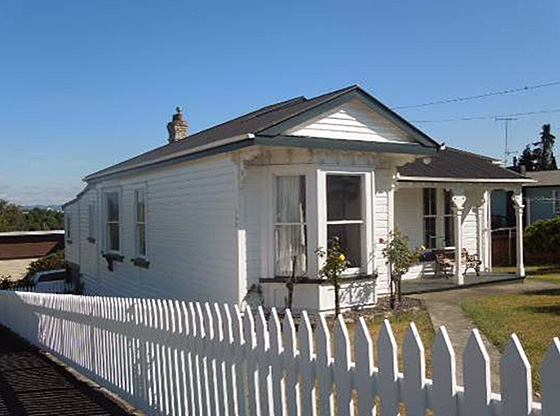
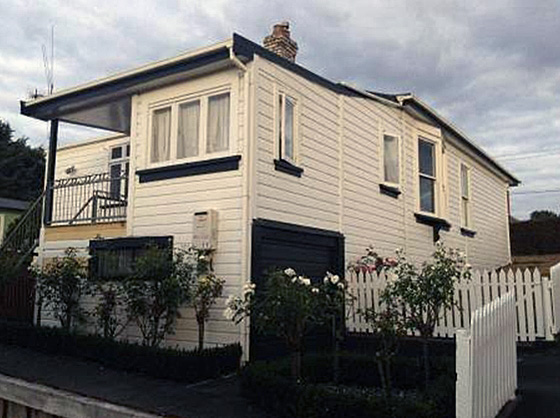
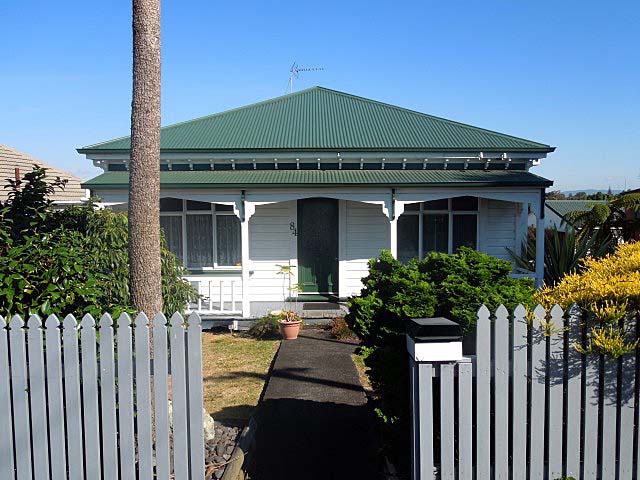
The house at 102 Forest Lake Road, Hamilton was constructed some time between July 1914 and 31 March 1917 as one of a group of state houses built under the Workers’ Dwellings Act 1910. The group of nine houses, all on the north-west side of Forest Lake Road,, was named the Laurenson Settlement after Liberal Member of Parliament George Laurenson, who advocated for the passage of the Act through Parliament. The Settlement was the earliest state housing in Hamilton. Research to date has not established which was the first house built nor the order (by address) of construction.
In 1905, the Liberal government (1890-1912) passed the Workers’ Dwellings Act, making it ‘the first central government in the Western world to build public housing for its citizens’. The Act paved the way for state housing, but proscriptive conditions meant it was only partially successful. These conditions were mitigated in part by the Government Advances to Workers’ Act 1906 and by July 1908, 94 workers’ dwellings had been erected in Auckland, Petone, Christchurch, Dunedin and Coromandel. Under the subsequent Workers’ Dwellings Act 1910, the government enacted to build dwellings for landless urban workers for a ₤10 deposit.
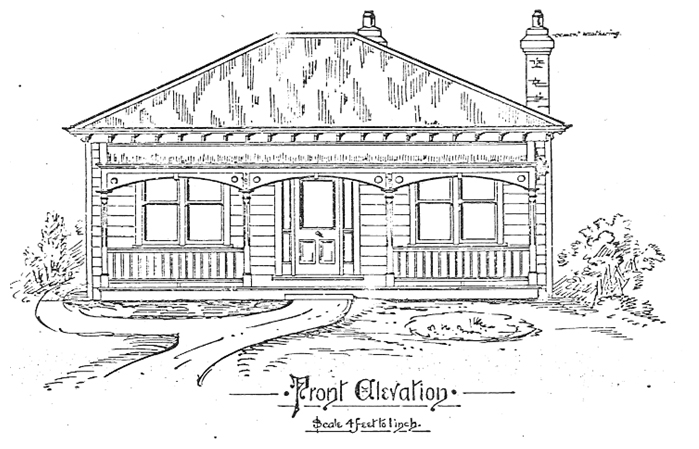
In 1910, architect Woburn Temple was reported as designing residences for those who had applied for and obtained loans under the Advances to Settlers scheme. It was compulsory for applicants to accept one of the designs provided by the Department of Labour, but modifications were allowed and Temple ensured there was no incongruity of design or materials. The designs, which had two to six rooms, followed ‘the usual style of smaller domestic architecture of New Zealand’. Plans for eight of the 15 designs are known to exist.
Woburn Temple was the Department of Labour Staff Architect from March 1907 until 1915. Prior to that, he was described as a ‘government officer’ when inspecting the erection of workers’ dwellings at Ellerslie in July 1906. He was gazetted as an architect in October 1907. In 1908, he controversially experimented with day labour instead of contract labour, and constructed two state houses in concrete instead of wood - experiments designed to compare costs. Little is known of Temple’s other work or his personal life. He and wife Eva had at least two sons, born in 1908 and 1912. Woburn Temple’s death and burial records have not been located.
The Laurenson Settlement is on Part Allotments 75 and 76 Pukete Parish and was first surveyed in 1864 into 50-acre allotments as grants to militiamen of the Fourth Regiment of the Waikato Militia. Allotments 75 and 76 were part of the 250 acres (101.25 hectares) allotted to Doctor John Carey, surgeon to the militia. He acquired an additional 150 acres (60.75 hectares) and called his farm ‘Forest Lake’ after its area of native bush and a small lake, Rotokaeo. His land extended along both sides of Forest Lake Road and the northern and eastern parts were adjacent to the original Town of Hamilton West.
After Carey’s death in 1889, the farm was owned by his daughter Margaret Kelly. By 1912, the subject area was owned by Mary Walsh, wife of John William Walsh, farmer and flaxmiller of Te Rapa. By that time, the town of Frankton had been established to the west of Hamilton and Forest Lake was in Waipa County, just outside the boundaries of Frankton and Hamilton. The North Island Main Trunk (NIMT) railway line ran along the west side of the Forest Lake property, then south through Frankton Junction. In 1908, the NIMT was open from Auckland to Wellington. With the eastern lines to Rotorua and the Bay of Plenty from Frankton Junction, the rail traffic was considerable. By 1911, Frankton’s population was over 1000 people and growing fast, with employment centred around the railway and associated trades and businesses.
Forest Lake fitted the government’s criteria for providing housing for workers with lower incomes in areas adjacent to cheaper rural land. On 20 May 1912, the government announced the purchase of land at Forest Lake for the purposes of providing housing under the Workers’ Dwellings Act 1910, with ‘general satisfaction’ being expressed locally. The land was a roughly 3.6 hectare strip on the north-west side of Forest Lake Road. The land was surveyed in June 1912 and divided into 36 lots plus one street (Lake Street) which lay between Lot 22 and Lot 23. The official land transfer post-dated the announcement of the purchase, as the Walshes did not have Certificate of Title. Title was issued to Mary Walsh on 18 September 1913, for 9 acres 2 roods 23.3 perches (3.9 hectares) on plan DP 7943. Three weeks later, on 8 October 1913, title was transferred to His Majesty the King for the purposes of the Workers’ Dwellings Act for 9 acres 18.7 perches (3.69 hectares) being ‘Lots 1 to 11, 13 to 36 and Walsh Street’ on plan DP 7943 being portions of Allotments 75 and 76 Parish of Pukete. Walsh Street was Lot 12. It was later named Moore Street. Lake Street was proclaimed a public road on 18 July 1914 and later named Walsh Street. The lots were numbered from one at the north-eastern end to 36 at the railway end, and with the removal of Lot 12 as a street, provided 35 sections for housing. The house at 102 Forest Lake Road was on Lot 11, adjacent to Moore Street.
The group of workers’ dwellings at Forest Lake was termed the Laurenson Settlement in recognition of Liberal Member of Parliament George Laurenson (1857-1913), a strong advocate for the Workers’ Dwellings Act during its passage through parliament. He represented the Lyttelton electorate from 1899 until his death in 1913, and was Minister of Labour, Customs and Marine in the McKenzie Administration of 1912. He supported the Labour Party’s stance during the Auckland Watersiders’ strike and in recognition of this, his funeral cortege included nearly 1000 members of the Waterside Workers’ Union.
On 8 November 1913, it was reported that the Frankton Borough Council had agreed at its monthly meeting to supply electricity to the Laurenson Settlement ‘if the government would erect poles and mains for about 30 chains to the nearest house, on the condition that the cost would be refunded if the property came into the borough’.
Also in 1913, another landowner subdivided a 29 hectare block bordering the south-eastern side of Forest Lake Road into 200 sections for residential development.
On 3 February 1914, the Superintendent Workers’ Dwellings advertised in the Waikato Times for tenders to construct six dwellings, each builder to state how many of the six he could construct; the closing date for tenders was 21 February. The plans, specifications and conditions of contract were available for inspection at the office of the Inspector of Factories in Hamilton.
The report by the Minister of Labour for the year ending 31 March 1914 states that 340 dwellings had been built or were under construction nationwide. The report also states that nine acres (3.6 hectares) had been bought at Frankton. Photographs in the report show houses in Christchurch, Wanganui and Greymouth in the same designs as those in the Laurenson Settlement.
On 28 May 1914, the Labour Department announced that it had accepted tenders for the construction of nearly 60 workers’ dwellings under the scheme inaugurated by the then Minister of Labour, John A. Millar several years previously. According to a newspaper report, ‘under [the scheme] a worker may, by paying a small deposit and subsequent regular instalments, obtain a house built from a selected design. A series being available, slight modifications are made to meet individual tastes and necessities’. As well as six contracts for Frankton Junction, there were others for Gisborne, Patea, Masterton and Tolaga Bay.
The first load of timber for the Laurenson Settlement houses was delivered in mid June 1914, and within three weeks the framework and roof of ‘what promises to be a picturesque villa’ had been erected and timber for three other houses was on the ground ready.
In the year to 31 March 1915, weekly or other payments contracted for in the Laurenson Settlement were ₤70/15/9, but only ₤64/4/7 was received, that is, ₤6/11/2 was in arrears. Of the 172 buildings built and disposed of nationwide during 1914-15, six were at Frankton Junction and none were in course of erection. All were built for applicant-purchasers. The average weekly amounts payable by the purchasers for a four-roomed house with section was 12/10 (12 shillings and 10 pence), and for a five-roomed house and section 15/6. The 1915 report states that the area available for new dwellings at Frankton was 7¼ acres (2.9 hectares) – the reduction being the roads.
In the 1916 departmental report on owners in arrears, someone (or more than one person) in Laurenson owed ₤19/10/ – this sum came under the category of ‘Dwellings transferred to new purchasers’ or ‘Efforts being made to find more suitable purchasers’.
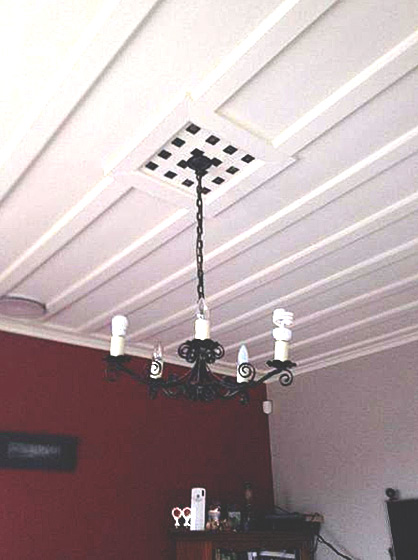
The houses were built to standard plans with some modifications and are likely to have had similar materials and fittings. In 1916, similar houses being built in Wellington were described in some detail: ‘In all details the houses are well finished. Plaster and beaver-boards, with rimu fixtures, make a room look well … . Windows and doors are of latest design, and in the living rooms the fireplaces are of the hearth-grate type. Linen cupboards are fitted for the housewife, and there is every convenience desired in the kitchen, scullery, and bath-room, including copper, tubs, and other sundries …. In the five-roomed houses, the occupier may have either one large living room and four bedrooms, or living room, sitting room and three bedrooms. The same choice is given in the four-roomed houses, but with one less bedroom. On the front of each house there is a wide verandah or porch, while bay windows further relieve any severity of style…’.
From the departmental reports, it seems that six houses were built in the Laurenson Settlement by March 1915, none in the April 1915 - March 1916 year (although three were in course of erection), and three in the April 1916 - March 1917 year. None were under construction at 31 March 1917. The houses were built on Lots 1, 3, 4, 11, 13, 14, 22 and 23.
At the end of March 1917, there were no payments in arrears for the Laurenson houses. The Forest Lake Road lots were sold off or dispersed under Warrants or Deferred Payment Leases from November 1917. None of the first 18 lots sold relate to the houses currently identified as Laurenson Settlement state houses.
Research to date has not established the date of construction of 102 Forest Lake Road nor the name of the first occupier or owner.
Fewer workers’ dwellings were erected nationwide in the 1916-17 year as building costs rose: the average cost for a four-room wooden dwelling from ₤360 to ₤460 and for a five-roomed one, ₤450 to ₤560. The Department of Labour inspected its houses throughout the country and found that most owners were taking pride in their homes, laying out gardens and planting trees and shrubs. By 31 March 1918, there were 647 workers’ dwellings (plus one built but destroyed by fire) in the country.
The Housing Act 1919 replaced the Workers’ Dwellings Act, the main change being to raise the income threshold for applicants. Further houses were built, and the 1920 report of the Minister of Labour stated that for Hamilton, negotiations for 25 houses were in progress. Two more houses may have been built in Forest Lake Road under the provisions of the 1919 Act.
Further subdivisions by the Walshes and other landowners provided more sections for housing and Forest Lake began to develop as a residential area. Frankton merged with Hamilton Borough in 1917, but this still did not include Forest Lake. By 1923, there were 150 school-age children in the locality, and in 1926, Forest Lake School opened.
In October 1923, Forest Lake Road was described in a house for sale advertisement as ‘the coming residential portion of Frankton’. In August 1923, householders from Forest Lake and Maeroa (adjacent to the south and south-east) decided to form a ratepayers association. The duly formed Maeroa Settlers’ Association considered a proposal to raise a loan for road improvements, but decided it was time for the locality to merge with Hamilton Borough. A petition signed by over 100 residents was submitted to the Governor-General and in December 1923, the Hamilton Borough Council agreed to incorporate Maeroa and Forest Lake. However, this did not happen officially until 1925.
As the population of the area rose, services such as sewers, drainage, water supply and bus transport were provided. Loan proposals for the provision of sewerage and water system were discussed in August 1925. In 1929, the Anglican community built a church hall. The suburb was close to the railway station and workshops; the railway house factory and mill; the bacon factory and the Frankton butter factory. Most of the residents were working class - in 1919 occupiers of the Laurenson Settlement included six railways employees, an engineer, a motor mechanic, a bacon-curer, a butter factory worker and an ironmonger. In 1930, six of the twelve listed occupants between the railway line and Mitcham Avenue worked in railways occupations; however, these were not all Laurenson Settlement houses.
On 9 May 1924, a new title for Lot 11 was issued to James Kane of Frankton Junction, an engine driver. He was seized of fee simple at that date but a Warrant had been issued to him for the same land on 24 March 1924. As the 1922 street directory shows J. Kane, railway employee, as being at Te Rapa, Frankton Junction (there is no listing by street), it is possible he was resident at 102 Forest Lake Road prior to his obtaining title. In a 1930 directory, Kane is shown as being on the block between Lake Avenue [sic] (now Walsh Street) and Mitcham Avenue (Moore Street did not then exist). Similarly, in 1932 and 1934 directories, he is shown at number 51. In 1947, Kane was in number 49, presumably a re-numbering. In 1949, Moore Street is noted, with Kane in number 102, another re-numbering.
In 1937, Mary Walsh subdivided the land on the north-east side of Walsh Avenue. The rear (north-east side) of these lots was the boundary between Waipa County and Hamilton Borough Council. More state housing was built on the south-east side of Forest Lake Road and also in Rimu, Hinau and Matai Streets after 1938. Private housing, in those side streets and further along Forest Lake Road, was interspersed amongst state houses as the government sold off the unused sections bought as part of the Laurenson Settlement.
By 1950, the Crown still owned nine of the Laurenson Settlement sections. Laurenson Lots 6, 7, 8, 16, 25, 26, 30, 31, 34, and 36 were held under deferred payment licenses under the Reserves and Other Lands Disposal and Public Bodies Empowering Act 1924, and validated many years later.
James Kane retained ownership until his death (possibly in 1954). On 23 July 1962 the title transferred to John Louis Kane of Frankton Junction (butcher) and Mary [Haha/Hale] of Ngaruawahia (married woman). On 10 September 1962, ownership transferred to Adrianus Everaarts of Hamilton, civil servant, and Neeltje Everaarts. After the latter died, ownership passed by transmission to Adrianus Everaarts on 16 September 1992. He transferred ownership on 17 March 1995 to David C. and Sierra C. Gallagher.
The Gallaghers, in combination with neighbours B. and D.J. Homewood, had the property surveyed in June 1996 in preparation for its subdivision and part merger with Lot 10. New titles were issued: D.C. and S.C. Gallagher received title to Lot 1 DPS 74198 (reduced to 610 square metres) on 1 November 1996. On 30 January 1997, title transferred to Doreen Maree Stedman. Current owners G.H. Douglas and P.M. Jones acquired the property on 21 August 2009. The north-western ends of former Lots 10 and 11 were surveyed subsequently as one lot on DPS 82364, then reconfigured again (DPS 92208). The north-western end of the original Lot 11 is now 2 Moore Street with another house on that land. An easement of right to drain sewerage exists on the title. Lot 1 with the original state house is the very corner of Moore Street and Lot 2 has access to both Moore Street and Forest Lake Road.
The current owners have made some alterations to the bathroom and installed a second bathroom in the former wash-house. They have also altered the north-east facing elevation of the wall on the rear lean-to, installing French doors and cladding the exterior with matching rusticated weatherboards.
The house has been recognised as being of value by its inclusion in the Schedule of Heritage Items Appendix 2.3-II in the Hamilton City District Plan (Operative) and the Proposed District Plan. Other early state housing groups in Hamilton include the Frankton railway settlement (1923-29), Richmond (late 1930s) and Hayes Paddock (1939-45). The Laurenson Settlement was the earliest state housing in Hamilton.