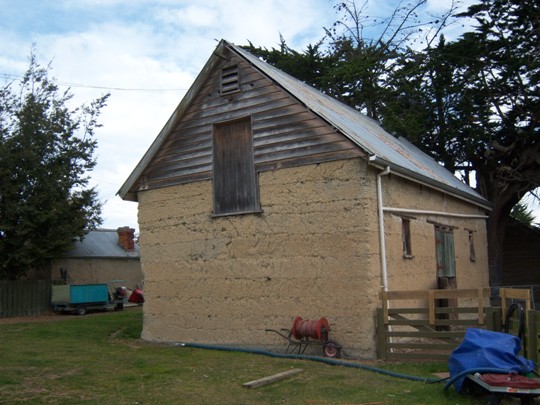
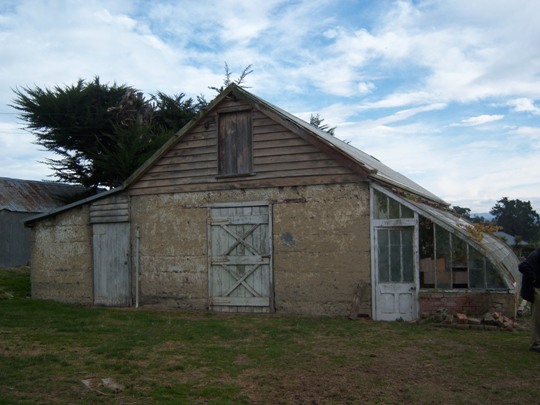
The building is approximately 13 metres by 20 metres rectangular in plan. It is constructed of cob with weatherboards in the gable ends. It has a cob lean-to that runs the length of the southern elevation and a glass house that runs the length of the northern elevation.
Cider was produced at Butchers Orchard from the late 19th century and the original cider press was worked by hand. Cider barrels and cider bottles remain stored in the lean-to section of the Cob Cool Store building.
The Cob Cool Store has historical significance as a tangible reminder of early horticultural endeavours in South Canterbury and of a type of building construction often used by pioneer settlers but now relatively rare.

List Entry Information
Status
Listed
List Entry Status
Historic Place Category 2
Access
Private/No Public Access
List Number
9940
Date Entered
26th September 2008
Date of Effect
26th September 2008
City/District Council
Timaru District
Region
Canterbury Region
Extent of List Entry
Extent includes part of the land described as Lot 1 DP 80646 and the building known as the Cob Cool Store (Butchers) thereon, and its fittings and fixtures. (Refer to map in Appendix 1 of the registration report for further information).
Legal description
Lot 1 DP 80646 (CB46B/374), Canterbury Land District
Location Description
Located near the corner of Fairview Road and Barton Road to the north-west of the brick Butchers homestead and behind a Cob Shed and Cob Washhouse
Why is this place significant?
Historic Significance
Historical Significance or Value The Cob Cool Store has historical significance as a tangible reminder of one of the earliest horticultural endeavours in South Canterbury and of a type of building construction often used by pioneer settlers. In the 1870s, cob was a typical and practical form of construction especially in South Canterbury where the area was sparsely wooded. However, as a construction type, intact cob buildings are becoming increasingly rare. The Cob Cool Store remains intact and continues to function as storage for the farm.
Physical Significance
ARCHAEOLOGICAL SIGNIFICANCE OR VALUE: The Cob Cool Store is of significance in its archaeology of a pre-1900 standing structure that was built largely of cob.
Why is this place Category 1 / Category 2?
Detail Of Assessed Criteria
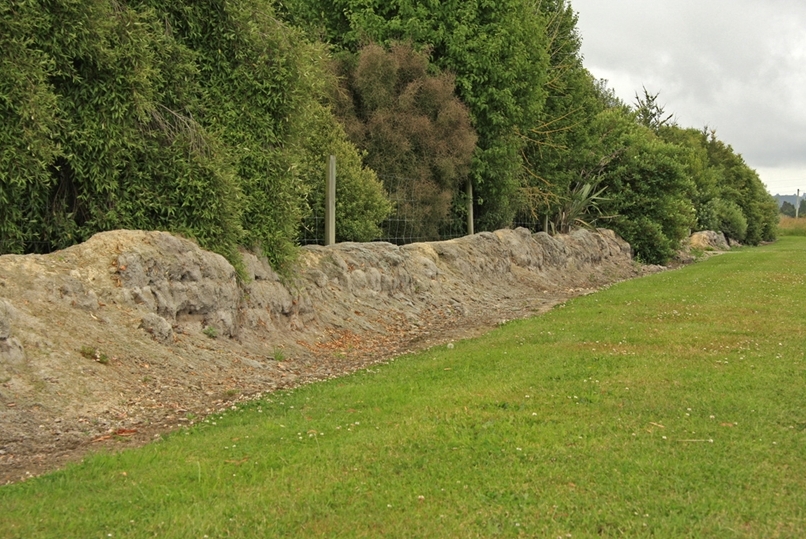
(a) The extent to which the place reflects important or representative aspects of New Zealand history: The Cob Cool Store reflects representative aspects of both building construction and horticultural development in South Canterbury in the mid to late 19th century. (j) The importance of identifying rare types of historic places: Whereas cob construction was reasonably common especially in rural areas in the 19th century, the survival of the century Cob Cool Store, along with the associated cob stables and cob wash house on the property, makes it now a relatively rare type of historic place. Many intact 19th century cob buildings have not survived to the present day, often because they have become vulnerable to the elements when roof coverings have deteriorated or been removed. (k) The extent to which the place forms part of a wider historical and cultural complex or historical and cultural landscape: The Cob Cool Store forms part of a wider historical complex, being one of three surviving cob buildings on the property, and nearby to a cob wall located diagonally opposite the property on Fairview Road. SUMMARY OF SIGNIFICANCE OR VALUES: This place was assessed against, and found it to qualify under the following criteria: a, j, k. CONCLUSION: It is considered that this place qualifies as a Category II historic place.
Construction Details
Type
Original Construction
Description
Cob Cool Store construction
Period
1800s
Construction Details
Type
Original Construction
Description
Cob Cool Store construction
Period
1800s
In 1872 Edwin Butchers took up land in the area now known as Fairview and established a commercial orchard, the trees for which had come from Australia. The orchard is thought to have been one of the earliest in South Canterbury. A cob house was built in the 1870s, and by the 1880s the Butchers had built a complex of cob buildings, namely the Cob Cool Store, as well as a cob stables building and a cob wash house. The cob was mixed by treading clay and tussock with bullocks and horses. The present brick homestead was built in the 1920s, possibly on the site of the original cob house. Edwin Butchers was born in Kent, England, in 1840 and was brought up as a farmer. He arrived in Lyttelton by the ship Canterbury in 1864 and worked for about 18 months on Longbeach Station in South Canterbury. Some time after this, he was employed in the formation of the West Coast road. In 1871 Butchers married and the following year, in 1872, he commenced farming at Fairview, on eighty acres of land. By the early 20th century this had increased to 106 acres. Cider was produced at Butchers Orchard from the late 19th century and the original cider press was worked by hand. Cider barrels and cider bottles are stored in the lean-to section of the Cob Cool Store. The pear cider was legendary with the locals. The cob building provided an even temperature of the storage of fruit and fruit produce. The homestead and complex of cob buildings has remained in the ownership of descendents of the Butchers family. COB: Cob construction is surprisingly like concrete once dry. A wet mix was made of clay, tempered with chopped straw and dung, which set hard as it dried. The materials were free and the method was very old and had been used in for many centuries, notably in England from where Edwin Butchers had hailed. In 19th century New Zealand cob construction was common. Several of the colonists' handbooks recommended it for its simplicity, pointing out that even farm labourers could build with it. In the thinly wooded Canterbury, cob was an ideal construction material and it was used widely. In 1871, more than 30% of all the houses in South Canterbury were built by cob. However, an overwhelming amount has not survived and it is not common for those cob buildings that do survive to remain in use. It is noteworthy that the Cob Cool Store at Fairview continues a storage function.
In 1872 Edwin Butchers took up land in the area now known as Fairview and established a commercial orchard, the trees for which had come from Australia. The orchard is thought to have been one of the earliest in South Canterbury. A cob house was built in the 1870s, and by the 1880s the Butchers had built a complex of cob buildings, namely the Cob Cool Store, as well as a cob stables building and a cob wash house. The cob was mixed by treading clay and tussock with bullocks and horses. The present brick homestead was built in the 1920s, possibly on the site of the original cob house. Edwin Butchers was born in Kent, England, in 1840 and was brought up as a farmer. He arrived in Lyttelton by the ship Canterbury in 1864 and worked for about 18 months on Longbeach Station in South Canterbury. Some time after this, he was employed in the formation of the West Coast road. In 1871 Butchers married and the following year, in 1872, he commenced farming at Fairview, on eighty acres of land. By the early 20th century this had increased to 106 acres. Cider was produced at Butchers Orchard from the late 19th century and the original cider press was worked by hand. Cider barrels and cider bottles are stored in the lean-to section of the Cob Cool Store. The pear cider was legendary with the locals. The cob building provided an even temperature of the storage of fruit and fruit produce. The homestead and complex of cob buildings has remained in the ownership of descendents of the Butchers family. COB: Cob construction is surprisingly like concrete once dry. A wet mix was made of clay, tempered with chopped straw and dung, which set hard as it dried. The materials were free and the method was very old and had been used in for many centuries, notably in England from where Edwin Butchers had hailed. In 19th century New Zealand cob construction was common. Several of the colonists' handbooks recommended it for its simplicity, pointing out that even farm labourers could build with it. In the thinly wooded Canterbury, cob was an ideal construction material and it was used widely. In 1871, more than 30% of all the houses in South Canterbury were built by cob. However, an overwhelming amount has not survived and it is not common for those cob buildings that do survive to remain in use. It is noteworthy that the Cob Cool Store at Fairview continues a storage function.
The Cob Cool Store is located on farmland, approximately 100 metres to the south-east of a 1920s brick homestead located at the corner of Fairview and Barton Roads, Fairview. The area has several large macrocarpa trees to the south-west and east of the building, and the ground is grassed. Two other cob buildings are located to the east of the Cob Cool Store, one being a smaller wash house building situated approximately half way between the homestead and the Cob Cool Store, and the other a substantial Cob Shed which was the original stables for the property, located approximately 25 metres to the east of the Cob Cool Store. All these buildings can be seen from Barton Road. The Cob Cool Store building itself is approximately 13 metres by 20 metres rectangular in plan. It is constructed of cob with weatherboards in the gable ends. It has a cob lean-to that runs the length of the southern elevation and a glass house that runs the length of the northern elevation. The glass house consists of a brick base with narrow vertical panes of glass and timber framing. The doors are timber. The roof is corrugated iron.
The Cob Cool Store is located on farmland, approximately 100 metres to the south-east of a 1920s brick homestead located at the corner of Fairview and Barton Roads, Fairview. The area has several large macrocarpa trees to the south-west and east of the building, and the ground is grassed. Two other cob buildings are located to the east of the Cob Cool Store, one being a smaller wash house building situated approximately half way between the homestead and the Cob Cool Store, and the other a substantial Cob Shed which was the original stables for the property, located approximately 25 metres to the east of the Cob Cool Store. All these buildings can be seen from Barton Road. The Cob Cool Store building itself is approximately 13 metres by 20 metres rectangular in plan. It is constructed of cob with weatherboards in the gable ends. It has a cob lean-to that runs the length of the southern elevation and a glass house that runs the length of the northern elevation. The glass house consists of a brick base with narrow vertical panes of glass and timber framing. The doors are timber. The roof is corrugated iron.
Historical and Associated Iwi / Hapū / Whānau
Completion Date
27th May 2008
Report Written By
Robyn Burgess
Information Sources
Allen, 1997
Miles Allen, Out of the Ground: Earthbuilding in New Zealand, The Dunmore Press, 1997.
Andersen, 1916
Johannes Andersen, 'Jubilee History of South Canterbury', Whitcombe & Tombs, Auckland, 1916
Cyclopedia of New Zealand, 1903
Cyclopedia Company, Industrial, descriptive, historical, biographical facts, figures, illustrations, Wellington, N.Z, 1897-1908, Vol. 3, Canterbury Provincial District, Christchurch, 1903
Gillespie, 1971
Oliver A. Gillespie, South Canterbury: A Record of Settlement, 2nd edn., Timaru, 1971
Salmond, 1986
Jeremy Salmond, Old New Zealand Houses 1800-1940, Auckland, 1986, Reed Methuen
Historic Places in New Zealand
Historic Places in New Zealand
Other Information
A copy of the original report is available from the NZHPT Southern region office. Please note that entry on the New Zealand Heritage List/Rarangi Korero identifies only the heritage values of the property concerned, and should not be construed as advice on the state of the property, or as a comment of its soundness or safety, including in regard to earthquake risk, safety in the event of fire, or insanitary conditions.
Current Usages
Uses: Agriculture
Specific Usage: Cool room
Uses: Agriculture
Specific Usage: Fruit shed/ store
Uses: Agriculture
Specific Usage: Shed
Former Usages
General Usage: Agriculture
Specific Usage: Cool room
General Usage: Agriculture
Specific Usage: Fruit shed/ store
General Usage: Agriculture
Specific Usage: Shed