List Entry Information
Status
Listed
List Entry Status
Historic Place Category 1
Access
Private/No Public Access
List Number
1107
Date Entered
21st September 1989
Date of Effect
21st September 1989
City/District Council
Napier City
Region
Hawke's Bay Region
Legal description
Lots 3,5 & 6 DP 1112
Location Description
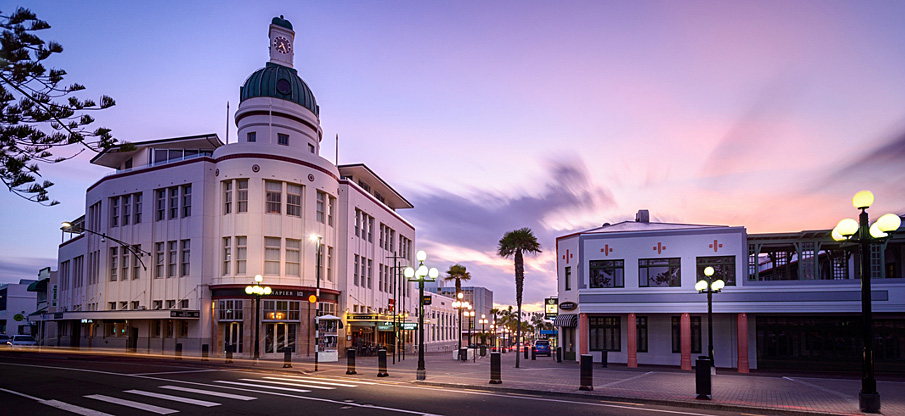
Located on the corner of 17 Browning Street and 1 Shakespeare Road, NAPIER
Status
Listed
List Entry Status
Historic Place Category 1
Access
Private/No Public Access
List Number
1107
Date Entered
21st September 1989
Date of Effect
21st September 1989
City/District Council
Napier City
Region
Hawke's Bay Region
Legal description
Lots 3,5 & 6 DP 1112
Location Description
Located on the corner of 17 Browning Street and 1 Shakespeare Road, NAPIER
Why is this place significant?
Historic Significance
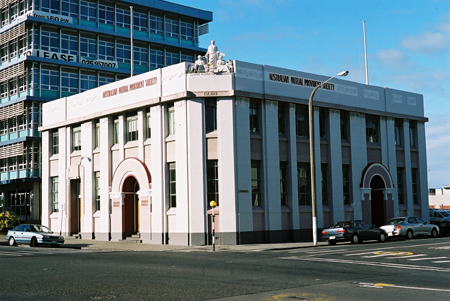
Historical Significance or Value This historic place was registered under the Historic Places Act 1980. This report includes the text from the original Building Classification Committee report considered by the NZHPT Board at the time of registration. The Australian Mutual Provident Society was established in 1849, and had been a prominent commercial organisation in Napier long before the earthquake. After the 1931 earthquake the company played a very important part in financing the reconstruction of Napier. The Society was looked upon as a benevolent and munificent commercial organisation of considerable significance for the community. The building itself is part of a collection of structures in Napier which all comply with the New Zealand Standards Association codes for earthquake resistant structures which were enforced after 1931.
Physical Significance
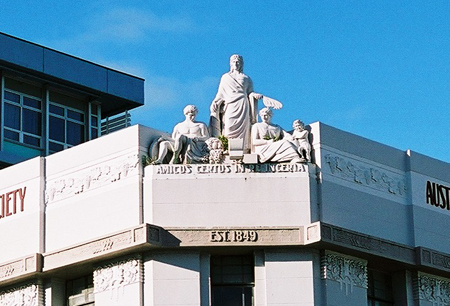
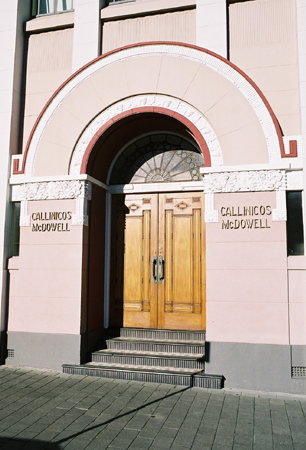
This historic place was registered under the Historic Places Act 1980. This report includes the text from the original Building Classification Committee report considered by the NZHPT Board at the time of registration. ARCHITECTURAL SIGNIFICANCE: Louis Hay was New Zealand's leading exponent of Chicago School architecture in the thirties. He was influenced by both Louis Sullivan and his famous pupil Frank Lloyd Wright. In the AMP building, Hay has concentrated his ornament on corners, at openings and at the junctions of features, where emphasis is appropriate. However, the proportions of the building derive from the work of Frank Lloyd Wright, particularly his Unity Temple, Oak Park, Chicago (1905-6) and show Hay's indebtedness to American precursors. Hay deploys ornament to great effect but always with restraint. Rather than derive the capitals to the pilasters from classical precedent, Hay has topped his engaged pilasters with rich foliate motifs, which although ornate, remain sculpted in low relief and therefore closely related to the structure. The incorporation of the AMP's classical statuary group on the pediment emphasises the classical derivation of the whole design and adds a dignity and monumentality to the architecture which is appropriate to the image of stability and dependability which the insurance company wished to have expressed. TOWNSCAPE/LANDMARK SIGNIFICANCE: The AMP building occupies a prominent site at the foot of Shakespeare Hill on the boundary of the central business district. Its style of architecture links it to Louis Hay's nearby Hildebrandt and Munster Chambers buildings in Tennyson Street as well as to the Hawkes Bay Art Gallery and Museum in Herschell Street which adjoins Browning Street.
Why is this place significant?
Historic Significance
Historical Significance or Value This historic place was registered under the Historic Places Act 1980. This report includes the text from the original Building Classification Committee report considered by the NZHPT Board at the time of registration. The Australian Mutual Provident Society was established in 1849, and had been a prominent commercial organisation in Napier long before the earthquake. After the 1931 earthquake the company played a very important part in financing the reconstruction of Napier. The Society was looked upon as a benevolent and munificent commercial organisation of considerable significance for the community. The building itself is part of a collection of structures in Napier which all comply with the New Zealand Standards Association codes for earthquake resistant structures which were enforced after 1931.
Physical Significance
This historic place was registered under the Historic Places Act 1980. This report includes the text from the original Building Classification Committee report considered by the NZHPT Board at the time of registration. ARCHITECTURAL SIGNIFICANCE: Louis Hay was New Zealand's leading exponent of Chicago School architecture in the thirties. He was influenced by both Louis Sullivan and his famous pupil Frank Lloyd Wright. In the AMP building, Hay has concentrated his ornament on corners, at openings and at the junctions of features, where emphasis is appropriate. However, the proportions of the building derive from the work of Frank Lloyd Wright, particularly his Unity Temple, Oak Park, Chicago (1905-6) and show Hay's indebtedness to American precursors. Hay deploys ornament to great effect but always with restraint. Rather than derive the capitals to the pilasters from classical precedent, Hay has topped his engaged pilasters with rich foliate motifs, which although ornate, remain sculpted in low relief and therefore closely related to the structure. The incorporation of the AMP's classical statuary group on the pediment emphasises the classical derivation of the whole design and adds a dignity and monumentality to the architecture which is appropriate to the image of stability and dependability which the insurance company wished to have expressed. TOWNSCAPE/LANDMARK SIGNIFICANCE: The AMP building occupies a prominent site at the foot of Shakespeare Hill on the boundary of the central business district. Its style of architecture links it to Louis Hay's nearby Hildebrandt and Munster Chambers buildings in Tennyson Street as well as to the Hawkes Bay Art Gallery and Museum in Herschell Street which adjoins Browning Street.
Construction Professional
Name
Hay, James Augustus Louis
Type
Architect
Biography
J A Louis Hay (1881-1948) was born at Akaroa, Banks Peninsula. He attended Napier Boys' High School and worked for both D T Natusch and Walter P Finch. Hay developed a strong interest in the work of William Morris (1834-1869), Louis Sullivan (1856-1924) and Frank Lloyd Wright (1869-1959). On completion of his training Hay worked both in Dunedin and Australia before returning to Napier to commence practice on his own account. Hay was chairman of the Hawkes Bay branch of the New Zealand Institute of Architects and was the Institute representative on the Napier Reconstruction Committee after the 1931 earthquake. He also did extensive work toward the reconstruction of Napier in the 1930s as a member of Associated Architects, a co-operative design organisation whose members included the principals of the three other major architectural practices in Napier at that time - C T Natusch and Sons, Finch and Westerholm and E A Williams. In collaboration with these architects Hay contributed to the Marine Parade Development plan, and the reconstruction of Napier Public Hospital. In his own practice Hay was responsible for the designs of the National Tobacco Company Building (now Rothman's), Ahuriri (1933), the Hawkes Bay Art Gallery and Museum (1935), and the Hildebrandt Building, Tennyson Street (1932). His domestic work includes 'Waiohika', Greys Bush, Gisborne (1920).
Name
Angus, William McKenzie
Type
Builder
Biography
William McKenzie Angus was born in Naseby in 1883. At age 14 he moved to Wellington to work as a blacksmith but changed to carpentry and worked in several North Island centres before coming to Napier in approximately 1907. He founded the firm W M Angus Ltd in 1923, with approximately 4-5 employees. At the time of his death in July 1968 the firm had 200 employees. His first major job in Napier, the Chief Post Office, withstood the 1931 Hawkes Bay earthquake as did the other buildings he had erected in Napier by this time. (Registration Report for the Waiapu Diocesan Office Building and Synod Hall, 2008).
Construction Details
Start Year
1976
Type
Modification
Description
Natusch, Shattky and Company redesigned interior spaces to improve the ratio of rental accommodation to floor area of ground and first floors.
Start Year
1933
Finish Year
1934
Type
Original Construction
Description
Stripped Classical (Art Deco motifs); Construction from September 1933 to July 1934
Start Year
2007
Type
Modification
Description
Strengthening of ground floor & parapet. No documents provided.
Period
2007-10
Construction Materials
Steel-framed; walls and partitions generally are in concrete, except the east and north outer walls and the parapets which are panelled in brick. The exterior in cement plaster.
Notable Features
F.G.F. Mercer's sculptural group on the corner pediment. The original light fittings, which derive from Frank Lloyd Wright's electrical fittings In the Larkin building (1903), Buffalo, New York; The wooden Interior fittings which feature floral motifs.
Construction Professional
Name
Hay, James Augustus Louis
Type
Architect
Biography
J A Louis Hay (1881-1948) was born at Akaroa, Banks Peninsula. He attended Napier Boys' High School and worked for both D T Natusch and Walter P Finch. Hay developed a strong interest in the work of William Morris (1834-1869), Louis Sullivan (1856-1924) and Frank Lloyd Wright (1869-1959). On completion of his training Hay worked both in Dunedin and Australia before returning to Napier to commence practice on his own account. Hay was chairman of the Hawkes Bay branch of the New Zealand Institute of Architects and was the Institute representative on the Napier Reconstruction Committee after the 1931 earthquake. He also did extensive work toward the reconstruction of Napier in the 1930s as a member of Associated Architects, a co-operative design organisation whose members included the principals of the three other major architectural practices in Napier at that time - C T Natusch and Sons, Finch and Westerholm and E A Williams. In collaboration with these architects Hay contributed to the Marine Parade Development plan, and the reconstruction of Napier Public Hospital. In his own practice Hay was responsible for the designs of the National Tobacco Company Building (now Rothman's), Ahuriri (1933), the Hawkes Bay Art Gallery and Museum (1935), and the Hildebrandt Building, Tennyson Street (1932). His domestic work includes 'Waiohika', Greys Bush, Gisborne (1920).
Name
Angus, William McKenzie
Type
Builder
Biography
William McKenzie Angus was born in Naseby in 1883. At age 14 he moved to Wellington to work as a blacksmith but changed to carpentry and worked in several North Island centres before coming to Napier in approximately 1907. He founded the firm W M Angus Ltd in 1923, with approximately 4-5 employees. At the time of his death in July 1968 the firm had 200 employees. His first major job in Napier, the Chief Post Office, withstood the 1931 Hawkes Bay earthquake as did the other buildings he had erected in Napier by this time. (Registration Report for the Waiapu Diocesan Office Building and Synod Hall, 2008).
Construction Details
Start Year
1976
Type
Modification
Description
Natusch, Shattky and Company redesigned interior spaces to improve the ratio of rental accommodation to floor area of ground and first floors.
Start Year
1933
Finish Year
1934
Type
Original Construction
Description
Stripped Classical (Art Deco motifs); Construction from September 1933 to July 1934
Start Year
2007
Type
Modification
Description
Strengthening of ground floor & parapet. No documents provided.
Period
2007-10
Construction Materials
Steel-framed; walls and partitions generally are in concrete, except the east and north outer walls and the parapets which are panelled in brick. The exterior in cement plaster.
Notable Features
F.G.F. Mercer's sculptural group on the corner pediment. The original light fittings, which derive from Frank Lloyd Wright's electrical fittings In the Larkin building (1903), Buffalo, New York; The wooden Interior fittings which feature floral motifs.
This historic place was registered under the Historic Places Act 1980. This report includes the text from the original Building Classification Committee report considered by the NZHPT Board at the time of registration. ARCHITECTURAL DESCRIPTION (STYLE): Stripped Classicism in the manner of the Chicago School, with a giant order of columns extending over two storeys and a large pediment with name inscription and sculptural group.
This historic place was registered under the Historic Places Act 1980. This report includes the text from the original Building Classification Committee report considered by the NZHPT Board at the time of registration. ARCHITECTURAL DESCRIPTION (STYLE): Stripped Classicism in the manner of the Chicago School, with a giant order of columns extending over two storeys and a large pediment with name inscription and sculptural group.
Historical and Associated Iwi / Hapū / Whānau
Completion Date
18th April 1989
Information Sources
Daily Telegraph
Daily Telegraph
Ives, 1982
Heather Ives, The Art Deco Architecture of Napier, Napier, 1982
New Zealand Institute of Architects Journal
New Zealand Institute of Architects Journal (NZIA), No.8, Aug 1974
Shaw, 1987
Shaw, Peter and Peter Hallett. Art Deco Napier: Styles of the Thirties, Reed Methuen, Auckland, 1987.
Frampton, 1980
Kenneth Frampton, Modern Architecture: A Critical History. Thames and Hudson, London, 1980
North and South Magazine
North and South Magazine
Other Information
A fully referenced registration report is available from the NZHPT Central Region office Please note that entry on the New Zealand Heritage List/Rarangi Korero identifies only the heritage values of the property concerned, and should not be construed as advice on the state of the property, or as a comment of its soundness or safety, including in regard to earthquake risk, safety in the event of fire, or insanitary conditions.
Historical and Associated Iwi / Hapū / Whānau
Completion Date
18th April 1989
Information Sources
Daily Telegraph
Daily Telegraph
Ives, 1982
Heather Ives, The Art Deco Architecture of Napier, Napier, 1982
New Zealand Institute of Architects Journal
New Zealand Institute of Architects Journal (NZIA), No.8, Aug 1974
Shaw, 1987
Shaw, Peter and Peter Hallett. Art Deco Napier: Styles of the Thirties, Reed Methuen, Auckland, 1987.
Frampton, 1980
Kenneth Frampton, Modern Architecture: A Critical History. Thames and Hudson, London, 1980
North and South Magazine
North and South Magazine
Other Information
A fully referenced registration report is available from the NZHPT Central Region office Please note that entry on the New Zealand Heritage List/Rarangi Korero identifies only the heritage values of the property concerned, and should not be construed as advice on the state of the property, or as a comment of its soundness or safety, including in regard to earthquake risk, safety in the event of fire, or insanitary conditions.
Current Usages
Uses: Trade
Specific Usage: Office building/Offices
Former Usages
General Usage: Trade
Specific Usage: Office building/Offices
Current Usages
Uses: Trade
Specific Usage: Office building/Offices
Former Usages
General Usage: Trade
Specific Usage: Office building/Offices