

Manawatū was first settled by Rangitāne o Manawatū who migrated south from the Heretaunga area and trace their origins back to Kurahaupō waka. They settled around the Manawatū River and established settlements all along the river which was the main route for both transport and communication. Rangitāne o Manawatū were later joined by Ngāti Kauwhata and Ngāti Raukawa following invasions from Waikato tribes in the 1820s. The Crown acquired large parts of Manawatū during mid-1800s, some of which it aimed to sell to colonists. In December 1871 Colonel William Feilding, Director of the London-based Emigrants and Colonists Aid Corporation, purchased some 106,000 acres of mostly bush-clad land between the Rangitīkei River and Ruahine Ranges which became known as the Manchester Block. A natural clearing was selected as the site of the block’s first township, which was named in honour of Colonel Feilding. The first colonial settlers arrived in Feilding from England in January 1874 and by 1906 it was a ‘thriving market town’ numbering almost 3000.
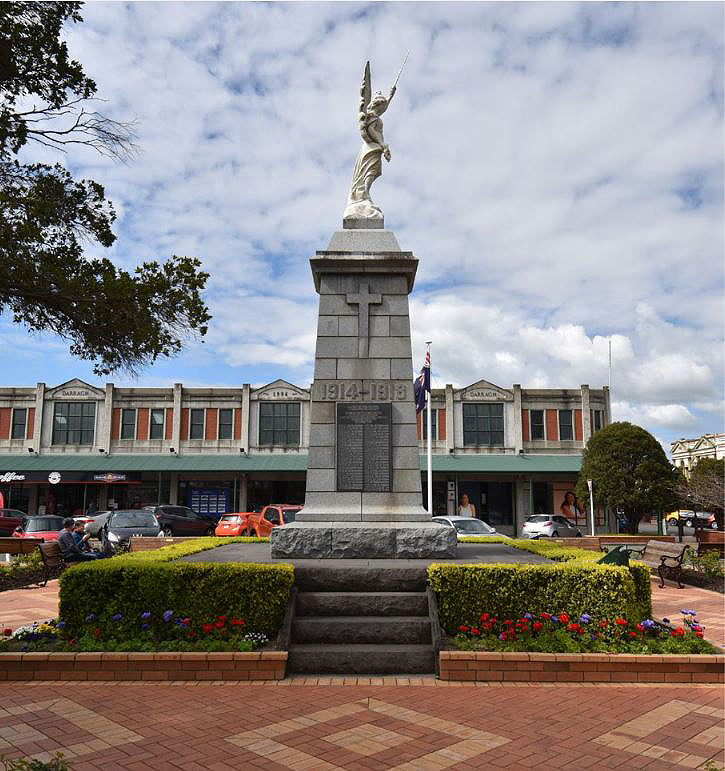
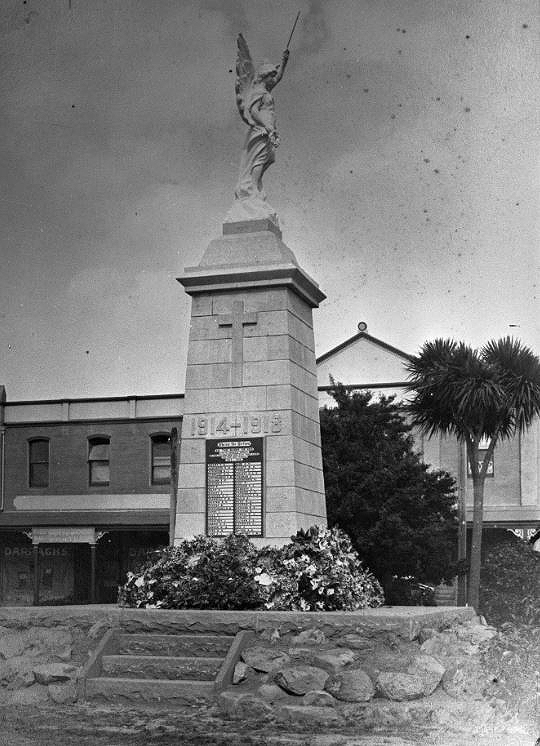
When the First World War broke out many young men from the Feilding area answered ‘the call to arms’ and more than 90 died ‘making the supreme sacrifice’. After peace was declared, the local community turned their minds to a fitting memorial to remember their war dead. Discussions occurred for some time as to the form and siting of a suitable memorial, and the necessary funding for its erection. In July 1921 the Feilding community decided to raise £1000 by voluntary subscription for a memorial in Manchester Square, an appropriate choice due to its prominent location within the township. £1200 was quickly raised and architect Robin Hood assisted the organising committee in choosing an appropriate design. They decided upon a tapering obelisk which was the most popular design for First World War memorials, and it was to be topped by a winged angel ‘symbolic of victory’. The successful tenderer was stonemason F.J. Jones, with a tender of £1270. The memorial was officially unveiled by Governor General Viscount Jellicoe on 4 October 1923, in a ceremony attended by hundreds including local dignitaries, next-of-kin and 200 returned soldiers.
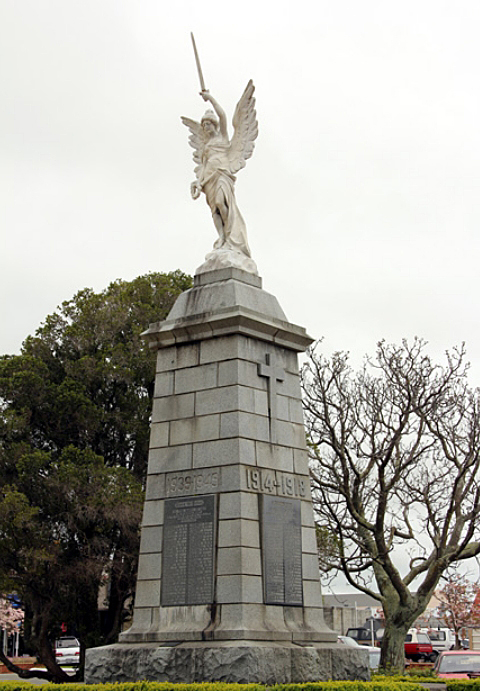
The granite obelisk sat upon an Australian bluestone base and the winged female angel atop the obelisk was carved from Sicilian marble. Her left hand was raised above her head holding a sword and there was a laurel wreath of victory in her right hand. Polished marble slabs were placed on the north-west and south-east faces of the obelisk listing the names of the fallen soldiers. The cross of St George was placed above each slab. Access steps up to the obelisk on the north-west and south-east faces enabled the laying of wreaths at its base.
A Second World War memorial slab was subsequently added to the south-west face of the memorial and unveiled and dedicated on ANZAC Day 1950 and in August 1995 a small plaque was placed beneath it to commemorate the 50th anniversary of V-J Day. A small plaque was also subsequently added to the north-east face to commemorate those who served in the Korean, Malaya, Borneo and Vietnam Wars and United Nations Peacekeeping Operations. In 2006 the South African War Memorial was relocated just to the north of the Soldiers’ Memorial and on 30 November 2010 a granite plaque was added to the obelisk’s north-east face in honour of Lieutenant Tim O’Donnell, the first New Zealander to die while serving in Afghanistan.

List Entry Information
Status
Listed
List Entry Status
Historic Place Category 2
Access
Able to Visit
List Number
1233
Date Entered
2nd July 1982
Date of Effect
2nd July 1982
City/District Council
Manawatū District
Region
Horizons (Manawatū-Whanganui) Region
Extent of List Entry
Extent includes part of the land described as Legal Road, Wellington Land District, and the structure known as the Feilding Soldiers’ Memorial thereon, and its landscaped setting (excluding the South African War Memorial). Refer to the extent map tabled at the Rārangi Kōrero Committee meeting on 24 November 2022.
Legal description
Legal Road, Wellington Land District
Location Description
Located on Manchester Square, Feilding. Area bounded to north west by Kimbolton Road, to the north east by Goodbehere Street, and to the south west by Manchester Street.
Status
Listed
List Entry Status
Historic Place Category 2
Access
Able to Visit
List Number
1233
Date Entered
2nd July 1982
Date of Effect
2nd July 1982
City/District Council
Manawatū District
Region
Horizons (Manawatū-Whanganui) Region
Extent of List Entry
Extent includes part of the land described as Legal Road, Wellington Land District, and the structure known as the Feilding Soldiers’ Memorial thereon, and its landscaped setting (excluding the South African War Memorial). Refer to the extent map tabled at the Rārangi Kōrero Committee meeting on 24 November 2022.
Legal description
Legal Road, Wellington Land District
Location Description
Located on Manchester Square, Feilding. Area bounded to north west by Kimbolton Road, to the north east by Goodbehere Street, and to the south west by Manchester Street.
Construction Professional
Name
F.J Jones
Type
Stonemason
Biography
Name
Hood, Robin
Type
Architect
Biography
Robin Hood was born in Dunedin in 1885 and then moved to the Manawatu around 1908. He was an architect based in Feilding from 1908 - 1920, and then in Palmerston North from 1920 - 1950. Among his known designs are the office building for future mayor Edmund Goodbehere at 71 Kimbolton St, Feilding.
Construction Details
Start Year
1923
Type
Original Construction
Start Year
1950
Type
Modification
Description
Addition of Second World War memorial plaque
Start Year
1959
Type
Modification
Description
Addition of floodlighting to base of the memorial
Type
Modification
Description
Addition of memorial plaque commemorating those who served in the Korean, Malaya, Borneo and Vietnam Wars and United Nations Peacekeeping Operations
Period
Unknown
Start Year
1995
Type
Modification
Description
Addition of memorial plaque for the 50th anniversary of V.J. Day
Start Year
2010
Type
Modification
Description
Addition of memorial plaque for Lieutenant Tim O’Donnell
Construction Professional
Name
F.J Jones
Type
Stonemason
Biography
Name
Hood, Robin
Type
Architect
Biography
Robin Hood was born in Dunedin in 1885 and then moved to the Manawatu around 1908. He was an architect based in Feilding from 1908 - 1920, and then in Palmerston North from 1920 - 1950. Among his known designs are the office building for future mayor Edmund Goodbehere at 71 Kimbolton St, Feilding.
Construction Details
Start Year
1923
Type
Original Construction
Start Year
1950
Type
Modification
Description
Addition of Second World War memorial plaque
Start Year
1959
Type
Modification
Description
Addition of floodlighting to base of the memorial
Type
Modification
Description
Addition of memorial plaque commemorating those who served in the Korean, Malaya, Borneo and Vietnam Wars and United Nations Peacekeeping Operations
Period
Unknown
Start Year
1995
Type
Modification
Description
Addition of memorial plaque for the 50th anniversary of V.J. Day
Start Year
2010
Type
Modification
Description
Addition of memorial plaque for Lieutenant Tim O’Donnell
Historical and Associated Iwi / Hapū / Whānau
Completion Date
10th November 2022
Report Written By
Joanna Barnes-Wylie
Information Sources
Davies, 1981
D. A. Davies & R.E. Clevely, Pioneering to Prosperity 1874-1974: A Centennial History of the Manchester Block (Feilding & Oroua Borough Councils, Feilding 1981)
Maclean and Phillips, 1990
Chris Maclean and Jock Phillips, The Sorrow and the Pride: New Zealand War Memorials, Historical Branch, Department of Internal Affairs, 1990
Maclean and Phillips, 1990
Chris Maclean and Jock Phillips, The Sorrow and the Pride: New Zealand War Memorials, Historical Branch, Department of Internal Affairs, 1990
Other Information
This place was identified as significant under previous legislation with different information requirements. It remains significant under the current legislation. There is opportunity under our legislation and policies to add to this information. Further information about this place may be available from the Central Regional Office of Heritage New Zealand Pouhere Taonga. A fully referenced copy of the list report is available on request from the Central Regional Office of Heritage New Zealand Pouhere Taonga Please note that entry on the New Zealand Heritage List/Rarangi Korero identifies only the heritage values of the property concerned, and should not be construed as advice on the state of the property, or as a comment of its soundness or safety, including in regard to earthquake risk, safety in the event of fire, or insanitary conditions.
Historical and Associated Iwi / Hapū / Whānau
Completion Date
10th November 2022
Report Written By
Joanna Barnes-Wylie
Information Sources
Davies, 1981
D. A. Davies & R.E. Clevely, Pioneering to Prosperity 1874-1974: A Centennial History of the Manchester Block (Feilding & Oroua Borough Councils, Feilding 1981)
Maclean and Phillips, 1990
Chris Maclean and Jock Phillips, The Sorrow and the Pride: New Zealand War Memorials, Historical Branch, Department of Internal Affairs, 1990
Maclean and Phillips, 1990
Chris Maclean and Jock Phillips, The Sorrow and the Pride: New Zealand War Memorials, Historical Branch, Department of Internal Affairs, 1990
Other Information
This place was identified as significant under previous legislation with different information requirements. It remains significant under the current legislation. There is opportunity under our legislation and policies to add to this information. Further information about this place may be available from the Central Regional Office of Heritage New Zealand Pouhere Taonga. A fully referenced copy of the list report is available on request from the Central Regional Office of Heritage New Zealand Pouhere Taonga Please note that entry on the New Zealand Heritage List/Rarangi Korero identifies only the heritage values of the property concerned, and should not be construed as advice on the state of the property, or as a comment of its soundness or safety, including in regard to earthquake risk, safety in the event of fire, or insanitary conditions.
Current Usages
Uses: Commemoration
Specific Usage: Memorial - Post World War Two
Uses: Commemoration
Specific Usage: Memorial - World War One
Uses: Commemoration
Specific Usage: Memorial - World War Two
Themes
War Memorial
Web Links
description: The Memorials Register, New Zealand History Online, Ministry for Culture and Heritage.
url: https://nzhistory.govt.nz/media/photo/feilding-war-memorial
Current Usages
Uses: Commemoration
Specific Usage: Memorial - Post World War Two
Uses: Commemoration
Specific Usage: Memorial - World War One
Uses: Commemoration
Specific Usage: Memorial - World War Two
Themes
War Memorial
Web Links
description: The Memorials Register, New Zealand History Online, Ministry for Culture and Heritage.
url: https://nzhistory.govt.nz/media/photo/feilding-war-memorial
Location
Sign up to hear more
Get the latest heritage news, features and events delivered
straight to your inbox.
