

The top of Te Waipounamu (South Island) is Te Tau Ihu o Te Waka-a-Māui, the prow of Māui’s canoe. Rich in minerals, fertile soil, and a variety of food resources from sea and land, the area attracted Māori from the 1300s as a place of plentiful fishing, gathering and horticulture. The Waimea plains were cultivated extensively, yielding bountiful crops of kumara. Argillite, a hard stone prized for its suitability for tools, was quarried around Motueka, Whakatu (Nelson) and Rangitoto ki te Tonga (D’Urville Island). The rohe, therefore, has a rich and layered history of Māori settlement over hundreds of years. Prior to European arrival, there were successive waves of migration by tribal groups who established settlements across the rohe, and through intermarriage, the eight iwi which today are mana whenua, are bound together by whakapapa.
Following New Zealand Company negotiations with some Māori, European settlement was established in Whakatū (Nelson Bay). Nelson was the second of four New Zealand Company settlements, with land purchases commencing from 1839, and the first immigrant ship, the Fifeshire, arriving in 1842. Colonial settlement developed slowly. Nelson became a city in 1858 but at the time had just over 5000 inhabitants and only 27 buildings made of brick or stone. This did not prevent the development of a small, wealthy class of settlers, who sought to establish an infrastructure and a social scene that echoed the small towns they had left on the other side of the world. Naturally, this included the establishment of churches and their associated community amenities.
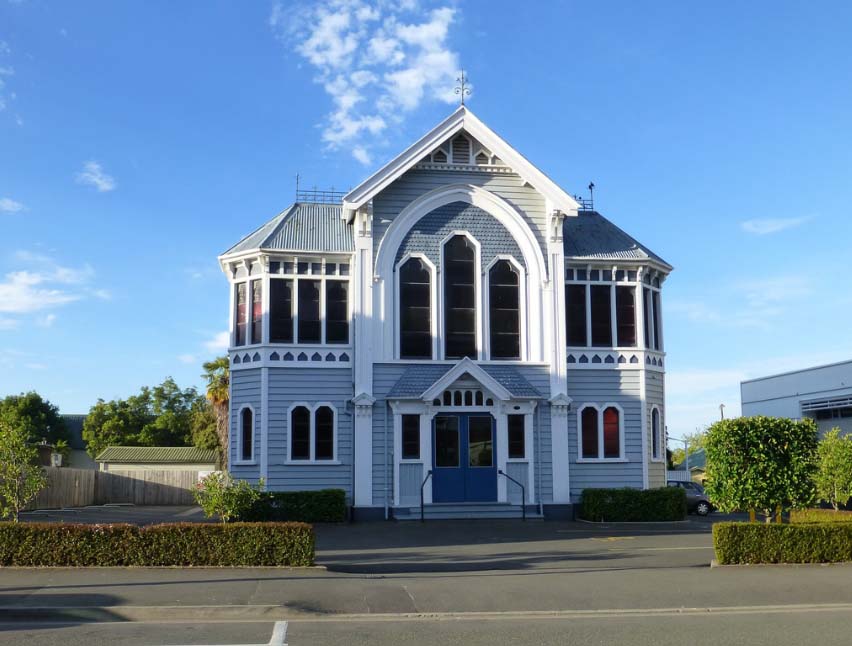
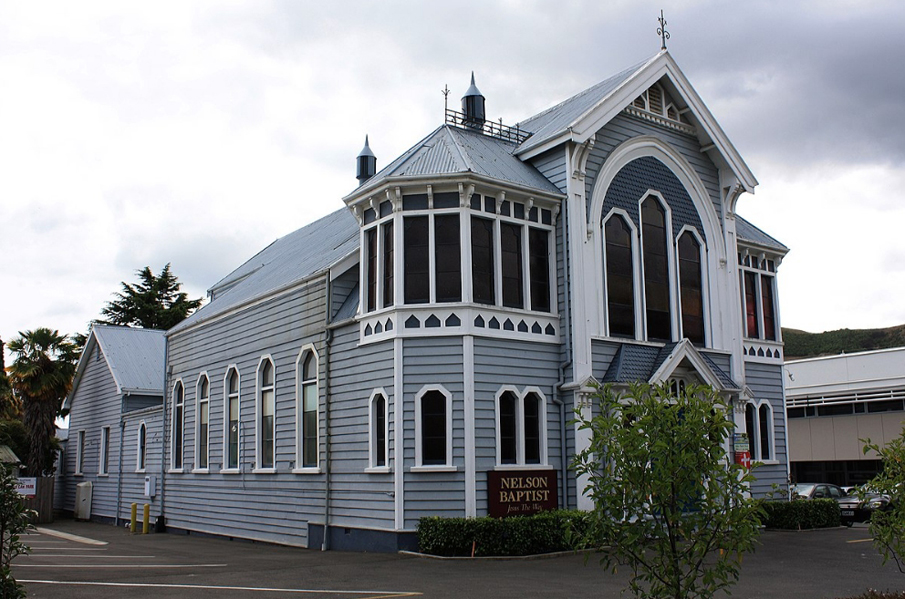
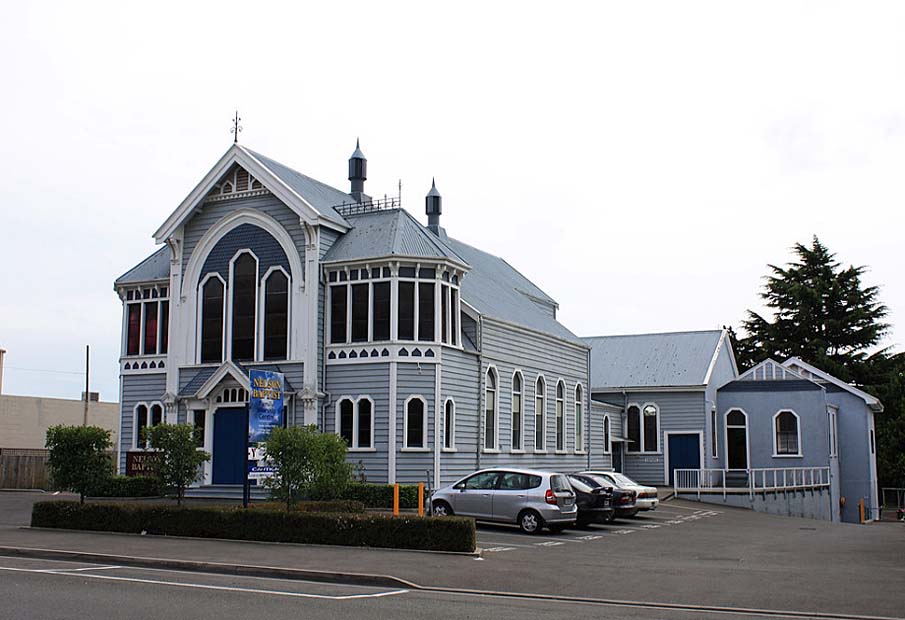
Nelson Baptist Church was the first Baptist church established in New Zealand. Services were first held at Campbell’s School before the foundation stone for a permanent church was laid in 1852, which opened for services in December 1854. By the early 1890s, the timber building needed replacing, and a successful rebuilding fund enabled a new church to be constructed within eight months and to hold its first service on 25 April 1897. The neo-Gothic styling is simpler and more stylised than the Vivian Street church, which it closely resembles, adapting the high style neo-Gothic elements with a more vernacular approach. However, the vertical lines of the frontage create a symmetry that provides a balanced, formal appearance, and the steeply pitched roof and decorative detailing contribute to the visual appeal from the street. The interior of the building is characterised by an irregular octagon in which the pews were originally arranged in a curve facing the platform with its concrete baptistry. The semi-cylindrical, panelled ceiling is supported by arched rimu beams, with moulded ribs and decorative cornice.
A Sunday School was opened just prior to the church, with the schoolroom constructed of timber from the old church and connected to the vestries of the new church. The integral nature of the church and Sunday School buildings paved the way for later additions to the building. One of the most significant was the construction of Cullen Hall in 1960 connecting the church and hall to a distinctive space developed for the All Ages Sunday School. Its construction completed a complex dedicated to the work of the Baptist Ministry in Nelson. Whilst the interior has undergone some alteration over the years, the church remains structurally the same as it was in 1896. Today, the church community plays host to a range of activities connected with worship and is a well-used venue for community groups in Nelson.
List Entry Information
Status
Listed
List Entry Status
Historic Place Category 2
Access
Private/No Public Access
List Number
1549
Date Entered
25th November 1982
Date of Effect
25th November 1982
City/District Council
Nelson City
Region
Nelson Region
Extent of List Entry
Extent includes part of the land described as Lot 1 DP 356960 (RT 232037), Marlborough Land District, and the building known as Church (Baptist) thereon.
Legal description
Lot 1 DP 356960 (RT 232037), Nelson Land District
Status
Listed
List Entry Status
Historic Place Category 2
Access
Private/No Public Access
List Number
1549
Date Entered
25th November 1982
Date of Effect
25th November 1982
City/District Council
Nelson City
Region
Nelson Region
Extent of List Entry
Extent includes part of the land described as Lot 1 DP 356960 (RT 232037), Marlborough Land District, and the building known as Church (Baptist) thereon.
Legal description
Lot 1 DP 356960 (RT 232037), Nelson Land District
Construction Professional
Name
Crichton, William
Type
Architect
Biography
William Crichton (1862-1928) was born in England in 1862. He trained as an architect under James Hicks of Redruth, before immigrating to New Zealand in 1879. Upon his arrival he joined the Colonial Architects Office. When Crichton designed the Dunedin Police Station in 1890 he was employed by the Public Works Department. One year later, in 1891, he established his own architectural firm. The same year he won the competition for the design of the Wellington Municipal Library, and in 1901 he won second prize for the Wellington Town Hall competition. In 1901 Crichton and James Hector McKay founded the firm Crichton and McKay. McKay had previously been in a partnership with Robert Roy MacGregor from 1898-1901. With the addition of Vivian Haughton in the 1920s the firm became Crichton, McKay & Haughton. Other notable works by Crichton, McKay & Haughton includes the Huddart Parker Building (1923) and the Dominion Building (1926-1927) in Wellington.
Name
Robertson, James
Type
Builder
Biography
Construction Details
Start Year
1896
Finish Year
1897
Type
Original Construction
Start Year
1911
Finish Year
1916
Type
Addition
Description
A two-storey meeting room was added to the church building.
Start Year
1924
Type
Other
Description
Memorial organ installed.
Start Year
1926
startYearCirca
Type
Other
Description
Conversion to gas, electricity and mains drainage
Start Year
1947
Type
Maintenance/repairs
Description
Treatment of woodwork and stonework for borer
Start Year
1961
Type
Addition
Description
Cullen Hall added to rear of church complex
Start Year
1965
Type
Maintenance/repairs
Description
Treatment of woodwork for borer
Start Year
1967
Type
Maintenance/repairs
Description
Painting of exterior and renovation of vestibule
Start Year
1981
Finish Year
1982
Type
Maintenance/repairs
Description
Exterior painting
Start Year
2000
Type
Refurbishment/renovation
Description
Interior painting and recarpeting; enlargement of orchestra pit; new lighting installed
Construction Professional
Name
Crichton, William
Type
Architect
Biography
William Crichton (1862-1928) was born in England in 1862. He trained as an architect under James Hicks of Redruth, before immigrating to New Zealand in 1879. Upon his arrival he joined the Colonial Architects Office. When Crichton designed the Dunedin Police Station in 1890 he was employed by the Public Works Department. One year later, in 1891, he established his own architectural firm. The same year he won the competition for the design of the Wellington Municipal Library, and in 1901 he won second prize for the Wellington Town Hall competition. In 1901 Crichton and James Hector McKay founded the firm Crichton and McKay. McKay had previously been in a partnership with Robert Roy MacGregor from 1898-1901. With the addition of Vivian Haughton in the 1920s the firm became Crichton, McKay & Haughton. Other notable works by Crichton, McKay & Haughton includes the Huddart Parker Building (1923) and the Dominion Building (1926-1927) in Wellington.
Name
Robertson, James
Type
Builder
Biography
Construction Details
Start Year
1896
Finish Year
1897
Type
Original Construction
Start Year
1911
Finish Year
1916
Type
Addition
Description
A two-storey meeting room was added to the church building.
Start Year
1924
Type
Other
Description
Memorial organ installed.
Start Year
1926
startYearCirca
Type
Other
Description
Conversion to gas, electricity and mains drainage
Start Year
1947
Type
Maintenance/repairs
Description
Treatment of woodwork and stonework for borer
Start Year
1961
Type
Addition
Description
Cullen Hall added to rear of church complex
Start Year
1965
Type
Maintenance/repairs
Description
Treatment of woodwork for borer
Start Year
1967
Type
Maintenance/repairs
Description
Painting of exterior and renovation of vestibule
Start Year
1981
Finish Year
1982
Type
Maintenance/repairs
Description
Exterior painting
Start Year
2000
Type
Refurbishment/renovation
Description
Interior painting and recarpeting; enlargement of orchestra pit; new lighting installed
Historical and Associated Iwi / Hapū / Whānau
Completion Date
18th December 2024
Report Written By
Anna Renton-Green
Information Sources
Kershaw, 1951
Charles Kershaw, A Short History of the Nelson Baptist Church 1851-1951, Institute of Printing and Publishing Society, Auckland, 1951.
Roberts, 2002
Alan Roberts, Nelson Baptist Church, The Journey Continues, A Narrative of the Years 1951-2001, Nelson Baptist Church, 2002.
Nelson Baptist Church
Nelson Baptist Church website: https://www.nelsonbaptist.org/
Other Information
A fully referenced copy of the Upgrade Report is available upon request from the Central Regional Office of Heritage New Zealand Pouhere Taonga Disclaimer Please note that entry on the New Zealand Heritage List/Rārangi Kōrero identifies only the heritage values of the property concerned, and should not be construed as advice on the state of the property, or as a comment of its soundness or safety, including in regard to earthquake risk, safety in the event of fire, or insanitary conditions. Archaeological sites are protected by the Heritage New Zealand Pouhere Taonga Act 2014, regardless of whether they are entered on the New Zealand Heritage List/Rārangi Kōrero or not. Archaeological sites include ‘places associated with pre-1900 human activity, where there may be evidence relating to the history of New Zealand’. This List entry report should not be read as a statement on whether or not the archaeological provisions of the Act apply to the property (s) concerned. Please contact your local Heritage New Zealand office for archaeological advice This place was identified as significant under previous legislation with different information requirements. It remains significant under the current legislation. There is opportunity under our legislation and policies to add to this information. Further information about this place may be available from the Central Regional Office of Heritage New Zealand Pouhere Taonga.
Historical and Associated Iwi / Hapū / Whānau
Completion Date
18th December 2024
Report Written By
Anna Renton-Green
Information Sources
Kershaw, 1951
Charles Kershaw, A Short History of the Nelson Baptist Church 1851-1951, Institute of Printing and Publishing Society, Auckland, 1951.
Roberts, 2002
Alan Roberts, Nelson Baptist Church, The Journey Continues, A Narrative of the Years 1951-2001, Nelson Baptist Church, 2002.
Nelson Baptist Church
Nelson Baptist Church website: https://www.nelsonbaptist.org/
Other Information
A fully referenced copy of the Upgrade Report is available upon request from the Central Regional Office of Heritage New Zealand Pouhere Taonga Disclaimer Please note that entry on the New Zealand Heritage List/Rārangi Kōrero identifies only the heritage values of the property concerned, and should not be construed as advice on the state of the property, or as a comment of its soundness or safety, including in regard to earthquake risk, safety in the event of fire, or insanitary conditions. Archaeological sites are protected by the Heritage New Zealand Pouhere Taonga Act 2014, regardless of whether they are entered on the New Zealand Heritage List/Rārangi Kōrero or not. Archaeological sites include ‘places associated with pre-1900 human activity, where there may be evidence relating to the history of New Zealand’. This List entry report should not be read as a statement on whether or not the archaeological provisions of the Act apply to the property (s) concerned. Please contact your local Heritage New Zealand office for archaeological advice This place was identified as significant under previous legislation with different information requirements. It remains significant under the current legislation. There is opportunity under our legislation and policies to add to this information. Further information about this place may be available from the Central Regional Office of Heritage New Zealand Pouhere Taonga.
Current Usages
Uses: Religion
Specific Usage: Church
Former Usages
General Usage: Religion
Specific Usage: Church
Current Usages
Uses: Religion
Specific Usage: Church
Former Usages
General Usage: Religion
Specific Usage: Church
Location
Sign up to hear more
Get the latest heritage news, features and events delivered
straight to your inbox.
